







Abstract
Keywords
Introduction
The increasing importance of social media for marketing communication has given rise to a number of studies that address the role of social media in mediating consumers’ interaction with brands, which is conceptualised in the academic literature as ‘consumer brand engagement’.
Yet, despite a growing amount of research, there is no consensus about the definition of consumer–brand engagement on social media. Widely differing definitions can be found in the literature, ranging from complex multidimensional constructs (Hollebeek et al., 2014) to simply ‘liking’ a brand on Facebook (Wallace et al., 2014). The definition of consumer-brand engagement and the questions researchers seek to answer determine the selection of the research approach and methods used. However, due to the great ambiguity in the concept of consumer-brand engagement, understanding of how social media engagement should be researched and measured is still very limited, as Schivinski et al. (2016) point out.
The methods and measures employed in the research on consumer-brand engagement have to a large extent shaped the way the research and the construct itself have evolved so far. They also influence how the discipline will evolve in future. Therefore, a review of the methods that have been used in the past will provide important insight into the overall development of the research, the evolution of the construct of consumer-brand engagement as used in the empirical research, as well as to identify gaps both in the methods and topics of research while outlining directions for future research and practice
So far, the methodological mapping has been the subject of only a few literature reviews in the broader field of the social sciences (e.g. Wiles et al., 2011; or Xenitidou and Gilbert, 2018). Some of the studies have focused on qualitative and mixed methods used for researching social media (Snelson, 2016). Within the particular field of consumer-brand engagement on social media, the literature reviews have mainly focused on thematic revision and categorisation (Schultz and Peltier, 2013 or Barger et al., 2016). A review of methods has not yet been attempted.
In this article, we will conduct a systematic review and organise the extant literature with the aim to explore what methods were used in the previously published empirical research on consumer engagement (CE) on social media in the marketing literature and explore how those methods have evolved over time. As the interest of marketers in the construct of CE is relatively new, our review will take a longitudinal perspective and capture representative research in the area of consumer-brand engagement from 2011, when the first major theoretical studies emerged (Brodie et al., 2011). The insights and the trends discussed here can be helpful for shaping future academic research in the field.
This article is structured as follows. First, it outlines various definitions of consumer-brand engagement and identifies related constructs. Next, it describes how consumer-brand engagement has been measured in the extant conceptual research. The methodological approaches used in the research will then be categorised and synthesised, followed by a discussion of the overall results of our review.
Theoretical background
Defining consumer-brand engagement
Consumer-brand engagement is a concept that stretches beyond the social media world. In its broad sense, it is understood as the relationship between a brand and its existing or potential consumers. Conceptualisation of the consumer–brand relationship in the academic literature is predominantly based on the broader concept of ‘engagement’, which has relatively recently spilled over into the marketing literature from related disciplines such as social psychology and organisational behaviour (Bowden, 2009; Brodie et al., 2011; Hollebeek et al., 2014; Dwivedi, 2015).
Referred to as ‘consumer engagement’, ‘customer engagement’, ‘brand engagement’ (Brodie et al., 2011; Van Doorn et al., 2010), ‘community engagement’ (Algesheimer et al., 2005) or ‘advertising engagement’ (Phillips and McQuarrie, 2010) among other terms, the concept comprises a broad span of relational constructs such as relationship marketing, concentric marketing, customer relationship management and social networks (Barger et al., 2016). The concept is based on the existence of a relationship between an ‘engagement subject’ and an ‘engagement object’. The choice of engagement subject determines the research perspective, such as consumer-centric or organisation-centric. The engagement object is quite variable. To illustrate, an engagement object can be a brand (Hollebeek et al., 2014), brand-related content (Schivinski et al., 2016), an organisation (Vivek et al., 2014) or an online brand community (Algesheimer et al., 2005; Baldus et al., 2015).
Due to the complexity of the CE construct, there is no one agreed-upon definition of CE (Kunz et al., 2017). However, despite the copious number of definitions used in the field, the most commonly articulated features of engagement are (1) multidimensionality, (2) interactivity and (3) the existence of certain antecedents and consequences of CE. Although the majority of studies agree that the CE concept is multidimensional, the number of ‘engagement’ dimensions and their interpretations and composition vary across studies.
Research that adopts a consumer-centric perspective predominantly uses a three-dimensional scheme as used by Brodie et al. (2013) in one of the most cited definitions, in which ‘consumer engagement’ is defined as ‘a multidimensional concept comprising cognitive, emotional, and/or behavioural dimensions, and plays a central role in the process of relational exchange where other relational concepts are engagement antecedents and/or consequences in interactive engagement processes within the brand community’. An alternative approach is taken by Algesheimer et al. (2005), who focus on CE within a particular brand community. In that study, the authors define ‘brand community engagement’ as ‘positive influences of identifying with the brand community through the consumer’s intrinsic motivation to interact/co-operate with community members’. The dimensions they propose reflect individual motivations for connecting with other community members: utilitarian, hedonic and social. Although the studies define the dimensions of CE differently, their common characteristic is that they both refer to an individual’s motivation for interacting with a brand or a brand community.
However, in the organisation-centric conceptualisation, the ‘engagement subject’ is the brand- or company-related variable, such as brand communication, promotional offerings or advertising, which can be multidimensional. For instance, this approach is adopted by Phillips and McQuarrie (2010), who define ‘advertising engagement’ as ‘a set of engagement modes that lead to persuasion’. They identify four engagement dimensions related to the capacity of advertising to engage consumers: immerse, feel, identify and act.
Despite diverse approaches and terminology used by the researchers, the constituents of consumer-brand engagement all reflect basic human capacities recognised by social psychology – thought, feeling and interaction – whose interplay produces a human experience and therefore engagement. One of those capacities, interaction, particularly resonates within online brand communities and the social media environment, where consumers directly engage with a brand. With a growing amount of research on CE in social media and other online settings, theoretical concepts are evolving to emphasise interactions as the focal element of consumer-brand engagement. In that light, following the multidimensional approach to CE, Hollebeek et al. (2014) define ‘consumer-brand engagement’ in the social media settings as ‘a consumer’s positively valenced, brand-related, cognitive, emotional and behavioural activity during or related to focal consumer-brand interactions on social media’.
It is broadly recognised that CE occurs in a specific set of context-dependent conditions, referred to as antecedents, and results in certain consequences (Brodie et al., 2013; Calder et al., 2016). In their literature review, Barger et al. (2016) focus on CE on social media and identify both its antecedents and its consequences, each of which they group into five categories. According to this study, the antecedents to CE include brand-related factors such as brand attitude and word-of-mouth; product-related factors such as product reviews; consumer factors such as attachment to social media or social influence; content factors such as the emotional sentiment of the message and social media factors such as platform characteristics. The identified consequences include brand-related effects such as brand loyalty, brand awareness and brand associations; product-related effects such as attitude towards a product; consumer-related effects such as consumer power; content effects such as attitude towards reviews; and market effects such as purchase intentions, sales, and willingness to pay. Antecedents and consequences of consumer–brand interactions are very similar to other relational concepts of CE, making it in some cases difficult to precisely separate them from CE as such and to clearly differentiate between antecedents and consequences. To illustrate, ‘attitudes towards a brand or a product’ can be understood as both an antecedent to CE (e.g. Dotson et al., 2017) and as a consequence of that engagement (e.g. John et al., 2017; Schivinski and Dabrowski, 2016). To take another example, word-of-mouth can act as an antecedent (Barger et al., 2016) or as a behavioural expression, or consequence, of CE (e.g. Van Doorn et al., 2010).
Distinguishing consumer-brand engagement from similar brand-related concepts
Consumer-brand engagement is related to several other concepts describing the consumer-brand relationship. However, the relationship between CE and other brand-related concepts remains unclear. From among the multiple constructs available in the literature, the closest ones the authors of this article have identified are brand experience, brand involvement and brand participation. Depending on the level of the consumer’s activity in relation to a brand and the intensity of the relational exchange between a consumer and a brand, the four constructs can be classified from the least participative to most participative as follows: brand experience, brand involvement, brand engagement and brand participation.
Brand experience is the least participative construct, in which a consumer’s response is evoked by a brand-related stimulus. However, unlike brand engagement, the consumer is not motivated on his own (Brodie et al., 2011; Hollebeek et al., 2014) and is not proactive in this case. Brand involvement is a more participative construct than brand experience. Like brand engagement, it presumes a motivated state, however, it is more of a cognitive and emotional reaction. Brand involvement is best understood as an antecedent of brand engagement (Brodie et al., 2011; Hollebeek, 2011; Hollebeek et al., 2014; Vivek, 2009). Brand engagement is more than involvement. It is a more active, intentional and directional form of consumer–brand relationship. However, the actual activity that constitutes the engagement may happen with or without an actual exchange (Solem and Pedersen, 2016). Activity in the form of an exchange is a key component of the brand participation, which is mainly understood to be a behavioural construct.
Measures of consumer-brand engagement
As illustrated above, the construct of consumer-brand engagement entails a certain ambiguity resulting from an unclear dimensionality and numerous related constructs. That poses a significant challenge to conceptualising it and results in the existence of multiple consumer-engagement constructs in the literature. Conceptualisations of CE have been derived from theoretical works (Brodie et al., 2011; Franzak et al., 2014; Van Doorn et al., 2010) and from studies employing qualitative and quantitative methods. Qualitative and quantitative studies employ various measures of consumer-brand engagement.
Conceptual qualitative studies have aimed to develop concepts of consumer-brand engagement with a bottom-up approach. In these studies, theoretical foundations are combined with rich insights gathered from qualitative research that enables the authors to investigate CE in all its multidimensionality. Qualitative methods allow researchers to explore the psychological aspects of CE as illustrated in Hollebeek’s (2011) study, which aims to explore how is customer-brand engagement conceptualised and map its key themes from a consumer-centric perspective. The data in that study were drawn from in-depth interviews and input from focus groups. Similarly, Gambetti et al. (2012) conceptual study employed interviews that produced data on CE from the organisation-centric perspective. With the objective of exploring how practitioners understand consumer-brand engagement and how they incorporate the concept in their branding strategies, the authors designed their study using a Grounded Theory approach that gathered data through semi-structured interviews with practitioners.
The orientation of CE research towards interactive online settings opened up the use of alternative qualitative methods while also analysing data that were publicly available online. Although such data do not allow deep exploration of psychological states or reveal individual perceptions and motivations, its benefit is that it eliminates the bias of self-report measures. An example of such an alternative method is ‘netnography’, as employed in the Hollebeek and Chen’s (2014) study. The authors there developed a conceptual model that addresses not only positively but also negatively valenced consumer-brand engagement, and the key antecedents and consequences of both types. By focusing on consumers’ discussions in social media brand communities, the netnographic approach enables researchers to investigate specific cognitions, emotions and behaviour patterns of community members.
A qualitative exploratory study may precede a quantitative study with the aim of developing an initial theoretical construct to scrutinise quantitatively (Hollebeek et al., 2014; Vivek et al., 2014). Unlike qualitative studies, quantitative conceptual research takes a top-down approach. Its purpose is to validate a defined theoretical construct empirically and determine typologies or scales of CE. The development of a scale and its validation follows a rather rigid procedure. In the first step, a factor analysis is employed to test whether the data fit a hypothetical model. Second, in order to validate and analyse the relationships between the measured variables and defined constructs, correlational statistical approaches are employed. These range from simple correlations (Schivinski et al., 2016; Vivek et al., 2014) to the application of structural equation models (Dwivedi, 2015; Solem and Pedersen, 2016; Hollebeek et al., 2014).
Measures of CE can be grouped into two types, multidimensional measures and one-dimensional measures, based on the researcher’s understanding of the scope of consumer-brand engagement. Development of multidimensional measures of CE that can be empirically validated in quantitative studies has been attempted in several studies in the last years. With the aim of constructing a generalisable multidimensional measure of customer engagement, Vivek et al. (2014) employed a mixed-method approach. They preceded an empirical quantitative validation of their proposed 10-item scale of measurement with a qualitative exploratory study using the Grounded Theory approach and data they collected through interviews and focus groups. The authors based their study on a three-dimensional conceptualisation of CE: conscious attention, enthused participation, and social connection. Although their approach is multidimensional, their definition of the dimensions and degrees of scale refer only to the behavioural manifestations of the concept.
The first empirical assessment of a three-dimensional conceptualisation comprising cognitive, emotional and behavioural dimensions as defined by Brodie et al. (2011) and Hollebeek (2011) was performed by Hollebeek et al. (2014) Like Vivek et al. (2014), the authors derived their conceptualisation from both a review of proposed theories and exploratory qualitative research findings in which they employed in-depth interviews. Using structural equation modelling, the authors identified brand ‘involvement’ as an antecedent of consumer engagement and consumers’ ‘self-brand connection’ and ‘brand usage intent’ as the consequences of CE. Unlike Vivek et al. (2014), who developed their scale of engagement for multiple contexts, Hollebeek et al. (2014) focused on the social media settings.
Whereas Hollebeek et al. (2014) measured CE with social network brands such as Twitter and Facebook, Solem and Pedersen (2016) examined CE with other brands in the social media context. The construct they developed was based on qualitative exploration employing structured interviews and online surveys as key methods. Similarly to Hollebeek et al. (2014) study, the results measure ‘brand involvement’ as an antecedent of CE and presume that the consequences of CE are changes in the consumer’s relationship to the brand, defined by authors as ‘brand satisfaction’, and second to consumer’s purchase intentions (defined by authors as ‘brand loyalty’).
In contrast to studies that consider a brand as the ‘engagement object’ (Hollebeek et al., 2014; Solem and Pedersen, 2016; Vivek et al., 2014), Baldus et al. (2015) examined CE with online ‘brand communities’. Like other studies that focus on developing scales of engagement, the authors applied a mixed-method approach, employing focus groups and qualitative surveys in the first phase, followed by a factor and correlational analysis. However, their measure of CE with online brand communities is based on the motivation of individuals to interact rather than on the interaction itself. An alternative view of measuring engagement with an online brand community is taken by Dessart et al. (2016) who identify two objects for engagement in a given context, the brand and the brand community. The authors developed a combined scale for measuring brand and brand community engagement online, which contains seven dimensions and 22 items.
Some authors consider engagement to be unidimensional. For example, Sprott et al. (2009) focus specifically on brand engagement in self-concept. They conceptualise CE and a scale of measurement in a way that only takes into account the emotional dimension. Other authors (Muntinga et al., 2011; Schivinski et al., 2016) envisage CE as a purely behavioural construct. For interactive settings, Muntinga et al. (2011) define a typology of ‘consumer online brand-related activities’ (COBRA) based on unstructured interviews. These types of behaviour were further explored by Schivinski et al. (2016) through online focus groups, online depth interviews and netnography. Based on their findings, and using factor analysis and correlations, the authors developed a measurement scale of the COBRA construct. Understanding CE as a behavioural construct is largely associated with research on social media, where users’ behavioural manifestations, such as likes, comments and shares, are scrutinised (e.g. Barger et al., 2016). These behaviours are widely understood as acts of CE by researchers.
This literature review focuses on empirical studies of consumers’ engagement with brands and brand communities on social media on the cognitive, emotional and behavioural levels, and the antecedents and consequences of such engagement.
Methodology
This article adopts Petticrew and Roberts’ (2016) systematic literature review methodology, a methodological approach that is designed for research in the social sciences. Unlike other literature reviews, the systematic review methodology provides a scientific tool that can be used to identify, summarise and synthesise studies relevant to answer a particular set of research questions. With the objective to eliminate the systematic error, it adheres to a detailed pre-defined protocol.
In that methodology, the point of departure is the formulation of a set of research questions and definition of methods to be used extract relevant studies, namely their localisation, study types and inclusion and exclusion criteria. The studies included in the review are then scrutinised and relevant information is extracted in an organised format. In doing so, a detailed table that describes every study is included in order to integrate, systematically describe and synthesise the information collected.
Our research questions break down and refine the research aim, which is to explore methods that are used to empirically investigate CE with brands on social media in the marketing literature and how the methods have evolved over time. To address the research aim, following research questions have been formulated:
What methods are used to investigate CE with brands on social media?
How the methods used to investigate CE with brands on social media have changed over time?
How the methods have shaped the way the research on CE on social media has evolved?
How the evolution of research methods will impact the way we investigate CE on social media in the future?
The research questions served as a basis for determination of inclusion and exclusion criteria for the types of studies that need to be located. Table 12 in Appendix summarises the criteria.
To identify a representative sample of studies published on the subject of consumer-brand engagement on social media in the marketing literature, the search was performed within the most relevant databases comprising major academic journals in the fields of marketing, management, business, communication, advertising and consumer research. The selected databases include Taylor and Francis, Emerald Insight, Scopus and Web of Science. As the main search term was used ‘consumer engagement’ instead of ‘consumer-brand engagement’ for two reasons. First, a more general search term was applied in order to retrieve studies that deal with two engagement objects – a brand and a brand community. And second, as the research on CE is often not identified as such, lower specificity of search terms enabled to retrieve larger amount of studies. The final decision on inclusion of a study was then performed manually based on assessment of the abstract. The literature search process, inclusion and exclusion of studies based on search terms and abstracts’ revision is illustrated in Appendix Table 13.
A total of 423 articles were identified. Based on revision of titles, keywords and abstracts of the retrieved studies, 97 articles were included for further scrutiny. The preselected articles were assessed on the basis of the inclusion and exclusion criteria. As a result, 66 articles met the criteria and were included in the review. Each of the articles was read and placed in a concept matrix containing the following headings: ‘Research questions / hypothesis’, ‘CE conceptualisation, ‘CE measures’, ‘Research design’, ‘Data collection methods’, ‘Datasets’, ‘Analysis’ and ‘Key findings’. In the matrix, the reviewed articles were classified and categorised in order to discuss employed research methods and their evolution in time. The focus was first put on the analysis of individual studies, then, the studies were analysed within the thematic categories and subsequently as a whole.
Results
The review identified 66 relevant empirical articles that deal with certain aspects of consumer-brand engagement on social media. The yearly distribution of articles, as demonstrated in Figure 1, confirms an increasing interest in the research of CE on social media. A larger amount of articles has been identified in the year 2016. This may be addressed to fact that ‘consumer/customer engagement’, its conceptualisation, definition and measurement, has been formulated by the Marketing Science Institute as a research priority for 2014–2016.

Yearly distribution of reviewed articles.
The database search identified relevant studies across a wide scope of marketing journals. The most represented journals within the set of reviewed articles are those with high impact factor (IF) and peer-reviewed journals, such as
In order to analyse the studies, the research was categorised into five groups based on the specific CE research themes: (1) Antecedents of CE, (2) Consequences of CE, (3) CE as mediator, (4) Engagement granularity and (5) ‘Dark’ side of CE. The categorisation of selected studies is demonstrated in Table 4. Given the abundance of research within the ‘antecedents’ and ‘consequences’ categories, these groups were further split into sub-groups. The distribution of studies within the defined categories is demonstrated in Table 1.
Categorisation of reviewed studies based on the main research theme.

CE: consumer engagement.
What methods are used to investigate CE with brands on social media and how they have changed over time?
The categorisation of studies based on their specific research theme was taken as a point of departure for the analysis of the similarities, differences and evolution of the research angles, employed methods, datasets and analytical approaches. Following sections will discuss each group of studies in detail.
Antecedents of CE
The largest group of studies focuses on the CE antecedents. Within these studies, four main types of CE antecedents were identified: consumer characteristics, content characteristics, contextual characteristics and organisational characteristics.
Consumer characteristics
Antecedents of CE often reflect consumer’s characteristics and individual motives for engaging with brands on social media platforms. This literature review identified motives that span from brand-related motives, such as self-identification with a brand (Rohm et al., 2013), to media-related motives, such as social media dependency or parasocial interaction (Tsai and Men, 2013) to personality-related motives, predominantly conceptualised as ‘personality traits’ (Claffey and Brady, 2017; Kabadayi and Price, 2014; Ul Islam et al., 2017) (see Table 2). Personality traits and their effect on CE conceptualised as liking and commenting behaviours of Facebook users were quantitatively analysed by Kabadayi and Price (2014). Alternatively, taking a multidimensional perspective on CE, Marbach et al. (2016) investigated the relationship between a broader spectrum of personality traits and CE in a qualitative exploratory study while focusing on a customer social media community. Similarly, investigating the effect of personality traits within a firm-hosted virtual community, Claffey and Brady (2017) validated the relationship in a large quantitative study. Findings of the quantitative studies suggest that personality traits are positively correlated with CE (Claffey and Brady, 2017; Kabadayi and Price, 2014). Consecutive quantitative studies focused on examination of the effect of CE triggered by personality traits on consumers’ ensuing purchase intentions (Ul Islam et al., 2017) and demonstrated the moderating effects of personal values (Marbach et al., 2019).
Antecedents of CE – consumer characteristics: reviewed studies.

CE: consumer engagement; LCA: latent class analysis; SEM: structural equation modelling; CFA: confirmatory factor analysis.
Content characteristics
The group of studies that aim to investigate correlations between the content features and CE is dominated by quantitative correlational research design. The studies explore relationships between various post types (Vargo, 2016), post characteristics, such as vividness, interactivity (Schultz, 2017) or content characteristic, such as brand personality (Lee et al., 2018) and behavioural interactions as captured by the social media metrics including likes, comments and shares. In comparison to studies that take a single post as a unit of analysis, Tafesse (2016) operationalised the measure of ‘experiential value’ on a brand page level. Similarly, Davis et al. (2019) analysed ‘brand hedonism’ on a brand page level which complements the analysis of ‘message readability’ on the level of single post. Focusing specifically on the Twitter context, Davis et al. (2019) takes into consideration not only textual information but also hashtags, emojis or at-mentions. Similarly, Antoniadis et al. (2019) attempt to explore new ways of analysing the social interactions by including analysis of the Facebook ‘reaction buttons’.
A complementary perspective on consumer interactions analysed by the public social media metrics offer studies employing industry data (Gavilanes et al., 2018; Lee et al., 2018; Moran et al., 2019). In these studies, additional behavioural features, such as clicks and click-throughs, are considered as a measure of attention given to a post. Given the nature and level of detail of industry data, the studies can present large-scale analysis (Lee et al., 2018) and longitudinal studies (Gavilanes et al., 2018; Moran et al., 2019).
While studies subscribed to the behavioural conceptualisation of CE and employing quantitative approaches, qualitative exploration of a multidimensional CE construct considered also valence of the engagement (positive or negative) as demonstrated in the study by Dessart and Pitardi (2019). Focusing on the branded storytelling through a netnographic approach, the authors complemented the sentiment analysis of user comments by exploration of ‘dislikes’ related to the brand advertising on the Youtube platform (Table 3).
Antecedents of CE – Content characteristics: Reviewed studies.
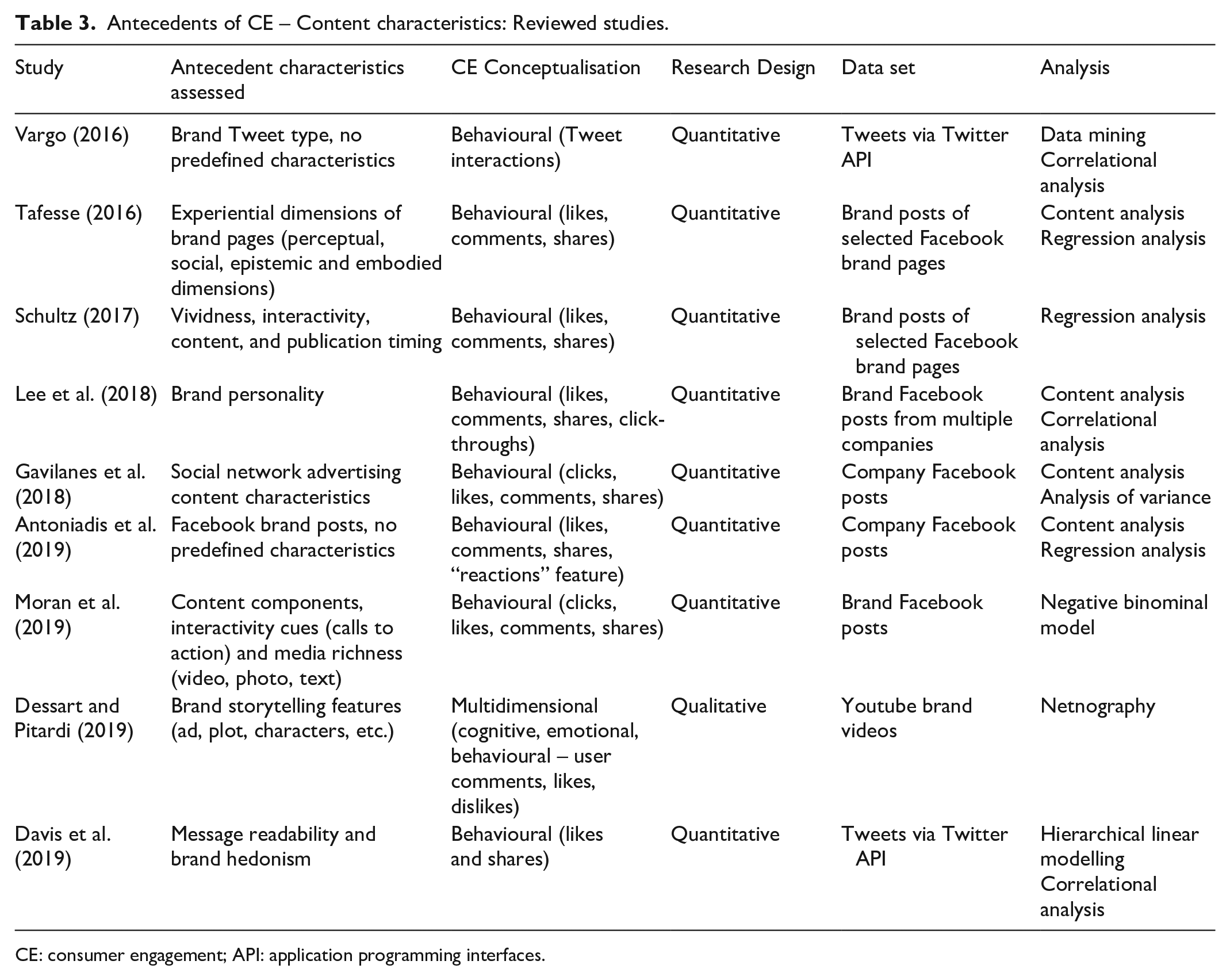
CE: consumer engagement; API: application programming interfaces.
Contextual characteristics
Studies within this category seek to find relationships between contextual characteristics and behavioural CE exclusively through statistical correlational approaches. Among these studies, a variety of contextual features has been identified that can be broadly understood as social media–related contextual characteristics and external characteristics that can be defined as spill-over effects.
First, the social media contextual characteristics include studies that presume social relationship factors, such as tie strength and homophily (Chu and Kim, 2011) or external social forces (Simon et al., 2016) as antecedent of further social media CE. An alternative view on the social media contextual factors has been taken by Triantafillidou and Siomkos (2018), who test the effects of Facebook users’ experience in a holistic way by taking into account the various dimensions such as entertainment, flow, escapism, challenge, learning, socialising and communitas.
Second, the characteristics that are related to brand promotion and advertising has been explored from the inside of social media in a study by Lou et al. (2019) who aimed to assess different CE and sentiment related to brand-promoted versus influencer-promoted ads. Alternatively, exploring the cross media effects, Voorveld et al. (2018) explored the effect of offline advertising on social media CE. In doing so, the authors worked with and media agency dataset comprising the advertising spend and Facebook reach metrics (organic and viral). Another type of spill-over effects in relation to CE has been investigated by Schivinski et al. (2019) who explored whether brand equity influences consumers’ behavioural engagement with brands. In this study, behavioural engagement is measured not only by liking, commenting and sharing, but also in terms of passive engagement activities, such as reading and watching (Table 4).
Antecedents of CE – context characteristics: reviewed studies.

CE: consumer engagement; SEM: structural equation modelling; CFA: confirmatory factor analysis.
Organisational characteristics
Although focus on managerial perspective and implications is incorporated in vast majority of studies, research included in this category investigates effects of specific marketing strategies and tactics on social media CE. To explore these effects, a larger variety of research designs has been employed. Similar methodological approach to that of studies that explore effects of content characteristics on CE is pursued by studies assessing effects of creative strategies (Ashley and Tuten, 2015), brand personification strategies (Chen et al., 2015) and message strategies, such as informational, transformational and interactional (Tafesse and Wien, 2018). These studies adopt quantitative correlational methods. In contrast, a qualitative approach has been pursued by Peeroo et al. (2019) who, by employing a netnographic approach, developed a typology of messages depending on the type of consumers’ reactions, such as expressing a complaint, criticism or customer query. Such approach enabled not only to define causal relationships but also to uncover motivations for consumer active engagement.
An alternative research stream demonstrates a shift from simple understanding of the consumers’ reactions to brand messages and strategies to exploring modes and effects of interactions between brands and consumers. In doing so, Röndell et al. (2016) focused on how to benefit from consumers’ value-creating activities. The potential of co-governance was scrutinised through in-depth interviews and netnography. Besides the co-creative potential of the consumer–brand relationship, the marketing perspective addresses the question of brand/company’s active involvement in brand-consumer conversations. In the experimental research, Schamari and Schaefers (2015) explore whether ‘webcare’ can serve as an effective marketing tool for reinforcing consumers’ engagement intentions. Similarly, Pina et al. (2019) propose a practice of active listening as a potential efficient tool to promote CE. Unlike the experimental settings of the study by Schamari and Schaefers (2015), their findings are based on implementation of data mining techniques and machine learning algorithms on a naturally occurring data set of online consumer comments (Table 5).
Antecedents of CE – Organisational characteristics: Reviewed studies.

CE: consumer engagement.
Consequences of CE
The outcomes of CE have received much attention from researchers in the marketing discipline. Therefore, the abundant research within this category has been divided into two subgroups – economic and non-economic consequences.
Economic consequences
Terms ‘consumer engagement’ and ‘customer engagement’ are frequently used interchangeably. However, in the context of research of economic consequences of CE, the term ‘customer engagement’ is mainly used as the research often focuses on customers of one specific brand/company community, rather than on general consumers. Such division is reflected in the two research streams depending on nature of data that researchers incorporate – ‘hard’ and ‘soft’ data.
First stream is the research that employs ‘hard’ industry data of purchase transactions (Kumar et al., 2016; Manchanda et al., 2015) or company revenue (Yoon et al., 2018) and correlates them with data on customer community activity. To illustrate, Manchanda et al. (2015) categorise customers based on their level of activity on ‘posters’ and ‘lurkers’, defined by data on product recommendations and reviews and investigate the relationships between each behavioural group and amount of purchase transaction. Similarly, comments on company Facebook posts served as a measure of customer engagement in the study by Yoon et al. (2018), while searching for correlations with company revenue.
The second stream of research assesses CE based on self-report data, such as questionnaires (Dhar and Kumar, 2014) or com; Kumar et al., 2016). Survey-based data collection methods have proved to be efficient also in research where CE is understood as a multidimensional construct. Such perspective is taken by Helme-Guizon and Magnoni (2019), who study effects of brand- and community- engagement on brand loyalty (Table 6).
Economic consequences of CE: Reviewed studies.

CE: consumer engagement.
Non-economic consequences
A wide range of non-economic consequences of CE has so far been explored. Those consequences range from personal-related consequences, such as brand love (Wallace et al., 2014), affective commitment (Claffey and Brady, 2019) to self-brand connection (Panigyrakis et al., 2019) or Consumer-social venture identification (Hall-Phillips et al., 2016) to company-related consequences, such as company reputation (Dijkmans et al., 2015) or paid search advertising effectiveness (Yang et al., 2016). This group of studies is dominated by datasets obtained through self-report measures, such as surveys, and operationalised on multiple point scales.
The main differentiating feature among those studies is conceptualisation of CE, which stems from simple ‘liking’ of a Facebook page (Wallace et al., 2014) or consumers’ statement of familiarity with a company’s social media activities (Dijkmans et al., 2015) to multidimensional constructs (Claffey and Brady, 2019; Hall-Phillips et al., 2016; Panigyrakis et al., 2019; Yang et al., 2016). In the latter studies, advanced regression models are used to validate the strength and directions of the relationships, such as Structural equation modelling (Table 7).
Non-economic consequences of CE: Reviewed studies.

CE: consumer engagement; SEM: structural equation modelling; CFA: confirmatory factor analysis.
CE as mediator
CE is often treated as a mediator between relationship qualities (e.g. brand involvement) and strength indicators (e.g. brand loyalty). This research stream comprises numerous conceptual models derived from previous theoretical works or from qualitative exploration. These studies follow a rather rigid methodological structure with the objective to empirically validate the proposed model. To test the validity, strength and directions of the proposed relationships, the authors mainly use regression models (Table 8).
CE as mediator: Reviewed studies..

CE: consumer engagement; SEM: structural equation modelling; CBSEM: Covariance-based structural equation modelling; CFA: confirmatory factor analysis.
Engagement granularity
The unifying feature of studies within this group is their objective to provide a granular view on CE. Either based on diversification of CE in relation to various research objects (Dessart, 2017; Dessart et al., 2015, 2016 ) or based on identification of levels of engagement (Schivinski et al., 2016), typology of engagement practices (Hollebeek et al., 2017) or categories of social media behaviours (Pentina et al., 2018). Schivinski et al. (2016) study was one of the first works to identify multiple levels of behavioural CE, distinguishing three behavioural levels: consuming, contributing and creating. The typology was based on findings from multiple data sources – focus groups, in-depth interviews and netnographic research. Similarly, netnography has been used as the main research method in subsequent works aiming to provide a typology of engagement practices (Hollebeek et al., 2017) or to explore culturally conditioned CE practices (Xinyu, 2018). Although netnography provides fine detail on consumers’ interactions, the motivations are only explorable through self-report measures, such as survey, as demonstrated on the Tsai and Men’s (2017) study, in which the authors explored culturally conditioned consumers’ motivations for engagement resulting in different levels of engagement.
Syrdal and Briggs (2018) take an alternative perspective on various engagement levels. The authors explored the differences between the practitioner’s and consumer’s understanding of engagement. Their findings demonstrate that marketing practitioners describe CE, in line with the predominant research stream, on a behavioural level, manifested through consumer’s active behaviours, such as liking, commenting and sharing. However, on the contrary, consumers understand engagement with social media content on a psychological level, as a state of mind and do not consider the behavioural component (Table 9).
Engagement granularity: Reviewed studies.
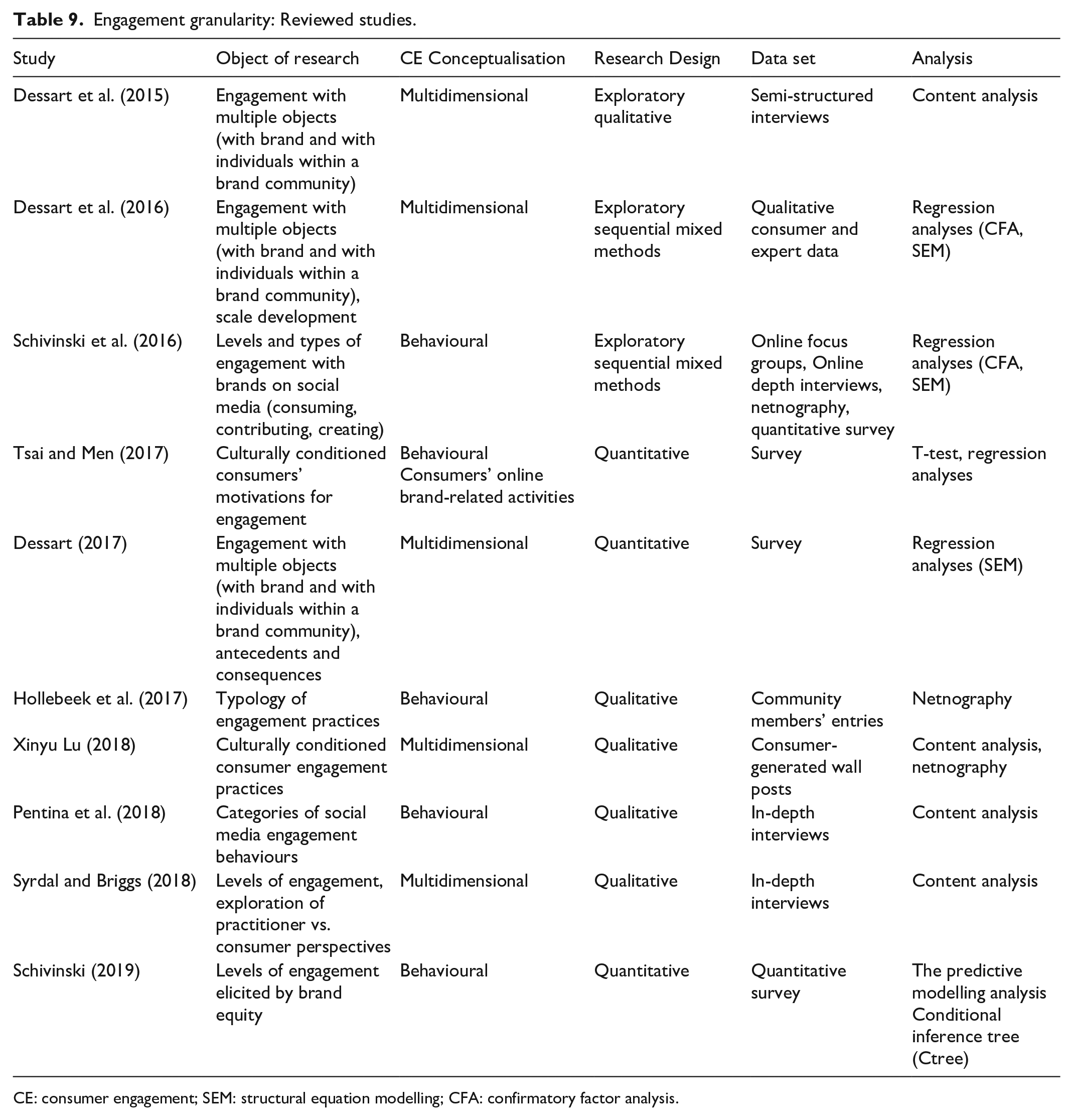
CE: consumer engagement; SEM: structural equation modelling; CFA: confirmatory factor analysis.
‘Dark’ side of engagement
The group of studies identified as the ‘dark’ side of engagement represents a relatively recent research stream that explores the construct of CE from two reverse perspectives – negative and passive. Negatively valenced manifestations of CE have primarily been explored by non-participant observation within love and hate brand communities (Hollebeek and Chen, 2014) and in-depth interviews (Bowden et al., 2017). In a subsequent study, Loureiro and Kaufmann (2018) investigated the effect of community engagement on negative CE, conceptualised as negative self-expression, through correlational analysis. While Loureiro and Kaufmann (2018) focused on positive and negative engagement, Rissanen and Luoma-Aho (2016) defined three types of engagement: positive engagement, negative engagement and disengagement. Their typology was based on a thematic analysis of focus group interviews comprising tones and degrees of online engagement. Disengagement has been lately explored in a quantitative study by Nguyen et al. (2019) focusing specifically on reasons for social media disengagement among young consumers (Table 10).
‘Dark’ side of engagement: Reviewed studies.

CE: consumer engagement; SEM: structural equation modelling.
The second reverse perspective investigates passive engagement, a non-transactional consumer social interactive brand-related activities (Gvili and Levy, 2018). In this sense, engaged passive consumers are those merely consuming brand-related content, as earlier defined by Schivinski et al. (2016).
Evolution of research topics and methods over time
The purpose of the earlier empirical studies on CE was to identify consumers’ motivations for engaging with brands on social media (e.g. Chu and Kim, 2011; Tsai and Men, 2013) and provide suggestions for marketing strategies. Although the determinants of CE continue to be of ongoing interest to researchers, the scope of research has widened and its specificity has increased. From a focus on consumer-related determinants of motivation, the research has moved on to identifying context-, content-, or organisation-related determinants. While the research on consumer-related determinants of CE is decreasing, the content- and context-related antecedents have gained an increasing attention. The research on content-related antecedents of CE has flourished over the past years, while examining the consumers’ engagement with various post types, post characteristics or content characteristics through application of correlational research designs. The research on context-related antecedents did not encounter such increased attention; however, its focus has shifted from the social media platform-related social relationship factors, such as tie strength and homophily (Chu and Kim, 2011) towards examination of spillover effects, such as cross media effects (Voorveld et al., 2018), Facebook user experience (Triantafillidou and Siomkos, 2018) or effects of brand equity on CE (Schivinski et al., 2019).
Similarly to antecedents, the consequences of CE were the key research interests throughout the period we studied (see Figure 2). Among the variety of consequences studied, the effects of CE on sales and company revenues were of primary interest. However, in the growing body of literature, research on the consequences of CE has identified many other potential relational outcomes, from ‘brand love’ (Wallace et al., 2014) to company reputation (Dijkmans et al., 2015). This research stream is largely dominated by qualitative correlational approaches. Multiple studies have addressed both antecedents and consequences of CE conceptually. In vast majority of cases, the studies followed exploratory sequential mixed-methods research design, which enabled to empirically validate the proposed model.

Trend in research topics by year.
Although the models often presume that CE has a multidimensional character, its behavioural dimension attracted disproportionately higher attention. This is demonstrated by an observation that within the set of reviewed studies, 72% of the studies conceptualised CE as a behavioural construct. Such development has naturally been influenced by the social media context of research and the availability of data. The abundance of relatively easily accessible qualitative and quantitative data on social media led researchers to employ such data as an alternative to self-report measures traditionally used in social science research. Therefore, a significant number of researchers began to work with social media data that were easily collected through the platforms’ application programming interfaces (APIs). This gave rise to a number of quantitative correlational studies using publicly available social media metrics as a database. The multidimensionality of the CE therefore remained rather unexplored empirically.
A quest for more detailed understanding of consumer behaviours led researchers to develop typologies of engagement behaviours (Schivinski et al., 2016), categorise the intensity of behaviours (Pentina et al., 2018), and define the cultural conditioned engagement behaviours (Tsai and Men, 2017; Xinyu, 2018). The behavioural research stream led to uncover the ‘dark’ side of engagement (Table 11). The research moved away from the presumption of inherently positive and public nature of social media CE and started to explore the negative and hidden aspects of CE, such as negative valence of CE posts (Hollebeek and Chen, 2014), negative engagement (Rissanen and Luoma-Aho, 2016), disengagement (Nguyen et al., 2019) or passive (non-public) engagement (Gvili and Levy, 2018). The new research streams, classified in this review as ‘Engagement granularity’ and ‘Dark side of engagement’, have naturally been mainly studies through exploratory qualitative research. A matrix identifying a number of studies in each of the categories and research designs is demonstrated in Table 11.
Research designs employed per category (number of studies).

CE: consumer engagement.
The rise of restrictive social media platform’s policies on data sharing together with new research questions demanding a higher degree of detail, such as levels and patterns of engagement, disengagement or passive engagement, affected both the quantitative and qualitative research stream. First, the quantitative methods have been the dominant research approach in the publications we studied, across all majority of categories as well as in the overall dataset. Over the studied years, it has evolved from simple correlations, multiple-level regression analyses to predictive models (Schivinski, 2019) and development of machine-learning algorithms (Pina et al., 2019). Implementation of advanced statistical techniques has enabled the researchers to capture the multidimensional character of the CE construct. Quantitative surveys based on multi-item measurement scales have been observed as the primary data source. However, it has been observed that the researchers started to increasingly investigate the qualitative social media data that are supposed to reflect more accurately human cognitive and emotional states (Figure 3).

Trends in research designs by year.

Trends in methods by year.
Second, the qualitative research stream encountered significant shift from traditional data collection methods, such as interviews or focus groups, towards non-participative observational methods. Compared to traditional self-report data, observational data serve as an unbiased source of information. However, it does not provide very rich detail on consumer’s feelings and emotions. Therefore, recent works have analysed not only textual data but also use of punctuation and visual clues, such as emojis and emoticons (Davis et al., 2019; Pina et al., 2019) or Facebook ‘reaction buttons’ (Antoniadis et al., 2019).
Discussion and conclusion
This article offers a comprehensive overview of the methods employed in the empirical research into consumer-brand engagement on social media over the period of 2011–2019. The review revealed three observations, from which implications for future research can be drawn: low methods’ diversity, reliance on public social media metrics and negative aspects of consumer-brand engagement as emerging theme.
First, the results reveal low diversity in the methods employed. The existing research is dominated by quantitative correlational approaches that rely on survey data and increasingly on quantitative social media data. This trend is particularly prominent when the literature is categorised by research topic, in which case a strong alignment of research methods has been observed. The choice of the research methods is driven by the research questions asked. Therefore, the employment of similar research methods could indicate that a uniform type of research question is being asked. However, due to the complexity of the consumer-brand engagement concept, no one type of research question, and thus no single method of research, can fully capture the phenomenon (Tellis et al., 1999: 121). As a result, the existing research has failed to capture the full scope of consumer-brand engagement, which may lead to an incomplete understanding of the phenomenon.
Methods diversity is more likely to lead to more reliable and valid insights into the topic of consumer-brand engagement. To illustrate, data gathered from surveys frequently provide different insights from those collected from in-depth interviews or by observing consumers’ behaviour in the natural setting (Davis et al., 2013). Hence, introducing new methods into the field of research has the potential to result in greater contributions (Davis et al., 2011) and further develop our understanding of the complex consumer-brand engagement phenomenon.
To further understand the diversity of the brand-engagement concept, there are two emerging methodological streams within both quantitative and qualitative research designs. We expect that quantitative methods will continue to prevail within the research designs employed in marketing research on CE with brands on social media. However, in addition to the currently prevalent correlational analyses using large data sets, which test the strength and direction of defined relationships, data mining and predictive modelling are likely to grow in importance. Future research is expected to develop models based on artificial intelligence, predicting future CE and investigating strategies for influencing consumers’ online behaviour. Such research will require working with different sets of data than self-reports and data describing consumers’ visible engagement in the form of likes, comments and shares. Non-participative data in the form of digital footprints or transactional data will become critical in such research.
Non-participative data are expected to play a key role in qualitative research as well. Collecting data under natural conditions will provide deeper understanding of CE and further explore its ‘dark’ side, including negative engagement, disengagement and passive engagement. Furthermore, in order to capture the complexity of human thoughts, feelings, motivations and behaviours in the course of consumers’ engagement on social media, future research is expected to explore a wider variety of multimedia data, such as images, video, audio, transactional data and software-generated data.
The second observation was a strong reliance on public social media metrics. The previous scholarship identified in this article shifts within the examined period from using self-report data, such as interview data to non-participative social media data. Marketing scholars have largely incorporated into their research designs the extensive data sets made available by the social media platforms themselves. This trend led researchers predominantly to explore the behavioural dimension of consumer-brand engagement and unlike the theoretical research stream, to empirically examine only one-dimensional consumer-brand engagement constructs.
As a result, over the last few years, the research has mainly depended on social media metrics, such as likes, comments and shares, as provided by the social media platforms. The advantage of ‘real social media data’ is, as Voorveld (2019) suggests, that it has great potential for explaining consumers’ reactions to brand communication in a natural setting. However, although social media data collected from the natural environment have the advantage of reducing self-report bias, that data represent only the public part of consumers’ engagement with brands. It is unable to capture reactions that are technically invisible through the social media metrics. The fact that that data are not visible in the metrics the social media platforms provide does not mean it is non-existent. Subsequently, our understanding of consumer-brand engagement is based on studies that empirically explore only public reactions. This finding is particularly disturbing, because the literature demonstrates that non-public interactions on social networks constitute 92% of all user activity (Benevenuto et al., 2009). One of the first attempts to study passive (i.e. non-public engagement that we observed within the reviewed studies) was a study by Gvili and Levy (2018). In that study, engagement was explored using a quantitative research design that employed survey data. In Gvili’s and Levy’s study, passive consumers are defined as those consumers who merely consume brand-related content, rather than those who interact with the content, even if non-publicly. Therefore, future research should look at more than visible engagement metrics provided by the social media platforms and employ methods that enable researchers to capture the full scope, characteristics and meaning of individual’s online actions and navigation.
Third, this review identified negative aspects of consumer-brand engagement as an emerging theme. The existing literature devotes considerable attention to
As illustrated in this review of the literature, the construct of consumer-brand engagement has evolved over time, from simply taking account of positive actions and towards a brand to acknowledging the negative side of engagement as well. This trend has been observed among the most recent studies, which study negative engagement (Rissanen and Luoma-Aho, 2016) or disengagement (Nguyen et al., 2019). In those studies, qualitative research designs gain prominence in order to capture the fine detail of engagement. The studies move from exploring (and understanding) positively valenced brand engagement to exploring and understanding negative expressions of brand engagement. Given that consumers today have a powerful role in influencing their peers thanks to social media, future research should provide a more granular view of the negative aspects of consumer-brand engagement including various levels of intensity, scopes and meanings.
Footnotes
Declaration of conflicting interests
Funding
ORCID iD
