







Abstract
Keywords
Introduction
Numerous studies have been conducted about mathematical modeling for a few decades (e.g., Blum & Borromeo Ferri, 2009; Borromeo Ferri, 2006; Kaiser & Schwarz, 2010; Lesh & Doerr, 2003). However, these studies have generally focused on the cognitive dimensions of students, especially on the examination of students’ mathematical modeling competencies. Yet, in addition to the cognitive dimensions of the students, affective dimensions are also important for their success at the cognitive level (Seah & Bishop, 2000; Seah & Wong, 2012). This is because affective dimensions can affect students’ choice for dealing or not dealing with mathematics and science (Bishop et al., 2006). Despite the importance of affective dimensions, it can be seen that affective dimensions are neglected in educational research due to the fact that these dimensions are not so easy to measure (see Seah & Bishop, 2000). Similarly, it can be seen that there is not a large number of studies in which cognitive/affective domains in general, and mathematical modeling/affective domains (especially values) in particular are examined in combination. However, determining the mathematical values involved in mathematical modeling tasks based on different mathematical modeling perspectives (e.g., realistic/applied, cognitive, model eliciting approach, and socio-critical) is considered to be very vital for a more conscious mathematical modeling education. This is because the values are conveyed to the next generations through the learning/teaching process implicitly or explicitly, consciously or unconsciously (FitzSimons et al., 2001). Moreover, positive values are not always transferred in learning environments (Gellert, 2000). In this context, it is considered that there is a great need for studies that involve both cognitive and affective dimensions, in particular, mathematical modeling tasks and mathematical values. Additionally, no studies have been found in the relevant literature about examining the mathematical values involved in mathematical modeling tasks produced in different mathematical modeling perspectives or cultures. Therefore, there is a dire need for studies investigating these values in mathematical modeling tasks. In this way, an effective mathematical modeling instruction which takes mathematical values into consideration can be provided. Within this scope, explanations related to the mathematical modeling and mathematical, mathematics educational, and educational values are given below.
Mathematical modeling
Professional application of each mathematical process standard used in instructional environments will help students to improve themselves in a way to achieve the desired goals. One of these process standards is mathematical modeling (National Council of Teachers of Mathematics [NCTM], 2000). Mathematical modeling is different from mathematical models. Lesh and Doerr (2003) defined mathematical models as physical objects or conceptual systems that students use to make sense of mathematical concepts. While mathematical concepts and operations used by students to understand the decimal base blocks, fraction bars and algebra tiles, such as concrete objects or manipulatives, are mathematical models (Cirillo et al., 2016), mathematical modeling is an activity involving two-way transitions between reality and mathematics in general and far more than “a ‘pseudo-realistic problem’, in which all data are given, or you only have to exercise algorithms” (Borromeo Ferri, 2018, p. 13).
Studies on mathematical modeling in education have become popular, especially after Henry Pollak’s study in 1969 entitled “How can we teach applications of mathematics” (Galbraith, 2012). Since then, different classifications and perspectives on mathematical modeling have emerged (see Kaiser-Meßmer, 1986; Kaiser & Schwarz, 2010; Kaiser & Sriraman, 2006). These different classifications and perspectives on mathematical modeling have naturally led researchers to understand the epistemological foundations of mathematical modeling differently (see Kaiser & Schwarz, 2010; Kaiser & Sriraman, 2006). Therefore, Kaiser and Sriraman (2006) felt the need to classify the different perspectives of mathematical modeling by explaining their similarities and differences. In this context, Kaiser and Sriraman classified mathematical modeling approaches into six categories as realistic or applied modeling, contextual modeling, educational modeling, socio-critical modeling, epistemological or theoretical modeling, and cognitive modeling (or meta-perspective). In addition to this classification, Kaiser and Schwarz (2010) added the model eliciting approach. Then, Blum (2015), using Kaiser and Sriraman’s (2006) classification, grouped the mathematical modeling perspectives under six different headings in terms of aim and suitable examples: applied modeling, educational modeling, socio-critical modeling, epistemological modeling, pedagogical modeling, and conceptual modeling. However, Blum’s (2015) classification does not include model eliciting approach and cognitive modeling present in the classification of Kaiser and Sriraman (2006). The classifications put forward by Kaiser and Sriraman (2006), Kaiser and Schwarz (2010), and Blum (2015) were considered together with the examples commonly used in the modeling literature, therefore it was decided to limit the scope of the present study to realistic/applied modeling (Anglo-Saxon pragmatism, mostly the UK), model eliciting approach (American problem-solving approach, mostly the U.S.), socio-critical modeling (Romanic tradition, mostly Brazil), and cognitive modeling (mostly Germany) in the mathematical modeling literature. Realistic/applied modeling is based on Anglo-Saxon pragmatism and applied mathematics. Real-life examples taken from industry-based and scientific applications have an important place in realistic/applied modeling (Kaiser & Sriraman, 2006). In model eliciting approach (Lesh & Doerr, 2003) which is based on six principles (model construction, reality, self-assessment, construct documentation, construct shareability and reusability, and effective prototype), American pragmatism is at the forefront and this approach has evolved into a process where students are revising their own models rather than classical problems solving (Kaiser & Schwarz, 2010). Socio-critical modeling, based on socio-critical approaches in political sociology, includes pedagogical purposes such as being able to understand its environment critically and also highlights the position of mathematics and mathematical modeling in society and is associated with ethnomathematics by D’Ambrosio (1999). Cognitive modeling is based on cognitive psychology and involves psychological purposes such as analysis, understanding, and development of cognitive processes involved in modeling (Kaiser & Sriraman, 2006). Meanwhile, these four different perspectives are important in terms of reflecting the mathematical modeling understanding of four different cultures; therefore, it increases the originality/value of the present study.
Mathematical modeling, mathematical values, and culture
Mathematical modeling, as mentioned above, is generally an activity involving two-way transitions between reality and mathematics (Borromeo Ferri, 2018). However, to solve the situations encountered in daily life, individuals/students need to know a certain level of mathematics and have mathematical literacy. Mathematical literacy in the Programme for International Student Assessment (PISA) surveys is defined as follows: Mathematical literacy is an individual’s capacity to formulate, employ, and interpret mathematics in a variety of contexts. It includes reasoning mathematically and using mathematical concepts, procedures, facts and tools to describe, explain and predict phenomena. It assists individuals to recognize the role that mathematics plays in the world and to make the well-founded judgments and decisions needed by constructive, engaged and reflective citizens. (Organisation for Economic Co-operation and Development [OECD], 2013, p. 25)
On the other hand, the development of mathematics, especially mathematics teaching may vary depending on culture, is also manifested in the mathematical modeling approaches proposed in the literature. As can be seen in the mathematical modeling perspectives, each perspective reflects another culture, and thus the modeling tasks based on different mathematical modeling perspectives also bear the characteristics of these reflected cultures (e.g., Anglo-Saxon, American, Romanic tradition, and Germany). However, when the relevant literature is examined, as mentioned earlier, it is seen that there is a limited number of studies examining values, which are a component of culture, in mathematical modeling. For example, Baba and Shimada (2019) named the problems that can be encountered in daily life and included some social values in their solutions as “open-ended problem,” and in their studies, they examined “socially open-ended problems” only in terms of social values. In the present study, three mathematical value pairs, especially in Western culture context, proposed by Bishop (1991) are discussed: rationalism–objectivism, control–progress, and mystery–openness. The mathematics educational values can differ in different cultures (Baba et al., 2012). Therefore, different classifications were used together for mathematics educational values included especially the five value pairs (formalistic–activist view of mathematics learning, relational–instrumental understanding/learning, relevance–theoretical aspect of mathematics learning, accessibility–specialism of mathematics learning, and process–tool focus of mathematics learning) proposed by Seah (1999), and values determined in the “Third Wave Project” (e.g., process–product, pleasure–hardship, ability–effort, ideas and practice–facts and theories, exposition–exploration, recalling–creating) proposed by Seah (2011).
Moreover, when the related literature in mathematics education is examined, it is seen that there are studies examining the mathematical and mathematics educational values involved in the textbooks (Dede, 2006; Seah, 1999; Seah & Bishop, 2000), and the values reflected in the mathematics tasks developed by preservice mathematics teachers (Dede, Akçakın, & Kaya, 2018). However, as mentioned above, no studies have been found which examined the mathematical values involved in mathematical modeling tasks. In particular, it is seen that there are no studies examining the mathematical, mathematics educational, and educational values of the mathematical modeling tasks based on different mathematical modeling perspectives; therefore, the mathematical values of these perspectives are examined in the context of cultural difference. In this context, the present study is thought to contribute to the literature of values in the context of mathematical modeling. In this context, it is thought that this study will contribute to the literature about values in terms of mathematical modeling.
Cultural differences and mathematical modeling
Modeling involves interaction among human subjects, mathematics, and the real world. In particular, the human factor in these interactions has a role in the classification of different modeling perspectives (Jurdak, 2016), as individuals carry the characteristics of the culture that they grow up. Additionally, while individuals are developed cognitively through educational practices, relevant cultural characteristics are also transferred (Gudmunsdottir, 1990; Powe, 1993). In this way, each society has its own unique culture. Similarly, in this study, culture is defined as “a way of dividing people up into groups according to some feature of these people which helps us to understand something about them and how they are different from or similar to other people” (Scollon et al., 2012, p. 3). Each society, as mentioned above, naturally has its own culture and culture-dependent values different from others. There are studies in the literature indicating that cultural values (e.g., educational values) vary according to countries (Hofstede, 1980, 2009). Hofstede explained the differences between countries under six cultural dimensions in his study: power distance, individualism, masculinity, uncertainty avoidance, long-term orientation, and indulgence.
Power distance is defined as the criteria that less powerful individuals in a country expect and accept the unequal distribution of power. Individualism is the degree of interdependence between members of society. A high score in the masculine dimension means that the society will resist competition and success, and a low score (femininity) means that the dominant values in the social care about others and quality of life. The dimension of uncertainty avoidance is the reactions against certain/uncertain situations for the future. Long-term orientation explains how each society should establish some ties with its own past while dealing with the challenges of the present and the future. Finally, the sixth dimension is called relatively weak control (indulgence) and relatively strong control (restraint). Cooper et al. (2007) made some determinations about the transfer and impact of Hofstede’s cultural dimensions, as mentioned above, to classroom teaching practices. Accordingly, in societies with a high level of power distance, and uncertainty avoidance, teacher-centered instruction is adopted, and questioning teachers’ teaching is considered disrespectful. Additionally, individuals are obliged to make sacrifices for society, and also the avoidance of vague and unclear teaching is highlighted. On the other hand, in societies with low level of power distance, and uncertainty avoidance, student-centered teaching is encouraged; students are encouraged to ask questions where they do not understand; teaching environments based on conflict situations are prepared as an incentive for teaching; it is open to innovations and especially technological changes; in ambiguous and open learning environments, problem-solving environments are prepared. In that vein, the codes of cultural value for the four different countries covered in this study are summarized in Figure 1.

Cultural value levels of societies: Brazil, Germany, the United Kingdom (UK), and the United States of America (U.S.) (Hofstede, 2009).
The six cultural values in Figure 1 represent the general value of Brazil, the UK, the U.S., and Germany. Individuals are consciously or unconsciously affected by the value structure of the country in which they live. This may affect their educational practices. Knowing the value characteristics of these four different countries can be considered as a way of understanding the value differences in the emerging modeling tasks. As can be seen in Figure 1, Brazil reflects a society that believes the hierarchy must be respected and inequalities between people are acceptable, while in other societies this ratio is generally similar and low compared to Brazil. In the dimension of individualism, it can be seen that the UK, the U.S., and Germany give priority to individualism value, whereas Brazil gives priority to collectivism value. In terms of masculinity, Brazil is in the middle of masculinity and femininity value, while in other societies, masculinity is at the forefront, meaning that competition is important and success is determined by the best of the winner or field. While Brazil and Germany tend to avoid unfamiliar and unclear situations, that is, there is no such trend in the U.S., and especially in the UK. Long-term orientation dimension points to values such as protecting the rights and dignity of each individual in society, respecting culture and tradition, and performing social responsibilities; and in other countries except Germany, this ratio is low. Again, indulgence is lower in Germany than in other countries, which means that Germany is a more restrictive country. This clearly shows that each country has its own cultural values. Borromeo Ferri (2015), for example, found differences in Western and Eastern cultures in her study of mathematical thinking styles. Different cultures produce different values (Dede, 2013, 2014; Clarkson et al., 2019) and differentiate accordingly in teaching (Seah, 2003). Because the values reflect the characteristics of the cultures (Cooper et al., 2007; Seah, 2003), the values involved in mathematical modeling tasks which are created according to different perspectives and the values reflected in the tasks prepared by the researchers educated/trained in different cultures may also vary. In this context, when the relevant literature is examined, there is no study examining the values contained in mathematical modeling tasks formed according to different perspectives (or different cultures).
Rationale of the study
By determining mathematical, mathematics educational, and educational values, as mentioned above, involved in mathematical modeling tasks based on different mathematical modeling perspectives, an effective mathematical modeling instruction which takes these values into consideration can be provided. Furthermore, each modeling perspective reflects different cultures, and thus the modeling tasks based on different mathematical modeling perspectives also bear the characteristics of these reflected cultures; for example, realistic/applied (mostly the UK), model eliciting approach (mostly the U.S.), socio-critical (mostly Brazil), and cognitive (mostly Germany). Therefore, the mathematical values of these modeling perspectives will be examined in the context of cultural difference. Moreover, as mentioned earlier, there is no study examining the values of mathematical modeling tasks in terms of culture. In this context, by discussing the values of mathematical modeling tasks in the context of culture may increase the originality of the present study and may be thought to contribute to the literature of mathematical, mathematics educational, and educational values. Additionally, considering that social and cultural factors affect education in general and mathematics education in particular, it can contribute to an effective mathematical modeling teaching by determining the values of mathematical modeling tasks shaped according to different cultures. In this context, the purpose of this study is to explore the mathematical values, mathematics educational values, and educational values involved in mathematical modeling tasks based on different mathematical modeling perspectives. In this sense, this research will aim to answer the following question:
What are the mathematical, mathematics educational, and educational values involved in mathematical modeling tasks based on different mathematical modeling perspectives?
Method
Research design
This study is a qualitative research based on document review. It involves the analysis of written materials containing information about the research topic (Yıldırım & Şimşek, 2008). In this design, the documents to be examined are analyzed using a systematic procedure to find answers to specific research questions (Gross, 2018). In document review, first, the suitability of the documents for the purpose of the research should be explored. It is then necessary to check whether the content of the documents conforms to the conceptual framework of the study. Finally, the authenticity, reliability, accuracy, and representability of the documents should be explored (Bowen, 2009). In this context, the tasks discussed in the present study were selected from the studies of the leading researchers of the aforementioned perspectives (see Kaiser & Sriraman, 2006). Tasks are taken from the research studies. The documents examined in the scope of this research include writing and some of them are visual in addition to writing. However, in the scope of this research, only the writings in the documents were examined. The documents (e.g., articles, and books) were collected by reaching out to the works of leading researchers of the perspectives identified in Kaiser and Sriraman’s (2006) study. As mentioned earlier, the fact that the studies of leading researchers of the perspectives in the selection of documents are determined as an inclusive criterion. Thus, it is aimed to ensure that the relevant document is compatible with the conceptual framework of the study. As a result, the level of representation of the relevant documents was increased (see Gross, 2018). Nevertheless, the reliability, accuracy, and representativeness of the documents obtained were reviewed by the researchers.
Data collection
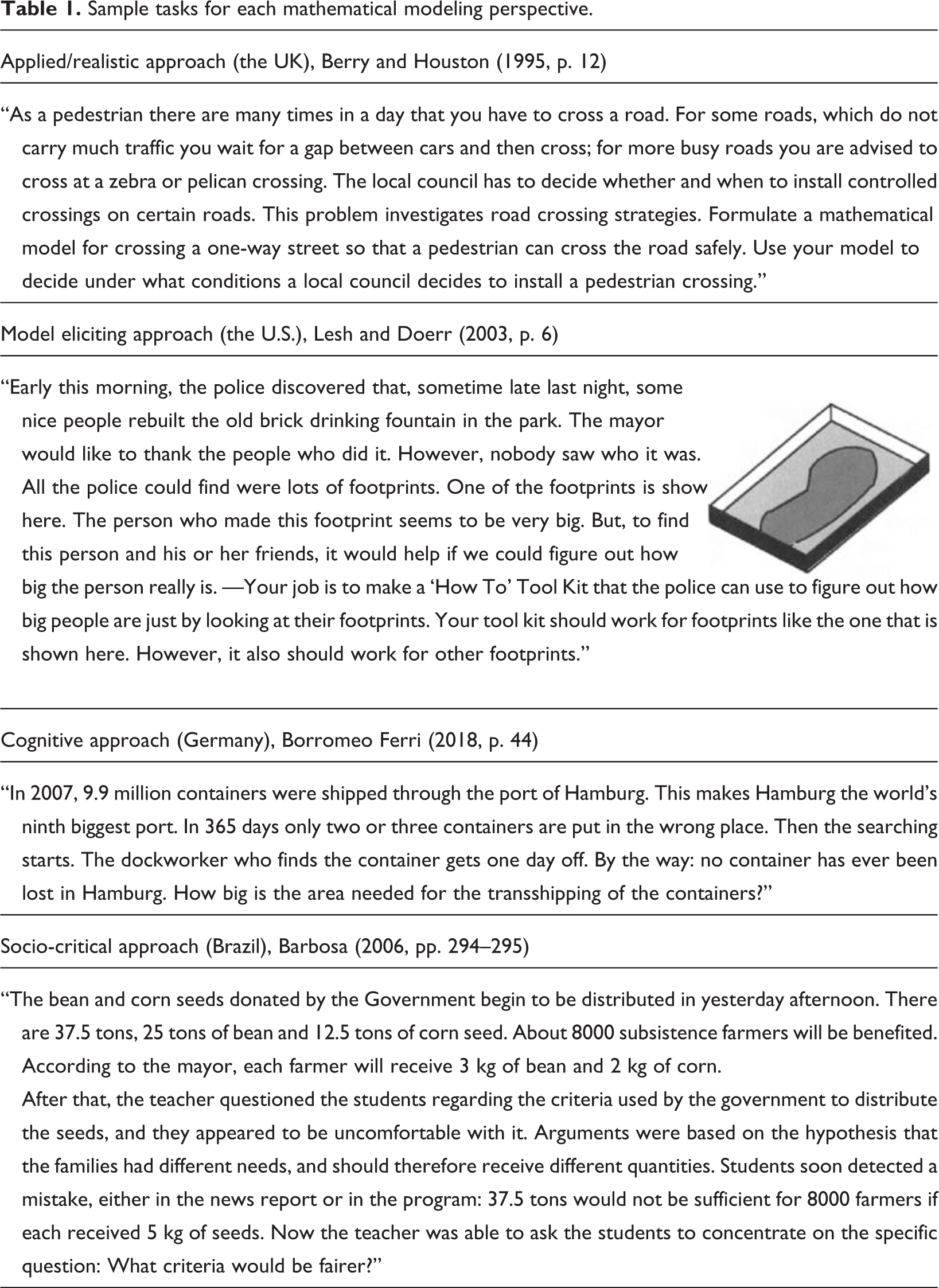
A total of 16 mathematical modeling tasks, 4 from each modeling perspective, were examined. After determining the tasks to be analyzed, repeated review, examination, and interpretation performed to gain meaning and empirical knowledge of the values in these modeling tasks. Sample tasks for each mathematical modeling perspective are presented in Table 1.
Sample tasks for each mathematical modeling perspective.

Data analysis
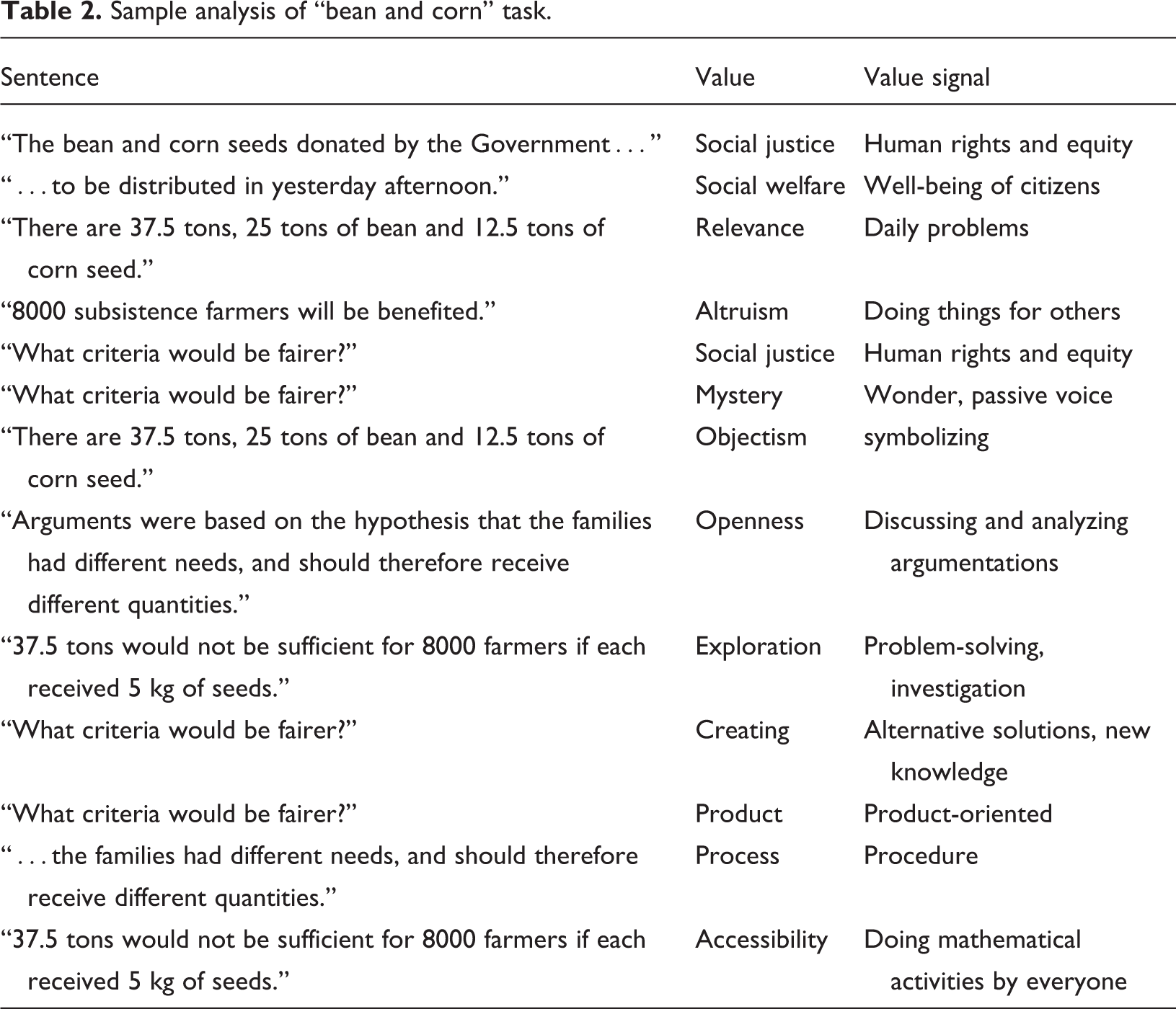
The data were analyzed using semantic content analysis, one of the qualitative research data analysis methods. It is the process of creating a category to explore the main subject areas at the core of the data analyzed and the specific subareas that these areas contain (Tavşancıl & Aslan, 2001). In the present study, in mathematical modeling tasks, mathematical values, mathematics educational values, and educational values are the main subject areas. In this sense, the analysis unit can be word, theme, character or person, sentence or paragraph, and content (Yıldırım & Şimşek, 2008). Considering the possibility of missing the meaning of the sentence in the analysis of words and paragraphs (Yıldırım & Şimşek, 2008), in the present study, the mathematical values, mathematics educational values, and educational values reflected in the mathematical modeling tasks are examined in terms of values at the sentence level by focusing on the meaning of the sentences of the modeling tasks taking into account the indicators of the aforementioned values (see Dede, 2006, 2012; Seah, 1999, 2011). It should be noted that a value can be both mathematical, mathematics educational, and educational value. A sample of how data analysis is performed is also presented on the “bean and corn” task in Table 2. Due to the page number and word count limit, not all activities and analyses can be added.
Sample analysis of “bean and corn” task.
Trustworthiness of the study
Qualitative research methods are generally preferred, as quantitative studies on values in mathematics education can lead to subjective and disputable insights due to the nature of these values. The reliability and validity of qualitative research methods is provided with triangulation (Seah, 2008). In this sense, in the context of the different mathematical modeling perspectives proposed by Kaiser and Sriraman (2006), Kaiser and Schwarz (2010), and Blum (2015), the values emerged in the current study were compared with Bishop’s (1991), Seah’s (1999, 2011) categories of mathematical values, and Hofstede’s (2009) cultural value categories so that “theoretical triangulation” (Cohen et al., 2000, p. 113) was implemented on the values. In addition, different mathematical modeling perspectives have been extensively included in the text, and in this way, an in-depth description and richness has been sought in the transmission of findings (see Creswell, 2012). The reliability of data was ensured with peer review. Peer review can be conceived as an external control procedure for the reliability of the study (Lincoln & Guba, 1985). Thus, values coded by the researchers were sent to three separate researchers, all of whom have a PhD degree in mathematics education. In the light of expert feedbacks, values were updated. Once all the categories were examined, the concordance correlation coefficients between the researchers and experts in mathematics education were calculated as 0.83, 087, and 0.81 respectively.
Findings
In this section, explanations about the situations in which the mathematical values, mathematics educational values, and educational values carried out by the mathematical modeling tasks prepared according to the four different mathematical modeling perspectives are provided (see Blum, 2015; Kaiser & Schwarz, 2010; Kaiser & Sriraman, 2006). Since the analysis on the basis of words and paragraphs may cause the missing of the meaning of the sentence (Yıldırım & Şimşek, 2008), mathematical modeling tasks are examined in the context of “sentence” in the present study. Mathematical values, mathematics educational values, and educational values reflected by the tasks were examined on the basis of the sentence by focusing on the meaning of the sentences and by taking into account the indicators of the aforementioned values (see Dede, 2012; Seah, 1999, 2011). In this context, the mathematical, mathematics educational, and educational values involved in the modeling tasks developed based on four different modeling perspectives are given respectively.
Mathematical values
In terms of mathematical values, socio-critical modeling perspective (Brazil) differs from all other perspectives (applied/realistic, cognitive, and model eliciting). In particular, the value of objectism was only involved in tasks as to socio-critical modeling perspective. Two of the cognitive modeling tasks involve the value of progress, and this value was also involved in all of the socio-critical modeling tasks. Control, mystery, and openness values were involved in all four perspectives (socio-critical, applied/realistic, cognitive, and model eliciting). Rationalism value was involved in some of the tasks in the socio-critical modeling perspective and was only involved in one of the tasks which belong to applied/realistic perspective. Examples of the analysis process are presented in Table 3.
Mathematical values in mathematical modeling perspectives.

Mathematics educational values
In terms of mathematics educational values, all modeling tasks involved the values of product, process, exploration, creating, relevance, pleasure, and application. Accessibility value was involved in all modeling tasks except three of the modeling tasks as to applied/realistic modeling perspective. The value of specialism involved in two modeling tasks of applied/realistic perspectives and theoretical value involved in two modeling tasks of socio-critical modeling perspective. Examples of the analysis process are presented in Table 4.
Mathematics educational values in mathematical modeling perspectives.

Educational values
In the context of educational values, social justice, equity, social welfare, humanity, and altruism (“…donated by the Government.” “What criteria would be fairer?” and “Landless Peoples’ Movement”) values come to the forefront in the tasks that take place in socio-critical modeling perspective. On the other hand, in the tasks as to model eliciting approach, individualism (“…which should be rehired…”) appears to be prominent. Examples of the analysis process are presented in Table 5.
Educational values in mathematical modeling perspectives.

Discussion and suggestions
In the present study, the similarities and differences between mathematical modeling tasks in general and mathematical modeling tasks developed in different cultures, in particular, have been revealed. In this context, the present study examined different mathematical modeling perspectives mentioned by Kaiser and Sriraman (2006), Kaiser and Schwarz (2010), and Blum (2015) in terms of mathematical, mathematics educational, and educational values. Mathematics education in different cultures and societies is strongly influenced by social and cultural factors that shape value, belief, purpose, teaching methods, and expectations. Different cultures and societies may have different views on mathematics education. The diversity of these values related to mathematics education may cause education systems and expectations to differ according to societies and cultures. The diversity of these values related to mathematics education may cause educational systems and expectations to differ according to societies and cultures (An et al., 2006). In educational environments, teachers transfer the values to their students consciously or unconsciously (FitzSimons et al., 2001), and sometimes unintentional value transfers can occur (Gellert, 2000). More clearly, in the scenario of a task used by a teacher during the lecture process, there is a possibility that an undesirable value will be formed as a result of explaining a situation (norm) that is not accepted by the society. For example, if the Big Foot (see Table 1) task examined in the present study is considered in relation to an individual who has committed theft and escaped from the arrest, rather than a person with a good attitude who repairs the fountain, in this case, there is a possibility that students may acquire the wrong value. In this regard, in the present study, mathematical modeling tasks written by the leading researchers of the aforementioned perspectives were examined in terms of the values they have.
In the literature, values are usually stated in pairs. For example, the values determined by Hofstede (1980, 2009) are individualism–collectivism, masculinity–femininity, power distance index (high–low), and uncertainty avoidance index (high–low); the mathematical values determined by Bishop (1991) are rationalism–objectivism, control–progress, and mystery–openness expressed as pairs. The same situation can be applied to many mathematics educational values (e.g., exposition–exploration, recalling–creating, pleasure–hardship, and relevance–theoretical knowledge). Bishop (1991) states that it is appropriate to carry out balanced teaching in terms of values, especially in mathematical value pairs. It can be said that the same applies to other value pairs. In contrast to Bishop’s (1991) discourse, in the present study, there was no balance, except the socio-critical modeling perspective, between rationalism–objectivism value pairs. While there was a balance between control progress values pair in socio-critical modeling tasks, the control value is usually foregrounded in other modeling tasks. In the mystery–openness value pairs, there is a balance in all tasks within the scope of the present study. The emergence in mathematical values of control, mystery, openness, and mathematics educational values of process, product, exploration, creating, relevance, pleasure, application in all tasks in the scope of this study may be due to the fact that mathematical modeling encourages nontraditional methods in mathematics teaching (Zawojewski & Lesh, 2007), and may be mathematical modeling exhibits the relationship between daily life situations and mathematics (Blum & Borromeo Ferri, 2009; Cirillo et al., 2016). Besides, it was explored that there was a balance in the distribution of process–product value pairing in modeling tasks, whereas this balance was not generally found in exposition–exploration, recalling–creating, pleasure–hardship, and relevance–theoretical knowledge value pairs. If accessibility–specialism value pairs are examined, there is not a complete balance in the distribution of these values in modeling tasks, and accessibility value is emphasized predominantly in other perspectives except realistic/applied modeling perspective, whereas specialism value is not emphasized in other perspectives other than realistic/applied modeling perspective.
In terms of educational values, it is seen that personal values are mostly involved in socio-critical modeling tasks, and less involved in realistic/applied modeling, and cognitive modeling tasks. In the socio-critical modeling perspective, social justice, equity, social welfare, humanity, and altruism values were emphasized more than others. On the other hand, individualism value comes to the forefront in model eliciting tasks. This may be due to the fact that the U.S., where the model eliciting approach tasks are dominant, is the country with the highest individualism emphasized in the context of individualism–collectivism cultural value pairs (see Figure 1). A similar situation also arises in studies on American advertising. For example, slogans in the advertising that emphasize individualism such as “A leader among leaders” and “You are better than everyone” in American commercials (see Han & Shavitt, as cited in Kağıtçıbaşı, 2010). A similar situation emerges in model eliciting tasks. Hofstede’s intercultural study also states that Americans are a society with high individualism value (see Hofstede, 1980, 2009).
Mathematics education in a country is influenced by the tradition of education, and mathematics. Additionally, the tradition of education is related to the country’s culture (Leung et al., 2006). Therefore, according to the perspectives discussed in the present study, there are some similarities in terms of the values (process, product, exploration, creating, relevance, pleasure, and application) of mathematical modeling tasks. These similarities may be due to the nature of mathematical modeling which emphasizes nontraditional methods in mathematics teaching (Zawojewski & Lesh, 2007) and shows the relationship between daily life situations and mathematics (Blum & Borromeo Ferri, 2009; Cirillo et al., 2016). Another reason may be that rapid developments in technology reduce the differences between cultural traditions (Leung et al., 2006). In addition, the results of the present study provide significant contributions to researchers, teachers, and policymakers about values in the mathematical modeling tasks. In this context, similar to the present study, researchers may examine the values which are included in mathematical modeling tasks produced by researchers in different countries. For instance, in the researches about mathematical modeling, it is seen that model eliciting approach, realistic/applied modeling, and cognitive modeling approaches are mostly used, in Turkey (e.g., Bukova-Güzel, 2011; Çelik & Bukova-Güzel, 2018). In this context, the values of the mathematical modeling tasks created by the researchers in Turkey can be explored and compared with the values obtained in the present study. Although information sharing accelerates due to developing technology, countries tend to use approaches that have emerged in another country by adapting them to their own culture. In this respect, similar studies can be carried out among countries instead of mathematical modeling perspectives. In addition, the questions used in large-scale international comparative studies, such as PISA, actually include mathematical modeling questions, and the questions are developed by educators in countries with different cultural characteristics. Therefore, the possible values of the questions included in these exams can be comparatively examined by countries. Finally, in the present study, it was explored that the mathematical modeling tasks chosen according to the modeling perspectives have almost similar values in terms of mathematical values and mathematics educational values. However, in terms of educational values, the modeling perspectives differed considerably. In this context, the results of the present study show that mathematical values and mathematics educational values in mathematical modeling tasks developed by researchers from different cultures differ partially from one another. In other words, although the definition of modeling is similar, cultures have effects on modeling tasks. Additionally, culture creates differences on the values in which mathematical modeling tasks involved. In this respect, awareness of values in mathematical modeling tasks is important for teaching mathematical modeling. Additionally, it will be very difficult to talk about effective education regardless of values, so awareness of the values in mathematical modeling tasks is important for mathematical modeling teaching. In this respect, mathematical modeling instruction can be simplified, taking into account the values of the present study. This result may contribute to the literature to see the effects of different cultures on mathematical and mathematics educational values. There is also a tendency to assume that school mathematics is the same everywhere when it is experienced, especially among mathematics education researchers and policymakers, but this is not true (Andrews, 2016). In this context, the results of this study support the following claim,