







Abstract
Keywords
Introduction
Education for students with special education needs (SEN) has experienced a variety of placement models, from isolated special education schools, classes, and resource rooms to the present model of inclusive education (Miles & Singal, 2010). Some countries adopt a one-track approach to include almost all students with SEN within mainstream education with a range of services provided, whereas others employ a multitrack approach to offer a variety of services between mainstream and special needs education systems (Sentenac et al., 2013). No matter what approach is chosen under the philosophy of inclusive education, they all lead away from the so-called segregated special education placement. The variation in educational placement forms has led to discussions on educational efficacy. Many studies have verified the effectiveness of inclusive education, with mixed and even contradictory results (Oh-Young & Filler, 2015). These studies have often compared academic and social development between students with and without SEN in inclusive settings as well as key stakeholders’ attitudes toward inclusive education (De Boer & Minnaert, 2011; Ruijs & Peetsma, 2009). Although inclusive education has been shown to benefit the social and emotional development (e.g., self-esteem and relationships) of students with SEN by providing supportive environments (Loreman, 2007), their prospects of academic achievement tend to be pessimistic (Oh-Young & Filler, 2015). Efficacy studies support a variety of service models, from partial to full inclusion, but the actual decision on choosing placement remains a complicated and challenging process for policymakers, professionals, and parents.
Inclusive education, renamed “Learning in Regular Classrooms” (LRC), has been developed as the key approach to serving students with SEN in China since the 1980s (Xie et al., 2023). Special schooling, representing the most typical segregation, and LRC, the most advanced inclusion, have both been emphasized and have thus formed a parallel and coexisting special education system in China (Li, 2019). Other options, such as special classes and resource rooms, are affiliated with regular education schools as complementary alternatives. Seldom has there been any advocacy to close special schools, as has happened in the West, resulting from the full inclusive education mandate, since they have often been taken as the “backbone” for inclusive education in local areas and the necessary placement for those with severe disabilities (Deng & Zhu, 2016). The literature reveals that special education schools focus on the training of students’ life skills and independent abilities, and scholarly attainment is not as important as is highlighted in regular education schools (e.g., Oh-Young & Filler, 2015; Thomas, 2013). Chinese studies have also highlighted that intense academic competition has become an obstacle for students with SEN to attend regular education schools (Fu & Xiao, 2016). In Chinese society, which views education as a vital ladder of social and economic mobility, even underachieving students without SEN would face intense pressure and criticism, not to mention those with SEN (Yang et al., 2018). Regular education teachers worry that students with SEN would lower their average class scores, affecting competition for higher levels of education (Cui et al., 2019; Malinen et al., 2012). Students without SEN and their parents are the most vocal groups against inclusive education because they believe that the presence of students with SEN demands relatively more energy and time from teachers (Sosu & Rydzewska, 2017; Stevens & Wurf, 2020).
Under such circumstances, choosing between special and regular education placements remains challenging for practitioners and parents of children with SEN. Investigations have found that professional support and resources for parents to make placement decisions are scarce in China (Wang et al., 2022). Very few empirical studies have been conducted to compare the effectiveness of placements ranging from segregated to inclusive education, and thus they cannot provide adequate scientific information to support decision-making. This has created a harsh situation in which many SEN students have been forced to continuously switch between special and regular education placements (Fu & Xiao, 2016). Research on students who have experience with two different types of education could clarify the process and influencing factors of placement decision-making more accurately. Decision-making includes a dynamic process of intellectual, emotional, and physical aspects to choose from various goals and relevant means, tools, and resources to reach the goals within a specific context (Maral, 2022). Decision-makers tend to make the best choices among various alternatives based on rationality, but the actual decision process is often underlined by the contextual factors of risk and uncertainty (Mager & Nowak, 2012). This study seeks answers from these students and relevant key stakeholders (e.g., teachers and parents) to explore their perspectives on why and how they have made educational decisions on placement changes. Thus, the effectiveness of inclusive and special education was compared, and the underlying rationale for placement choices was examined according to the Chinese cultural and educational context.
Method
Participants
Convenience sampling was used to recruit the participants. We first contacted the principals of regular and special education schools in Beijing and Nanjing, China, who had cooperative relationships with our institutions. We then applied for a recommended list of students willing to participate in the interviews. Students’ family members and relevant school staff members were contacted by phone to confirm the interview arrangements. Eight students (with pseudonyms) under 16 years of age diagnosed with intellectual or physical disabilities (World Health Organization, 2019) in compulsory education participated in this study (Table 1). Among them, four participants (female: Lin and Zhang; male: Wu and Chen) from Grades 5 to 8 had intellectual disabilities and were currently studying in special education schools. They all have effective communication skills but are easily provoked. Their experiences in regular education schools were so miserable that their parents had to send them to special education schools. Four other participants (female: Wang; male: Hu, Liu, and Han) from Grades 6 to 9 had physical disabilities, including limb deformities and cleft lip and palate. They had powerful learning motivation and decided to transfer to regular education schools because they thought that special education schools would rarely meet their learning needs. We invited at least one parent per student to participate in the study.
Demographic information of students with SEN.

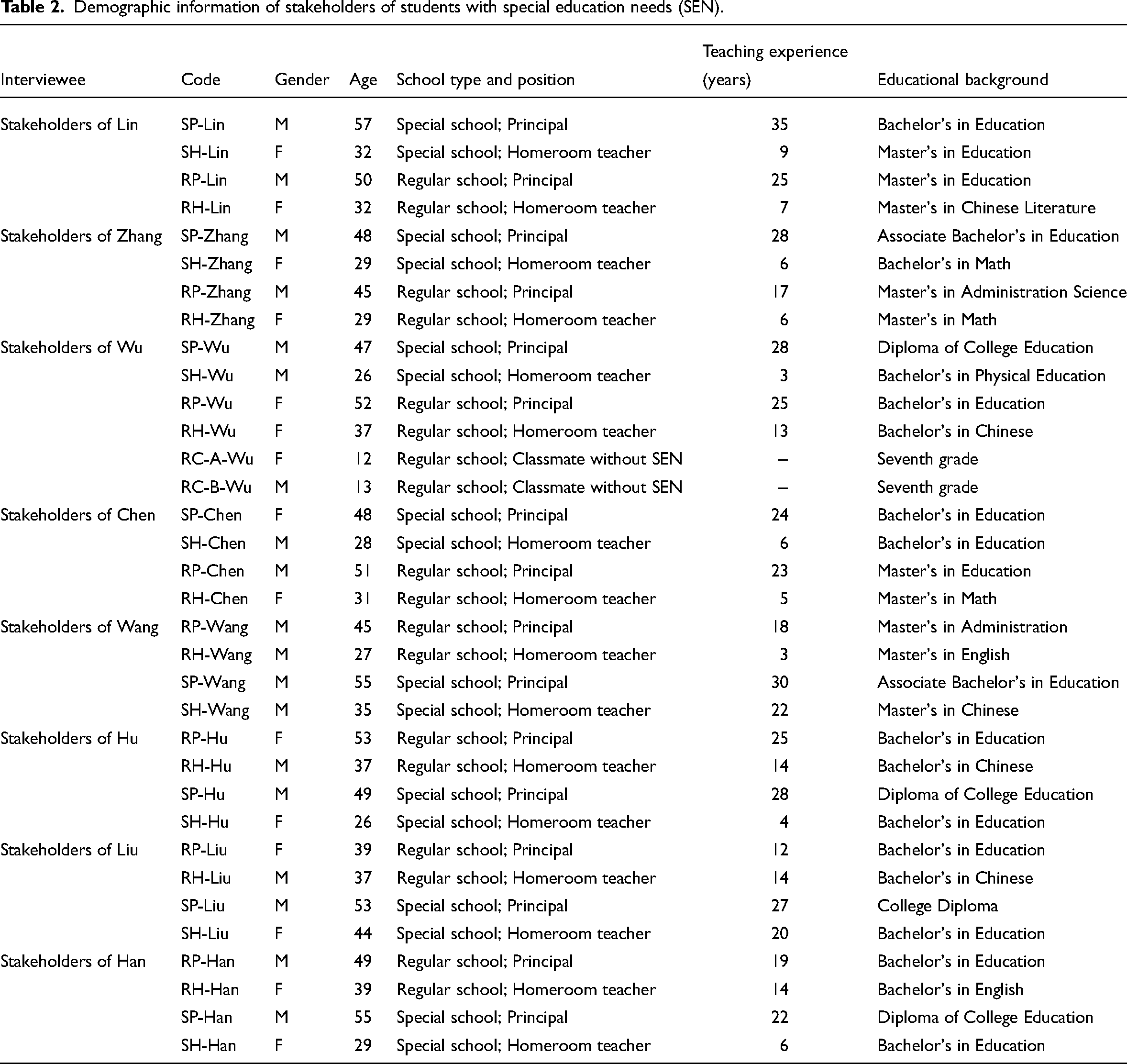
Homeroom teachers and the principals of regular and special education schools were also involved in this study. Interviews with school principals concerned school policies and support for teachers and students. Homeroom teachers, who hold special faculty positions in China, were the most important informants. Each class usually has a permanent classroom that contains five to 10 students in a special education school or 40 to 50 students in a regular education school. Students from one class were managed by a designated homeroom teacher leading a team of subject teachers. Homeroom teachers are responsible for students’ academic development, extracurricular activities, and physical and psychological states (Gu et al., 2017). They have the same role as school counselors in the U.S. (Wang & Yang, 2021), and are responsible for teaching a subject and managing the entire class. Therefore, they are the most important witnesses in the school lives of students. Detailed information on the participants is presented in Table 2. All the participants were informed of the research purpose and signed a consent form.
Demographic information of stakeholders of students with special education needs (SEN).
Data collection
Both semistructured and open-ended interviews were used to collect data. Semistructured interviews were conducted to ascertain the perspectives and experiences of stakeholders (e.g., parents, principals, classroom teachers, and students without SEN) concerning the effectiveness of special and regular education. The interview questions concerned the topics of students’ daily performance and outcomes, the reasons why SEN students entered or left school, the types of support schools provided, parental participation, and the feelings of classmates without SEN about their SEN peers. Each participant was interviewed separately, and the interview length ranged from 30 min to 1 hr. The number of interviews depended on whether the interview had achieved data saturation and whether the interviewees answered all questions in the interview guide.
Open-ended interviews with students with SEN were conducted in classrooms, playgrounds, and other natural environments where conversations could be more relaxed and authentic. Students with SEN were encouraged to share their experiences in different educational settings. Also included were questions aimed at examining their opinions of other relevant personnel, such as homeroom teachers or classmates; examples include, “What do you appreciate most in this school?” and “Can you receive extra help from others at school?”
Data analysis
All the interviews were recorded and transcribed. Thematic analysis was used to establish themes from the textual data (Braun & Clarke, 2006). First, the texts were read thoroughly to obtain a holistic sense of the ideas emerging from the material. Second, initial codes were generated from each text file after checking the transcripts line by line using NVivo 11. Third, all codes were collated into potential themes, and the data relevant to each potential theme were gathered. Fourth, all the authors checked whether the potential themes worked in relation to the extracts and discussed the names and definitions of each theme. Themes such as “discrimination and stigma,” “conditional inclusion,” and “special schools are happy but not enough” were identified in this step. Finally, all inductive themes were integrated into two deductive categories according to SEN students’ experiences: transferring from regular to special education schools and transferring from special to regular education schools.
Results
A practical choice to transfer from regular to special education schools
Four participants (Lin, Zhang, Wu, and Chen) with intellectual disabilities were currently studying at special education schools. They decided to give up regular education after failing to compromise with their schools, which were very much elite-education-oriented and did not welcome students who needed extra support for learning.
Failed students: I will never go back
Discrimination and stigma
When asked if he would like to go back to the regular education school to study again, Chen, an 11-year-old boy with intellectual disability who is very impulsive and emotional, said, “I will never go back! I just want to burn it [the regular school] down!” Wu, who has a mild intellectual disability, complained that “They called me an idiot and threw things at me.” Zhang, who studied in a regular elementary school for five years and left for a special school for his sixth grade, said, “The teacher yelled that ‘get out of my classroom’ at me. I cannot get my test paper for the exams.” Her regular schoolteacher (RH-Zhang) said that there was no need for her to take the test because she could not do anything and usually scored zero. Zhang's homeroom teacher, actually a young and excellent regular education teacher, commented, “Sometimes her [Zhang's] behavior affected my teaching process, and I was so angry to tell other students that ‘Don’t be a silly student like her’” (RH-Zhang).
Negative peer relationships
All relationships in regular education schools seemed to deteriorate among SEN students. They were rejected because they had no friends at regular education schools. A classmate of Wu said, “He smells terrible. I do not want to play with him” (RC-B-Wu). RH-Lin, a homeroom teacher with a master's degree in Chinese literature and seven years of teaching experience, believed that students with disabilities could not establish close peer relationships even with the assistance of teachers. She said: I have persuaded other students to treat Lin friendly. But the best situation that she can get is being away from bullying. She was always isolated. Students make friends based on their personal preferences, not on the teacher's orders. (RH-Lin)
All these factors have caused students with SEN to escape from regular education schools. Now, these four students enjoy campus life in special education schools, as they described: Everything is good, my classmates also have disabilities, but they are sincere and friendly; we are just like siblings. We play together and share everything. (Lin)
Intransigent principals: We cannot let him in
Conditional inclusion
Students with SEN encounter many barriers when studying in regular education schools. Principals indicate that these children must meet particular enrollment criteria and follow their school routines. They commented, “It is fine to attend our school only if she can behave like a normal child. She must have the ability to look after herself” (RP-Zhang), and “If Wu does not disturb others, it would be possible for him to stay in class” (RP-Wu).
In addition, the disability type and degree contributed to determining whether the students could be enrolled. As Chen's principal said, “We [all teachers] agree that we could tolerate those physically disabled but cannot bear with students with intellectual disabilities, psychiatric or behavioral problems” (RP-Chen).
It seems that there are thousands of excuses for refusing students with SEN. However, what is the real reason for this? Regular school principals expressed their real feelings: “Is it fair for us to accept one student and then leg the whole class behind in the school evaluation indices?” (RP-Zhang), and “This is a school for elites. Scores and college enrollment rates are our priorities” (RP-Wu).
Pressure from teachers and parents of students without SEN
Principals reported their reasons for rejection. Chen's principal said: Teachers asked me, “We even have entrance exams and enrollment criteria for students without SEN. Why we don’t choose the best ones?” (RP-Chen)
Regular education schools always fail to convince parents of students without SEN to accept the students with SEN, as one commented: Once those parents rallied to expel the child with SEN jointly. Parents of students with and without SEN were all involved in the conflict, and the school was caught in the dilemma and trouble. (RP-Lin)
Parents were very concerned about their children's studies and their interpersonal atmosphere. Students with SEN are viewed as “time-bombs” placed around their children. RP-Lin said that the parents of non-SEN students warned their children not to play or even talk to those “abnormal” students. The mother of a student without SEN even asked him, “I’ve seen a transferred student beating another student, will you allow your child to study and play with him anymore?” (RP-Lin).
Exhausted teachers: All my efforts were in vain
Helpless and no sense of achievement
In this study, none of the regular education teachers initially abandoned the SEN students. They complained that these students could create enormous challenges for the classes. Over time, they became desperate and did not know what to do. One homeroom teacher said: At first, I would feel sorry for that child and try to help, but after so many invalid efforts, I began to give him up uncontrollably. (RH-Wu)
The most unacceptable thing for teachers was that their efforts did not generate positive results, and they complained that they could not see any improvement in students with SEN. All my efforts were in vain. I tried my best, but I didn’t think it took any effect. No matter what I did and how hard I worked, I couldn’t improve his performance at all. (RH-Chen)
Challenging behaviors
Teachers who had students with SEN in class unanimously said that specialized placement was more suitable for these children, especially considering SEN students’ disturbing behaviors. Lin always cries in the classroom. If I tolerate this behavior, it will sacrifice the rights of other students for a quiet study environment. (RH-Lin)
I think it's good to teach these children separately. Special school teachers can handle their challenging behaviors because they are professional. (RH-Wu)
Constant failures in all aspects of school life highlight doubts that mainstream education is not responsive to students with SEN. Most teachers hold negative attitudes toward inclusive education for these students.
Despairing parents: We have to leave
Parents had high expectations at the beginning of inclusive schooling. In stark contrast to their hopes, harm to SEN students remains and inconsistent school–home communication was often highlighted.
Failed social development of their children
Facilitating children's social interaction skills and inclusion is one of the most important reasons why parents send their children to regular schools. However, in reality, this backfires, as they complain: I have low expectations for my child's academic performance … At least, I thought he could make some progress in social development. But, look what they’ve done to my child. They gave him a nickname and mock him. He became very timid and often cried. (Mrs. Chen)
She [Lin] was very resistant to going to the regular education school, saying that other students don’t play with her, and teachers despise her too. I just don’t want her to get hurt. (Mrs. Lin)
Zhang believes that everyone was smarter and stronger than her. She was particularly depressed or irritable after school, indicating that she was being blamed or bullied. The inclusive experience was a nightmare for her. (Mrs. Zhang)
Home–school conflict
All the participating parents of students with SEN referred to their relationships with regular education teachers as fraught or tense. The former homeroom teacher was excellent, and she didn’t treat her as an intellectually disabled child. But after the change of the homeroom teacher, all kindness disappeared, and conflicts broke out. The new homeroom teacher criticized us for not educating our children well and complained about her poor performance, conflict with classmates, and lagging the whole class behind in exams. (Mrs. Lin)
On most occasions, teachers’ indifference and inaction in the case of bullying were the final straw that crushed parents and students with SEN. Mothers often complained with tears. Not only did the teacher fail to educate the students to be kind and tolerant, but the teacher seemed to connive some bullying and discriminating behaviors. Teachers’ attitudes and behaviors to my kid even reinforced some negative notions and behaviors of his classmates. (Mrs. Wu)
The parents consistently mentioned “happiness.” For example, Mrs. Wu said, “I hope he can learn to live independently and be happy.” However, Mrs. Lin said, “Ironically, we have to choose between knowledge and happiness, namely regular or special schools.” “Knowledge” and “happiness” are not prima facie two contradictory concepts. However, the support available from regular education schools for students with SEN is limited, which makes it difficult for parents to choose between knowledge and happiness. The answer given by parents who moved their children to special education schools was “happiness.” Mrs. Zhang said, “There is no need for us to stay in regular education since there are just failures and tears.”
Moving from special to regular education schools for academic progress
Four students with physical disabilities (Wang, Hu, Liu, and Han) who studied in special education schools exhibited high motivation to learn. They were then transferred to regular education schools for more academic assistance.
Special schools are happy but not enough
Students with SEN: I want to learn more
Teachers in special education schools indicated that the curriculum was not appropriate for all students, especially those with higher potential. The reason most frequently mentioned by students was that the course content was too simple: I could learn something at special education schools, definitely, but it was just not enough for me. I want to go to university, but the knowledge taught there was not enough to help me compete [in] the entrance examination. (Hu)
On most occasions, I have already mastered the new knowledge teachers taught, but most of my classmates haven’t. I have to wait for the others to follow up, and I am not able to learn more things. (Wang)
In addition to the curriculum being too simple compared to that offered in regular education schools, teaching progress was also very slow in special education schools: Teaching progress was plodding, and we just simply learned a few things in a week. Class has often been interrupted by something, and teachers need to maintain discipline very often. (Hu)
Parents: Special education schools have nothing to do with study
Parents realize that if they want their children to have better academic development, they cannot remain stuck in special education schools and must transfer to regular education schools. Typical remarks are: “Han is in Grade 8 now, but their courses are at the 6th-grade level. How could he possibly pass a high school entrance test?” (Mrs. Han), and “Special education school is not the right place to study but just to drift along” (Mrs. Hu).
Idleness is another negative consequence of the simplified curriculum, reduced pressure, and zero competition in special schools. As Hu's father said: Contents are simple; exams are straightforward; assignments are not challenging. All of these have made him relaxed and slack, and lose ambition. (Mr. Hu)
Neglect of learning exerts a negative impact on students in many ways and is far more significant than expected. In a school lacking an academic atmosphere, hard work has become a strange thing, as Han said, “If I study actively, people will laugh at me and wonder what's wrong with me.”
Teachers: I cannot teach him more
Special education schools have failed to make adjustments or individualize teaching for students with varying abilities. Principals and teachers confessed frustration about the fact that the individual needs of SEN students could not be addressed adequately: The class is too diversified, and there are too many students with lower abilities waiting for us to help. So, the progress might be too slow for some students. (SH-Han)
Actually, the leading role of special education schools is to enable students to take care of themselves, to overcome their sensory obstacles, and to adapt to society … Our job has nothing to do with examinations but life skills. (SH-Wang)
It is undeniable that learning in inclusive settings is the best choice for obtaining more academic assistance. All stakeholders have expressed their support for inclusion from their perspectives, in both academic development and social adaptation areas: “I wish him to go to a ‘normal’ environment to improve the academic performance and to learn the right way of getting along with people” (SH-Hu).
Regular education schools are good for study but bad for happiness
Although SEN students have found suitable regular education schools, they face problems during the process of inclusion that determine whether they can improve their performance and whether they will transfer to another school.
Students with SEN: What I got is just knowledge
Regular education schools did not promote the academic and social development of the transferred students as they had expected. All four students with physical disabilities experienced exclusion at the initial stage of transfer. Students recalled an inclusive life as follows: No care, no share, not to mention any happiness. The only advantage here is that I could learn more knowledge than from special education school, and nothing else. (Liu)
Additionally, SEN students are threatened by campus discrimination. Wang complained, “I am physically disabled, but I can rely on myself. I don’t bother anyone, why do they still dislike me?”
Hu's homeroom teacher said helplessly, “I had some special care for Hu, but other students would be very susceptible and sensitive to what I did, so I stopped giving him extra help” (RH-Hu).
Parents: The only way is to work hard
Being placed in a mainstream school with no support system, students with SEN could only rely on their own extreme and tough efforts: “Wang works very hard. I think education is the only way to change her life” (Mrs. Wang), and “We have no other options. This is the only school willing to accept him after thousands of rejections” (Mrs. Liu).
We should note that their school adaptation and the change in the campus atmosphere is a long-term and challenging process. Under the unremitting efforts of SEN students and their parents, the school environment gradually improved, as described by some stakeholders: When she just came, she refused to get in touch with anyone. Now she has a few friends. (RH-Wang)
I don’t think that the students refuse him (Han) deliberately. They just could not understand what he was talking about. Now they are getting along well. (RH-Han)
Teachers: We need more support
Unlike intellectually disabled students who were rejected because of their own emotional or behavioral problems, physically disabled students were rejected by regular education teachers because they did not know anything about how to help them. The problem is not just to slow down or repeat the context a few more times, but to plan teaching based on his learning style. But I don’t know what he needs. (RH-Han)
When asked if the school has a resource room and teacher, or if any support had been provided, a regular teacher replied, “No, our school does not have other professionals except psychological teachers. The heavy responsibility falls on the homeroom teachers” (RH-Hu).
Additionally, the teachers’ needs were related to a more flexible evaluation system. The current elite education system does not offer a wide space for teachers to tolerate student performance being below standards because of its punitive and highly accountable nature. As Liu's homeroom teacher commented: One student's failure could lag my class down to the last row with the lowest test scores. I cannot bear this shame and pressure. Also, only when we establish a more diversified, flexible, and process-oriented evaluating system will teachers never be ashamed of teaching these under-performance students. (RH-Liu)
Not only teachers but also regular education schools failed to receive sufficient support from outside. Regular education schools were desirous of professional support and in-service training, as claimed by the participants. We have more and more students with SEN now. It is good and necessary that researchers and professionals can come to help us solve some practical problems. (RP-Hu)
In-service training is a very effective solution, but most teachers in our school do not have such opportunities yet. (RP-Liu)
Discussion
This research explored the decision-making process and influential factors in choosing educational placements for students with SEN in China in an era moving toward inclusion. The findings indicate that the choice of educational settings has been a complex process full of dilemmas and conflicts shaped by a few contextual factors: expectations of stakeholders, students’ abilities, teachers’ competence, schools’ enrollment policy, and support. Students’ abilities stood out as the most dominant factor underlying expectations and attitudes, as well as actual decisions and school practices. This finding has been evidenced in this study, in that students with cognitive difficulties moved to special schools for less competitive academic requirements but a more favorable atmosphere, and those with physical disabilities transferred to regular schools for better academic than social gains. This implied that disability is seen as a personal issue based on the traditional biomedical model instead of a right model from a social–political perspective, as a result of which students with SEN are easily labeled as “low ability” and “losers” (Smart, 2009).
Those choosing special education schools craved an environment that is more relaxed and less competitive and discriminatory than in regular education, which often brought about social maladjustment and psychological deterioration. Yang (2016) argued that simple and intimate interpersonal communication and relationships in special education schools stabilize students’ psychological states, but their closed and isolated environment is not conducive to the students’ future social adaptation and integration. The concepts and practices of special education schools are deeply rooted in the spirit of the Confucian tradition, which nurtures a culture of tolerance and charity. It is widely believed that the campus environment where SEN students live should be tolerant and harmonious based on traditional views of disability, and thus the students can be taken better care of by special rather than regular education schools (Fu & Xiao, 2016).
However, parents worried the most about transferring to a special education school because it could only provide basic support for academic development. Choosing a happy environment means that students must give up opportunities for inclusion and to gain better learning (Wei et al., 2020). This study found that the main driving forces behind the transformation from special to regular education schools were academic needs and higher personal development goals. Students with SEN encounter many more obstacles when trying to enter regular education schools than special education schools. They are not easily accepted by teachers because they are not encouraged by school policies or supported by resources. This means that the greatest obstacle for SEN students to enter school is from regular education schools, which echoes the assertion that systematic institutional barriers have led regular education to accept inclusion sometimes “in theory” (Tiwari et al., 2015). The school's actual enrollment policy takes students’ ability as the primary admission index, which was not a “zero rejection” rule as written in governmental documents (Yan & Deng, 2019). The data showed that only students with essential learning and self-care capacities were allowed to enter school, and those who needed more support could only stay in special education schools. The stronger their academic ability, the higher the inclusion that SEN students experience.
This situation is consistent with the current Chinese exam-oriented education system resulting from the Confucian legacy that education chooses elites through intense competition for exam results (Deng & Poon-McBrayer, 2012). Elitism attaches the most importance to ability, which is why ability is seen as the fundamental factor for inclusion in China. One challenging issue is that the national education system has not yet produced profound changes to provide equal opportunities for SEN students (Deng & Zhao, 2019). The regular education principals interviewed in this study admitted the educational and social significance of inclusion; however, they must take into account the functions expected of their schools and defined by society necessary to pursue excellence. Accepting students with low abilities runs counter to schools’ goals of cultivating elites, and regular education schools are caught in a game of educational right versus quality (Peng & Lei, 2013).
Thus, students with SEN often struggle in the learning process within a regular educational environment, wherein many teachers do not feel informed or equipped to teach them effectively (Connor & Cavendish, 2020). SEN students’ self-concept and social identity were often negatively influenced by regular education teachers and typically developing classmates, and they were often stigmatized as “abnormal” and “useless” (Mu, 2015). Meanwhile, students studying in special education schools complained that schools have always focused more on life skills and interpersonal relationships while neglecting their unique academic needs. The overly restrictive and protective environment limits students’ willingness to grow and propels them toward regular education schools. This is highly relevant to the initial purpose of Chinese special education schools, which, being based on Confucian benevolence, prioritizes the protection of students with SEN (Deng & Poon-McBrayer, 2012). We note that neither placement pattern could provide high-quality education for students with SEN. Their parallel or even conflicting development impeded the sharing of institutional resources and forced SEN students to ceaselessly seek better educational placement (Deng et al., 2017; Deng & Zhu, 2016).
Regular education schools cannot fully recognize and accept equal participation and sharing of educational resources for students with SEN (Yan et al., 2021). Consistent with previous studies conducted in other countries, this study showed a similar gap between educational ideals of inclusion and school practices for students with SEN (Tiwari et al., 2015). To segregate or to include? To be happy or to work hard? The decision on educational placement for SEN students is an irrational and pragmatic compromise in this actual educational situation.
Conclusion
This study provides an in-depth understanding of why and how placement decisions related to educating students with SEN are made against the unique Chinese cultural and educational background. The findings show that stakeholders were torn between the two conflict placement forms and decisions largely relied on SEN students’ abilities, stakeholders’ attitudes, and school policies, with SEN students’ abilities being the most dominant factor. Placement decision-making is a very complex process, where different forms mean different educational patterns and teaching effects, and the way and quality of education contribute to the decision to choose a corresponding placement in return. This complicated process was influenced by multiple factors and shaped by the unique Chinese sociocultural and educational contexts. Meanwhile, we should also be aware that students with disabilities have already broken institutional shackles and successfully obtained the opportunity to choose educational placements, as expected. We noticed that the learning environment of SEN students could be enhanced by teachers’ higher acceptance of disabilities and schools’ reinforcement of follow-up services, which should also serve as a reference for educational practice for individuals with disabilities. At the same time, it is worth noting that China has made steady and deliberate efforts in developing inclusive education, which have begun to yield encouraging progress in policy design and school-level practices.
It is highly recommended that the government formulate and implement policies to ensure adequate resources for students with SEN. Governments and schools should consider equipping teachers with essential knowledge, skills, and competencies. In addition, these policies should include providing adequate professionals and support staff, reducing class size, and creating effective communication opportunities for parents and teachers to improve educational quality. The study also revealed that whether in regular or special education schools, students with SEN still experienced substantial misunderstanding and discrimination, so the advocacy of inclusive education, equity, and rights of people with disabilities needs to be further emphasized and promoted in school systems and society. The combination of Chinese traditional culture and the consciousness of the right should be an effective way to break down barriers for Chinese students with disabilities.
This study had three limitations. First, by using convenience sampling, this study mainly focused on students with SEN falling into the categories of mild or moderate intellectual and physical disabilities who can communicate verbally. Students in other disability categories and those with severe disabilities without effective verbal communication skills were excluded from the study. Future research could further explore placement issues in other types of SEN students, such as those with hearing impairments, visual impairments, autism spectrum disorders, and cerebral palsy. Second, the participants were students who had been successfully transferred to the target schools. We believe that there are still many students who wanted to make transfers but failed, and future studies can recruit them as research participants to address their concerns. Finally, further studies using larger samples are needed to examine the placement issues related to students with SEN to reflect the large regional disparities between rural and urban areas and eastern and western areas in China.
Footnotes
Acknowledgments
Contributorship
Declaration of conflicting interests
Ethical statement
Funding
ORCID iD
