







Abstract
Keywords
Introduction
The emphasis of inclusive education is on offering the appropriate educational services to meet the needs of all students, including those with disabilities, in the least restrictive environment and to facilitate their success. Although inclusive education has been conceptualized for several decades, a gap remains between the ideal and the reality. Researchers are still exploring issues such as what constitutes ideal inclusive education and how to achieve it (Haug, 2017).
Furthermore, the Chinese government established an educational approach known as “learning in a regular classroom (LRC)”, which means that students with disabilities are educated in regular classrooms in mainstream institutions to address the issue of enrolling students with disabilities in education (Xiao, 2007). After decades of implementation, LRC is now the primary educational placement for students with disabilities in China's compulsory education (Guo & Deng, 2021). Thus, LRC has shifted the focus to improving the quality of inclusive education for children with disabilities.
Educational outcome is viewed as the component by which to evaluate education, and the desired educational outcome is recognized as the point of departure for curriculum, instruction, and assessment (Spady, 1994). Based on this premise, defining the desired educational outcomes of LRC could support pertinent education practices. Additionally, the educational outcome refers to the result of interactions between individuals and the educational process (Ysseldyke et al., 1992; Ysseldyke & Thurlow, 1995, p. 2). Previous literature notes that there are educational outcomes at social, organizational, and individual levels. The current study focuses on the individual-level outcomes of LRC for students with disabilities.
Inclusive educational outcomes for students with disabilities
At the individual level, better academic achievement, better social adaptation, and less challenging behaviors are among the positive and desired outcomes of inclusive education. Loreman (2014) analyzed relevant articles and summarized that participation (social and academic participation in school life), student achievement (e.g., academic achievement), and post-school (graduating and pursuing a good career) are three themes of the outcome component in inclusive education evaluation.
Improvements in learning, social adaptation, and challenging behaviors have been found to be positive outcomes of inclusive education in several studies. For example, consistent with the theme of student achievement, the results of a meta-analysis of 40 studies showed that better academic performance in students with learning difficulties is an outcome of inclusive education (Krämer et al., 2021). According to studies comparing students with disabilities studying in inclusive settings to those in segregated settings, the learning outcomes and psychological or personal outcomes of inclusive education are more positive, including better academic learning outcomes (reading and literacy), better social adaptation (e.g., social behaviors, personal and social responsibility), and reduced occurrence of challenging behaviors (e.g., self-stimulation, self-injury; Dell’Anna et al., 2022). Increased levels of social involvement, perception of the self, and independent living skills are the positive outcomes of inclusive postsecondary education perceived by 23 parents of adult students with intellectual and developmental disabilities (Miller et al., 2018).
The social outcomes of inclusive education, such as social acceptance and peer relationships, can also be negative or undesired. Numerous studies have revealed that some students with disabilities experienced a low level of peer acceptance and sometimes were excluded from the regular class context (Tuersley-Dixon & Frederickson, 2016). Students with severe disabilities and behavior problems may encounter social rejection and isolation in inclusive settings (Ferreira et al., 2017). Psycho-social outcomes such as self-concept and well-being showed no significant difference between the students studying in inclusive settings and those in segregated settings (Krämer et al., 2021). Furthermore, some studies have shown that inclusive education was not able to prepare students in terms of better career opportunities (Loreman, 2014; Miller et al., 2018).
The literature mentioned above may be able to reveal the critical outcomes of inclusive education in Western countries. However, the outcomes of inclusive education in China have rarely been investigated. The development history of inclusive education in China differs dramatically from those in other countries, and even within the country, it varies from area to area as well.
Factors influencing inclusive educational outcomes
Several themes of factors that likely influence the outcome of inclusive education have emerged from previous studies. Although it is difficult to differentiate which levels of educational outcomes are affected by these factors, findings in the literature can facilitate the development of a framework for determining the individual-level factors of concern.
The first theme is curriculum and instruction (Hua & Li, 2006; Lee et al., 2015), which is expected to be differentiated and individualized (Hua & Li, 2006; Lee et al., 2015). The second theme is teacher education and training (Conrad & Brown, 2011; Geldenhuys & Wevers, 2013; Knight et al., 2022; Pavlović Babić et al., 2018; Poon-McBrayer & Wong, 2013; Smith & Smith, 2000), which is expected to help teachers meet the diverse needs of students in inclusive settings (Knight et al., 2022). The third theme is collaboration among stakeholders (such as teachers, paraeducators, coordinators, advisors, school leaders, parents, peer students, community groups, local businesses, and students themselves; Conrad & Brown, 2011; Eldar et al., 2010; Geldenhuys & Wevers, 2013; Lee et al., 2015; Pavlović Babić et al., 2018; Poon-McBrayer & Wong, 2013; Wang et al., 2015). For family–school collaboration, good parent support, such as sharing information about their children and advocating for them in regular classrooms, is considered a strong facilitator (Wang et al., 2015). The fourth theme is professional support (Deng & Poon-McBrayer, 2012; Mfuthwana & Dreyer, 2018; Smith & Smith, 2000), which involves specialized in-class advice, assistance, mentoring, and supervision in the classroom as well as psychological counseling and intervention therapy (Wang et al., 2015; Yu et al., 2011). The fifth theme is the cultural and physical environment (Ackah-Jnr & Danso, 2019; An et al., 2018; Broomhead, 2019; Sharma et al., 2016; Wang et al., 2015). On the cultural front, excellent culture is supposed to be fair and collaborative and involve sharing; students with and without special needs frequently remain together and help each other, have equal access to all in-class and extracurricular activities, and have a sense of belonging to the class (Wang et al., 2015). On the physical side, it is necessary to promote effective natural and artificial illumination in classrooms and school buildings, as well as accessible facilities and the landscape of the school (Ackah-Jnr & Danso, 2019). Furthermore, other factors, such as student characteristics, policy, and class size, emerged as well (Beco, 2018; Eldar et al., 2010; Geldenhuys & Wevers, 2013; Knight et al., 2022; Sharma et al., 2016; Smith & Smith, 2000).
Though the research findings suggest that the factors above may influence the outcomes of inclusive education, limitations remain. First, the objects of influence are not detailed enough to determine which are relevant to the individual-level outcome. Second, LRC, as the main form of inclusive education in China, has not been adequately explored, and the findings may differ from those of other nations.
The present study
To fill the research gap mentioned above, this study aims to investigate the individual-level educational outcomes of LRC and the influential factors by conducting semi-structural interviews with teachers working in inclusive education settings, whose perspectives on the topic could reflect the realistic situation of LRC and would affect the goals they work toward and the actions they take to achieve those goals. The framework developed by the National Center on Educational Outcomes (NCEO; Ysseldyke, 1994) and the themes derived from the literature are adapted and applied to data analysis. The following are the questions driving this study:
Method
In the present qualitative study, individualized, semi-structured interviews were conducted with teachers who had at least five years of experience with inclusive education in Shanghai. The data collected from interviews were analyzed through thematic analysis.
Participants
A purposive sampling technique was used to select participants for this study. The participants were supposed to meet the following criteria: (a) compulsory education teacher who has at least five years of working experience in inclusive education; (b) had been working with at least five students with disabilities in regular classrooms directly or indirectly over one year, as a general education teacher, a resource teacher (a full-time special education teacher in regular school), a special education researcher, an itinerant teacher providing district-level special education support. The participant recruitment was carried out in Shanghai, a city in the eastern coastal area of China where education is advanced. This area has implemented inclusive education practices for decades and accumulated practical experience.
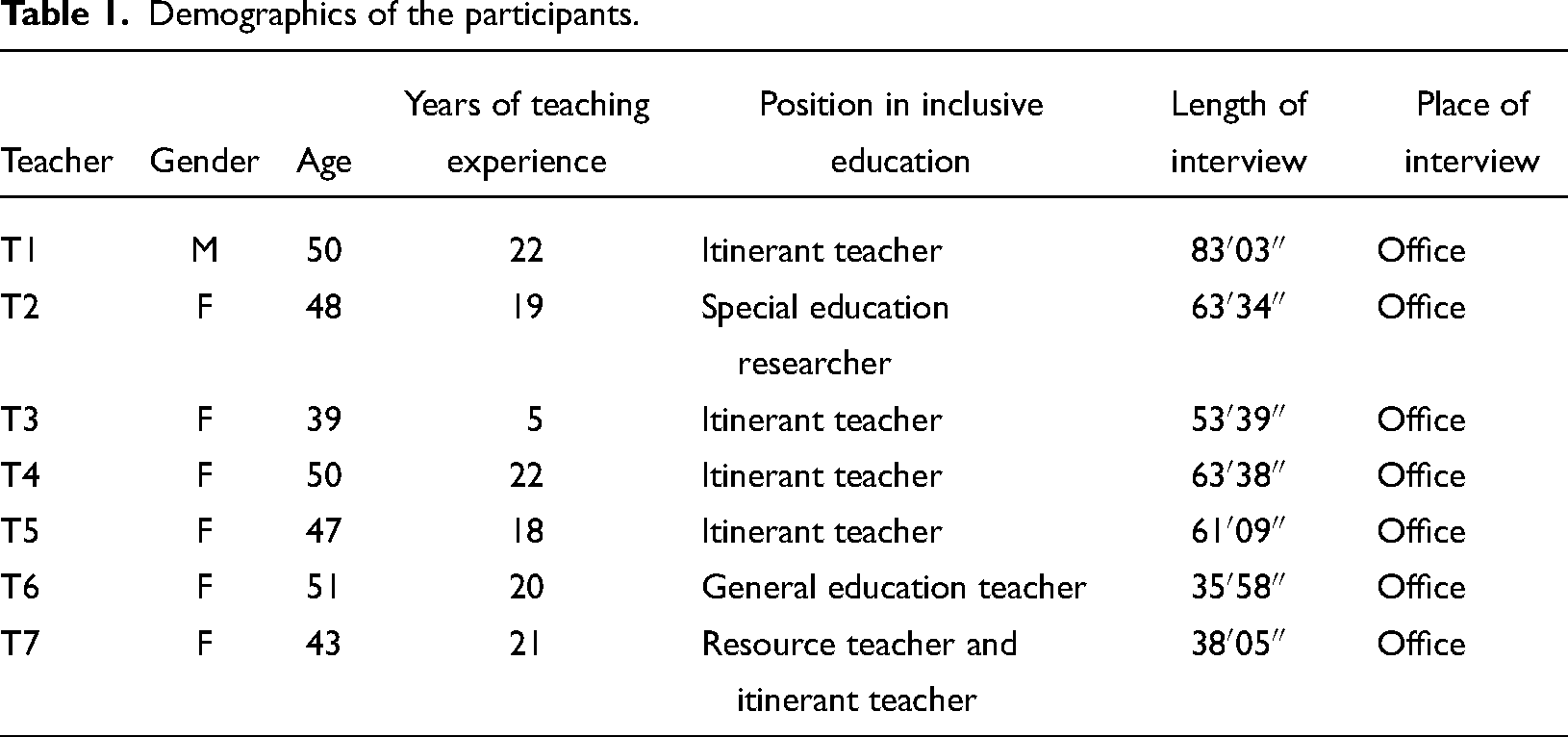
Seven participants (one male and six female participants aged 39–50) from regular schools, special education schools, and special education guidance centers in four districts in Shanghai were recruited. Participants’ demographics are presented in Table 1. Every participant voluntarily participated in the study and completed an informed consent form, which met the research ethics requirements of the University Committee on Human Research Protection.
Demographics of the participants.
Data collection
Data were collected through a process of semi-structured interviews. An interview outline was developed to guide the conversations and ensure that important topics were covered. The interview questions encouraged teachers to reflect on their experiences and provide their views on the subject matter. The interviews were recorded with their permission. These recordings were then transcribed into verbatim transcriptions.
The outline includes the following main questions: (a) For students with disabilities, what do you think are the key educational outcomes of LRC? Please give examples. (b) What factors do you think influence these outcomes?
Data analysis
The data analyzed in the present study were verbatim transcriptions totaling 87,543 words, which were transcribed from recordings totaling 398 minutes.
Thematic analysis is a method for identifying, analyzing, and reporting patterns (themes) within data (Braun & Clarke, 2006). The researchers conducted a thematic analysis based on the framework that emerged from the literature. The software program Nvivo 11 was utilized as a tool for analysis by two special education postgraduates. The analysts implemented the following analysis process. (a) After familiarizing themselves with the data, they coded the sentences of the verbatim recording separately, then modified the coding to ensure consistency and determined the logical relationships among the codes. (b) Next, they set the codes similar to the outcomes and factors that have emerged from the literature as main themes and generated the initial thematic maps (a tree diagram that demonstrates the main educational outcomes and factors mentioned in the interviews; the names and definitions of the themes are determined based on both previous literature and the actual context that the present data reflect, and the language is adapted to Chinese culture and customs). (c) The researchers coded all data using the initial thematic map and then further discussed and modified the thematic map. (d) They divided the code into two groups: Group A includes the desired outcomes and positive factors. Group B involves the undesired outcomes and negative factors. (e) Finally, the researchers picked the most mentioned themes and the most representative themes out and removed other themes, combined group A and group B, here, the final thematic map was developed (presented in Figure 1).

Thematic map.
The following are the definitions of each main theme:
Social participation and contribution: The extent to which a student with disabilities participates in and gives something to the class/school collective.
Physical presence: The time a student with disabilities spends in regular settings (classrooms/schools).
Academic performance: The engagement and achievement of a student with disabilities regarding academic schoolwork (including classroom activities and homework).
Self-concept: The evaluation and feelings that a student with disabilities demonstrates about himself/herself.
Independence: The extent to which a student with disabilities functions independently and assumes responsibility for themselves; this can be shown by the amount of support provided by others.
Severity of disabilities and problem behaviors: The features of a student with disabilities relating to their disabilities, including the category and severity of disabilities and the problem behaviors the student exhibits.
Professional support: The special education specialists and the professional services they provide to support a student with disabilities in learning in regular settings.
Teaching practice: The regular teachers adjust the regular classroom instruction (this usually involves curriculum objectives, the teaching model, the organization of teaching, and teaching aids) for students with disabilities.
Inclusive climate: The climate in which class/school members understand, respect, and accept students with disabilities.
Collaboration between school and family: Teachers and parents of students with disabilities make an effort in a way that is approved by the other to achieve a shared goal.
Results
Key educational outcomes of LRC
Social participation and contribution: Being part of the class and helping each other
Six participants regard good social participation and contribution as a key desired outcome of LRC. The concrete manifestation of good social participation and contribution involves good friendships, positive interaction, good study cooperation, and mutual help with classmates. As participant T3 said, “The most important thing is that students (with disabilities) are accepted by their teachers, other students, and parents of other students … Accept them into their class … No matter whether their behaviors are appropriate or not, no matter whether they study well or not, the teachers accept them (students with disabilities).”
Participation and contribution in peer relationships are more important than that in the teacher–student/parent–child relationships. For example, T6 said, “(In successful cases) they could feel themselves being parts of the classes. Classmates help them, and they can serve their classmates, too. I think it's critical.” There are also examples of good social participation and contribution in successful cases: (a) “No one (classmates and teachers) considers her (a student with disabilities) as a special child in her regular class … This child lives happily among her peers and helps others with daily affairs … Her classmates think highly of her” (T3); (b) “Primary school students are warm and unsophisticated so that everyone (the student with disabilities and her classmates) grows up together, and while growing up, strong affection was built between them” (T4).
Physical presence: Until environmental accessibility and facilities are in place, there is little I can do other than provide excessive protection
Six participants stated that students with disabilities spending more time in regular settings over the course of the day is a positive outcome, such as T2 reported that “He attended school only half a day when he was in Grade 1, and after targeted functional training, appropriate adaptation of teaching aids and the cultural and physical environment, he attended school all day every day from the second term of Grade 3 onwards”; or withdrawing from inclusive settings is an outcome that signals the failure of inclusive education, such as some students were referred back to special education schools after studying in regular school for years, because the factors that prevented them from learning and living successfully in school had not been improved (T4, T7). In a challenging case, a student with problem behaviors entered a regular school and studied in a regular classroom for a semester, at which point several parents of the student's classmates strongly opposed his inclusion, and the student eventually no longer attended that school (T6).
It is worth noting that studying in a regular school does not mean studying in a regular class. There is a special and representative case of students who can attend regular schools but are kept out of the mainstream study environment for a long period of time. In this challenging case provided by T2, a student with physical disability and without intellectual disabilities was allowed to study in a single room every day with no classmates in a regular school. A group of teachers was arranged to deliver individual lessons to her. The main reason for this arrangement was that the principal of the school was concerned that the school could not guarantee the safety of the student in the regular classroom without properly accessible facilities that could not be improved in a short time. T2 reported that the school principal insisted that “I can do nothing except provide excessive protection before the accessibility environment and facilities are in place.”
Academic performance: He is learning like everyone else, just a little slower
The six participants mentioned this dimension when discussing the key desired outcomes of LRC. Such as T1 emphasized that it is essential for students with disabilities to learn effectively in a constraint amount of time. Two sub-themes, academic engagement and academic achievement, derived from the data.
Academic engagement. Three participants consider more effective learning engagement as one of the key desired outcomes of LRC. As T2 reported, effective learning engagement involves an increase in activity participation in classrooms. In a successful case from T2, a student showed better classroom behavior than before: “He shows fewer problem behaviors in class. Though he does move, he does not move like he used to, and it doesn’t affect other students. He would stop very quickly, and he will read if the teachers require him to.” Ineffective learning engagement was regarded as the challenge of inclusive education by one participant. Some students with disabilities sit in the classroom without listening to the teachers, following the teachers, or doing anything meaningful. Such a case is provided by T5: “He does not even glance at the teacher; he just stands there, leaning on the wall throughout the class. He does not understand anything about the geometry information that his teacher is teaching. In such situations, he sits there every day, three or four sessions in the morning, four sessions in the afternoon, eight each day; he is indeed suffering.”
Academic achievement. Fair academic achievement was reported as the key desired outcome of LRC by five participants. T2 reported that “academic achievement means actual improvement of academic ability, in other words, an increase in the accuracy of homework or tests and enhancement of cognitive level and knowledge.” For students with disabilities, the improvement in academic achievement can be measured according to an Individualized Educational Plan (IEP; T3). The rank among the overall class and the passing criteria of academic tests are also standards by which to judge academic achievement (e.g., T2: “As for himself, (let me tell you) how good he is now, he can keep his Chinese grade higher than other slow students in his class, and he is not at the bottom of the class. He sometimes scores over 60, sometimes under 60, but generally meets the criteria.”). In addition, participant T7 reported that “at least not falling too far behind in academic achievements.” No obvious academic progress and falling far behind compared to peers in the same grade are challenges that arise in inclusive education, such as noted by participant T5: “She was not able to read the words in secondary school and hadn’t known how to add and subtract within ten when in Grade 6, while those skills are usually taught in the junior grade of primary school.”
Comparing these two subordinate themes of academic performance, T2 stated that academic engagement is more important than academic achievement: “In terms of academic ability, the cognitive level of his or her peers is already in Grade 3, while he or she is still at the kindergarten (level). In that case, what do you expect him or her to learn? Only if his or her teachers consider his or her cognitive level and design teaching activities accordingly can he or she actively and effectively participate in the class. This is inclusion.”
Self-concept: She would live a better life with more confidence
Among the outcomes related to personal and social adaptation, self-concept was mentioned the most. Five participants reported positive self-concept among students with disabilities as the key desired outcomes of LRC, such as becoming more confident, cheerful, and likable (T2, T6, T3). As T3 said, “She would live a better life with more confidence; I think her mother has a very good saying: I didn’t even graduate from primary school, but I’m getting on well now.” However, challenges in inclusive education can push these attributes in a negative direction. As T1 reported, “Once a student has low self-esteem, he or she would think that he or she is not a normal person but a person who always needs others’ help.”
The case provided by T1 shows that there was a negative impact on a student's self-concept when he entered a less supportive inclusive secondary school from a more supportive primary inclusive education setting: The student was a primary school student with cerebral palsy who needed someone to take care of him, and he had low self-esteem and was under a great deal of pressure in a regular class. With the provision of professional interventions, his language barriers and living environment improved; thus, he was very cheerful in his later primary school years. However, he lost his confidence very soon after he entered secondary school. Multiple factors led him to low self-esteem, and then he wanted to escape from the study environment and resisted applying for any jobs.
Independence: They cannot go to school without their parent as a crutch
One participant (T3) proposed that excessive company is a challenge in inclusive education. To focus more on the changes of the students themselves, we renamed the theme independence. According to the statement from T3, a challenging case illustrated a specific instance of excessive company when the father and mother insisted on rotating in accompanying their child at school despite the fact that the teachers had attempted to persuade them many times: “The student was accompanied by his parents at every class session, and it is certain that all things would be done by his parents; when the teachers require him to do something, he does not need to ask for the classmates’ help—their parents would do it for him.”
T3 explained why this was an undesired outcome of LRC: “My understanding is that the purpose of accompanying students is not to accompany them… It is good to accompany, but excessive company could lead to the result that the students would not be able to go to school without their parents as crutches. He (the student mentioned before) possesses many good conditions to include. His study environment and the headmaster are really good; the headmaster told us to instruct them frequently because they do not know how to do it (inclusive education). He does not have problem behaviors, and the teacher in charge of the class was an experienced full-time special education teacher for students with disabilities learning in regular classes.”
Factors influencing the key educational outcomes of LRC
Severity of disabilities and problem behaviors
All participants mentioned factors in this theme. Children with physical or hearing disorders are easier to include, while it is more difficult for children with intellectual disabilities or autism spectrum disorder. For example, T1 said that “it was easier for students with hearing impairment because their disabilities were much easier to improve than students with visual or intellectual disability, and it was more complicated to include students with intellectual disabilities
The more severe students’ disabilities are, the more difficult it is to include them. Intelligence is considered as a determining factor by participant T4: “I know three children who have been included with great success; they all have cerebral palsy, and their intelligence is almost the same as typically developing children … Though simple and crude, intelligence is a requirement, and when a student's intelligence score is below 50, learning in regular class does not help them a lot—just like if you throw me into Tsinghua [one of the top universities in China], I could not learn anything. There is a huge gap!”
Problem behaviors are also considered a key factor influencing the outcomes of LRC (mentioned by seven participants). Participants emphasized that the absence of severe problem behaviors is conducive to the outcomes of inclusive education. For example, T2 said that “children without behavior problems would certainly be accepted better than others.” T3 said, “In a successful case, the reason why the classmates do not dislike the student with disabilities is that she is not a troublemaker. Children who are disliked by teachers or classmates are certainly those with behavior problems rather than academic underachievers.” As a negative factor, this usually refers to behaviors that threaten the safety of others or disrupt classroom order. Sometimes, teachers consider such problem behaviors more important than academic ability. As T3 said, “A student with attention-deficit hyperactivity disorder has a lot of behavioral problems that affect the classroom, and children like him are the most troublesome in the school. The school does not really exclude children with poor grades or intellectual disabilities. You (they) would be allowed to come to school and participate in any of our activities; it does not matter, (what really matters) is the behavior.”
Professional support
The six participants reported professional support as a factor. Although disability and problem behavior are important factors, as some teachers mentioned, difficulties in inclusive education resulting from the students’ disabilities can be reduced by providing sufficient professional support. When the participants discuss professional support, they primarily point out whether there are sufficient personnel to provide professional services and what professional services they provide.
The first point is professional support providers. Six participants mentioned the importance of resource teachers and itinerant teachers who provide professional support. Resource teachers, referring to full-time special education teachers in regular schools, are considered a positive factor by five participants. T5 reported that in the schools with resource teachers in her district, children with disabilities always develop better. When it comes to challenges in inclusive education, a lack of professional support providers was mentioned by three participants, some of whom reported that the greatest difficulty in inclusive education is insufficient resources (T4), though only resource teachers were specifically mentioned. T5 reported that if there is no resource teacher at the school, it will cause substantial trouble for the regular teaching there. Resource teachers are especially important when teachers in regular schools are worried that they are not equipped to teach students with disabilities. As T3 reported, “Some students do not have the ability to sit (quietly) in the classroom; they need a specially assigned person. My classmate (a teacher) told me that they really do not have the ability to teach such students. In fact, I think she represents the most intuitive thoughts of many schools, principals, and teachers. We care, and we also agree that students should (receive inclusive education), but we are not able to do it—we can’t do it, so no one does it.” The itinerant teacher is considered a positive factor by five participants. This term refers to special education teachers from the special education resource center. Some participants (T2 and T1) reported that the most crucial factor in inclusive education is a professional team consisting of itinerant teachers. They emphasized that the functions of such a team should include professional guidance, support, research, dealing with emergencies, and coordination.
The second point noted is the provision of professional support. Additional courses is an important form of professional support mainly provided by resource teachers, as mentioned by participants. Such courses provide students with additional instruction on academic, rehabilitation, interests, and social interactions according to their individual needs. For example, as T1 noted, some students with severe intellectual disabilities have difficulty finishing math applications or Chinese writing, and remedial curricula are needed when these tasks are clearly far beyond them: “I teach him (a student with disabilities) math in our resource classroom, then he can write, memorize, and read these words. It is a better way for him to study here than sitting in a classroom and copying the answers to math applications.” Interest courses refer to courses designed by resource teachers according to students’ interests and abilities, such as handicraft classes. Provision of these courses cultivates the students' interests and promotes their potency; an example is as follows: “The resource teacher designed some activities for her (a student with disabilities). She is very interested in these activities, and it's good for her small muscle exercise” (T4). Compensatory courses refer to courses offered to make up for students’ physical and mental defects and improve their learning and living abilities. These courses are important for some students with disabilities, as T1 said, “Rehabilitation training can slow down the negative tendency of students’ physical function. As for this student, his lower limbs are actually failing, but the failure might speed up without lower limb strength training. It slows down the failing speed of his lower limbs rather than having no effect.” A professional team consisting of itinerant teachers is expected to provide professional supports as well. As T2 said, love and passion are not sufficient for inclusive education; scientific and accurate methods are necessary. Members of her team continue to improve their specialization quality, and now each of them can provide ecological assessments to students with disabilities; in other words, they can explain the physical and psychological mechanisms of students with disabilities through their behaviors in inclusive settings. After assessments, team members can develop accurate IEPs for students and solve problems, lead, advocate, and coordinate in inclusive education practice, including instruction on teaching, inclusive climate improvement, and behavioral intervention. T1 also mentioned the coordinating ability of the professional team, such as coordinating the government and schools in constructing inclusive education resources when schools’ inclusive resources are insufficient. If necessary, they can also organize an emergency response team to evaluate and address obstacles in inclusive education.
Teaching practice
Teaching practice was reported by two participants. When explaining the importance of “teaching practice,” T2 used the example of the provision of personalized adjustment of the general curriculum: “He is auditory-oriented, and his eyesight is not good enough for him to see, so we provided him learning materials, such as a large-print textbook that he can read easily, and we gave him a package of literacy spellings …” T3 mentioned that teaching adjustment influences the outcomes involving academics and confidence: “We analyzed her problems after so many assessments and gave the teacher guidance, then, the teaching methods and the content, of course, turned more targeted and individualized somehow.”
Inclusive climate
An inclusive climate was mentioned by six participants, referring to a climate in which other members of the classes, the schools, and the communities tend to accept and welcome students with disabilities as members in mainstream environments (regular schools and regular classes). Teachers’ efforts to promote a class-wide inclusive climate were mentioned in most of the successful cases. There are three main approaches to improving an inclusive climate: building study groups, guiding students to understand the diversity of people and respect others, and advocating the value of students with disabilities to other students’ parents.
The class-wide inclusive climate can be improved by building study groups, giving classes, and so on, and in such practices, the teacher in charge of a class can play a key role with a guide provided by iterant instructors. In the case given by T1, with the guidance of itinerant teachers, the teacher in charge of a class creates study groups to encourage students to help each other. The direct aim of creating the groups is to help students with disabilities, and different teachers work together to ensure that students do not know that the direct aim is to protect the dignity of students with disabilities. In another case, the teacher in charge of a class educated students to understand and accept the diversity of human beings by teaching specially designed courses: “We know quite a successful case. The student with albinism, whose wish is to have black hair, is a very smart preschooler. The teacher in charge of his class searched for a large amount of information. Among the information is promotional material for the 2007 Special Olympics, which shows many types of people in the world, some with dark skin and some with yellow hair. Inspired by this information, the teacher designed a series of courses aiming to teach the whole class to accept their special classmate and then let the student know that he is special and not defective” (T4). In addition, the concept held by typically developing students’ parents is sometimes in conflict with what the teacher wants to teach in the class. It is necessary for parents to share the same point of view as the teacher. Some teachers give parents detailed information about students with disabilities as well (T6), and T1 once explained to the parents of typically developing students the value of inclusive education at parents’ meetings and ultimately obtained a good outcome (T1).
A school-wide inclusive climate influences inclusive education as well, and the headmaster and teachers of the school can be the determinants. T3 pointed out (the school-wide cultural) environment when asked about the most essential factor. In T3's description, the school-wide inclusive climate can be reflected in school staff such as teachers, leaders, and special education teachers. If teachers and principals are gentle and cultivated, the school would accordingly be “slow-paced.” The school-wide climate contributes to positive outcomes and has two main features. First, teachers should consider students with poor academic foundations more. Second, the school principal should place great importance on “cultivating people,” that is, they should be oriented toward quality education. Compared with “elite education,” in a school with this type of cultural environment, students with disabilities would be under less pressure and would likely behave better.
Collaboration between school and family
This theme was mentioned by seven participants. It was considered an important factor by some participants, as T2 said, “The parents, who are unreasonable and uncooperative even when the children are like that (in difficulties), are the most troublesome.”
In some successful cases, the cooperation of parents is a positive factor. For example, T5 mentioned that “The parents still did not want to give up helping the child study; they place considerable value on education all of the time. There is a clear division of work between the parents and the teacher: The teacher coaches the student in Chinese literacy, and the parents focus on English literacy.” T6 selected collaboration between school and family as the primary positive factor in a successful case: “The parents are not at a high cultural level, but their character is simple, so they believed that I was doing what was best for their child and were willing to cooperate with the teacher in schoolwork. Since then, the student has made great progress in Chinese.” In these successful cases, the parents and the teachers recognize each other in education and take actions they believe helpful to students’ development.
In some challenging cases, parents’ inappropriate support and negative attitudes toward cooperation were cited as important deterrents. “Inappropriate decision and method” and “inability” of family may lead to poor cooperation. In the first situation, some parents make improper choices or use inappropriate methods in their children's education, despite the fact that the teachers have communicated with the parents and suggested better choices and methods. In a case provided by T1, parents with disabilities were reluctant to send their child with disabilities to receive intervention in the special education guidance center because they feared the child being labeled “stupid.” In the case provided by T3, the parents of a student insisted on accompanying their child at school for too many years; thus, the student rarely interacted with his classmates.
In the second situation, some families lack the time and resources to educate their children; in other words, they lack the ability to cooperate with the school. In an unsuccessful case from T7, a student with visual impairment did not have a consistently stable family income and environment. He and his father lived in a cheap and narrow rented room when the family income was moderate and in a free public bathhouse or game room when the family income was very low. In such family conditions, the child has no settled place to live or sleep well and no routine for doing homework or a review or preview. This case shows that lacking a settled place to live, adequate income, and parental care can disrupt a student's studies.
Discussion
This study investigated five key desired educational outcomes of LRC and five main factors influencing those outcomes by interviewing inclusive education teachers based on the interview data. The major findings of this study are discussed below.
Important outcomes of inclusive education
Both psychological and physical inclusion are considered important outcomes. Most of the participants stated that the social participation and contribution of students with disabilities, which can be regarded as a form of psychological inclusion, constitute an important outcome of LRC. Similar outcomes have been identified in previous literature (Avramidis et al., 2018; Broomhead, 2019; Haug, 2017; McCoy & Banks, 2012). In addition to accepting students with disabilities in regular classrooms, teachers also reported that, in some successful cases, these students played an active role in class and demonstrated their value.
Physical presence, which is a form of physical inclusion, is a fundamental and desired outcome of LRC. Numerous studies argue that students with and without disabilities should study together whenever possible (Jia et al., 2024; Knight et al., 2022). Similarly, this study's results indicate that the amount of time students with disabilities spend in regular learning settings is a crucial aspect of physical presence, and the participants stated that too little such time indicates a failure to achieve inclusive education. This finding supports existing literature. For example, Göransson and Nilholm (2014) defined placement in general education classrooms as a basic condition that meet the social and academic needs of those with disabilities, all pupils, and specific communities.
Strong need for appropriate professional support
Our findings suggest that professional support may influence the educational outcomes of LRC. Furthermore, one participant mentioned unsatisfactory outcomes due to excessive parental involvement, which hindered their child's independence and social interaction. In such cases, even if students with disabilities spend all of their school time in regular settings, the outcomes of inclusive education may not meet expectations. Existing literature has recognized professional support as a necessity for inclusive education (Jia et al., 2024; Jia & Santi, 2020). This finding is supported by the present study. However, few studies have clarified the appropriate extent of professional support. The results of this study regarding responsibility and independence suggest that independence achieved by students could be one of the dimensions for assessing the appropriateness of professional support, but further investigation is needed.
Dynamic systematic feature within the influential factors
According to Bronfenbrenner's ecological theory of development, the influencing factors of individual-level educational outcomes are primarily concentrated at the micro- and meso-system levels. In addition to the reported factors, there is also a dynamic factor, “time,” which is termed the chronosystem in the more recent version of the theory (Santrock, 2016, p. 24). Time, as manifested in the interview data, refers to teachers evaluating whether students have improved or worsened over time when reporting educational outcomes. These findings indicate that the reported factors are relatively direct, though further investigation is needed into the chronosystem factor.
Severe disabilities and problem behaviors pose significant challenges, but these are not insurmountable
The results demonstrate that students with severe intellectual disabilities, autism, or significant problem behavior are the most difficult to include. Reflecting on the outcomes, this factor may lead to a reduced presence of students with disabilities, which partially explains its impact. Some students with severe disabilities or problem behaviors eventually, either actively or passively, give up studying in regular classrooms, due to their low learning effectiveness or aggressive behaviors that threaten the safety of their peers. Previous studies have also identified the behavior problems, social abilities, and cognitive and academic capabilities of students with special needs as influential factors (Beco, 2018; Eldar et al., 2010; Knight et al., 2022). However, these personal characteristics are not considered the main factors influential the outcomes of LRC. Despite the challenges, there are potential solutions. Curriculum adjustments and differentiated instruction help meet the diverse educational needs of students (Geldenhuys & Wevers, 2013; Hua & Li, 2006; Lee et al., 2015; Sharma et al., 2016). However, the current research participants rarely mention differentiated instruction in collective regular classroom teaching provided by general education teachers. Addressing behavior problems through interventions such as positive behavior support can be beneficial. Limited education resources and conditions, including class size and special education training for general teachers, can hinder meeting all students’ needs (Geldenhuys & Wevers, 2013; Smith & Smith, 2000). The insufficiency of professional services and support may contribute to the personal characteristics above. According to the interviews, LRC is the primary form of inclusive education in Shanghai, but compulsory requirements for differentiated instruction and curriculum, which should be provided by general teachers, are rare. Furthermore, several schools still lack resource classrooms or resource teachers.
Collaboration between school and family is reported as a significant factor influencing the educational outcome of LRC. The participants mentioned that sharing the same educational concepts as teachers', a positive attitude, and a clear division of responsibilities among parents contribute to the positive outcomes of LRC. However, parents' conflicting educational concepts with teachers, inappropriate educational decisions and methods, and vulnerable economic conditions can hinder progress. Most of these points align with the previous literature (Eldar et al., 2010; Geldenhuys & Wevers, 2013; Knight et al., 2022; Stanviloff, 1997; Wang et al., 2015). Furthermore, positive collaboration between families and schools contributes to improve students’ academic performance, reduce problem behaviors, enhance self-confidence, foster peer relationships, and even alleviate parental stress (Reio & Fornes, 2011; Sad & Gurbuzturk, 2013).
However, in relation to the related literature, there is a requirement that has not been addressed in this research. Equal and cooperative partnership between schools and families, as well as between teachers and parents, is vital for collaboration in the education of children with special needs (Wang et al., 2005). Parents are more likely to engage positively in collaboration when there is an equal partnership (Kim et al., 2012). However, the participants in this research seldom mention equal partnership between teachers and parents. They seem to believe that teachers should take the dominant role in collaborations, and parents should agree with teachers’ educational decisions and follow their advice. However, there may be some discrepancy between this perception and reality because there were no parent participants in the current research. Overall, further investigation is needed to address the difficulties in family–school collaboration and to ensure equal partnership between parents and teachers.
Conclusion
This research uncovered the following findings. (1) Teachers mainly regard social participation and contribution, physical presence, academic performance, self-concept, and independence as the key outcomes of LRC. Additionally, they expect that increased acceptance from teachers, classmates, and parents, more time spent in regular settings, effective academic engagement, acceptable academic achievement, enhanced confidence, and greater independence can be achieved through appropriate support. (2) The outcomes of LRC are influenced by various factors, including the severity of disabilities and problem behaviors, professional support, teaching practices, inclusive climate, and collaboration between schools and families. Specifically, mild intellectual disabilities and problem behaviors, professional support provided by special education teachers, teaching adjustments, efforts to promote an inclusive climate, alignment of educational philosophy and approaches between teachers and parents, positive and cooperative attitudes and actions are identified as potential facilitators of positive outcomes in LRC.
Limitations
There are only seven participants in this study, and all of them work in Shanghai. Therefore, the results of this study can only generally reflect the views and experiences of teachers of LRC in Shanghai, and it is limited in its ability to reflect the situation of LRC in China as a whole.
Footnotes
Contributorship
Declaration of conflicting interests
Ethical statement
Funding
ORCID iD
