







Abstract
Keywords
Academic competitions are considered as an important platform for promoting science education and fostering future talents in science, technology, engineering, and mathematics (STEM) fields. Among them, science and technology innovation competitions are particularly special, which are thought to enhance science learning through several important elements: problem-based interdisciplinary projects, a competitive framework that fosters passion for learning, and authentic research evaluation conducted by scientists (Li, 2010). More and more attention has been paid to such competitions for its potential to reform the paradigm of science education, but what kind of educational effect they can play is still to be discussed, while their utilitarian nature and fairness remain topics of contention (Gadola & Chindamo, 2019).
China, which is leveraging competitions to drive science education reform, may offer a dynamic window into the educational role of innovation competitions. In recent years, Chinese government has issued a series of seminal documents in a dedicated effort to promote the “addition” of science education within the “double reduction” policy. 1 Among the documents, national competitions such as the China Adolescents Science and Technology Innovation Contest (CASTIC) are considered to be a crucial means of exploring effective long-term mechanisms for selecting and nurturing innovative talents and driving them to pursue a career in scientific research. By introducing educational resources and creating opportunities to participate in a complete scientific research process for students, CASTIC is trying to address China's dual challenges of upgrading all students’ science capital under limit resources and cultivating future STEM elites, meanwhile promoting the science education system to pay more attention to scientific practice.
Shanghai is one of the earliest regions in China to hold CASTIC, and has accumulated a variety of mature and diverse talent training practices. Focusing on the Shanghai division of CASTIC, this study mainly raises the following questions: (1) What is the operating mechanism and educational environment of CASTIC's current system? (2) What kinds of talent training models have been formed through the system? (3) Can CASTIC achieve its educational goals? If not, why? Around these research questions, this study identifies and examines different talent development models resulting from the competition, as well as learning environment and processes it stimulates.
Literature review and analytical framework
The nature and educational effect of science and technology innovation competitions
Unlike traditional academic competitions, which are based on standardized examinations, science and technology innovation competitions typically take the form of science fairs—a hybrid of competition and exhibition that has existed around the world for more than eight decades (Slisz, 1989). Renowned competitions such as the International Science and Engineering Fair (ISEF) and Science Talent Search merged during the global education race among major powers in the mid-twentieth century. Originally intended to discover gifted individuals, such competitions gradually developed into a form of educational activity that promotes the popularization of science (Guo et al., 2010). A vast body of research has substantiated the positive value of science and technology competitions in discovering a reserve of scientific research talents (Huler, 1991; Marsa, 1993). In 1982, the Chinese government founded the CASTIC, which not only filled the domestic gap in related competitions, but became a pivotal platform for promoting STEM education.
Science and technology innovation competitions fulfill their educational goal through learning activities that typically simulate the process of knowledge production (Ren et al., 2015). Science fairs and competitions provide contestants without prior experience in scientific research the opportunity to role-play as scientists in advance. During the competition, contestants familiarize themselves with the methodology of knowledge production and construct knowledge, rather than merely encoding it. In other words, they need to engage in the standard steps for conducting scientific research, such as identifying real-life problems, formulating research proposals, reviewing the literature, designing experiments, performing field studies, building models and display boards, and defending their findings. They also learn to work as a team and engage in horizontal interactions with the academic community.
This breaks with the tradition of learning within the “acquisition metaphor” in conventional classrooms and unintentionally brings the method of learning closer to the “participation metaphor” (Sfard, 1998). This has numerous benefits. Notably, such competitions stimulate students’ motivation to learn through active inquiry-based learning, accelerating the interaction and integration of existing cognitive structures and giving rise to a “meaningful learning” process (Ausubel, 1963). Students also gain a considerable amount of emotional and social experience through “legitimate peripheral participation” in the productive activities of the academic community, enhancing their connection with science and equipping them with “the ability to cope with the external world” (Eberle, 2018).
Learning driven by science and technology innovation competitions is a complex process, making it necessary to evaluate the educational effectiveness through both summative and formative assessment of each stage of participation. Dai et al. (2017a) examined the effects of college students’ participation in science and technology competitions based on the underlying psychological and behavioral mechanisms of such competitions. Results revealed that college students’ participation is generally driven by both intrinsic motivation, which arises from the pursuit of fun and self-improvement, and extrinsic motivation from external rewards, points, and awards. While the former drives students to fully commit themselves and fuels their creativity, overemphasis on the latter can have the opposite effect, dampening their commitment to solving difficult problems. Dai et al. (2017a) also found that many participants experienced a shift in behavioral control during the competition—the change from being dominated by extrinsic motivation to being dominated by intrinsic motivation reflecting a process of ego development. This change in behavioral control is often induced by incentives from the process of training for the competition. On the other side, the competitive process and experience had a more profound mental impact on students than the actual outcomes of competition. Students also had stronger perceptions of their own formative outcomes, listing benefits like gaining an unusual experience, fulfilling their interest in research, and meeting a venerable academic predecessor.
Investigating science competitions in Chinese Taiwan based on the activity theory, Hong (2012) emphasized the importance of the object of an activity for the competitive outcomes. Drawing on Engeström's (1993) theory of individual-level activity system, Hong (2012) suggested that activities are always driven by objects. To achieve an object, subjects use tools to interact with it, producing outcomes.
Therefore, at both micro- and macro-levels, the development of competitive talents must first undergo the thorough transformation of its object (i.e., motivation) before developmental outcomes can be achieved. However, the thorough transformation of motivation is largely dependent on the format and content of training. Figure 1 illustrates this process in cultivating talent through science and technology competitions.

Process of talent development through science and technology competitions for adolescents.
Moreover, the role of science and technology competitions in education may spill over from individual participants into their surrounding communities and environment. Research indicates that engaging students in science and technology innovation competitions not only helps enhance participating students’ scientific and technological knowledge, but indirectly influences the understanding, attitudes, and value judgments of non-participating student and parent communities toward science and technology (Hong, 2012). This may create a favorable competitive climate for the participating students.
Analytical framework of talent training in science and technology innovation competitions
As Figure 1 indicates, when training for a competition, students’ internal motives should fully interact with their educational, institutional, and social environments in order to encourage greater intrinsic motivation and produce corresponding formative outcomes. In other words, whether science and technology competitions can fulfill their role in education is closely related to how the process of talent development is implemented by educators and the types of conditions they provide for interaction, which are embedded in their educational philosophies.
However, the educational philosophies underpinning existing science and technology competitions are riddled with cognitive biases (Yang & Zhang, 2014). For instance, such philosophies may emphasize the importance of technological and knowledge learning while disregarding the development of individuals as social beings. They also rarely touch on or promote the interaction and understanding between students and society, which are vital prerequisites for research-based learning to be productive. In this respect, Dai et al. (2017b, pp. 95–102) proposed a whole-person education system and model of science and technology innovation competitions for college students which is developed from the learning triangle model of Knud Illeris (2016, pp. 25–27), highlighting the impacts of social situations on participants’ learning behaviors and placing the development of a “social person” at the forefront of the educational objectives of these competitions.
From this perspective, science and technology innovation competitions are themselves akin to an educational platform, while the school, home, and society are the external settings in which this platform operates. All of these elements come together to form a complete operating system of competitions centered on education in science and technology innovation. In other words, contestants’ behaviors during science and technology innovation competitions are not merely individual learning behaviors of a closed nature, but a form of social behavior involving constant interactions with the external environment and the ongoing molding and adjusting of cognitive structures. Moreover, the types of social support that can be accessed by contestants play a decisive role in the types of innovative behaviors they are capable of exhibiting (Xiao, 2010). Inspired by this model, this study constructed a general system of science and technology innovation competitions for adolescents based on environmental interactions (Figure 2).

A system of science and technology innovation competitions for adolescents based on environmental interactions.
Research methods
Based on the foregoing, to understand the real-life processes involved in the development of competitive talents, a multi-case rooted study was conducted by sampling schools that actively participated in the CASTIC and ISEF in Shanghai, China, as well as their teachers and students. In terms of interview sampling, a basic database of the CASTIC was first constructed by collating and refining the lists of past Shanghai CASTIC awardees and their subsequent performance data in the national finals and ISEF between 2010 and 2019.
Statistical analysis was then performed to identify the most actively participating/awarded teams over the years. It is evident that there are two distinct categories of active participants: schools and social science clubs. Furthermore, from a trend perspective, there are four categories of participation samples: those with consistently stable annual performance (e.g., T1), those who have been active but experience fluctuating award situations (e.g., T2 and T7), and those who were more active in previous years but have shown a gradual decline in recent years (e.g., T4).
Taking into account the participants’ activeness, resource endowment, and social nature, eventually seven samples were finally selected for individual interviews through a snowball sampling and chain referrals, numbered T1–T7 based on the chronological order. The science and technology coach of each sample was then contacted; on average, they had more than 5 years of experience in leading competition teams, to ensure they have adequate experience with the whole procedures of CASTIC and educational curriculum of the school or club they work for.
Each interview lasted 60–120 min. Interview questions mainly include the interviewees’ experience in coaching the competition, the student selection process within both the competition and the institution, the characteristics of talents, their training program and its effect, as well as an overall assessment of CASTIC. Then we got an interview transcript of 127,318 Chinese words; relevant information of the cases was obtained and then triangulated with relevant literature such as participants’ self-narrative of their experience published by their school, experience-sharing posts online, and relevant interviews from news reports. All the interviewees were fully informed of the purpose of the study, and their personal information has been anonymized before the analysis to ensure their privacy. Table 1 presents the selected cases.
Cases selected for interview in this study.

aShanghai Science Association for Young Talents, also known as Shanghai Science Seed Youth Science and Technology Innovation Service Center, is a scientific and technological innovation club for young talents, which is also a public welfare social organization in charge of the Shanghai Association for Science and Technology under the support of the China Association for Science and Technology.
District Juvenile Science Education Center is a type of Chinese educational public welfare institution affiliated to the District Education Bureau, which implements science education for children and teenagers.
China Welfare Institute Children’s Palace is a well-known public welfare institution founded by Soong Ching Ling in 1953 in Shanghai to provide children with out-of-school education.
The interview transcript was encoded using NVivo 11.0, a qualitative data analysis program. First, the text was open coded to obtain primary topic nodes, and then relational coded to sort out and combine different topic nodes step by step, summarizing the interviewees’ core views on the implementation process of CASTIC as well as its settings and model of talent development. Finally, selective coding on the above data was carried out, and four main dimensions of youth talent training in CASTIC are obtained as problem identification, learning assistance, organizational support, and social interactions. The coding process example is shown in Table 2.
The coding process example of talent development through the CASTIC.

The CASTIC learning environment
Based on the status quo of talent training for the Shanghai CASTIC, the community of science education practice comprising schools, science clubs, and competitions has created the social and cognitive environment in which learning through science and technology innovation competitions takes place.
An immersive learning environment
Schools and science clubs are the first sites of talent selection and training. Participating students interact with their teachers and peers on a daily basis, and are heavily influenced by their abilities. As such, schools and science clubs provide an immersive learning environment for these students.
However, there are significant disparities between schools in various aspects ranging from teaching force to hardware availability and institutional safeguards. Case study analysis indicates that students who performed outstandingly in the CASTIC typically enjoyed unique resource advantages. Take a key middle school in Shanghai where T1 is located as an example. The middle school is affiliated with universities and has special science and technology counselors to lead competitions.
For instance, T1 works for a key middle school in Shanghai, which is an affiliated middle school of a well-known university. Due to its unique institutional safeguards, the middle school was able to assign dedicated science and technology counselors who don’t have heavy daily teaching tasks as subject teacher to coach students. As the interviewed coach (T1) noted, We are a bit of an oddity. If we were a regular high school without a specially staffing establishment for science and technology counselor, our teachers wouldn’t have had the extra energy to do these things. Since our entire staffing system follows that of the cooperative university, we are not bound by the staffing restrictions on basic education … Coaching each research project of students can be counted toward his workload [which is usually invisible labor in many middle schools that does not count as teacher's performance].
Basically, as long as it doesn’t violate national policies on the security conditions permit, we’ll be able to support all experimental conditions and ensure that students can work on research projects independently. The cost of laboratory operation is included in the school regular expenses. (T1)
Despite the lack of top-caliber students and support from universities, regular schools—that is, those not considered to be elite—can still create a favorable competitive climate similar to that of elite institutions, by adopting top-down administrative designs and harnessing the full potential of teachers’ personal resources, science clubs, and other social resources. Of course, compared to traditionally elite schools, the commitments they need to make in preparing for science and innovation competitions are fundamentally different. Without additional input into the competitions, regular schools struggle to produce the same output as their elite counterparts. Indeed, according to one of the interviewees, students had to conduct additional research-based learning from 6 to 9 p.m. every night in order to link their studies with the weekly tutoring sessions with science club experts.
However, both traditionally elite schools and “up-and-coming” players in science and innovation competitions share the same risk preference, namely, prioritizing the securing of students’ future matriculation over their preparation for competitions. Among the interviewees, participation in science and technology innovation competitions was generally perceived as the result of their school's spare capacity—that is, an academic “showdown” beyond the scope of basic education. As one teacher explained, “The competition is essentially about how our students spend their extracurricular time” (T3). To some extent, this has resulted in a tendency for schools to focus their energy on preparing for the first stage of the competition, that is, the preparation stage of the Shanghai division before the annual Senior Secondary Academic Proficiency Test (colloquially known as the “
The grounds for mentorship-based training
In recent years, public science clubs have emerged as a major training ground for students participating in science and innovation competitions (Sahin, 2013). In Shanghai, well-known science clubs such as SSAYT (Shanghai Science Association for Young Talents) and its joint agency like the China Welfare Institute Children's Palace and Juvenile Science Education Centers in district-level offer comprehensive guidance throughout the CASTIC. To be more specific, those clubs provide members with intensive training and regular opportunities to interact with experts as part of a high-intensity academic training program; such programs are typically run over a period of 4 months: We have our own science teachers and offer classes every weekend. We also have our own pool of young talents. Hence, in line with our regular science classes, we ask our teachers to coach students who are participating in CASTIC, while developing teaching skill of our staff. (T5)
Interactions with experts offer students an opportunity to communicate with their “academic idols.” Despite their brevity, such interactions serve as an indispensable form of mental incentive for students. Experts also incentivize students by facilitating research progress. For instance, one interviewee explained, “The experts also helped us reach out to relevant government departments such as Shanghai Public Security Bureau Traffic Police Corps Elevated Road Detachment [when conducting the experiment] to check relevant data” (T3).
Significantly, despite possessing adequate funding support and tertiary education resources, science clubs and their subdivisions are hindered by the examination-oriented educational environment in two ways. First, they lack a mass mobilization mechanism like that available in schools. As one interviewee noted, “School teachers can get hold of students every day, but we get to see them perhaps only once a week, or slightly more just before the competition” (T7). For instance, district Juvenile Science Education Center and social organization like the China Welfare Institute Children's Palace are largely dependent on students taking the initiative to enroll themselves. Ultimately, as only those selected by club members can engage in training, only 40–50 projects entered the Shanghai CASTIC each year. Second, students do not have the time or energy required to put in the ideal amount of effort for the competition. According to one interviewee, “The intensive training can be stressful. Students can only take part during the weekends, and their academic pressure continues to mount as time goes by” (T6). This may explain why most of their students “were from elementary schools or junior high schools” (T6).
A competitive stage for self-actualization
In addition to allowing students to gain hands-on experience of the scientific research process, CASTIC provides students with the opportunity to showcase their research findings and scientific thinking in a competitive stage.” The showcase serves as a ritual whereby students can validate themselves through interactions with the external world. Some interviewees especially mentioned the importance of social interaction in the competition for the development of students’ independent personality, the showcase serves as a ritual whereby students can validate themselves through interactions with the external world on boards, find a place to print posters, and learn to associate with scientists …” (T4).
In particular, students are easily impressed by the presence of their “academic idols” when interacting with scientist judges: “In the Shanghai regional finals (of CASTIC), the judges are all in the exhibition hall. It's easy for students to find the jury and have more opportunities to show themselves” (T1). The experts’ ways of thinking about problems and rigorous grasp of detail in scientific research, would inspire students a deeper understanding of the process of knowledge production, and even motivate them to emulate in the future. “The students were encouraged that the judges recognized them and asked a lot of questions” (T2).
Meanwhile, interactions between students during the competition create a peer effect based on mutual encouragement and resonance, reinforcing students’ motivation to participate in the competition and their understanding of society. “Students who were on the final spot had the opportunity to interact with students from other research groups … They came back and said it was eye-opening” (T3).
Learning processes in the CASTIC
Influenced by the learning environment discussed above, the disparities in resource endowments and competitive preferences of teachers and students across different schools engender a variety of learning processes.
Motivation to learn
Motivations to learn differ across learning environments (Hu & Li, 2012). In the case of the CASTIC, initial motivations of participants are often of an instrumental nature, such as to the desire to pursue further studies, improve the school's ranking, and align activities with higher education resources. Some of these motivations stem from the resource dividend unlocked by the construction of competition platforms and science clubs. Others result from contestants’ internal drive to practice their educational philosophies. For example, one of the interviewees suggested that such competitions offer a platform to put into practice what is difficult to achieve in traditional education, so that “students recognize that their knowledge has the power to transform society and can be applied in real life” (T7).
For most students, the competition gives them a legitimate reason to take a temporary break from the stress of basic education and fully explore their own interests. It provides an unusual experience and allows them to fulfill their interest in research, constituting another form of incentive. This type of motivation is contingent on having an enabling climate of competition. In other words, the participating unit to which the students belong needs to possess a sufficiently long competitive tradition or the readiness to compete in the competition. Table 3 presents the motivations to compete in the CASTIC identified by the interviewees.
Motivations to compete in the CASTIC.

Learning behaviors
Of course, the same motivation to learn does not necessarily produce homogenous learning behaviors. The types of learning behaviors stimulated by innovation and science competitions like the CASTIC are bound by the structure and rules of the competition and shaped by the participants’ inherent resource endowments and other personal circumstances. In terms of level of commitment, for instance, most interviewees offered one or two competition-related classes per week in order to strike a balance between basic education and training for the competition, whereas some institutions invested more time and energy into preparing for the competition. Indeed, the school of T3 reported spending around 3 hr a night preparing for the competition. Figure 3 presents an overview of the preparation process for the CASTIC followed by different schools.

Workflow of CASTIC preparations in some participating schools.
This boils down to the contestants’ grasp of the value of the competition and the weight they accord to the overall objectives of basic education. Put bluntly, “If students are driven by the end goal [the National College Entrance Examination, colloquially known as
Analysis of the interview responses revealed three main models of talent development among participating teachers and students: project-based management, mentorship-based learning, and platform-based training.
Project-based management
The project-based model emphasizes project management and modular production by teachers. It has clearly defined development objectives, time schedules, and other elements to ensure the quality of the projects coached by teachers. According to one interviewee employing this model, “We focus mainly on providing assistance and support. We offer guidance on the projects, on how to write their research paper, and on how to defend their research, the entire process basically” (T1). Another teacher noted, “Teachers’ roles are divided by academic subject. You are responsible to coach whichever student enrolled in your line of teaching” (T3).
The advantage of this training model lies in its standardized and large-scale nature. First, in terms of the portfolio-based management of competition-related information, some of the schools compiled each year's participating projects into a database for future reference. Second, this model establishes a comprehensive process of modular learning. For example, a set period of time (6–9 p.m.) per week day was designated to research-based learning in order to link in and align with the weekly training session of the science club and ensure that progress could be made when interacting with experts. In terms of talent development arrangements, elaborate time scheduling was carried out, so that students were engaged from the start of the school term and encouraged to participate in research-based learning. Teachers also developed and distributed a detailed time schedule to every student. Apart from the training offered by the coaching teachers, some schools encouraged senior students who had participated in past science and technology innovation competitions to mentor junior students. Such mentorship filled any gaps in the teacher's role while facilitating adequate and multi-level communication and exchanges between students.
Mentorship-based learning
The mentorship-based model focuses on learning through mentorship and advocates talent development based on step-by-step instruction and strong communication. Teachers provide students with comprehensive and personalized training that extends beyond the content of competitions. In this model, the coaching teachers usually have a greater say, while individuals tend to have access to more scientific research resources. However, due to teachers’ limited time and energy, the scope of coaching is often smaller. Illustrating this model, one interviewee explained: I requested a few things when the school principal decided to hire me. First of all, I needed my own office. Second, I needed a laboratory on par with college standards. Third, I would have the say in how to coach students and which student to coach, not the school principal or the chief of the bureau. This is how things can be done efficiently…. (T4)
More specifically, teachers would observe students’ personal habits and lives more granularly and teach according to their abilities. In addition to scientific research capabilities, the model underscores the development of students’ independent character, behaviors, and habits. It also requires teachers to put in immense effort into guiding each student and bear a high cost of communication, as the following interview excerpts illustrate: [A student] came up to me and asked to join my science club, so I decided to check his qualifications and personality first. We were studying bryophytes at the time and had planned a field visit to collect some specimens at Tianmu Mountain. Then I asked if he wanted to tag along. I told him that even though the specimens we were collecting had nothing to do with his project, he should learn to exert himself because he was spoilt at home and always dragging his feet around. I said that was not acceptable. […] After we were back, he came up with a project idea himself and decided to work on it with my approval. […] I’ve paid three visits to his home. What struck me the most was how proficient he was in literature, history, and philosophy and how good he was at the game of Go. At the time, teachers and students weren’t aware of the situation … I teach anyone who's a good student, irrespective of who they are. (T4)
Platform-based training
Platform-based training is mainly conducted through science clubs like SSAYT. In this model, teachers interact with students less frequently, as their primary role involves helping students tackle problems such as competitive readiness by integrating resources and overseeing processes. According to one interviewee, under this model, As students’ science and technology innovation needs to take place in environments such as the laboratory of an institute, our main job is to connect them with the right experts, who can then guide them through the experimental processes that would follow. (T5)
Platform-based training often involves a diversity of external resources, giving students more opportunities to “venture out.” For example, students can gain experience using the laboratories at higher education institutions in advance and be exposed to the scientific research environment of these institutions. Moreover, depending on the needs of their research, students might conduct a variety of social experiments. Such opportunities offer new and refreshing experiences for students.
At present, the training offered by science clubs takes place “at an advanced stage” (T5). Emphasis is placed on the importance of students’ self-reflection during the earlier stages of the projects to prevent excessive interference in their originality. For this reason, training at science clubs typically begins in August of the year before the competition and spans a period of around 4 months. Such training is mainly intended for projects that have already begun to take shape, with a primary strategy of promoting the project's level of sophistication by matching students with the resources they need.
In fact, a participating unit might adopt a blend of talent development models mentioned above at a given time. However, while these models generally value the same set of dimensions—including the selection of a research topic; teacher responsibilities; the duration, content, and format of training; and communication and exchanges with students—they vary in practice.
For instance, research topics from different sources reflect various levels of interference by educators and their differing educational philosophies. For some participating units, it is important for students to identify a research topic on their own, especially one that is relevant to their age and grounded in everyday life. Others prefer using in-depth classroom discussions as a source of research topics. Some students may even tap into external sources, such as direct suggestions from their parents. In terms of teacher responsibilities, coaching teachers vary in how they position themselves. While some believe that their main role is to facilitate and support the research and competition processes, more specialized teachers tend to provide more in-depth guidance during the scientific research process. Meanwhile, others might view the pre-competition training as a crucial opportunity to implement character education and feel somewhat obligated to conduct an informal screening of the students and motivate them. Similarly, the format of training differs with the educational objective, leading to discrepancies in teachers’ pedagogical focus and ways of communication.
The effectiveness and problems of using the CASTIC for talent development
According to the overall survey results, interviewees generally viewed the CASTIC as a useful platform, one “easily adapted to schools, welcomed by students, and accepted by everyone” (T3).
It is evident that science and technology innovation competitions can produce considerable formative outcomes, including technical experience in conducting scientific research, the opportunity to interact with academic idols, and sufficient social interactions. These experiences can be far beyond what students typically experience on a daily basis. By matching, and sometimes significantly surpassing, students’ self-efficacy expectations, participating in these competitions can gradually help students transition from extrinsic to intrinsic motivation, regardless of the outcomes. The interviewees generally agreed that the CASTIC was immensely effective in unlocking and improving students’ capabilities in various domains, especially those related to self-management and active learning. Some interviewees mentioned that their students had learned to “allocate and utilize resources” rather than simply “burying their heads in work” (T3).
The emergence of public science clubs has also alleviated the imbalance in the availability of competitive resources between both schools and individual students. Nevertheless, whether schools benefit from the resources provided by these clubs depends on aspects like their institutional design and competitive readiness. This also concerns realistic issues, such as whether pre-competition training can be developed into a curriculum and included in teachers’ assessments, whether overtime allowances can be granted accordingly, and whether the necessary support can be provided to science and technology teachers.
In terms of the sustainability of outcomes, the long-term effects of talent development through competitions remain unsatisfactory. According to the survey responses, the training provided by science clubs tends to be more “transactional” and, despite having considerable technical significance, is less likely to foster a deep emotional connection with students. As one interviewee pointed out, “After each round of training, we basically have to start preparing for next year's competition straightaway” (T5). Although the onus of subsequent talent development after the competition is on schools, most interviewees said they had difficulty keeping in touch with or tracking the further development of the participating students. In general, students who are more immersed in the competition and have better recognition of its outcomes are more likely to pursue follow-up training or interaction, whereas more extrinsically motivated students who have been in the competition for a shorter period of time tend to have weaker emotional attachments with the competition.
Meanwhile, with the accumulation of platform resources and sophistication of the talent development models, schools are increasingly recognizing the value of science and technology innovation competitions and participating in these in an organized manner. They are also seizing this opportunity to promote the development of research-based learning programs, harnessing the value of competitions for enhancing teaching to some extent.
However, existing science and technology innovation competitions for adolescents are beset by a series of deep-seated problems in terms of their competitive environment. Table 4 summarizes the structural distribution problems caused by the inadequacy of total educational resources available for science and technology innovation.
Summary of the problems with the talent development models of science and technology innovation competitions for adolescents.
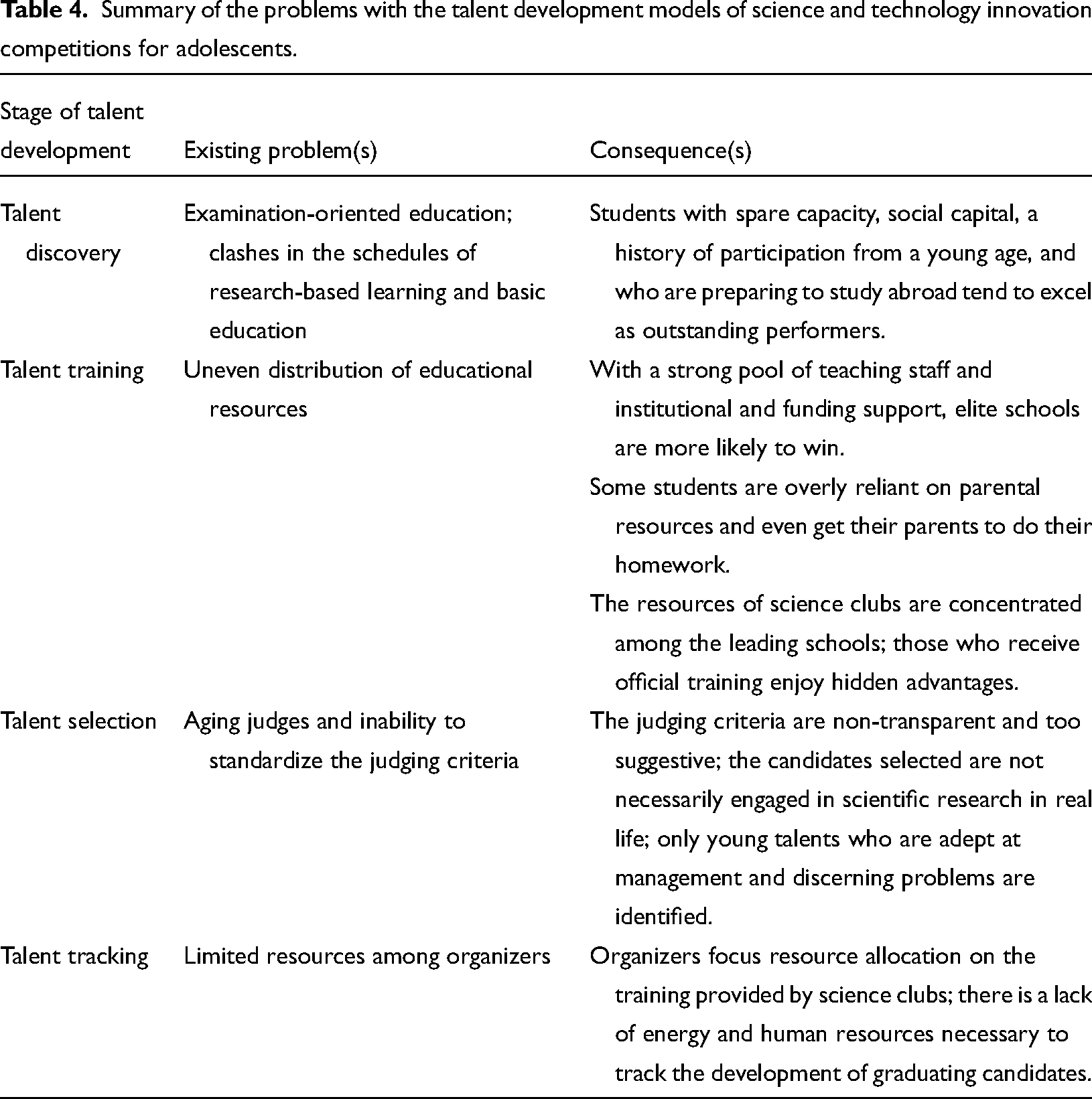
At the heart of this is a fundamental problem that needs to be addressed: Given the limited and uneven availability of educational resources, how should science and innovation competitions establish a clear educational objective, ensure the balanced allocation of the educational resources needed to participate, and explore more learning resources in order to stimulate more universally beneficial scientific learning (Korkmaz, 2012)?
Implications
This article analyzes various types of active participants in CASTIC Shanghai division, and finds that the competition has established multiple learning scenarios of “school–science club–competition field,” and promotes diversified talent training models based on process incentive in schools.
It's predictable that science education enabled by science and technology innovation competitions such as CASTIC will play an increasingly prominent and demonstrative role in educational reforms going forward: Using a project-based competitive framework, such competitions have reconciled the learning environment with the knowledge application environment, which are detached in the traditional classroom. At the same time, they stimulate a complex set of learning processes, largely centered on social interactions, that significantly influence students’ ways of learning, mental development, and emotional connections with science.
However, to make competitions like CASTIC play a greater role in education, it is necessary to improve the design of such competitions, and build a learning environment and talent training mechanism conducive to it, so that the dividends of STEM education can be released to a wider range through the competition.
Specifically, the first is to clarify the demonstration function for science education of such competition platform more clearly, weaken the utilitarian goal and add more process monitoring, clarify the popularization and investigation of project-based learning, and clarify its demonstration function for science education.
Second, it is necessary to create and improve the learning environment associated with science and technology innovation competitions, with a series of necessary space, teachers, and resources. For instance, Guo et al. (2010) advanced the need for such competitions to establish a wider social participation mechanism and incorporate more diverse educational resources, such as those from research institutes, science museums, and high-tech enterprises.
The third is to further improve the talent training mechanism based on science and technology innovation competitions, systematically design the training model on the four core dimensions of problem identification, learning assistance, organizational support, and social interaction, meanwhile institutionalizing the expansion of interested participants by gradually changing university talent selection policies and regularly launching training salons for science and technology counselors (Lu & Leng, 2020).
Broadly, to better fulfill the educational functions of science and technology innovation competitions, further integration with reforms in basic education and more planning are necessary. Whether systematic curriculum reforms and institution building can transform science and technology innovation competitions from a unique medium for selecting innovative talents to a standard platform for talent development is crucial. This transformation should be rooted in basic science education and intertwined with science curriculum design. It will determine if future competitions can stimulate further paradigm shifts in science education and be integrated into the wider science education system.
Footnotes
Contributorship
Declaration of conflicting interests
Ethical statement
Funding
ORCID iDs
