







Abstract
Keywords
Background
Background of historiographic research on the history of visual science
Since the mid-twentieth century, visual representations in the history of science (including scientific illustrations, maps, diagrams, symbols, engravings, photography, film, video, models and specimens) have emerged as special research objects that are different from linguistic and textual historical materials. These representations have gradually attracted attention from scholars in Western countries across various fields, such as art history, art psychology, history of science, iconology, semiotics, sociology of scientific knowledge and visual cultural studies. This body of work has evolved into a branch of research known as the study of visual representation in the history of science, or simply the visual history of science.
Since 2008, the author of this paper has conducted historiographic research on the visual history of science in the West since the mid-twentieth century and has produced a doctoral dissertation titled
Background of the compilation of the Primary School Science Textbooks (Daxiang Edition)
On 29 May 2001, the State Council issued the ‘Decision on basic education reform and development’, stating that: The approval and review of textbooks shall be administered by education departments at both the State Council and provincial levels, ensuring the diversification of textbooks under the guidance of basic national requirements. The State Council's education department shall oversee the approval of textbooks for the national curriculum and review these textbooks and those used across provinces, while provincial education departments shall manage the approval and review of local textbooks. (The State Council, 2001)
On 8 June 2001, the Ministry of Education issued the ‘Outline for basic education curriculum reform (trial)’, which introduced ‘science’ into the national curriculum for primary and junior high school students. Concerning textbook management, the outline stipulates that: A policy of diversification of textbooks under national guidance shall be implemented, encouraging institutions and publishers to compile textbooks based on national curriculum standards. A system for the approval of textbook compilation shall be established, requiring compilers to apply to the Ministry of Education and pass qualification approval. The review system for textbooks shall be improved: provincial review committees authorized by the Ministry of Education shall review local textbooks, while the National Primary and Secondary School Textbook Review Committee shall review materials for both national and inter-provincial curricula. (Ministry of Education, 2001a)
In July 2001, the Ministry of Education officially published the
On 19 January 2017, the Ministry of Education published the
On 25 March 2022, the Ministry of Education issued the
The relationship between the classification of cognitive functions of visual scientific representations and the main theme of the cognitive evolution of Primary School Science Textbooks (Daxiang Edition)
In Chapter 5 of
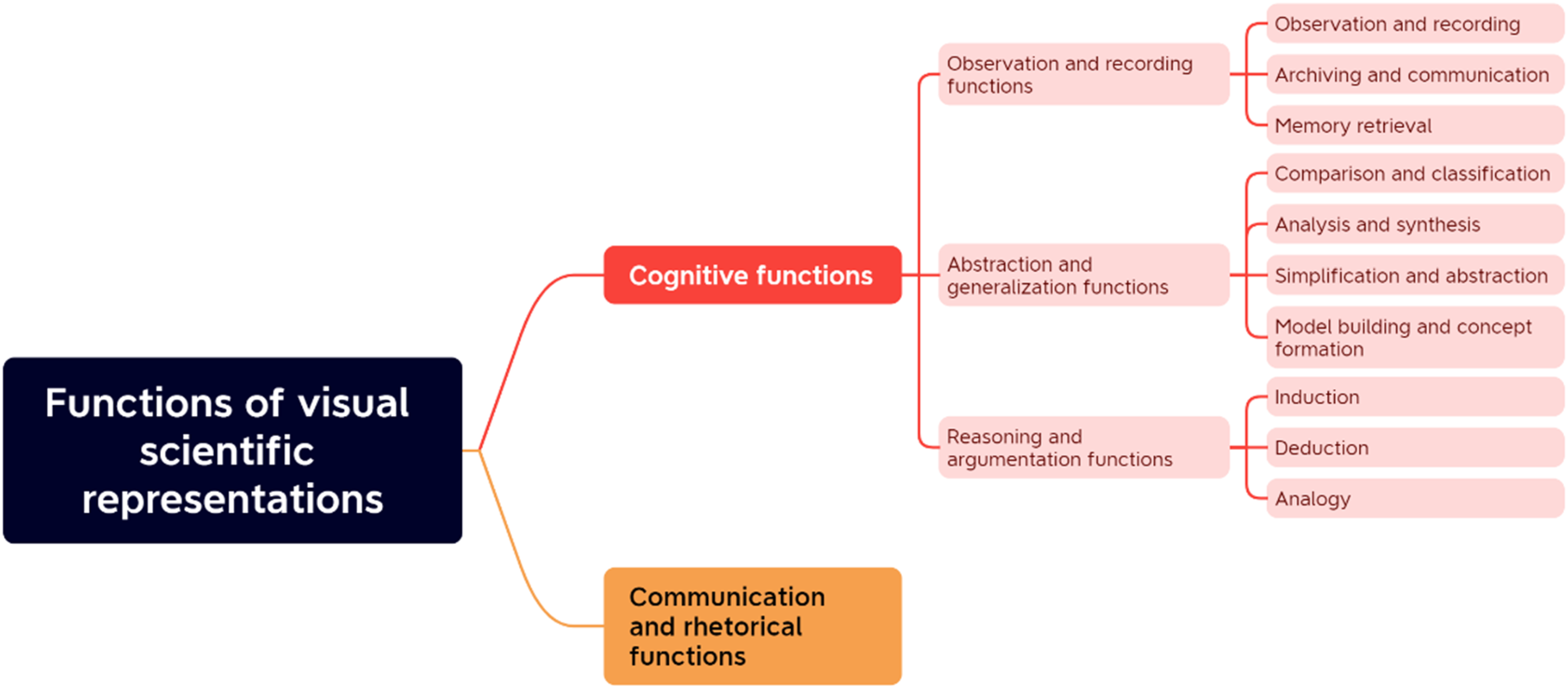
The functions of visual scientific representations.
The classification of cognitive functions of visual scientific representations (from lower to higher order) identified by art and science historians aligns with the cognitive development process (Figure 2) described in dialectical materialist epistemology (also known as ‘Marxist epistemology’). According to this view, human cognition evolves dynamically, where perceptual knowledge (sensation, perception and representation) transitions into rational knowledge (concept, judgement and reasoning), which then informs practice, and thus being tested and refined in this process (Ouyang, 2017). Observation and recording functions of visual scientific representations correspond to the perceptual knowledge stage, while the process of comparison, classification, abstraction, generalization and model building correspond to the transition from perceptual to rational knowledge and concept formation. Visual thinking corresponds to judgement and reasoning within the rational knowledge stage.

The cognitive development process.
From the perspective of child developmental psychology, children move from imaginal thinking (ages 3–6 or 7) to image-based abstract thinking (ages 6 or 7 to 11 or 12) and then to abstract thinking after age 11 or 12 (Fu, 2018). This transition from concrete imagery to abstract logic mirrors the progression from lower to higher-order cognitive functions of visual scientific representations and the shift from perceptual to rational knowledge in cognitive development.
The
The vertical line of competency development reflects the process of students’ cognitive development from concrete imaginal thinking to abstract logical thinking. It also mirrors the broader progression from perceptual to rational knowledge. For example, regarding scientific thinking, the 2022 curriculum standards require students in Grades 1–2 to focus on observing and describing the components and external features of objects, as well as comparing and classifying objects based on these features. For students in Grades 3–4, the focus shifts to observing relationships among components, analysing object features and structures, comparing and classifying objects based on essential features, drawing analogies, designing simple experiments using variable control, and applying induction, generalization and models to explain natural phenomena. By Grades 5–6, students are expected to comprehensively use methods such as analysis, comparison, abstraction and generalization to study object features and component relationships, analyse variables in experiments, use models to explain structures, relationships, processes and cycles, and conduct inductive and deductive reasoning. Grades 1–2 are thus characterized by concrete image thinking, Grades 3–4 by image-based abstract thinking, and Grades 5–6 by abstract logical thinking. The progression from lower- to higher-order cognitive functions in visual scientific representations also follows this development process.
However, while the core competency goals and core concept requirements for each stage reflect students’ general cognitive features, it may not fully capture the specific processes of students’ cognitive development. The latest revision of the Primary School Science Textbooks (Daxiang Edition) is based on requirements of the 2022 curriculum standards, considering the core competency goals for each stage, the content and academic requirements of core concepts, recommended teaching activities and core competency features for each stage. It also combines theories on children's cognitive progression from concrete imaginal thinking to abstract logical thinking, the dialectical materialist epistemology of perceptual and rational knowledge, and philosophies from logical positivism, falsificationism, sociology of scientific knowledge and philosophy of scientific practice. Thus, a key cognitive development goal is identified for each book, aiming to cultivate students’ cognitive abilities step by step. The key cognitive goal from Grade 1 to Grade 6 include senses and observation, tools and observation, features and classification, influence and connection, observation and commonality, abstraction and concept, phenomena and laws, variables and judgement, induction and modelling, explanation and application, deduction and verification, and criticism and argumentation. These elements form a horizontal line of cognitive development within the textbooks. The integration of the vertical line of core competencies and the horizontal line of cognitive development creates a unique twin-theme structure in the textbooks.
Observation, recording, comparison and classification functions for grades 1–2
(1) Observation and recording
Visual representation is an essential tool for scientific observation, recording and communication. Vision plays a prominent role in cognitive activities, yet it is limited in communication and dissemination due to human physiological constraints. While we can replicate sounds or language, we cannot directly share our visual experiences. To convey information obtained visually, one must depict the observed objects or internal visualisations. Spanish historian Gonzalo Fernández de Oviedo y Valdés (1478–1557) argued in the sixteenth century that knowledge originates from direct experience, which must be represented in text and images to be understood by others (O’Malley and Meyers, 2008). Thus, scientific illustration is vital for observing and understanding the world to acquire knowledge.
The 2022 curriculum standards emphasize the need for Grades 1–2 students to observe, under the teacher's guidance, specific object components and describe external features through oral narration, drawing and other methods. Reflecting this, the Primary School Science Textbooks (Daxiang Edition) include activities guiding Grades 1–2 students to record observed objects’ external features through drawing and communicate their findings with each other. For example, in the ‘Drawing Ants’ section for the first semester of Grade 1 (Henan Educational Press Agency, 2024), students are first asked to draw ants from memory. Through discussion, they discover variations in their drawings—some ants have four legs, others six or more; some have two body segments, others more; some draw ants’ legs on the second body segment, and some on other segments. This discrepancy prompts questions like: How many legs do ants have? How many body segments do ants have? Where are the legs of ants located? Through guided observation, students redraw the ants more accurately, emphasizing personal observation's role in understanding objects correctly. Similarly, the ‘Observing Rabbits’ lesson for the first semester of Grade 1 asks students to complete a rabbit drawing with missing ears, tails and mouths. The ‘Understanding Wheat’ lesson for the second semester of Grade 1 asks students to observe and draw wheat on a record sheet.
1
The reading material ‘Scientific Illustration of Plants’ provided at the end of this lesson helps students understand that scientific illustrations should be both aesthetically pleasing and accurately descriptive. The ‘Features of Common Plants’ lesson continues to guide students in observing and recording plant features through drawing.
(2) Comparison and classification
From the perspective of science historians, visual representations have been instrumental in defining and explaining scientific knowledge before its dissemination. Such representations allow observers to refine perceptions and see discoveries more clearly. They are also used to compare, classify, synthesize, reorganize, simplify and abstract numerous specimens, helping scientists establish accurate scientific models, thereby forming an essential part of scientific research.
Comparing images of different objects helps scientists identify common properties and distinctive features, while comparing images of the same object across stages reveals patterns of change. For instance, German botanist Eduard Strasburger (1844–1912) documented plant cell division through comparative illustrations, using successive images to reveal the stages of cellular division (Robin, 1992).
Classification is an important research method in science, aimed at discovering commonalities in natural order. One's knowledge about an object must be classified, encoded and stored, and should be compared with one's subsequent observations or others’ observations to detect subtle differences in the object. Images play a key role in disseminating knowledge about the appearance of an object and classifying complex phenomena. Therefore, comparison and classification through imagery have been widely applied in natural history studies.
In the scientific thinking goals for Grades 1–2, the 2022 curriculum standards require students to compare the differences and similarities in the external features of objects and classify common objects based on their external features. In the Primary School Science Textbooks (Daxiang Edition), the key cognitive development goal for the second semester of Grade 2 is set as ‘features and classification’, focusing on cultivating students’ abilities to classify objects based on external features. Activities using images for comparison and classification are included. For instance, the practical and assessment section of the ‘Changing Weather’ unit provides students with photos of five weather types and asks them to match these with their names and characteristics. In the ‘Push and Pull’ lesson, the students are asked to observe pictures of everyday scenes involving push and pull forces, with directions of the forces indicated, and discuss whether actions are pushes or pulls and their effects. This activity guides students to compare and classify different forces, thereby building the concepts of push and pull forces. The ‘Shape Change’ lesson describes the pictures of a squeezed plastic and a squeezed glass bottle, each filled with water and equipped with a thin glass tube in the stopper. Through this comparative experiment, students can discover that force can alter an object's shape, with some objects experiencing more change than others with the same applied force.
Abstraction and generalization functions for grades 3–4
Scientific images often are not faithful depictions of an object at a specific time and place but rather synthesise various forms of the same object across different times or common forms of similar objects to present a fuller picture of the object's overall features. This synthetic function is essential in scientific imagery. For example, botanical illustrations need to show a full picture of a plant instead of part of the plant in a specific time. This requires the synthetic function of scientific images, combining the plant's roots, stems, leaves, flowers and fruits into a single image, showing distinct features from different growth stages.
Scientists frequently confront the conflict between the richness of natural objects and the selective, constructive ‘working objects’ they create. Scientific images also need to balance heterogeneity and standardization. While many scientists aim to ‘faithfully present samples with all their imperfections’, depicting specific entities alone is insufficient to produce universal scientific knowledge. Therefore, abstracting common features from various similar objects is essential. Scientific images are widely used to capture these abstractions, creating models that reflect essential features, including samples that show typical external features or abstract depictions of systems, processes or concepts under study.
In the scientific thinking goals for Grades 3–4, the 2022 curriculum standards require students to observe and describe the components of a concrete object under the guidance of a teacher, analyse relationships between these elements, and identify significant common features, as well as use models to explain simple scientific phenomena. In the Primary School Science Textbooks (Daxiang Edition), the key cognitive development goals ‘observation and commonality’ and ‘abstraction and concept’ are set for the first and second semesters of Grade 3, respectively. The aim is to guide students to identify common features of objects through observation, experimentation and comparison, and to abstract essential features through abstraction and generalization, thereby forming concepts and models and using these models to explain simple phenomena. To achieve these goals, the textbooks also use some scientific images to help students with abstraction, generalization and concept building. For example, the ‘Motion of Objects’ lesson for the second semester of Grade 3 guides students to observe and compare the motion trajectories of two children, who are running along a straight track and doing a long jump, respectively. It uses illustrations to abstract and generalize the trajectories as straight and curved lines, thus establishing the students’ concepts of rectilinear and curvilinear motion. The ‘Forms of Motion’ lesson leads students to observe and compare the motions of a running child, a rotating top and a swinging swing, using illustrations to abstract and generalize the motion forms, thus establishing the concepts of translational, rotational and oscillatory motion.
Reasoning and argumentation functions for grades 5–6
Combining numbers and shapes is a significant form of visual reasoning. There are numerous cases in the history of science where conclusions were drawn through this combination rather than language or symbols alone. For example, astronomer John Herschel used numerical and graphical methods to determine binary star orbits, solving a problem that could not be resolved through formulaic derivation alone (Hankins, 2006).
Graphs are commonly used in science to summarize experimental data and uncover relationships between variables or changes in objects. The Primary School Science Textbooks (Daxiang Edition) includes numerous activities designed to meet the scientific thinking goals for Grades 5–6 as required in the 2022 curriculum standards: to demonstrate an understanding of systems, structures, relationships, processes and cycles of objects and use or construct models to explain scientific phenomena and processes. For instance, the ‘Secret to Throwing a Solid Ball’ unit for the first semester of Grade 5 guides students to investigate the optimal angle for throwing a ball through simulated experiments. By analysing statistical graphs, they can discover that the optimal angle is close to 45°. In the ‘Healthy Growth’ lesson for the second semester of Grade 5, students are guided to compare average heights of boys and girls from Grades 1–5 using statistical graphs to understand height changes by gender. They are also guided to compare their own growth with class averages and national standards to assess whether their growth rates are normal. The ‘Structure and Thermal Insulation’ lesson uses line charts to compare the water temperature changes in double- and single-layered plastic bottles, exploring the impact of structure on heat transfer.
Strengths and problems of the cognitive development theme of the Primary School Science Textbooks (Daxiang Edition)
The theme of textbook compilation reflects the underlying educational philosophy and guiding principles. Hu and Liu (2022) summarize eight common themes in science textbook compilation worldwide: development of inquiry abilities, development of life experience, development of knowledge and cognition, providing learning materials, the scientific concept system, unified concepts and processes, scientific methods, and real-life applications. Each theme has its unique historical context, with individual strengths and weaknesses.
Traditional science textbooks emphasize teaching scientific knowledge and methods, typically using the scientific concept system (the internal logic of scientific knowledge) as the main theme. However, the elementary education curriculum reform launched in China in 2001 emphasized inquiry in students’ learning, advocating a balance between knowledge impartation and competency development. Therefore, textbooks should encourage students to actively explore the creation and evolution of knowledge using their existing knowledge and experiences, and textbook content should be diverse, engaging and conducive to student inquiry. The
The emphasis on scientific inquiry in the curriculum reform has sparked varying opinions in educational practice. Some experts and teachers argue that an overemphasis on scientific inquiry might lead to a neglect of scientific knowledge and even challenge the objectivity of scientific knowledge. The 2017
Despite this balance, some experts continue to question the emphasis on scientific inquiry as one of the two main themes in the textbooks. They argue that since inquiry is the principal method through which students learn science, each activity in the textbooks should encompass a complete inquiry process. Therefore, the eight elements of scientific inquiry should not be treated separately within separated textbooks, as this could inadvertently lead teachers and students to consider the scientific inquiry process in a fragmented way.
The Primary School Science Textbooks (Daxiang Edition), based on the 2022 curriculum standards, adopt a twin-theme structure with core competencies as the warp and cognitive development as the weft. This structure sets key cognitive development goals for each textbook according to students’ cognitive development levels, designs inquiry and practice activities based on the content of learning for each stage, and guides students to achieve core competency goals for each stage through these activities. This approach avoids the logical inconsistencies found in previous textbook editions, thus achieving a consistency between core competency goals and students’ cognitive development process. By placing students at the centre of the learning process, it promotes a more holistic, impactful and systematic cultivation of their core competencies. This twin-theme structure has been praised by experts, teachers and educational researchers during textbook reviews, trial teaching and trial use.
In October 2023, the textbooks passed the preliminary review of the Expert Committee of the National Textbook Committee. Review experts lauded the textbooks as aligning well with the requirements of the
During the review phase, a large number of distinguished frontline science teachers and educational researchers conducted trial teaching and provided comprehensive feedback. Most teachers observed that the textbooks are logically rigorous, well-structured and follow a rational learning sequence that progresses from basic to advanced concepts. The instructional pace is thoughtfully aligned with the 2022 curriculum standards, reflecting students’ cognitive development and the evolution of conceptual understanding. For example, Wang Xiaoning, a teacher at Xinghe Experimental Primary School in Chaoyang District, Beijing, states that ‘The textbook's content arrangement is well-structured and logically clear, allowing students to grasp and retain related knowledge. Through continued learning, they can develop a systematic approach to problem-solving and can analyse and address issues using the textbooks’ logical framework’. Most teachers involved in the review appreciated the significance of the key cognitive development goals designed for each textbook, as well as the methodology employed by each book to cultivate students’ cognitive skills. Zhu Chunping, a teacher from Liyuan Primary School in Futian District, Shenzhen, Guangdong Province, commented on the Grade 6 textbooks: ‘The first-semester textbook, progressing from experience and understanding to inquiry and practice, and finally to reflection and evaluation, allows students to master scientific thinking through inductive and deductive reasoning. The second-semester textbook teaches logical reasoning and critical thinking based on evidence, encouraging students to demonstrate their views and challenge opposite views, and to respect evidence and differing opinions. This approach is consistent with students’ cognitive development patterns.’
Trial teaching results indicate that the textbooks can achieve the goals of cultivating students’ key cognitive skills for each book. For example, the key cognitive development goal for the first semester of Grade 1 is ‘senses and observation’, aimed at developing students’ basic ability to discover external features of objects, obtain evidence and draw conclusions through sensory observation. It also aims to foster a scientific attitude of respecting evidence, truth-seeking and questioning. Jin Yan, a teacher from Zilang No. 1 Primary School in Nantong, Jiangsu Province, conducted a trial lesson using the ‘Drawing Ants’ unit from the first-semester Grade 1 textbook. Students enjoyed the lesson, with one remarking, ‘After observing the ants, I know what they look like when I draw them again.’ Another student noted, ‘My first drawing was not right, but after observing, I understood where I went wrong. I like science class.’ Others observed, ‘You need to draw accurately in science class. You cannot just draw anything—you have to observe carefully before drawing.’
The cognitive development theme of the Primary School Science Textbooks (Daxiang Edition) captures the progression of core science competencies, incorporating foundational theories from diverse fields, including child development psychology, dialectical materialist epistemology, logic, logical positivism, falsificationism, sociology of scientific knowledge and philosophy of scientific practice. Training on textbook use has revealed that many primary school science teachers in China also teach other subjects and may lack a strong theoretical foundation in science education, which can make it challenging to grasp the textbooks’ underlying structure. While following the inquiry-based activities in the textbooks can support student-centred learning, a deeper understanding of the theoretical foundation would enhance teachers’ ability to effectively manage, direct and adapt their teaching. To achieve this, there is a clear need for systematic, well-structured and accessible training programmes for frontline teachers, and for providing such training on a broader scale.
Conclusion
According to art and science historians, the cognitive functions of visual scientific representations include observation, recording, comparison, classification, abstraction, generalization and visual thinking. These functions align with dialectical materialist epistemology, which describes knowledge progression from perceptual to rational understanding. They also reflect child development psychology's insights into cognitive features across different ages and correspond with the stage goals outlined in the
In different learning stages, the textbooks include diverse instructional activities that leverage adaptive types of scientific images to facilitate students’ inquiry. For example, in grades 1–2, students are guided to observe, record, compare and classify using photos and drawings; in grades 3–4, students are guided to abstract and generalize using diagrams and charts; in grades 5–6, students are guided to analyse, synthesize, reason and argument using concept maps and flow charts. These scientific images play a more pivotal role than written texts in nurturing students’ cognitive skills and in fostering their core competencies holistically in the process of cognitive development.