







Abstract
Introduction
In East Africa, and particularly Kenya, an informal sector known as “Jua Kali” has turned into the largest employer of elementary and high school graduates (Maundu, 1997; McLeanand & Kamau, 1999). Jua Kali is a small-scale manufacturing and technology-based service sector (UNESCO, 1997). The name is derived from the conditions (scorching sun) under which the artisans who manufacture equipment and provide related services to other small-scale producers operate. Over the years, Jua Kali artisans have been grappling with the challenge of developing more efficient, environmentally appropriate products that utilize locally available resources that would otherwise go to waste.
Although there are numerous products produced within the Jua Kali sector including charcoal stoves, kerosene lamps, and chicken brooders, all of which are prevalent household items ubiquitous in everyday Kenyan culture, classroom teaching of science rarely makes links to scientific phenomenon richness of these local production activities and products. Given that Jua Kali has become the most direct pathway for securing employment by high school graduates compared with securing employment in the diminishing public sector, we see it as an important reason to rethink high school education programs, especially science education the majority of students receive. It is also a common rhetoric in the Kenyan media and public policy documents to transform this sector into a competitive industrial sector (e.g., Master Plan on Education and Training [MPET]; Republic of Kenya, 1998). This vision of industrialization appears unlikely to be realized without understanding how to connect classroom science to the real world of Jua Kali.
It is the view in this paper that classroom knowledge should have relevance to real-world contexts. Moreover, industrialization will mean production of goods that are competitive both locally in Kenya and elsewhere. It means that those who join Jua Kali need to have the relevant scientific and technological knowledge and skills to transform the sector. Hence, there is a need to refocus science teaching by using local contexts or materials to deepen students’ understanding of science and its relevance to their local environment. Yet there is no strong curriculum link between activities in the Jua Kali, which have come to characterize the common sociocultural environment of many young Kenyans, their school science (classroom knowledge), and their culturally shaped ways of knowing (Cobern & Aikenhead, 1998; Falk, 2001). However, any attempt to link classroom science to the real world of Jua Kali activities cannot be effectively developed if there is no understanding of students’ ways of learning and knowing, implied in their degree of disposition to contextualized learning, which according to Baker, Clay, and Fox (1996) are shaped by their sociocultural environment.
To date, there is no reported research that considers East African high school students’ ways of learning and knowing and related worldviews in the context of science activities that integrate classroom science and the science imbedded in the Jua Kali activities (real world).
In this study, we hold several key assumptions: (a) understanding how students see the world and harnessing this understanding can enable the development of better science learning experiences, (b) examining Kenyan students’ ways of learning and knowing can enlighten our current understandings of how people make meaning of the world, (c) recognizing the relationship between classroom science and the science imbedded in the Jua Kali (real world) production activities is a key step toward the attempt to revolutionizing this sector to the benefit of Kenya, and (d) understanding Kenyan students’ ways of learning and knowing will inform education programs through which the majority of Jua Kali artisans are prepared.
Using Local Contexts to Teach and Learn Science
Although this can be interpreted differently, in this study we use Hull’s (1993) contextual learning theory as a basis for understanding and interpreting learning activities that would be considered as contextualized learning of science in particular (Nashon & Anderson, 2013). According to Hull, contextual learning involves the mind in seeking meaning in a context as well as relationships that make sense and resonate with one’s sociocultural background. Thus, contextual teaching and learning of science means using local contexts to explain scientific concepts or phenomena by showing how the concepts can be applied in solving local everyday problems. In some cases, this is presented as making science relevant to students. There are two commonly applied perspectives to contextual learning of science and are defined by the point in the teaching learning processes when links are made to the learners’ local context. Although both approaches aim to fulfill the desire to make students see the links between classroom science and their everyday life, the two approaches are subtly distinct (Bennett, 2003). According to Bennett (2003), the distinction is at the point where the links are made. In the context-based case, the links are made at the beginning of the topic and used as a starting point to introduce and develop scientific ideas, whereas in the relevant science case, the scientific ideas are introduced first and then links are made. In this paper, we use contextualized science to mean both context-based and relevant science. We adopt this loose understanding to be in consonant with the constant cry for making science education relevant and meaningful (Knamiller, 1984; Tsuma, 1998; Yoloye, 1986). As demonstrated in the literature, contextualizing science teaching and learning promotes active engagement of students with respect to interest and motivation (Campbell, Lazonby, Nicholson, Ramsden, & Waddington, 1994; Fensham, 1988; Hofstein, Aikenhead, & Riquarts, 1988). Originally meant for nonscience students, contextualized science has been used to make a case for addressing the concern of many students in high school who are dropping out of science courses early and, by extension, very few of them are getting into science-related postsecondary programs. These concerns indeed have not spared East Africa and, in particular, Kenya.
The Kenyan Context
Despite numerous attempts to reform education in East Africa and, in particular, Kenya, considering that the question of relevance has always been discussed as part of the reform agenda, careful analysis of the state of education, and especially science education, tells that attaining relevance is like a mirage (Knamiller, 1984; Yoloye, 1986). Over the years, there have been reform-driven commissions of inquiry into matters of education and its relevance in Kenya (Gachathi, 1976; Kamunge, 1988; Koech, 2000; Mackay, 1981; Ominde, 1964a, 1964b) and all have at best elicited the unending national debate on the question of relevance in terms of the role of science and technology in national development.
Despite the major structural changes in Kenya’s education system over the years, with the question of relevance characterizing the rhetoric for change, there has never been much effective shift from
Any attempts to integrate into curriculum authentic science learning activities in contexts such as Jua Kali are seen as unnecessary distractions. But for most Kenyans, the question of relevance is very important as eloquently expressed by Tsuma (1998): “no Nation can develop in any sense of the term, with a population which has not received a thorough and relevant education” (p. i). And, despite the local setting’s richness in scientific phenomena that can be readily mediated through curriculum, Kenyan science teachers rarely exploit this potential to mediate student learning. Hence, there is a need for Kenyan teachers to change the way science curriculum and pedagogy are reformed as a means to making science more relevant and meaningful to Kenyan learners.
The Nature of Science Curriculum and Instruction
The Kenyan education system operates in an 8:4:4 framework, that is, 8 years of primary education, 4 years of high school, and (a minimum of) 4 years of university education. At the end of the primary and secondary phases, students take national examinations, Kenya Certificate of Primary Education (KCPE) and Kenya Certificate of Secondary Education (KCSE), respectively. KCSE enables the students to join universities, middle level colleges, or polytechnics. One of the requirements is to pass in at least one of the main science subjects (physics, chemistry, and biology) and mathematics to be graded or receive a certificate, which in Kenya is the basis for consideration for entry into postsecondary programs.
The national language of Kenya is Kiswahili. However, all examinations are written in English, as it is both the official language and medium of instruction in Kenyan schools. Use of English as a medium of instruction in Kenya starts from Standard (grade) 4 up to university, although prior to Standard 4, it is taught only as a subject. Selection in a high school and university in Kenya depends on a student’s performance in KCPE and KCSE, respectively. Due to limited places in these institutions, admission is very competitive. Although there is an effort to make the educational standard uniform in all high schools, there are still three categories of public high schools:
Prior to sitting these national examinations (KCPE and KCSE), the students are subjected to rigorous testing and mock exams. In fact, throughout the years preceding the national examinations, testing is routine, where teaching and testing are driven by past examination content.
Faced with the task of helping the students to do well in these exams, the teachers adopt extreme teacher-centered approaches where note giving,
An implicit and prevailing attitude among high school teachers is that they do not need new teaching methodologies, and the need to make science relevant to the students is regarded as superfluous to examination performance. Inherent in this view is that the classroom is the best place to equip students with the knowledge needed to pass the examination, and the visits to authentic science learning environments are unnecessary distractions. The practice in most Kenyan classrooms is that teachers subject the students to only exam-content-laden lectures. The limited number of university places for which high school graduates compete exacerbates this.
Currently, the Kenyan curriculum is still modeled on an outdated, decontextualized curriculum that is irrelevant to the majority of the students. Also, it lacks relevance in terms of connections to work places—the Jua Kali, where 75% of high school graduates get employed. Furthermore, there is lack of real mechanisms to help facilitate Kenyan industrialization via effective links to school curriculum, in particular, science education. Confounding this problem is the fact that there is no reported research that considers Kenyan high school students’ dispositions for learning that integrates classroom science and the science imbedded in activities in the real world of Jua Kali. Thus, developing an instrument to assess students’ disposition for contextual learning of science is a first step in the attempt to understand how to connect classroom science to events in students’ local environment.
A Review of Personality Assessment Instruments in Science Education
A number of instruments that assess students’ personality constructs associated with science are available, understanding of which informed the general framing and construction of the items on Instrument for Assessing Disposition for Contextual Learning of Science (I-ADCLOS). A variety of standardized instruments are available that can be used to assess different personality behaviors and characteristics. Some of the instruments are specific to science, while others are general but relevant to science.
Based on assessment type, these standardized instruments can be grouped into five major categories: interviews, point scale, multiple choice, short and extended response, and drawing. Examples of instruments falling under each category are briefly outlined in the next sections.
Interview type of instruments
This category includes instruments such as Views of Nature of Science Questionnaire (VNOS-D) and Views of Scientific Inquiry, Primary School Version (VOSI-P).
VNOS-D is a seven-open-ended-question instrument that assesses students’ views about the empirical, tentative, inferential, creative, and imaginative nature of science, as well as the distinction between observation and inference; and VOSI-P is a five-open-ended-item questionnaire that is used to elicit details of learners’ ideas of what scientists do in the production of valid scientific knowledge.
Point scale/Likert-type scale instruments
Commonly available instruments in this category include: Scientific Attitude Inventory: A revision (SAI II), Modified Attitudes Towards Science Inventory (mATSI), Relevance of Science Education (ROSE) Student Questionnaire, Views About Science Survey (VASS), Asian Students Attitudes Towards Science (ASATS) class survey, Changes in Attitudes About the Relevance of Science (CARS), Thinking About Science Survey Instrument (TSSI), Children’s Science Curiosity Scale (CSCS), Science Opinion Survey (SOS), Wareing Attitudes Toward Science Protocol (WASP), Revised Women in Science Scale (WISS-R), Exploring Physics Confidence Survey (EPCS), Revised Simpson–Troost Attitude Questionnaire (STAQ-R), Science Motivation Questionnaire (SMQ), Environmental Values–Short Form (EV-SF), Self-Efficacy and Metacognition Learning Inventory–Science (SEMLI-S), Attitude Toward Science in School Assessment (ATSSA), Critical Thinking in Everyday Life (CTIEL), Chemistry Attitude and Experience Questionnaire (CAEQ), College Biology Self-Efficacy Instrument (CBSEI), Test of Mathematics-Related Attitudes (TOMRA), and Self-Concept and Competence Scale in Physics (SCACSIP).
SAI II instrument comprises 40 items on a 5-point Likert-type scale and assesses students’ interest in science, their attitude toward science, their views of scientists, and their desire to become scientists; mATSI comprises 25 items on a 5-point Likert-type scale and measures students’ attitudes toward science related to such factors as students’ perceptions of the science teachers, anxiety toward science, values of science in society, self-concept toward science, and desire to do science activities.
The ROSE instrument comprises items in various scales and assesses children’s interest in, attitude toward, and experiences in science and technology; VASS is a 30-item on a 5-point scale instrument and probes personal beliefs about the nature of science within three scientific dimensions (structure, methodology, and validity of science) and learning science within three cognitive dimensions (learner ability, reflective thinking, and personal relevance of science); ASATS class survey uses 30 items on a 5-point Likert-type scale and assesses three science attitude constructs (science enjoyment, science confidence, and importance of science as related to science class experiences) based on Asian school culture; CARS was developed to measure the change of science-related attitudes over time among students and the effect of similar curricular on the attitudes of different classes.
TSSI instrument is a 30-item, 5-point Likert-type scale and assesses sociocultural resistance to and support for science that can be used in efforts to quantitatively document the presence or absence of significant cultural factors that contribute to resistance or affirmation of science; the CSCS instrument uses 5-point scale items to measure elementary school children’s attitudes toward science in a learning context; the SOS instrument comprises 30 items on a 5-point Likert-type scale and assesses current interest and attitudes in science activities at school; the Test Of Science-Related Attitudes (TOSRA) instrument comprises 70 items on a 5-point scale and assesses science-related attitudes along seven dimensions, namely, social implications of science, normality of scientists, attitudes toward scientific inquiry, adoption of scientific attitudes, enjoyment of science lessons, leisure interest in science, and career interest in science
WASP is a 50-item, 5-point Likert-type scale instrument that measures the relationship between various aspects of class achievement (students’ self-reported grades, number of tests, internal structure of the course, degree of rewards, degree of stress, gender) and students’ attitudes toward science; WISS-R is a revised 14-item, 6-point Likert-type scale version of the original tool, WISS instrument, that assesses attitudes of adolescent girls and boys toward women in science. It uses no option for a neutral response; the EPCS instrument comprises 6 closed-ended questions on a 9-point Likert-type scale and evaluates physics extracurricular program, with a focus on female students.
STAQ-R is a 22-item, 5-point Likert-type scale of the revised version of the original tool Simpson–Troost Attitude Questionnaire (STQ), which evaluates factors influencing commitment to and learning of science among adolescent students; the SMQ instrument has 30 items on a 5-point Likert-type scale, measuring the domains of engagement and attitude; the Inventory of School Motivation (ISM) instrument contains 68 items on a 3-point scale, 44 items on a 4-point scale, and 20 items on a 5-point scales, measuring high school students in the domains of engagement, attitude, competence, and career, as well as evaluates the reasons for students to abandon science, engineering, and medical (SEM) pipeline while others choose to continue; the Epistemological Views Towards Science (EVTS) instrument contains 35 items on a 5-point Likert-type scale, measuring high school students in the domains of engagement and career as well as evaluating students’ epistemological views toward science; the EV-SF instrument contains 31 questions on a 5-point Likert-type scale and assesses people’s attitudes toward their environment; the SEMLI-S instrument contains 30 items on a 5-point Likert-type scale and assesses students’ metacognition, self-efficacy, and constructivist science learning processes in the domains of knowledge, skills (critical thinking, communication), and motivation (attitude, self-efficacy, values)
ATSSA instrument contains 14 items on a 5-point Likert-type scale and assesses middle and whigh school students’ attitude toward science; the CTIEL tool has 20 items on a 5-point Likert-type scale that assesses youth’s critical thinking ability by examining constructs of reasoning, enquiry, analysis/information processing, and flexibility; the CAEQ instrument has 76 items on a 5-point Likert-type scale and measures 1st-year university chemistry students’ attitude toward chemistry, chemistry self-efficacy, and learning experiences; CBSEI contains 15 items on 5-point Likert-type scale, measuring undergraduate students in the domain of competence; the TOMRA instrument contains items on a 5-point Likert-type scale for measuring the attitude of middle school students toward math class; and SCACSIP contains three items as part of a questionnaire on a 5-point Likert-type scale assessing students’ interest in physics in general, in relation to physics course they have at present, and in relation to other science and nonscience courses.
Multiple-choice instruments
Instruments under this category include Children’s Environmental Attitudes and Social Knowledge Scale (CHEAKS), Epistemological Beliefs Assessment for Physics Science (EBAPS), National Assessment of Educational Progress (NAEP) Science Assessment Instrument, and Program for International Student Assessment (PISA).
CHEAKS contains 36 items on a 5-point scale addressing attitude, and 30 multiple-choice questions addressing knowledge that measure children’s global attitudes and knowledge about environmental issues, such as animals, energy, pollution, recycling, water, and general issues; the EBAPS instrument contains 30 items on a 5-point scale and multiple-choice items that measure students’ views about nature of knowledge and learning in the physical sciences; the NAEP instrument contains multiple-choice questions, short constructed response questions, and extended constructed response questions that evaluate students’ knowledge of three fields of science (i.e., earth, physical, and life); and the PISA instrument has several multiple-choice items on various 4-point scales that assess how well students can apply the scientific knowledge and skills they have learned at school to real-life challenges.
Short and extended response instruments
Instruments under this category include VNOS-D and NAEP Science Assessment Instrument. The NAEP and VNOS-D instruments appear in more than one category, that is, interview and short and extended response.
Drawing instruments
Draw-a-Scientist Test (DAST) particularly assesses children’s conceptual images of a scientist. It consists of open-ended projective items on a 7-point scale based on the presence of personal characteristics (e.g., lab coat, eye glasses, facial hair, pencils/pens in pocket, unkempt appearance), symbols of research (e.g., test tubes, flasks, microscope, Bunsen burner, experimental animals), symbols of knowledge (e.g., books, filing cabinets), signs of technology (e.g., solutions in glassware, machines), drawings depicting men/women, drawings depicting racial/ethnic group of scientists, and so on.
NAEP and VNOS-D instruments appear in more than one category. While the instruments reviewed attempt to measure or assess a wide range of personality constructs in general, there appears to be a lack of instruments assessing students’ disposition for learning science in local contexts. Hence, the development of I-ADCLOS attempts to contribute to a growing stock of instruments to be available to teachers and students to gauge their level of disposition for this way of learning science.
Objectives
This article reports on the (a) development and validation processes of a questionnaire instrument, I-ADCLOS, and (b) insights into the influences that underlay students’ decisions or orientations as derived from the questionnaire’s quantitative data through a process of factor and follow-up interview analyses that resulted in emergent factors and subfactors, through validating interview themes after the participating students experienced an integrated classroom–Jua Kali science discourse.
Importance of I-ADCLOS
I-ADCLOS can help teachers gain insight into their students’ prior disposition toward contextual learning of science. The instrument development and validation process was part of a research that investigated (a) students’ potential disposition to engage and learn science in integrated classroom–Jua Kali–based activities, and (b) students’ ability to link classroom science to the science imbedded in the Jua Kali products and production activities. Having knowledge of the students’ potential dispositions is important in planning contextualized science activities in terms of their interest, learning culture, and learning strategies. For the teachers, such information from the students should be useful in creating science curricular units that better connect classroom science to the students’ social cultural environment.
Theoretical Framework and Literature Review
This paper draws on sociocultural theories of knowledge construction (Vygotsky, 1978) to develop and use a questionnaire instrument to assess and interpret students’ potential dispositions to contextualized science learning. The interpretation process was aimed at elucidating their ways of learning and knowing through a validation process that involved factor analysis of questionnaire data prior to and interview data after experiencing an integrated classroom–Jua Kali science discourse. Sociocultural perspectives place emphasis on the interdependence of social and individual processes of knowledge construction, especially social sources of individual growth and semiotic (signs and symbols, including language) mediation in human development (John-Steiner & Mahn, 1996). Also, given that learning is an ongoing process, we consider the students’ learning strategies as being shaped by the culture in which they learn.
Consistent with these theories, learning is seen as occurring holistically and not in isolated contexts (Ausubel, 1963) and as a dynamic process developed through experiences that are interpreted in the light of the learners’ prior knowledge (Driver, Leach, Millar, & Scott, 1997; Hodson, 1998; Nashon & Anderson, 2004), attitudes, and personal background (Guerts, 2002; King, Chipman, & Cruz-Janzen, 1994; Lave & Wenger, 1991). Furthermore, as Lave and Wenger (1991) stipulated, learning is situated in some community/culture, which is typically defined by sociopolitical environment as well as historical context. In the case of Kenya, these are critical influences on teachers’ practices. As earlier indicated, for Kenya, curriculum is modeled on the outdated Western content and formats. This is a historical fact as it is in part a colonial legacy as well as political with regard to policy making. This should be no surprise as it is often a fact for decision makers to hang on to or invoke a system in which they themselves succeeded as learners. Furthermore, it is considered in this article that learners’ conceptions of science have direct impact on the ways in which they learn (Hodson, 1998). Also, the learners’ worldviews are the key to influencing their perceptions, interpretations of experience, and ultimately the conceptions of their reality (Hodson, 1998).
The sociocultural identities of individuals and the groups to which they belong determine the cultural tools that they use to make sense of the world (Anderson, 2003; Bell, Lederman, & Abd-El-Khalik, 2000; Nashon, 2003, 2004). Hence, I-ADCLOS is meant to provide science teachers with insight into students’ degree of disposition to contextual learning of science so that they are able to develop contextualized learning experiences that can influence the students to see the need for this approach to science learning.
The aforementioned sociocultural frame elaborated was very important in developing questionnaire items to elicit students’ individual dispositions toward contextual learning of science. The dispositions are shaped by the sociocultural milieu in which the students live. As local contexts are socially created and regulated by the culture in which the students reside, we see a sociocultural framework to be appropriate in the development and interpretation of questionnaire items and student responses, respectively.
The literature on context-based science teaching and learning is broad, but in this paper we specifically focus on the literature that informed the development of I-ADCLOS, which we themed as attitudes toward Jua Kali (attitudes toward science), science learning culture, nature of science, nature of traditional knowledge and sources of knowing, and ways of knowing beyond science.
A critical review of studies involving context-based science and its effect on students indicates strong evidence that this approach to science has positively influenced students’ interest in, attitudes toward, motivation about, and understanding of science (Bennett, Hogarth, & Lubben, 2003; Campbell et al., 2000; Ebenezer & Zoller, 1993). In addition, a literature review on the topic of the indigenous African learners (Asante, 1987; Dei, 2000, 2002; Gitari, 2006; Goduka, 1999; Horton, 1967; Mazama, 1998; Nashon, Anderson, & Wright, 2007; Ngara, 2007; Owuor, 2007; Shizha, 2005; Wright, Nashon, & Anderson, 2007) and consultation with teachers and other scholars who were of continental African backgrounds or had had or had ongoing research or professional development projects in Africa enhanced the content of the questionnaire developed to assess students’ dispositions for contextual learning of science. Having the emergent understanding to signpost students’ potential for disposition for science learning in their local context (Jua Kali), which in our view has rich potential for science teaching and learning, is very important prior to planning subsequent instructional experiences. Moreover, attitudes that have a strong influence on students’ level of disposition toward learning in and from a local context shape
A study by Scoultler (1998) indicated that examination types (multiple choice, essay) have a direct influence on how students learn with constructed perception that multiple-choice examinations require shallow or surface thinking while essays require deep thinking. By extension, examinations and the nature of items on them inevitably influence students’
The learning culture in which students operate and embrace would inevitably influence their
What students possess as knowledge comes from a diversity of sources. Sources tend to be the authorities that students invoke in defense of their views/understandings of the world. Typically, in traditional science classrooms, the teacher, textbook, and significant others are sources most commonly referenced during science discourses. It has been widely reported and acknowledged in the literature that students come to science classrooms with already constructed views of the world (Driver, 1983; Hodson, 1998). Some of the views are inconsistent with scientific reasoning. Nonetheless, this does not invalidate other
Ways of knowing beyond science have been widely discussed including Horton’s (1967) seminal work on African knowing complemented by Gitari’s (2006) work on health and healing, in which she discusses revelations from her study of a rural Kenyan community’s knowledge of health and healing that showed personal learning tools, relational learning tools, genres of moral obligation, and genres of knowledge guarding as unique and indigenous ways of learning and knowing.
This literature synthesis provided an understanding that influenced the construction of items on the questionnaire as well as provided an interpretive lens consistent with the sociocultural framework for the emergent dimensions and subdimensions following factor analysis of students’ questionnaire responses and follow-up interviews.
Method
This study used both quantitative and qualitative approaches to the development and validation of a 36-item instrument or questionnaire for assessing students’ disposition for contextual learning of science (I-ADCLOS; see Table 1a). The construction of items was guided by theoretical insights from the literature synthesized earlier with regard to Attitudes Towards Science in Jua Kali (Attitudes Towards Learning Science in Local Contexts [AT_SJK]; 7 items), Science Learning Culture (SLC; 11 items), Nature of Traditional Knowledge and Ways of Knowing Beyond Science (NOT_WKBS; 9 items), Nature of Science (NOS; 4 items), and Sources of Knowing (SK; 5 items). As a first tier, the instrument was piloted with 36 students and quantitative methods including Cronbach’s alpha reliability tests and exploratory factor analyses were used to inspect, refine, and validate the instrument, I-ADCLOS.
Initial 36-Item I-ADCLOS.

The data, initially obtained from 36 students purposely selected from the participating schools and representative of the diverse cultural background of the student population that participated in the in the study, were first inspected. The students with incomplete or no data were excluded resulting in 29 valid cases (Table 1c). Negatively stated items were reverse coded. The inspection of the items’ content and their effect on the Cronbach’s alpha reliability led to the deletion of some items. In other words, apart from the content being inconsistent with the scale, the deletion of the particular items did not affect the Cronbach’s alpha reliability (Table 1d) of the instrument.
However, due to the small sample size of the pilot, the initial factors were considered tentative as some of the items loaded on more than one factor. But these acted as guidance to further analysis. The refined instrument was administered to a further 261 Kenyan high school students. Exploratory factor analysis tests to determine the dimensions (factors) and subdimensions (subfactors) were carried out. Also Cronbach’s alpha reliabilities for each factor were inspected to ensure that the items were reliably assessing the content of the dimension. The item clusters were tested for respective reliabilities. Also each dimensional cluster was factor analyzed to detect any existence of subdimensions and their respective interpretations.
This was followed by harnessing qualitative interview data about students’ ways of learning and knowing with a subsample (
Validated 31-item I-ADCLOS.

We considered the instrument development and validation to be part of the assessment of the students’ baseline dispositions toward science learning in their local contexts. The numerical (quantitative) values served as pointers or signposts to how students might act in contextualized science discourses (Thomas, Anderson, & Nashon, 2008), hence the reason for the interview that probed the students with regard to the emergent pointers resulting from exploratory factor analysis and as a way of further validation of the instrument.
All the interview data were transcribed verbatim for detailed analysis involving searching for expressions that reflected the content of the factors (dimensions) and subfactors (subdimensions), examining, categorizing, and testing assertions for reliability, and recombining evidence from the different interview transcripts with regard to description and interpretation of the emergent dimensions and subdimensions. This was done consistently with the objective of the study (Miles & Huberman, 1984; Yin, 2003). Analysis of interview data sets from different focus groups involved comparing within and across the sets to further clarify and interpret the quantitatively determined characteristics of the students with respect to their potential to develop dispositions for contextual learning of science. Informed by the literature reviewed and factor analysis, we were able to interpret the participating students’ potential to be disposed toward learning science in their local context.
We individually and collectively reviewed the interview transcripts as well as videos by reading and reviewing back and forth, respectively (Dahlberg & Drew, 1997), as we searched for emergent themes that cut across focus interview groups who were representative of the participating students, and compared them with the quantitatively determined dimensions and subdimensions to ascertain their validity.
The Participants
The pilot group (
It is worth noting that the five themes (AT_SJK, SLC, NOT_WKBS, NOS, and SK) around which the instrument’s content was based were considered to be different angles from which students’ disposition toward contextual learning of science could be probed or inferred. In other words, it is possible to assess and understand this phenomenon from these angles. In a way, this could be considered a form of triangulation (Mathison, 1988). Therefore, the instrument was expected to assess the same thing, that is, students’
The I-ADCLOS
The initial theoretically determined components AT_SJK, SLC, NOT_WKBS, NOS, and SK comprised 7, 11, 9, 4, and 5 items, respectively. Each item was decided on a scale of 1 (s
The results discussed in the next section follow from the analysis of questionnaire responses from a study group (
Results
Validating the Instrument
Reliability analyses were performed on questionnaire data to assess the questionnaire’s ability to consistently assess students’ dispositions toward contextualized science learning. Processing of pilot data excluded seven invalid cases (Table 1c). Using valid pilot data (
Case Processing Summary.

Cases with incomplete data.
Reliability Statistics.

Exploratory factor analysis generated three clusters of items (see Table 2a). We considered these clusters as tentative components or dimensions on which the 31 items loaded positively and reflected in the component transformation matrix (see Table 2b). Some of the items had very low loadings (<0.3) on all the three factors and others had loadings (≥0.3) on more than one factor.
Component Matrix.

Component Transformation Matrix.

Consequently, for the questionnaire to have been assessing students’ dispositions toward contextual learning of science, each individual item should assess students’ dispositions plus some amount of random error. A reliability coefficient (α) of .70 or higher is considered acceptable (Anderson & Nashon, 2007; Radhakrishna, 2007). As the reliability for the instrument on 29 cases (see Tables 1a and 1b) was .628, we proceeded to administer the instrument to a larger sample (
Case Processing Summary.
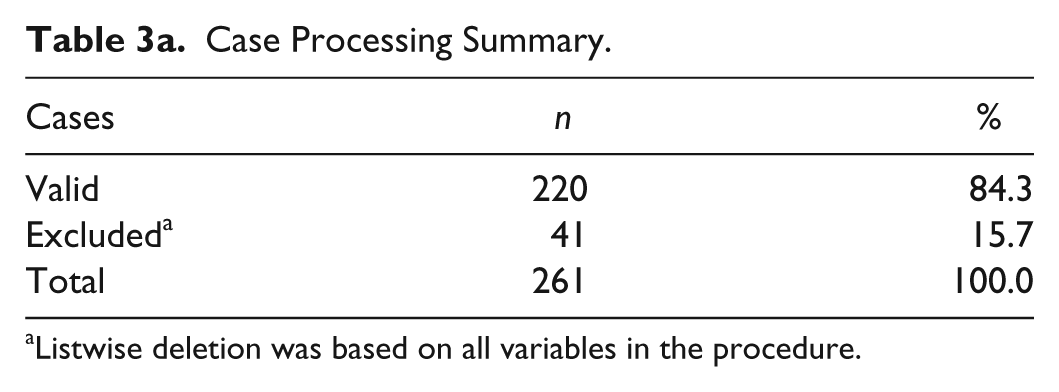
Listwise deletion was based on all variables in the procedure.
Reliability Statistics.

Item-Total Statistics.

With the overall instrument reliability at α = .811 and individual item reliabilities at α > .7, we performed exploratory factor analysis of the data obtained from 220 acceptable cases out of the initial 261. This time the items loaded higher (≥0.3) on at least one of the components and still clustered around three components (Table 4). The shaded factor loadings (Tables 4; 5a, 5b, 5c; 6, 6a, 6b; 7, 7a, 7b; 8, 8a, 8b) indicate the items that constitute the factor or component. An item can only be considered under a factor or component to which it has highest loading value and is ≥0.3. It should be pointed out that we considered a factor significant if it were loaded with three or more items.
Rotated Component Matrix.

Component 1.

Component 2.

Component 3.

Personal Awareness of Influences on Learning Science and Limitations of Traditional Knowledge (PA_ILS_LTK): Extraction of Subdimensions (Rotated Component Matrix).

Subdimension 1 (Independence of Science Learning From Cultural Influences).

Subdimension 2 (Metacognitive Learning).

Attitudes Toward Science Learning in Local Contexts and Nature of Traditional Knowing (AT_SLiLC_NoTK): Extraction of Subdimensions (Rotated Component Matrix).

Subdimension 1 (Instrumentalist–Culturalist Perspectives).

Subdimension 2 (Exam-Centered, Textbook/Teacher Reliant Learners).

Orientation Toward Collateral and Personal Learning Strategies (OTC_PLS): Extraction of Subdimensions (Rotated Component Matrix).

Subdimension 1 (Personal Awareness of Successful Learning Strategies and Other Ways of Knowing).

Subdimension 2 (Privileging Science and Learning by Rote).

The alpha reliabilities for the three Components 1 (12 items), 2 (11 items), and 3 (8 items) had α1 = .869, α2 = .669, and α3 = 0.507, respectively, and respective variances explained as 17.659%, 8.434%, and 6.714%. In other words, the total variance explained by these components or factors (dimensions) was 32.805%.
Extracting the items that loaded on Component (dimension) 1 (Table 5a) and carefully considering the meaning of what they convey, we find them pointing to awareness. Also, a number of items are about traditional knowledge. Mostly these items convey what traditional knowledge cannot do. We see in these items indications of limitations of traditional knowledge. Hence, we interpret and describe Component or Dimension 1 as “Personal Awareness of Influences on Learning Science and Limitations of Traditional Knowledge” (PA_ILS_LTK). Similarly, items that loaded on Component (dimension) 2 were extracted and reflected on with a view to interpreting and describing this cluster of items (see Table 5b).
Conveyed in these items is the attitude toward learning science in Jua Kali and nature of traditional knowledge. We revisited the literature reviewed earlier, especially on attitudes (Hodson, 1998), where it was expressed that “what the students choose to learn, how they learn it, and when to learn it” (Hodson, 1998; Nashon, 2005, Nashon & Nielsen, 2007) is a function of attitude. Thus, we described and interpreted Component (dimension) 2 as “Attitudes Towards Science Learning in Local Contexts and Nature of Traditional Knowing” (AT_SLiLC_NoTK). Finally, the items that loaded on Component (dimension) 3 were similarly extracted, examined, described, and interpreted (see Table 5c).
Using Gitari’s (2006) analysis of a Kenyan community’s knowledge of health and healing that showed personal learning tools, relational learning tools, genres of moral obligation, and genres of
To understand these dimensions, we performed further factor analysis on each to determine the subdimensions that characterize them. Thus, we were able to extract two subdimensions from each dimension as shown in Tables 6, 6a, and 6b; 7, 7a, and 7b; and 8, 8a, and 8b. We followed similar procedures as in the extraction of Components 1, 2, and 3 for interpretation and description.
Although the extraction of subcomponents followed the procedures for factor analysis of the whole instrument, we adopted similar procedures to reveal the characteristics of each factor, which we considered to be factors characterizing the main components. In this paper, we used factors, components, and dimensions interchangeably. Similarly factor analysis of each dimension resulted in subdimensions (subfactors or subcomponents). We considered this approach to the extraction of subfactors to be appropriate because factor analysis requires at least three items for meaningful interpretation (Kim & Mueller, 1978).
We considered the subdimensions to describe key characteristics of the principal components underlying the instrument assessment of the construct: disposition to contextual learning of science. As conveyed, factor analysis of each component revealed subcomponents. These we interpreted and described as (a) PA_ILS_LTK (see Table 6): independence of science learning from cultural influences (see Table 6a) and metacognitive learning (see Table 6b); (b) AT_SLiLC_NoTK (see Table 7): instrumentalist–culturalist perspectives (see Table 7a) and exam-centered and textbook/teacher reliant learners (see Table 7b); and (c) OTC_PLS (see Table 8): personal awareness of successful learning strategies and other ways of knowing (see Table 8a) and privileging science and learning by rote (see Table 8b).
Variance Explained
These three components or factors explain 32.805 of the total variance distributed as follows.
PA_ILS_LTK
A total of 17.657% of the variance of contextual learning of science by the participants is attributed to this factor. Subsequently, two subcomponents characterize this factor (dimension or component), which we have described and interpreted as independence of science learning from cultural influences (see Table 6a) and with expected variance explained being 27.385% and 23.251%, respectively. In other words, these subdimensions account for 50.686% of contextual learning attributed to PA_ILS_LTK.
AT_SLiLC_NoTK
A total of 8.434% of the variance to contextual learning of science is explained by this factor. And, the two subdimensions, instrumentalist–culturalist perspectives and exam-centered and textbook/teacher reliant learning, which characterize AT_SLiLC_NoTK explain 20.011 % and 16.138% of variance, respectively. This means that these two subdimensions can explain 36.149% of variance explained by AT_SLiLC_NoTK.
OTC_PLS
The 6.714% of the variance attributed to contextual learning of science can be explained by this factor. Furthermore, the subdimensions, personal awareness of successful learning strategies and other ways of knowing and privileging science and learning by rote, can explain 20.430% and 16.149% variance, respectively. Thus, these two subdimensions can explain a total of 36.579 % of the variance attributed to this factor.
Prior to engaging in a curriculum experience that integrated classroom and Jua Kali learning experiences, select groups of participants were interviewed as a way of probing the viability of the characteristics that underlay the three dimensions and six subdimensions extracted in a factor analysis process. It was an open-ended interview where students’ attitudes with regard to learning science in their local context, Jua Kali; learning styles; and views of traditional knowledge were probed. The questions asked covered a wide range of topics including how best they learn science, how they see the role of religion and culture in their understanding of science, and where Jua Kali artisans get their knowledge from and whether it has any connection to science.
Using qualitative methods of analyzing the interview data corpus, we read the interview transcripts back and forth to see if there were ideas expressed that were consistent with the extracted subfactors as these were characteristics that underlay the three components of the instrument. In other words, we coded the data according to the subfactors listed in the following text. In most cases, the statements reflected more than one subfactor or characteristic:
Independence of science learning from cultural influences
Metacognitive learning
Instrumentalist–culturalist
Exam-centered, textbook/teacher reliant learners
Personal awareness of successful learning strategies and other ways of knowing
Privileging science and learning by rote.
In response to open-ended questions regarding the feelings about having a fieldtrip to a Jua Kali shed, the students were metacognitive about their learning and expressed awareness of learning strategies that they considered successful with respect to out-of-school contexts. It should be pointed out that this method of teaching and learning science is atypical in Kenyan schools despite the fact that the syllabus has objectives to this effect. Also, the teachers had during a preparatory workshop expressed pessimism at the students’ response to the idea of learning science in a Jua Kali context, citing the negative perception and low status of the jobs in the sector, rightly due to some of the insecurity associated with the sector. The sentiments were summarized by one of our research assistants who facilitated a preparatory workshop for the teachers on the need to use local contexts in teaching science and development of science curricular units that integrated classroom and Jua Kali experiences without violating the mandated curriculum:
[Workshop] participants from MG high school expressed the challenge in engaging students from their school in applying [science] knowledge to the Jua Kali sector, as they are likely not to perceive it as having status in the socioeconomic setting. There is the need to help students deconstruct the perception of Jua Kali as it is often perceived as a sector for failures in the education system. Yet students from MG, given their social backgrounds, aspire to go to the university . . . [or] higher level academically oriented technology . . . professions more geared toward the industrial sector as engineers.
However, when the students were interviewed about how they felt about the possibility of learning science at a Jua Kali shed, they were very metacognitive and displayed knowledge of personal learning strategies they felt were effective or less effective. Such statements were coded under two subdimensions or characteristics: metacognitive learning and personal awareness of successful learning strategies and other ways of knowing, as illustrated by the excerpts below:
I think when you relate science to situations in life, like in real life situations it becomes more practical. Okay we may not be able to go out all the time and have these field trips but when you relate science to real life practical things that we do in everyday life it becomes more applicable and science becomes easier to understand.
I was interested in science and outdoor activities. You know learning of science is concentrated in class. Supposing we open our minds and go outside in our environment. It got me thinking of learning science beyond the classroom.
I think reading and understanding, then seeing it practically, even doing it at some point, I think I am actually seeing the fun part of science.
These excerpts demonstrate
Besides being coded under metacognitive learning and personal awareness of successful learning strategies and other ways of knowing, the following excerpts also intersected with exam-centered and textbook/teacher reliant learners and privileging science and learning by rote:
I can’t just read something once and I understand it. I cram but after repetitive reading I understand it and I can even use the same words from the book word for word.
When I cram I forget it after the exam. That is why I turn to my mapping to help me visualize.
I really hate cramming because I prefer actually reading a month before the exam. I actually get bored with subjects, so if I read something and I don’t understand it, I just cram it and then I do the exam and forget about it. Then again I have to come back and read because I just get so bored. I prefer to know something than cram and forget.
Cramming in our view is a strategy that is aimed at achieving a threatening goal, say passing an exam. Failure is a threat and cramming for these kinds of learners is meant to prevent failure. In other words, this could be driven by the “better something on paper compared with none” strategy. Nonetheless, the three students, Sally, Erica, and Fay, demonstrated a high degree of
In general, consistent with the PA_ILS_LTK dimension, the students expressed awareness of effective science learning strategies and influences on their science learning.
Science needs to be practical; it needs to be related to something, to be given contrast to something. So it becomes really interesting and you actually get the concepts. But where there is so much theory it’s also a bit hard to understand.
Some students need experiments to be able to understand concepts better because you will find that subjects like biology. Some students live in towns and so they don’t know other names of the native plants or other animals so they have to be shown. They need experiments or field study.
Mine is in chemistry a topic called structure and bonding. The teacher did a very good presentation and we saw it practically and we understood it better. She used the model, which was very clear and I was able to visualize what an atom . . . is.
Mine was a topic on classification. We went out a lot; we got various specimens out there about various living things. So we saw a lot of organisms until now I still understand a lot. We collected a lot of specimens.
[Through] discussion you get to know more. This can be with peers even when you are home during the holidays just go and share with people from other schools then you get to know more and understand it (ideas/concepts) better.
It also emerged from these interviews that apart from the students having diverse views of what culture is, which they defined based on their lifestyles and where they live, they recognized its place as conveyed in the excerpts following questions that sought understanding of culture and how it affected them. We coded these under the independence of science learning from cultural influences, instrumentalist–culturalist, and Personal awareness of successful learning strategies and other ways of knowing dimension:
Culture is what our ancestors and the society believe in but I believe they are not useful now.
When the culture is not there you will not be bonded into that ethnic group.
Culture is actually what you live, what your life is, what practices, what values you are taught . . . There is also that aspect that . . . you still connect to your ethnicity.
Culture . . . [is] the practices, . . . all the taboos, and all the restrictions.
Some of the cultures require familiarity with them but I am not used to going to my rural place. So some of the questions I found to be very difficult to answer.
The three dimensions, PA_ILS_LTK, AT_SLiLC_NoTK, and OTC_PLS, are also reflected in the literature. Studies on student metacognition have shown that students who are aware and in control of their own learning process including awareness of the strategies they successfully use to learn become more empowered learners (Anderson & Nashon, 2007; Anderson, Nashon, & Thomas, 2009; Gunstone, 1994; Nashon & Anderson, 2004; Thomas et al., 2008).
Low enrolment in physics has been linked to factors such as attitudes toward and emotional connections to physics (Fischer & Horstendahl, 1997; Nashon & Nielsen, 2007; Rowsey, 1997). And, studies among African and First Nations students in Canada have revealed that scientific and alternative frameworks can coexist, a phenomenon Jegede (1995, 1996) and Aikenhead and Jegede (1999) called collateral learning. In some cases, students have been found to segregate against certain views depending on the context, which is sometimes referred to as a cognitive apartheid (Cobern, 1996; Cobern & Aikenhead, 1998; Young, 1992). The following excerpts serve to further illuminate the validity of the OTC_PLS dimension:
How do you reconcile the two perspectives on religion and science in your learning environment? Does it create contradictions to you as an individual when you are learning science?
I think I have my knowledge in religion and my knowledge in science, so there is no much of contradiction. I see them as separate issues.
I am trying to think of something about science that it is also a discipline that respects religion because there are aspects of life that science cannot explain . . . Science has also defined itself and it respects matters of religion because no one can tell me how I was given life, no one can tell me how my soul lives, no one can tell me how I have this soul in me. It is only God who can tell me that. And science has not tried to tell me that this is what is happening to your soul.
Conclusion
The construction of the initial 36-item instrument was informed by theory and experience with a special focus on AT_SJK (7 items), SLC (11 items), NOT_WKBS (9 items), NOS (4 items), and SK (5 items) as ways of developing items that captured as wide a scope as possible to triangulate the students’ dispositions toward contextual learning of science.
The results of factor analysis using questionnaire data from 220 valid cases of the initial 261 participants from selected high schools revealed factors or dimensions that were defined differently, although some of the content of the original concepts influenced the redefinition of the factors that reflected this population of students more. It is possible that different factors can be extracted if the instrument is administered to a different population of students outside the Kenyan context. Furthermore, as already pointed out, reliability tests as well as factor analyses supported the stability of these dimensions whose characteristics have been reflected in group interview data on questions related to students’ dispositions toward learning science in local contexts.
Normally, a scale of alpha reliability greater or equal to .7 is acceptable. Nonetheless, we retained the OTC_PLS dimension (α3 = .507) because of the strong qualitative and theoretical validity and very high individual item reliabilities on the main scale I-ADCLOS. Jegede (1995, 1996) and Aikenhead and Jegede (1999) have demonstrated the prevalence of collateral learning among continental African and First Nations students. The equivalent in Western cultures is what some scholars call cognitive apartheid (Cobern, 1996; Cobern & Aikenhead, 1998; Young, 1992). According to Cobern (1996), the students simply wall off the concepts that do not fit their natural worldviews and instead create a compartment for scientific knowledge from which it can be retrieved on special occasions, such as school exams. Moreover, as Young (1992) noted,
this is likely to be more common if the new challenges the old. Under such circumstances, it is difficult for the new knowledge to be really made the pupil’s own, a part of reality. It gets learned in a shallow way and . . . easily forgotten after the last examination, if it was ever really understood in the first place. (p. 23)