







Abstract
Introduction
Much of human activity is time bound, both chronologically and psychologically. The subjective perception of time, in the form of perceived duration, synchrony, pace of life, and more, as well as our temporal perspectives are deeply ingrained. McGrath and Tschan (2004) distinguished four processes in temporal aspects of everyday life:
If these psychological aspects are tightly linked to human activity, it is not surprising that time sense should reveal major cross-cultural differences (Frank, 1939; Kluckhohn & Strodtbeck, 1961; Levine, 1997; Luhmann, 2002; Poole, 2000). Previous cross-cultural studies have addressed different aspects of McGrath and Tschan’s (2004) classification of psychological time processes. Hall (1989), utilizing his anthropological experience, dichotomized cultural time orientations into monochronic and polychronic. He argues that cultures with monochronic time orientation tend to prefer to do one thing at a time, rely on schedules and segmentation. However, people with polychronic time orientation tend to do several things at once, and they stress the completion of transactions rather than adherence to preset schedules. Hall (1989) asserted that Westerners are likely to be monochronic, while Latin American and Mediterranean people are more polychronic oriented.
Brislin and Kim (2003) have suggested a closely related dichotomy of clock and event time. Clock-time cultures, like the United States, adhere to schedules and punctuality, whereas event-time cultures, like Latin America, go more with the natural flow of social events. Hofstede (2001) who studied work-related values in 40 countries, found a long-term versus short-term orientation factor in the Chinese Values Survey administered to university students in 22 countries (Chinese Culture Connection, 1987). Countries with a strong short-term orientation (most Western countries) foster values involving future-oriented rewards, in particular perseverance and thrift, whereas countries with a long-term orientation (such as China and Taiwan) foster respect for tradition, preservation of “face,” and fulfilling social obligations. Long-term orientation shows significant correlations with other national characteristics, notably the current economic growth. Recently, Hofstede, Hofstede, and Minkov (2010) proposed a new version of this index of long-term versus short-term orientation, based on a subset of the World Values Survey items, and evidenced a relation between the score calculated for 93 countries with school results and economic growth (Hofstede & Minkov, 2010).
Another large cross-cultural study is the GLOBE project. This 62-country study focusing on leadership and organizational behavior also collected data on future orientation, described as “the degree to which a collectivity encourages and rewards future-oriented behaviours such as planning and delaying gratification” (Ashkanasy, Gupta, Mayfield, & Trevor-Roberts, 2004, p. 282). Societies with a stronger future orientation, such as Singapore, Austria, and Canada, tend to be less hierarchical, more humane, and individualistic. Another study conducted by Trompenaars and Hampden-Turner (1998) examined time horizon in 42 countries. Time horizon refers to the length of the planning horizon and the length of time a person uses to think about the past or future. Confucian cultures scored higher on long-term planning, whereas Western cultures scored higher on short-term planning.
Three other cross-cultural studies on time should be mentioned. One focused on the pace of life in 31 countries using behavioral observations (Levine & Norenzayan, 1999). Pace of life was significantly faster in colder climates, economically developed countries and in individualistic cultures. A second study by Luszczynska, Gutiérrez-Doña, and Schwarzer (2005) measured Consideration of Future Consequences (Strathman, Gleicher, Boninger, & Edwards 1994) in Americans, Turkish, and Polish high school students. Greater consideration of future consequences was associated with high general self-efficacy in all countries. The third study (Milfont & Gapski, 2010) has integrated a number of culture-level data of time orientations from 73 countries, yielding two factors related to future and long-term orientation. Only the future-oriented factor was associated to the countries’ national wealth and level of human development.
Time orientation has been the topic of several major cross-cultural studies; however, an integration of their findings is impossible due to the absence of an underlying general theoretical basis and a lack of methodological convergence across these studies. In our view, this is due to both substantive and methodological reasons. Shortcomings include a lack of a global view on parts of the domain of psychological time and an absence of widely employed instruments with well-established psychometric properties for the time concepts studied. In addition, almost no cross-cultural studies have conducted equivalence analyses; thus, some reported cross-cultural differences in time orientation might have been influenced by measurement anomalies, such as inadequate item content for some countries.
Why is equivalence analysis so important in this kind of cross-cultural research? When comparing groups on a measured construct, such as time perspective, an assumption is made that the instrument measures the same psychological construct in all groups. This assumption is verified by equivalence testing. Equivalence refers to the measurement invariance of the measured construct across groups. If this equivalence assumption holds, the group comparisons are valid and differences/similarities between groups can be meaningfully interpreted. If this equivalence assumption does not hold, comparisons and interpretations are not fully meaningful (Milfont & Fischer, 2010; van de Vijver & Leung, 1997). Establishing measurement invariance is thus a prerequisite for meaningful comparisons across groups, and four main levels of equivalence can be distinguished: functional, structural, metric, and full score or scalar equivalence (Fontaine, 2005).
In the present article, we aim to address these shortcomings by examining the extent to which the Zimbardo Time Perspective Inventory (ZTPI; Zimbardo & Boyd, 1999), an instrument that uses the most comprehensive conception of time perspective (McGrath & Tschan, 2004) and that validly and reliably assesses time perspective in a Western context, also captures dimensions of time perspective in a diverse set of other cultures.
The ZTPI
In recent years, research on the psychological dimension of time that can be identified as “time perspective” has increased considerably. Time perspective corresponds to an individual’s view on his or her past and future at a given time (Frank, 1939; Lewin, 1942). Time perspective links past, present, and future (Hoornaert, 1973), or in Zimbardo and Boyd’s (1999) words: “Between the abstract, psychological constructions of prior past and anticipated future events lies the concrete, empirically centered representation of the present” (p. 1271). In addition, these researchers conceive of time perspective as the ways in which individuals partition the flow of their personal experiences into time zones or temporal categories (see also Zimbardo & Boyd, 2008).
Usually, such temporal categories have been identified as past, present, and future. However, they can vary in their salience or in the extent of utilization so that some of these time frames are overused, while others are underused by individuals, social groups, nations, and cultures. Such biased time perspectives function automatically and non-consciously, and may be influenced by many factors, including education and upbringing, social class, religion, geography, economic and political stability–instability, as well as family, social, and cultural structures. Time perspective is critical when it comes to goal setting and decision making: the actor may be too distracted by the immediate situation (present orientation), immersed in memories (past orientation), or preoccupied with future gains and losses (future orientation).
The development of ZTPI (Zimbardo & Boyd, 1999) was based on theoretical analyses, in-depth interviews, focus groups, factor analyses, feedback from participants, and has refined the three major time zones of past, present, and future by empirically confirmed factors that decompose the past into a focus on positive or negative memories, while the present decomposes into a focus on hedonism versus fatalism. As a result, the ZTPI measures five temporal orientations: Past Positive (PP), Past Negative (PN), Present Hedonistic (PH), Present Fatalistic (PF), and Future (F).
The PP dimension represents pleasurable, usually sentimental and nostalgic views of one’s past, while emphasizing the maintenance of relationships with family and friends. In contrast, the PN dimension reflects a focus on personal experiences that were aversive, noxious, traumatic, or filled with regret. Those high on PH live in the moment, enjoy high intensity activities, sensation seeking, and act with minimal concern for the consequences of their behavior. The PF dimension reflects helpless and hopeless attitude toward the future and one’s life that seems fated and not under personal control. The F factor represents an attitude of goal setting and working for these goals at the expense of present enjoyment and delaying gratification, while always considering the consequences of one’s own actions and decisions.
Various studies have addressed the psychometric properties of the ZTPI in particular cultural contexts, and the scales reveal adequate internal consistencies (in the range of .63 to .84). Adequate psychometric properties were found in more than 20 countries: Algeria (Djarallah & Seghir Chorfi, 2009), Brazil (Leite & Pasquali, 2008; Milfont, Andrade, Belo, & Pessoa, 2008), Czech Republic (Lukavská, Klicperová-Baker, Lukavský, & Zimbardo, 2011), Estonia (Seema & Sircova, 2013), France (Apostolidis & Fieulaine, 2004), Greece (Anagnostopoulos & Griva, 2012), Israel (Carmi & Goroshit, 2014), Japan (Shimojima, Sato, & Ochi, 2012), Latvia (Kolesovs, 2009), Lithuania (Liniauskaite & Kairys, 2009), Mexico (Corral-Verdugo, Fraijo-Sing, & Pinheiro, 2006), the Netherlands (van Beek, & Kamphuis, 2012), Philippines (Cebuano language; Agsoy, Cacanog, Chiong, & Ocenar, 2010), Poland (Przepiorka, 2011), Portugal (Ortuño, & Gamboa, 2009), Romania (Gavreliuc, Mitu, & Gavreliuc, 2012), Russia (Sircova, Sokolova, & Mitina, 2008), Serbia (Kostic & Nedeljkovic, 2013), South Africa (Dissel & Potgieter, 2007), Spain (Diaz-Morales, 2006), Sweden (Carelli, Wiberg, & Wiberg, 2011), and Ukraine (Senyk, 2012).
The predictive, convergent, and discriminant validity of the instrument has also been demonstrated across a number of studies. The nomological network of each scale and reference to specific studies is given in the website: www.TheTimeParadox.com. To illustrate, PN is positively associated with various mental health problems (Laghi, Baiocco, D’Alessio, & Gurrieri, 2009; Sircova et al., 2008; van Beek, Berghuis, Kerkhof, & Beekman, 2011; Zimbardo & Boyd, 1999) and negatively associated with life satisfaction (Boniwell, Osin, Linley, & Ivanchenko, 2010; Shipp, Edwards, & Lambert, 2009) and positive relations with others (Holman & Zimbardo, 2009; Sircova & Mitina, 2008). PP is positively correlated with mental health and self-esteem (Zimbardo & Boyd, 1999), health responsibility, nutrition, and spiritual growth (Hamilton, Kives, Micevski, & Grace, 2003). Higher scores on PF are positively associated with aggression, anxiety, and depression (Zimbardo & Boyd, 1999); suicidal ideation (van Beek et al., 2011); physical activity (Hamilton et al., 2003); use of tobacco/alcohol/drug (Daugherty & Brase, 2010), and procrastination (Ferrari & Diaz-Morales, 2007). Individuals with high scores on PH also tend to have high scores on novelty and sensation seeking (Zimbardo & Boyd, 1999), substance use (Fieulaine & Martinez, 2011), curiosity and exploration (Kashdan, Rose, & Fincham, 2004) and satisfaction with life (Boniwell et al., 2010). Future time perspective is positively correlated with conscientiousness, preference for consistency, a consideration of future consequences measure, and self-report hours spent studying per week (Zimbardo & Boyd, 1999); healthy life style (Daugherty & Brase, 2010); long-term adjustment following a highly stressful event (Holman & Silver, 2005); and pro-environmental attitudes and behaviors (Milfont & Gouveia, 2006).
In sum, from studies conducted in different countries, PN and PF orientations repeatedly appeared as negatively associated with psychological well-being and behaviors, whereas PP and F orientations appeared to be positively associated in many cases. PH appeared as having associations, simultaneously related to risky behaviors and to more satisfactory relations and greater psychological well-being. Recently, Boniwell and Zimbardo (2004) investigated temporal profiles based on the interrelations between the five dimensions of the model. These authors proposed that the more functional profile is a balanced time perspective with low scores on dysfunctional orientations, high scores on the functional ones, and a moderate score on the remaining present-hedonistic orientation. Three studies subsequently demonstrated that balanced time perspective profiles are closely related to subjective well-being and satisfaction with life (Boniwell et al., 2010; Drake, Duncan, Sutherland, Abernethy, & Henry, 2008; Sircova & Mitina, 2008). Finally, clinical investigations demonstrated that this balanced time perspective model is effective for diagnosis and interventions (van Beek et al., 2011; Zimbardo, Sword, & Sword, 2012).
Many researchers now incorporate the ZTPI into their studies; however, only a few studies adopted a comparative approach. Some studies performed comparisons of time perspective as measured by the ZTPI between countries (Russia and United Kingdom; Boniwell et al., 2010) or ethno-linguistic samples (Kolesovs, 2009), with no or limited tests for structural equivalence. A study by White, Valk, and Dialmy (2011) tested for structural equivalence of the ZTPI measure between three countries (Estonia, Morocco, and United States) using principal components analysis within each country sample compared with factors extracted from a pooled matrix through Tucker coefficients of congruence. They concluded that the ZTPI showed somewhat comparable, but not completely identical factors across the three countries. An attempt to summarize the available findings using ZTPI in different countries (Brazil, France, Italy, South Africa, Spain, Russia, and the United States) was presented by Sircova et al. (2007). Thus, the possibility to meaningfully compare findings with other studies becomes of critical importance.
The Current Investigation
The current study assesses the structural equivalence of the ZTPI in 24 countries by investigating the invariance of its five-factor structure. Applying exploratory factor analyses, followed by target rotations and confirmatory factor analyses, we examined if the five time perspective dimensions first established in the United States also emerge in other cultures, and therefore if we can utilize this measure of time perspective as suitable for meaningful cross-cultural comparisons on these dimensions. To evaluate scalar equivalence of the specific scales, we have also performed Differential Item Functioning (DIF) procedures.
Method
Participants and Procedure
The final sample included 26 samples from 24 countries with a total of 12,200 participants (Table 1). 1 The data were collected by members of the International Research Network on Time Perspective between 2003 and 2007, and for the United States the original 1999 data were included.
Description of Country Samples.

The final sample used in the article excluded Brazil-1 sample, and 131 respondents failed to indicate their gender.
The sample sizes varied from 180 (United Kingdom) to 1,269 (Russia) participants. The average age of respondents was 26.9 years (
Measure
The ZTPI (Zimbardo & Boyd, 1999) contains 56 items tapping the five time perspectives dimensions discussed. Participants were asked to indicate the extent to which each of the statements are characteristic or true of them on a 5-point Likert-type scale ranging from 1 (
Language and Culture Adaptations
Data providers were asked to assure quality of their translation. The type of the quality check was left for their choice and in every case included one of the following (see Table 1): translation-back-translation method (Brislin, 1986), bilingual committee approach (van de Vijver & Leung, 1997), or translation-back-translation combined with a bilingual committee approach (Harkness, van de Vijver, & Mohler, 2003).
Results
Descriptive Statistics
We performed data quality check on the instrument level by evaluating the number of missing values and comparing reliability coefficients (Cronbach’s α). Our sample contained 8.06% cases with some missing data (7.14% had three or less items missing). Item correlation matrices were produced for each sample using pairwise deletion. Regression-based imputation on the dataset of each country was used to calculate total scale scores for individual responses with missing data. Overall, Cronbach’s alphas for three scales (PN, PH, and F) were above .7 with mean values of .79, .77, and .74, respectively, and for the other two scales (PP and PF) the mean coefficients were .68 (see Table 2).
Internal Consistency Coefficients (Cronbach’s α) and Proportionality Coefficients After Procrustes Rotation.

Construct Equivalence
An exploratory factor analysis was performed upon the aggregated correlation matrix (
To measure the similarity of the factor analytic solutions across samples, and thus examine construct equivalence, exploratory factor analyses with subsequent Procrustes rotation were undertaken in which the factors from each country were compared with the factors in the pooled solution (Table 2). The factor congruence coefficients (Tucker’s phi) were higher than .90 for most of the factors, indicating factorial similarity in most cases (van de Vijver & Leung, 1997). The average proportionality coefficients across all 26 samples were .93 for PH, .93 for PN, .91 for F, .90 for PP, and .84 for PF. The proportion of explained variance ranged from 29.92% (China-1) to 39.48% (Czech Republic), with an average of 35.05%.
It can be concluded that structural equivalence was rather well supported for the first factors. However, notably PF yielded values in various countries that left considerable room for improvement; some PF items showed relatively high secondary loadings (e.g., Items 33 and 47 had secondary loadings on PN). Additional analyses of the misfit did not yield a clear patterning (such as moving these items to other factors); hence, there were multiple reasons for the lower values of the proportionality coefficient, and these lower values were not associated with specific clusters of countries or salient sub-clusters of items not covered in the five-factor model. It can be concluded that the cross-cultural differences of the PF have to be interpreted with great caution.
Scalar Equivalence
We assessed item bias (DIF) using ANOVA approach (van de Vijver & Leung, 1997) to evaluate if direct comparison of ZTPI scores is possible across the cultural groups. Effect sizes (partial eta-squared) for the country factor were calculated for each item and used as a DIF indicator (similar to Cohen’s
Cross-Cultural Psychometric Properties of the Short Version of the ZTPI
To investigate the 36-item structure across the 23 countries, we factor analyzed the resulting set. Five factors were extracted, explaining 37.74% of the variance (Table 3). The loading pattern corresponded to that of the full ZTPI version, with the exception of two items. Mean alpha coefficients were .77 for PN (7 items), .69 for PH (10 items), .66 for PP (6 items), .64 for F (7 items), and .60 for PF (6 items).
Loading and Explained Variance in Exploratory Factor Analysis of the Aggregated Solution and Unbiased 36 Zimbardo Time Perspective Inventory Items (

To test four alternative models, we used confirmatory factor analysis (LISREL 8.80) taking the pooled covariance matrix (based on the whole sample, weighted by the square root of the sample size) as the input, and considering only the 36 unbiased items. Model 1 tested the original five-factor structure, Model 2 tested moving items 25 and 52 to the other related factor, Model 3 tested the same structure, but moving items 24 and 33, and Model 4 tested the same structure but shifting these four items. Models with comparative fit index (CFI), root mean square error of approximation (RMSEA), and standardized root mean square residual (SRMR) having values close to .95, .06, and .08 or better indicate acceptable fit (Hu & Bentler, 1999).
It should be noted that these criteria are mainly based on experiences with fit measures in smaller samples. Some fit statistics, notably the χ2 measures, are sensitive for sample size. In large samples, it is not uncommon to apply more relaxed fit criteria. Given these considerations, the first three models had an acceptable fit to the data: Model 1, χ2(
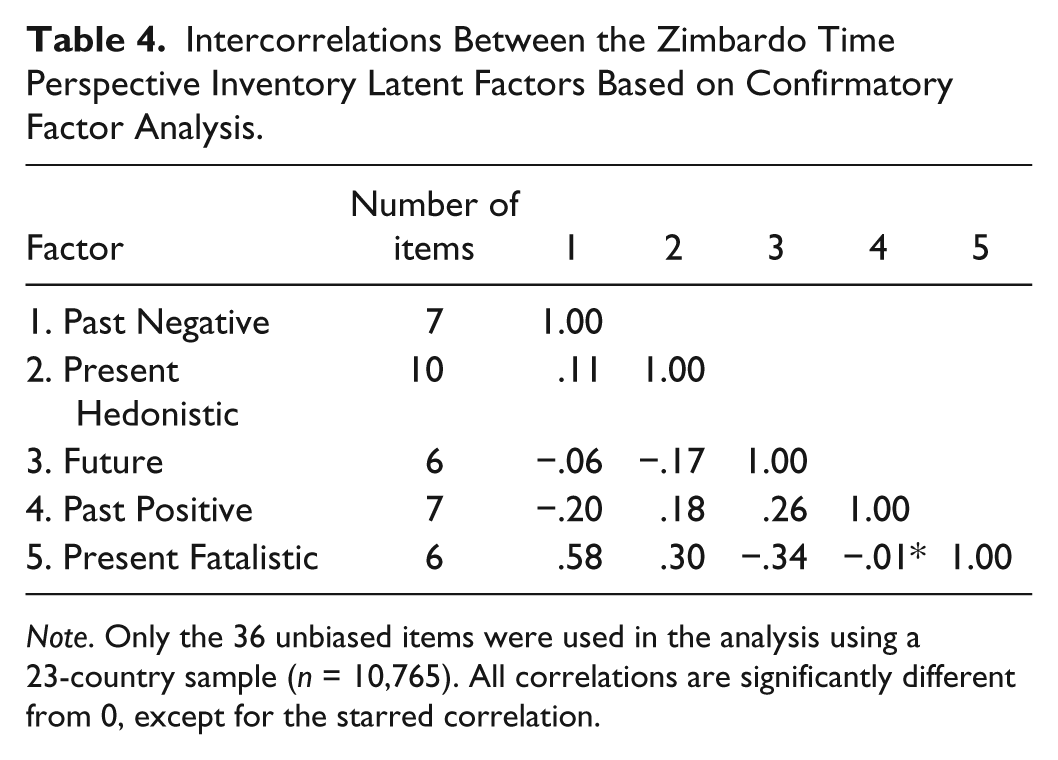
All factor loadings were significant (
Intercorrelations Between the Zimbardo Time Perspective Inventory Latent Factors Based on Confirmatory Factor Analysis.
Discussion
Our study represents a significant contribution to cross-cultural research and to time studies by providing a comprehensive model of time perspective and a suitably reliable, valid measurement instrument for making meaningful psycho-social comparisons. Most studies have focused on the cross-cultural variations of the time dimension of cultures, splitting between contrasted profiles across cultures. This focus and the many claims to consider differences in time orientations, perceptions, or perspectives led to a wide variety of approaches that did not yield an integrative theory or a relevant measure to assess these variations systematically. At the same time, research on the psychological dimension of time that can be identified as “time perspective” has increased considerably both within nations and also across cultures in recent years. Despite this recent increase in research on time perspective, there has been more confusion than enlightenment created by varying, non-comparable definitions of terms, along with a myriad of assessment devices, both verbal and pictorial, some with no acceptable psychometrics,
The ZTPI has proven to be a standardized, easily administered measure for assessing relatively stable individual differences across five time perspective domains (PN, PP, PF, PH, and F). This inventory is being used by a diverse set of researchers in many countries who are uncovering a new body of links to attitudes, values, and behaviors. For a full presentation of its development, a range of variables related to each factor and ideas about changing biased time perspectives into balanced ones, see Zimbardo and Boyd (2008). In the present study, we extended the utility of the ZTPI by establishing that these five factors of time perspective can be empirically identified across diverse cultural samples, and further that their meaning is fully or partially invariant across countries. We subjected our measure of time perspective to invariance tests across the set of data from 24 nations with a large total sample of more than 12,000 respondents.
Our results suggest that five temporal orientations as measured by ZTPI are invariant across many countries with diverse cultural traditions and across several dozen different language adaptations. The considerable item reduction on the basis of the exploratory factor and DIF analyses did not affect the global factor structure. The emergent 36-item ZTPI is sufficiently reliable for country-level analysis, whereas for the individual-level analysis the use of full scales is recommended.
Despite strong empirical evidence that support the five-factor model across cultures and the measurement invariance of the ZTPI, we have to mention some limitations. First, the participants from the individual studies used were from convenience samples, thus being very heterogeneous in composition, with many more females than males. The individual studies also varied considerably in sample size (ranging from around 100 individuals to more than 1,000). In addition, given the wide range of research teams involved, there has been considerable variability in the data collection methods they used (e.g., paper-and-pencil vs. web-based). Moreover, some statistics (proportionality coefficients and model fit) were low in some analyses. Future research should seek alternative methods of data collection organization that could allow
Notwithstanding these limitations, our results strongly suggest that five temporal orientations are invariant across many countries with diverse cultural traditions. Although the original scale was developed in the United States on English-speaking respondents, we now show for the first time the invariance of the ZTPI across several dozen different language adaptations. Therefore, we can now strongly recommend these ZTPI versions as the “gold standard” for further research on time perspective, as well as its utility in cross-cultural comparisons. We can also recommend its inclusion in cross-national studies of well-being, psychological health, and economic decision making at individual and national levels.
Our study confirms the relevance of the theoretical model of time perspective proposed by Zimbardo and Boyd (1999), and suggests that this construct can be considered as a relevant dimension when analyzing cultural variations. Beyond comparisons between country-level scores, future research should relate time perspective to other indicators such as economic development, well-being, and social functioning. At the current time of economic crises in many countries, those with insecure economic situations tend to move away from a focus on the future of saving and investing toward a more pragmatic routine, living each day as it comes (Fieulaine, Apostolidis, & Olivetto, 2006). Time perspective might thus change during economic crises as the future becomes unpredictable and uncertain, and people cannot afford to plan for the long term and thus come to prefer an orientation toward the present (Muzdybaev, 2000). In addition, recent dramatic storms and droughts around the world make evident that global climate change is upon us, creating natural disaster-induced traumas for many citizens.
The 36-item ZTPI opens the way to more integrative and cumulative research on issues of economic and political instability as well as natural threats by providing a validated cross-cultural measure. Research on these topics would especially benefit from a more integrative approach that the revised ZTPI can now address. For example, a new time-based therapy for treating post-traumatic stress disorder has been proven to be effective for many different types of traumas, by exchanging narratives of being stuck in the past with ones of creating a hopeful future and a selected present hedonism of enjoying family, friends, work, and fun (Zimbardo et al., 2012). Using the cross-culturally validated version of the ZTPI, researcher will be able to more effectively test whether this new time-based therapy can be effective across cultural milieus. Similarly, we would expect that central to establishing a solid future orientation is a sense of trust in one’s predictions of outcomes of given current behaviors. With instability in one’s family, children cannot trust that parents will deliver on their promises, so it is wiser to accept lesser short-term certain gains than plan on bigger elusive future ones. Future research will also be able to more systematically examine this prediction.
Individuals’ time perspectives are not only antecedent of society’s sustainability and growth, but also consequences, and research is needed to clarify how this construct, largely considered as a personality variable, interacts with cultural contexts (see Zimbardo & Boyd, 2008). It is our hope that our study will lead researchers to pay more attention to time perspective as a critical construct linking attitudes, values, and behaviors in cross-cultural research.
Footnotes
Authors’ Note
Declaration of Conflicting Interests
Funding
Author Biographies
