







Abstract
Employees in contemporary societies are constantly faced with challenges associated with conflicts between work and life roles. Studies found that work–life issues impact everyone regardless of individual demographics, social economic status, or family structure (Frone, 2003; Kinnunen, Geurts, & Mauno, 2004; Kossek & Ozeki, 1998; McMillan, Morris, & Atchley, 2011). Furthermore, stress resulting from work–life conflicts affects employees’ general well-being (Grzywacz & Bass, 2003) and impedes individual job performance (Allen, Herst, Bruck, & Sutton, 2000; McMillan et al., 2011; Pitt-Catsouphes, Matz-Costa, & MacDermid, 2007). For these reasons, cumulative interest in the nexus between work and life has generated substantial attention to approaches directed at attaining congruence between work and life in the literature (Frincke, 2007; Victor, 2012).
In addition, a growing base of research suggests that work–life stressors, when not adequately dealt with, lead to negative organizational outcomes (Allen et al., 2000; McMillan et al., 2011; Morris, Storberg-Walker, & McMillan, 2009; Pitt-Catsouphes et al., 2007). In response, organizations invest significant amount of resources in the design and implementation of work–life initiatives targeted at alleviating work–life stressors (Fegley, 2007). However, despite the associated costs, measures of the efficacy of work–life initiatives have rarely been aligned with key business strategies of most organizations (Kossek & Friede, 2006; Morris et al., 2009).
Hence, in this article, two work–life approaches, work–life balance (WLB) and work–life harmony (WLH), will be examined and differences between these approaches will be explored. Furthermore, current indicators used to measure the efficacy of work–life initiatives in organizations are also explored. Based on the review, a new measure—based on creative work performance—is proposed that sheds light on the relationship between key business strategies and work–life initiatives.
Perspectives of WLB and WLH in the Literature
WLB is broadly defined as the degree to which individuals attain equal levels of engagement and satisfaction in work and life roles (Clark, 2000; Greenhaus, Collins, & Shaw, 2003). Studies on WLB most often adopt a conflict-based outlook where work and life are perceived as mutually exclusive domains that are constantly competing for an individual’s resources (e.g., time, energy). For example, in Clark’s (2000) theory on WLB known as the
In a recent review, McMillan and colleagues introduced a new approach known as “WLH,” which is defined as a pleasant, harmonious arrangement of work and life roles that is integrated into a single narrative of life (McMillan et al., 2011). The notion offers a differential perspective where work and life are seen as integrative rather than competing domains, and in which the emphasis is on the complimentary rather than conflicting aspects of work and life. This approach was promptly highlighted in Hill et al.’s (2007) large-scale qualitative analysis, which identified numerous complimentary aspects between the work–life domains. Specifically, Hill and colleagues found that success at work often contributes to success in life and vice versa. In a similar vein, McMillan et al. (2011) proposed that achieving WLH involves the compromise and sharing of role responsibilities, assimilating both domains and allowing them to move in tandem with minimal conflict.
It is evident in the aforementioned that a major difference between WLB and WLH lies in the perspectives of the domains of work and life. However, despite the apparent conceptual disparities, efforts to validate these differences remain absent in literature. Moreover, previous works have adopted the term
In sum, there are existing differences between WLB and WLH based on the current conceptualization of the constructs in the literature. Despite so, the approaches have been adopted and used in parallel, both by scholars and by practitioners in the field (e.g., Stum, 2001; Wiley et al., 2007). Such ambiguity in the definition of harmony and balance can lead to difficulties in construct development targeted at measuring WLB and WLH. Furthermore, greater clarity in the understanding of these work–life approaches bears practical significance to human resource (HR) professionals attempting to develop effective work–life interventions (Grzywacz & Carlson, 2007; McMillan et al., 2011; Morris & Madsen, 2007). Hence, a lack of empirical evidence substantiating the conceptual differences between WLB and WLH represents a significant research gap that requires further attention.
As WLH is a recent concept in the literature, existing instruments have generally been developed to evaluate WLB (e.g., Dex & Bond, 2005; Greenhaus et al., 2003; Saltzstein, Ting, & Saltzstein, 2001). Thus, there are presently no instruments that can be applied to measuring both constructs. Nonetheless, because the interface between work and life is multifaceted and it encompasses the affective, social, and behavioral dimensions of an individual (Morris, 2008), it can be argued that a lack of WLB or WLH can generate conflict in an individual’s thoughts, emotions, and behaviors, which in turn creates an aversive emotional state known as
Efficacy Measures of Work–Life Initiatives
Because organizations invest substantial amount of resources in implementing work–life initiatives (Fegley, 2007), the effectiveness of these initiatives is often considered to be a major concern to the executive management (Morris, Heames, & McMillan, 2011; Morris et al., 2009). Existing measures on the efficacy of work–life initiatives have largely adopted organization outcomes as indicators of policy success. However, by adopting these indicators, the existing measures do not sufficiently demonstrate the strategic value of work–life initiatives in contemporary organizations (Kossek & Friede, 2006; Morris et al., 2009). For example, several studies have focused on the impact of work–life initiatives on the reduction of costs associated with labor by tracking employee absenteeism (Madsen, 2003) and turnover intentions (Batt & Valcour, 2003). Furthermore, by correlating work–life initiatives with firm productivity (Bloom, Kretschmer, & Van Reenen, 2009; Bloom & Van Reenen, 2006; Konrad & Mangel, 2000; Perry-Smith & Blum, 2000) and employee job satisfaction (Deery, 2008), numerous studies have also examined how the implementation of work–life initiatives enhanced the interests of various stakeholder groups in organizations. Finally, other studies have emphasized on the long-term payoffs associated with meeting employee work–life needs such as employee retention (Deery, 2008) and employee organization commitment (Halpern, 2005).
It is apparent, therefore, in the above-mentioned studies that there is a lack of research assessing the relationship between key business strategies and work–life initiatives. Furthermore, by providing such a measure, it offers organizations and academics in the field a viable method to assess the extent to which work–life initiatives can enhance organizations’ key business strategies. Hence, such a lack in measures linking the efficacy of work–life initiatives to strategic business concerns represents a significant research gap that needs to be addressed.
A growing base of research suggests that contemporary organizations increasingly depend on creativity and innovation to sustain a competitive edge in the market (Buzzacchi, Colombo, & Mariotti, 1995; Debruyne et al., 2002; Dewett & Jones, 2001; Greve & Taylor, 2000; Thompson, 2003). For instance, studies found that creativity and innovation play an integral role in the profitability of organizations (Eisenhardt & Tabrizi, 1995; Geroski, Machin, & Van Reenen, 1993), and are also positively related to other key aspects of organizational functioning such as organization planning processes (Mumford, Bedell-Avers, & Hunter, 2008); teamwork, collaboration, and organization citizenship behaviors (Ayers, Dahlstrom, & Skinner, 1997; McGourty, Tarshis, & Dominick, 1996); increased job satisfaction (Amabile, Schatzel, Moneta, & Kramer, 2004); and organization’s ability to respond to crisis (Tushman & O’Reilly, 1996).
Thus, creativity has become a progressively more valuable asset as contemporary organizations continue to acknowledge its importance in contributing to organization success (McLean, 2005; Mumford, Scott, Gaddis, & Strange, 2002; Shalley & Gilson, 2004). For this reason, it can be argued that a key business strategy in contemporary organizations involves creating and maintaining a creative workforce. In addition, it is also important to note that individual creativity functions as a determinant to innovative behaviors in organizations (Amabile, Conti, Coon, Lazenby, & Herron, 1996; Mumford, Hester, & Robledo, 2012; Woodman, Sawyer, & Griffin, 1993). Hence, it is possible to further suggest that individual creativity can serve as a measure of the efficacy of work–life initiatives, and is one that is aligned with a key business strategy in contemporary organizations.
The Current Study
The current study attempts to address the identified research gaps by (a) providing evidence of the differences between the constructs of WLB and WLH through measuring individual levels of cognitive dissonance in each condition, and (b) assessing how work–life initiatives, adopting either a WLB or WLH approach, influence individual creativity. Participants’ levels of cognitive dissonance were measured on a newly created cognitive dissonance scale (α = .83), while participants’ creativity was measured using both creative self-efficacy (CSE) scale (α = .62; Tierney & Farmer, 2002) and creative personal-identity (CPI) scale (α = .89; Jaussi, Randel, & Dionne, 2007). Jaussi et al. (2007) found that both CSE and CPI independently influence and predict creative work performance in organizations and taken together, both measures offer greater explanatory power of individual creative performance at work.
As stated in the aforementioned, participants’ levels of cognitive dissonance were expected to indicate the conceptual differences between a WLB and a WLH approach. Given the conflict-based outlook of work and life in the WLB approach, individuals adopting the approach will arguably experience higher levels of cognitive dissonance compared with individuals adopting an integrative approach in WLH. Hence, it is hypothesized as follows:
Second, Hill et al. (2007) in their work proposed that work–life interventions targeted at attaining harmony will achieve greater success compared with balance. Therefore, it is possible to suggest that a WLH approach will have greater facilitative influence on individual creativity compared with a WLB approach. Therefore, it is hypothesized as follows:
Method
Participants Characteristics
Hundred and thirty-one participants were recruited for the current study. The eligibility criteria of the study were as follows: The participants should (a) be Singaporean citizens or permanent residents, (b) be between the ages of 18 and 32 years, and (c) have at least 6 months of full-/part-time work experience prior to participating in the study. Altogether, 31 participants were excluded from the study of which, 27 had incomplete responses, 3 did not meet the inclusion criteria, and 1 did not consent to participation. This leaves a total of 100 participants who were included in the final sample.
There were 58 female and 42 male participants age ranging between 18 and 32 years (
Sampling Procedures
A snowball sampling technique was used to recruit participants for this study. The study was publicized using advertisements posted on social media website www.facebook.com. Data were collected using a customized questionnaire hosted on www.survey-gizmo.com, and all responses were completed between November 2012 and March 2013. All participants took part in the study voluntarily, no form of compensation or benefits were given to the participants.
Materials and Design
Data were collected using an online questionnaire hosted on www.surveygizmo.com. The questionnaire comprised of the information sheet, informed consent, experimental manipulations, manipulation check, and all dependent measures used in the study.
Experimental conditions
To expose participants to conditions depictive of WLB and WLH, two hypothetical scenarios were created based on the current conceptions of these constructs. Each scenario was comprised of two parts. In the first part, all participants were presented with a standard description of an individual’s work life problem where a close kin came down with a major illness and require care. Subsequently, the individual submitted a request to the management to adjust the current work arrangements. In the second part of the scenario, participants were randomly allocated to receive a response from the manager either adopting a WLB approach or a WLH approach to the issue. The responses were phrased in the way where the WLB approach depicts a work-or-life solution to the problem, while the WLH approach illustrates an integrative approach between work and life as discussed in the aforementioned literature review.
Manipulation check
A four-item cognitive dissonance scale was created for the purpose of this study. The scale served as a manipulation check by measuring participants’ level of cognitive dissonance in each experimental condition. After being exposed to the experimental condition, participants were instructed to rate how much they feel unpleasant, conflict, comfort (reverse scored), and troubled on a Likert scale of 1 (
Psychometrics of manipulation check
An exploratory factor analysis was conducted on the cognitive dissonance scale using the Statistical Package for the Social Sciences (SPSS) 19. Prior to performing factor analysis, the suitability of data for factor analysis was assessed. First, the data met the recommended minimum sample size of 100 (MacCallum, Widaman, Zhang, & Hong, 1999) and have a ratio of at least 10 cases for each item in the instrument (Velicer & Fava, 1998). Next, inspection of the correlation matrix revealed the presence of numerous coefficients of .3 and above. The Kaiser–Meyer–Oklin value was .74, exceeding the recommended value of .6 and Bartlett’s Test of Sphericity reached statistical significance, χ2(6,
Principal component analysis indicated the presence of a single factor with eigenvalue greater than 1, explaining 66.15% of the total variance. This was also reflected in the scree plot which revealed the presence of one factor. Variance accounted for by the first factor (66.15%) was more than three times larger than the second factor (17.01%), providing a good indication of a single-factor structure (White, 1990). The solution revealed the presence of a simple structure with all items loading strongly on the single component extracted as shown in Table 1. Therefore, the single-factor solution (α = .83) supported the use of the scale as an indicator of the level of cognitive dissonance.
Factor Loadings of Cognitive Dissonance Scale.

CSE and CPI
CSE was measured using Tierney and Farmer’s (2002) three-item CSE measure (α = .62), whereas CPI was measured using the CPI scale (α = .89) by Jaussi et al. (2007). The original CPI scale comprised of four items: “In general, my creativity is an important part of my self-image,” “Overall, my creativity has little to do with how I feel about myself” (reversed scored), “My ability to be creative is an important reflection of who I am,” “My creativity is an important part of who I am.” However, two items—“In general, my creativity is an important part of my self-image” and “My ability to be creative is an important reflection of who I am”—were excluded in the study as they appear to be repetitions of the same aspect. Items from both scales were combined and randomly ordered into a single five-item questionnaire rated on a Likert scale of 1 (
Psychometrics of creativity scales
A confirmatory factor analysis was conducted on the combined five-item CSE/CPI scale using SPSS 19. Prior to performing factor analysis, the suitability of data for factor analysis was assessed. The data met the recommended minimum sample size of 100 (MacCallum et al., 1999) and have a ratio of at least 10 cases for each item in the instrument (Velicer & Fava, 1998). Inspection of the correlation matrix revealed the presence of numerous coefficients of .3 and above. The Kaiser–Meyer–Oklin value was .66, exceeding the recommended value of .6 and Bartlett’s Test of Sphericity reached statistical significance, χ2 (10,
Principal component analysis revealed the presence of two components with eigenvalues greater than 1, explaining a total of 62.34% of variance with Component 1 contributing 41.67% and Component 2 contributing 20.67%. To aid in the interpretation of the components, a direct oblimin rotation was performed. The interpretation of the two components was consistent with previous research where CSE items loaded strongly on Component 1 (α = .62) and CPI items loaded strongly on Component 2 (α = .60) as shown in Table 2. There was a weak positive correlation between the two factors (
Item Loadings for CSE and CPI.

Scores from these items were reverse coded in the actual analysis.
Procedure
Participants were invited to complete a 10-min online questionnaire. An information sheet was presented on the first page detailing information on the study and contact details of the principal investigator and the supervisor. After which, participants were directed to the informed consent page where they were requested to indicate their consent to participate in the study. Participants who did not consent to participation were directed to the end of the questionnaire immediately. Following the informed consent, participants were requested to provide demographic information on age, gender, working experience, and type of job one currently or previously held. Participants who did not meet the inclusion criteria were not permitted to proceed on with the study. Names and other identifying personal information were not requested to ensure anonymity.
The study was conducted in four successive segments. First, participants were requested to complete the five-item creativity scale to establish the baseline for participants’ level of creativity. Participants were instructed to read each statement carefully and respond to how well each statement describes them. Upon completion, participants were randomly assigned to either of the experimental conditions. It should be noted that the random assignment was set up using an interface of the questionnaire-design-tools on the website in the way where each participant will have a 50% probability to be presented with either the WLB or WLH vignettes as they click on the interface to proceed to this segment of the study. Such an approach eliminates possible experimenter bias as the identity and assignment of participants were unknown to, and outside of the experimenter’s control. In each condition, participants were instructed to take time to read the scenarios carefully and were further instructed to imagine themselves in the scenario and identify with the feelings associated with the described situation before responding to the questions in the third segment.
In this segment, participants were requested to complete the cognitive dissonance scale as a manipulation check. Participants were instructed to indicate how they were feeling on each item as they imagine being in the described scenario. Prior to the fourth segment, participants were given the following instructions: Imagine now that you have this work arrangement in place and your boss hands you a task and expects you to complete it in a week. Given the working conditions, how would you rate yourself on the following statements in the current situation?
After the above-mentioned set of instructions, the creativity scale was administered for a second time in the final segment of the study. Participants were instructed to rate each statement according to how well it described them in the given situation. An optional comments/thoughts section was provided at the end of the study to allow participants to share any insights or thoughts that they may have on the study.
Results
Data Preparation and Assumption Testing
SPSS version 19 was used for data analysis in this study. Prior to all analyses, data were examined for their accuracy, missing cases, outliers, and normality of the distribution of the responses. Scores for measures on cognitive dissonance, CSE, and CPI, were created by computing mean scores of all items in each respective scale. There were no outliers in the data set and normality was assumed.
Manipulation Check
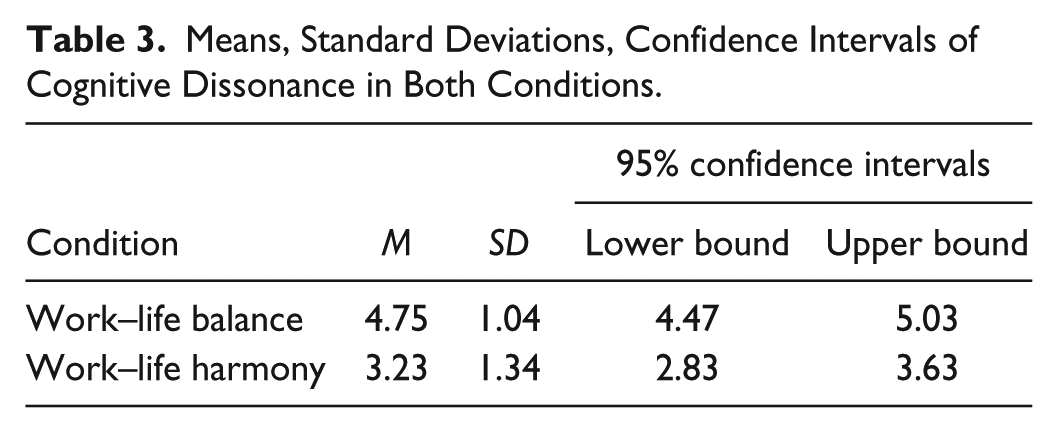
A one-way between-groups ANOVA was conducted to explore the differences in levels of cognitive dissonance between the work–life conditions. Participants were either assigned to the WLB (
Means, Standard Deviations, Confidence Intervals of Cognitive Dissonance in Both Conditions.
CSE
WLB
A one-way repeated-measures ANOVA was conducted to compare the effects of WLB intervention on CSE in Time 1 (prior to experimental conditioning) and Time 2 (following exposure to experimental condition) conditions. There was a statistically significant effect of WLB intervention on CSE, Wilks’s Lambda = .86,
WLH
A one-way repeated-measures ANOVA was conducted to compare the effects of WLH intervention on CSE in Time 1 (prior to experimental conditioning) and Time 2 (following exposure to experimental condition) conditions. The effects of WLH intervention on CSE did not reach statistical significance, Wilks’s Lambda = .97,
CPI
WLB
A one-way repeated-measures ANOVA was conducted to compare the effects of WLB intervention on CPI in Time 1 (prior to experimental conditioning) and Time 2 (following exposure to experimental condition) conditions. There was a statistically significant effect of WLB intervention on CPI, Wilks’s Lambda = .89,
WLH
A one-way repeated-measures ANOVA was conducted to compare the effects of WLH intervention on CPI in Time 1 (prior to experimental conditioning) and Time 2 (following exposure to experimental condition) conditions. The effects of WLH intervention on CPI did not reach statistical significance, Wilks’s Lambda = .94,
Summary of Results for CSE and CPI Scales in WLB and WLH Conditions.

Statistically significant differences were found.
Discussion
Results of the study found that participants in the WLB condition elicited higher levels of cognitive dissonance than participants in the WLH condition. This finding lends support to the first hypothesis of the study. Furthermore, the study also found that participants’ self-perceptions of creativity, CSE and CPI, were influenced by work–life initiatives adopting either a WLB or a WLH approach. Specifically, the non-significant results in the WLH condition suggest that participants’ CSE and CPI did not substantially differ from the baseline, subsequent to the experimental manipulation. In contrast, participants in the WLB condition appeared to have reduced self-perceptions of creativity (i.e., CSE and CPI) following the experimental manipulation. It should be noted while interpreting these results that the variances in the self-concepts of creativity were induced by the work–life problem introduced at the outset of the hypothetical scenario presented in the study. The resolutions, in the form of work–life initiatives adopting either a WLB or a WLH approach, were intended to reduce this impact. For these reasons, results of the study indicated that work–life initiatives adopting a WLH approach have greater facilitative impact on participants’ CSE and CPI compared with initiatives adopting a WLB approach. Hence, this finding supports the second hypothesis of the study.
In line with the earlier suggestion, differences in the levels of cognitive dissonance found between participants in the WLB and WLH conditions provided empirical evidence on the identified conceptual differences, based on the differential perspectives to work and life (i.e., conflict-based vs. integrative approach), in the current literature. These findings bear practical significance to organizations adopting the practice of work–life initiatives. By instituting that WLB and WLH are in fact different approaches that can be adopted to the implementation of work–life initiatives, the study expands and shapes organizations’ understanding of these work–life approaches. Through enhanced understanding of these approaches, HR professionals can more effectively develop strategic work–life interventions targeted at alleviating work–life stressors (Grzywacz & Carlson, 2007; McMillan et al., 2011; Morris & Madsen, 2007). Furthermore, clarity in the understanding of these work–life constructs can augment efforts in construct development targeted at measuring WLB and WLH in the literature. The dissociation of both these work–life constructs also endorsed the advancement of theory on WLH, a relatively new construct in the literature. Scholars interested in WLH can move forward and explore how work–life initiatives adopting a WLH approach can translate into positive organizational outcomes.
Second, given that both CSE and CPI are predictive of creative work performance (Jaussi et al., 2007), the findings of this study suggest that work–life initiatives adopting a WLH approach have greater facilitative impact on creative performance at work compared with WLB. This is consistent with Hill et al.’s (2007) proposition that work–life interventions adopting a harmony approach will achieve greater success compared with balance. These findings aid in the understanding of how adopting WLB and WLH approaches in work–life initiatives can influence creativity at work. Specifically, the WLH approach appears to offer a more conducive interface, which encourages creative performance at work compared with a WLB approach. These findings carry practical implications to organizations that are concerned with promoting creativity in their employees and can influence key decisions on work–life policies. Furthermore, the study also addresses the research gap by demonstrating how efficacy measures of work–life initiatives can be aligned with key business strategies of contemporary organizations. With evidence of the strategic value of work–life initiatives, organizations will more likely be willing to implement work–life initiatives in the workplace (Kossek & Lambert, 2005).
Limitations
As is the case with any study, there are several limitations that bear noting. Participants of the study were typically generation Y Singaporeans who had at least 6 months of working experience. This represents a narrow range of the population of the current workforce and hence the generalizability of these findings is limited. A larger sample with more diversity, and representative of the current workforce at large, would have benefited from the findings of this study. Next, because individual creative performance at work is influenced by multiple factors (Amabile et al., 1996; Amabile et al., 2004), the approach of work–life initiatives can at best offer only a partial explanation of the variances in creativity found in this study. Including and assessing the influence of these factors might have impacted the findings. Finally, the experimental conditions of the study were based on hypothetical scenarios created for the purpose of this study. In a real-life setting, organizations often do not adopt a clear distinction between WLB and WLH approaches ; hence, it is difficult to tell how the current findings can be generalized to a real-life scenario.
Future Research Suggestions
As mentioned earlier, because the experimental conditions were based on hypothetical scenarios, future studies conducted in an organizational setting will offer valuable insights on both the approaches, and their impact on creative work performance. Second, future studies can consider evaluating the effects of work–life initiatives beyond its initial implementation by taking multiple time-period measurements of individual creativity following the introduction of the work–life initiative. Long-term cost-benefit analyses of work–life initiatives can aid organizations make informed decisions in the design and implementation of strategic work–life initiatives, which are most beneficial to both employees and organizations. Third, because creative behaviors in the workplace are influenced by numerous factors, researchers can examine how work–life initiatives relate to or impact these factors, which in turn influence creative work performance.
Culture
There are many possible avenues for future research that expands knowledge on the work–life interface. As researchers continue to advance work–life theories and develop recommendations for contemporary organizations, it is important to note that cultural differences in the perspectives of work–life domains can have a significant influence on the outcome of these approaches. To illustrate, individualist cultures tend to perceive work and life as separate and individual domains where work is seen as a means to personal achievement and development (Brett & Stroh, 2003; Markus & Kitayama, 1998). In this view, work and life are perceived as competing domains where addressing either is likely to be at the cost of the other (Yang, Chen, Choi, & Zou, 2000). In contrast, collectivist cultures are less likely to view work and life as independent domains (Ishii-Kuntz, 1994). Work is seen as contributing to the family rather than competing with it (Bu & McKeen, 2000; Shenkar & Ronen, 1987) and people who put in additional effort into work are viewed as making sacrifices for the family and are appreciated by the family (Yang et al., 2000). Given that empirical evidence has successfully validated the conceptual differences between WLB and WLH, researchers can now consider how each of these approaches can be successfully applied to different cultures.
Implications
The modern-day workforce operates in an environment characterized by enhanced connectivity and communication made possible through technological advancements, such as the introduction of smart phones and increased connectivity in public and private spaces through wireless internet connections. Inadvertently, these advancements in technology have re-defined the experience of work and life in the modern-day workforce. For example, increased connectivity in both public and private spaces enabled employees to remain connected to work regardless of their time zone and location. Through the use of smart phones, employees can continue to be notified of, and access their emails received at work when engaged with activities in life. Therefore, the interface of work and life in the modern-day context appears to be enmeshed and it is difficult for employees to completely disconnect one from the other. Consequently, this raises the question of the viability of adopting an either/or approach to work and life where the goal is to maintain equivalence, with minimal interference between both domains. Based on this view, one can speculate that the integrative concept of WLH may become an increasingly relevant approach to the modern-day workforce.
Conclusion
Overall, the present study contributed to the current literature by addressing two significant gaps in research. First, the study provided empirical evidence validating the conceptual differences between the constructs of WLB and WLH. Enhanced understanding of these approaches can advance construct development targeted at measuring these concepts. In addition, a clearer understanding of these approaches can also aid HR professionals in strategically developing effective work–life initiatives. Second, the study offers an indicator of the efficacy of work–life initiatives that is aligned with a key business strategy of contemporary organizations. Although it is agreed that there is no single comprehensive approach in measuring the efficacy of work–life initiatives, it is nevertheless important to find credible ways to measure how these interventions affect key business strategies in organizations.