







Abstract
Introduction
The international education industry has been growing rapidly, earning a remarkable size with regard to the number of international students and export earnings (C. H. Chen & Zimitat, 2006; Yang, 2007). International student mobility has significantly escalated more than the total international migration during the same period (King, Findlay, & Ahrens, 2010), and this reflects the globalization of higher education (Sidhu, 2002). This rapid growth is due to a number of factors, namely, rising levels of prosperity in sending countries, rising demand for tertiary education, expected economic and social value of studying abroad, and commercialization of higher education within host countries (Hughes, 1988; Mazzarol & Soutar, 2002). The growing competition to attract and retain international students has increased competition among host countries and has expanded and diversified the students’ map of destinations (Labi, 2006; Organisation for Economic Co-Operation and Development [OECD], 2016).
As competition within domestic markets has increased due to declining or stagnating local demand, universities are seeking to compete on international markets more than ever (Mazzarol & Soutar, 2012). The globalization of higher education industry has created a whole new market place for educational institutions and has placed increasing pressure on universities to compete and make the transition from local to global players (Mazzarol, Norman Soutar, & Sim Yaw Seng, 2003; Wood, Tapsall, & Soutar, 2005). The success of universities in this globalized market depends on how well they make this transition given their resource constraints (Wood et al., 2005). Higher education managers are expected to think and act strategically so that they can secure competitive advantage for their institutions (Mazzarol & Soutar, 2008). The evident growth in international higher education signalizes the need to enrich our understanding of this globalized market. It is through this understanding that a quality and relevant higher education is served to international students and their needs are appropriately addressed (Maringe & Carter, 2007). The growing awareness of students and the fact that they have become more discriminating and demanding in their choice of destination country and institution sheds light on the importance of understanding what the prospective international student’s desires and expectations are (Petruzzellis & Romanazzi, 2010).
Although there exists a comprehensive literature on international higher education and the international students’ motivations for choosing to study abroad, not much research has been done concerning why and how Iranian students choose to study abroad. Therefore, to gain a better understanding of the international education market in Iran, it is imperative that international higher education providers be cognizant of why and how a growing number of Iranian students are choosing to study outside of their home country and what factors influence their choices. The identification of key determinants of Iranian international student mobility is necessary and constructive in developing and implementing higher education policies aimed at attracting and retaining these students, in both Iran and host countries around the world (Beine, Noël, & Ragot, 2014). The purpose of this study is to provide insight into the decision-making process of Iranian international students. This study attempts to identify the key choice factors considered by Iranian students and prioritize them according to their relative importance. Moreover, the results of this study provide implications for education managers, marketers, and policy makers inside and outside Iran. This article fills two gaps in the literature, first by shifting the focus to Iranian students as a growing segment of international higher education student flow, and second, by using a novel research methodology which utilizes Multicriteria Decision Making (MCDM) method based on Best-Worst Method (BWM) in identifying and prioritizing the factors.
The current study seeks to identify the factors influencing Iranian international students’ decision-making process regarding the choice of study abroad, and host country and host institution selection. The article begins with exploration of trends in higher education and presents data regarding host and home countries, international students, and their economic impact in the host country. It then turns to the broad literature of international student decision making and the commonly used push–pull model to identify choice factors. The next section presents the novel research methodology and the results of the study. Ultimately, the article concludes with a discussion regarding the results, their implications, and suggestions for further research.
Literature Review
The Landscape of International Education
The mobility of international students not only affects the careers and lifestyles of the students, it is instrumental in the internationalization of institutions as well (Li & Bray, 2007). International education is viewed by many students as a “ticket to migration” (Rizvi, 2005). It is also perceived as a way of gaining advantage over the students who have a degree from domestic institutions. This is defined as mobility in pursuit of what is considered a better form of education, what Rivza and Teichler (2007) called “vertical mobility” (Brooks & Waters, 2009). The rising global demand for tertiary education, the internationalization of labor markets, recognition of study abroad as a differentiating factor in the recruitment process, and the importance of expanding one’s knowledge of other societies and languages are only some of the factors strengthening students’ motivations to study abroad (Movassaghi, Unsal, & Göçer, 2014; OECD, 2016).
Many countries have become interested in international students in the past decades due to a number of reasons. Developed countries are cognizant of the reality that to be capable of competing in the global economy, their students must have a global perspective and awareness, which can be achieved through international higher education (Altbach, 2004). Moreover, Western countries, the main destination of international students, gain both short-term benefits as in the economic contribution of students by spending money on tuition, living expenses, and other costs, and long-term benefits of adding the best potential students from developing countries to their human capital by retaining them once their studies are done, which is a form of migration called skilled migration (Baruch, Budhwar, & Khatri, 2007; Tremblay, 2005). Host institutions view international students from various perspectives. They are viewed as a source of revenue (J. J. Lee, Maldonado-Maldonado, & Rhoades, 2006; Marginson, 2002), as a means to increase cultural diversity and as teaching and research contributors (Altbach & Knight, 2007; Bolsmann & Miller, 2008; Wilkins & Huisman, 2011). International students are not just seat-fillers, their potential contribution to the host nation’s economic development, global competitiveness, and the success of its domestic organizations, given that they stay and work in the host nation after their studies, can be of considerable significance (Altbach, 2004; Wei, 2013).
The global demand for international higher education services experienced a threefold increase from 1.3 million in 1990 to nearly 4.3 million in 2011 (OECD, 2013) and is forecast to reach 7.2 million in 2025 (Bohm, Daris, Meares, & Pearce, 2002). The official reports indicate that the number of international higher education students has experienced a 50% increase from 2005 to 2012 (OECD, 2015). The demand from Asia will dominate the international higher education market, constituting 70% of the total global demand by 2025 which represents a 27% increase from 2000 (Bohm et al., 2002). It is estimated that the number of international students was nearly 5 million in 2014. The United States hosted 19.4% of all international tertiary students worldwide in 2013, continuing its dominance as the host country with the largest population of international tertiary students; following the United States were the United Kingdom (10.3%), Australia (6.2%), France (5.7%), Germany (4.9%), and Canada (3.4%), hosting more than half of all the international tertiary students in the world all together. Asian students were the largest group, forming 53% of all students, which reflects the significance of Asian students in the global market of higher education (Australian Education International [AEI], 2016b).
The revenues generated by international students and their economic contributions are substantial (Consterdine & Everton, 2012). The Association of International Educators (National Association of Foreign Student Advisers [NAFSA]) estimated that the economic contribution of international students studying in the United States was US$32.8 billion during the 2015-2016 academic year, creating or supporting more than 400,000 jobs (NAFSA, 2016). International students studying in the United Kingdom are of significant importance both to the U.K. higher education sector and to the country on a wider scale. During the 2012-2013 academic year, international students contributed more than £7 billion to the U.K. economy (Universities, 2014). International student expenditure (i.e., tuition, accommodation, and living expenses) in Canada contributed more than Can$8 billion to its economy in 2010, which was greater than the total exports of unwrought aluminum or helicopters, airplanes and spacecraft (Canada, 2012). Furthermore, international students studying and living in Australia contributed Aus$18.8 billion to its economy in 2015. The revenues generated by international students is Australia’s third largest export after iron ore and coal, and it is the largest services export constituting 28% of the total services exports (AEI, 2016a).
Iran is recognized predominantly as a sending country in the international market of higher education. Iran was the top sender of students to the United States from 1974 to 1983. The 1979-1980 academic year was the peak year, during which 51,310 Iranian students were studying in the United States; however, after the Iranian revolution in 1979, the number of Iranian students in the United States significantly dropped throughout the 1980s and 1990s, reaching its lowest number of 1,700 students in 1998. However, this figure has risen significantly since 1998, rising to 12,269 students in 2015-2016 academic year which is the highest number in the past three decades. This significant growth can be accentuated by considering that the total number of Iranian students in the United States has quadrupled since 2005-2006 academic year (Open Doors, 2016).
According to The United Nations Educational, Scientific and Cultural Organization’s (UNESCO) estimations, Iran’s total number of international mobile students in 2015 was 50,053, and this number has been steadily rising since the beginning of the 21st century. These estimations indicate a significant growth from 21,701 students in 2000 to 50,053 students in 2013 recording a 130% increase. Top five destinations for Iranian students are the United States, Canada, Italy, Germany, and Australia, respectively (UNESCO, 2016). According to Open Doors report, the economic contribution of Iranian international students to the U.S. economy has been significant. The total contribution during the 2014-2016 period amounts to US$971 million in total, recording a 47% growth from US$262 million in 2014 to US$386 million in 2016 (Open Doors, 2016).
International Student Decision Making
In the highly competitive environment of higher education, students are faced with a wide range of options and have to undertake complex decisions to make the correct choice. They have become more critical, demanding, and analytical when choosing their destination (Binsardi & Ekwulugo, 2003). However, they try to be realistic and match their qualifications and ambitions to the characteristics of the destination (Hemsley-Brown, 2012). The study abroad decision is considered as one of the most significant and costly measures students will ever undertake (Mazzarol, 1998). This choice is time-consuming, expensive, includes a variety of alternatives and possibilities, and has high personal relevance (Pimpa, 2005). Despite spending significant time probing all the information and evidence, students find the decision-making process risky and complicated (Moogan, Baron, & Harris, 1999; Pimpa, 2005). The decision-making process places students in contradictory situations. The possibility of making a free choice regarding host country, university, and course makes them feel empowered. On the contrary, they feel their weakness, as they understand that they are involved in a highly competitive selection process (Hemsley-Brown, 2012).
The international higher education decision making and choice is an area of growing research interest and many studies have attempted to describe its constituting processes, choices, and factors (Petruzzellis & Romanazzi, 2010; Pimpa, 2005; Wilkins, Shams, & Huisman, 2013). These choices are recognized as multicriteria, unstructured, and complex which incorporate many determinants (Pimpa, 2005). The study abroad decision process contains a series of stages. A number of researchers have suggested that this process commences with the commitment to study abroad and ends with the selection of a host institution (Roberts, Chou, & Ching, 2010). Mazzarol and Soutar (2002) not only view the student decision-making process as a series of distinct stages but also consider the role of push and pull factors in this process. They maintain that this process comprises at least three distinct stages. The first stage entails the decision whether or not to study abroad. Factors within the student’s home country can act as influencing factors during this stage. The second stage entails the selection of a host country. Here, the factors within a host country can make it more attractive than other alternatives, and finally, the third stage involves selecting an institution. In another study, in an attempt to provide a model for the decision-making process of international graduate students in undertaking overseas graduate studies, L. H. Chen (2007) proposed a three-step process. The first step is “predisposition,” during which the student assesses personal needs, gathers information on study abroad, and decides whether or not to study abroad. “Search, selection, and application” is the next step during which the student acquires information on countries, universities, programs, costs, and location. Then, after comparing and analyzing the obtained information, the student arrives at a decision regarding where to study and which and how many schools to apply to. The third step is “choice,” during which the student assesses the factors that were considered in the previous step; examines what each city, university, program, and country has to offer; and eventually makes the final enrollment decision.
Push–Pull Factors in Study Abroad Decision Making
There exists a considerable literature which tries to explore and identify key factors in the choice of higher education by international students (Agarwal & Winkler, 1985; Ahmad & Hussain, 2017; Beine et al., 2014; Binsardi & Ekwulugo, 2003; L. H. Chen, 2007; Eder, Smith, & Pitts, 2010; Kim, 2011; María Cubillo, Sánchez, & Cerviño, 2006; Maringe & Carter, 2007; Mazzarol & Soutar, 2002; McMahon, 1992; Wadhwa, 2016). However, almost none has had Iranian international students and key determinants of their choice and mobility as its primary focus. Virtually all the studies in the extant literature attempt to explain the global flow of international students and the influencing factors on their decisions to study abroad through a commonly used theoretical framework called push–pull model, which involves the interplay of a conglomerate of “push” and “pull” factors (Mazzarol & Soutar, 2002; Wilkins & Huisman, 2011; Wilkins et al., 2013). The “push–pull” model is relevant to cross border movement, especially for the global mobility of international students. The factors constituting this model function along the international student’s decision-making process (Baruch et al., 2007; Mazzarol & Soutar, 2002).
“Push” factors operate within the student’s home country such as the home country’s cultural, economic, political, and academic aspects. These factors engender the student’s interest and initiate the decision to undertake international study. On the contrary, “Pull” factors operate within a host country. These factors are a host nation’s attributes which make it relatively more attractive and influence the international student’s decisions (Mazzarol & Soutar, 2002). In addition to various aspects of host and home countries, push and pull factors also comprise the effect of significant others and students themselves as well (Kim, 2011). The push–pull model has been commended for utilizing the process of identifying and defining key factors that influence the patterns of international student flow. However, this model makes the suggestion that international students can be perceived as a homogenized group rather than a cluster of individuals with significant differences between and within their nationalities (Roberts et al., 2010). Therefore, this research attempts to address this existing limitation.
The review of the previous studies involved different domains of the literature covering undergraduate, graduate, and international students. Moreover, studies on student mobility and migration and college choice factors were reviewed as well. In this study, the existing models in the literature were identified and the most important push and pull factors were recognized. The following paragraphs shed some light on the extant literature regarding factors influencing international student choice of study abroad. A comprehensive division of the factors in the literature is demonstrated in Table 1.
Factors and Subfactors in the Study Abroad Decision-Making Process.

Mazzarol and Soutar (2002) studied 2,485 students from four different Asian countries who were studying in post-secondary education in Australia. The study resulted in a conglomerate of push and pull factors influencing the student’s decision in choosing to study abroad and selecting a study destination. The most important factors motivating students to study abroad were the perception that overseas study is better than a local one and their desire to gain a better understanding of Western culture. The study introduced awareness and knowledge of the host country as one of the critical pull factors. Moreover, recommendations from family, friends, and relatives; financial issues; geographic proximity between home and host nations; host country’s environment; and social links as in family or friends living or studying there were identified as other factors influencing destination choice.
María Cubillo et al. (2006) attempted to study the decision-making process of prospective international students from an integrated point of view. Therefore, the study proposed a theoretical model that aimed to amalgamate the factors recognized by the extant literature. The proposed model considered purchase intention as an independent variable. The main five factors put forth by the study were personal reasons, country image effect, city image effect, institution image, and program evaluation. The final choice is determined through conscious or unconscious consideration of different elements that constitute these five factors.
The study conducted by L. H. Chen (2007) focused on the decision-making process and influencing factors regarding East Asian international graduate students’ enrollment in Canadian graduate schools. The study develops a synthesis model to explain their decision-making process. The strongest factors were institutional academic pulling factors (e.g., professors, program reputation, quality, and ranking), administrative and economic pulling factors (e.g., tuition, net costs, and scholarships), the Canadian environment (e.g., diversity and multiculturalism), visa/immigration, proximity to the United States, marketing of Canadian education, and information on studying in Canada, respectively. The most important factors which influenced the student’s enrollment decision were tuition fees and scholarships, academic reputation or quality of Canadian graduate education, and the visa process, respectively.
The study conducted by Eder et al. (2010) applied a contemporary qualitative approach in identifying the motivational and constraining factors that affect international student choice. The proposed model comprises nine themes and their respective subsumed categories. The study introduced a series of push, pull, and structural factors, all of which influence the student’s destination choice. The most important pull factors were personal growth, language, and career, respectively. Furthermore, three pull factors were identified as the most important which were, respectively, college issues (e.g., availability of courses and departments), physical geography, and culture. The structural factors included visa and monetary issues and opportunities for improvement by the host nation, with visa being the most important one.
The factors determining international student choice of location were assessed by Beine et al. (2014), based on a multiorigin and multidestination framework. This study used the available data on international students from more than 180 origin countries who were studying in a set of 13 OECD countries. The study found that the presence of country nationals at destination country acts as a strong pull factor for international students. Furthermore, other destination-specific factors attracting international students were wage and quality of higher education at destination, host’s higher education capacity, and living costs. The role of education fees (e.g., tuition) were found to be ambiguous and not significant, which could be explained by the fact that most universities are covered by grants that benefit international students.
Ahmad and Hussain (2017) studied the choice and underlying reasons and motivations of African students in choosing United Arab Emirates (UAE) as a study destination for tertiary education. The factors which influenced the choices made by these students were identified through development of a push–pull model. The study indicated that five factors influencing the choice of African students were learning environment (e.g., safe and multicultural environment), cost issues (e.g., living and tuition costs), institution’s reputation, key influencers (e.g., family, friends, agents, etc.), and geographic proximity. Furthermore, the analytical hierarchy process (AHP) was used to determine the relative importance of these factors. The study identified learning environment, geographic proximity, and key influencers as the top three factors influencing African student’s choice of UAE as a study destination.
In the review of the literature, the study identified factors that followed similar threads and had common themes. For the purposes of this study, the identified similar factors were grouped and titled as “subfactors.” Next, the “subfactors” which had similar broader themes were gathered under one incorporating “factor.” These “factors” act as an umbrella, encompassing the subfactors and their respective descriptions. This classification is demonstrated in Table 1.
Research Methodology
In this section, an innovative MCDM model based on BWM is presented to address the problem of identification and prioritization of international higher education decision-making factors. The flowchart of the proposed hybrid model is shown in Figure 1.

Flowchart of the proposed approach.
Fuzzy Delphi
The Delphi method was developed by Dalkey and Helmer (1963) at the Rand Corporation in the 1950s (C. C. Hsu & Sandford, 2007). This method is an expert opinion survey method with three basic characteristics: anonymous response, iteration and controlled feedback, and statistical group response (Y. L. Hsu, Lee, & Kreng, 2010). Delphi method is a technique for structuring an effective group communication process by providing feedback of contributions of information and assessment of group judgments to enable individuals to reevaluate their judgments (Mikaeil, Ozcelik, Yousefi, Ataei, & Hosseini, 2013). In many real situations, experts’ judgment cannot be precisely interpreted into quantitative values (Y. L. Hsu et al., 2010) and crisp data are insufficient to model real systems due to the vagueness, imprecision, and the subjective nature of human thinking, judgment, and preferences (Kannan, de Sousa Jabbour, & Jabbour, 2014). Therefore, fuzzy set theory, proposed by Zadeh (1965), is the best tool to overcome the mentioned problem (Bouzon, Govindan, Rodriguez, & Campos, 2016). Fuzzy-Delphi method (FDM), first proposed by Ishikawa et al. (1993), is a combination of fuzzy set theory and Delphi method. The steps of FDM are as follows:
In this step, based on detailed literature review, the factors and subfactors are identified, which are demonstrated in Table 1.
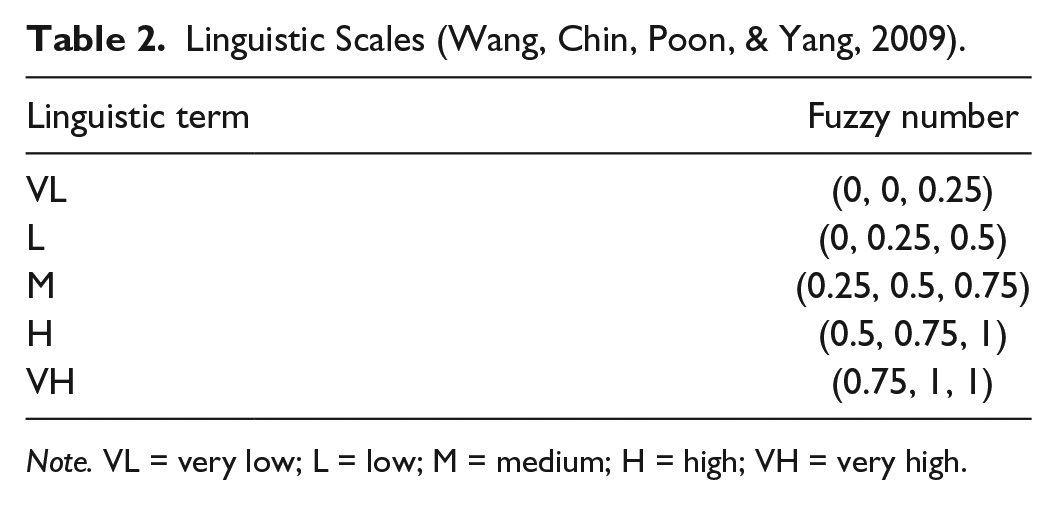
After identifying the factors,
Linguistic Scales (Wang, Chin, Poon, & Yang, 2009).
The final step in the FDM is identifying the important factors which is done by comparing the weight of each factor with the threshold


In these equations, index “I” refers to the “expert” and index

After calculating the mentioned values, if the crisp value of
The BWM
BWM is a comparison-oriented MCDM method that compares the best factor to the other factors and all the other factors to the worst factor. The goal is to find the optimal weights and consistency ratio through a simple linear optimization model constructed by the comparison system (Rezaei, Nispeling, Sarkis, & Tavasszy, 2016). In the literature, some papers have utilized this novel MCDM approach. Table 3 shows the summary of previous research with respect to BWM.
Summary of Previous Research With Respect to BWM.

Below is a description of the steps of BWM to calculate the weight of the factors (Rezaei, 2015; Rezaei, Wang, & Tavasszy, 2015):
Determination of the set of decision factors
Determination of the best and the worst factors to be used for the decision environment:
In this step, decision makers choose the best and the worst factors among the set of criteria identified in Step 1 from their perspective. The best factor represents the most important factor and the worst factor is the least important factor for the decision.
Determination of the preference of the best factor over all the other factors:
A number between 1 and 9 (1: equally important, 9: extremely more important) is used to indicate this value. The resulting Best-to-Others (BO) vector would be as
Determination of the preference of each of the other factors over the worst factor:
A number between 1 and 9 is assigned to this case as well. The Others-to-Worst (OW) vector would be
Find the optimal weights (
Solving problem (1) will result in the optimal weights for the factors. To determine the optimal weights of the factors, the maximum absolute differences

This model can be solved by transferring it to the linear programming formulation (8) (Rezaei, 2016):

By solving this problem, the optimal weights

The consistency index can be retrieved from Table 4. The lower the consistency ratio, the higher the reliability of the comparisons.
Consistency Index Table (Rezaei, 2015).

Empirical Example
In this step, FDM and BWM which were explained in the “Research Methodology” section are utilized to obtain importance weights of international higher education decision-making factors of Iranian students. The 45 research respondents in the FDM phase comprised 40% prospective international tertiary-level students, 29% professors and members of faculty, 7% Deputy Deans of Management Departments of the top universities in Iran, and 24% Iranian international tertiary students studying outside Iran. The respondent students’ fields of study ranged from engineering and medicine to arts and humanities. The prospective international students were undergraduate, graduate, or doctoral students who had demonstrated a firm commitment to study abroad by taking part in predeparture programs such as language training courses (e.g., Test of English as a Foreign Language [TOEFL] or International English Language Testing System [IELTS]) and others like the Graduate Record Examination (GRE) or the Graduate Management Admission Test (GMAT), or had already applied to international universities and were waiting for the results of their application. The international students were graduate and doctorate students currently studying in Europe, North America, and Australia. All the professors, faculty members, and Deputy Deans taking part in this phase had previously attended at least one level of tertiary education outside Iran and were specialized in human resources management (HRM) or organizational behavior (OB).
The 10 respondents in the BWM phase were (a) Deputy Dean for Education at University of Tehran’s Department of Management; (b) a professor of HRM at University of Tehran; (c) Dean of Sharif University of Technology’s Department of Management; (d) a professor of management at Sharif University of Technology; (e) Deputy Dean for Education at Amirkabir University of Technology’s Department of Management, Science, and Technology; (f) an assistant professor of HRM and OB at Amirkabir University of Technology’s Department of Management, Science, and Technology; (g) Deputy Director at Iran’s Vice-Presidency for Science and Technology; (h) Head of the Statistical Center of Iran; (i) a Deputy in Ministry of Science, Research, and Technology of Iran; and (j) the CEO of a study abroad recruitment institute in Iran. These respondents either had had the experience of studying abroad or were working in organizations and departments which directly dealt with prospective international students or the students who were already studying abroad.
FDM Results
Based on extensive literature review and discussions with experts, Fuzzy-Delphi questionnaires were designed for data gathering. In the first stage, the 21 recognized factors from the literature were sent to 45 respondents in Iran to identify the important factors. This sample size is suitable for FDM, considering that the minimum acceptable number introduced in the previous studies are nine (Y. L. Hsu et al., 2010) and 10 experts (Bueno & Salmeron, 2008). Therefore, this study using more than 10 respondents gives the results of this phase added validity. The FDM results are presented in Table 5. From the 21 factors identified from the literature, 15 factors were accepted in this research. The list of the accepted factors and their subfactors are provided in Table 6.
FDM Results.

List of Accepted Factors.

BWM Results
At this stage, BWM which was explained in the section “The BWM” is utilized to obtain importance weights of international higher education decision-making factors and subfactors of Iranian students.
Determination of the set of factors
The criteria set is determined on the basis of the FDM results as shown in Table 6.
Determination of the best and the worst factors and subfactors
The second step in the BWM is the determination of the best and the worst factors and subfactors. The best factor/subfactor is the one selected by each respondent as the most important factor or subfactor, while the worst factor/subfactor is the one which is the least important based on the opinion of each expert. The respondents selected “Aids and Scholarships (C6)” as the best factor and “Language (C12)” as the worst factor. Moreover, based on the respondents’ opinions, the best and worst subfactors in each of the 15 factors were identified, as shown in Tables 8 through 29.
Determination of the preference of the best factor/subfactor over all other factors/subfactors
This step consists of identifying the preferences of the best factor over all other criteria. These data are obtained by using BWM special questionnaire. The experts are asked to compare their selected best factor and subfactor to each of the other factors and subfactors and state their preference by using a value between 1 and 9. A score of 1 implies an equal importance over the other factors. A score of 9 implies the most important factor is extremely more preferred to the other factors. Finally, by calculating the arithmetic mean of the 10 experts’ questionnaires, aggregated BO vector was constructed for factors, which are provided in Table 7. Also, subfactors’ aggregated BO vectors are shown in Tables 8 to 22.
Factors BO Vector.

Cost Issues Subfactors BO Vector.

Job and Career Issues (Host Country) Subfactors BO Vector.

Job and Career Issues (Home Country) Subfactors BO Vector.

Academic Ranking and Reputation (Institution) Subfactors BO Vector.

Application and Admission Subfactors BO Vector.

Aids and Scholarships Subfactors BO Vector.

Quality of Institution Subfactors BO Vector.

Host Country’s Education Subfactors BO Vector.

Home Country’s Education Subfactors BO Vector.

Environment of the Host Country Subfactors BO Vector.

Environment of the Home Country Subfactors BO Vector.

Language Subfactors BO Vector.

Personal Subfactors BO Vector.

Visa and Migration Subfactors BO Vector.

Value and Prestige of Study Abroad Subfactors BO Vector.

Determination of the preference of all factors/subfactors over the worst factor/subfactor
This step is similar to the previous step, but here, the experts are asked to state their preferences of all other factors and subfactors over the least important factor and subfactor and state their preference by using a value between 1 and 9. A score of 1 implies an equal importance with the least important factor. A score of 9 implies that the other factors are extremely more preferred to the least important factor. Then by calculating the arithmetic mean of the 10 experts’ questionnaires, aggregated OW vector was constructed for factors, which are provided in Table 23. Also subfactors’ aggregated OW vectors are presented in Tables 24 to 29.
Factors OW Vector.

Job and Career Issues (Host Country) Subfactors OW Vector.

Job and Career Issues (Home Country) Subfactors OW Vector.

Application and Admission Subfactors OW Vector.

Quality of Institution Subfactors OW Vector.

Environment of the Host Country Subfactors OW Vector.

Environment of the Home Country Subfactors OW Vector.

Determination of international higher education decision-making factors and subfactors’ weights
The weights of international higher education decision-making factors and subfactors are calculated with a linear model (8) of BWM. By solving this linear model, optimized values of international HE decision-making factors and subfactors’ weights and
Higher Education Decision-Making Factors and Subfactors’ Weights.

As can be seen from the results, in this case, “aids and scholarships (C6),” “cost issues (C1)” and “environment of the home country (C11)” are the most important, and “language (C12),” “value and prestige of study abroad (C15),” and “job and career issues (home country) (C3)” are the least important international higher education decision-making factors, respectively. Also “scholarships and financial support (C6-1),” “quality and satisfaction (C9-1),” and “education costs (C1-1)” are the most important, and “better work environment (C2-5),” “economic and political (environment of the host country) (C10-3),” and “climate (C10-2)” are the least important international higher education decision-making subfactors, respectively. As shown in Table 30, the comparisons indicate a very high consistency as the value of consistency ratio of factors and subfactors is close to zero (the consistency ratio for factors and subfactors comparisons obtained are 0.0049, 0, 0.03141, 0.05909, 0, 0.00165, 0, 0.051, 0, 0, 0.0569, 0.065378, 0, 0, 0, and 0, respectively).
Discussion and Conclusion
The international mobility of Iranian higher education students has experienced a constant growth since the beginning of the 21st century and these students are seeking to study overseas more than ever. This international mobility, the students’ reasons and motivations for studying overseas, and the factors influencing their choice have not been fully explored. This study sought to investigate and understand why and how Iranian higher education students choose to study overseas.
In the first step, 49 general recurrent subfactors, alongside their respective descriptions, were identified through a comprehensive literature review. The subfactors with common origins and themes were gathered under 21 encompassing factors. In the next step, Fuzzy Delphi questionnaires were assigned to experts and based on their opinions, six factors with the least importance were eliminated. Then, two sets of questionnaires were designed based on BWM to prioritize the factors influencing the international higher education choice of Iranian students. The results of the first set of questionnaires determined that the most important factors were “aids and scholarships,” “cost issues,” and “environment of the home country,” respectively. On the other hand, “language,” “value and prestige of study abroad,” and “job and career issues (home country)” were identified as the least important factors, respectively. Furthermore, the best and worst subfactors were distilled from the second set of questionnaires. The five most important subfactors were, respectively, “scholarships and financial support,” “quality and satisfaction (home country’s education),” “education costs,” “economic and political (environment of the home country),” and “migration and living costs.” The results of this study are consistent with and well supported by previous studies (Beine et al., 2014; Binsardi & Ekwulugo, 2003; Kim, 2011; María Cubillo et al., 2006; Maringe & Carter, 2007; Mazzarol & Soutar, 2002; Park, 2009; Wadhwa, 2016; Yang, 2007). Moreover, the findings expands upon the frameworks introduced in the literature (e.g., Mazzarol & Soutar, 2002) and María Cubillo et al. (2006) by utilizing the miscellany of factors presented through articles concerning students from all around the world. However, the results are based on respondents from Iran and the order of importance in factors and subfactors may vary among international students from other countries.
During the past decade, due to the imposition of sanctions against Iran and its subsequent inflation, economic restrictions has increased for the general public, especially for university students (Chamlou, 2016; Farzanegan, Khabbazan, & Sadeghi, 2016). Iranian public universities, which are under the government’s control, are not sufficiently funded due to the government’s financial and budgetary constraints. These institutions have tried to obtain sufficient funds through increasing tuition fees and restricting student loans. They provide next to nothing financial aid and scholarships to students striving to study graduate and doctorate programs. This lack of support forces underprivileged students to look for employment during their studies. Considering the structure of the domestic labor market, these students find jobs which are unrelated to their studies and, as they have no bargaining power, they become overworked and underpaid. Therefore, these students are faced with two choices: they can either work hard and allocate much less time to their studies or focus on their studies and face financial hardships in paying for living and education costs (e.g., books, workshops and conference fees, etc.). It seems that, either way, their education is going to be negatively affected (Hamdhaidari, Agahi, & Papzan, 2008). This supports the main finding of this research which indicates that, the availability of “aids and scholarships” attracts students to study overseas, as with the financial support provided by the host country or institution, they can afford their living and tuition costs.
The fourth best factor identified in this study was “home country’s education” alongside its subfactor “quality and satisfaction” which was the second best subfactor overall. This has important implications for Iran’s higher education system. The number of domestic tertiary-level institutions has significantly increased during the past 20 years with slight consideration for quality. These universities are struggling with the lack of necessary financial resources and qualified teaching and research staff. A significant number of students enter these universities every year, but their respective universities lack the teaching and research staff to ensure them the quality education that they had been promised. Furthermore, Iranian institutions are not considered international. They do not provide courses in English or have international accreditations and their educational infrastructure and curriculum is not desirable for international students. Furthermore, the dissatisfaction with domestic institutions could have also emerged from the lack of university and industry collaborations and partnerships. This can adversely affect the students’ education and preparation for their future occupations, as they cannot gain a perspective and awareness regarding their respective industries before entering the labor market (Hamdhaidari et al., 2008).
The economic and political environment of Iran has been unstable for the past decade, resulting in a general dissatisfaction among university students regarding their own and their country’s economic and political future (Chamlou, 2016; Farzanegan et al., 2016). Iran’s economic instability directly and indirectly affects a number of the factors and subfactors mentioned in Table 1. This instability affects wage and employment prospects of the students who graduate from their universities hoping to find employment related to their area of expertise with great opportunity for further advancement. But that is not the case for a number of these graduates. Moreover, the politicized environment of major public universities in Iran has acted as a stimulus for students to study in an environment free of these political and social forces.
The mandatory military service for males in Iran is an area in need of more exploration. After turning 18, Iranian males are eligible for the mandatory military service which lasts 21 months. This service is an issue for the Iranian male youth and could be considered as an interruption, as they are obliged to serve in the military after finishing their studies and before entering the labor market. The mandatory military service could diminish the person’s motivation and productivity especially in pursuing career or educational goals. This is one of the legal forces in Iran which may motivate male students to pursue international higher education as a means to evade or postpone this mandatory service. However, it is worth mentioning that it is now possible to postpone this service for a number of reasons, such as being accepted at a university inside or outside of Iran. This aspect could be considered and further explored in the future research.
Considering all the above arguments, it seems that by utilizing the results of this study, the gap between perceived and actual quality of institutions could be tightened to utilize Iran’s existing human capital and decrease the rate of outward student mobility and brain drain.
The top factors and subfactors identified in this study indicate that, in developing strategies and policies aimed at attracting Iranian students, host nations and institutions could benefit from providing more financial aids and scholarships, lowering the costs of living and education, highlighting their academic quality and reputation, moderating the student visa process, and accentuating the career prospects in the host country.
Limitations and Suggestions for Further Research
The current research was not without limitations. Considering our research methodology, the current data were collected from a handful of universities located in the North of Iran, specifically Tehran. Therefore, conducting a research with a more comprehensive sample of Iranian students from around the country could be an extension of the current research. The authors also suggest that other MCDM methods be used in identifying and prioritizing the factors influencing Iranian students. Moreover, further research could attempt to propose a push–pull model for Iranian students in choosing international higher education. Finally, employing qualitative methods to conduct interviews with prospective international Iranian students and comparing the results with the current study could be another possible dimension for the extension of this study.