







Abstract
Keywords
Introduction
In the context of globalization, the flows of investments, information, knowledge, and talents have increased exponentially, driven by technology and other forces, which strengthen the international and global connectivity of higher education (Rizvi, 2008). In the process of higher education internationalization, international student mobility becomes one of the key aspects (Moskal, 2018). Among the millions of international students in Australia, Chinese students became the largest group, and the number of Chinese students has been increasing. According to the 2016 China International Graduates Development Report, the number of Chinese students who study abroad rose up to almost 544,500 in 2016, increasing by 3.9% than that in 2015. Meanwhile, in 2016, returnee students in China increased by 5.72%, reaching 432,500. China has become the largest source country sending international students (C. Cao, Zhu, & Meng, 2016; Choudaha, 2017; God & Zhang, 2018; Gong & Huybers, 2015).
Choudaha (2017) puts forward the three waves of international student mobility from 1999 to 2020. Between 2013 and 2020, the world has been experiencing the third wave of international student mobility. In the third wave, Australia surpasses France and becomes the third largest country hosting international students. The United States and the United Kingdom, respectively, rank as the first and second largest countries hosting international students, but the two countries, compared with the second wave of international student mobility (2006-2013), have slower growth in the third wave (Choudaha, 2017). The case of Australia provides a good example for the analysis, because in Australia, Chinese students account for the largest proportion among international students (Department of Education, 2014), and the proportion of Chinese students in Australian universities shows a growing tendency in the third wave of international student mobility (C. Wang, Andre, & Greenwood, 2015). For a long time, Australia is a popular study destination hosting Chinese students, because of its perceived academic reputation and prevalence of the English language (Iannelli & Huang, 2013). For Australia, attracting international students becomes an important part of Australian universities’ business and cultural diversity. Sequentially, Australia can enhance its international influence, share knowledge globally, and increase cultural awareness (C. Wang, Singh, Bird, & Ives, 2008). In addition, under the third wave of international student mobility, the United States restricts its immigration control (Choudaha, 2017). By contrast, Australia welcomes young talent from all over the world, because it has friendly immigration policies (Sa & Sabzalieva, 2018; Xiao, 2013). Due to the Australian immigration policies, some Chinese students choose to study in Australia to get permanent residence (Guo, 2010; Kuang & Qi, 2016). However, in spite of the friendly immigration policies, a large number of Chinese students still choose to come back to China after graduation. The internationalization of Australian higher education and immigration policy, on the one hand, and economic and demographic transformations in China, on the other hand, contribute to this phenomenon (Guo, 2010). More importantly, the increasing number of Chinese students in Australia results from a common perception that a higher education degree from Australia can bring advantages to graduates’ career development when returning to China (Bamber, 2014; Huang, 2013; Q. Wu, 2014). Nevertheless, some extant research reveals mixed results. For example, in terms of returnees’ monetary return, Zweig and Wang (2013) point out that an overseas degree is positively correlated with returnees’ salary. However, on the contrary, returnees are disappointed with their salary, because their salary is not as high as they expect (Xiang & Shen, 2009).
According to the existing research, what is less known and understood is the factors influencing Chinese students’ international academic mobility within a specific context (C. Cao et al., 2016) and motivations for returning (Cheung & Xu, 2015). There is limited research about the factors influencing Chinese students choosing Australia as their overseas study destination (C. Wang et al., 2015). Although international academic mobility of Chinese students increasingly becomes a topic of public concern and concentrated research interests, there is no systematic review in this research field (Roy, Newman, Ellenberger, & Pyman, 2018). Several review articles have concluded a series of factors influencing Chinese students’ academic mobility, but they are fragmented in terms of research context and research methods (X. Hao, Yan, Guo, & Wang, 2017). To fill the research gap, we determined to conduct a systematic review of published articles so that a map of existing knowledge can be drawn, and the future research directions can be identified (X. Hao et al., 2017). This paper aims to present comprehensive factors for choosing Australian higher education and motivations for returning. Focusing on the Australian context, understanding and analyzing nationally representative evidence for how a variety of factors determine Chinese international students can contribute to sorting literature focusing on Chinese international students in Australia.
This paper is organized as follows. It begins with background and research problem. Research gap is identified and then the research question is put forward. Following research motivation and rationale, the “Conceptual Frameworks” section describes the theoretical considerations. In the “Method and Data” section, the search strategy, review criteria, and assessment criteria are established. Finally, research results are provided, followed by the “Discussion and Conclusion” section.
Conceptual Frameworks
Push-Pull Model
Push-pull model has been widely used in analyzing factors for selecting overseas study destination. Push-pull model for international academic mobility was established by Altbach (1998), and according to this model, students are motivated by favorable factors and pushed out by unfavorable factors. Tian (2003) divides all push and pull factors into three main categories, including economic, educational, and social factors. With the help of push-pull model, C. Cao et al. (2016) conclude 11 factors, including seven pull factors and four push factors. Seven pull factors include mobility cost, employment and income in host country, geographical distance, climate environment in host country, reputation and quality of host institution, financial aid, and career prospects. Four push factors are economic development of home country, lack of foreign language and intercultural training, impact from parents, and personal interest in international academic mobility. There is rich research exploring the factors influencing Chinese students’ international mobility (C. Cao et al., 2016), and the existing research provides a basic research framework for this paper. We used the existing factor system as a reference for coding the selected articles.
The push-pull model can also be applicable to analyze the motivations for returning. Cheung and Xu (2015) report two main pull factors that attract Chinese international students to come back, including job opportunities in China and family ties. Besides, they conclude one main push factors: difficulties in adjusting to Western culture and life. In addition to the factors identified by Gross and Connor, Ip (2006) finds a series of pull factors: the comfort and reassurance of the cultural milieu in China, the familiarity with China’s social environment, and more space for career development. Gill (2010) concludes the push factors, including a restrictive immigration policy, increasing costs, racial discrimination, and difficulty in social and cultural integration. The main pull factor is their perceptions of positive career opportunities and contributions to China’s transformation.
Human Capital Theory, Cultural Capital Theory, and Symbolic Capital
The drivers of international academic mobility derive from human capital theory (Gerard & Uebelmesser, 2014). The different forms of capitals, including economic, cultural, social, and symbolic capitals, are resources for converted and exchanged to financial gains and social class upward. In recent 40 years, China’s tertiary education enrolments have experienced dramatic expansion, and the higher education massification leads to the devaluation of higher education degrees (Bai, 2006). In line with the fact that China’s higher education degrees are devalued, the competition of entry examination for top university is increasingly fierce. Thus, Chinese university graduates are experiencing low employment rate (Mok, 2015). Facing the dilemma, international academic mobility becomes an alternative to deal with China’s domestic competition. From a human capital perspective, studying abroad becomes an instrumental means of sending positive and distinctive signals to employers in the context of globalization (Fong, 2011). Therefore, Chinese students regard international education as an opportunity of getting satisfying monetary return and career development (Cebolla-Boado, Hu, & Soysal, 2018; Cozart & Rojewski, 2015).
Existing research pays much attention to cultural capitals and social offerings that host universities provide. According to the cultural capital perspective, the cultural distinction and social networks play important roles in labor market result (Collins, 2013). Cebolla-Boado et al. (2018) expound that reputation and quality of host institution are the most significant factors. In the process of decision-making, young Chinese students and their families are highly aware of prestigious host institution, as competitive entry into a top university can be regarded as symbolic capital attainments (L. J. C. Ma & Cartier, 2003). There is a substantial and growing body of studies on the international students’ intercultural and academic experiences (Coleman, 2004; Schweisfurth & Gu, 2009), and global competence becomes a significant cultural factor among Chinese students (Moskal & Schweisfurth, 2018). Beyond the substantial benefits, overseas study is also related to “soft skill” training, such as self-growth (Tran, 2016), promoted horizon and lifestyle and tastes (Cebolla-Boado et al., 2018). Due to the curriculum internationalization and intercultural learning environment, Chinese international students can acquire distinguished cultural capital (Cheng, Adekola, Shah, & Valyrakis, 2018), compared with the local graduates without international academic mobility.
A degree from a good university is closely associated with symbolic capital (Rivera, 2011). According to Bourdieu, symbolic capital refers to the form that the various species of capital assume when they are accepted as legitimate (Bourdieu, 1989). Similarly, academics can obtain the symbolic capital resulted from institutional affiliation (Gerhards, Hans, & Drewski, 2018). Motivated by the symbolic capital, many Chinese students are going to apply for universities with good ranking (L. J. C. Ma & Cartier, 2003). Because of the China’s higher education massification after 1990s, degrees issued by different universities cannot confer the same sense of symbolic capital or cannot secure a job in China’s labor market anymore (Bai, 2006). Afterward, pursuing the symbolic capital of overseas higher education becomes a smart choice (Cebolla-Boado et al., 2018). Due to the increased globalization of higher education, world-class education has been seen less as a means to an end and more as symbolic capital (Hansen & Thogersen, 2015). Chinese students and their families are highly sensitive to such globally constructed university ranking and reputation and the invisible symbolic capital (Cebolla-Boado et al., 2018).
The existing literature has conceptualized sound frameworks and laid robust foundation for developing themes for this paper. However, it can be found that a systematic review within a specific context is in great need (X. Hao et al., 2017). In addition, only relying on a specific theory or framework is not sufficient to study Chinese student’s choices, so this systematic review is timely and necessary.
Method and Data
The review process consists of the following phases. First, we determined the inclusion criteria. After we chose the databases, keyword search strategy was employed for selecting articles. According to the review results, all factors and motivations were coded. After the open coding was accomplished, themes were categorized. Articles in Chinese and English language were reviewed, respectively. We searched and reviewed articles that were published between January 1, 2000 and December 31, 2017.
Criteria for Articles in the Review
Articles were eligible for review if (1) the article studied Chinese students’ international academic mobility, (2) the article studied Chinese students in Australia, (3) the article studied Chinese returnees having Australian academic mobility, (4) the article studied factors influencing Chinese students choosing Australian higher education, (5) the article studied motivations or factors of returning for Chinese students accomplishing degree in Australia, and (6) the article studied returnees in China who obtained higher education degrees in Australia.
Search Strategy
In the process of searching the relevant literature, we first used a keyword search with a variety of electronic bibliographic databases, because it was more robust than subjective heading search (Vreeman & Carroll, 2007). With respect to the articles written in English language, the following databases were searched: Social Science Citation Index (SSCI), Australian Education Index (AEI), Dissertation and Theses Global, Dissertation Abstracts International (DAI), Education Database, International Encyclopedia of Education, International Bibliography of the Social Sciences, Internationalization of Higher Education, and Social Science Abstract. To ensure sensitivity and specificity, headings and word text of articles were searched in a systematic process. The search strategy included keywords such as Chinese student studying abroad, international mobility of Chinese student, returnee from Australia, Chinese student in Australia. To search Chinese language articles, China Knowledge Resource Integrated Database, Wanfang, Chinese Social Science Citation Index (CSSCI), and China National Knowledge Infrastructure (CNKI) were searched. Regarding Chinese articles, we used three Chinese keywords to find relevant ones: haigui (student returnees), chuguoxuexi in Australia (studying abroad in Australia), and haiguihuiguoyuanyin (reasons of returning).
After the keyword search was finished, hand searches for content were completed with the following journals:
Assessment Criteria
Assessing quality and susceptibility to bias is essential when conducting a systematic review (Sanderson, Tatt, & Higgins, 2007), and it is also useful for the readers to understand the comparability and quality of the included articles. Although there are more than 100 tools for assessing the quality of a systematic review, most of them are designed for research of health or observational studies. By contrast, there are a few assessment tools evaluating the quality of systematic review of this research field. In this paper, we used A Measurement Tool to Assess Systematic Review (AMSTAR). AMSTAR is commonly used in assessing systematic reviews (Burda, Holmer, & Norris, 2016), because it demonstrates strong reliability and validity (Shea et al., 2007). The items of AMSTAR mainly assess quality of reporting and risk of bias. There are 12 items in AMSTAR, and a tick is given if the item can meet the assessment standard. The results of the assessment of quality are shown in Table 1, and they indicated that the selected studies are able to give strong evidence for this systematic review.
AMSTAR Assessment of Systematic Review.

Coding and Categorizing
The search yielded 3,327 English language articles and 1,683 Chinese language articles. The titles of these articles were reviewed to determine which studies examined the factors for Australian academic mobility of Chinese students. The two reviewers worked together on screening articles to avoid bias. If a disagreement had appeared, the two reviewers would discuss it based on the predetermined inclusion criteria, and then consensus would be reached. Articles were excluded immediately if they had far relevance to Australian academic mobility of Chinese students. For example, articles were excluded if they address irrelevant context-specific or mainly discuss migrant workers and Australian holiday market. In addition, overlapping articles were also excluded. For instance, some articles were published in both English and Chinese, so it was necessary to avoid the repetition. Based on the inclusion criteria, after the abstracts and keywords of all articles were reviewed, 27 English language and 41 Chinese language articles met the criteria for further analysis. Then, according to the initial decision about the topics of these filtered articles, we conducted coding working under the above theoretical considerations discussed in section “Conceptual frameworks.” In the process of coding, many repetitive codes were merged, such as academic training and overseas study. And then, after codes were gathered, they were sorted into groups. Based on the initial coding results, axial coding followed. Finally, themes were developed. Figures 1 and 2 show the coding results.

Factors for choosing Australian higher education.

Motivations for returning.
Findings
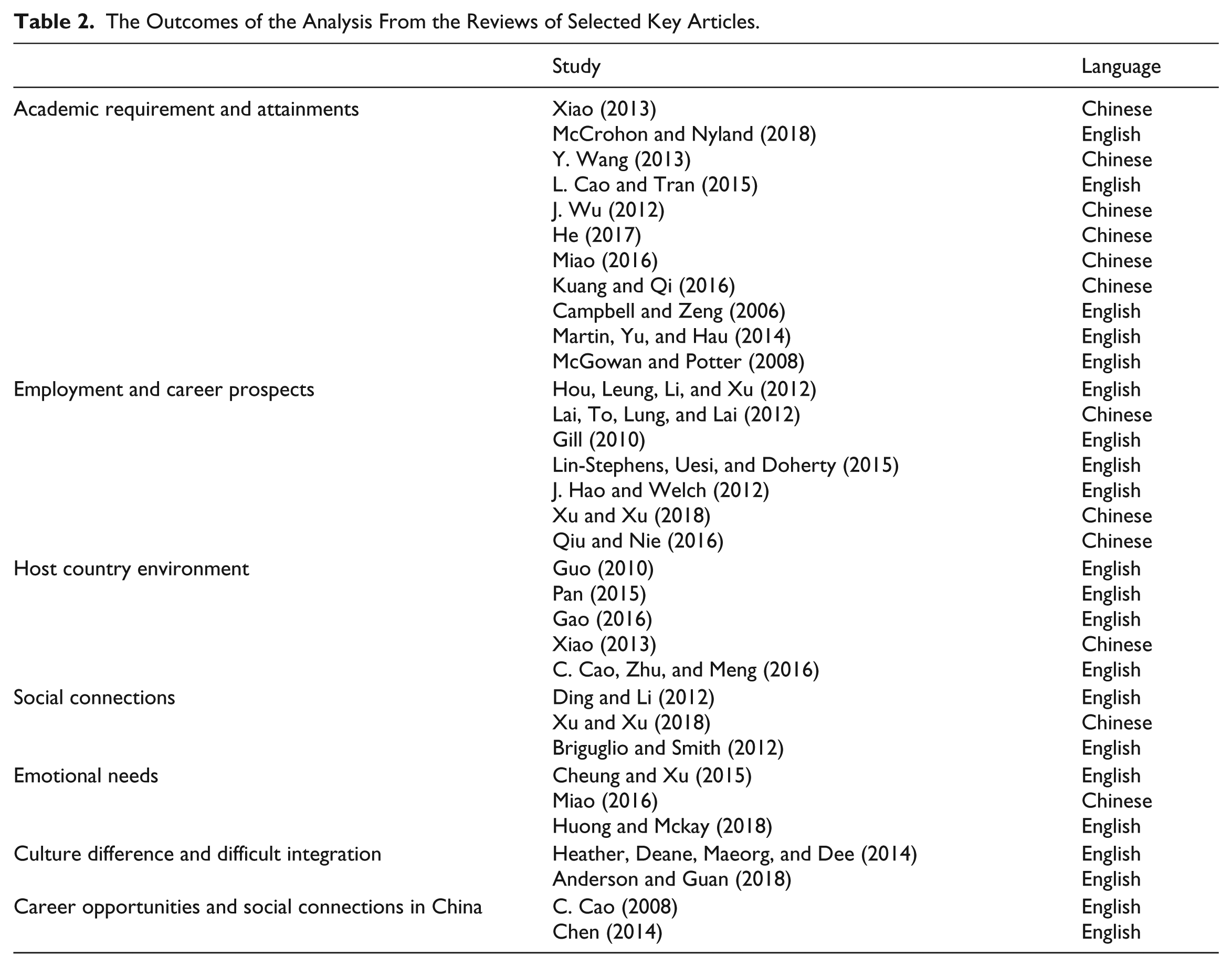
After reviewing the 68 selected articles, we categorized all codes into more concentrated themes. Four main themes of studying in Australia are categorized, including academic requirement, university reputation and ranking in Australia, future career prospects, host country environment, and social connections. Three themes for returning include emotional needs, culture difference and difficult integration, and career opportunities and social connections in China. We read every selected article to make sure we correctly understood the main issue in the articles. In this process, we found some miscoded articles and reassigned them to correct group. Besides, to share the evidence and outcomes of the key selected articles and the justification from the emerging themes with readers, we show the review outcomes of some key articles in Table 2 in which seven themes, including 4 for studying in Australia and 3 for coming back. More importantly, we conducted quality assessment with the help of AMSTAR. Through the assessment results, we can conclude that the systematic review is convincing and valid.
The Outcomes of the Analysis From the Reviews of Selected Key Articles.
Themes for Choosing Australia as Higher Education Destination
According to the coding results, four main themes were developed (Figure 1). In Figure 1, the two numbers in the parentheses represent the number of English language articles and Chinese language articles, respectively. In Figure 1, the four main categories were unpacked into subcategories. Based on the reviewed articles, push-pull theory framework is widely used (C. Cao et al., 2016; Maringe & Carter, 2007; Tian, 2003). This systematic review was also based on push-pull theory when we coded all factors. However, based on reviewed articles, all of them concentrated on pulling factors and studied why Australia can attract Chinese students. Only a few discussed the problems of China’s higher education and saw them as pushing factors. Because these pushing factors did not concentrate on Australian context, this study did not code them. Thus, it did not affect the review results.
Academic requirement and attainment
The theme, academic requirement and attainment, consists of three subcategories: the relatively low entry requirements, the high reputation of Australian universities, and the symbolic capital of studying in Australia.
After 1980s, Australia implemented opening policies for promoting industrialization of education export. By 2025, Australia aims to admit more than 100 million international students (Bryant & Wells, 2002). Due to the Australian national policies, a Chinese student has a variety of pathways of getting Australian higher education, including formal application, vocational education, foundation course, and so on (Xiao, 2013). The flexible entry paths and lower entry requirements are keys for attracting Chinese students (X. Ma & Abbott, 2006). Chinese students are all experiencing rigorous examination system in China (Kuang & Qi, 2016). Numerous Chinese students who cannot secure their places in China’s top universities turn to overseas higher education (Tsang, 2013), so studying abroad can be seen as an alternative choice for these students. Besides, compared with the university entry requirements in the United Kingdom and the United States, Australian universities have lower admission requirements in recruiting international students (Xiao, 2013), which is essential for attracting Chinese students (Y. Wang, 2013). Although Australian higher education has relatively low entry requirements, Australia has abundant qualified education recourses (L. Cao & Tran, 2015). Looking into various university rankings, Australia has the third largest number of top universities, following the United States and the United Kingdom, indicating that Australian universities have good academic reputation in the world (Mazzarol, Soutar, Smart, & Choo, 2001; McCrohon & Nyland, 2018; C. Wang et al., 2015; J. Wu, 2012). Due to its perceived academic reputation (Iannelli & Huang, 2013), Australia is a popular study destination for Chinese students. Many Chinese students also choose Australian vocational education as their educational pathway (L. Cao & Tran, 2015). Although Australian higher education is endowed with good reputation, Chinese students acquire less knowledge and have less satisfactory study experiencing in Australia than expected (McCrohon & Nyland, 2018). The unbalance between high costs of studying in Australia and the low quality of teaching and learning is the main problem for Chinese students. However, the dilemma does not affect the enthusiastic pursuit of Australian higher education, because more and more Chinese students are going to pursue symbolic capital through getting higher education degrees from Australia (L. J. C. Ma & Cartier, 2003) and cultural capital (Cheng et al., 2018; Gerard & Uebelmesser, 2014; Moskal & Schweisfurth, 2018) rather than focus on educational attainment. University symbolic capital is more important than the quality of department in the process of international academic mobility (Gerhards et al., 2018), and thus many Chinese students choose Australian university out of its symbolic capital. In addition to symbolic capital of a university, Chinese students are motivated by returnee aureole (He, 2017). Although the symbolic capital is not as strong as it was in the 20th century, the symbolic capital is still playing positive roles in returnee’s future development in China.
Employment and future career prospects
In addition to academic training, employment and future career prospects gain much attention when choosing Australian higher education (Hou, Leung, Li, & Xu, 2012). With the standpoint of consumer value, the functional and pragmatic value of a degree is a key factor regarding Chinese students’ choice (Lai, To, Lung, & Lai, 2012). Cultural awareness, changes in worldviews, and cosmopolitanism are enhanced through international academic mobility (Collins, 2013; Gill, 2010), and these are positive elements when finding jobs in China (Cozart & Rojewski, 2015). Through studying in Australia, Chinese students obtain substantial benefits, including hard currencies and soft currencies. However, among the returnees from Australia, soft outcomes, including personal and life fulfillment, are seen more important than hard outcomes such as employment results (Lin-Stephens, Uesi, & Doherty, 2015). J. Hao and Welch (2012) examine the job-seeking of Chinese students who have taken advanced degree from Australia and find these returnees meet challenges in China’s labor market. Although they have adequate employment results, they meet a series of problems in identity and career development perceptions. We can conclude that the career development is a core consideration when Chinese students choose overseas higher education destinations. Among Chinese students studying in Australia, they also prioritize future career prospect when they choose overseas study destination (Xu & Xu, 2018). According to the reviewed articles, a large number of returnees from Australia have good employment results and positive career development. With respect to future development, returnees, no matter where they gain their higher education degrees from Australia, have more opportunities of getting promotions than their peers (Qiu & Nie, 2016).
Host country environment
Host country environment is made up of three subcategories: natural, immigration, and living community. Australia is famous for good natural environment, and this is an important factor influencing Chinese students (C. Cao et al., 2016; Xu & Xu, 2018). Australia has a series of immigration policies and welcomes talents from all over the world, so it is easy and convenient to obtain a study visa (Xiao, 2013). After graduating, Chinese students have a large number of opportunities of being a permanent resident in Australia (Guo, 2010), which is rather divergent from the United States and the United Kingdom. Post-migration is one of the positive adaptation outcomes, and Chinese students develop a moderate level of post-migration growth in Australia (Pan, 2015). This is the main motivating factor influencing Chinese students’ choice. Besides, different from other western countries, Australia is a country with many large Chinese communities (Gao, 2016). Through connections with local Chinese communities, Chinese students in Australia can acquire knowledge, including job market information and entrepreneurial endeavor. The Chinese community in Australia can provide much help for Chinese students whose first language is not English. Chinese language and culture identity determine Chinese students to prefer staying in a comfort zone.
Social connections
Social connection has strong positive and significant effects on Chinese students when choosing destination for studying abroad (Ding & Li, 2012). According to Bourdieu’s culture theory, people with similar taste, education, and lifestyle would easily come into a same field and enter a same social class (Bourdieu & Randal, 1993), which can also be applied for Chinese overseas students. Social connection is also an important factor according to the analytical results of the 68 reviewed articles. Pursuing intercultural communication in English language is an important aspect for Chinese students when they determine to study abroad, so Australian context and Australian culture can provide the opportunities for Chinese students (Briguglio & Smith, 2012). Besides, Chinese students increasingly pay attention to social connections of alumni and see classmates as an important factor when choosing Australian universities (Xu & Xu, 2018). As the third largest host country receiving Chinese students, Australia could provide Chinese students with plenty of platforms for social connections. According to the coding results, alumni connections are important for entrepreneurs (Ding & Li, 2012). More importantly, social connection is integrated with Chinese student’s future career prospects and migration (Guo, 2010).
Themes for Returning to China
According to the results of coding, there are three main themes of motivations for returning (Figure 2). In Figure 2, the two numbers in the parentheses represent the number of English language articles and Chinese language ones, respectively.
This theme of emotional needs is made up of two subcategories: family tie and loneliness abroad. Family tie is a significant factor that attracts Chinese international students to come back to China (Cheung & Xu, 2015). Based on the 68 reviewed articles, it is also an important factor for Chinese students. In addition, loneliness in Australia is another emotional problem for Chinese students (Heather, Deane, Maeorg, & Dee, 2014; Miao, 2016). The intercultural communications are difficult for Chinese students whose first language is not English (Anderson & Guan, 2018; Miao, 2016), and thus integration into Australian society is a large challenge for Chinese students. In addition to the language, different cultural values are also a major barrier (Miao, 2016). Although Australia has a series of friendly migration policies and cultural diversity, social integration in Australia is still a major challenge for Chinese students, which pushes Chinese students to come back to China. China is experiencing the dramatic development, and its economic growth needs plenty of talents. The majority of Chinese students choose to come back after they finish studying in Australia, because there are better career opportunities in China (Cebolla-Boado et al., 2018). Finally, in Chinese culture, guanxi (social connections) is still playing significant roles in individual career development (C. Cao, 2008; Chen, 2014). Most of the graduates from international or transnational higher education institutions come from relatively advantaged family backgrounds and attain their first job through their social network (Mok, Han, Jiang, & Zhang, 2017). Therefore, for many Chinese students, career development can be better in China than in Australia.
Discussion and Conclusion
Rich existing research has concluded comprehensive factors based on pull-push theory such as mobility cost (Naidoo, 2007); economic status of home country (Naidoo, 2007); quality and reputation of host institutions (Van Bouwel & Reinhilde, 2013); future career prospects (Parey & Waldinger, 2011); a clean, safe, English-speaking environment and the quality of the educational facilities (Melissa & Dongkoo, 2017); and interest in mobility (Li & Bray, 2007). Among a series of factors, some of them cannot be applied to analyze Chinese students in Australia. Much research discussing factors influencing Chinese students’ choice of studying abroad does not have a specific context. The different host countries have divergent pulling factors, and there are a large number of controversial findings (X. Hao et al., 2017). Facing the research gap, this systematic review provides a big picture based on the fragmented studies. Based on the 68 reviewed articles, there is not controversial finding, which may result from the small number of relevant articles. Regarding the research methods, there is a significant increasing number of research using quantitative methods in Chinese articles, and qualitative methods are widely used in English articles and there are several review articles in English. The English articles and Chinese articles can be complementary to each other.
Although existing studies have concluded a series of factors influencing Chinese students’ international academic mobility, they did not focus on a specific context (X. Hao et al., 2017). Moreover, there is limited research exploring the factors influencing Chinese students choosing Australia as their overseas study destination (C. Wang et al., 2015). This systematic review fills the gap and contributes to a comprehensive understanding of international Chinese students and their perceptions of returning. The findings suggest that there are four main factors influencing Chinese student’s choice, including entry requirement, education reputation and symbolic capital, employment and future career prospects, host country environment, and social connections. Besides, there are three main categories explaining why Chinese students return to China after accomplishing higher education in Australia. The results can be explained by pull-push theory and capital theory. All factors discussed in this systematic review can be retrieved in Tian’s (2003) and C. Cao et al.’s (2016) research. The two articles, based on pull-push theory, explain all factors. In this systematic review, the pulling factors include China’s fast development, good career opportunities, and existing social connections in China. The pushing factors include difficult integration into local society, language problem, different cultures and values, family ties, and loneliness. All themes are derived from extant research. Because we set the context in Australia, the results are more concentrated.
According to the above research results, this systematic review can provide policy implications for the international student recruitment of Australian international higher education and China’s domestic higher education development. This study is essential for Australian higher education to take Chinese student’s educational expectations into consideration and enhance their educational experience to attract more international students. Australian universities should promote quality and reputation of universities, updating flexible admission requirements and establishing more intercultural communication platforms for Chinese students. The friendly immigration policies are always an important pull factor for Chinese students. In addition, the safe and beautiful environment of Australia is noticed by more and more Chinese students. For China’s domestic higher education development, these implications are also applicable. China needs to consider adopting flexible entry assessment to widen higher education participation. Nevertheless, the single means of higher education massification makes the higher education entry more competitive.
For future research, more attention should be paid to in this research field, because under the third wave of international student mobility, Australia becomes the third largest country with stable increase of hosting Chinese students. Besides, more demographic factors are required to be considered, including gender, age, marital status, and duration of stay overseas (Moskal, 2018). There is a need to conduct studies supported by rigorous research design and large samples. More robust research and empirical support are needed for future research.
Footnotes
Declaration of Conflicting Interests
Funding
ORCID iDs
