







Abstract
Introduction
Many studies have been conducted in an attempt to understand how the expectations of return and perceived risks are identified when evaluating a business plan, demonstrating the importance and justification of the theme in this study (Bucciol et al., 2017; Zhang et al., 2018). One of the recent methodologies used to identify the expectations of return and perceived risks is the multi-index methodology, initially proposed by A. Souza and Clemente (2009).
The essence of the multi-index methodology consists of (a) not incorporating the premium for the risk as a spread on the minimum attractiveness rate (MARR); (b) expressing the profitability of the project through added return resulting from the investment (return on investment assets [ROIA]) as an additional return beyond what would be received by the application of capital in low-risk securities; and (c) comparing the expected gains with the perceived risks of each project (A. Souza & Clemente, 2012). In the recent literature, the multi-index methodology has been validated by several studies, mainly with regard to decision-making processes in business plans (Bendlin et al., 2017; Harzer et al., 2016; Strapasson et al., 2018).
The term “business plan” is not unheard of in academia. Its importance to the success of a project had already been highlighted by Headings (1958) and its scope was extended by Gold (1973) to emphasize the need for innovation in new products, processes, and especially in organizational structure innovation. The scope is widened even more by Gold (1973) and Shanklin (1979), who underscored that the business plan came to be seen in the 1970s as a tool for medium- and long-term planning. Two decades later, the business plan assumed the status of “strategic” (Kaplan & Norton, 1997). According to these authors, it is strategic because its objectives, target consumers, and products or services to be offered to the market must be defined.
“Enterprising,” “adding value,” and “business plan” are among the most commonly used expressions among decision-makers for investments in real assets (Anderson & Lent, 2017; Simón-Moya & Revuelto-Taboada, 2016). It is no coincidence that these guidelines directed the decision to start a business unit to add value to the tilapia production chain. The existing regional production arrangements (tilapia production, leather treatment, leather sewing in panels, sewing the final product, and marketing fairs) guided the option for the cost leadership strategy regarding the decision to invest in a factory of tilapia leather purses, focusing on women buyers. This combination provided the elements required in this project’s risk and return to assist the decision-making process regarding the implementation of this business unit. Thus, the research question as a whole addresses and analyzes whether the strategy of cost leadership (Block et al., 2015; Ramaswamy & Ozcan, 2018; Shank & Govindarajan, 1993) formed from the intensive use of regional productive arrangements enables the project in terms of return and risk dimensions. The originality of this research lies in the use of the multi-index methodology, which, in addition to positioning the business plan as a necessary and inherent element in the strategic process, also specifies, as its analysis prerequisite, the perception of the risks involved in decision-making.
This business plan analysis discusses issues such as strategic positioning, marketing planning, product and market characteristics, and indicators of risk and return, which support the decision-making process with regard to investing in a new business unit. The strategy selection was discussed by considering environmental analyses, market research, trends, opportunities, and threats for inclusion in the national and international market.
According to Noriega and Carvajal (2011), it is important to note that the business world constantly undergoes transformation, resulting in profound changes in management technologies, production technology, and consumer habits. In general, a business unit needs to be monitored by establishing a system to track trends and important developments, with political, economic, and environmental understanding beyond the opportunities and threats that permeate the business under analysis (Melo & Alcantara, 2012). Thus, this permanent monitoring and revision consolidates the notion of removing the business plan from its view as an event, consolidating it as a process. Thereafter, it should be clarified that it is not enough simply to have an idea, a new creation, or a new conception to produce wealth: It takes planning, control, and analysis to bring certain projects to fruition (Beheshti et al., 2012). Thus, one might realize that proactive management and good planning for the effective use of available human, material, and financial resources are a good start for the success of enterprises. Following this dynamic, it is argued that a business plan can be developed by business undertakers when there is an intention to start a business. Otherwise, it can be used as an instrument of the internal marketing management (Melo & Alcantara, 2012). The use of strategic plans or a business plan is a dynamic, participatory, continuous, and systemic process because it aims to determine the strategies and actions to be taken by the company, in addition to being a relevant instrument for dealing with changes in the internal and external environment.
To develop a business plan, as well as a strategic plan, the company’s business and its activities, target consumers, corporate training, taxation regime, and, especially, what options are available to entrepreneurs if the future is substantially other than expected should be made clear. Furthermore, the mission, view, and values of the company must be developed, showing the company’s positioning and business objectives (Kotler, 2010). Therefore, one can see that the business plan has become an increasingly important tool for anticipating the results of the scenarios of a business unit even before its implementation, and that not only is the return a decisive parameter, but so is the perception of the risks involved in this new business. All of these are summarized in a perceptual map for decision-making. Following this theoretical line, the purpose of this article is to identify the expectations of return and perceived risks in evaluating a business plan for the deployment of a manufacturing unit of purses made of tilapia leather in the city of Campo Mourão in Paraná State in the south of Brazil. We sought to analyze the business plan with the support of the multi-index methodology, which uses a perceptual map to compare the expectations of return against perceived risks (Bendlin et al., 2016; Niven, 2005; M. L. R. Souza et al., 2003; Torrico et al., 2016).
In addition to this introduction, this article is structured into seven parts: a systemic view of the commercial exploitation of the tilapia production chain as an alternative income for small and medium-sized business undertakers, the theoretical basis, market characterization, methodological aspects, systematization of the information, feasibility analysis by means of the multi-index methodology, and, last but not least, the final considerations.
Materials and Methods
Theoretical Foundation for the Logic of Enterprising
According to Guimarães (1987), in the theoretical framework of the Theory of the Growth of the Firm, the firm is the
Given these assertions that induce growth through new investments (i.e., new projects), let us examine the following consideration: If, on one hand, investors seek new heights of profitability through new projects, on the other, they also want to know the risks associated with these decisions. Therefore, to measure return expectations and risks perceptions, it is essential to use the appropriate tools to analyze investment decisions involving real assets. Still, these decisions are complex because they require medium- or long-term projections and involve a large sum of resources. In general, they are irreversible and/or have a high cost of reversibility and may consolidate a trajectory of expansion or jeopardize the survival of the firm (A. Souza & Clemente, 2012). The complexities of these scenarios depend on the manner that the strategy makers perceive the uncertainties and risks and also their skills in mitigating the associated risks (Rêgo et al., 2015). Following this, the process of implementing the strategy in competitive advantage, and the investment project and its related analysis is nothing more than the details of the resources needed and their respective monetary values vis-à-vis the cash flow of expected benefits arising from this decision and the perception of the risks associated with it (Dalmoro & Wittmann, 2011).
From World War II until the mid-1970s, in a market environment with low competitiveness, abundant consumption, and a rigid production system, risk and uncertainty were considered relatively low and demand was practically stable (Penrose, 2006). In this relatively stable environment, the classical methodology with a deterministic approach for the evaluation of investment fulfilled its role well. From the moment when such conditions no longer existed and the dynamics of production, distribution, and consumer satisfaction changed, the risks inherent to investment projects led to the improvement of the analysis methodologies.
The Multi-Index Methodology
There are three major categories for analyzing investment decision-making: the Classical Methodology, Theory of Real Options, and Multi-Index Methodology (Penrose, 2006). All of these methods rely on the discounted cash flow and are in agreement to a certain extent with the analysis of the expected return, but differ in the analysis of risk perception. These differences depend on the way that the MARR is estimated, cash flow dynamic capabilities incorporate new information, and how the sensitivity analysis on key metrics of each assessment is undertaken (Nogas et al., 2011).
The advantages of using the multi-index methodology to generate indicators of risk and return and the use of the perceptual map to compare the expectations of return with the perceived risks are highlighted by Torrico et al. (2016) and Rêgo et al. (2015). This methodology makes use of two distinct groups of indicators for evaluating the expectations of return and risk perception. The first group is represented by the net present value (NPV), yearly NPV, benefit–cost index, and additional return that resulted from the investment (ROIA). The second group seeks to represent, on a scale of 0 to 1, the perception of the risks inherent to the project and is composed of the MARR/internal rate of return (IRR) index as a proxy of P(NPV ≤ 0), payback/N index as a proxy of the risk of nonrecovery of the invested capital, and degree of commitment of the income to represent operational risk, management risk, and business risk.
The essence of the multi-index methodology consists of not incorporating the premium for the risk as a spread on the MARR (A. Souza & Clemente, 2012). By not incorporating the spread for the risk over the MARR, this happens to be represented by an almost risk-free application and will always be an option in relation to the capital investment in analysis. Figure 1 presents the multi-index methodology characteristics and some of the peculiarities. Thus, for the multi-index methodology, there is always the option of not investing in the project and leaving the investment capital applied in the MARR.

Multi-index methodology characteristics.
According to, multi-index methodology has proved to be consistent for analyzing small and medium-sized projects, and its use has been widespread in academia, in undergraduate, master’s, and PhD dissertations, as well as in several scientific articles published in scientific journals and conference proceedings. The importance of its use for the purpose of having more robust and consistent information in relation to the risk and return of certain investment projects was observed given these considerations. Figure 2 summarizes the process of using the multi-index methodology, starting with strategy, marketing, and sales forecast.

Overview of the multi-index methodology.
The great difference of the multi-index methodology is that it is not simply a cash flow analysis tool. It is part of the whole strategic process and attempts to summarize it into a set of indicators and a perceptual map that allows the decision-maker to evaluate whether the expected return is compatible with the perceived risks. Thus, all information from here on is necessary for using the multi-index methodology.
A Systemic View of the Commercial Exploitation of Tilapia
To Ênio Queijada, manager of the Agribusiness Sector of the Brazilian Service of Support for Micro and Small Enterprises (Serviço Brasileiro de Apoio às Micro e Pequenas Empresas [SEBRAE], 2015), tilapia is the most cultivated fish species in Brazil, representing 47% of national production. Due to its quick weight gain (800 g in 6 months), fish farmers love tilapia. The coproducts of tilapia are shown in Figure 3: (a) human food and (b) leather for industrial objects and raw material for animal food (Andrade, 2015).

Tilapia and its coproducts.
It is clear that the business’s “flagship” derives from the fact that tilapia meat is greatly accepted by the Brazilian population. According to the Instituto Brasileiro de Geografia e Estatistica (IBGE, 2016), tilapia production in Brazil went from 95,000 tons in 2011 to 219,000 tons in 2015 and as much as 400,280 in 2018. Currently, five Brazilian states account for approximately 75% of the national production of tilapia, and 90% of this production is concentrated in only 10 states. Paraná State, located in southern Brazil, stands out with approximately 28% of national production. Table 1 illustrates this situation, emphasizing (a) the state where production occurs, (b) the price per kilogram traded, (c) the value, and (d) the average price.
Main Tilapia-Producing States in Brazil (Data of 2015).

Paraná is the leader in tilapia cultivation in Brazil. This is partly due to the expansion of cold storage, slaughterhouses, cooperatives, and, especially, the technical assistance provided by EMATER (Paraná Institute of Technical Assistance and Rural Extension). Most small and medium-sized rural aquaculture–oriented producers working in cooperative systems and who rely on the support of AQUIPAR (Association of Fish Farmers in the West of Paraná) are concentrated in the western region of the state. The relationship network formed by these players and the higher education institutions (federal, state, and private Universities) operating in the region form the basis for local production arrangements with the systemic competitiveness of this agribusiness. Figure 4 presents tilapia’s production chain in the Paraná state and a clear overview of this local production arrangement. We highlight the city of Cianorte, capital of clothing in Paraná, the hub of factories, which attracts buyers from all over Brazil and will serve as a presentation and testing spot for fashion trends.

Tilapia’s production chain.
Highly valued in the market, fish leather has become a source of income for fish farmers and artisans in the production of shoes, clothes, and accessories such as handbags, necklaces, and even furniture (Centre for the Brazilian Tanning Industry, 2015). In Brazil, besides tilapia (whose production has been growing rapidly due to parks and the increased demand for fish meat), there are many freshwater fish whose skins are suitable for tanning (SEBRAE, 2015). The choice of tilapia as a source of raw material is due to the fact that its leather has a low value because it is considered a pesky residue by fish processors, and after tanning, it results in a raw material of an inimitable and unique-looking quality, due to its resistance and the pattern that forms on its surface, especially the skins of fish with scales (SEBRAE, 2015). According to Godoy et al. (2010), the leather with the greatest elasticity is fish leather, and it is also easier to achieve the proper thickness for artifacts made of leather. After tanning, the skins of species can be transformed into a type of leather as resistant as cow leather (Strzelczyk et al., 1997). Figure 5 illustrates the result of tanned tilapia leather.

Tilapia leather, post-dyeing process.
Characteristics such as the resistance of raw materials, exotic and environmental aspects, applicability to various products, and high added value have aroused the interest of many entrepreneurs. The skin of the fish can be obtained directly from the fish processing industry and from artisanal fishermen. In the case of the fish industry, the entire process takes place in its own tannery (SEBRAE, 2015). As for artisanal fishers, they can be trained in the techniques of conserving and storing several fish skins before marketing them (Loizou et al., 2014). Despite the findings of M. L. R. Souza et al. (2003) that “the development of leather, from residual skins of the fish filleting process for the manufacture of leather and clothing, has for some years been an alternative source of income,” the fish skin is mostly discarded after slaughter (Bellmann et al., 2016). This finding shows that, from a systemic and local production arrangements view, an alternative source of income for medium and small farmers/producers can be glimpsed.
If Brazil is a quality leather importer, substituting it with another leather of equal quality and resistance and a better visual appeal emerges as a business opportunity, and fish leather can occupy this space (Moreira et al., 2016). Fish leather is increasingly used in the manufacture of purses and is considered a great potential for Brazil (Brazilian Society of Agriculture, 2015). The country can become one of the largest fish producers in the world in the medium term because it has favorable conditions for aquaculture: climate, availability of grains for the production of fish food, and water (Roriz et al., 2017). Furthermore, fish leather is 3 times stronger than hide, not to mention that the authorization of this commercialization does not depend on Brazilian Institute of the Environment and Natural Resources (IBAMA).
Producers of leather handbags and accessories should have their own sales point to ensure the feasibility of the business. It is also essential for them to have several distribution channels, and this is precisely where the business undertaker meets the greatest obstacles to marketing the product (Roriz et al., 2017). It is interesting for the business undertaker to have a contract with exporters for the production of bags with the retailer’s own brand, which is an option that lowers the costs of marketing, as it does not require high investments in advertising and publicity to disseminate the maker’s brand. It also ensures access to thousands of consumers.
Competition Strategies
One of the main goals of strategic planning in companies is to expand levels of rationality in business decisions through the understanding of internal and external factors that influence or determine its operation. To address these factors, managers can react to them appropriately, and if well executed, strategic planning provides organizations with greater capacity for anticipation (Kotler, 2010; Veiga et al., 2016).
Corporate strategy summarizes the purpose, the
In the process of refining the concept of the business strategy, it is categorized into four aspects: market penetration, product development, market development, and diversification (Ansoff, 1965). One more step in the refinement process was given by Porter (1980), who proposed three generic strategies: cost leadership, differentiation, and focus. According to the latter author, cost leadership strategies and differentiation seek competitive advantages in a wide range of industrial segments, while the focus of strategy is a cost advantage (focus on cost) or a differentiation (focus on differentiation) in a well-defined segment. Furthermore, it is pointed out that the differentiation strategy focuses on the product offered from the perspective of the customer, who should perceive some characteristics that add value to the product (Mintzberg, 1988). To this author, there are six basic ways for a company to differentiate its offerings: price, image, product support, perceived quality, attention-seeking design, and imitation (nondifferentiation).
Among the strategies highlighted above, it was observed through an analysis of the leather bag market that a combination of cost leadership and differentiation is required. As for the differentiation, a design with a strong visual appeal, combining aspects of attractiveness and sustainability, is sought to put on the market products that meet the target audience of fashionable and influential women. For this reason, the strategy is one of constant design innovation in an attempt to anticipate fashion trends. Some possible designs for the first launch on the market are shown in Figure 6.

Designs for tilapia leather bags.
The brand is essential in this process because it identifies the origin or the manufacturer of the product and trust. It also determines the quality and retains loyal consumers, resulting in more stable demand (Kotler, 2000). The brand for the project was chosen by consensus among its creators, and the name
Relevant Players
The firm, as a
According to Tagliassuchi (1986), the barriers to entry are considered co-regulators of conduct and performance of the company. In the case of
Methodological Aspects of the Study
This is applied research of a descriptive and explanatory nature with regard to its objectives. At the same time, it is a constructive case study with regard to the strategy employed to address the problem. Data were collected through bibliographic research, the analysis of documents pertaining to the operational cycle of the activities of a company that already produces tilapia leather bags, and unstructured interviews with the unit’s manager. The data analysis is qualitative concerning the perception of risks and quantitative regarding the estimation of return indicators and the sensitivity analysis of the results. The purpose of this survey was to provide details on investments, costs, and productivity, as well as the risks associated with this agribusiness. The practical benefits of this study are that it generates and systematizes the information required according to the various stages of the drafting of a business plan. This information is systematized according to the methodology used (multi-index), with the intention of aiding decision-making on investments in real assets.
Presentation of the Results
Figure 7 presents the specifications of the four products and their marketing prices (R$340, R$430, R$550, and R$700), and the annual estimates of demand, production units, initial investment, and production costs are also estimated.

Price, participation in the mix, and expected demand of products.
To meet the level of production and sales, the remaining investment was estimated at R$420,000 (fixed assets, R$150,000; preoperational expenses, R$140,000; and initial working capital, R$130,000). Due the limitation of equity, 40% of the initial investment will be financed with third-party capital at a cost of 14% per year. For the calculation of the variable cost per unit of goods, aspects of resistance of the leather to be used and the quality and visual appeal of the final product were considered. Table 2 illustrates the unit variable costs related to Product 1. Similarly, the variable costs per unit of Products 2, 3, and 4 were estimated, resulting in R$285.14, R$365.14, and R$445.14, respectively.
Variable Cost Per Unit—Purse Model 1.

Figure 8 presents the demand expectancy, variable unit costs, and budgets (production, commercial expenses, and administrative expenses) allowed for the projection of the Income Statement using the direct costing method and Brazilian National Simple Tax. Relevant information on demand, cost, and operating expenses and profit after taxes is shown in Figure 8.

Estimates of sales revenue, income, and profit.
After a few adjustments, the profit flow is converted into cash flow representative of the business plan as shown in Table 3—investor’s cash flow.
Investor’s Cash Flow.

Analysis and Discussion of the Results
The first step for the analysis of the feasibility of the business plan is the construction of the projected cash flow. The second is to fixate the discount rate. For the current context, the recent Monetary Policy Committee (

Project feasibility indicators.
For a better understanding, it is important to stress the interpretation of some specific indicators of the multi-index methodology, as shown in Figure 10.

Specific indicators of the multi-index methodology.
Figure 11 presents the results of the multi-index methodology that are synthesized in the perceptual map, enabling a perception of the magnitude of the gains and risks. In this map, the business plan receives the green light to enter into business if the perceived risks are in the same ROIA column or to its left. If that does not occur, further analyses and adjustments will be necessary.
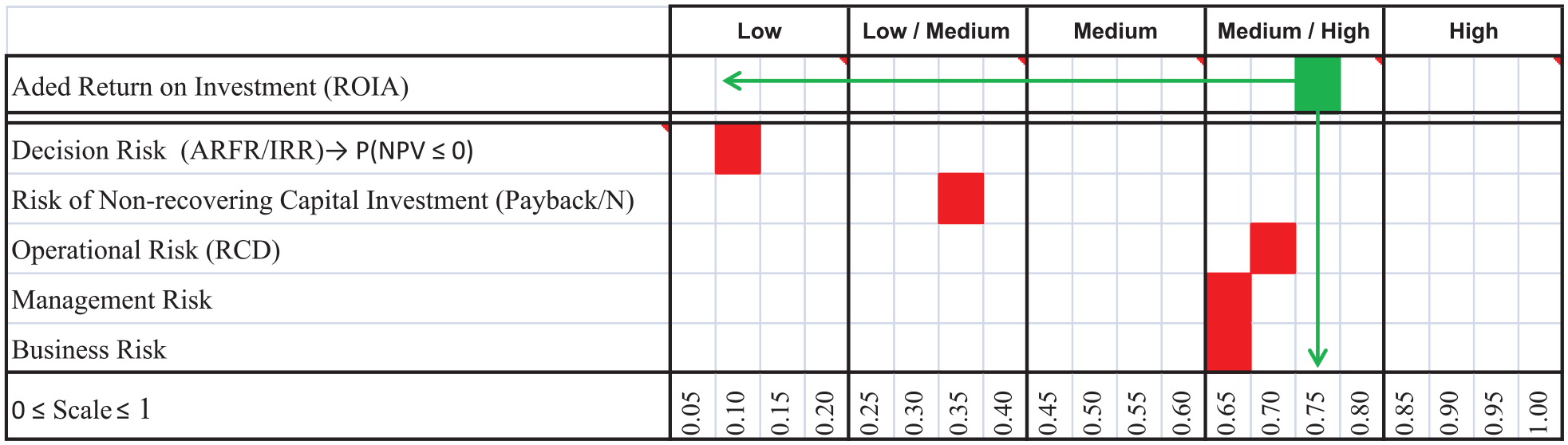
Multi-index methodology perceptual map.
The perceptual map shows that the perceived risks are consistent with expectations of return (all risks are on the left side of the return), thereby suggesting that the business undertaking will be continued. It is important to note that the results that were presented were estimated for the most likely scenario. It is clear that, in alternative scenarios (pessimistic, optimistic, or any combination of these), the results may not remain unchanged. To better substantiate the decision, it is important to estimate P(NPV ≤ 0) for scenarios that consider the uncertainties in the parameters of demand, the selling price, and the cost of leather. For this purpose, Crystal Ball software was used. The hypotheses were as follows: variation of ±10% in demand and selling price (uniform distribution), −20% and +10% around the most likely value for the cost of leather (triangular distribution), and ±5 percentage points in annual growth rates. Figures 12 and 13 represent the probability distribution for the NPV and ROIA, respectively.

NPV—probability density function.

ROIA probability density function.
Figure 12 suggests that the result of the simulation of different scenarios depending on the variations of demand parameters, selling price, cost of acquisition of leather, and the demand growth rate is compatible with the recommendation by the multi-index methodology and that for conventional cash flows if the MARR/IRR index is ≤ 0.60, then P(NPV ≤ 0) ≤ 0.05. Here, it easy to see an important theoretical finding of the multi-index methodology, which is the possibility of creating a proxy of P(NPV ≤ 0) from the MARR/IRR ratio when it is less than 0.66 without any further calculation whatsoever. Another important outcome can be seen in Figure 13. It is observed that the probability of practically doubling the gain (retrieving the ARFR and then duplicating its value) is approximately .50. This information co-substantiates the decision to invest in the business of tilapia leather bags.
Final Considerations
The main aim of this article was to show that the multi-index methodology imposes more rigorous analysis in the discussion of risks and specification of a business plan. To do so, we analyzed, through a case study, the expectancy of return and perceived risks of a business plan to produce and commercialize women’s handbags made of tilapia leather in the city of Campo Mourão, in the southern Brazilian state of Paraná. To achieve this goal, relevant information was collected through document research and semi-structured interviews, which were conducted in 2016 and 2017. For this purpose, analyses were performed regarding the strategic positioning, marketing appeals, location that provided better synergy with existing local production arrangements, and, finally, the use of the multi-index methodology to compare the expected return with the perceived risks.
For the most likely scenario, the multi-index methodology perceptual map signals a medium/high return, and the perceived risks are compatible with profit expectations. The ROIA, which, according to the multi-index methodology, is the scorecard that best represents the profitability of a project, was estimated at 23.71% per year, meaning that if the decision to invest is taken, the profit expected to be recovered has been applied on ARFR (12%), and an additional return of 23.71% is obtained, which would total to around 36% per year.
The most critical risks perceived were the management risks and the business risk. This was due to the Group Manager having no previous experience with this kind of business and especially no experience of working with the players to show the potential of cooperative arrangements for the production of tilapia leather in large quantities and, thus, reduce the cost of raw materials. Regarding the business risk, there is a natural concern regarding environmental legislation, to the extent that as the commercial exploitation of natural environments intensifies, phytosanitary problems may arise, forcing the suspension of the activity for a period of time before the natural conditions are reestablished.
To compare the results of this study with previous works in the literature (Rae et al., 2014), we performed a sensitivity analysis of the proposed methodology. Crystal Ball software was used, and simultaneous variations were allowed in the parameters of the business plan, namely, demand (variation of ±10% according to the uniform distribution), selling price (variation of ±10% according to the uniform distribution), cost of acquisition of raw material leather (variation of −20% and +10% around the most likely value—triangular distribution), and rate of growth of the quantities sold (±5 percentage points according to a uniform distribution). The results of this analysis, using the Monte Carlo method, showed that P(NPV ≤ 0) ≈ 0.0002 and P(ROIA > 2 × almost risk-free rate) ≈ 48%, backing the decision to invest in the business.
In short, in addition to the results presented, four main contributions of this research can be highlighted. The first contribution is positioning the business plan as an integral part of the strategic process to increase the profitability of the investor capital. The second contribution is that this study can stimulate actions to drive the decision-making process toward a direct comparison of estimated returns versus perceived risks. The third contribution is the introduction of the multi-index methodology as a feasible technique for analyzing the business plans of small and medium-sized enterprises. The fourth is a theoretical finding that allows the easy estimation of a proxy of P(NPV ≤ 0) from the MARR/IRR ratio without any further calculation whatsoever when this ratio is lower than 0.64 (Harzer, 2016). All these contributions are important because they improve the decision-maker’s perceptions of risks and returns of business plans, especially when a broader view of the factors involved is required.
Future studies on the entire utilization of tilapia, with a focus on collaborative processes and better integration among the existing local production arrangements, could result in an improvement of the whole process of breeding, fattening, slaughter, filleting, extraction, and commercialization of leather
Footnotes
Declaration of Conflicting Interests
Funding
ORCID iD
