







Abstract
Keywords
Introduction
Besides the global cryptocurrency market, where digital assets are traded in the USD, the bourgeoning cryptocurrency markets in the emerging markets economies (EMEs) continue to hold sway. TheEMEs selected in this article include Russia, India, and China. The choice of these countries is based on the fact that they are core of the BRICS (Brazil, Russia, India, China, and South Africa) countries that represent the face of EMEs. However, we settled for Russia, India, and China because these are the only countries in the block with available data for the cryptocurrency pairs of interest. In the respective economies, trade and exchanges in digital assets are on a rapid increase in both volume and value. Innovations have also led to an increase in the number of digital currencies in these markets, making them strong and attractive to traders and portfolio investors. Given that empirical studies on the transmissions between cryptocurrencies in these economies are still embryonic, this article is contributing to extant literature by assessing the developments in these nascent cryptocurrency markets and comparing them with the evolutions in the advanced USD crypto market, with a view to understand their peculiar dynamics.
In recent years, the global financial system witnessed a new way of making payments with virtual currencies otherwise known as cryptocurrencies. Weaver (2018) opines that “the primary notion behind Bitcoin’s (BTC) design is to enable a censorship-resistant and irreversible payment system and it is intended that there should be no central authority that can say ‘thou shalt not’ or ‘thou shouldn’t have.’” An important development in the advances in encryption and network has been the emergence of digital currencies, which are driving transformational change in the world economy (He et al., 2016). Digital currencies allow for instant domestic and international transactions and serves as an effective medium for a direct peer-to-peer electronic payment that prevents transaction time and fees of going through a financial intermediary (Aloosh, 2017). Gantori et al. (2017) explains that by allowing direct and un-intermediated transactions between two parties, the process could make transacting faster and cheaper. A most popular example and largest cryptocurrency is the BTC. Being an unconventional unit of exchange, it has become imperative that investors in this new asset must understand the behaviors and the modeling of these currencies (Pärlstrand & Rydén, 2015).
A defining feature of a cryptocurrency is in its organic nature; being a decentralized currency that is outside the control of economic systems and central banks (Baumann & Lesoismier, 2018; European Central Bank, 2015) it is, as a result, insulated from political influences usually applied or instigated by governments and corporations. Aloosh (2017) argues that innovations surrounding decentralized currencies will promote customers’ welfare, significantly reduce banks’ revenues from currency trading fees, and shrink governments’ revenues from currency trading taxes.
Nonetheless, digital currency is designed to serve as a medium of exchange, using cryptography, to keep transactions secure and to control further creation of additional units of the currency (Chu et al., 2017). With increasing interest in this digital asset, the need to quantify its variation becomes necessary. It is widely acknowledged that cryptocurrencies are highly volatile compared with conventional currencies. Vejačka (2014) asserts that cryptocurrencies have extremely high volatility compared with basic investment instruments. Definitely, their exchange rates cannot be presumed to be independently and identically distributed (Chan et al., 2017).
Dyhrberg (2015) asserts that the market for computer-generated currencies has grown vastly since 2008 in terms of the number of new digital currencies, consumer base, and transaction frequency. Digital asset has culminated into a unique market where many players enter and compete. For instance, after the invention and trading of BTC in 2009, several other currencies have continued to emerge and ostensibly make a difference by improving on the shortcomings of the existing currencies (Dyhrberg, 2015). Bullard (2018) posits that currency competition is nothing new, and neither is the electronic delivery of value, and privately issued currency like the BTCs can fit into this context of many competing virtual currencies. At equilibrium, however, one type of currency need not crowd out the other—rather, both are required to allow all intended trade to occur (Bullard, 2018).
Among the most traded cryptocurrencies, beside BTC, include Litecoin (LTC), Ripple (XRP), Ethereum (ETH), Peercoin (PPC), Namecoin (NMC), Bitcoin Cash (BCH), Feathercoin (FTC), Terracoin (TRC), Dash, EOS, Novacoin (NVC), and so on. Sophistication of digital currencies and their free entry into the market has possibly induced network effects where a winner-takes-all dynamics is imminent and hugely expected (Gandal & Halaburda, 2016). When network effects set in, convergence to one single digital asset is possible. Thus, when a particular currency becomes more popular, it is perceived to be more useful and also easily attracts new users. This creates what is called reinforcement effect as opposed to substitution effect.
The reinforcement effect describes a situation where it is expected that the most popular cryptocurrency would, by and large, get even more recognized and could possibly dominate the entire market (Gandal & Halaburda, 2016). On the contrary, a user’s preference for one currency over another may be due to competition. Later currencies may have possibly fixed the deficiencies in the existing currency and, as a result, could relatively have a better appeal compared with other currencies in the market. This is called substitution effect. Gandal and Halaburda (2016) contend that the availability of better or differentiated cryptocurrencies allows for a substitution effect where it is beneficial for users to substitute one cryptocurrency for another. So far, empirical studies on the network and competition effects are sketchy and still evolving.
Most existing literature has often assumed that cryptocurrencies are only traded directly for the U.S. dollar, thereby potentially foreclosing the understanding of peculiar dynamics in other economies or markets where they are traded directly for other conventional currencies. Against this backdrop, it becomes necessary not only to analyze the reinforcement effect (due to network effect) and substitution effect dynamics (due to competition) for BTCs and Altcoins traded directly for the USD, but to also examine the narratives for trades completed directly, and particularly, for currencies of the emerging market countries. This will not only allow us to have a broader perspective in both developed and emerging markets, but will also enable us make comparisons that could have both policy and practical relevance.
Related Literature
A vast majority of studies seem to agree that the concept of an open-source currency where payments can be made directly between parties without the involvement of a financial service provider is new (Alfonso et al., 2016; Badev & Chen, 2014; Brosens & Cocuzzo, 2017; Guo & Antulov-Fantulin, 2018; Hileman & Rauchs, 2017; Lánský, 2016; Zhao, 2015). Unlike conventional money assets issued and controlled by a central authority, a cryptocurrency is a privately issued digital currency created and managed through the use of advanced encryption techniques referred to as cryptography. Cryptography, which comprises the principles of computer science, mathematics, and engineering, is the study and practice of techniques for secure communication when third parties, often called adversaries, are present (Nayak et al., 2014).
Given that private e-currencies are not issued by any central authority, they are rendered theoretically immune to government interference or manipulation (Baumann & Lesoismier, 2018). The emergence of other digital currencies has also sparked competitions and considerable volatilities in the currency market in which competition is proven to play a major role (Gandal & Hałaburda, 2014).
Gandal and Halaburda (2016) analyzed the influence of network effects on competition in the cryptocurrency market using the correlation matrix and the traditional regression analysis. The data did not provide any evidence of a winner-takes-all effect early in the crypto market, whereas for a relatively long period, a few other virtual currencies competing with BTC appreciated much more rapidly than BTC. However, BTC appreciated against the USD, whereas other digital currencies depreciated against the USD.
Francés et al. (2018) evaluated the characteristics of the daily price series of selected cryptocurrencies using the Minimum Spanning Tree (MST) and the Pearson correlations between daily returns. The results identified a high correlation between price movements for all the analyzed cryptocurrencies. In addition, the ETH, rather than BTC, was identified to have significant influence in the currency market and was attributed to its increasing popularity and rising trading volume. In contrast, Aste (2019) examined the cryptocurrency market structure as well as the collective evolution of both prices and social sentiment associated with traded cryptocurrencies. The results revealed that most major capitalized cryptocurrencies, such as BTC, play a central role in the price correlation network but that the Altcoins, with small capitalization, play a critical role in shaping the currency market structure.
Burnie (2018) employed correlation networks to detect characteristics that have influence on the evolution of currency prices over time. Excluding USD Tether (USDT), the results showed a positive association between different cryptocurrencies, which was statistically significant.
Bação et al. (2018) investigated the information transmission between major cryptocurrencies, using a vector autoregression (VAR) modeling approach. The finding indicated that most of the information transmission is basically contemporaneous, whereas the generalized impulse-response functions confirmed a strong contemporaneous correlation without evidence of lagged effects.
Zięba et al. (2019) examined interdependencies between log-returns of cryptocurrencies, with a special emphasis on BTC. The results obtained using the MST approach revealed that cryptocurrencies form hierarchical clusters, suggesting potential topological features of the cryptocurrency market. The VAR model results showed that variations in BTC price had no effect and were not affected by changes in prices of other currencies.
Hyun et al. (2019) examined dependence relationships among five selected cryptocurrencies, namely, BTC, ETH, LTC, XRP, and Steller (XLM), using a Gaussian copula marginal beta regression model. The results show that the copula directional dependence from BTC to LTC is stronger among all ordered directional dependencies, whereas the copula directional dependence from ETH to the other four cryptocurrencies is relatively higher than the magnitude established from those cryptocurrencies to ETH. This finding suggests that the return shocks of BTC could have the most influence on LTC and that the return shocks of ETH relatively affect the shocks on the other four cryptocurrencies.
Ferreira and Pereira (2019) employed the detrended cross-correlation analysis to assess the contagion effect between BTC and other major cryptocurrencies. The results provided evidence of a contagion effect, with the analyzed market being more integrated currently than in the past. Chan et al. (2017) examined the statistical properties of BTC and other selected cryptocurrencies relative to the U.S. dollar by fitting parametric distributions to them. The finding showed that returns are clearly non-normal, and no single distribution fits well jointly to all the digital currencies analyzed.
Data and Method
In our analysis, we employed daily cryptocurrency prices that were obtained from finance.yahoo.com. Historical data on this site are publicly available. The data set spanned the period from August 1, 2017 to November 30, 2018. This period marks a phase of moderate volatilities in the crypto market. Our choice of the beginning day is due to the fact that it is a common day for which BTC and selected Altcoins prices were available, hence allowing us to include more Altcoins in our sample. Altcoins refers to traded cryptocurrencies other than the BTC. The “adjusted closing price” was used as our price as it reflects the daily closing rate at midnight GMT.
Our primary cryptocurrency of interest is the BTC, which commands the largest share as well as more popularity in the market. Moreover, six Altcoins competing with the BTC and traded on daily basis for the period under review were selected. The Altcoins include ETH, LTC, XRP, BCH, USDT, and XLM. These are among the most important traded digital currencies globally. Our justification for choosing these Altcoins is because they are the top seven most capitalized cryptocurrencies and attract a larger proportion of the market. Within the coverage period of the study, they were the only cryptocurrencies with market capitalization of at least one billion U.S. dollars and with substantial trade volumes relative to the BTC. Thus, we consider these set of Altcoins capable of competing effectively with BTC, with the possibility of provoking either reinforcement or substitution effects in the bourgeoning crypto market.
We included the currency pairs that were traded throughout the sample period. Specifically, BTC and Altcoins traded directly for USD and for currencies of the selected emerging market economies (EMEs) whose trading pairs and data are publicly available. These include the Russian ruble (RUB), Indian rupee (INR), and the Chinese yuan (CNY). Trading pairs are mostly dominated in the USD and few existing studies have really looked beyond the USD-cryptocurrency narratives. With the expansion as well as sophistication of the digital currency market, trading in EMEs continues to gain prominence as investors leverage on movements of conventional currency exchange rates in the emerging markets vis-à-vis digital currencies.
In summary, our daily price data comprise the following:
BTC and Altcoins traded directly for USD:

BTC and Altcoins traded directly for the RUB:

BTC and Altcoins traded directly for the INR:
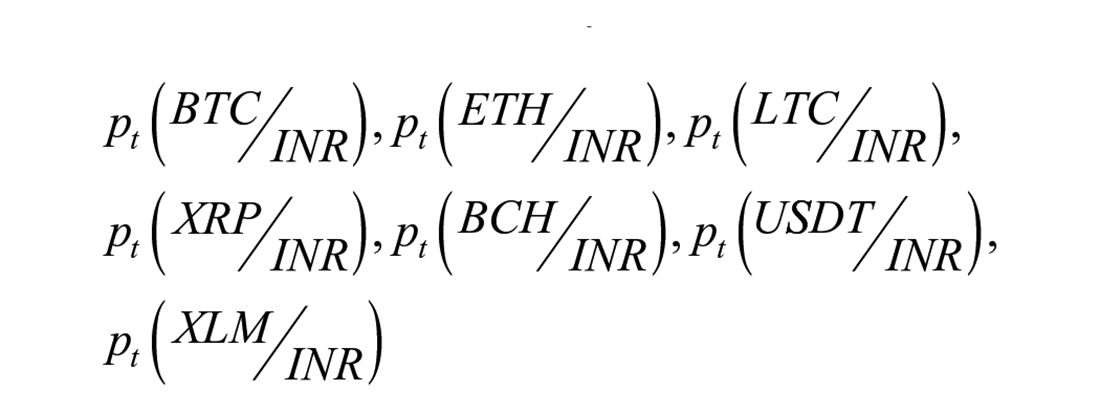
BTC and Altcoins traded directly for the CNY:

where
However, the prices were transformed in return rates, using the traditional difference of price between two consecutive moments as follows:


where
Correlation Metrics
If two or more cryptocurrencies’ daily returns data are influenced by the same common characteristics, then these returns are expected to be strongly associated Burnie (2018). Such association is analyzed using a correlation metric. Particularly, Pearson’s product–moment correlation coefficient (PMCC), Spearman’s rho (SR), and Kendall’s tau (KT) are the most popular correlation metrics. Citing Xu et al. (2013), Burnie (2018) argued that the application of PMCC, which is primarily restricted in assessing linear relationships, holds under the presumption that cryptocurrency returns follow normal distributions—an assumption that previous studies have considered unreasonable (Chan et al., 2017; Osterrieder et al., 2017). Following the constraints of PMCC, evidence abounds supporting SR as being a more accurate measure of the association between series (in terms of mean square error), when the sample size is not large and true population correlation is assumed to be weak (Burnie, 2018).
Osterrieder et al. (2017) observed that the correlations between cryptocurrencies were typically small (except mostly for between BTC, LTC, and ETH) and the data set size is often limited. Against this backdrop, this article primarily employs the SR methodology to measure the association among selected cryptocurrencies’ daily returns series.

where
Vector Error Correction (VEC) Model
This approach is employed to study the substitution and reinforcement effects among all analyzed cryptocurrencies. Recent existing digital finance literature adopted variants of the vector autoregressive approach to analyze the transmission between cryptocurrencies (Bação et al., 2018; Huynh, 2019). Thus, we analyze the effects of all cryptocurrencies on all other ones in the USD market and across all the selected emerging markets economies. The choice of VEC is based on the outcome of stationarity test results, which indicate that our variables are all stationary at first difference. Moreover, in a system of variables, there could be a number of linearly independent cointegrating vectors. It follows that linear combinations of these vectors are also cointegrating vectors as linear combinations of stationary variables are stationary. The regression form for the VEC is represented as follows:

where Δ = differencing operator, Δ
Results and Discussion
Preliminary Analysis
Trend analysis
Figure 1 presents a 486-day rolling window evolution of selected cryptocurrencies, namely, BTC, ETH, LTC, and USDT denominated in USD, RUB, INR, and CYN. The justification for the selected cryptocurrencies is that they are among the leading currencies in trading activities, with a market capitalization threshold of at least US$2 billion during the sample period. The figure reveals the constant increase in prices that mainly started from September 2017 and lasted until December 2017. Except for USDT, whose price was observed to be relatively stable throughout the sample, the other cryptocurrencies appeared to have some similarities in their fluctuations. Particularly, the Tether appeared to be consistently stable over the sample period and across all the markets. The stability shown seems to confirm the widely held opinion about the Tether (USDT) as “Stablecoin” characterized as the most stable compared with any other traded cryptocurrency as the USDT is designed to be stable, that is, 1:1 with the USD. Whereas other cryptocurrencies across the markets are fluctuating within some extreme bounds, the USDT is found to maintain a relative degree of stability at 1:1 with USD within the sample period.

The 486-day rolling window of prices of selected cryptocurrencies denominated in USD, RUB, INR and CNY.
However, the same stability and possible reinforcement influence of the USDT, as shown in the USD market, does not seem to be evident in the EMEs. The trend of the USDT in these markets does not portray stability and is relatively similar across the markets and with other selected Altcoins. This seems to be a reflection of the underlying strengths of the respective conventional currencies in the emerging markets in relation to the USD. Notably, the reason for comparing the USD denominated cryptocurrencies with those of the selected EMEs is to ascertain whether the price evolution follows a similar trend, or whether there are variations. This could have implications for cryptocurrency substitutions or reinforcements thereof, which underscore the goal of this article.
In Figure 2, the prices were transformed in return rates, using the traditional difference of price between two consecutive moments. Figure 2 shows that for each of the cryptocurrencies, except the USDT, associated return rates have similarities in fluctuations, with marginal differences in the degree of variations. In the USD-denominated market, the BTC, ETH, and LTC exhibited a strong fluctuation pattern compared with the USDT that seemed to be fairly stable during the period. The USDT did not show a significant association with BTC during the sample period, which is not surprising, as evident from the analysis in Figure 1. It should be noted that the popularity status of the USDT among traders is evidently explained by the fact that, at the end of a trading day, they normally exchange everything for tether, thereby having all crypocurrencies in their book “frozen” and indirectly having them denominated in USD. The rationale for this action is that crypto-to-crypto transactions are cheaper than crypto-to-fiat transactions.

Fluctuations in cryptocurrency returns rates.
Statistical summary of return rate distributions
Visually, the boxplot in Figure 3 presents a statistical summary of distribution of prices as transformed in return rates. Figure 3 shows that the median of the data for all the digital assets was very close to zero. Moreover, the most important information embedded in the boxplots is the extent of extreme values that appear in all coins across the markets, both positive and negative, which is an indicative of the possibility of obtaining extreme gains or losses over time. To this effect, Huynh (2019) warned that digital coins often change negatively in terms of extreme values and could foreclose possibilities of extreme gains or losses. However, Figure 3 further showed that only the USDT/USD seemed to have identical outliers that could portend equal chances of gains or losses. USDT/CNY is also very distinct with the median of returns above zero and all outliers on the positive horizon, thus suggesting possibilities of extreme gains without a corresponding likelihood of extreme losses.

Boxplot graph of the returns on cryptocurrencies.
Correlations analysis
Table 1a represents a global evolution in cryptocurrencies, where cryptocurrencies are traded directly for USD. The result shows that the highest correlation pairing is between ETH and LTC at .77 and the next is between BTC and ETH at .67. With the exception of USDT, cryptocurrency returns were positively and significantly correlated with each other. This outcome is in line with Burnie (2018) and provides evidence that the USDT is an outlier, being negatively (although weakly) correlated with the other cryptocurrencies. A weak association was expected as USDT, unlike the other cryptocurrencies, is fixed at 1 USDT equal to 1 USD. However, this correlation was consistently negative in value and statistically insignificant. A possible explanation, according to Burnie (2018) is that cryptocurrencies are often bought using USDT; for this reason, USDT is mostly sold at a time a cryptocurrency is being bought. This, therefore, appears to suggest that sudden increases in the demand for cryptocurrencies (which raises their prices) potentially correspond with sudden increases in the supply of USDT (bringing about decreases in the USDT price), which could explain the negative correlation observed.
Similarly, Table 1b explains the association between cryptocurrencies traded for the RUB where the highest correlation pairing is between ETH and LTC at .71, and the next is between BTC and ETH at .54. However, except for the XLM, all other cryptocurrencies were found to be positively and significantly correlated. The XLM was observed to be an outlier, being negatively associated with the other cryptocurrencies. For Tables 1c and 1d, where cryptocurrencies are traded for the rupee and the yuan, respectively, the highest correlation is between ETH and LTC at .90 and .88, respectively, and the next is between BTC and LTC at .92 and .91, respectively. There is, however, no strong evidence of outliers in both markets, with all cryptocurrencies being positively and strongly correlated with one another. This is in line with the findings in Aslanidis et al. (2018) and Songmuang et al. (2018), which suggest that, on average, correlation between digital assets in the cryptocurrencies ecosystem is positive. Supporting our finding, however, Stosic et al. (2018) found that the Altcoin community consists of some cryptocurrencies, with strong inverse correlations such as USDT. Burnie (2018) corroborated this aspect of our correlation results in his article, which found that with the exception of the USDT, there is a positive and statistically significant association between different analyzed cryptocurrencies.
Correlations Between Cryptocurrencies.

Tables 2 to 5 present the VEC results and simultaneous equations that analyze the effects of all cryptocurrencies on all other ones traded in USD. Among the recent empirical studies, Bação et al. (2018), Smith (2015), and Huynh (2019) used variants of the vector autoregressive model, whereas Gandal and Halaburda (2016) employed the ordinary least squares (OLS) regression technique to examine interactions between cryptocurrencies. The results provide additional details and insights that could help to explain the degree of substitution and reinforcement effects in each market over time.
Regression Analysis of the Effects of All Cryptocurrencies on All Other Ones Traded in USD.

Regression Analysis of the Effects of All Cryptocurrencies on All Other Ones Traded in RUB.

Regression Analysis of the Effects of All Cryptocurrencies on All Other Ones Traded in INR.

Regression Analysis of the Effects of All Cryptocurrencies on All Other Ones Traded in CNY.

Table 2 represents VEC regression estimates based on the USD. When we considered the effect of BTC on the Altcoins, we observed that the BTC was negatively associated with ETH, LTC, XRP, and BCH, thereby suggesting reinforcement effect in favor of the BTC and also that the BTC holds a winner-takes-all advantage over these set of Altcoins. However, the results showed that the USDT and XLM were positively associated with the BTC, which is an indication of the substitution effect in favor of the USDT and XLM. In other words, the BTC was losing its competitive edge to the two Altcoins and appeared to be increasingly converted to (or substituted for) the USDT and the XLM. Moreover, when the Altcoins were regressed against the BTC, we found that, except for the BCH, all other cryptocurrencies exerted negative effect on BTC. This outcome points toward relative reinforcement effects in favor of ETH, LTC, XRP, USDT, and XLM, which contradicts a perception of the winner-takes-all advantage commonly ascribed to the BTC.
The results further showed that the USDT had the strongest winner-takes-all advantage over the BTC and all other Altcoins. This finding points to the fact that the USDT is having a competitive advantage and is high in demand compared with other cryptocurrencies, as observed in Burnie (2018). Thus, confirming the status of the USDT as “Stablecoin” wherein, at the close of trading, traders often convert their cryptocurrencies into the USDT due to its stability in price as it is pegged 1:1 to the USD. Besides the BCH appearing to be the most substituted Altcoin, it was the only cryptocurrency that is positively related to the BTC (suggesting substitution effect in favor of the BTC). This supports the findings in Gandal and Halaburda (2016), which argued that an increase in the popularity of BTC potentially increases or decreases the value of Altcoins. Table 2 also provided mixed results of both reinforcement and substitution effects when an Altcoin is regressed on all other Altcoins.
The coefficient of determination (
Table 3 presents the regression estimates of cryptocurrencies traded for the RUB. The results of the effects of Altcoins on the BTC showed that, with the exception of XLM, which is positively related to BTC (suggesting substitution effects in favor of BTC), ETH, LTC, BCH, XRP, and USDT hold fairly strong winner-takes-all advantage over the BTC. Moreover, when the effect of BTC on the Altcoins is estimated, the results revealed a reverse outcome where the BTC was negatively associated with all the analyzed Altcoins (suggesting a reinforcement effect in favor of the BTC), except for the BCH and XLM, which were positively related to the BTC and entails substitution effect in favor of BCH and XLM. This finding is supported by the coefficient of determination, which confirmed marginal competitive advantage in favor of the BCH and XLM although the level of competitiveness in the bourgeoning market seems to be evenly shared. Accordingly, we observed that 36.34% and 35.74% of changes in BCH and XLM, respectively, were explained by the variations in the all other cryptocurrencies. This could be attributed to the fact that the BCH is closer in parity to the RUB in real market terms. A look at the price movements in the RUB-traded cryptocurrencies indicated an average parity with RUB at 1:0.24. This seems modest compared with all other cryptocurrencies with substantially wide parity with the RUB. Thus, traders within the Russian crypto market could be more inclined to hold more of BCH and XLM against other traded digital assets. Very closely following the BCH in the popularity test are XRP (32.69%), BTC (31.23%), LTC (30.55%), ETH (28.39%), and USDT (21.45%).
Table 4 explains the dynamic relationship among the analyzed cryptocurrencies traded in the INR. The estimated influence of all other cryptocurrencies on the BTC revealed that all the Altcoins but BCH were negatively associated with the BTC and suggests that the analyzed Altcoins, with the exception of the BCH, had some competitive edge (or reinforcement effect) over the BTC. Moreover, when the responsiveness of all analyzed Altcoins to the BTC is estimated, the results indicated that, whereas the USDT and XLM had favorable substitution effect over the BTC, the rest of the Altcoins trailed the BTC in the competitive crypto environment. Whereas the established influence within the Altcoins community varies in both direction and magnitude, activities in the market showed signs of robustness, with the majority of the cryptocurrencies proving to be a strong determining factor in the price/returns. For instance, 73.72% of the changes in XLM were explained by changes in all other analyzed cryptocurrencies. This is an indication that the XLM could represent a “Stablecoin” in the market and hence commands the reinforcement advantage over other cryptocurrencies. The XLM is closely followed by the BTC (69.41%), ETH (64.25%), LTC (61.26%), XRP (54.73%), BCH (48.07%), and USDT (48.03%).
Table 5 analyzed the relative association among all the analyzed cryptocurrencies traded in the CNY. Analysis of the effect of Altcoins on the BTC revealed that ETH, BCH, and USDT were positively related to the BTC, whereas LTC, XRP, and XLM were negatively associated with BTC. This is an indication that the BTC had relative reinforcement influence over ETH, BCH, and USDT while being mostly substituted for the LTC, XRP, and XLM. Furthermore, the effect of the BTC on the Altcoins showed that the BTC is positively related to all the Altcoins and signals substitution effects against the BTC. In other words, there is the likelihood that the BTC seem to be substituted for the Altcoins. The activity on the BTC could further be explained by the coefficient of determination, which revealed that about 69.02% of the changes in the BTC were driven by developments in Altcoins ecosystem. Next to the BTC in the nascent market are ETH (62.21%), LTC (60.02%), BCH (50.32%), XLM (21.41%), XRP (15.08), and USDT (7.23%).
However, it is noteworthy that the USDT has a similar evolution in the EMEs where it appears to have relatively marginal influence in the markets in contrast to evidence in the USD crypto market. We observed that the USDT, while commanding a strong influence in the USD market, trailed all other analyzed cryptocurrencies that traded in RUB, INR, and CNY. In other words, whereas the USDT has “Stablecoin” status in the advanced wider market, it does not seem to have the same representation in the EMEs. This finding is supported by the results of the SR metric in Table 1 and corroborated by the trend analysis in Figures 1 and 2. This seems to be a reflection of the underlying strengths of the respective conventional currencies in the emerging markets in relation to the USD. In other words, converting cryptocurrencies into the USDT could invariably mean saving them in USD. Hence, the cryptocurrencies thus saved could be prone to fluctuations of the underlying conventional currencies relative to the USD. Therefore, if investor confidence in the primary currency is weak, they could be more inclined to choose any other cryptocurrency believed to offer stability relative to the underlying conventional currencies during or at the end of any trading day.
Conclusion
This article analyzed the association between cryptocurrencies in the global U.S. dollar–denominated market (where cryptocurrencies are traded directly for the USD) and in the EMEs of Russia, India, and China (where digital currencies are traded directly for the ruble, rupee, and the Yuan), with a view to ascertaining whether activities in both markets are predominantly shaped by reinforcement effect, due to the winner-takes-all phenomenon, or by substitution effect, occasioned by competition. Our analysis based on the relation between returns of cryptocurrencies in each of the markets over time suggests that, on average, correlation between digital assets in the cryptocurrencies environment is positive. This result is supported by findings in Aslanidis et al. (2018) and Songmuang et al. (2018), which confirmed that a majority of digital currencies in the cryptocurrency ecosystem are not unrelated. However, our results detected a case of an outlier with respect to the USDT in the global market, where the USDT was found to be negatively associated with all other crypotocurrencies. This is in line with the findings in Stosic et al. (2018), which argued that the digital assets community consists of some cryptocurrencies with strong inverse correlations such as USDT. This outcome is also in tandem with the finding of Burnie (2018), which found that the USDT is an outlier, being negatively correlated with the other cryptocurrencies traded in the USD. A weak association was expected as USDT, unlike the other cryptocurrencies, is fixed at 1 USDT = 1 USD. A possible explanation, according to Burnie (2018) is that cryptocurrencies are often bought using USDT as it is considered the most stable currency. For this reason, USDT is mostly sold at a time a cryptocurrency is being bought. This, therefore, appear to suggest that sudden increases in the demand for cryptocurrencies (which raises their prices) potentially correspond with sudden increases in the supply of USDT (bringing about decreases in the USDT price), which could explain the negative correlation observed.
The results further showed that, whereas there is an outlier in the crypto RUB market with respect to the XLM, there is no strong evidence of outliers in the INR and CYN markets, with all cryptocurrencies being positively and strongly correlated with one another.
The regression results relatively corroborated our correlation metric results and revealed that, in the global cryptocurrency market, the reinforcement effect is in favor of the USDT contrary to findings of Gandal and Halaburda (2016), which argued that the BTC has a winner-takes-all advantage in the USD crypto market. This finding points to the fact that the USDT is having a competitive advantage and is high in demand compared with other cryptocurrencies thus confirming the status of the USDT as “Stablecoin” where, at the close of trading, traders often convert their cryptocurrencies into the USDT due to its stability in price as it is pegged 1:1 to the USD.
It is, however, noteworthy that the USDT has a similar evolution in the EMEs where it appears to have relatively marginal influence in the markets in contrast to evidence in the USD crypto market. We observed that the USDT, while commanding strong influence in the USD market, trailed all other analyzed cryptocurrencies traded in RUB, INR, and CNY. In other words, whereas the USDT has “Stablecoin” status in the advanced wider market, it does not seem to have the same representation in the EMEs. This seems to be a reflection of the underlying strengths of the respective conventional currencies in the emerging markets in relation to the USD. In other words, converting cryptocurrencies into the USDT could invariably mean saving them in USD. Hence, the cryptocurrencies thus saved could be prone to fluctuations of the underlying conventional currencies relative to the USD. Therefore, if investor confidence in the primary currency is weak, they could be more inclined to choose any other cryptocurrency believed to offer stability relative to the underlying conventional currencies during or at the end of any trading day.
Our findings have implication for existing and potential investors in the cryptocurrency market and would provide them some insight into market dynamics, which could be a guide in making investment decisions across different economies and digital assets.
Research Limitations
According to data availability at the time of this study, daily data set spanning the period from August 1, 2017, to November 30, 2018, reflecting daily closing prices at midnight GMT, was used. However, we consider the 486-day rolling window evolution as well as the adjusted period of observation relatively short. Second, the Altcoins examined were selected based on market capitalization of at least one billion U.S. dollars at the time of the study. This criterion essentially limited the number of Altcoins that could have been included in the analyses.
Suggestions for Future Study
Given that the cryptocurrency market has continued to witness unprecedented expansion, future research work could analyze digital assets at longer time periods while also considering varying time frequencies and a larger number of crypto assets for analysis. For further insights into the interrelationships among competing cryptocurrencies, digital assets could be selected based on total supply, circulating supply, or trading volume.
Footnotes
Declaration of Conflicting Interests
Funding
ORCID iD
