







Abstract
Keywords
Introduction
The Criminal Justice System (CJS) is the life-wire that provides the foundation upon which social order rests. The system, according to Agbonika and Alewo (2014) is an embodiment of crime regulatory techniques that bring those who have breached the laws of the state to justice. It includes all the government institutions used by the state to enforce and implement a set of rules necessary for the maintenance of peace and order. Accordingly, Coldham (2000) and Igbo (2007) identify the police, courts, and the prisons as major agencies of the CJS. The police as an arm of the CJS is the agency concerned with the maintenance of public order, apprehension of lawbreakers, and deterrence of potential offenders. On the other hand, the court is the agency that determines the criminal liability of suspected offenders and dispenses effective and fair punishments against those found guilty; while the prison or correctional agency provides after-care services to offenders sentenced by the courts (Ajah & Ugwuoke, 2018; Ajah et al., 2020; Alemika, 2014; Igbo, 2007; Kinnes, 2005; Orakwe, 2013).
More generally, the task of the CJS is carried out by investigating, arresting, trying, adjudicating, and punishing societal members who break established laws of the state (Ajah & Okpa, 2019). The realization of this task in turn depends on the level of coordination and cooperation among the various components of the system and through which the laws guiding the existence and order in every society are applied and the rights of the citizens are upheld (Ajah, 2018; Alemika, 2005; Alemika, 2014; Eze et al., 2021; Ukwayi & Okpa, 2017). In practical terms, the CJS is the machinery that determines the guilt or innocence of suspects and allocates sanctions that are fair and proportional to the offense committed when found guilty by the courts (Ajah, 2018; Olonisakin et al., 2017; Onyejegbu et al., 2021). In developed countries such as United States of America (USA), Britain, and Canada (Nnamani et al., 2021), the efficiency of the CJS is a clear indicator of how well justice is dispensed to the people by the state (Eze et al., 2020; Kinnes, 2005). There may be unintended consequences such as faulty interlocutory rulings and eventual judgments or verdicts as a result of investigations done in a hurry, evidences, arguments, and addresses garnered in half-baked manner in the course of trials.
The perception of inefficiency in the CJS continues to constitute a clog that slows the delivery of justice in Nigeria. In Ebonyi State, findings showed there is lack of proper record of detained-suspects and more often than not, suspects languish in prison custody without the opportunity of trial as some of them have little or no access to a legal assistance (Ajah, 2018; Nwune et al., 2019; Ugwuoke et al., 2020).
According to the provision of the Constitution of the Federal Republic of Nigeria (CFRN) 1999 as amended, Section 35 (5) of the 1999 constitution, “a person must be taken to court within 24 hours from the date of arrest, where there is a court of competent jurisdiction within the radius of 40 km or within 2 days or such period considered by the court to be reasonable.” This law is however observed more in the breach. Despite the legal provisions, there abound systemic shortcomings such as regular bureaucratic delays within the justice agencies and other inefficiencies like misplacement of files, loss of evidence, physical, and sexual abuses of varying degrees etcetera. The major outcome of all these challenges is that awaiting-trial inmates reportedly spend extremely longer years in prison and their lives are immeasurably shattered by prison incarceration.
However, the introduction of technology in various facets of life has made things a bit easier and more efficient. Even within the government, certain computerized tools have been deployed. The introductions of the Treasury Single Account (TSA), Bank Verification Numbers (BVN), and Integrated Personal Payroll Information System (IPPIS) have all assisted the Federal Government of Nigeria in blocking revenue leakages and detecting fraud. Likewise, a computerized central repository can be deployed to automate and monitor the progress of cases from point of arrest to delivery of judgment. Ajah and Okpa (2019) observed that the backbone of this system will be a central digital database (repository) where all cases will be uploaded. Access to this repository will be given to law enforcement agents, relevant prosecution agencies, and the courts. When cases are uploaded in the system by law enforcement agents, they can then be transferred to the nearest court of competent jurisdiction with click of the button from where the trial will continue. As the case progresses, the digital case file can then be updated accordingly until judgment is passed after which the case is marked closed. This system presents a lot of advantages apart from the very obvious, which is the reduction of awaiting-trial inmates and the speedy dispensation of justice in line with the Administration of Criminal Justice Act (2015). Judges can view a list of cases queued up for them to try, see the status of cases, and transfer cases (if necessary) in split seconds with the click of a button. There will also be no incident of lost case files, and there will be a huge reduction of costs associated with the Administration of Criminal Justice process (Ajah & Okpa, 2019).
As the delays experienced in processing cases have a significant effect on the number of inmates awaiting-trial in Nigeria (Ayo, 2008), the introduction of Information and Communication Technology (ICT) however, allows the judiciary to share information with the prisons and police which increases efficiency, increases access to justice and makes the justice sector more transparent (Doma, 2016). In Nigeria, pre-trial detention periods can last from days to months and up to 10 years or more awaiting-trial. These long delays can be due to an interplay of many factors, which in most cases are mutually reinforcing, which include; “interruptions during criminal investigation, disconnection in communication between police, prosecutor and the court, bureaucracy in court proceeding, incessant adjournment of cases occasioned by shortage of judges, absence of witnesses, lack of transport to take accused person to court, lack of security for transport (particularly in crisis area) and lack of proper filing and tracking systems in prisons to ensure that pre-trial detainees are taken to court on dates fixed by the court system” (Ukwayi & Okpa, 2017, p. 13). Further, ICT appears to be an important vehicle in assisting the judiciary, carry out its functions maximally in a transparent and accountable manner (Velicogna, 2007).
In a bid to address the prevalent disconnect between the police, prisons, and court, the Structural Functionalism Theory was adopted. The theory as postulated by Durkheim who views society “as a single interconnected social system, in which each part performs a definite function” (Ottong, 2014, p. 2). The basic characteristic is the merger of its components as well as the efficient functioning of the system made possible by interdependence of parts working together to bring about an equilibrium social system (Ottong, 2014). Structural functionalism was chosen as the theoretical framework for this study because the framework views human society as a system made up of interconnected components which function harmoniously as a whole for the benefit of the social system. This harmonious functioning helps in sustaining the system and actualizing the needs of the system. In this study, the component parts of the social system were the police, prisons, and judiciary which must work as one for an efficient functioning of the Nigeria CJS in order to manage the awaiting-trial problem in Nigeria correctional facilities. However, where any of these parts fail to function efficiently, social disequilibrium occurs. Within the context of this study, the awaiting-trial problem caused by inability of the police to arraign a suspect in court with 24 hours, carry out proper investigation and the delay inherent in the judicial system is responsible for the disequilibrium occurring in Ebonyi State CJS. Parsons (1951) also shared Durkheim’s view and observed that if certain institutions abandon or fail to perform its institutionalized functions, problems could set it. Similarly, Ekong (2005) opined that each system is assessed by the contributions each unit brings to the system as a whole. Brayne et al. (2018, p. 11); Stevenson and Doleac (2018, p. 9) found that “resentment toward predictive algorithms is fueled by fears of deskilling and heightened managerial surveillance; two practical strategies of resistance emerging as a result: foot-dragging and data obfuscation. A few existing studies have also been drawn to examine the reception of ICTs in police, criminal courts, and prisons. First, scholars report that digital tools are often translated in order to fit local priorities and concerns, both in police departments and criminal courts, which leads practitioners to ignore the tools that they find inefficient” (Brayne et al., 2018, p. 11; Stevenson & Doleac, 2018, p. 9). This means that many of the tools that are praised by superiors as revolutionary end up not being used by officers or front-line legal professionals (Christin, 2017). “Second, extant studies suggest that the implementation of quantitative instruments lead to what is known as “reactive” processes among police officers and legal professionals, who adjust their daily practices as new standards” (Lynch, 2017, p. 2). Third, Ajah et al. (2021, p. 18) established in their study “that Virtual and Augmented Realities (VAR) have become ICT frameworks that could best establish the connections between the social thought patterns and psychologies of inmates which help to reshape the criminal view of inmates through technological imagery and visualized psychosocial reconstructions”. Based on the foregone, robust, and empirical studies on how repository system could address awaiting-trial problems are still missing. This gap had to be addressed, as it creates serious limitations to not only concerns and active participations to design and carry out a truly systematic and scientific approach to the study of awaiting-trials, but also to policy implications.
Similarly, research questions were outlined in order to investigate and proffer workable solutions to the quick dispensation of justice and the role of computerized central repository in addressing awaiting-trial problems in Ebonyi State, Nigeria. Research questions include: (i) What is the length of time spent in prisons? (ii) What is the mode of operation used by the Criminal Justice agents? (iii) Does non-use of ICT affect the operation of the CJS? (iv) Does non-use of ICT make it difficult to investigate cases and information about suspects? (v) To what extent does non-use of ICT cause work overload among police officers? (vi) To what extent do police officers’ response on the assertion that non-use of ICT affects easy access to case files? (vii) What is the ATIs opinion on whether they have experienced a case where it took them long time to find their name and its details in the log books or register? (viii). What is the ATIs opinion on whether they have experienced erroneous recording of information that affected them while their case is still ongoing? (ix) What is the agents’ of CJS response on the assertion that there is no central computer-repository system that connects the police, courts, and prison to fast-track trial of criminal matters? (x) What is police officials’ opinion on whether the introduction of ICT will speed up criminal prosecution? (xi) What is the CJS agents’ response whether deployment of a central based computerized repository system to link the Criminal Justice agencies could fast-track criminal trials? and (xii) To what extent will ICT method facilitate pretrial detention and bring it to conclusion?
Methodology
Study Design and Location
“This study adopted a cross-sectional survey design. This type of design is considered appropriate because of its capacity to accurately gather necessary information within a limited timeframe on a large sample. The study was conducted in the Police Command Headquarters, Courts and Prisons within Abakaliki and Afikpo prisons located in Ebonyi State, Nigeria” (Ajah et al., 2021, p. 8). In addition, the data collected were corroborated with previous work done by researchers as the problems giving rise to the awaiting-trial inmates in Ebonyi State has been well documented by researches done previously.
Participants and Procedures
“The target population for this study was 4,032 which comprises awaiting-trial inmates, police officers, court officers and prison officers in Ebonyi State. Of this population, 1,013 (25.1%) are awaiting-trial inmates in two prisons, 312 (7.7%) are prison officers (see Nigerian Prison Records, 2018), 118 (2.9%) are court officers (see Ebonyi State Judicial Records, 2018) and 2,589 (64.2%) are police officers (see Nigeria Police Records, 2018). Using Taro Yamane’s (1967) method of sample size determination, with a 95% confidence level and level of maximum variability (
“The multi-stage sampling technique that involves successive random sampling was adopted in the selection of respondents from the Local Government Areas (LGAs), prisons, police stations, and courts. Multi-stage method is relevant to this study because the population is made up of several clusters: prisons, police stations, and courts. The researchers clustered Ebonyi state into its 13 LGAs which were further grouped into urban and rural LGAs. From this categorization, five LGAs were purposively selected. In this light, Ebonyi, Abakaliki, and Afikpo North LGAs were purposively selected from the urban LGAs, while Ezza South and Afikpo South LGAs were purposively selected from the rural LGAs. The essence of choosing these LGAs is because the only two existing prisons in Ebonyi State are located within the selected LGAs, precisely in Abakaliki and Afikpo North LGAs. Also, a greater number of courts and police stations in Ebonyi state with sufficient manpower, from where the researchers drew their respondents, are also located in these LGAs” (Ajah et al., 2021, p. 9).
The researchers asked the participants about their experiences in the CJS, whether the processes were manual or automated and how the process affects their experience in the CJS. These questions were asked with a view to identifying the gaps caused by the absence of ICT in the Criminal Justice System and determining how ICT deployment will fill that gap. ICT is an extended term usually employed in place of Information Technology (IT) (Hill & Shaw, 2013). It describes an extensive industrial spectrum of services focusing on information technology, information systems, computer science, e-business, and software engineering (Moshood et al., 2020). ICT embraces both soft and hard skills in programming development and systems, in addition to interpersonal communication skills (Ahmad & Daud, 2016; Nnam et al., 2019; Odubiyi et al., 2019). However, the central barrier to adopting ICT systems in many countries including Nigeria is endemic corruption. Corruption has hampered national, social, economic, and political progress. Public resources are allocated inefficiently, honest citizens feel frustrated, and the general population’s level of distrust is high. “As a result, productivity is lower, administrative efficiency is reduced, and the legitimacy of the political and economic order is weakened” (Shehu, A. 2011, p. 14; Ajah & Onyejegbu, 2019, p. 2); the judiciary, which ordinarily should be the last hope of the common man, “is plagued by corruption, a lack of access to justice, and lack of trained professionals” (Jimmy, 2008, p. 33).
Data Collection and Procedures
“This study adopted mixed methods of scientific enquiries. And the instruments for data collection were structured questionnaires and unstructured In-Depth Interview (IDI). The research instruments were distributed with the aid of four research assistants. Out of the 1,551 questionnaires distributed, 1,518 were returned with 20 not properly completed and thus were rejected while 13 were not returned and thereby leaving us with a total of 1,498 copies for data analysis representing a response rate of 96.58%. In order to complement data generated through questionnaire instrument, in-depth interviews were conducted on eight inmates and four police officers, prison officers, and court officials, respectively—totaling 20 interviewees. Each respondent’s interview lasted between 35 and 90 minutes. The interviewees disapproved of our attempts to record their responses in audiotape, so only handwritten notes were taken” (Ajah et al., 2021, p. 8). Respondents from the inmate population were obtained through a prison member who assisted in bringing out the inmates in batches at a particular location (phones and other electronic gadgets are not allowed in the prison); then the researcher distributed the questionnaire to the inmates; and after 2 days, the questionnaire were retrieved.
Further, due to the high rate of prison break, prison officials were highly skeptical about the research and they were also wary of infiltrators disguising as researchers. These and many more limited the ability of the researcher to interface with the awaiting-trial inmates and prison officers reasonably. The interviews, especially for the awaiting-trial inmates and prison officers, were hectic because of the apprehensive nature of Nigerian security, since there had been now and again jail breaks (Ukwayi & Okpa, 2017). Participants were given the same questionnaire with slight variation. However, they were divided into four categories because there were some questions that were not meant to be answered by the inmates who are still awaiting-trial. For example, the question “length of time spent in the prison” cannot appear in the questionnaire for police officers. Secondly, for the CJS, they are questions that cannot be asked a prison officer, for instance “the ingredients that formed stringent conditions of bail given to inmates” cannot be posed to a prison officer, rather, such questions were directed to members of the court.
Data Analysis
“The quantitative data analysis was performed using International Business Machine (IBM) Statistical Packages for Social Sciences (SPSS) version 20. Utilizing descriptive statistics, Chi-square, Pearson correlation, and Multi-linear regression, result of IBM SPSS were further analyzed, interpreted, and organized using tables, frequencies, charts; the qualitative data were analyzed using manual thematic method, where the responses were transcribed with some catchy phrases retained in their original versions and contexts in the form of extracts or excerpts (see the result section for details). Specifically, the thematic analysis which follows a six-step process of familiarization, coding, generating themes, reviewing themes, defining and naming themes, and writing up were utilized in this study” (Ajah et al., 2021, p. 10).
Ethical Consideration
“The researchers obtained ethical clearance from the ethical committee of the University of Nigeria Teaching Hospital; Ituku-Ozalla, with ethical clearance number NHREC/05/01/2008B-FWA00002458-1RB00002323. Accordingly, all the participants were provided with consent form on which clear explanations were made regarding their participation in the study. The participants were assured of anonymity, confidentiality, and safety with regard to information in the questionnaires they responded to. They were made to know that their participation in the study was voluntary. The data collected were safely stored and kept in confidential place to maintain the anonymity and confidentiality of the respondents that were of prime importance” (Ajah et al., 2021, p. 9).
Results and Discussion
Table A1 clearly introduced socio-demographic characteristics of respondents at a glance according to the four category of groups recruited for the study.
The awaiting-trial respondents were asked about the length of time they have spent in prisons. Below are their responses as presented in figure 1.

A bar chart showing length of time spent by awaiting-trial inmates (ATIs).
“The chart shows that 5.3% of the respondents had spent 4–6 years in custody awaiting-trial, 24.8% had spent 7 to 9 years, 42.5% of the ATIs had spent between 10 and 12 years in custody, 15.9% of the ATIs had spent 13 to 15 years in custody, and 11.5% of the ATIs had spent more than 15 years in custody—all awaiting-trial. This is an indication that highest percentage (42.5%) of the awaiting-trial inmates had spent between 10 and 12 years in custody” (Ajah et al., 2021, p. 13). The above findings agree with the assertions of Ajah (2019, p. 31); Okunola and Dinne (2016, p. 13) when they opined that “ATIs are victims of fundamental human right abuse as Nigerian prisons guarantee no prompt trial. They further observed that most ATIs in Agodi prison in Ibadan had spent 5 to 10 years or more awaiting-trial for offenses such as peddling in hard drugs, homicide, armed robbery, and even for petty offenses. This shows that the delays in the Criminal Justice System especially as it concerns the ATIs is not peculiar to Ebonyi prison, it is equally prevalent in other states in Nigeria like Oyo” (Ajah, 2019, p. 31; Okunola & Dinne, 2016, p. 13).
For further understanding of the mode of operations in the Nigeria Criminal Justice System (NCJS), the Criminal Justice agents were asked about their mode of operations as indicated in Figure 2 below,

Response of CJS Agents on their mode of operations.
Figure 2 above presents opinions of CJS agents on mode of operations. The result shows that 83.5% of police officers said that they use manual modes of operation while 16.5% stated that they combine both manual modes and ICT devices. This shows that majority (83.5%) of police agents use manual modes of operation. Amongst the prison officers, 94.5% of them stated that they use manual modes of operation while 5.5% said they use combination of manual modes and ICT devices. This is an indication that majority of prison officers (94.5%) use manual modes of operations. Amongst court officials, 100% of them stated that they use manual modes in daily operations. This shows that all the agents of the Criminal Justice System use manual processes in day-to-day operations. The above finding is in agreement with qualitative data as most of the Criminal Justice agents interviewed affirmed that they use manual modes of operations. Here are the actual words of an interviewed police officer: In arrest, detention, investigation, we use manual means. We have not started using ICT devices except in some places where they have CCTV, we can watch the recordings to see if we can recognize the individuals that are in such activities and then from such information, start investigation and then arrest of suspects.
Male/Police Officer/13 years in Services as Police Officer in CID/IDI/August 2019
“Manual method” of the Nigerian Legal System, simply refers to the analog/non-digital approach generally adopted in courts. Two major examples readily come to mind. Viz: (a) The use of type-writers in typing the Cause List for some courts in Nigeria, in spite of technology prevalence in this millennial era. (b) The use of ink/pen and paper by the magistrate and judges in Nigeria courts, to record court proceedings word for word, as against using technological media to make for ease of recording which in turn will inevitably help speed up the matter at hand, and bring about quick and efficient dispensation of matters.
Another respondent had this to say to buttress the above assertions, here are his actual words: Although we are trying as a country and organization to embrace ICT but we have not gotten to that level of using ICT in everything we do here in the prison. So ensuring that the suspects in custody are taken to court, brought back safely, rehabilitated, corrected and sent back to their family and society—we use mostly manual modes of operations here in Afikpo prison.
Male/Prison Staff/8 Years in Service as Prison Warden/Afikpo Prison/IDI/July 2019
The above narratives from respondents show that agents of the Criminal Justice System use manual processes as their modes of operations. This could be as a result of lack of ICT devices within the system and then they resort to manual modes of operation. This has resulted in slow delivery of required services.
To ascertain if non-use of ICT affects the operations of the Criminal Justice agents, their opinions were ascertained as presented in Table A2.
Amongst the police, result shows that 1.1% disagreed that non-use of ICT makes it difficult to investigate cases more efficiently, 11.8% somewhat agreed to the above assertion, 70.5% agreed while 16.5% strongly agreed to the above assertion. This shows that majority (70.8%) police officers agree that non-use of ICT makes it difficult to investigate cases more efficiently. Amongst the prison officials, 9.7% of them strongly disagreed to the assertion that non-use of ICT makes it difficult to prepare suspects for court, 15.2% disagreed to the above assertion, 10.3% somewhat agreed, 41.4% agreed, while 23.4% strongly agreed. This indicates that higher percentage (41.4%) of prison inmates agreed that non-use of ICT makes it difficult to prepare suspects for court. Amongst court officials, 0.9% strongly disagreed that non-use of ICT makes it difficult to resolve questions of law more efficiently, 4.4% of them disagreed, 6.2% somewhat disagreed, 48.7% somewhat agreed, 32.7% agreed while 7.1% strongly agreed. This shows that higher percentage of court officers somewhat agreed that non-use of ICT makes it difficult to resolve questions of law more efficiently. This finding agrees with the study of Areh et al. (2020) and Ayo (2008) who found that delays experienced in processing of cases before a final sentence is passed, have a significant effect on the number of inmates awaiting-trial in many countries including Nigeria. The above finding is also in corroboration with qualitative data as most police officers interviewed opined that non-use of ICT makes it difficult to investigate cases more efficiently. Here are the actual words an interviewed police officer: Without using electronic gadgets to study crime scenes and then store all evidences using computer like is done in advanced worlds, we find it difficult to effectively do investigations on cases. Our manual modes make it difficult to investigate cases efficiently.
Police Officer/Male/13 Years in Service as Police Officer CID/Afikpo/IDI/August 2019
A response from a prison warden on whether non-use of ICT makes it difficult for them to prepare suspects to court adds more integrity to above points of the police officer, he noted as below: We use manual mode to arrange suspects and their files and most times someone may mix it up and this would (could) have be (been) prevented if we are using computer records. Without computer, it is difficult for us to prepare suspects to court and it slows down every step in our work.
Male/Prison Warden/9 Years in Service as a Prison Warden/Afikpo Prison/IDI/July 2019
To further explain the above assertion, a court official added her opinion on whether non-use of ICT makes it difficult to resolve questions of law more efficiently, she narrated as below: Occasionally, we find ourselves at a point where effectively cross-checking or resolving law questions is the only option. At such times, our manual processes of book verification has always failed or delayed court proceedings. I am very sure that adoption of ICT that wastes no time in search and enhances all other operations would swiftly solve these problems for the justice system
Female Magistrate/6 Years Experience as a Legal Practitioner/IDI/August 2019
From the above arguments/assertions of the Criminal Justice agents ranging from police, prison officials to court officers, it is apparent that non-use of ICT makes it difficult for police officers to investigate cases more efficiently. The effect of this difficulty is a reverberated chain reaction that slows down other criminal procedures in the justice system and results to the inefficiencies making awaiting-trial inmates to overstay in custody. The point is not very different from the concerns of the prison warden who noted that non-use of ICT makes it difficult for them to prepare suspects to court as sometimes suspects’ records in custody are mixed-up and sorting them out for particular files may be difficult – and this does definitely delay taking suspects to court as when due. Moreover, the court officials stated that non-use of ICT makes it difficult to resolve questions of law more efficiently. The difficulty posed by the non-use of ICT devices cuts across all the agents of the Criminal Justice System, from police officers, court officials to prison wardens all have their shares of the difficulties. The above finding is in tandem with the observations of Adelowo and Halimat (2015, p. 33); Ajah et al. (2020, p. 8) who observed that difficulty in “filing court processes is not a gain, noting that court officials in some courts have made it a tradition not to allow filing of court processes beyond 2 pm. The implication is that filing of processes becomes impossible even where the litigants come from a far distance location, thereby frustrating many cases” (Adelowo & Halimat, 2015, p. 33; Ajah et al., 2020, p. 8).
Figure 3 above presents opinions of NCJ agents on the assertion that non-use of ICT makes it difficult to investigate cases, process criminal cases, and information about suspects. The result shows amongst police officers, 0.8% disagreed that non-use of ICT makes it difficult to investigate cases, 7.9% somewhat disagreed, 68.2% agreed while 23% strongly agreed that non-use of ICT makes it difficult to investigate cases. This is an indication that majority (68.2%) of the respondents agreed that non-use of ICT makes it difficult to investigate cases. Amongst the prison officials, 6.2% strongly disagreed that non-use of ICT makes it difficult to get information about suspects, 4.8% disagreed, 0.7% somewhat agreed, 21.4% agreed, and 64.1% strongly agreed that non-use of ICT makes it difficult to get information about suspects. This is an indication that majority of prison officers agreed that non-use of ICT makes it difficult to get information about suspects. Amongst court officials, 8% strongly disagreed that non-use of ICT makes it difficult for them to process criminal cases, 12.4% disagreed to that assertion, 6.2% somewhat disagreed, 46% somewhat agreed, and 27.4% strongly agreed to above assertion. This shows that higher percentage (46%) of the respondents somewhat agreed that non-use of ICT makes it difficult for them to process criminal cases. The above is further buttressed by the assertions of Adelowo and Halimat (2015) who observed lack of transparency in the conventional method (manual method and non-use of ICT) as only trial judges, counsels, and litigants have access to criminal case files. Interested persons may be denied access. More especially, it is easier for court documents to be tampered with (Adelowo & Halimat, 2015). This finding also shows some similarity with the study of Brayne and Christin (2020) who found that resentment toward predictive algorithms is fueled by fears of deskilling and heightened managerial surveillance.

CJS agents’ response on whether non-use of ICT makes it difficult to investigate cases, processing criminal cases, and information about suspects.
Table A3 above presents opinions of NCJ agents on the view that non-use of ICT causes work overload. The result shows that 13.9% of police officers somewhat agree that non-use of ICT causes work overload, 77% agree that non-use of ICT causes work overload while 8.1% strongly agreed that non-use of ICT causes work overload. This shows that majority of the police officers agreed that non-use of ICT causes work overload. Amongst the prison officials, 2.8% of them strongly disagreed to the assertion that non-use of ICT causes work overload, 4.8% somewhat disagreed, 2.8% somewhat agreed, 17.9% agreed while 83.4% strongly agreed. This is an indication that majority (83.4%) of prison officials strongly agreed that non-use of ICT causes work overload. Amongst court officials, 43.4% strongly disagreed that non-use of ICT causes work overload, 15.9% disagreed that non-use of ICT causes work overload, 23% somewhat disagreed that non-use of ICT causes work overload, while 17.7% of the court officials agreed that non-use of ICT causes work overload. This shows that higher percentage (43.4%) of court officials strongly disagreed that non-use of ICT causes work overload. The above finding is corroborated with the qualitative finding as some of the agents of the Criminal Justice interviewed affirmed that non-use of ICT causes work overload while some of them stated to the contrary. These are the actual words of one of the CJS agents interviewed: You know that the use of ICT makes things easier for people. Let me use the ATM for example, before the use of ATM, you know many people uses to queue in the bank to collect money but since the introduction of ATM many people don’t have to go inside the bank to withdraw money especially lower amounts. So when we introduce adequate ICT, it will make things easier for us and we will be more effective, efficient and prompt in our service delivery. For example, if we have CCTV in all the streets in Nigeria and we have our police officers especially in the CID or ICT department monitoring all the CCTV, the issue of kidnapping, arm robbery will be a history by now but we know that the Nigerian government lack money to engage in such project.
Male/Police Officer/CID/B.Sc. Holder/15 Years in Service as a Police Officer/IDI/ Abakiliki/August 2019
On the contrary, court officials opined that non-use of ICT does not cause work overload, a court official noted as below: For us in the court or judiciary as a whole, I do not consider not using ICT to cause any work overload. The magistrates or judges have to hear both the defense and prosecuting counsels make their cases manually before the court, there is no part of these proceedings where ICT is indispensable except in few occasions where video or audio records are tendered as exhibits. In the absence of such few scenarios, not using ICT does not cause work overload for the court.
Female/4 Years Experience as a Legal Practitioner/August 2019
From above two narratives, it is obvious that there are diverse opinions on the issue of non-use of ICT and work overload. The police officers and prison wardens affirmed that non-use of ICT causes work overload in their daily work while court officials stated to the contrary that non-use of ICT does not in any way cause work overload to them.
Table A4 above presents the opinions of NJC agents on the assertion that non-use of ICT affects easy access to case files. The data shows that 0.8% of police officers disagreed that non-use of ICT affects easy access to case files, 12.5% of the police officers somewhat agreed that non-use of ICT affects easy access to case files, 76.2% agreed, while 10.5% strongly agreed. This shows that majority of police officers (76.2%) agreed that non-use of ICT affects easy access to case files. Amongst prison officers, 9.7% strongly disagreed that non-use of ICT affects easy access to case files, 12.4% agreed that non-use of ICT affects easy access to case files while 77.9% strongly agreed. This shows that majority (77.9%) of prison officers strongly agreed that non-use of ICT affects easy access to case files. Amongst court officials, 66.4% agreed that non-use of ICT affects easy access to case files, while 33.6% strongly agreed that non-use of ICT affects easy access to case files. This is an indication that majority (66.4%) of prison officials agreed that non-use of ICT affects easy access to case files. This also shows that all the agents of NJC ranging from police to court officials affirmed that non-use of ICT affects easy access to case files.
In order to ascertain the challenges faced by ATIs in accessing their records, they were asked to share their experiences about the difficulty in locating their records as presented in Table A5 below.
Table A5 above presents ATIs’ opinions on whether they have experienced a case where it took them long time to find their name and its details in long log books or registers. The result shows that 2.1% of the respondents strongly disagreed that they have experienced a case where it took them much time to find their names in long log books or registers, 4.3% of the ATIs disagreed, 3.5% somewhat disagreed, 17% somewhat agreed, 47.2% agreed while 25.8% strongly agreed that they have experienced a case where it took them long time to find their names and other details in long log books or registers. This shows that higher percentage (47.2%) of the respondents agreed that they have experienced a case where it took them long time to find their names and other details in long log books or registers. This finding is bulwarked by the fact that the agents of Nigerian Criminal Justice System (NCJS) use analog and manual systems in processing and recording their cases. This finding correlates with Nwune et al. (2019) who showed there is lack of proper record of detained-suspects and more often than not, suspects languish in prison custody without the opportunity of trial as some of them have little or no access to a legal assistance. In addition, the above finding is in corroboration with the quantitative data as some of the ATIs interviewed stated in the affirmative that they have experienced a case where it took them long time to find their names and other details in the long log books or registers. These are the direct words of the respondents interviewed: This is my third (3) year here as (an) interviewed trial inmate. They accused me of armed robbery but every time my lawyer comes, he will say that they said that they have not seen my case file and that have (has) continued for a very long time. Me (I) have been praying to God for him to intervene in this case because (I) am tired of this place.
Male/ATI/3 Years in Prison Awaiting-Trial /IDI/Abakiliki Prison/July 2019
Another respondent had this to say: I have experienced it. It took them six (6) months to see my case file before I was charged to court although my case is still ongoing but when I first come here, it took them six whole months to find my case file. That has affected the period that (I) am in the prison.
Male/ATI/2 Years in Prison Awaiting-Trial/IDI/Afikpo Prison/July 2019
From the above assertions of respondents, it is obvious that the awaiting-trial inmates have experienced cases where it took them long time to find their names and other details in the long log books or registers and that has contributed to why they are staying longer in custody than necessary.
Accordingly, the ATI’s were also asked whether they have experienced erroneous recording of information that have effect on them while their cases are still ongoing. Their responses are presented in Table A6 below.
Table A6 above presents ATIs’ opinions on whether they have experienced erroneous recording of information that affected them while their cases are still ongoing. The result shows that 8.8% of the ATIs strongly disagreed that they have experienced erroneous recording of information that affected them while their cases are still ongoing, 8.3% disagreed to the above assertion, 13.8% somewhat disagreed to the above assertion, 15.4% somewhat agreed, 14.8% agreed while 38.8% agreed. This shows that higher percentage (38.8%) of the ATIs have experienced erroneous recording of information that affected them while their cases were still ongoing. This finding is in line with Ajah et al. (2020, p. 9); Alemika and Alemika (2005, p. 13) who asserted that “there is lowest concern for the rights and plights of the suspects at all levels of the system from the police to the prisons. This could be buttressed by the fact that errors and mistakes will abound in a system that practice manual and analog recording systems.”
To ascertain whether there is a repository connection that links the Criminal Justice agencies together, an assertion was made for the Criminal Justice agents to share their opinions as indicated in Table A7 below.
Table A7 above presents opinions of CJS agents on the assertion that there is no central-based computer repository system that connects the police, courts, and prison to fast-track trial of criminal matters. The result shows that amongst the police officers, majority (81.5%) agreed that there is no central-based computer system that connects the police, courts, and prison to fast-track trial of criminal matters. Amongst the prison officials, the result shows that majority (83.4%) strongly agreed that there is no central-based computer system that connects the police, courts, and prisons to fast-track trial of criminal matters. With respect to the court, (73.5%) strongly agreed that there is no central-based computer system that connects the police, courts, and prisons to fast-track trial of criminal matters. The above finding could be as a result of manual operations of the CJS agents and independent operations of the Criminal Justice agents.
In order to understand if criminal trials can be fast-tracked with the introduction of ICT, the responses of the Criminal Justice agents were presented in Table A8 below.
Table A8 above presents CJS agents’ opinions on whether the introduction of ICT will speed up criminal proceedings. Amongst the police officers, 94.5% opined that introduction of ICT will speed up criminal prosecution while 5.5% of the police officers said they do not know if introduction of ICT will speed up criminal prosecution. This is an indication that majority (94.5%) of the police officers are of the opinion that introduction of ICT will speed up criminal prosecution. Amongst prison officials, 89% said yes that the introduction of ICT will speed up taking inmates to court, 9.7% said no that introduction of ICT will not speed up taking inmates to court while 1.3% said they do not know if the introduction of ICT will speed up taking inmates to court. This is an indication that majority (89%) of prison officers opined that introduction of ICT will speed up taking inmates to court. Amongst court officers, 100% stated that introduction of ICT will speed up conclusion of criminal matters. This shows that all the court officials are of the opinion that introduction of ICT will speed up conclusion of criminal matters. This finding is in consonance with Asonibare and Akaje (2016) who found that Tanzania and Rwanda have made remarkable efforts in improving their court systems using ICT currently acquiring electronic filing systems, electronic records management systems, and legal information portals.
In order to ascertain if linking the Criminal Justice agencies can assist in speeding criminal trials, the opinions of the Criminal Justice agents are presented in Table A9 below.
Table A9 above presents CJS agents’ responses on the assertion that using a central-based computer system to link the Criminal Justice agencies could fast-track criminal trials. The result shows that higher percentage of police officers (39.1%) said it is most necessary. Amongst the prison officials, majority (69%) said it is necessary to use a central-based electronics system to link the Criminal Justice agencies. Amongst court officials, majority (53.1%) stated that it is most necessary to link the Criminal Justice agencies using a central-based electronic system. This indicates that all of the CJS agencies agreed that it is necessary to link all the Criminal Justice agencies using a central-based electronic system. The above finding could be as a result of the immense benefits of a synergized, harmonized digital Criminal Justice System. Similarly, the qualitative data obtained is in line with the above findings as most of the agents of CJS interviewed affirmed the importance of central based electronics system to link Criminal Justice agencies. This finding intersects the studies of Velicogna (2007) who suggested that ICT appears to be an important vehicle in assisting the judiciary, carry out its functions maximally in a transparent and accountable manner. One of the participants interviewed shared her views as below: Although independence is needed from all agents of the Criminal Justice System, synergy in operations between the trio; police, court and prison will enhance synchronization of justice and bring efficiency to the Criminal Justice System. A central-based electronic system that links all the justice agencies will tremendously facilitate speedy delivery of justice in criminal trials.
Female/Court Official/6 Years Experience as a Legal Practitioner/August 2019
From the narratives, a central-based computer repository system that links Criminal Justice agencies together will enhance speedy and efficient service delivery especially as it concerns the criminal trial proceedings. This is further buttressed by the position of Ajah and Okpa (2019) who observed pilot initiatives such as the digital case file and online plea submissions have begun to prove how digitization can increase access to justice whilst reducing costs, streamlining processes, and improving quality (Table 1).
Multiple Linear Regression Showing the Contribution of Manual Method of the Nigerian Legal System and ICT Method on Pretrial Detention of Inmates.

Being a linear regression statistics, this summary shows the overall fit statistics. We find that the adjusted R² of our model is 0.036 with the
Diagramatical view of Ezimechile (Computerized central repository system PLATFORM).
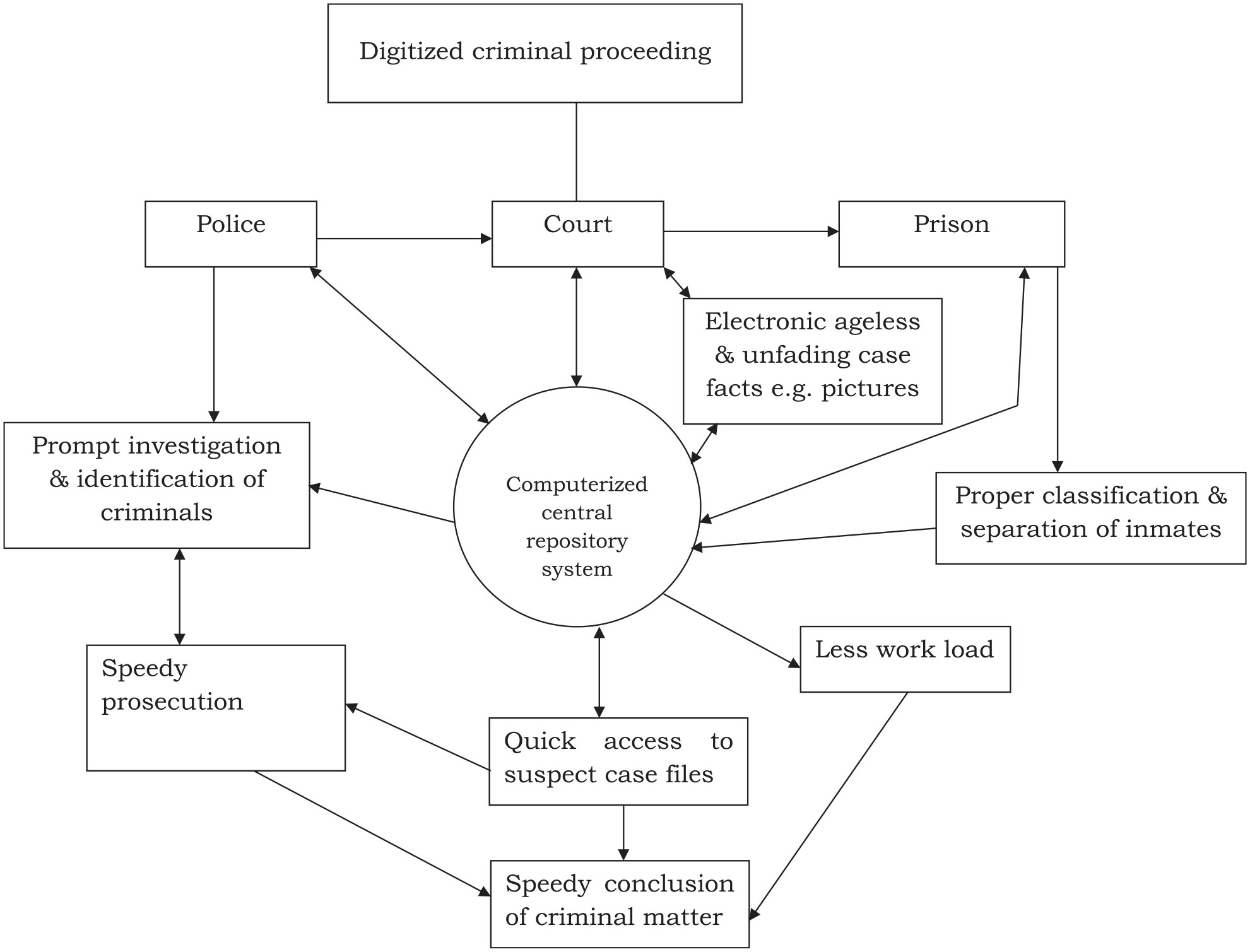
The above diagram depicts a typical or ideal digital Criminal Justice System. Specifically, when suspects are arrested, the allegations and evidences are collated and uploaded into the central repository by the police; the system then assigns the case to the nearest court of competent jurisdiction. As the case progresses in court, the proceedings are digitally recorded and, when judgments are passed for remand, these are also implemented, and records maintained digitally by the prison officials. All CJS agents in Ebonyi State will have access to this repository. The courts only need to access the system to see cases they should try, and the prisons only need to access the system to see details of inmates to be detained in their prisons.
Ezimechile is a proposal and represents the knowledge of the Computerized Central Repository System Platform (CCRSP) in the Igbo’s local parlance and the concept was utilized because it is a local word that is common among respondents. Ezimechile implies something that has to do with a solution-oriented concept in solving ATP’s. Ezimechile can be likened to a path which opens the way for issues to be addressed. The platform emerged from the conclusion and based on results of the study; the process of Ezimechile can actually be automated. The circle in Ezimechile’s diagram can be likened to the brain which controls everything including how to eat, sleep, and walk. The circle can be likened to the hub that can resolve inherent ATP’s. The specific interest is to explain how Ezimechile (computerized central repository system) can assist in achieving better Criminal Justice outcomes and reach desired global best practices in handling suspects and inmates. Thereby determining what works in achieving behavioral modifications of inmates.
This computerized central repository system will be linked together through one directional communication channel; intelligence gathering will be collective and shared. This will ensure inter-agency communication in the CJS. The police communicate one directionally with the courts as well as the courts communicate with the police. This channel of communication saves time and ensures necessary information is preserved. The prison officials will easily classify and separate inmates in the category they belong. This means that condemned criminals, first time offenders, awaiting-trial inmates, debtors, and delinquents will not all be put in the same prison as was observed in Abakiliki and Afikpo prisons. The ideal computerized repository system will help CJS agents to have quick access to suspects’ case files which will lead to fast and prompt prosecution of criminal cases and in turn will help in the enhancement of quick conclusion of criminal trial cases in Nigeria.
Conclusion, Recommendation, and Limitations
The aim of this study was primarily to advocate for quick dispensation of justice and to ascertain the role of computerized central repository in addressing awaiting-trial problems in Ebonyi State. A disconnect between the police, courts, and prisons ushers a huge gap between the three agencies of the CJS. These gaps are created by manual processes, distrusts, and other unforeseen circumstances like loss of evidence or paper works that occur during the transitioning of cases from one agency to another. It does also occur within agency activities because data were not properly stored and causes loss of data as cataloging is clumsy thus costing time to find references or key case files. Whether within agencies or during transitioning of cases, any form of disconnect between the three main agencies of the CJS negatively disrupts the smooth flow of cases. The central impact of this disconnect is delay in the administration of justice for the suspects that eventually causes overstay of awaiting-trial inmates in prisons—and thus leads to overcrowding of prison facilities. To prevent this disconnection, the study recommends the introduction of a computerized central repository platform (Ezimechile). What a computerized central repository platform (Ezimechile) does, is to fill the gaps between the police, courts, and prisons—thus connecting all parties to communicate easily, faster, and without loss of data. As the police carry out investigations and upload their findings on the digital platform, the court and prisons have immediate access to these findings and begin necessary processes within their own agencies. First, the police uploading their findings preserves evidences from the findings against mutilation or loss. Second, all the agencies gain quick access to needed information at all time, thus reducing communication time and smoothening the processes of the Criminal Justice System to fasten trial of awaiting-trial inmates. Computerized central repository platforms are needed in every possible step to support the CJS and reduce awaiting-trial time for suspects.
This recommendation addresses the challenge of loss/manipulation of data, and enormous challenges faced with the manual processes and other efforts expended in sorting through large files. Prior research, the perception of interviewees on the role of ICT, the reality on ground as gleaned from the interview of awaiting-trial inmates, prison officers, police officers, and court officials exposes the fact that the major challenges causing the awaiting-trial problem in Ebonyi State is related to the manual processes involved in the CJS and the lack of synergy between different agencies within the Criminal Justice System. This study was not without limitations. The fact that all respondent refused to have the interview recorded because of fear of victimization, political reasons, and inability to allow electronic gadgets into the prison yard, prevented the researcher from obtaining salient first-hand information that could have been very important in the findings of this study. Also, the interview especially for prison officers was hectic because of their busy nature.
Footnotes
Declaration of Conflicting Interests
Funding
ORCID iDs
