







Abstract
Introduction
Blending learning has emerged in an effort to enhance student learning experience whilst increasing their flexibility and convenience. The necessity of blended learning in higher education has become more obvious with the outbreak of the COVID-19 pandemic. An increasing number of researchers have stressed the need of adopting blended learning (Bennardo et al., 2020; Alammary et al., 2017; Finlay et al., 2022; Theoret & Ming, 2020). Many studies have reported that blended learning will become the normal approach for course delivery in the Post-COVID-19 era (Ehrlich et al., 2020; Jones & Sharma, 2020).
Developing a successful blended learning course is challenging. The literature shows that academics normally face several challenges when developing their blended courses. A major one is deciding the most appropriate proportion of online components that should be incorporated into their courses (Ashraf et al., 2021; Müller & Mildenberger, 2021; Oliver & Stallings, 2014). Reaching a harmonious balance between online and face-to-face components is vital for the success of blended learning courses. A harmonious balance can increase student engagement, provide them with more control over the time and place of their study and improve the overall student learning outcomes. In some courses, a higher proportion of online components can be more appropriate, while in others, a lower proportion can be more helpful (Müller & Mildenberger, 2021; Öncü, 2022). In our previous study (Alammary, Carbone et al., 2015), we identified 37 criteria that could influence the decision regarding the proportion of online to face-to-face components of blended courses. However, their impact on the design of blended learning courses has not been yet assessed. Therefore, this study aims to examine the impact of these criteria on the design process and on determining the proportion of online to face-to-face components of a blended course. More specifically, the study attempts to answer the following questions:
RQ1: How does each of the identified criteria affect the proportion of online to face-to-face components of a blended course?
RQ2: What is the most appropriate proportion of online to face-to-face components that should be incorporated into blended learning courses?
This study uses a two-round Delphi survey to assess the criteria and understand their impact on the proportion of online to face-to-face components of a blended learning course. The paper is organized as follows. Section 2 introduces the background of the research. Section 3 lists the criteria that have been assessed and describes the process that has been employed to select them. Section 4 provides a detailed description of how the Delphi method was used for the assessment. Section 5 presents the results that were obtained. Section 6 analyses and discusses the study’s findings. Section 7 explains the study’s limitations. Finally, Section 8 concludes the paper.
Research Background
There is continuing debate about the most appropriate definition of the concept of blended learning (Müller & Mildenberger, 2021). Picciano (2009) points out that “blended learning is not one thing but comes in many different flavors, styles, and applications; it means different things to different people.” According to Driscoll (2002), the confusion surrounding the term might appear to be a drawback. However, these multiple definitions also show the untapped potential of blended learning; Sharpe et al. (2006) argue that the ambiguity of the term blended learning allows teachers and instructional designers to develop their own understanding of the term within the context of their institutions or courses.
In this study, a blended learning course is defined broadly as “a course that: (i) thoughtfully integrates different delivery methods such as lectures, in-class discussion, online discussion, and self-paced activities and (ii) contains both face-to-face and online portions” (Alammary, 2022). A crucial point in this definition is that the final course should comprise a mixture of online and face-to-face components. This makes it encompasses a range of implementations from adding one single online activity to a face-to-face course to building a whole blended course from scratch with a variety of online activities.
Blended learning provides teachers with a wider choice of online and face-to-face components that can help them to develop solutions to course problems. These components support different types of interaction between learners, instructors, and content. Kearsley (1995) notes that interaction is a critical design factor for all types of courses, whether in the traditional, distance, or blended learning format. Bonk and Graham (2012) describe interaction as the “glue” that holds the components of a blended course together. Moreover, Wagner (2012) states that interaction “continues to be perceived as the defining attribute for quality and value” (p. 42) in the learning experience. Constructivist learning theory, the most influential theory impacting pedagogy and hence blended learning (Kirkley & Kirkley, 2005; Ogbona, 2021), suggests that learners “build personal interpretations of the world based on individual experiences and interactions” (Ertmer & Newby, 2008, p. 55).
Moore (1989) identifies three types of interaction: learner-instructor, learner-learner, and learner-content. Learner-content interaction is described by Moore (1989, p. 2) as “the process of intellectually interacting with content to bring about changes in the learner’s understanding, perspective, or cognitive structures.” Moore also points out that this type of interaction is a “defining characteristic of education.” According to constructivist theory, knowledge does not exist independent of the learner; it is constructed through interaction with the content (Piaget, 1977) or other individuals (Vygotsky, 1980). In constructivist settings, learners should have control over their own learning and should be provided with the resources, tools, and support necessary to manage their learning (Kwangmuang et al., 2021). Blended learning supports this type of interaction through online self-paced activities, for example, interactive videos, podcasts, and online reading. This type of activity allows students to study in their own time and at their own pace, from their own location (Kliziene et al., 2021).
Learner-instructor interaction attempts to “motivate and stimulate the learner and allows for clarification of any misunderstanding by the learner in regard to the content” (Moore, 1989). Cognitive development, according to Vygotsky (1980), begins with an interaction between the student and a more knowledgeable other. A number of studies (Iaconelli & Anderman, 2021; Liu, 2021) have found that a teacher’s nonverbal and verbal immediacy can increase students’ affective and cognitive learning. In blended learning, learner-instructor interaction is achieved through face-to-face instructor-led activities (e.g., face-to-face lectures and labs) and online instructor-led activities (e.g., virtual classrooms, webcasts, and scheduled internet instruction). These activities allow teachers to maintain control over their students’ learning experience and tailor teaching strategies accordingly.
Leaner-learner interaction, according to Moore (1989), occurs “between one learner and another learner, alone or in group settings, with or without the real-time presence of an instructor” (p. 4). Social constructivism, a parallel argument to constructivism, suggests that learning takes place because of students’ interactions in a group (Lave & Wenger, 1991; Vygotsky, 1980). Therefore, social constructivism stresses the need for student collaboration via approaches such as peer collaboration, problem-based instruction, or other methods that involve learning with others (Lombardo & Kantola, 2021; Woo & Reeves, 2007). In blended learning, collaboration occurs both online and offline through a variety of activities such as writing groups, peer teaching, online discussion, and online learning communities. This variety of activities available for instructors would allow them to better engage their students, help students to develop critical thinking, and help students to construct a deeper understanding of the material being learned (Lane et al., 2021).
To gain maximum benefit from blended learning, academics need to reach a harmonious balance between face-to-face and online components. A harmonious balance can help students better achieve the desired learning outcomes (Alammary, 2021). In some courses, a higher proportion of online components can be more appropriate, while in others a lower proportion can be more helpful (Hamann et al., 2021; Müller & Mildenberger, 2021). Setyaningsih (2020), for example, surveyed undergraduate students from three different higher education institutions in Indonesia. Most students expressed a strong preference for the face-to-face components of their blended learning courses. The two most frequently mentioned reasons for their preference were familiarity with the delivery mode and their ability to get direct clarification from their teachers.
Poon (2012) found different results when surveying a diverse group of students that included undergraduate, postgraduate, full-time, and part-time students. She noted that the majority of students were satisfied with the online components of their courses. Students reported that these components allowed them to better manage their own learning experience and learning pace. Poon also surveyed the academics who designed these blended courses. She found that institutional support (e.g., time release, technical support, funding, and professional development) was essential for successful online component integration. She also found that academics’ technological knowledge helped them in developing the online components.
In reviewing the literature, it was found that although the integration of the online components was driven by pedagogical needs, the proportion of online components seems arbitrary and not determined by certain criteria. Some courses were designed so they had more face-to-face than online components, while others tipped the balance in favor of online components. Other courses mixed the two modes of instruction somewhat equally.
One example is a first-year writing course taught at Brigham Young University. This course was redesigned so that students were required to attend one class a week instead of three (Waddoups et al., 2003). The two face-to-face classes were replaced by online lectures including explanations of difficult concepts. Students were also provided with online feedback and guidance on their writing. The integration of the online components was to improve student learning through using technology. However, no explanation was provided for how the proportion of online components was determined.
Another example is a third-year philosophy course which was originally delivered via two 90-minute seminar sessions per week (Garrison & Vaughan, 2011). This course was redesigned by reducing the number of face-to-face weekly sessions to one. An online portfolio system was introduced. Students were required to write short papers and upload them to the system. Then, they were asked to use a weblog feature in the system to provide reflective comments on their papers. They were also required to use a wiki feature of the system to comment on their peers’ papers. The integration of the online components was driven both by the students’ poor performance in the assignments and the fact that the majority of them were not reading the assigned articles before attending classes. However, again, no explanation was provided for how the proportion of online components was determined.
A third example is the blended courses taught to undergraduate and postgraduate students at the Saudi Electronic University. These courses were designed in the same format so they contained 33% face-to-face components and 67% online components. The decision regarding this proportion was made by the university. The main aim is to increase flexibility and convenience and to allow people with outside commitments such as family and work to continue their higher education (Saudi Electronic University, 2021).
In our previous study (Alammary, Carbone et al., 2015) we identified 37 criteria that need consideration when deciding the proportion of online to face-to-face components of a blended learning course. The study also rated the importance of these criteria and classified them into four categories: (i) criteria related to courses (11 criteria); (ii) criteria related to students (11 criteria); (iii) criteria related to teachers (8 criteria); and (iv) criteria related to educational institutions (7 criteria). The outcome of that study indicates that educational institutions play significant role in facilitating the integration of online components into the traditional face-to-face experience and helping academics to design successful blended learning courses.
To sum up, it is apparent from reviewing the literature that the appropriate proportion of online components can vary widely between courses. Our previous study shows that deciding this proportion is influenced by different criteria related to the nature of the course, the educational institution, the teacher, and the students. However, the impact of these criteria on the online proportion is not clear.
Criteria That Were Considered for Analysis
The 37 criteria that we found to influence the decision regarding the proportion of online components in a blended course were considered for analysis. Due to the large number of these criteria and due to the low importance rating of some of them, we decided to only analyze criteria that have achieved the highest importance ratings. The inclusion of 37 criteria in the assessment process would have resulted in a very long Delphi survey. According to Guthrie et al. (2022) and Keeney et al. (2001), the more statements in the questionnaire, the less likely experts will be to complete it.
To determine which criteria are the most important, a cut-off point was applied. Using a cut-off point is a common technique for determining Delphi consensus and carrying over statements from one Delphi round to the next (de Haan et al., 2022; von der Gracht, 2012). There are no recognized formulae or defined standards to guide the selection of cut-off points. They are normally determined based on the data obtained in the study (Cottam et al., 2004).
In this study, a mean score of 3.5 was set as the cut-off score. The selection of this cut-off score was arrived at in two steps. At first, and because of the 5-point ordinal scale (1 = very unimportant to 5 = very important) that has been used to rate the criteria, an initial cut-off score of 3.00 was chosen (Ahuja et al., 2009; Ugwude et al., 2021). However, this yielded a list of 34 criteria. The inclusion of 34 criteria in the survey would have resulted in a very large survey, especially when bearing in mind that each criterion had a number of options and participants were required to respond to each option, as can be seen in Figure 1.

Extract from the survey.
Hence, in the second step, the cut-off was increased to 3.50. This yielded 17 criteria, then, two criteria, which were very close to the cut-off point, were also included. The final list had 19 criteria which was a reasonable size (see Table 1).
The Criteria that were Considered for Assessment.

Data Collection and Analysis
This study used a two-round online modified Delphi survey to assess the 19 criteria. We decided to limit the number of rounds to two, mainly because Round 1 is normally used to identify the criteria. This was not needed in this study as all the criteria were identified in a separate study.
Reasons for Selecting the Delphi Method
A Delphi method was used in this study for a number of reasons. First, and most importantly, the Delphi method can help in building consensus among a group of experts who are geographically spread across a wide area and unable to participate in a face-to-face consensus method. Second, the Delphi method is able to provide anonymity of responses. Anonymity is an important characteristic as it allows participants to respond freely without the effects of dominant individuals which is a normal concern when using a group-based approach (Nasa et al., 2021). Anonymity can also eliminate persuasion and coercion to adopt a certain view and reduce the disagreeable aspects of group discussion (Brooks, 1979; Rowe & Wright, 1999). This provides an opportunity for participants to express their opinions and refine their ideas based on their own values or experiences.
Another important characteristic of the Delphi method that can be useful when assessing criteria that might influence the design of a blended course is the iteration process. As has been discussed, the Delphi process consists of a series of rounds. In each round, a panel of experts is asked to respond individually to a questionnaire. They can freely express their opinions and return their answers to the researcher. The researcher collects the responses, revises them, and returns to each participant a summary of the position of the whole panel. Then, as part of the process, the participants rethink and revise their original responses based on the feedback from the previous round (Xie et al., 2021). This process offers the experts the opportunity to suggest an initial assessment of each criterion as they can think of and then rethink and revise their initial responses based on the range of opinions of the whole panel. As a result, experts can move toward more accurate findings that are the product of detailed examinations and discussions.
A final reason behind the selection of the Delphi method was its ability to minimize the effect of noise. Noise, according to Dalkey et al. (1969), is the type of communication that occurs in group discussions and focuses on participants’ interests rather than problem-solving. It causes collected data to be distorted as it is normally biased and not related to the purposes of the study. The controlled feedback process of the Delphi method can reduce the effect of noise (Barrios et al., 2021). Hsu and Sandford (2007) state that when a well-organized summary of the previous round is distributed to the participants, it can provide them with the opportunity to obtain additional insight and can more thoroughly clarify the data collected in previous rounds. By operating within multiple rounds, participants become more focused on problem-solving and they can offer their opinions more insightfully.
Participant Recruitment
A two-step process was used to recruit experts for the study. At first, experts who participated in the previous Delphi Study were asked, in the survey itself, if they were willing to participate in another Delphi study to analyze the impact of the identified criteria. Of the 15 participants who completed the Round 2 survey of the previous Delphi study, 13 agreed and their names and contact details were added to an initial list of potential participants.
In the second step, a purposive approach was adopted to find more experts. The three inclusion criteria were as follows:
A participant should have been involved in designing at least one course;
A participant should have experience with online components such as virtual classes and online discussion boards; and
A participant should have at least one publication in the field of educational technology in top-tier publication venues. Publication records, according to Mirza et al. (2021) and Yazit and Zainab (2007), are an indicator of the professional expertise of academics.
With these inclusion criteria in mind, several university websites were searched. While searching theses websites, the researcher was aiming to include experts from different academic disciplines to understand the impact of the experts’ discipline on criteria assessment. The search resulted in identifying another 42 participants. Eventually, a total of 55 academics were added to the potential participant list.
When recruiting participants, it was important to decide how many experts would be enough for the Delphi panel. There is a wide variation regarding the number of experts on a Delphi panel. While some studies have employed over 60-panel members (Alexander & Kroposki, 1999; Crawford-Williams et al., 2022), others have involved as few as 10 members or less (Steinmann et al., 2021; Zeedick, 2010). Ludwig (1997) notes that the majority of Delphi studies have between 15 to 20 participants. Skulmoski et al. (2007) state that a Delphi panel of 10 to 15 can yield sufficient results. Rowe and Wright (1999) argued that the number of participants should depend on the nature and quality of data being collected and that in-depth feedback might require a smaller panel. They also add that the number of experts available should be considered, as should cost.
In order to decide the minimum number of experts required to yield sufficient results for the study, three key factors were considered: the time available to complete the study, which was 3 to 4 months; the number of facilitators available to moderate the discussion, which was only one researcher; and, the scope of the study, which was the assessment of the impact of 19 criteria on the design of blended learning courses. Taking these factors into account, a decision was made to recruit a panel of 15 to 20 members. It was felt that recruiting more than 20 experts may generate a large amount of data, which can lead to issues of data handling and potential analysis difficulties. It was also thought that a panel of fewer than 15 participants might not yield sufficient results.
To ensure the right number of participants in the Delphi panel, only five experts were contacted at a time. This continued until 15 to 20 experts completed the Round 1 survey.
Developing Round 1 Survey
LimeSurvey was used to develop the surveys for the two rounds. The first round survey comprised two main sections. The first one explained the purpose of the study and asked questions to ascertain the participants’ expertise, and hence their eligibility for inclusion in the panel, that is, experience with online components and experience in course design.
The second section was designed to assess the 19 criteria. The experts were instructed to indicate the proportion of online components that they might incorporate into a blended learning course with respect to each criterion. They were presented with five options to choose from Very high online proportion, High online proportion, Medium online proportion, Low online proportion, and Very Low online proportion (see Table 2). They were also asked to provide any comments regarding their responses. Figure 2 shows an extract from the second section of the Round 1 survey.
Possible Online Proportions.


Extract from the second section of Round 1 survey.
After developing the survey, it was pilot tested for reliability and validity. Two academics who have experience in online learning and instructional design were asked to assess the clarity and relevance of the survey items. Their feedback was collected, analyzed, and then several changes were made to the survey items.
Conducting and Analyzing Round 1 Survey
An email containing a link to the online survey was sent to the participants. Round 1 data analysis involved mainly quantitative methods. The standard deviation (level of dispersion) and mean (central tendency) were used to represent participants’ responses. The mean (
Standard deviation (
Developing Round 2 Survey
Round 2 had one section. Experts were presented with the criteria that they had responded to in Round 1 and the panel mean response for each item. They were encouraged to reconsider their responses while taking into account the panel’s mean response. The experts were asked to consider adjusting their responses toward the panel mean response. They were also instructed that if they want to keep any response that is more than one point away from the mean, they should provide justification. Figure 3 shows an extract from the first section of the Round 2 survey.

Extract from the first section of Round 2 survey.
After developing the survey, it was pre-tested and refined. The two academics who had participated in piloting the Round 1 survey were requested to comment on the clarity and relevance of the survey items. Their feedback was collected, analyzed, and then several changes were made to the survey items.
Conducting and Analyzing Round 2 Survey
The same expert panel from Round 1 was sent e-mails containing a link to the Round 2 survey. Three of them pointed out the need for a No Answer or Not Relevant option suggesting that some criteria were irrelevant or difficult to respond to. The initial intention of not including such an option was to encourage experts to try and complete all the items. Despite that, experts were reminded, in the Round 2 invitation emails, that a previous Delphi study was used to identify criteria that influence the design of blended learning courses. Only criteria that achieved a high importance rating were included in the current study. They were also informed that if they felt that a certain criterion was irrelevant or they could not respond to it, they could leave it blank.
Similarly to Round 1, the Round 2 data analysis involved mainly quantitative methods. The mean (central tendency) and standard deviation (level of dispersion) were used to present information concerning the experts’ responses. Experts’ comments were also analyzed to obtain an understanding of the reasons behind their ratings.
Results
Round 1 Survey
Of the 55 experts who had been invited, 18 (33%) accepted our invitation and completed the Round 1 survey. Six of them were from the 13 experts who participated in the previous Delphi study and had indicated their willingness to participate in this second Delphi Study.
Demographic Data
Table 3 shows the demographic data of the expert panel that was recruited. As can be seen, the members came from different academic disciplines and had years of experience in course design and using online delivery methods (see Table 3). They all had several publications in the field of online learning and 10 of them occupy leading positions in their educational institutions in the field of teaching and learning.
Experts Involved in the Study.

Some experts belong to more than one discipline.
Course-Related Criteria
As can be seen in Table 4, all items in this category achieved consensus (
Ratings of Influence of Course-Related Criteria.

Student-Related Criteria
As can be seen in Table 5, all items in this category but one, that is, Majority have difficulties using the technology required for the online components, achieved consensus. Students’ access to technology (criterion 5) had the greatest impact on the proportion of online components. Students’ attendance requirements (criterion 6) had very little impact on the proportion of online components. This criterion was considered to have the least impact compared with all the other criteria in the whole study.
Ratings of Influence of Student-Related Criteria.

Teacher-Related Criteria
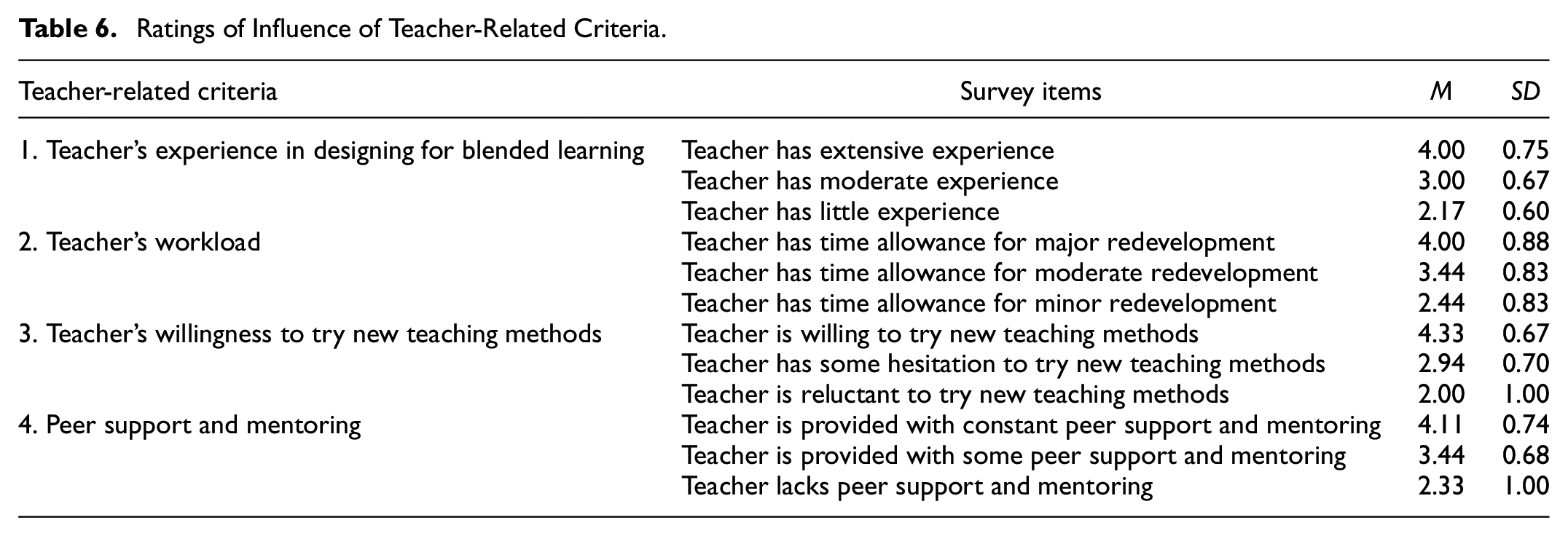
As can be seen in Table 6, all items in this category achieved consensus. The highest mean of online proportion was given to courses taught by teachers who are willing to try new teaching methods (4.33). Teachers’ willingness to try new teaching methods (criterion 3) recorded the highest impact on the proportion of online components compared with the other teacher-related criteria. The experts indicated a high proportion of online components (
Ratings of Influence of Teacher-Related Criteria.
Institution-Related Criteria
As can be seen in Table 7, of the 18 items listed in this category, 15 items achieved consensus. Technical support (criterion 3) had the greatest impact on the proportion of online components compared with the other institution-related criteria. Teacher performance evaluation (criterion 5) had very little impact on the proportion of online components. This criterion was considered to have the second least impact compared with all the other criteria in the study.
Ratings of Influence of Institution-Related Criteria.

Round 2 Survey
Fifteen of the expert panel who completed the Round 1 survey have also completed the Round 2 survey with a response rating of around 83%.
Course-Related Criteria
As can be seen in Table 8, no significant changes were noticed in the experts’ responses compared to the Round 1 results. Experts again gave a very high proportion of online components (
Ratings of Influence of Course-Related Criteria.

Student-Related Criteria
As can be seen in Table 9 below, the experts gave the highest proportion of online components for courses that have a majority of students with outside commitments (
Ratings of Influence of Student-Related Criteria.

Teacher-Related Criteria
As can be seen in Table 10, the highest online proportion was given to courses taught by teachers who are willing to try new teaching methods (
Ratings of Influence of Teacher-Related Criteria.

Institution-Related Criteria
Similar to Round 1, Technical support (criterion 3) continued to score the greatest impact on the proportion of online components compared with the other institution-related criteria. The score for Teacher performance evaluation (criterion 5) also continued to demonstrate very little impact on the proportion of online components. It was the criterion with the least impact compared with all the other criteria in the section. The three items that did not achieve consensus in Round 1 moved considerably closer toward consensus and achieved consensus in Round 2. Eventually, all items in this subsection (see Table 11), achieved consensus and they all moved closer to consensus when compared to Round 1 scores.
Ratings of Influence of Institutional-Related Criteria.

Analysis and Discussion
This two-round Delphi study assessed the impact of criteria that need consideration when deciding the proportion of online components of a blended learning course. A total of 19 criteria were assessed in this study. Below is a detailed discussion of their impact on the design of blended courses.
Course-Related Criteria
Three course-related criteria were assessed and their impact on the proportion of online components can be seen in Figure 4.

Impact of course-related criteria.
Course type (theoretical, practical, or a combination)
The experts recommended that the more practical content in the course, the fewer online components that should be incorporated into that course. This agrees with Díaz and Entonado’s (2009) finding that it is more satisfactory and efficacious to deliver theoretical content online and that students who are studying online may find it difficult to cope with practical content. This, however, should not be interpreted to mean that
How students are enrolled (on campus, off campus, and both)
The experts recommended that the more students studying off campus, the more online components that should be incorporated into the course (see Figure 4). Not surprising, a very high proportion of online components was indicated for courses with a majority of off-campus students. This was the highest mean of online proportion given to any item in the survey. It is probably due to the fact that off-campus students are usually seeking flexibility and convenience (Graham, 2012; Ota et al., 2018), and activities that require them to be time- and place-bound are not desirable. One expert commented: “
Availability of technology to enable online delivery (Do teachers have all the technology they need for the online delivery?)
The experts recommended that the more technology available, the more online components that could be incorporated into the course. Most importantly,
Student-Related Criteria
Six student-related criteria were assessed. The impact of three of them on the proportion of online components is presented in Figure 5; the impact of the other three is presented in Figure 6.

Impact of student-related criteria (Part A).

Impact of student-related criteria (Part B).
Students’ preferred learning style (online or face-to-face)
The experts recommended that the more students who prefer online instruction, the more online components that should be incorporated into the course (see Figure 5). This view is supported by the finding of Limniou and Smith (2010) and Wang et al. (2019), who stress the importance of providing students with a learning experience that matches their individual learning styles. However, it is worth noting that some experts highlighted the necessity for teachers to push their students to work outside their comfort zone. One expert remarked: “
Students’ life situation (any outside commitments, such as work or family?)
The experts recommended that the more students who have outside commitments, the more online components that should be incorporated into the course. An explanation for this is that online components provide flexibility and convenience for students to pace their own studies. Flexibility and convenience are of great importance for students who seek additional education but who have commitments such as family and work (Graham, 2012; Peck et al., 2021). What was interesting is the medium proportion of online components that was indicated for courses with the majority of its students having no outside commitment (see Figure 5). It seems that the experts believe that blended courses should have more online than face-to-face proportions regardless of outside commitments.
Students’ access to campus (Do they live near or away from the campus?)
The experts recommended that the more students who live away from the campus, the more online components that should be incorporated into the course. This again seems to be related to the need for blended courses to provide a flexible and convenience learning experience. Aggun (2019) and Vaughan (2007) point out that an important aspect of blended learning is to allow students to choose the time and place for their learning rather than commuting and finding available parking spaces.
Students’ technology literacy (Can they use the technology required for the online components?)
The experts recommended that the more students who can easily use the technology required for the online delivery, the more online components that could be incorporated into the course. Dahlstrom and Bichsel (2014) and Zhu et al. (2021) recommend that it is important for teachers not to assume that all students are technically inclined. They stressed the need to assess students’ technology literacy and provide those who are less technically inclined with more personalized help. Interestingly, as can be seen in Figure 6, experts indicated a notable proportion of online components for courses with a majority of students who cannot use the required technology. It might be the case that experts believe that students’ technology literacy can be resolved by providing more support and resources to students commencing with a blended learning course.
Students’ access to technology (Can they access the technology required for the course?)
The experts recommended that the more students who have difficulties accessing the technology required for the course, the fewer online components that should be incorporated into that course. As can be seen in Figure 6,
Students’ attendance requirements (e.g., international students on visas)
The experts recommended that, given the increased number of international students, slightly more online components than face-to-face components could be incorporated into the course. As can be seen in Figure 6, this criterion showed very little impact on the proportion. In fact, it scored the least impact on the proportion of online components compared to all the other criteria that have been analyzed. This result was not entirely unexpected given the fact that out of the 19 criteria that have been qualified for assessment, this criterion had the lowest importance rating of 3.47.
Teacher-Related Criteria
Four teacher-related criteria were assessed and their impact on the proportion of online components is shown in Figure 7.

Impact of teacher-related criteria.
Teacher’s experience in designing for blended learning
The experts recommended that the more experience the teachers have in designing for blended learning, the more online components that could be incorporated into the course. This corresponds with the work of Duhaney (2004) who suggests that teachers with little experience in blended learning should start simply and implement incrementally. Ertmer and Ottenbreit-Leftwich (2010) and Alammary, Sheard et al. (2015) also point out that experience can help build teachers’ confidence in developing and running their blended learning courses.
Teachers’ workload (Do they have time allowance for redevelopment?)
The experts recommended that the more time allowance the teachers have for redevelopment, the more online components that could be incorporated into the course. This agrees with many studies such as those of Dekeyser et al. (2014) and Ibrahim and Ismail (2021) that identified teachers’ workload as a constraint that may limit the proportion of online components that could be incorporated into blended courses.
Teacher’s willingness to try new teaching methods
The experts recommended that the more willingness the teachers have to try new teaching methods, the more online components that could be incorporated into the course. Teachers’ willingness, as can be seen in Figure 7, seems to be a major contributor that can motivate the integration of a high proportion of online components. However, it also seems that teachers’ negative attitudes toward new technology should not stop them completely from integrating some online components for the benefit of their students.
Peer support and mentoring (Are they provided with peer support and mentoring?)
The experts recommended that the more peer support and mentoring provided to the teachers, the more online components that could be incorporated into the course. However, as can be seen in Figure 7, even when teachers lack peer support and mentoring, the majority of experts recommended a low to a medium proportion of online components be incorporated into the course. One of them commented: “
Institution-Related Criteria
Six institution-related criteria were assessed. Three of them are presented in Figure 8 while the other three are presented in Figure 9.

Impact of institution-related criteria (Part A).

Impact of institution-related criteria (Part B).
Blended learning alignment with institutional goals (culture)
The experts recommended that the more blended learning aligns with institutional goals, the more online components that could be incorporated into the course. One expert explained: “
Time release (Does the institution provide teachers with time release?)
The experts recommended that the more time release the institution provides to teachers, the more online components that could be incorporated into the course. According to many studies, it is vital to provide time release for teachers engaged in blended learning developments(Benson & Avery, 2009; Wedding et al., 2018). Vaughan (2007) proposes that the development of a blended course normally takes two to three times longer than the development of a similar course in the traditional format. However, the findings of this study, as can be seen in Figure 8, suggest that the lack of time release should not stop teachers from incorporating some proportion of online components in their courses.
Technical support
The experts recommended that the more technical support the institution provides to teachers, the more online components that could be incorporated into the course. Technical support seems to be important to facilitate the design of the blended course and to minimize the risk of failure. One expert explained: “
Professional development (Does the institution provide professional development?)
The experts recommended that the more professional development the institution provides to teachers, the more online components that could be incorporated into the course. Similar to
Teacher performance evaluation (Is performance evaluation conducted?)
It seems that performance evaluation can motivate academics to incorporate more online components into their courses. However, it is important to note that there was some divergence of opinions. While the majority of experts believe that online components might result in better evaluation, some think that it might result in poorer evaluation. One of them explained: “
Supporting teaching innovation
The experts recommended that the more support for teaching innovation, the more online components that could be incorporated into the course. Supporting teaching innovation, as can be seen in Figure 9, seems to be a major contributor that can facilitate the integration of a high proportion of online components. However, when it is not valued, experts also recommended that a medium proportion of online components be incorporated.
Implications for Teaching and Best Practices
This study investigated the impact of 19 different criteria on the design of blended learning courses and on determining the most appropriate proportion of online to face-to-face components of a blended course. The study shows that designing a successful blended learning course is a complex problem that requires academics to compromise between what is good for their students and what is possible, considering different influential criteria. Tables 12 and 13 show the top cases where the lowest and highest proportions of online components were proposed by the experts who participated in this study. These cases show that academics should start their design process by paying careful attention to the technologies needed for online delivery. When most of these technologies are not available, or when students cannot access or use these technologies, only a small proportion of online components should be added. Academics should then look at the life situations and preferences of their students. If the majority of students have a strong preference for online instruction or have outside commitments, this should encourage the integration of the highest possible proportion of online components. Institutional support is a key factor for the success of blended learning. Considering the large number of delivery options available for blended courses, academics should be provided with professional development focused on the proper use of online components that academics have never experienced before. Valuing teaching innovation and dealing with academics’ resistance to new teaching approaches can encourage them to step out of their comfort zone and commit to blended learning.
Top 5 Cases Where the Lowest Proportions of Online Components Were Proposed.

Mean proportion of online components.
Top 5 Cases Where the Highest Proportions of Online Components Were Proposed.

Mean proportion of online components.
In around 76% of the cases that were presented to the experts, they recommended medium to high proportions of online components to be added to blended courses, that is, 46% to 80% of course components are online with the rest being face-to-face. This indicates that blended learning courses should normally have more online than face-to-face components. The inclusion of a higher proportion of online components could overcome the shortcomings of traditional teaching methods and encourage the use of innovative teaching approaches. It would increase students’ flexibility and provide them with a larger range of course-scheduling options. It also gives students more autonomy in coordinating their learning, helping them to become independent learners. This learning independence is attributed to the limited attendance time. While students are spending most of their time online, there are still face-to-face collaborative activities with peers and teachers to increase learning motivation and reduce procrastination. Moreover, the majority of online activities are student-centered approaches that are useful to meet diverse students’ needs. Student-centered teaching approaches focus on improving students’ learning skills. Academics role is only to facilitate learning by understanding students’ different needs and developing a learning environment that can meet these needs. As a result, students become more engaged in the learning process and take more responsibility for their own learning.
The Impact of Disciplines and Academic Levels
The experts’ area of discipline does not seem to have an effect on their preferences regarding the proportion of online components. For example, the four experts from the Business discipline indicated different proportions of online components for courses that mainly comprise theoretical content. One indicated a very high proportion, another indicated a high proportion, the third indicated a medium proportion and the last one indicated a low proportion. Moreover, the three experts who indicated a very high proportion of online components for courses that have a majority of domestic students, were from three different disciplines: Information Technology, Exercise Science, and Education.
The course level at which the experts teach, that is, undergraduate, postgraduate, or both, also does not seem to have an effect on the experts’ preferences regarding online proportion. For example, the five experts who teach at the postgraduate level indicated different proportions of online components for courses that have a majority of students with no outside commitments. Two indicated a very high proportion, one indicated a high proportion, the third indicated a medium proportion and the last one indicated a low proportion.
Limitations
Despite the contribution that this research has made to the understanding of blended learning course design, it has some limitations that warrant mention. First, the experts who participated in the study comprised academics from New Zealand and Australian universities only. Therefore, some of the identified criteria might only be relevant in the New Zealand and Australian contexts. A limitation associated with the Delphi method is the problem of requiring all participants to respond to the open-ended questions that ask them to justify their responses. While a good number of experts provided justification for their ratings, some did not. According to Adler and Ziglio (1996) and Lim et al. (2014), the nature of the open-ended questions in a survey format may not yield the rich explanation that is characteristic of one-on-one interviews.
Conclusion
This study provided a detailed description of how a two-round modified Delphi method was used to assess 19 criteria that have been found to influence the decision regarding the proportion of online components in a blended course. To our knowledge, this is the first study to investigate this aspect of blended learning course design. The study has made two primary contributions. First, it identified the impact of the 19 criteria on the design process, and accordingly, the cases in which the lowest and the highest proportions of online components should be added to blended courses. Second, it helped in answering the frequent question regarding the most appropriate proportion of online to face-to-face components that should be incorporated into blended learning courses. The results show that technological aspects, that is,
Footnotes
Declaration of Conflicting Interests
Funding
ORCID iD
