







Abstract
Keywords
Introduction
This paper focuses on the detrimental behavior of leaders when they escalate their commitment and tend to knowingly persist with a failing course of action, despite clear evidence that this course of action is futile and counterproductive (Brockner, 1992; Staw, 1997). Escalation of commitment (hereafter EOC) has been studied extensively since the 1970s (e.g., Desai & Chulkov, 2011; Sleesman, 2019; Staw, 1997) because it has been found to be a conspicuous feature in wide-ranging failed decisions (Sleesman et al., 2012). EoC affects decisions in various organizational settings including business and innovation investments (Jani, 2011), war and conflicts (Renshon & Kahneman, 2017), public sector investments (Montealegre & Keil, 2000), health decision such as selecting a course of action while confronting the COVID-19 pandemic (Schippers & Rus, 2021) and obviously finance (Berg et al., 2009).
EoC studies often relate to and draw on disciplines in the wider domain of the social sciences including economics (e.g., Chulkov & Barron, 2019), psychology (e.g., Kong & Belkin, 2019), and sociology (Westphal & Graebner, 2010). Most EoC research is based on psychological theories (Sleesman et al., 2012). Within the psychological domain, the main mechanism underlying EoC draws on the self-justification perspective (Holland et al., 2002). This perspective suggest that decision-makers tend to process information in a biased fashion in order to reduce the dissonance that arises when their positive self-perceptions conflict with evidence showing that past investments have been unsuccessful (Kerstholt et al., 2010). After committing to a choice, people tend to give too much weight to evidence that supports their decision and disregard evidence that does not (Kerstholt et al., 2010). For example, self-justification theory explained consumers purchasing behavior during the COVID-19 pandemic by the justification of massive on-line purchasing due to pursuing freedom or confronting boredom (Di Crosta et al., 2021). Another psychological explanation to EoC is loss aversion- the psychological propensity that losses cause a greater emotional impact on an individual than does an equivalent amount of gain (Kahneman & Tversky, 1979). Therefore, people will choose to avoid losses, and this idea is at the heart of EoC (Drummond, 2014).
Additional theory that serves as a possible explanation to EoC is the sunk cost fallacy (Haita-Falah, 2017). According to normative or rational economic theory, costs incurred in the past are immaterial for forthcoming marginal payoffs, that is, sunk costs must be disregarded, However, the sunk cost fallacy is irrational behavior of people to commit to an investment (e.g., time, money, effort), and invest even more resources despite it being unprofitable (Haita-Falah, 2017). For example, Tucker and Alewine (2021) used the sunk cost fallacy to explain persistence with governmental policies during the COVID-19 pandemic.
Despite this psychological tendency, leaders’ personality characteristics have been marginally addressed in the extant EoC literature (K. F. Wong et al., 2006). EoC has been extensively studied in the field of decision-making as a fallacy that is common for most individuals but rarely from the personality perspective by mapping the profiles that are more prone to EoC in general and among leaders in particular. Leaders’ personalities affect their organizations considerably (Judge et al., 2008). Personalities affect job performance (Kiarie et al., 2017), job satisfaction (Dababneh et al., 2022), and other important job criteria such as team effectiveness, job attitudes, and coping mechanisms (Judge et al., 2008).
The impact of a leader’s personality is particularly apparent in decision-making processes (Peterson et al., 2003), which feature prominently in EoC situations (Lunenberg, 2010). Peterson et al. (2003) found that when leaders’ decision-making is typified by caution, they are more likely to succeed. Successful leaders are also open to criticism (Peterson et al., 2003). Consequently, it is vital to understand the role of leaders’ personality in circumstances where EoC transpires, and specifically to understand those personality traits and dispositions that appear pertinent.
We draw on Sleesman et al. (2018) review that offered a multilevel model for the causes of EoC. Their model suggests that EoC is elicited by external factors, organizational factors, and groups factors. Importantly, in this extensive review the authors stress that leaders’ attributes do contribute to EoC in processes such as identification, commitment and motivation of leaders but called upon “future studies [to] draw on research that has examined the influence of broad personality traits on the tendency of individuals to escalate.”
Following this call, the current study investigates how and why leaders’ personality traits and behavioral dispositions enhance EoC. Explicitly, we focus on the roles of extraversion, sensation-seeking and hubris in aggravating EoC. Our model contributes to the extant EoC literature, as it focuses on a personality perspective rather than on psychological biases presumably common to most people (Staw, 1997). Importantly, the premises of this study do not contradict the psychological biases that underpin leaders’ EoC, but rather further explain which personality variables/dispositions are more prone to EoC. The research model variables were selected after a comprehensive research for possible antecedents for EoC based on high-echelon managers’ unique personality profile. Importantly, the main theoretical contribution of this study is that it offers a new perspective on EoC that is rooted in the unique personality structure of high-echelon managers. This study’s findings may be helpful in creating safety measures for early detection of EoC. Awareness of managerial proneness to EoC may be helpful in making practical decisions concerning resource allocation.
Theory
Extraversion and EoC
A common organizational decision focuses on whether to continue along a path that has initially resulted in failure (Tsai & Young, 2010). There is ample evidence showing that when faced with such decisions, individuals often persist in investing in the failing project instead of allocating resources to alternative ventures (Brockner, 1992; He & Mittal, 2007). In an EoC situation decision-makers invest significant resources they then receive feedback indicating that the chosen course of action is unsuccessful, but they still decide to continue to invest in the original course of action or not withdraw resources from their prior bad decision (Whyte & Saks, 2007). They do so in an effort to “turn things around”; however, by investing more resources in the failing venture, they escalate their commitment to their initial choice (Staw, 1997).
Although the EoC phenomenon has been extensively researched, previous studies focused primarily on decision-making mechanisms (Sleesman et al., 2012). An important feature common in most EoC cases is the presence of a dominant decision-maker (Moon, 2001). For example, Schaubroeck and Williams (1993) found that individuals with a type A personality are more inclined to escalate their commitment compared to those who have type B personality. This research examines personality traits that allegedly induce leaders to escalate or attenuate their commitment to a chosen course of action. In the following sections, we develop hypotheses related to EoC and personality traits.
Extraversion is one of the domains of the Five-Factor Model (henceforth FFM), (Bagby & Widiger, 2018; Costa & McCrae, 1992). It is the state of attaining gratification from outside oneself and seeking stimulation in the company of others (Costa & McCrae, 1992). Extraverts tend to enjoy human interactions and to be enthusiastic, talkative, assertive, optimistic, cheerful, and gregarious (Wilt & Revelle, 2008). Extraverts are invigorated when socializing and are more prone to boredom derived from solitude (Aliabadi M et al., 2020). We have chosen to focus specifically on extraversion, since it appears to be more theoretically pertinent to the model’s constructs: sensation-seeking, hubris, and EoC.
According to Ewen (1998), extraversion is characterized by a deep interest in other individuals and external events, and by venturing forward with confidence into the unknown. Durand et al. (2008) assert that extraverts are more prone to escalating their commitment in stock-trading due to their overconfidence, which induces them to stick to their selected course of action and fuels their tendency to participate in innovative projects. Extraverts’ tendency to be overconfident also explains their propensity to escalate their commitment (Durand et al., 2008). This is because they are more inclined to take risks and be assured that the path they have taken was the right course of action (Michailova et al., 2017). Also, they pay extra attention to positive and less attention to negative information which explains why they would disregard the negative feedback on their chosen course of action (Noguchi et al., 2006)
Additionally, extraverts are more influenced by external elements and other people, rather than by an intellectual or rational evaluation of the situations they encounter (Sadi et al., 2011).
Finally, Extraverted decision-makers experience higher cognitive dissonance when confronted with recurring negative feedback while engaging in projects and are therefore more expected to persist with the course of action they took (Marx et al., 2021).
Extraversion and Sensation-Seeking
Our model suggests that sensation-seeking mediates the relationship between extraversion and EoC. A facet of extraversion, excitement-seeking, is closely related to sensation-seeking (Zuckerman, 2009). Individuals scoring high on this facet tend to enjoy and pursue exciting activities and are open to engage in new experiences (Malkin & Rabinowitz, 1998). They constantly search for excitement and stimulation (Aluja et al., 2003). Highly excitement-seekers are also prone to be risk-takers (Oehler & Wedlich, 2018; Terracciano et al., 2008). Hence, they naturally engage in dangerous activities, as opposed to moderate extraverts, who tend to avoid risk and danger (Malkin & Rabinowitz, 1998). Aptly, extraversion has been also found to be significantly and positively associated with the sensation-seeking (Zuckerman, 1994), and specifically with sensation-seeking’s thrill and adventure-seeking facets. This relationship exists since excitement and stimulation-prone extraverts tend take risks and seek thrills (Mahdiuon et al., 2010). Finally, extraversion is related to increased levels of risk-seeking behaviors, resulting in increased accident and absenteeism rates (Judge & LePine, 2007).
Sensation-Seeking and EoC and the Mediating Role of Sensation-seeking on the Relationship Between Extraversion and EoC
Sensation-seekers are more likely to perceive a situation as one of low-risk and thus have a higher tendency to underestimate risks (Rosenbloom, 2003). High sensation-seekers are more likely to perceive a situation as being of low-risk, and thus have a higher tendency to underestimate risks. Thus, they are commonly inclined to escalate their commitment to a chosen course of action (Doerflinger et al., 2017). Fuster (2002) argues that decision-making is strongly influenced by emotions rather than by cautious cognitive processing of risk information. Therefore, though decision making is believed to be a rational process, Kahneman’s discusses a framework that could allow room for emotions by addressing two types of intuitions emanating from System 1 (The intuitive system): accurate intuitions explained by practice, and inaccurate intuitions based on “gut feel” (Kahneman, 2011).
Thus, it is plausible that sensation seekers miscalculate or undervalue risks involved in certain business strategies (Horvath & Zuckerman, 1993). This assertion is also supported by Arria et al. (2008), who found that individuals characterized by low or moderate risk-seeking are particularly susceptible to the influence of perceived harmfulness and hence are inclined to perceive risks of a certain business course of action more accurately. Finally, Brown et al. (2018) found sensation-seeking to be a strong predictor of hazardous financial decisions commonly related to EoC.
Sensation-seeking is likely to mediate the relationship between extraversion and EoC through the innate tendency of extraverts for overconfidence (Schaefer et al., 2004). The positive association between extraversion and overconfidence has been established in previous studies (Meisel et al., 2016). There is a positive association between overconfidence and extraversion because extraverts are dominant, forceful, decisive and generally optimistic, all of which typify overconfident individuals (Pallier et al., 2002). When this overconfidence is met with a disregard of taking precautionary measures, perceiving situation as being with low risks and assuredly striding toward the uncertain the results could be disastrous (Ronay et al., 2017).
Furthermore, extraverts are more likely to be sensation-seekers because two facets of extraversion, excitement and activity, are closely related to sensation-seeking (McEwan et al., 2019). Sensation-Seeking and extraversion, and specifically these two facets of excitement and activity, are perceived as two different theoretical structures but share a significant amount of variance (Laborde et al., 2020; McEwan et al., 2019; Rumbold et al., 2021). This relationship between these two constructs was explored in studies that examined the personality of individuals who engage in dangerous sports such as rock-climbing (Rumbold et al., 2021; Woodman et al., 2020).
To explain the reason extraversion precedes sensation-seeking in the mediation we differentiate between extraversion as a higher-order and generic personality trait (i.e., trait-like disposition; Zilcha-Mano, 2021). We posit based on extant and relevant literature that extraversion is a higher-order trait-like disposition, while sensation seeking is a state-like disposition (parallel to emotional intelligence, leadership, etc.), meaning extraversion cannot be taught, enhanced or diminished, as it is relatively constant (as a part of the individual’s personality). On the other hand, sensation seeking can be taught, enhanced, or diminished, just like people can be trained to be more efficacious or flex their emotional intelligence. This indicates that extraversion must precede sensation seeking in a causal flow model (we stress “causal flow,” not causality). Lastly, escalation of commitment is a behavioral factor, and is, in fact, the product of extraversion and sensation seeking in our causal flow mediational model. In other words, by order of precedence extraversion is the predictor, sensation seeking is the mediator and escalation of commitment is the outcome.
Hubris as a Moderator of the Relationship Between Sensation-Seeking and EoC
The
Hubristic leaders may ignore negative or contradictory information and inherent flaws (Klayman et al., 1999), believe in their invulnerability and refrain from delving into details (Owen, 2012). In this vein, in EoC circumstances, hubristic leaders tend to ignore negative feedback related to a chosen course of action (Huning & Thomson, 2013).
We postulate that hubristic managers are likely to escalate their commitment regardless of their tendency toward sensation-seeking. Owen and Davidson (2009) postulated that hubristic individuals’ recklessness generates emotional grandiosity and insulated decision-making amongst hubristic leaders. This isolation is predisposed to prevent consultation and the down-toning of negative information concerning investments or helpful clues regarding a failed course of action (Hayward et al., 2004).
However, we argue that leaders who have low level of hubris are still in danger of escalating their commitment, depending on their level of sensation-seeking. We have shown that individuals with high hubristic tendencies will most certainly escalate commitment. This behavior will probably be true regardless of their sensation-seeking level, due to the strong effect of the hubris syndrome on careless behavior and their feeling of invulnerability (Owen, 2008). When managers are inclined to be hubristic, their low sensation-seeking tendency will not prevent them from escalating their commitment, since they are characterized by disregard for details, feeling of omnipotence and they do not care if their actions will have negative implications on other people (Owen, 2008).
Contrary to the above, we expect to see differences between the high and low sensation-seekers primarily in managers with low levels of hubris. We suppose that low sensation-seekers will show low levels of escalation while high sensation-seekers, managers who are careless and do not take relevant precautionary measures, will show higher levels of escalation of commitment (Tsai & Young, 2010).
To conclude this section, we present a conceptual model (Figure 1) that ties together our theoretical ideas and clarifies the place of each variable in the larger picture of personality and EoC. The model depicts the inter-relations of the variables and their relative effect. Though research shows that each variable has value on its own, taken together, these variables allow us to see a simultaneous effect on EoC.

The conceptual model.
Method
Sample and Procedure
A total of 500 questionnaires were sent out to managers working at various managerial levels at a wide range of Israeli industries. A total of 324 were completed (64.8% Response Rate). Participants were mainly from private firms, including service industries, Hi-tech, production, and retail industries. Participants were asked to complete a multiple-choice structured questionnaire. Sampling was based on Network respondent-driven sampling (Heckathorn, 2011).
The average respondent’s age was 40.86 years (
Measures
EoC
We used a scenario-based scale (called a “blank radar plane”), which was used in various studies to estimate EoC (e.g., Emich & Pyone, 2018; Feldman & Wong, 2018; Moon, 2001). The participants had to estimate the likelihood that they would continue their commitment and decide whether they should allocate additional funds by responding to this question: “What is the likelihood that you will continue the project? Please rate from 0 to 100.”
FFM
We used the Mini-IPIP (Donnellan et al., 2006) to estimate the Five-Factor Model. Participants responded to 20 items) on a five-point Likert scale—ranging from 1 (Totally disagree) to 5 (Totally agree). Sample item: “I talk to a lot of different people at parties.” The Cronbach’s alpha was .75.
Sensation-seeking
We used Zuckerman’s (1994) sensations-seeking sub scale. This sub-scale is comprised of 11 “true or false” items. The scale included items such as “I like doing things just for the thrill of it.” The Cronbach’s alpha was .79.
Hubris
We used the Owen and Davidson hubris scale (Owen & Davidson, 2009). Participants responded to 13 items on a five-point Likert scale—ranging from 1 (Totally disagree) to 5 (Totally agree). Sample item: “I am accountable only to a higher authority (the Queen, God).” The Cronbach’s alpha was .72.
Common Method Bias
Since our research instrument was based on self-reports, ex-ante remedies were applied in-order-to attenuate CMB and self-report bias (Podsakoff et al., 2003).
In addition to these ex-ante remedies, a test of Common Latent Factor (CLF) was applied (Podsakoff et al., 2003) using SEM to assess whether a common latent factor emerges. This method allows questionnaire items to load on their theoretical constructs, as well as on a latent CMV factor, and examines the significance of theoretical constructs with or without the common. Concisely, the technique requires the comparison of the standardized regression weights, before and after adding the Common Latent Factor (CLF). It is recommended that substantial differences (>0.2), needs to be retained in the structural model (Richardson et al., 2009). This analysis showed that none of the regression weights were fundamentally affected by the CLF, that is, the deltas between loadings were no higher than .20.
Results
Means, standard deviations and inter-correlations are presented in Table 1.
Means, Standard Deviations, and Intercorrelations.

Main Analysis and Hypotheses Testing
To test our model and hypotheses, we used Hayes’s (2017) procedure to test for regression mediation and moderated mediation. We ran the analysis using the SPSS macro PROCESS 3.2, model 4 (for Hypotheses 1–4) and model 14 (for Hypotheses 5 and 6). To reduce nonessential multicollinearity concerns (Enders & Tofighi, 2007), the independent variables were mean-centered before computing product terms.
Hypotheses 1 to 4 jointly proposed that sensation-seeking would mediate the relationship between extraversion and EoC. To test these hypotheses, a mediated regression analysis was conducted using Hayes’s (2017) PROCESS model 4 to test the mediation model. As hypothesized, extraversion was positively related to EoC (

Moderated-mediation model.
Hypotheses 5 and 6 proposed that hubris would moderate the direct relationship between sensation-seeking and EoC, and the indirect relationship between extraversion and EoC. These hypotheses were tested using Hayes’s (2017) PROCESS model 14 to test the moderated mediation model.
As shown in Table 2, the predicted interaction; namely, sensation-seeking × hubris, was statistically significant (
Moderated Mediation Effects Predicting EoC.

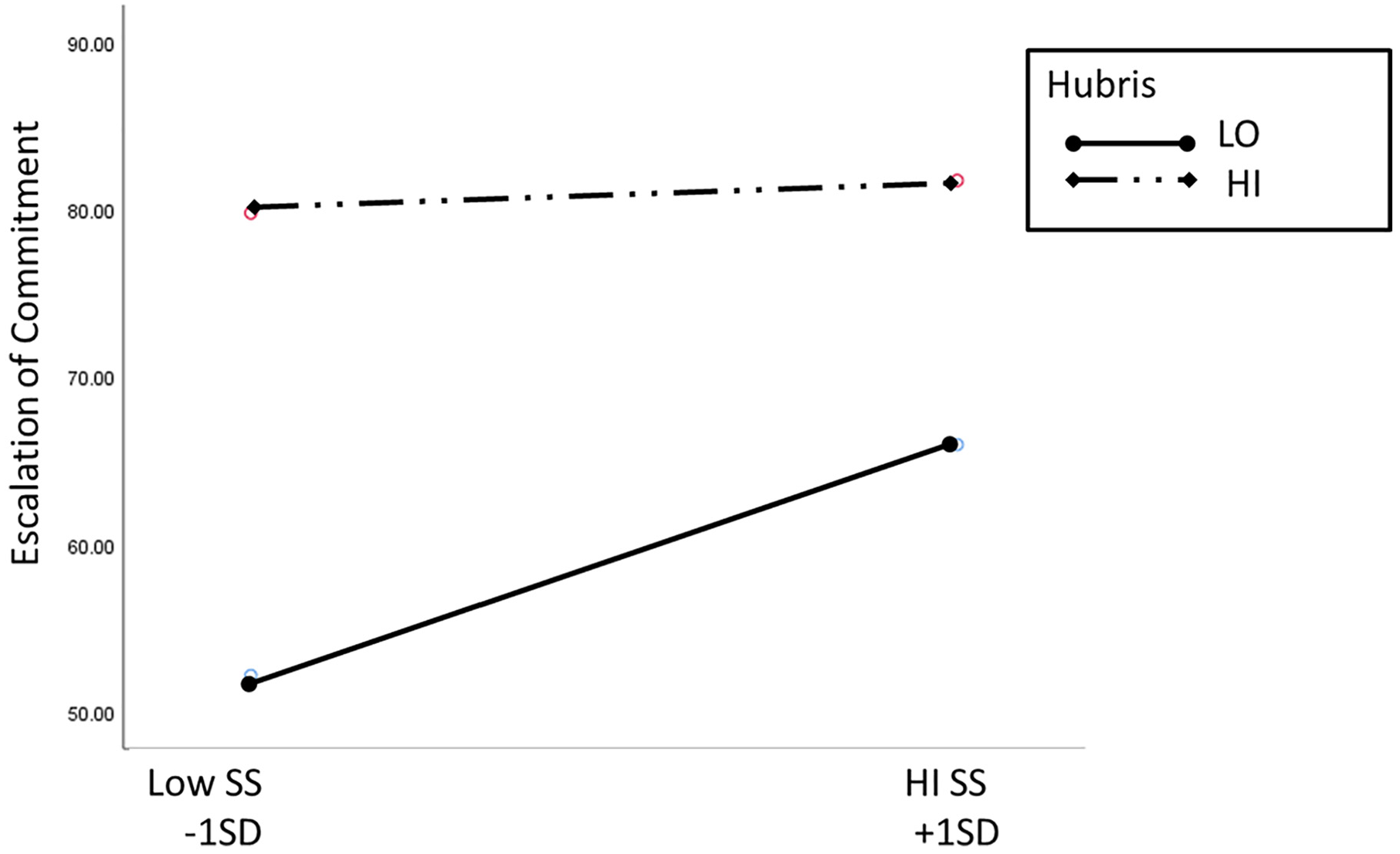
The interaction between sensation-seeking and hubris, on escalation of commitment.
When examining the moderated mediation hypothesis, we looked at the index of the moderated mediation of hubris. This index was statistically significant (95% CI = [−5.989, −0.25]), indicating that this variable moderated the mediation of SS; thus,
Explicitly, individuals with low hubris levels who have high levels of SS show higher EoC while those with low levels of SS show lower levels of EoC. As shown in Figure 3, for individuals with high levels of hubris, EoC was high regardless of SS levels, that is, EoC was similar for both high and low SS levels (no significant difference).
Discussion
The primary goals of this study were to further explicate the effect of personality traits on EoC. We attempted to improve EoC predictability by shedding light on the role of personality traits and personal dispositions in shaping this disorder, notably amongst higher-echelon managers. A deeper understanding of leaders’ EoC enables organizations to prevent such negative business outcomes as retaining bad loans, inaccurate stock forecasting, promotion of unqualified employees (Kelly & Milkman, 2013), and particularly continuing to invest in failing projects (Lee et al., 2021). Our research model corroborated an indirect relationship between extraversion and EoC through the mediation of sensation-seeking and the moderation of hubris. Relationships between the personality domain of extraversion and the dispositions of sensation-seeking and hubris are commensurate with past studies. Findings showed that extraverted individuals are prone to escalating their commitment to a proven course of action. Our study takes EoC research one step further and adds personality to the equation by demonstrating both direct and mediated associations between extraversion and EoC.
A potentially important ramification emanating from the findings refers to the fact that EoC has been studied as a behavioral pattern instigated mostly by managerial decision-making’s psychological mechanisms, common amongst most people, regardless of individual differences (Sleesman et al., 2012). These psychological mechanisms draw primarily on such decision-making perspectives as self-justification theory (Brockner, 1992) and prospect theory (Leal et al., 2020). Essentially, most individuals share EoC, as it mainly emanates from decision-making processes common to most individuals and external-situational causes (e.g., how much of the project has been completed), irrespective of individual personality variance (Brockner & Rubin, 2012).
The current study addressed the individual differences that predict proneness to EoC, as it portrays a unique EoC managerial profile, as opposed to managers whose behavior is not indicative of EoC. To that end, the research model depicts a personality framework in which managerial EoC is predicted. Past research points to and explores specific relationships between the Big-Five Model and EoC (e.g., Liang, 2020). Accomplishing this line of research, our study enabled an inclusive understanding of personality aspects that account for EoC and the interplay between them, as these personality aspects mediated and moderated the link between extraversion and EoC.
Furthermore, our research showed that sensation-seeking mediated the relationship between extraversion and EoC. This is significant because extraversion traits (e.g., confidence or persistence in the face of challenges) that are beneficial to organizations could be detrimental when they are coupled with a sensation-seeking disposition to avoid a rational assessment of risks and ensuring the taking of necessary precautionary measures. Our research demonstrates the potential hazardous ramifications of sensation-seeking. Sensation-seeking managers will not perceive accurately the risks in escalating their commitment and most likely will not take the necessary precautionary measures and rational evaluation of the path they have chosen. Extraverts have a strong need to be admired and to be socially recognized for their success and achievements (Rogoza et al., 2016). This need could be adaptive and motivate managers to achieve great accomplishments but could also prove to be maladaptive if these managers ignore the risks even if the data suggest that they are on the wrong path.
We have shown that managers who are low sensation-seekers could still escalate their commitment depending on their hubris level. Hubristic managers tend to escalate their commitment regardless of their sensation-seeking level. They will escalate their commitment because they possess various hubristic characteristics that are also at the heart of EoC such as disregard to small details, high self-confident, and contempt to others’ counsel (Owen, 2008). If we add the fact that these leaders are in a power position, in charge of budgets, and often have the last say on various matters, it could be highly influential on numerous organizational decisions. Therefore, we still need to be wary of mangers even when their sensation-seeking level is low. For these mangers we will need to know their level of hubris. Because when it is low, their escalation tendencies are low and not alarming but when it is high; it can have a dramatic effect on their propensity to escalate their commitment. Consequently, we will need to know both the level of hubris and the level of sensation-seeking of our managers, to curb EoC.
Our findings contribute to top management personality research (Resick et al., 2009) by clarifying underlying mechanisms of managerial behavioral tendencies and leadership patterns, as in the case of EoC. The current study endeavored to improve the existing understanding of psychological mechanisms linking top management personality with behavioral tendencies that have remained relatively under-explored. Our findings show that the higher up the managers are on the firm’s ladder, the more likely they are to be hubristic. This is in line with previous studies that show top managers to be overconfident (John et al., 2011)—a key factor of hubris.
Practical Implications
Our findings are helpful in creating safeguards in the form of early warning signals that enable the timely detection of EoC. Acquaintance with managerial proneness to EoC may be helpful, chiefly at the board level, in making sensible decisions concerning resource allocation (Woods et al., 2012).
Our research model highlights factors that are liable to result in EoC. The personality traits and syndromes discussed and analyzed in this paper should be monitored continuously as part of boards’ control mechanisms, with the view of administering personality tests to top managers, regardless of whether or not they are susceptible to EoC (Desai & Chulkov, 2011). Focusing our attention on the individuals who make the decisions by attempting to restrain them when deemed necessary is a positive step toward curbing some EOC processes.
Limitations and Future Studies
Much like any study, our work has limitations that restrict interpretation and generalization of the findings. First, since this study is self-reported, common-method variance may be of concern (Podsakoff et al., 2003). Systematic measures have been taken to attenuate CMV (Chang et al., 2010).
Also, although the study’s EoC scenario is intended to inspire respondents’ involvement, it cannot accurately simulate the anxiety, pressure, and consequences of being held responsible for a real-life failure (Schmidt & Calantone, 2002). We framed the decision as the likelihood of project continuance. Clearly, managers can make other choices, for instance, by changing project specifications (Keil & Robey, 1999).
Our data were collected at a single point in time. Most EoC studies are not longitudinal, meaning; they do not draw on what occurred before, during and following the commitment’s escalation. Since the data is cross-sectional and the model tests for mediation using PROCESS, we capitalized on Vandenberghe et al.’s (2017) method and assessed the fit our model using AMOS software (v. 22). Evidently, the fit of the model is adequate when depicted as it is in our research (see Figure 1), but the fit is drastically poorer when the arrows are reversed, indicating that the model, as it is now, fits the theory and data more appropriately.
Therefore, it is suggested that future research applies a longitudinal and quasi-experimental research design (Shadish et al., 2002). Hence, it is advisable to study EoC using methods that are as factual as possible to increase the realistic elements of the methods. These include working hours spent or money invested. Applying objective data on top of data gleaned from questionnaires reduces subjective interpretation (Brannick et al., 2010).
Footnotes
Declaration of Conflicting Interests
Funding
Ethics Statement
ORCID iDs
