







Abstract
Introduction
Virtual technology is regarded as a powerful marketing tool for hospitality and tourism (Huang et al., 2016), because it provides tourists with unique and enhanced experiences (D. I. D. Han et al., 2019). Virtual technology includes virtual reality (VR), augmented reality (AR) and mixed reality (MR). VR with a head-mounted device (HMD) has the unique ability to provide an immersive experience to users (Wei, 2019). AR is the superposition of a composite image on real images to enhance the information obtained by the users (T. H. Jung et al., 2018). MR combines the real and virtual worlds to produce experiences based on physical and digital interactions (De Souza & Sutko, 2009). Virtual tourism derived from virtual technology is a new form of tourism (Talwar et al., 2022) that can create economic benefits to the tourism industry. Virtual economy revenue has grown nearly 20-fold in the last 5 years (Talafubieke et al., 2021), and the period since the end of 2019, given the COVID-19 pandemic, has been a critical time for the development of virtual tourism (W. J. Lee & Kim, 2021). The value of VR tourism is expected to reach USD 49.7 billion in 2023, up from USD 3.13 billion in 2018 (Orbis Research, 2018). Many studies about different types of virtual technologies have recently been conducted in different research settings in hospitality and tourism, but a systematic literature review is needed to have a holistic review of the usages and impacts of virtual technologies on this sector.
Research in hospitality and tourism has recognized the importance of virtual technology for tourism development and opened a research era on the experience economy. There have been large-scale discussions about the use of virtual technology in hospitality and tourism such as theme parks (e.g., Wei et al., 2019), museums (e.g., M. C. Tom Dieck et al., 2016) and hotels (e.g., McLean & Barhorst, 2022). In museums and art galleries in particular, AR smart glass has been seen as an alternative to traditional audio guides (D. I. Han et al., 2013). Recognizing the importance of literature reviews, researchers have reviewed the research on VR/AR/MR in hospitality and tourism; for example, Yung and Khoo-Lattimore (2017) reviewed 46 manuscripts from 1995 to 2016, Wei (2019) selected 60 research papers from 2000 to 2018 and Loureiro et al. (2020) used citation network analysis with 56 journal papers from 1995 to 2018. Existing literature reviews have, however, been based on a relatively small number of articles (46–60) that were published before 2019. However, the present review found that 59 articles had been published in 2021 alone. Previous literature reviews obviously cannot reflect the research content and trends of the rapidly growing number of articles in this field, so the reference value they can provide to researchers is limited. It is thus necessary to make a more comprehensive literature review based on the larger amount of recent journal articles to gain a more accurate picture of research progress in the field (Shen & Lai, 2022).
The purpose of this study was to conduct a comprehensive systematic literature review based on Scopus to identify the current research, core research topic and research opportunities for virtual technology in tourism and hospitality. Scopus is frequently used in tourism research (Shen & Lai, 2022) and provides more articles on virtual technology than Web of Science (WOS). This study answers the following questions: What is the latest research progress on virtual technology in hospitality and tourism? What are the current research topics in hospitality and tourism research? What are the opportunities for future research in this field? This systematic literature review provides an accurate and comprehensive understanding of the latest research progress, core research topics, research gaps and opportunities in virtual technology research in hospitality and tourism. Some possible concerns for hotel and destination marketing managers are also discussed.
This article contains seven sections. The introduction describes the research background, research gaps and objectives. The literature review section reviews previous research on VR/AR/MR. The methodology section describes the research design, data collection and research tools. The findings section summarizes the evolution of the research process, the distribution of the sample articles in journals, the most influential researchers and most co-cited articles, as well as the institutional and national affiliation of these articles. In the co-occurring analysis section, research clusters and corresponding hot topics under these clusters are discussed, and agendas with potential for future implementation are then proposed. The last section presents the conclusions and implications.
Literature Review
VR Studies
VR is a new technology that creates a simulated visual 3D environment that provides users with an interactive experience (Tussyadiah et al., 2018). Virtual tourism is gaining attention because of the extensive applications of VR technology in tourism (W. J. Lee & Kim, 2021), and the use of VR technology in travel activities means that people can experience virtual travel in time or space outside their everyday environment for cognitive or entertainment purposes (Roman et al., 2022). The application of VR constructs an image of tourism objects, and this ability to visualize the spatial environment is the greatest advantage of VR (Gao et al., 2022). It is especially important in the hospitality and tourism industry because of the invisibility of the products (Yung & Khoo-Lattimore, 2017). Immersion, presence and preview are the key factors often mentioned in VR research for tourism, because these are the unique features of VR and the core concepts for measuring the quality and effectiveness of the VR experience (Tussyadiah et al., 2018). Some studies have suggested that VR is a better way to promote a destination than traditional media (e.g., Wei et al., 2019) because it presents the destination more vividly and interactively (Wu & Lai, 2021). To reduce the risk of uncertainty, consumers can use VR to collect travel information without an actual visit (Bogicevic et al., 2019). Given that VR is considered an effective marketing tool to promote tourism, researchers have studied VR in the field of tourism marketing research.
Among different types of VR applications, 360° virtual video is the one most useful in tourism marketing (Xi & Hamari, 2021), so there were many studies on this topic, especially after 2018. For example, studies have discussed affective motivational states (T. Yang et al., 2021), emotional and psychological states (Wu & Lai, 2021) and the perceived enjoyment and autonomy (Rahimizhian et al., 2020) of viewing 360° virtual videos. Despite the numerous existing studies on the topic, the applications of 360° virtual videos remain a potential research area for future investigation (Argyriou et al., 2020). Because previous literature reviews only considered studies through 2018, they have not discussed the applications of 360° virtual videos in depth, so an up-to-date review of VR is needed.
AR Studies
AR overlays digital and real-world information related to certain topics engagingly and effectively (Gheorghiu & Stefan, 2020), which enhances tourists’ perceptions and awareness (T. Jung et al., 2015). With the explosive growth in the number of smartphone users, app-based AR has been more accessible to wider use (H. Lee et al., 2015). In recent years, the quantity of AR-related research in tourism has increased, especially related to heritage destinations, because the use of mobile AR to enhance tourists’ visit experiences at such sites has become a trend (Marto et al., 2021). AR provides significant value from experiential, cognitive, cultural and educational perspectives, as well as increasing visitor satisfaction and generating positive word-of-mouth (M. C. Tom Dieck & Jung, 2017). Previous literature reviews found only a small number of studies on AR (eight articles, Yung & Khoo-Lattimore, 2017) before 2019, but in recent years there have been many AR applications. Current studies on how AR affects tourism activities in terms of functions and effects have not been fully discussed in previous literature reviews. For example, Bec et al. (2019) found that integrating history with AR in immersive environments has the potential to preserve heritage sites and enrich the visitor experience or subsequent engagement. These findings contradict Dueholm and Smed’s (2014) argument that AR may reduce the authenticity of tourism objects. A systematic review of the literature would help in clarifying future research directions and resolving such contradictions.
MR Studies
MR is an environment in which real and virtual images are presented together in the same display and can interact in real time (Kasinathan et al., 2017). Although MR is understood as an indispensable part of research on virtual technologies, studies on this topic are still largely conceptual (Trunfio et al., 2020). MR alters the perceptions of users by providing a powerful mechanism and realistic visual stimuli, as well as amplifying the effects of the human cognitive styles of interaction and visual behaviors (Basu et al., 2021). Recent MR studies have covered heritage reconstruction demonstrations (Evangelidis et al., 2020) and museum sightseeing tools (Hammady et al., 2021). Given that the applications of MR in tourism are very new, previous literature reviews on virtual technology did not include MR research, and this review can fill this gap.
Methodology
Research Design
The design of the research process in this study referred to the methods of Mascarenhas et al. (2018) and Shen and Lai (2022), which can draw large bibliometric maps that assist in providing a better understanding of the research progress and identify gaps in a particular area of research (Shen & Lai, 2022).
Data Collection
Scopus was selected as the data source because it is the most widely used in bibliometric analysis and is considered one of the most comprehensive and powerful databases (Mongeon & Paul-Hus, 2016). It is also widely used in tourism research (e.g., Shen & Lai, 2022; E. C. L. Yang et al., 2017). Scopus is a citation database covering multidisciplinary research areas that is operated by Elsevier. It is the largest existing database, covering 40,000+ peer-reviewed journals from more than 5,000 international publishers (Carrera-Rivera et al., 2022), and many researchers therefore use it as a data source for systematic literature reviews (e.g., Gholizadeh & Mohammadkazemi, 2022).
This literature review focused on virtual technology in hospitality and tourism, and a set of keywords was developed for subsequent searches. The following query string queried were used: TITLE-ABS-KEY (“VR,”“AR,”“MR,”“virtual reality,”“augmented reality,” OR “mixed reality”) AND (“tourism” OR “hospitality”). In addition, because 360° stereoscopic media is considered within the scope of VR (Xi & Hamari, 2021), they were also included in the study, with TITLE-ABS-KEY (“360”) AND (“videos,”“virtual” OR “tour”) as additional search keywords for the related literature on Scopus. To ensure the quality of the articles, the criteria below were carefully considered in the selection process. First, this study only selected articles published in English academic journals with additional search criteria LIMIT-TO (LANGUAGE, “English”). Second, articles and reviews were limited to peer-reviewed journals, using the search criteria LIMIT-TO (DOCTYPE, “ar”) OR LIMIT-TO (DOCTYPE, “re”) and (LIMIT-TO (SRCTYPE, “j”). Conference papers and book chapters were excluded. As of July 2022, the Scopus search results for peer-reviewed academic articles in English yielded 1,371 records, and 1,369 records were retained after removing duplicates. Third, articles and reviews not published in the past 10 years (2013–2022) were removed, which left 560 records. Fourth, the articles that mentioned relevant keywords in the topic and abstract but were not related to hospitality and tourism research, such as research in archeology, information engineering and computer system development were deleted. After the screening, there were 274 eligible articles that were used for the literature analysis. Figure 1 shows the steps for article selection and the filter criteria, which follow the preferred reporting items for systematic reviews and meta-analyses (PRISMA; Moher et al., 2009).
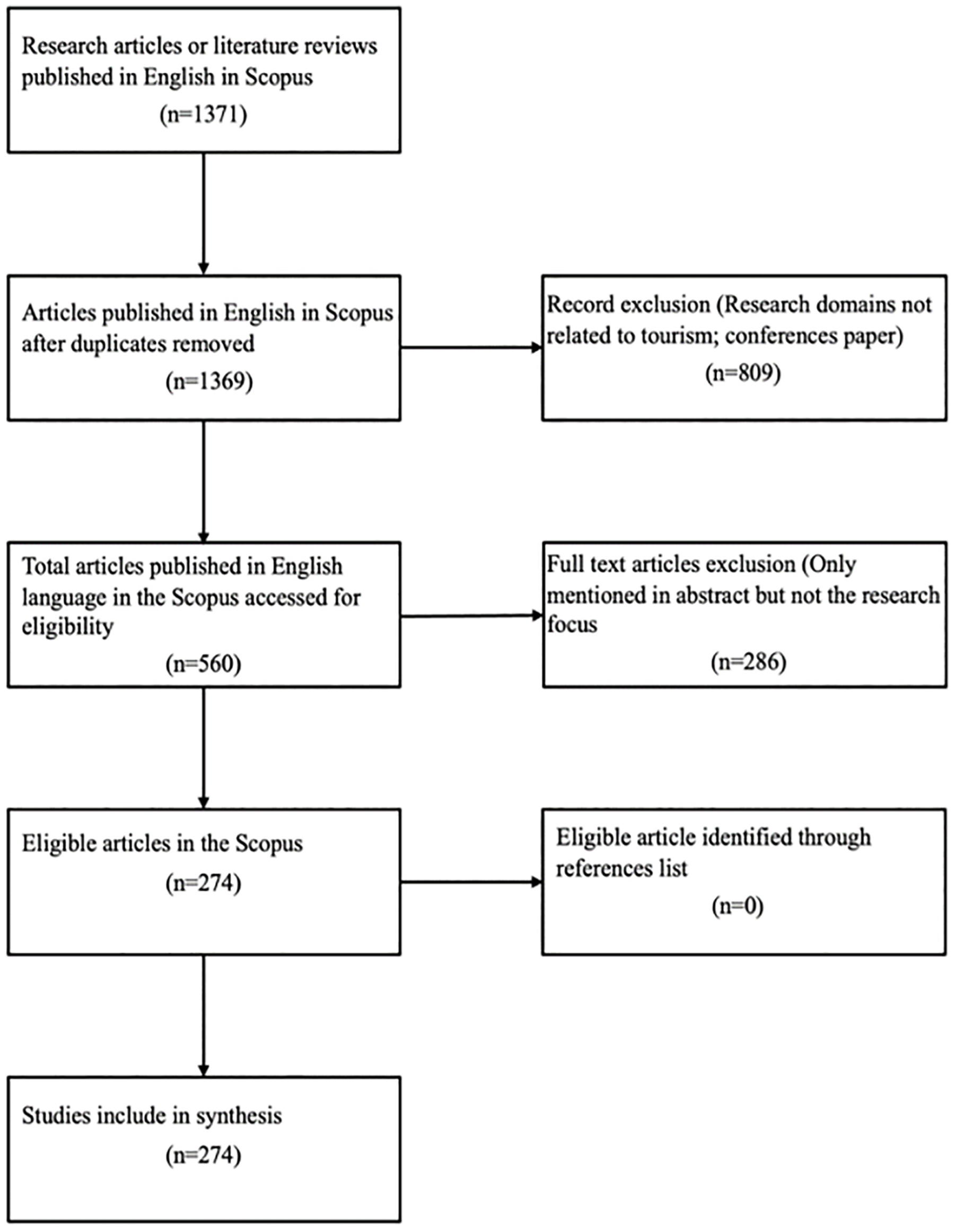
PRISMA flow diagram in identifying and screening sources.
Research Tools
VOSviewer 1.6.18.0 was used for bibliometric analysis. The construction of a bibliometric maps generally attracts the most attention in the results for bibliometric analysis. Previous analysis results represented in simple graphs (e.g., Pajek) were inadequate, and VOSviewer can identify research clusters and their networks. It is an effective document viewer that can provide large bibliometric maps that include a zoom function, special labeling algorithms and density metaphors (van Eck & Waltman, 2010). VOSviewer can also be used to build maps for authors, journals and keywords based on analysis of co-citation and co-occurrence data (Waltman et al., 2010). The first step for using VOSviewer is to import a bibliometric dataset, including choosing keyword co-occurrence and data sources. The previous section explained the query strings and criteria for searching articles on Scopus. Based on text data downloaded in the RIS file format, the second step involved creating a semantic map to show the research clusters and themes.
To explore the research status of VR/AR/MR in the context of hospitality and tourism, bibliometric analyses used in the study included: determining the research trends for VR/AR/MR by analyzing the number of papers published each year; determining the research contributions of famous journals, influential researchers and influential institutions, countries and regions through co-citation analysis and co-authorship analysis; clarifying the research topics through term co-occurrence analysis in the titles and abstracts; and discussing and putting forward a research agenda based on the literature review and content analysis.
Research Findings
Research Period and Progress
Figure 2 shows the number of articles published from 2013 to 2022, and 2019 can be considered as a dividing line. In Period 1 (2013–2019), research was limited, and the number of articles per year was similar. In Period 2 (2020–July 2022), the number of articles increased sharply from an average of 14 articles (2013–2019) to 56 (2020), 9 (2021), and 54 (July 2022). The topics related to the VR/AR/MR field have changed as well. This study therefore discussed the research progress in these two periods according to the changes in research scopes and the number of articles published.

Number of articles published annually on VR/AR/MR in hospitality and tourism (* up to July 2022).
Period 1 (2013–2019)
The early research focused on discussing how virtual technology could be promoted in hospitality and tourism (e.g., Pantano & Corvello, 2014). Articles mainly mentioned the use of VR/AR/MR technology in tourism activities (e.g., T. Jung et al., 2015; M. C. Tom Dieck et al., 2016) and proposed a framework and design scheme for human-computer interaction as development ideas (e.g., Tatzgern et al., 2015). The acceptance and adoption of the technology by users were discussed, and the usability and promotion functions of VR/AR/MR were analyzed (e.g., M. C. Tom Dieck & Jung, 2018). The articles in this period explored the opportunities and challenges in the application of VR/AR/MR in terms of theoretical study and empirical research based on different backgrounds (e.g., museums and cultural heritage), which provided a preliminary basis for subsequent research.
Period 2 (2020–July 2022)
Articles in this period discussed in greater detail what VR/AR/MR could provide to users in travel activities. In contrast to Period 1, studies in Period 2 began to identify other issues from the perspective of VR/AR/MR, and some topics that had not been mentioned or received limited attention in the past began to be emphasized, such as those related to user perspectives (destination image, presence, perception; e.g., Skard et al., 2021; T. Yang et al., 2021) or industry perspectives (sustainable development, technology development; e.g., Talwar et al., 2022). Some studies were also based on the perspective of technological innovation (e.g., Bogicevic et al., 2021). In addition, COVID-19 had a significant impact on VR/AR/MR research and spawned a series of studies on the opportunities and challenges for virtual technologies during the pandemic.
Distribution in Journals of Published Articles
The main topics of the 274 articles published in 141 journals were destination promotion, cultural heritage, tourist experience, smart tourism, technology and so on. Based on the citations of the published journals and rankings in Scopus, this review sorted out the top 10 most influential journals, and most of these journals are major for tourism research. Table 1 shows the number of publications and the ranking of citations.
Top 10 journals (2013–2022).

Most Influential Researchers and Most Co-cited Articles
To identify the most influential researchers in hospitality and tourism research on VR/AR/MR, co-citation analysis was used. Setting the minimum number of co-cited authors at 20, 144 scholars met the threshold. Table 2 lists the top 10 researchers with the most co-citations. It can be found that T.H. Jung (27,181 link strength) is the most influential researcher, followed by M.C. Tom Dieck (19,722 link strength), N. Chung (11,277 link strength), I.P. Tussyadiah (7,586 link strength) and D. Buhalis (74,71 link strength).
Ten Most Influential Researchers.

Regarding highly co-cited articles, Table 2 lists the top 10 articles with the most co-citations, which showed that Tussyadiah et al. (2018); “virtual reality, presence, and attitude change: Empirical evidence from tourism”) is the most cited article, followed by Yung and Khoo-Lattimore (2017), T. Jung et al. (2015), and Huang et al. (2016). These highly cited articles were distributed almost every year from 2013 to 2020, indicating that there were similar numbers of high-impact articles published every year during this period.
Research Contributions of Institutions, Countries and Regions
Table 3 shows the top 10 institutions that published the most articles from 2013 to July 2022 in this field. The United Kingdom, South Korea, Australia, Hong Kong and Macau each have one university in the top five, and the university from the United Kingdom has published the greatest number of articles. When focusing on where articles were published, the results showed that there were 61 countries/regions of interest. If ranked by the number of articles published, the United Kingdom, Mainland China and the United States were the most productive places. In terms of the research contribution of places ranked by citations, the United Kingdom, South Korea and the United States were the most influential places. Table 3 shows the details of the ranking of countries and regions. Among the top 10 published countries/regions, 50% are in Europe, 40% are in Asia and 10% are in the Americas. There are limited research outcomes in American institutions, which reflects that the research on VR/AR/MR in countries in North and South America is not popular and strong. In addition, most of the top 10 countries and regions are famous travel destinations. It seems that countries or regions with better tourism development have greater influence and contribution to VR/AR/MR research. The innovation and application of new technologies may probably attract the attention of countries or regions with better tourism development.
Top 10 Institutions and Countries/Regions.

The distribution of international collaboration on academic research in VR/AR/MR shows relatively frequent academic research collaboration between the United States, Korea and Portugal; relatively stable collaboration between Mainland China, Canada and Macau; and relatively frequent collaboration between the United Kingdom, Hong Kong and the Netherlands. There are collaborative relationships between the United Kingdom, Mainland China and the United States as well.
Hot Topics for Research According to Co-occurring Analysis
Figure 3 shows the terms with the most occurrences and highest relevance scores. In co-occurrence networks, a larger frame means that the term is more important (van Eck & Waltman, 2010). Table A1 in the Appendix shows the number of co-occurrences and the scores of terms in each cluster.

Research clusters and themes.
Cluster 1—VR Research
Cluster 1 is highly associated with VR research. As shown in Figure 3, “tourist destination,”“presence” and “COVID-19” are prominent in cluster 1.
Tourist Destination
Research related to this theme has mainly focused on what drives VR users to visit destinations depicted in virtual tours, as well as the effectiveness of VR experiences in inducing tourists’ willingness to visit destinations. VR provides tourists with a new way to experience the charm of a destination or attraction in depth (Shao et al., 2020), which has a strong potential to affect users’ experience of and attachment to destinations (Pantelidis, 2019), as well as emotions and attitudes toward the destinations (Chang & Chiang, 2022). Tussyadiah et al. (2018) proposed that VR can provide an interactive experience and rich information for potential visitors who are seeking information about a destination, while the sense of being there in the virtual experience leads to a stronger interest in and visit intention for the destination. This could also explain the effect of VR marketing in stimulating tourists (Huang et al., 2016). For destination marketers, VR assists in developing customer relationships and creating a destination image (Oncioiu & Priescu, 2022). This line of research plays an essential role in revealing why potential tourists visit destinations shown in VR (Kim, Lee, & Jung, 2020), and it is necessary to understand the effectiveness of VR in promoting destinations.
Presence
A sense of presence refers to the user’s perception of a sense of “being there” (Skard et al., 2021). Besides a sense of presence, telepresence and social presence were also often used in research. Some research considers them to be equal (e.g., Wei et al., 2019), but some studies understood them separately (e.g., T. Yang et al., 2021). Presence is more inclined to explain the psychological similarity between perceived virtual objects and real objects when people experience or interact with VR (Bogicevic et al., 2019), while telepresence describes a subjective instant feeling of “being there” based on technology (T. Yang et al., 2021). Social presence is understood as the process by which VR users develop human interaction and social awareness in a virtual environment (Ying et al., 2022).
Presence is the key to measuring the virtual experience (Tussyadiah et al., 2018). The consequences of a sense of presence have attracted researchers’ attention. Presence leads directly to user enjoyment and affects VR tour satisfaction and visit intention (De Canio et al., 2022). Presence is a key driver of tourists’ attitudes and behaviors in virtual tours (Bogicevic et al., 2019), and can lead to improved users’ attitudes toward the brand and booking intention in the hotel context (Lyu et al., 2021). Other than the consequences, researchers have also been interested in finding the antecedents of presence. A sense of presence can be derived from the vividness of VR (Wu & Lai, 2021); users’ mental imagery, engagement and immersion (Wu & Lai, 2021); the attention-directing effect of VR; mental states based on involvement and immersion (Tussyadiah et al., 2018); and the authenticity perceived by users (Zhu et al., 2023). Presence can be understood as closely related to tourists’ psychological response, and the research on this theme is of great significance given the important role of presence in virtual experiences.
COVID-19
COVID-19 has had a strong impact on tourism, with restrictions on travel activities and the use of public space that have forced people to seek new forms of tourism (Roman et al., 2022). Virtual tourism is gaining attention as a solution to this need (W. J. Lee & Kim, 2021). VR can help tourists avoid excessive going out during the COVID-19 pandemic and experience a tourist attraction (Mohanty et al., 2020). In addition, T. Yang et al. (2021) found that 360° virtual tours help people to reduce stress while they stayed at home during the pandemic.
Research also began to discuss how virtual technologies can continue to develop in the post-COVID-19 era. For example, Drianda et al. (2021) argued that virtual tourism would not replace traditional tourism and that virtual technology is a potential tool for marketing or promotion to spark tourists’ interest in travel post-COVID-19. Generating tourist interest and positive emotions is crucial to destination recovery in the post-COVID-19 era, so research has supported growing opportunities for the future use of virtual technologies in tourism marketing (Yung et al., 2021).
Cluster 2—AR Research
Cluster 2 is primarily related to AR research; the 15 frequently co-occurring terms are listed in Figure 3. The terms “cultural heritage,”“heritage tourism,”“tourism development,” and “museum” are prominent in AR research. The scope of AR research is mainly focused on the above four areas and on cultural heritage tourism in particular.
Cultural Heritage
Research related to cultural heritage has put forward applications of AR in cultural heritage sites from the perspectives of sustainable development (e.g., González-Delgado et al., 2020), public cognition (e.g., Tsai & Lee, 2017) and digitization (e.g., Shih et al., 2020) of cultural heritage. Mobile AR applications can stimulate potential visitors’ interest and enthusiasm in an engaging and efficient manner (Gheorghiu & Stefan, 2020) by, for example, bringing historic buildings back to life by reconstructing and interpreting old events (M. C. Tom Dieck & Jung, 2017). This positively influences the sustainability of cultural heritage and increases public self-assessment of local history and culture (Tsai & Lee, 2017), while providing a barrier-less opportunity for scholars and the public to learn about cultural heritage that may be inaccessible (Pehlivanides et al., 2020). AR can promote the conservation of cultural heritage without weakening cultural and tourism value, thus providing an effective digital heritage conservation method (Rueda Márquez de la Plata et al., 2022). AR is thus critical to cultural heritage and has great potential for its future development.
Heritage Tourism
The potential of AR apps in the production, consumption and management of visitor experiences in heritage tourism is recognized. When young tourists visit cultural heritage sites, AR apps provide a learning function to improve their attraction and learning experience (M. C. Tom Dieck et al., 2018). In addition to enhancing tourists’ historical and geological knowledge and social awareness to create better travel experiences (T. Jung et al., 2015), AR could create more memorable heritage tourism experiences (Jiang et al., 2023). AR apps can also act as a mechanism for the dissemination of real-time messages such as offers, ticketing and parking (Ivars-Baidal et al., 2019). AR apps can thus effectively add value to the visitor experience (Nevola et al., 2022). Some studies have also discussed user acceptance of AR in cultural heritage tourism. For example, M. C. Tom Dieck and Jung (2018) and Chung et al. (2015) discussed the triggers that may motivate visitors to accept and actively use AR in heritage tours.
Tourism Development
Under this theme, researchers have focused on the implications of technology for assisting the development of tourism destinations. Such studies have generally mentioned sustainability (e.g., Bec et al., 2019), app-based technological development and innovation (e.g., Buhalis et al., 2019) and destination conservation (e.g., Bec et al., 2021). AR research has moved into the spotlight for the study of its effect on tourism industry development (D. I. D. Han et al., 2019). AR makes tourism resources more widely known in an attractive and educational way, thus contributing to the sustainable development of tourist destinations (Marino Alfonso et al., 2021). In the cultural heritage tourism context in particular, AR has been found to provide an enhanced tourist experience, as well as creating business benefits (Cranmer et al., 2020). The immersive environments created by AR can broaden the appeal of various cultural landmarks to tourists or residents, thus realizing the best use of tourism resources (Garau, 2014). There is also the potential to apply AR to destinations that have succumbed to over-tourism, leading to deterioration and even destruction (Bec et al., 2021). These findings reflect how AR technology can drive tourism development and provide new ideas for strategic planning in the tourism sector.
Museum
AR is an effective virtual technology for museums (Hijazi & Baharin, 2022). Researchers have discussed the use of AR for the digitization of museums (e.g., Stichelbaut et al., 2021), but AR can also enable visitors to fully explore and appreciate museums beyond time, space and language barriers (Chung et al., 2018), while providing a visualization of history and situations that cannot be represented in normal exhibitions (Recupero et al., 2019). AR provides visitors with interactive experiences that can effectively transform the content displayed in the museum into more attractive and understandable elements (Spadoni et al., 2022). Researchers have also identified the AR design elements (e.g., imagery vividness and information type) that affect tourists’ willingness to pay in museums (He et al., 2018). There have been many studies on the impact of AR on visitors’ museum experiences; however, there is now a trend of using MR in museums. Although studies of MR are still largely conceptual in nature (Trunfio et al., 2020), research on MR for museums has the potential to replace research on AR for this context.
Cluster 3—VR Experiences
Cluster 3 covers eight terms that frequently appear in the co-occurrence analysis, among which the terms “immersion,”“human” and “behavioral research” are prominent. The research in this cluster focused on psychological, emotional and affective responses to virtual technologies in relation to behavioral responses, which are the users’ experiences of using virtual technologies.
Immersion
Witmer and Singer (1998) defined immersion as users’ psychological state users when they interact with a virtual environment. Immersion is one of the unique features of the virtual experience (Wu & Lai, 2021) and an important predictor of VR adoption (Vishwakarma et al., 2020). Researchers usually discuss the different levels of immersion or different media; for example, 360° virtual videos can provide travelers with better opportunities than traditional videos for the immersive exploration of destinations, which can have a significant impact on their decision-making (Argyriou et al., 2020).
Immersion leads to greater product knowledge and physiological arousal in a mediated environment (Macedonio et al., 2007), which generates a higher sense of presence and ultimately a positive destination image (Wu & Lai, 2021). In addition, existing studies have found that immersion affects user engagement (Flavián et al., 2019), as well as VR tourism satisfaction and visit intention (De Canio et al., 2022). These studies reflect the importance of immersion in user attitudes and behavioral intentions.
Human Responses
Researchers have studied how emotional and affective responses to viewing VR videos influence behavioral intentions, including place attachment and place identity (Wang et al., 2022), affective and cognitive responses (Kim, Lee, & Jung, 2020) and perceived pleasure (Do et al., 2020). They have discussed how these responses improve viewers’ experience, as well as visit and revisit intentions. For example, Flavián et al. (2019) discussed how the implementation of virtual technology would enhance viewers’ emotional reactions and engagement. De Canio et al. (2022) found that as the utility, ease-of-use and interactivity of VR/AR increase, the perceived enjoyment and satisfaction of the user also increase, thus giving rise to stronger impulse buying behavior.
Several studies have also compared emotional and affective responses between audiences with different demographics. For example, older adults report higher levels of presence and stronger emotional responses than younger adults (Liu et al., 2020), and females show a higher sense of presence and a greater sense of engagement in virtual environments (Melo et al., 2022). In summary, the emotional and affective responses to virtual technologies for different audiences vary.
Behavioral Responses
As mentioned above, emotional and affective responses to virtual technologies affect audience behavior. Researchers have discussed how virtual technologies influence consumer behaviors (e.g., McLean & Barhorst, 2022), behavioral intentions (e.g., Kim, Lee, & Jung, 2020) and technology adoption behaviors (e.g., D. I. D. Han et al., 2019). Because the combination of VR with other travel information such as e-reviews and word-of-mouth provides information that text and still images cannot, researchers have investigated how such information interventions are more predictive of audiences’ behavioral intentions, including purchase intentions (Zeng et al., 2020). Researchers have identified some imagery factors such as mental imagery, vividness and interactivity that lead to stronger travel intentions and purchasing attitudes (Lyu et al., 2021).
To test virtual technology adoption behaviors, some researchers have tested VR/AR acceptance factors by adopting the technology acceptance model and unified theory of acceptance and use of technology framework. The factors that affect VR/AR adoption or acceptance include social acceptability and social interaction (D. I. D. Han et al., 2019); hedonic and utilitarian motivations (Shin & Jeong, 2021); as well as usability and hedonic, emotional, and social benefits (D. Tom Dieck et al., 2018). Researchers have also suggested exploring the influence of cultural differences on consumer adoption of AR (Grzegorczyk et al., 2019).
In summary, articles related to behavioral responses have focused on how users’ attitudes toward brands or technologies and product knowledge change after viewing VR/AR, as well as how VR/AR technologies affect purchase intentions or generate a greater willingness to pay. However, there is a trend of researchers extending studies from behavioral outcomes to psychological outcomes such as subjective well-being (Kim, Lee, & Preis, 2020) and stress reduction (T. Yang et al., 2021).
Cluster 4—Virtual Technology Applications
Cluster 4 includes only four frequently co-occurring terms, but three of the strongest correlation were found (Figure 3). They are mainly related to the application of VR in the tourism industry and its future sustainable development.
Virtual Tourism
Virtual tourism is one of the most direct applications of virtual technologies in tourism and has turned out to be an effective tool for engaging customers. Virtual tourism means that, with VR devices, users can visit various locations in the real world and even travel virtually in space (Damjanov & Crouch, 2018) or visit fictional, dangerous or politically restricted destinations (Roman et al., 2022). Researchers have also explained how virtual tourism can help the development of nature tourism. For example, Wu and Lai (2021) explained the potential mechanisms by which virtual travel experiences can motivate audiences to engage in mountain climbing. Researchers commonly agree that VR tourism will not replace real-world tourism. On the other hand, VR tourism will be more beneficial to developing countries facing economic difficulties or provide an alternative to exploring the world’s tourism resources for people with disabilities or illnesses (Roman et al., 2022).
Virtual Reality Technology
The tourism industry and tourism organizations are facing various challenges, including attracting consumers. Different tools can be used to encourage potential customers and create a favorable and unique image (Damavandi et al., 2022). Some studies have discussed the development and refinement of virtual technology in terms of computer science (e.g., McLean & Barhorst, 2022). Existing research on the development of virtual technology includes practical applications of technology as well. For example, Aramendia et al. (2021) proposed the use of VR technology to facilitate the digitalization of wine tourism and form better electronic word-of-mouth and loyal brand community. Because VR is a potential tool for maintaining the appeal of destination operations (Lin & Yeh, 2023), the travel industry is thus increasingly perceiving the potential of VR technology in the tourism arena (Leung et al., 2022). This also means that future new virtual technologies, such as MR, will provide new experiences in the travel segment that would be worth investigating.
Sustainable Development
The sustainability-related literature has mainly discussed topics such as tourism in the post-pandemic era, heritage protection and smart tourism. Some studies have suggested that virtual technology could provide inspiration for the sustainable development of destinations, virtual tourism in the post-pandemic era and the new world order (Zhang et al., 2022). For example, Rueda Márquez de la Plata et al. (2022) investigated how virtual technologies can provide conservation functions to heritage sites. In addition, researchers have argued that virtual technology can assist in the development of niche forms of tourism, such as smart ice tourism (Lv, 2022), eco-tourism (Talwar et al., 2022) and underwater heritage tourism (Pehlivanides et al., 2020). It seems clear that the adoption of virtual technologies can promote sustainable tourism, but research in this area is still in its infancy.
Future Agenda
The thematic map and the content analysis provide important inspiration for future research directions.
MR Research
The first and second clusters of current studies focused on VR research and AR research. MR combines the real environment and digital content in a way that allows for interaction with the physical environment and virtual objects, which makes it different from VR, which immerses users in a virtual environment, and from AR, which overlays digital content on a real object. MR has the ability to blend the physical environment and digital objects, while enabling interaction with and among real and virtual objects, thus allowing tourists to obtain more knowledge about tourism attractions and cultural tourism. MR therefore deserves more research attention as more MR applications are introduced in the tourism and hospitality industry.
Negative User Experiences
Most previous studies have investigated user experiences when viewing AR/VR, such as presence, immersion and engagement. These studies have focused on the positive emotional, affective and behavioral responses of users to virtual technology, particularly in the applications of marketing (Huang et al., 2016). The negative responses have received less attention in existing research. Negative user experiences—for example, nausea and disorientation—can result in poor viewing experiences and users’ unwillingness to accept the new technology. Future research could pay more attention to these negative user experiences and investigate the factors that cause them.
Experimental Research
Although virtual technology has proven superior to traditional media, many destinations and hotels are still using traditional media, such as pictures and videos, on their official websites. In addition to vividness and interactivity, experimental research is needed to explain how to advance the technology to improve the virtual experiences of users and affect their behavioral intention. Experimental research could provide many details for improving the quality of virtual tourism, such as navigation, language, video length and background music.
Research Sites
Previous studies have mainly examined the use of virtual technology in tourism destinations (VR, including 360° virtual tours), museums (AR) and cultural heritage sites (AR). Research on hotels, restaurants, cruise ships, events and resorts has been relatively neglected. The immersive nature of VR and real-time interactive characteristics of AR and MR can be applied in various sub-sectors of the tourism and hospitality industry to enhance users’ cognitive and affective processing. Other than using VR/AR/MR to market hotels, restaurants, cruise ships, events and resorts, it is also possible to examine how virtual technology can be used on-site during the visit to facilitate value co-creation and enhance tourists’ on-site satisfaction. Future research could examine the application of virtual technology in these multidisciplinary research projects to advance the development of the technology.
Research Target Groups
Previous studies have seldom focused on a specific group of people. The literature has confirmed that virtual tourism can immerse users, reduce their stress and improve their satisfaction (T. Yang et al., 2021), so future research could involve people with disabilities who may benefit more from virtual travel. In addition, current research has focused on new VR users and those who have not yet reached the destinations shown in virtual tours. As virtual technology becomes more widespread, future studies may consider repeat users and compare new and repeat users. People who have been to a destination can be involved in studying the impact of virtual technology on their memory and attitudes toward the destination. In addition, cross-cultural comparison could be conducted that would allow comparison of participants from different cultures.
Sustainability
Future research could explore how virtual technology can help to develop sustainable tourism. For example, future studies could investigate the way to use virtual technology to build up tourists’ environmental responsibility. Studies could also address how tourism sustainability can be enhanced through the efficient use of technology, thereby enhancing sustainable competitiveness, especially for heritage sites that are at risk of destruction. In addition, research could also examine the effectiveness of smart tourism in addressing the challenges facing the tourism industry, such as pollution and over-tourism.
Virtual Space Tourism
Technology has a greater opportunity to be implemented at different scales to improve user experiences (Graziano & Privitera, 2020), especially for hard-to-access attractions. Virtual technology could, for example, be applied to space tourism. A space overview could be activated by using a virtual tour. The viewers’ experiences, attitudes toward space and attitudes toward the world and its inhabitant could be examined. Because the investment in space tourism is huge for governments, citizens may be against the development of this special interest tourism. Using virtual technology would be a way to gain citizens’ support for the development of space tourism.
Conclusions and Discussion
Conclusions
In the past decade, especially after 2018, virtual technologies have attracted significant attention from tourism scholars and practitioners. Based on 274 English journal articles indexed in Scopus, this study systematically reviewed the research on the field of VR/AR/MR in hospitality and tourism. Prestigious journals, influential researchers, citations and research contributions from institutions and regions were reviewed. The results of this review allow researchers to understand the different relevant concepts presented in previous studies (Mohammmadkazemi et al., 2019). In this review, four research clusters were identified, and 13 research themes were discussed.
This review provides researchers with up-to-date literature to guide references in their own studies. The research clusters revealed that VR research was more mature than research on AR and MR. The characteristics of VR, the responses of VR users and the promotional effect of VR have been widely discussed, except for the applications of 360° virtual tours. AR research has tended to be limited to heritage tourism sites, while MR research is still in its infancy. This review has identified research opportunities and proposed a future research agenda in seven areas that researchers could investigate.
Theoretical Implications
First, this article contributes to the literature on VR/AR/MR in hospitality and tourism by systematically reviewing the literature. Previous literature reviews were based on a relatively small number of papers and were conducted before the outbreak of COVID-19. There have been great opportunities for virtual tourism since the outbreak of COVID-19, and numerous papers have been published since then. It is thus time for a more comprehensive systematic literature review. In addition to the number of papers, the selection of databases is also essential in the review process. Wei (2019) called for a literature review of VR and AR based on the database Scopus, because this database provides broad coverage of the literature. In response to this call from Wei (2019), the present study conducted a systematic and thematic review based on Scopus. Previous literature reviews primarily focused on the applications of 3D VR and rarely discussed the applications of 360° virtual tours and AR, and there has also been a lack of reviews on MR research. With the increasing applications of 360° virtual tours in hotel and destination marketing (Wu & Lai, 2021, 2022) as well as the applications of AR and MR in hotel previews and museums (Hammady et al., 2021), this study supplements the gaps of previous literature reviews and provides a systematic understanding of the research themes in VR, AR and MR applications in the tourism industry. This review expands researchers’ knowledge regarding the state of research on virtual technology in hospitality and tourism.
Second, this study also updates researchers with the research trends and outlines the research gaps in terms of research methods, population and settings. Researchers have stated that the COVID-19 pandemic has been an accelerator for the rapid development and adoption of virtual technologies in tourism (W. J. Lee & Kim, 2021), and it has been claimed that virtual technologies can help tourism destinations recover and the tourism industry to grow sustainably in the post-pandemic era (Drianda et al., 2021). This review suggested a future research agenda to inspire researchers to undertake research with different research methods in diversified research settings, providing detailed insight into technology development and applications. Because virtual technologies (VR/AR/MR) can create unique experiences for tourists while promoting sustainable tourism practices, this review provides valuable suggestions and guides for future research.
Practical Implications
The research findings can also provide support for hospitality and tourism practitioners. Based on the literature reviewed in this study, cutting-edge virtual technology can immerse users and provide the feeling of “being there.” Because virtual technology is superior to traditional marketing stimuli such as pictures, it is recommended that hospitality and tourism marketers should be proactive in technology development and use innovative technology to develop their marketing strategies. Hospitality and tourism marketers are encouraged to use highly immersive and interactive VR devices, which can provide an isolated environment and lead to a positive destination image. Finally, hospitality and tourism marketers should keep their eyes on the trend of using MR to enhance customer experiences during travel.
Limitations and Future Research
The present review has a few limitations. First, the analysis was based on papers in one database (Scopus) from 2013 to July 2022, so papers not indexed in Scopus and papers outside the past 10 years were not included in the study. Future studies could use other academic databases and include literature over a longer period to provide additional insights. Second, only English papers were reviewed in the study, and future studies could include papers in different languages to provide a more comprehensive picture of virtual tourism research. Third, some research opportunities may have been overlooked in the thematic map, and more subtopics could be discussed in future studies.
Footnotes
Declaration of Conflicting Interests
Funding
ORCID iDs
