







Abstract
Keywords
Introduction
The civilians that face frequent transitions of regimes don’t have the same political affection and participation which frequent elections natives hold. Unfortunately, Pakistan is one of those countries that face the frequent transition of regimes. In 1958, 1977, and 1999 Pakistan faced three martial laws (Mahmood, 2016). These consecutive transitions of regimes and political institutions encourage scholars to focus on the causes and effects of these transitions on civil society. Instead of focusing on the civic attitude and political affection of the natives their attention is on the impact of these frequent democratic to autocratic transitions on the societal level. Scholars begin to focus on the election in the political atmosphere instead of focusing on the subjective consideration of voters, they take an idealistic approach considering the national and ideological issues of importance (Al Mujahid, 1971). Fortunately, after 66 years of its independence, Pakistan marks a peaceful transition from one democratic to another democratic regime and at this point, scholars start to study the voting behavior of the masses in the domain of identity politics and social cleavages that influence and impact the voter’s decision. As Pakistan is a plural society, having horizontal and vertical social stratification. In its politics, ethnicity, caste, and religion play a dominant role (Majeed, 2010).
In Pakistan, political and technological development goes side by side, with the frequent interaction with elections its nationals also experience an unprecedented pattern of interaction with politicians using Facebook. Pakistan has 40 million users of Facebook and is ranked 11 on the list of countries that have the most Facebook users (Tankovska, 2021). This elevated usage of Facebook in Pakistan highlights the fact that more exposure to Facebook may impact the political perception of its users. According to the Cambridge Dictionary “Perception is a belief and opinion, often held by people and based on how thing seems.” The political perception of people, especially of youth is largely determined by Facebook, because of continuous and frequent interaction unhindered by any State control, in contrast to China, where social media is vastly controlled by state institutions due to its state-centric approach (Yuan, 2018). In Pakistan social media, particularly Facebook offers its users a variety of information unfiltered by State institutions.
The following research questions are framed to know the impact of Facebook on voting decisions.
What is the intensity and frequency of Facebook usage among youth during the 2018 election in Pakistan?
How the Facebook political campaign changes the voting behavior of youth in Pakistan?
What are the reasons to follow the official pages of political parties among youth in Pakistan?
What is the ideological standpoint/ partisan attachment of youth in Pakistan?
What is the difference in the use of Facebook in shaping the voting behavior of educated youth based on their gender and age?
Among the scholars of Pakistan, there is less work in the field of psephology, the more extensive and elaborated work in the field of election is done by Waseem (2006). He discusses in detail the 2002 elections in Pakistan that took place under the military regime. Other such studies were conducted at the district level that focuses on electoral malpractices and the pressure of feudal lords on voters’ decisions (Khan & Musarrat, 2014). Although they are comprehensive research, however, they did not consider external and ecological factors into consideration. This study as compared to previous research intends to explore the impact of the external factor that differentiates this from the previous research secondly, this study makes a new contribution to the field of psephology in Pakistan by developing a data bank of young voters.
Literature Review
Pakistan is undertaking democratization and has recently completed its second peaceful democratic transition. Along with democratic development, Pakistani nationals also experience technological development that has intermingled with democratic progress, such as at election time the use of Facebook becomes highly important, as it reduces the cost of election for candidates and political parties. On the other hand, this medium also provides its users with an immense range of information and a platform for active interaction with politicians.
Interactivity is considered a key variable to study the uses and effects of new media technologies and Facebook is one of them that allows interaction without constraints of time and distance. Khobzi et al. (2017) discussed the bilateral aspect of interactive media, which not only allows recipient interaction but also proclaimed dialogue. They explained that social media, particularly Facebook propounded another way of interaction between people and firms. Other scholars discuss the impact of active and passive Facebook engagement on political participation. Lin (2016) suggested that active political participation on Facebook serves as a gateway to motivate first-time voters to become more engaged in offline political activities. Facebook’s impact directly and indirectly on political participation depends on the pattern of usage.
Besides providing interaction, Facebook also aids in developing, sharing, and discussing public opinion on different political issues. For offline political participation, online political participation has become the precursor for youth. Masiha et al. (2018) found a positive correlation between Facebook usage and political participation, they discovered that the youth of Pakistan share more about the policy of a particular political party than the political issue, as mentioned earlier that Facebook has lower the cost of political participation by providing the freedom to express their political opinion without constraints of time and distance.
Facebook has been used in multiple ways by the candidates, they used a marketing advertising strategy to target the general or specific users of Facebook. Liberini et al. (2020) have discovered that micro-targeted advertisements on Facebook have been highly effective in perusing undecided voters to support Donald Trump during the 2016 US Presidential elections. This type of strategy would only benefit the political candidates at the cost of the trust that a Facebook user holds for Facebook.
Besides the positive use of Facebook in political participation, some negative usages also threaten the backbone of democracy. Facebook alone sits on a stockpile of data that could be used to drive election campaigns toward any preferred outcome. Campaigners in the UK use their budget to place content on social media platforms on voter files offered by the data broker (Neudert et al., 2019). However, Alcott and Gentzkow (2017) argued that Facebook content that circulates among users lacks third-party filtering and fact-checking, and any individual with no track record can in some cases reach as many readers as Fox News, CNN, or The New York Times. After the misuse of users’ data in the US 2016 presidential elections, the Facebook administration is trying to reduce fake news by making rules for political advertisement and third-party fact-checking for their partners (Mosseri, 2017).
Pakistan youth has recently been exposed to the Facebook political campaign. According to Ahmed et al. (2021) the marketing strategy of Facebook guarantees the high engagement of social organizations, they found that during the general election in 2013 in Pakistan, political parties including Pakistan Peoples’ Party, Pakistan Teheek Insaf, Pakistan Muslim League-Nawaz, Mutahida Qoumi Movement, Awami National Party, and Jamiat Ulema Islam established social media cells through which their political candidates communicated their thought, messages, and program to the Facebooks’ audience of Pakistan. They discovered that the Facebook campaign was s first pioneered by Pakistan Teheek Insaf in the general elections of 2013 and now in the 2018 general elections in Pakistan it has become the ruling party. This shows that the Facebook is used for political information sharing and political campaign massively impacts the thinking capabilities of youth. Pakistan’s 2018 parliamentary elections marked a new evolution, not only politically but also ideologically (Sajid, et, al. 2021).
Research Model of the Study
There are different theories like the Columbia School of Thought, Downsian, Rational choice theory, and Michigan approach that tries to predict the voters’ behavior. In this section, we will discuss different factors that these different theories take into account in predicting voting behavior, and then we will talk about our course of action regarding the research model of this research.
Columbia School of Thought believes that the sociological characteristics of voters will be dominant over cognitive factors, their impact on voting behavior will depend on voter attachment to caste, race, religion, and ethnicity. This approach has created a new concept of cross-pressure on electoral behavior (Sarlamanov & Jovanoski, 2014). They define cross-pressure as when other social groups provide conflicting information and drive them to change their voting behavior. This theory concentrates more on the sociological characteristics of voters which are extensively studied by researchers in the local context. Downsian theory also introduced the theoretical game model of political participation. Downs (1957) introduced the equation of voter participation (Hansen et al., 1987). The following equation was brought up by Down.

Downsian’s (1957) theory is an economics theory based on rigorous calculus. It puts more emphasis on maximizing benefits to electors and reducing costs. This model is not required in our study because it places greater emphasis on the maximization of public services.
The focal point of rational choice theory is at the micro level, they consider the cognitive value of individuals in decision-making. According to Simon (1972), rational choice theory concentrates on strategic calculation, limitations, and options and their effect on individual decisions. The rational choice theory at the individual level formalizes what empirical researchers do, whereas, at the collective level, rational choice theory leads to counterintuitive ideas.
Michigan’s Approach considers that voters are the dominant player in the electoral process and the social context of voters has an indirect effect on the partisan and ideological attachment of voters. Social context act as a funnel, voters are sovereign in term of making a decision. This approach was developed by Campbell and Kahn (1952). They consider three key variables that voters consider while making a decision. These variables are party identification, issue orientation, and candidate orientation. Party identification is the voters’ attachment to a political party irrespective of their official involvement in party activities and membership. Party identification was developed by the social group where the voter resides, the peer group, and the family. Issue orientation is the orientation of youth toward issues that they see as more important and that voters see as important for their progress. Candidate orientation is the style and strategies of candidates that are expressed through candidate behavior, public discourse, and gestures. Both issue orientation and candidate orientation depend on the party identification that was developed at the early stage of life through sociological factors.
This study uses the Michigan approach because it takes into account the social context of individuals and in this research, we take Facebook as a social context of youth that influences their decisions. The three variables that this approach considers are party identification, issue orientation, and candidate orientation, and these variables are consistent with our research questions.
Methodology
This is a quantitative study based on a questionnaire. This study is the offspring of an MPhil thesis. The key objective of the study is to assess the effect of Facebook on the voting behavior of educated youth. A semi-structured questionnaire was developed by reviewing the relevant academic literature. The questionnaire used a five-point Likert-type scale from Strongly Disagree to Strongly Agree. The questionnaire has three parts first, demographic information second, the Use of Facebook during the 2018 general election and third the effect of Facebook use on their voting behavior along with two open-ended questions. To verify the reliability, Cronbach’s alpha has been computed. Cronbach’s alpha value of nine statements about how users perceive the effect of using Facebook on their voting behavior is .78, which specifies internal consistency par excellence.
Proportional stratified random sampling is applied and the population is divided into subgroups that share common characteristics. Samples were drawn from subgroups on a probability basis in which case each individual had an equal chance of selection. Punjab University students have been selected as units of analysis. The rationale behind choosing this university is that it has diverse students from all over Pakistan. This population will be helpful to grasp the general impact of Facebook on voting behavior in the nutshell. The sample size was calculated using the Taro Yamani formula (Krejcie & Morgan, 1970).

These eight departments were selected from five major facilities that include the Faculty of Commerce, Arts and Humanities, Science, Behavioral and Social Sciences, and Education. This is the representative population and belonged to three major fields of knowledge: humanities, pure sciences, and social sciences. A preliminary questionnaire test was conducted in advance of the survey to determine if there was an understanding problem with the questionnaire that needs to be addressed.
Additionally, all students provided their informed consent before completing the questionnaire. Participation in this survey was voluntary and no honorarium or ancillary benefits were provided to respondents. They could quit at any stage of data collection and their identities remained confidential. A consent form was designed along with a questionnaire, and cover letter and signed by all respondents. The researchers followed all ethical guidelines to take data from human subjects (Table 1).
Sample Allocation in Eight Departments of the University.
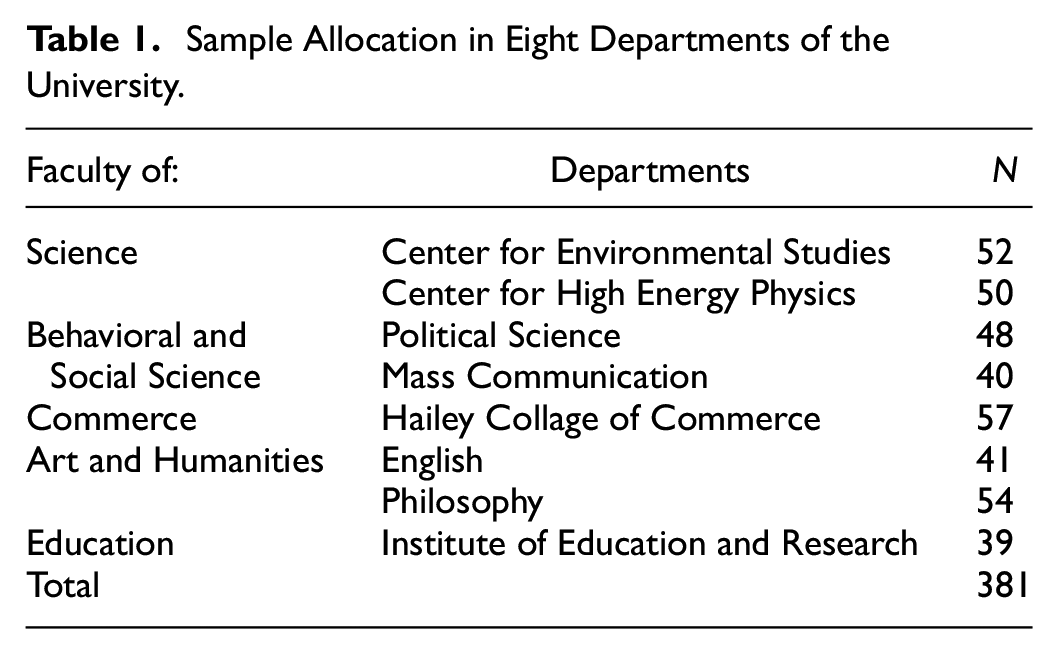
Ten questionnaires were distributed randomly and were analyzed objectively. These participants’ responses were not added to the actual survey. Little changes were made to the questionnaire based on the feedback of some students who were not part of the population. After pretesting, a questionnaire survey was conducted among students. A Proportional stratified random sampling was used, (In this sampling technique the size of each stratum is proportional to the size of the stratum population when viewed from an overall population) they filled out questionnaires and then returned them to the surveyor. Moreover, guidance was provided to participants when needed. The collected data were entered into the Statistical Package of Social Sciences (SPSS version 21). After the creation of the database, descriptive analyses were conducted including Mean,
Result and Discussion
As discussed earlier, the research questions revolve around the impact of Facebook on the voting behavior of youth and the ideological standpoint of youth within the context of Pakistan. A questionnaire was designed that consisted of four sections. First section contained questions related to demographic information, that is, gender, age, department, and educational program which helped to measure the impact of Facebook based on gender/age. Second section contained general questions related to the usage, frequency, and purpose of using Facebook. Third section revolved around the perception of youth regarding Facebook. The respondents expressed their opinion on nine statements and their opinion was measured by using the five points Likert–scale from strongly disagree to strongly agree. The data set was created using SPSS and a descriptive test was applied to it. The last and the fourth section contained open-ended question to know about the ideological orientation and political party identification of youth.
Demographic Information
Respondents’ Age and Gender
Data demonstrates that 381 individuals participated in the study. It is noted that out of 381 respondents, 210 (55%) were female and 171 (45%) were male (Table 2). Among the 210 female respondents, the age of the significant majority (168 respondents) ranged from 20 to 25 years followed by 35 females from the 26 to 30 age group.
Demographic Characteristics of the Respondents (

Only seven female respondents were from more than the 30-year age group. While among the 171 male respondents, 158 were from the 20 to 25 age group, and 10 were from 26 to 30 years of age. Overall, the majority of respondents 326 (85%) were from 20 to 25 years and 45 (15%) respondents were from the 26 to 30 age group (Table 2). In Pakistan minimum age for voting is 18 years.
Respondents’ Educational Program
Out of 381 participants, a significant number of respondents 268 (70%) were bachelor/undergraduate students, 75 (20%) were Master’s students and 38 (10%) were MS/MPhil scholars.
Figure 1 displays the educational program of respondents. Out of 381 participants, 70% were bachelors, 20%were Master’s students, and 10% were MS/MPhil scholars

Respondents’ Educational Program (
Purpose and Frequency of Facebook
The current study indicates that 87% of youth believe that social media political campaign affects their voting behavior. The media’s massive following of information creates awareness among individuals in all aspects including politics (Kroll-Smith et al., 2002). Exposure to political content creates better public awareness, which may result in better voting decisions.
Table 3 shows the purposes of using Facebook, out of 381 respondents 105 (27.5%) use Facebook to get information, 103 (27%) use only for entertainment, and 12 (4%) respondents use it to know their opinion of people.
Purpose of Using Social Media (

Furthermore, 159 (41.73%) use Facebook for all the above-mentioned purposes. The results indicated that most youths use Facebook for all purposes.
Data illustrated the frequency of Facebook use (Table 4). Eighty (21%) respondents were always logged in to Facebook, 94 (25%) used it several times a day and 68 (18%) used it once a day. Moreover, it was noted that 59 (16%) respondents use Facebook 1- 2 times a week and 77 (20%) respondents rarely used Facebook. Now there are also other mediums such as Snapchat, Instagram, and Twitter that attract the attention of youth. According to Hendricks (2013) in the early 21st century, Social Networking Sites (SNS) such as Myspace, Facebook, LinkedIn, and Twitter are easily accessible all over the world and some other SNS such as Spotify, Tumblr, Foursquare, and Pinterest have begun to pop up to fill specific social network nook. The findings provided a perplexing view of Facebook usage, it showed a difference in degree between those who always logged in (21%) and those who use it rarely (20%), and although the dwindling intensity is 5%, it points toward the process of declining. This finding negated the findings of Richter (2018) who excogitates that Facebook usage increases drastically from 2012 to 2018 in the United States. This contradiction indicates the decrease in the intensity of Facebook usage in developing countries as compared to developed ones. According to a Pew research center survey on teens, social media, and technology, the social media environment revolves less around a single platform than it did 3 years ago (Anderson & Jiang, 2018).
Frequency of Facebook Use Among Youth in the 2018 Pakistani General Election.

Effect of the Facebook Campaign on Voting Behavior
Data presented the impact of Facebook on voting behavior. The respondents expressed their opinion on nine statements and their opinion was measured by using the 5 points Likert–scale from strongly disagree to strongly agree (Table 5). Out of 381, only 378 responses were in this section.
Effect of Facebook on Voting Behavior (

The results show that majority of educated youth believe that Facebook influences their voting behavior. The mean value of all nine statements ranged from 3.04 to 3.53. The statement “Facebook showed biasedness while expressing views” has the highest mean value of 3.53. This finding keeps up with Kroll-Smith et al.’s (2002) research, they found that media follow-up of information generates consciousness among folks. Finding reveals that cognizance between objective and subjective viewpoints is generated through exposure to unrestraint information provided on Facebook.
It is worth noting that respondents perceived that Facebook assisted political entities to manipulate data to increase their vote bank during the 2018 election with the second-highest mean value of 3.30 on a five-point Likert scale. This result shows that people are conscious of marketing strategies and tactics used by politicians. Political marketing abates the distance between voters and candidates and impacts directly the cognitive thinking of its audience. Facebook further elevated these strategies by providing a platform to gather data on users’ likes and dislikes, there are various platforms available to academic researchers to extract data from people’s profiles and groups. Many applications that help in the extraction of data from Facebook, that is, include “
Some countries have been trying to control Facebook. Latif (2018) in his study of Malaysian elections quoted the statement of defeated leader Abdul Ahmad Badwi, he said that the Barisan Nasional suffered defeat in an online war because they underestimated the power of Facebook. Recently South Korea suspended the internet portal ahead of April 15, 2020 legislative election after controversy over politicians trying to manipulate data (Dawn, 2020).
It is observed that respondents thought about the ethical check of content posting on Facebook (
But also motivated users to vote (
Respondents believed that Facebook’s codified rules for political advertisement improved information reliability with the second-lowest mean score value (3.19). The result shows that youth were not satisfied with the new rules developed by Facebook to improve information reliability. Facebook spread rumors as authentic news scored the lowest mean (3.04). That shows that youth trust the news and information spread on Facebook. The result indicates that Pakistani youth is less concerned about fake news.
The effect of Facebook on the voting behavior of male respondents (
To see a statistically significantly different mean in the opinion of both groups (male and female) of respondents regarding the effect of Facebook on voting behavior, an independent sample
Gender-Based Difference Regarding the Effect of Facebook on Voting Behavior.

To see a statistically significantly different mean in the opinion of respondents regarding the effect of Facebook on their voting behavior during the election 2018 based on their age group, one-way ANOVA was applied. Mean,
Age-Based Difference Regarding the Effect of Facebook on Voting Behavior.

An open-ended question was added to know why youth follow the official pages of political parties. According to the survey, out of 309 respondents, 120 answered the question that they follow the pages of political parties for different reasons. Ninety-six individuals follow official pages to know about the projects and programs of political parties. These results go along with the Michigan approach which believed that individual considers issue orientation, and party identification in making voting decisions. Sixteen respondents mentioned that they follow the official pages of political parties due to a Personality-oriented approach or hero-worship followed eight individuals follow these pages to know the manifesto of political parties. It is assumed that the remaining 189 participants who didn’t answer this question may not follow the official page of any political party. These results go along with the Michigan approach which believes that individual considers issue orientation, and party identification in making voting decisions (Table 8).
Reasons to Follow the Official Page of the Political Party (

Thus, the result shows that less than half of the respondents follow the official pages of political parties. This shows that respondents prefer to get information from the secondary than the primary source. This also shows that most individuals rely on their friends and family network through “
Figure 2 presents the ideological orientation and party identification of youth. According to data, 32% of youth were rightists, 58% were liberalist, and 10% of youth have a leftist political ideology. The results indicate an ideological shift in youth. In the 2013 general election, most youths supported rightist political parties (Election Commission of Pakistan, 2013) but in the 2018 election, 10% of youth supports leftist political ideology. The results display an ideological shift from rightist political ideology to liberalize political ideology (58%). It is noted that

Political ideology of youth (
Conclusion
Facebook has impacted substantially the voting behavior of the youth by acting as a social context in which the individuals reside. The degree of its influence depends on the frequency of its usage as our study explores that 94% of youth in Pakistan use this platform several times a day and that elucidates that Facebook impacts their voting decisions. In the 2018 general elections of Pakistan, Facebook impacted youth’s partisan attachment as we have seen a shift from rightist to liberalize political parties. Secondly, the social context of Facebook consists of family and peer networks that act as opinion builders and defines the political issues for youth irrespective of gender and age that make it easier for them to focus on the political issues that are generally held by the public.
In the context of Pakistan, we can’t ignore the role of identity politics in elections because it’s a plural and ethnically diverse society and the youth who are the users of Facebook belong to different ethnicities that influence them but in 2018 general elections of Pakistan youth have taken an unprecedented decision and elect a different political party which shows that Facebook creates a virtual social reality that impacts youth with more intensity as compared to the original reality. Another interesting point is that the recruited party “Pakistan Tehrek Insaf” is the pioneer of the Facebook political campaign in the 2013 general elections and got the fruit of its effort in the 2018 general elections of Pakistan. It’s not wrong to say that Facebook has opened a new door to virtual reality and made us unconscious of the original reality.
Footnotes
Declaration of Conflicting Interests
Funding
ORCID iD
