







Abstract
Introduction
The term diaspora is defined as a community of people dispersed across at least two countries worldwide (Schulz & Hammer, 2003). Initially, the term diaspora was applied to aggrieved immigrants who had to migrate to their homeland. However, after 1980, the content of the term was expanded to include other reasons for migration (Butler, 2001). Diasporas are characterized by transnational existence, global expansion, and permanent residence. However, they often define themselves as temporary residents in the country where they are currently residing (Schulz & Hammer, 2003).
Diasporas can be classified as victim diasporas (Jews, Africans, Irish, Palestinians, etc.), labor/working diasporas (Chinese, Japanese, Turks, Italians, South Africans, etc.), settler/colonial diasporas (British, Russians, etc.), commercial diasporas (Lebanese, Chinese, Japanese, etc.), and displaced/cultural/hybrid diasporas (Caribbean, Sintian, Parsi, etc.; Cohen, 2008). Migration can be voluntary or involuntary (Kaygalak et al., 2015), and today many migrants live in a transnational social space and develop networks or communities. Furthermore, diasporas engage in economic, political, social, familial, religious, and cultural activities (Huang et al., 2013).
The most significant factor influencing the decision of immigrants to settle in a particular country is the level of economic and social comfort that can be achieved in that country. Even if the country in question is not particularly developed, immigrants may still choose to settle in a country that is geographically close to their country of origin, if there are no significant cultural adaptation issues. This is the case with migration from the Turkic Republics to Turkey, as evidenced by Bulut (2021). The advent of modern technology has enabled migrants to maintain both virtual and physical contact with their country of origin, thereby reinforcing their ties to their homeland (Huang et al., 2013).
One of the most common methods by which diasporas maintain links with their homelands is through travel. This can be undertaken for several reasons, including the maintenance or strengthening of personal and emotional ties and the rediscovery of places. Indeed, connections to places are the main motivation for tourism flows for immigrants and their descendants who wish to rediscover their roots, re-experience their former homeland, and thus reposition their identity (Iorio & Corsale, 2013). Diaspora tourism is also associated with individuals traveling to places where they previously resided for reasons including a longing for relatives, friends, homeland, the protection of their identity, or a search for origins (Çıkı & Kızanlıklı, 2021).
Diasporas possess considerable tourism potential and confer several benefits upon their home destination. For new tourist destinations striving to gain a foothold in the international market, diaspora tourists may be the first to visit these destinations. These individuals invest directly in the promotion of the destination, the construction of new tourist facilities, or the upgrading of existing facilities to meet the expected standards. While diaspora tourists do not spend as much as foreign tourists, they are more likely to spend on local craftsmen, accommodation, and restaurants. Diaspora tourism is less seasonal than mass tourism, which allows for more stable use of infrastructure and employment opportunities throughout the year. Furthermore, diaspora mobility can facilitate the expansion of tourism geographically within the country (Newland & Taylor, 2010).
Migration has resulted in significant alterations to the demographic profiles of numerous countries. While some nations have established diasporas in a multitude of global locations because of their citizens’ overseas migration, others have become increasingly multicultural due to the influx of immigrants. Because of these migratory movements, the United States, Russia, and Germany have emerged as significant sources of diaspora tourists, while China, India, Turkey, and Israel have become the primary destinations for diaspora tourists (Tören, 2021). Globally, there are approximately 70 million Irish, 60 million Chinese, and 25 million Indians living abroad. The 2011 report of the Foreign Economic Relations Board (DEIK) indicates that the number of diaspora members worldwide will reach 405 million by 2050. The diasporas that have been established abroad because of Turkey’s historical migrations, as well as those that have been formed in Turkey as a result of migrations (Crimean Tatar, Circassian, Bulgarian, East Turkestan Uyghur diasporas), have demonstrated that Turkey is an important center for diaspora communities (Tören, 2012).
Countries are establishing global communication networks for their diasporas. Advance Australia, GlobalScots, ChileGlobal, Ireland Funds, and KEA New Zealand are leading global diaspora networks. In addition, some countries implement various visit programs. For instance, the Irish government announced in 2010 that 70 million citizens of Irish descent would be issued a certificate to substantiate their Irish roots. This certificate offers discounts on travel, accommodation, and activities. The Taglit-Birthright Israel program is a project that enables Jewish youth aged 18 to 26 to spend 10 days in Israel. Since 2000, over 260,000 young Israelis from 52 countries have visited Israel through this program. In 2011, the G'Day USA program held events in 8 US cities over 14 days, focusing on business, the arts, education, and tourism. The events resulted in the creation of two-way business opportunities. In order to promote tourism in the Turkish diaspora, it is recommended that visits to the homeland be organized (Foreign Economic Relations Board, 2011). Çıkı & Kızanlıklı (2021) emphasize that events, festivals, and tours that encourage migrants to travel to their homeland are essential for the long-term sustainability of diaspora tourism.
Although the Central Asian Turkic Republics possess considerable tourism potential, the level of tourism activity is below expectations (Tanrısever, 2016). Over the past 20 to 30 years, there has been a significant influx of individuals from the Central Asian Turkic Republics to Turkey (Bulut, 2021). Despite the shared origin of the independent Turkic Republics in Central Asia and the migration of their ancestors from Central Asia, the number of Turkish citizens who travel to the region remains insufficient (Tanrısever, 2016). For example, while the number of tourists visiting Turkey from Kazakhstan, one of the Central Asian Turkic states, was 43,793 in 2002, this figure increased tenfold to 421,369 in 2019 (TURSAB, 2022). The 2018 First Term Report of the Ministry of Culture and Tourism indicates that Turkey is the preferred destination for international travel among Kazakh citizens, with 402,830 people having visited the country during that period. However, official information from the Border Service of the National Security Committee of Kazakhstan indicates that the number of tourists from Turkey to Kazakhstan between January and September 2017 was only 75,000 (T.R. Ministry of Culture and Tourism, 2018). When these figures are compared, it becomes evident that the number of tourists from Turkey to Kazakhstan is limited.
It is similarly evident that collaboration between countries with a shared historical legacy and a common cultural heritage, such as the Turkish states, is of paramount importance for the advancement and resilience of these countries (Tuna et al., 2022). In this context, the partnership between Kazakhstan and Turkey in diaspora tourism mobility will undoubtedly boost the number of tourists for both countries. However, it is crucial to recognize that diaspora tourism mobility should be conceptualized as a two-way process rather than a one-way phenomenon, and that tourism strategies must be designed accordingly. It is similarly important to consider the impact of diaspora tourism mobility in the form of visits to the home country, as it is to consider the impact of visits to the place of migration from the home country.
A search of the national and international literature revealed no studies that examine the reverse tourism activity of the diaspora. Reverse diaspora tourism can be defined as a form of tourism that involves the local population in countries of origin visiting diaspora communities or engaging with cultural products and experiences in their home countries, as opposed to diaspora tourists visiting their countries of origin. An understanding of the travel patterns and economic, cultural, and social impacts of reverse diaspora mobility will significantly benefit the creation of new tour packages and destination marketing and management. The objective of this study is to elucidate the economic, cultural, and social implications of “reverse diaspora tourism” by contrasting the travel behavior and expenditure patterns of friends and relatives visiting diasporas with those of traditional diaspora migrants.
Literature Review
Diaspora Tourism Behavior
Diaspora tourism can be defined as the act of traveling to one’s ancestral homeland, typically by an individual of immigrant origin, to reconnect with their cultural heritage (Chen et al., 2023). Those undertaking such tourist trips are called “diaspora tourists” (Pala & Tören, 2023). The diasporic tourist's objective is to practice their own culture for a limited period and to transmit their cultural heritage to the younger generations they accompany (Çetinkaya Karafakı, 2023). While diaspora tourists travel with artistic and cultural heritage motivations, it has been determined that they engage in the exploration, discovery, learning, and experiencing the cultures of their ancestors and families, that is, their own cultures, driven by emotional, and historical ties (Pala & Tören, 2023).
Diaspora tourism is a type of cultural tourism that transcends geography and offers unique ways of experiencing culture and interacting with hosts (Weaver et al., 2017). Diaspora tourism emphasizes two dimensions: roots and tourism. People are motivated to travel to places where they believe they have their roots and where their families are from (Iorio & Corsale, 2013). Personal ties include talking to family abroad, providing emotional support, traveling for leisure, sending, and receiving money, and discussing politics in their country. However, destination marketing organizations often opt for the diaspora, which includes recent and long-term migrants and their descendants (Huang et al., 2013). In this context, diaspora tourism activities will continue for generations to come. According to Çıkı and Kızanlıklı (2021), diaspora tourism is most sustainable when it targets the second and subsequent generations.
Diaspora tourism plays a role in the preservation of cultural heritage through the interest that visitors express in their origins. The places visited are preserved and revitalized because of the interest demonstrated by the diaspora. This serves to enhance the value of cultural heritage for both local communities and diaspora members alike. Diaspora tourism provides individuals with the opportunity to reinforce their cultural identity and sense of belonging. Such tourism activities facilitate a deeper comprehension of one’s cultural roots and facilitate a reconnection with one’s personal past. Second- and third-generation migrants tend to develop a stronger attachment to the cultural heritage of their ancestors because of such trips. Furthermore, diaspora tourism contributes to economic development. The places visited by migrants benefit from tourism revenues, which in turn stimulate the local economy. Additionally, it facilitates cultural exchanges and social bonding between diaspora members and local people (Reed, 2015; Tan & Abu Bakar, 2018).
People have different motivations for visiting their homeland, including nostalgia, cultural identity, and social ties. Years ago, they migrated voluntarily or involuntarily for various reasons. Their travels to the countries they left have been studied in different ways, such as “individual heritage tourism,”“ethnic tourism,”“friends and relatives visiting tourism,”“origin tourism,” and “diaspora tourism” (Kaygalak et al., 2015). The summary of studies on diaspora tourism in the literature review is as follows;
In the case of diaspora tourism mobility, loyalty to the homeland is a key motivator for travel. Çıkı and Kızanlıklı (2021) found that people who feel attached to their homeland tend to travel there more often. This attachment to the homeland has a positive effect on the motivation for diaspora tourism. Tanrısever’s (2016) study also revealed that 27 people visited Azerbaijan for the first time to learn about their roots, 53 to invest in property, and 113 to visit family. Furthermore, Otoo et al. (2021b) found a positive correlation between attachment to the homeland and the intention to travel in the future.
In most studies, travel motivations related to attachment to the homeland, such as visiting friends and relatives, religious or cultural interests, family ties, and gaining new experiences, have been at the forefront of common reasons for travel. For example, Iorio and Corsale (2013), based on 103 surveys and 10 interviews with first, second and third-generation Romanian immigrants living in Germany, found that visiting friends and relatives was the main motivation for first-generation immigrants to travel to their homeland. As a result of Moufakkir’s (2011) study on the tourism behavior of people of Turkish origin living in Germany, he concluded that ethnicity, which is characterized by familism, religion, and tradition, interacts in shaping people’s travel behavior. Yüksel and Harman (2019) applied a questionnaire to 405 people to determine the demographic characteristics, travel habits, and motivations of Assyrians visiting Mardin. The study found that most Assyrian tourists from Mardin live in European countries, stay in Mardin for an average of 10 days, prefer individual travel, and stay in their familiar homes. It was also found that the travel motivations of these people can be examined under three headings: religion and origin, family ties, and rest and discovery. Otoo et al. (2021a) identified a five-dimensional structure based on the scale study they conducted to identify the travel motivations of diaspora tourists. Within the five-factor structure, “seeking unforgettable experiences” was identified as the most important motivation for participating in diaspora tourism. In another study, Otoo et al. (2021b) found that the essential travel motivations of African diasporas were seeking memorable experiences, achieving a sense of pride and learning, and seeking connectedness dimensions.
Travel motivations may vary between generations, depending on their attachment to the homeland. Iorio and Corsale (2013) found that second and third-generation immigrants’ attachment to their country of origin gradually weakened. Huang et al. (2018) surveyed 808 Chinese immigrants living in North America to determine international immigrants’ passion for their homeland and their motivation to travel. The study identified generational differences in homeland-place attachment. It was concluded that loyalty to the homeland decreased in the second generation compared to the first-generation but increased in the third and fourth generations compared to the second generation. In addition, it was observed that the first and one and a half generations are equally attached to their homeland and the place where they live, while the following generations are more attached to their country.
Similarly, while the first and first-and-a-half generations perceived Chinese culture and family heritage as equally important, Chinese culture was found to be more important for subsequent generations. In another study, Huang et al. (2016) interviewed 26 second-generation Chinese Americans with travel experience in China to understand the experiences of second-generation immigrants while traveling to their ancestral homeland. They found that second-generation immigrants had different experiences than first-generation immigrants, due to differences in language proficiency and familiarity with the culture. In addition, although most participants said they felt more Chinese or closer to China after the trip, not all participants developed a strong loyalty to their homeland or destination.
Research shows that the memories and stories told by family members increase the motivation to travel, due to their attachment to the homeland. For example, Kaygalak et al. (2015) interviewed 11 people who participated in a Balkan tour to determine the purpose and motivation of people visiting the Balkan countries. They found that people were motivated by curiosity about the memories and stories they heard from their family elders, and therefore participated in the tour. Seraphin et al. (2023) interviewed 56 migrants about the need for a child-centered approach to diaspora tourism. The study highlighted the vital role of families in transmitting knowledge, memories, traditions, and cultural practices to diaspora children. The study also proposed a child-friendly marketing approach (child-friendly website, social media communication and activities).
Factors such as leisure time, number of trips, length of stay, cinema, and culinary culture increase diaspora mobility. Huang and Chen’s (2021) study on the relationship between transnational leisure time and diaspora tourism activities found a positive association between these concepts. They also found that the frequency of travel and the intention to visit differed according to the type of leisure time. In another study, Huang et al. (2013) found a relationship between the number of diaspora tourism trips and the length of stay and the attachment of immigrants to their ancestral lands, as they studied the devotion of second-generation immigrants to their homeland. As a result of Bandyopadhyay’s (2008) study on the impact of Bollywood films in the Indian diaspora, he determined that Bollywood films are of great importance in the identity construction of the Indian diaspora, encouraging diaspora tourism and creating excellent opportunities for economic development. Çıkı and Kızılırmak’s (2021) study found that Turkish cuisine played an important role in the travels of second-generation Turkish immigrants to the motherland. The findings of these studies indicate that the second generation, who have never had the opportunity to visit their homeland, develop a romanticized view of their family homeland and an increased desire to travel.
Previous studies have mainly focused on the travel motivations of diaspora tourists of different nationalities and generations, their attachment to their home country and their future travel intentions. In Minta’s (2007) study, the concept of reverse diaspora is discussed as the urge of the African migrant community to return to their home. In Hess’s (2014) study, it is defined as the phenomenon of immigrants returning to their ancestral homeland, but instead of resolving their diasporic identity, they create a new type of diaspora in their so-called homeland. In the context of reverse diaspora tourism, diaspora members who do not return to their homeland engage with products and services related to their own culture in the countries where they reside. This contributes to an increased interest in these cultural items and, consequently, to economic development. In Bowen’s (2022) study, visitors who experience products through food tourism and then try to buy these products when they return to their countries as a reverse diaspora effect were evaluated in terms of diaspora marketing. Furthermore, as previously stated, Bollywood films (Bandyopadhyay, 2008) and Turkish gastronomy and culinary culture (Çıkı & Kızılırmak, 2021) have been demonstrated to have a significant impact on travel, inspiring curiosity among the second generation who have never visited their homeland. Consequently, it can be posited that the preservation of cultural heritage in the countries where diasporas reside can foster travel motivation and consumption behavior.
Diasporas engender intercultural interplay and the evolution of an urban identity. To illustrate, the largest diaspora group in Izmir is that of the Franks, who are predominantly Christian and Italian. The Muslim diaspora group is followed by Albanians, Circassians and Balkan immigrants. Diaspora groups in Izmir continue to maintain their cultural heritage through the preservation of their language, religion, music, dance, food, clothing, activities, and rituals. These practices serve to sustain their collective identity, evoke a sense of community, and honor the past, which they consider vital for the continuity of their cultural heritage. In this context, the protection of diasporic heritage in the city and its transfer to future generations is crucial for the sustainability of cultural identity (Çatalbaş, 2023). In terms of reverse diaspora tourism, it can be assumed that diasporas will elicit reverse travel behavior by locals and acquaintances in the home country to visit the historical and cultural heritage of diasporas.
In this study, the concept of reverse diaspora tourism covers the visits of diasporas' acquaintances in their homeland to the countries where diaspora communities live and the economic, cultural and social behavior patterns that emerge as a result of these travels. This study, for the first time, compares the Turkish and Kazakh diasporas as reverse diaspora mobility and highlights the importance of the economic, cultural, and social contributions they make. This leads to three research questions:
Methodology
A qualitative research method was used in this study. Qualitative research is a research process in which perceptions and events are revealed realistically and holistically through qualitative data collection techniques such as observation, interview, and document analysis (Yıldırım & Şimşek, 2011). Qualitative research also has a systematic like quantitative research. In this context, there is also a research problem in qualitative research. Therefore, a research design is developed to investigate the research problem (Balcı, 2013). In this study, a semi-structured interview method, which is one of the qualitative research methods, was used. The characteristic of this method is that it provides in-depth knowledge about a specific topic (Yıldırım & Şimşek, 2011). In this context, diaspora tourism and reverse diaspora tourism activities between Turkey and Kazakhstan have been studied in detail. The model of the research is presented in Figure 1. As can be seen from the model, the social, cultural, and economic effects of diaspora tourism and reverse diaspora tourism activities between Kazakhstan and Turkey were examined in the research.
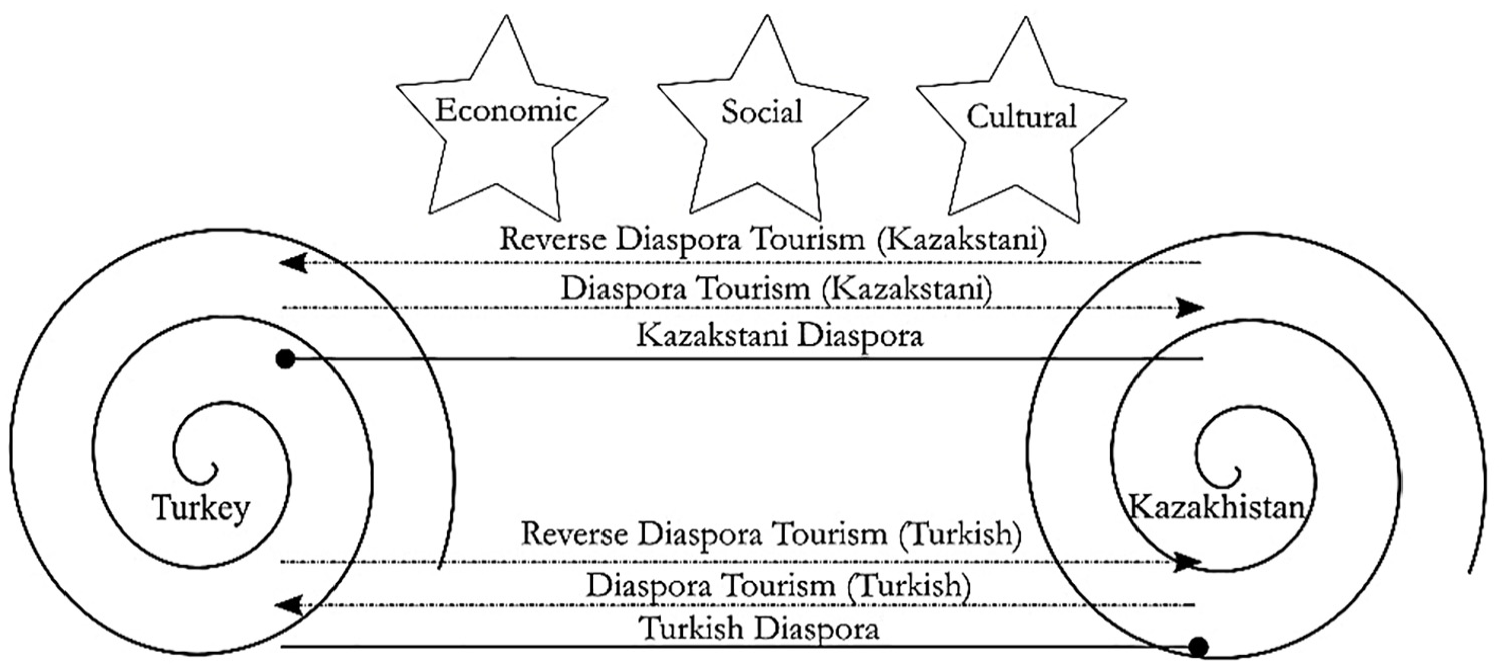
Research model.
Sampling and Data Collection
In this study, a combination of criterion sampling from purposive sampling methods, snowball sampling from non-probability sampling methods and disproportionate stratified sampling from stratified sampling methods were used in the sample selection process. Individuals with certain characteristics are selected in criterion sampling. In this context, participants were selected from individuals who were fully settled in the country to where they had migrated and who were willing to participate in the study (Patton, 2002).
At another stage of sample selection, snowball sampling was used to increase the number of participants. This method used connections within the relevant diaspora communities in Turkey and Kazakhstan. More participants were reached through recommendations from these communities. Snowball sampling is particularly effective in studies conducted within hard-to-reach or restricted communities (Biernacki & Waldorf, 1981).
Within stratified sampling, disproportionate stratified sampling was used. In this method, the number of participants to be sampled from each stratum was predetermined and an equal number of participants were selected from each stratum, regardless of their proportion in the population (Creswell, 2012). During the selection process, 60 participants were identified, with 30 Kazakhstani citizens residing in Turkey and 30 Turkish citizens residing in Kazakhstan. This sampling aimed to ensure equal representation, regardless of the actual proportions of the groups within the population.
Throughout the study, great care was taken to adhere to ethical principles and informed consent was obtained from participants, either in writing or verbally, before data collection began. Participants were thoroughly informed of the purpose of the study, the data collection process and how the data would be used. In addition, participants’ identities were anonymized in accordance with the principles of data protection and confidentiality. Each participant was given a pseudonym. Sample selection criteria were clearly defined and only individuals who met these criteria were included in the study. Participants were assured that the data collected would only be used for scientific research.
Informed consent was obtained verbally or in writing before the interviews were conducted with the participants. Participants were identified by a code name instead of a name. Furthermore, the criteria of having migrated to Kazakhstan and fulfilling the conditions of being a diaspora were defined. Therefore, the working group consists of 30 participants from the Kazakh diaspora in Turkey and 30 participants from the Turkish diaspora in Kazakhstan, a total of 60 participants. Information about the participants can be found in Table I.
Demographic Information about Participants.

Table 1 shows that 12 participants are women and 48 are men. The participants migrate mainly for business reasons and these participants usually migrate alone. Forty-one participants migrated alone, and 19 participants usually migrated in groups. The migration years of the participants also typically cover the 2000s and show diversity.
This study used one of the qualitative data collection methods, the structured interview technique. Structured interviews were conducted based on pre-determined questions that allowed for in-depth exploration of topics relevant to the research objectives. The interview consisted of semi-structured, open-ended questions designed to elicit detailed responses from participants about their experiences, perceptions and thoughts, thereby providing insights into the research questions.
The data collection process took place between January and April 2022, using two methods to collect participant data. The first method involved conducting online face-to-face interviews using the Zoom application. These interviews were conducted with 56 participants, including Kazakh tourists visiting Kazakhs settled in Turkey and Turkish tourists visiting Turks settled in Kazakhstan. The choice of online interviews was mainly due to the fact that the participants were located in different geographical regions and to the restrictions imposed by the pandemic. This method allowed for real-time interaction, enabling the researcher to collect immediate responses and guide the interview process accordingly. The interviews were audio recorded and later transcribed for analysis.
The second method of data collection was email-based interviews. This approach was used for four participants who had limited internet access or who were unable to participate in face-to-face interviews. The interview form was emailed to these participants and after they completed the form, follow-up communication was conducted to confirm and validate their responses. This step was taken to ensure the accuracy and reliability of the data. Email-based data collection allowed participants to reflect on their responses and provide comprehensive answers that were checked for consistency.
Language barriers were not an issue during the data collection process as the participant's mother tongue was Turkish. Therefore, the interview forms were prepared in Turkish, and all interviews were conducted in Turkish. The use of a common language allowed the participants to express their thoughts comfortably and naturally, ensuring smooth communication.
Throughout the data collection phase, informed consent was obtained from all participants and confidentiality was maintained by using code names instead of real names. The data collected were processed using qualitative data analysis techniques and analyzed thematically in line with the research objectives.
Data Analysis
The interview data were analyzed thematically using MAXQDA 2020 qualitative data analysis software. This method of analysis creates a specific framework and organizes the collected data into categories and themes. Braun and Clarke (2006) argue that thematic analysis is a qualitative research method that can be used across a range of epistemologies and research questions. They also state that thematic analysis should be a basic method for qualitative data analysis, just as it provides basic skills for carrying out many other forms of qualitative analysis. Thematic analysis can be seen as the most appropriate method for a study that aims to explore through interpretation. Thematic analysis goes beyond counting explicit words or phrases and focuses on identifying and explaining both implicit and explicit ideas. Codes developed for ideas or themes are applied to or associated with the raw data as summary markers for analysis. This may involve comparing the relative frequency of themes or topics in a dataset, looking for co-occurrence of codes, or graphing code relationships (Namey et al., 2008). The interview questions to the participants were as follows:
(1) What are the reasons for migration from your homeland to your host country?
(2) Do your relatives/friends from the homeland visit you? On average, how many friends/relatives visit you each year? On average, how many nights do these visitors spend per person during their visit?
(3) How many times a year do you visit your home country? In total, how many people do you visit your home country with? On average, how many nights do you stay in your home country when you visit?
(4) When you visit your homeland, how much (in $) do you spend on average per person on accommodation, travel, food and beverage, entertainment, etc.? When your relatives/friends come to visit you from their hometown, how much (in $) do they spend on average per person on accommodation, travel, food and beverage, entertainment, etc.?
(5) What is the impact of reverse diaspora tourism on the relationship between your home country and your host country?
(6) What motivates your friends/relatives to visit your host country?
(7) Do visits by friends and relatives strengthen the host country in economic, cultural, and social terms?
(8) What difficulties do your friends/relatives face when visiting your host country? How can travel between these countries be facilitated?
(9) What kind of cooperation and contributions does reverse diaspora tourism offer to the countries in the field of the tourism sector?
Validity and Reliability
In contrast to quantitative research, numerical indicators are not evidence of validity and reliability in qualitative research. In qualitative research, reliability rather than validity-reliability is necessary. In this context, the credibility of the results is accepted as one of the essential criteria of scientific research. Credibility criteria are categorized under four main headings: reliability, credibility, transferability, and confirmability. In qualitative research, researchers should take steps to ensure credibility, clearly define the research process and data, and select an appropriate sample size. The methods listed in Table 2 ensure validity and reliability in qualitative research (Guba & Lincoln, 1982).
Methods of Validity and Reliability in Qualitative Studies.

Long-term interaction with participants is necessary to ensure internal validity. In this context, the researchers tried to control their biases by conducting long-term interviews (prolonged engagement) with the participants. Allowing sufficient time for data collection enabled the researcher to understand the culture, language, or views of the study group in depth. When interviewing participants of Kazakh nationality, a translator who spoke Kazakh Turkish was used. Interviews with participants of Turkish nationality were conducted in Turkish. In addition, the accuracy of the data was tested by asking the same questions in different ways from time to time during the interview.
Asking participants whether the study’s results accurately reflect their thoughts is called member checking. This involved asking participants for feedback on the accuracy of their comments and conclusions about the findings. This method ensured the internal validity of the research. The researcher triangulation method involves more than one researcher in collecting, analyzing, and interpreting data. In this context, researcher triangulation was used with three researchers involved in data collection, analysis, and interpretation. In addition, peer debriefing was used to increase the study’s credibility, and the findings were reviewed by three academics who were experts in their field (Creswell, 2003).
Findings
Comparison of Diaspora and Reverse Diaspora Tourism in Terms of Economy
This heading examined diaspora and reverse diaspora tourism, considering economic indicators such as visitors, overnight stays and tourism expenditure. Table 3 shows the results for diaspora and reverse diaspora mobility. There are 60 participants: 30 from the Kazakh diaspora and 30 from the Turkish diaspora.
Travel Behavior of Diaspora and Reverse Diaspora Tourists.

Figure 2 shows a radar chart of the total annual number of visitors according to the direction of movement of diaspora tourism, taking into account the data obtained from the participants. According to the figure, 53 diaspora tourists visit Kazakhstan, while 32 diaspora tourists visit Turkey in 1 year. On the other hand, 66 diaspora tourists visit Kazakhstan, and 73 diaspora tourists visit Turkey annually if we look at the reverse diaspora tourism activities. As a result, the total number of visitors participating in reverse diaspora tourism is 139, and diaspora tourism averages 85 per year. Thus, reverse diaspora movements stand out in terms of visitor numbers.

Number of total visitors.
Regarding visitor numbers, the gray triangle indicates the volume of diaspora tourism, and the black triangle indicates the volume of reverse diaspora tourism in the figure. The number of visitors is economically and culturally significant, considering that tourists spend money on travel, accommodation, food and beverage, recreation, souvenirs, and cultural interaction with the local population. In this context, the importance of reverse diaspora tourism becomes clear.
Figure 3 shows the average number of visitors per diaspora migration. These averages have been examined by direction of diaspora tourism and by country. The average number of visitors per diaspora migration was calculated using the following formula:


Number of average visitors.
Considering the travel behavior of the diaspora, each migration movement generates an average of 1 to 2 tourist visits per year (
Figure 4 illustrates the total number of overnight stays generated by diaspora tourism and reverse diaspora tourism visits. In diaspora tourism, the Kazakh diaspora generated 1,116 overnight stays per year, while the Turkish diaspora accounted for 524 overnight stays. On the other hand, in reverse diaspora tourism, Kazakh visitors generated a total of 1,777 overnight stays, and Turkish visitors generated 2,030 overnight stays. These results indicate that reverse diaspora tourism generates significantly more overnight stays for both countries than regular tourism. Therefore, the number of overnight stays in reverse diaspora tourism is significantly higher than in diaspora tourism.

Number of Total Nights.
Figure 5 shows the number of nights per visitor for diaspora and reverse diaspora tourism. According to the data, while a visitor spends an average of 19.29 nights per year in diaspora tourism, this number increases to 27.39 nights in reverse diaspora tourism. In particular, Kazakh diaspora tourists spend an average of 21.06 nights per year, while Turkish diaspora tourists spend 17.47 nights. Within reverse diaspora tourism, Kazakh tourists spend an average of 26.92 nights per year, while Turkish reverse diaspora tourists spend 27.81 nights per year.

Number of nights per visitor.
These results show that reverse diaspora tourism has a much greater potential than diaspora tourism, both in terms of overnight stays and number of visitors. Moreover, according to TurkStat data (2021), foreign tourists visiting Turkey stayed for an average of 7.5 nights, while reverse diaspora tourists stayed for an average of 27.39 nights, indicating that this group visits for much more extended periods. This result shows that Reverse diaspora tourists have more substantial social and cultural ties with their country and seek to maintain and strengthen them through extended visits. At the same time, longer stays by reverse diaspora tourists mean they can make a more significant economic contribution. It can be concluded that reverse diaspora tourism is more strategic than diaspora tourism in maintaining socio-cultural ties and economic contributions.
Table 4 shows diaspora and reverse diaspora tourism expenditure on accommodation, travel, souvenirs and recreation. Based on data collected from 60 participants, it was found that 85 diaspora tourists, including their companions, spent a total of $79,315 in 1 year, while 139 reverse diaspora tourists spent a total of $145,850. Of the 85 diaspora tourists, $5,103 was spent on entertainment and activities, $48,312 on travel, $15,138 on souvenirs and shopping, $8,200 on food and beverages and $2,562 on accommodation. On the other hand, the 139 reverse diaspora tourists spent $10,093 annually on entertainment and activities, $10,256 on souvenirs and shopping, $33,746 on food and beverages, $74,330 on travel and $17,425 on accommodation. It was observed that the reverse diaspora's tourism expenditure was higher in all categories except souvenirs and shopping.
Total Tourism Expenditure by Diaspora and Reverse Diaspora Tourists.

Tourism expenditure for Kazakh tourists was $48,316, while Turkish diaspora tourists spent $30,999. In terms of reverse diaspora visitor expenditure, $67,756 was spent by visiting members of the Kazakh diaspora and $78,094 by visiting members of the Turkish diaspora. It is evident that reverse diaspora tourism expenditure is higher than regular diaspora tourism expenditure. It can, therefore, be concluded that reverse diaspora tourism generates more income for destinations than diaspora tourism.
Table 5 shows the per visitor tourism expenditure of diaspora and reverse diaspora visitors. The following formula was used to calculate the per capita expenditure of the participants:

Per Capita Tourism Expenditure by Diaspora and Reverse Diaspora Tourists.

The table demonstrates that diaspora tourists spend an average of $30 per person on accommodation, while reverse diaspora tourists spend $125 per person. This difference can be explained by the fact that diaspora tourists often have the opportunity to stay with family and relatives in their home country. Regarding travel expenditure, diaspora and reverse diaspora tourists spend similar amounts; a diaspora tourist spends an average of $568 on travel, while a reverse diaspora tourist spends $535. For food and drink, diaspora tourists spend an average of $96 per person, while reverse diaspora tourists spend $243 per person. The higher expenditure on food and drink by reverse diaspora tourists may be explained by the fact that diaspora tourists staying with family or friends in their home country often receive meals at home, reducing their need for such expenditure. Regarding leisure activities, diaspora tourists spend an average of $60 per person, while reverse diaspora tourists spend $73. This difference may be explained by diaspora tourists spending more time visiting familiar places. In contrast, reverse diaspora tourists tend to engage in more activities as they explore new places and experiences. Regarding souvenirs and shopping, diaspora tourists spend $178 per person compared to $74 for reverse diaspora tourists. Diaspora tourists may spend more on local products as gifts for family, relatives and friends back home, which explains this higher expenditure.
Diaspora and Reverse Diaspora Tourists’ Social and Cultural Bond
This section analyzed the participants’ views on diaspora tourism’s social and cultural contributions to the countries. Table 6 shows participants’ perceptions of the impact of reverse diaspora tourism on relations between Turkey and Kazakhstan. Participants stated that reverse diaspora tourism leads to a sense of sympathy toward the visited country (
The Impact of Reverse Diaspora Tourism on Relations between Turkey and Kazakhstan.


Table 7 shows the factors that motivate visitors to participate in reverse diaspora tourism. The motivating factors include visiting (
Factors That Motivate Visitors to Reverse Diaspora Tourism.


Figure 6 shows that most participants (
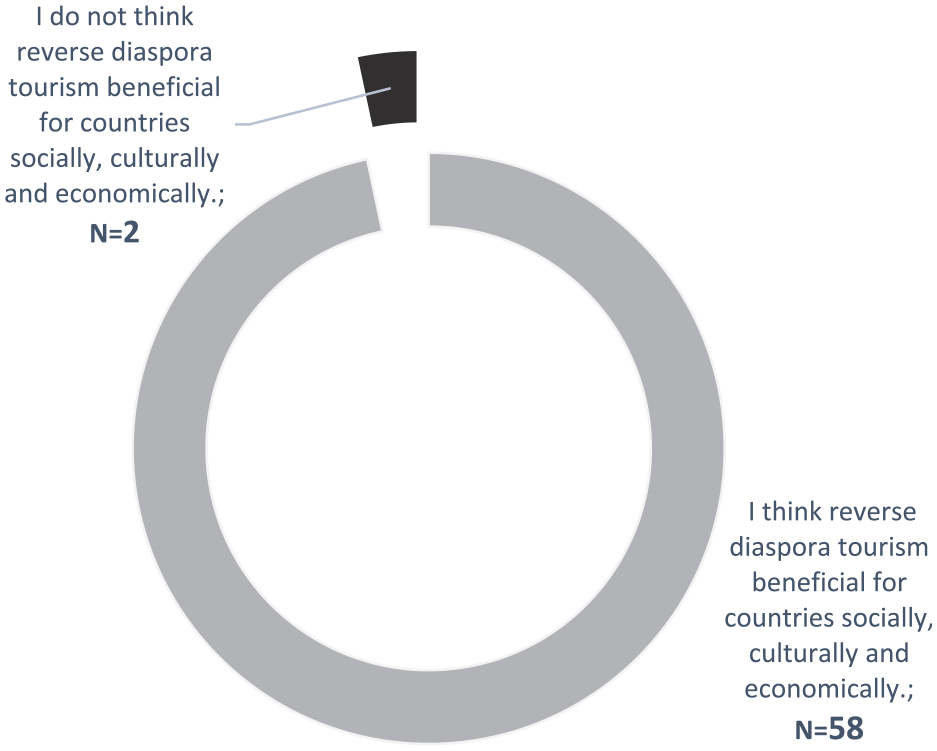
Participants’ views about reverse diaspora tourism.
Table 8 presents the findings on participants’ perceived barriers to diaspora and reverse diaspora tourism. Participants identified expensive plane tickets (
Participants’ Perceptions of Barriers to Diaspora and Reverse Diaspora Tourism.


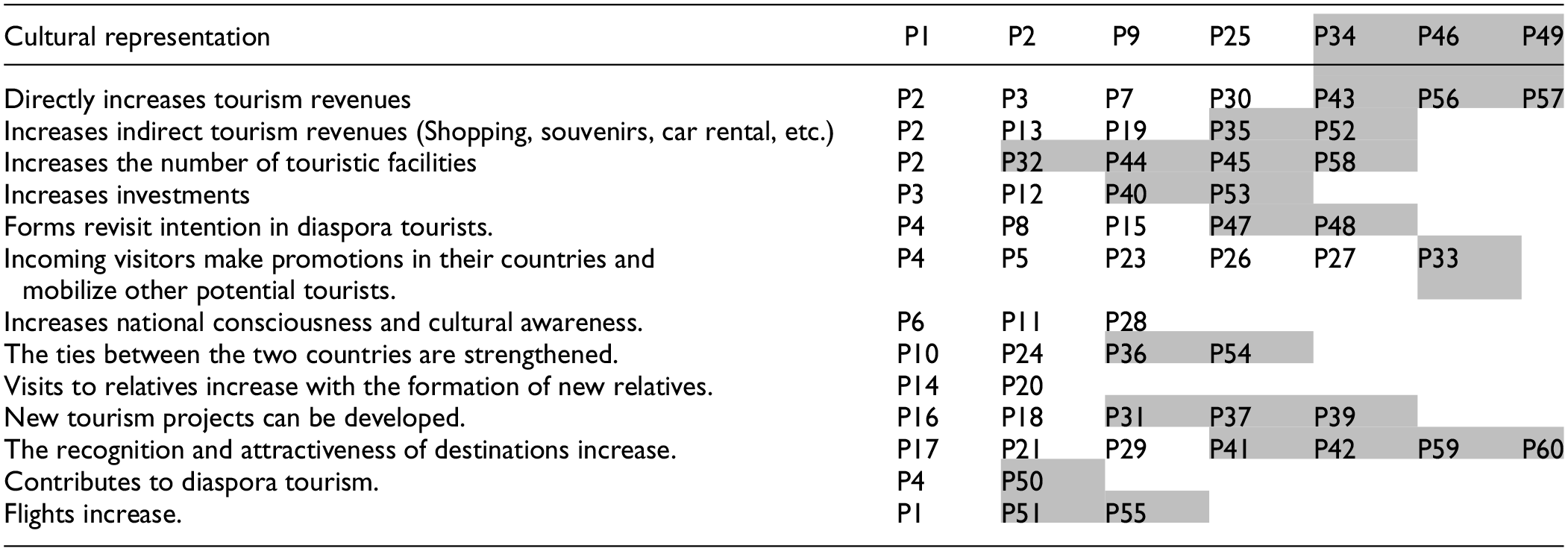
Table 9 illustrates the contribution of reverse diaspora mobility to tourism in Turkey and Kazakhstan. Participants stated that diaspora tourism increases the visibility and attractiveness of destinations (
Contribution of Reverse Diaspora Mobility to Turkey and Kazakhstan Tourism.

Overall, diaspora tourists spend an average of $933 per person per year, while reverse diaspora tourists spend $1049. These findings indicate that reverse diaspora tourism generates more revenue than diaspora tourism, particularly regarding accommodation, travel, food and beverage, and recreational activities. Diaspora tourists’ lower accommodation and food expenditures can be attributed to their access to free lodging and meals with family or friends. Conversely, reverse diaspora tourists spend more on leisure and activities, likely due to their desire to explore new cultures and places during their visits.
Figure 7 is a diagram visualizing reverse diaspora tourism’s social, economic and cultural contributions. There are four main categories in the figure: Social Contributions, representing the impact of reverse diaspora tourism in strengthening family ties and improving social relations; Economic Contributions, representing the contribution to the local economy through tourist spending; Barriers, representing the challenges facing reverse diaspora tourism, such as high transport costs, visa procedures and language barriers; and Cultural Contributions, representing the promotion of cultural heritage and the strengthening of cultural interactions. This figure summarizes the multidimensional nature of reverse diaspora tourism and its far-reaching impact on countries.

The contributions, effects, motivational factors, and barriers to participation in reverse diaspora tourism.
Conclusion, Implications, and Limitations
This study introduces reverse diaspora tourism to the literature for the first time, contributing a significant innovation to the existing body of research. This research primarily aims to compare diaspora and reverse diaspora tourism mobility in Kazakhstan and Turkey, examining travel patterns and tourism spending behaviors within these tourism types. Additionally, the study seeks to identify the motivating factors behind diaspora and reverse diaspora tourism mobility and the social, economic, and cultural contributions of these tourism activities. In this regard, reverse diaspora tourism provides a unique perspective to the literature, offering a foundation for a deeper understanding of the dynamics of this area.
Three main findings were obtained from the research. First, the study reveals significant differences in the travel behaviors of diaspora and reverse diaspora tourists. According to the research results, reverse diaspora tourism attracts more tourists than diaspora tourism. While diaspora tourism sees an average of 1–2 tourists visiting the host country annually, this number rises to 2–3 in reverse diaspora tourism. Another important economic factor is the number of overnight stays. On average, diaspora tourists spend 19.29 nights per visit, whereas reverse diaspora tourists spend 27.39 nights. These findings highlight the distinct advantages of reverse diaspora tourism over diaspora tourism in terms of both visitor numbers and length of stay. According to TÜİK data (2021), the average length of stay for foreign tourists visiting Turkey is 7.5 nights. The significantly more extended stays in diaspora tourism (19.29) and especially in reverse diaspora tourism (27.39) are noteworthy, positively impacting tourism revenues. These results indicate that reverse diaspora tourism represents a significant, previously underexplored area in the literature.
Second, the study found differences in the spending patterns of diaspora and reverse diaspora tourists. While diaspora tourists spend an average of $933 per person, reverse diaspora tourists spend $1,049. Reverse diaspora tourism offers higher revenue potential regarding accommodation, transportation, food and beverage, and leisure activities. The extensive family connections that diaspora tourists typically have in their homeland allow them to access free accommodation and meals, reducing their spending. In contrast, reverse diaspora tourists spend more on leisure activities and cultural exploration, which can be attributed to their desire to experience new cultures and places. Therefore, reverse diaspora tourism makes a significant economic contribution, with a higher potential for generating revenue in areas such as accommodation, transportation, food, and entertainment. This finding underscores the study’s originality and highlights the economic benefits of reverse diaspora tourism.
The finding that reverse diaspora tourism attracts more visitors and generates higher tourism revenue than diaspora tourism is particularly striking from an economic perspective. Reverse diaspora tourists typically stay longer when visiting their homeland and contribute more to tourism expenditures in areas such as travel, accommodation, food, and entertainment. Their extended stays provide greater economic benefits to the accommodation sector, while their overall spending substantially impacts local economies.
The greater involvement of these tourists in cultural and social activities, their tendency to explore different destinations and their higher expenditure on transport, food and local products are the main reasons why reverse diaspora tourism can generate higher revenues. In addition, reverse diaspora tourists are often motivated by a desire to reconnect with their cultural roots, leading to increased demand for a wider range of tourism services. This result boosts tourism revenues and contributes positively to local businesses. In summary, the higher economic returns from reverse diaspora tourism are directly related to a broader consumption of tourism services, longer stays, and higher spending patterns. These findings demonstrate that reverse diaspora tourism holds much greater economic potential than diaspora tourism and is essential in strengthening economic relations between countries.
Third, the motivating factors for reverse diaspora tourism include family visits, vacations, discovering historical and alternative destinations, business trips, maintaining family ties, and spending time together. Most participants believe reverse diaspora tourism is socially, culturally, and economically beneficial for countries. The primary contributions of reverse diaspora mobility include attracting tourists, promoting culture, increasing economic revenues, and encouraging potential tourists. High airfare prices are the most significant barrier to diaspora and reverse diaspora tourism. Other challenges include long visa processes, limited flight availability, economic constraints, language differences, and restricted baggage allowances. These findings highlight reverse diaspora tourism’s valuable social, cultural, and economic contributions and fill a gap in the literature. In conclusion, this study is unique in introducing reverse diaspora tourism to the literature, making a significant contribution toward a more comprehensive understanding of the dynamics of diaspora and reverse diaspora tourism.
Theoretical Implications
With 215 million members worldwide, diasporas represent a significant tourism market. Diaspora tourism has characteristics such as non-seasonality, employment opportunities and recognition of new tourist destinations. In addition, the mobility of diaspora tourism not only provides a sustainable flow of tourists but also contributes to the transfer of a sense of attachment to the homeland to future generations (Çıkı & Kızanlıklı, 2021; Huang et al., 2021).
Understanding the motivations for diaspora travel is essential for destinations. Many motives, such as nostalgia/longing for home, people and places, or searching/reinforcing cultural and social identities, lead to visits to the home. In the studies conducted, getting to know the ancestral land (Tanrısever, 2016), visiting friends and relatives (Iorio & Corsale, 2013), family ties, religion and origin, rest and discovery (Yüksel & Harman, 2019), family, religion and culture (Moufakkir, 2011), it was found that diasporas travel with many motives, such as seeking unforgettable experiences, gaining a sense of pride and learning, and seeking connection (Otoo et al., 2021b). On the other hand, Bollywood films were found to be influential in the Indian diaspora in Bandyopadhyay’s (2008) study and gastronomy and culinary culture in the Turkish diaspora in Çıkı and Kızılırmak’s (2021) study. There are many motivations for reverse diaspora tourism. Individuals engage in this phenomenon for various reasons, including leisure, business, historical and alternative exploration, family reconnection, and simply spending time together.
This study compares the Turkish and Kazakh diasporas regarding reverse diaspora travel time and expenditure. Understanding the tourism purpose travel patterns created by reverse diaspora mobility and the economic, cultural and social impacts of these trips will significantly benefit new tour packages, destination marketing and management. In order to strengthen the links between the Turkish and Kazakh diasporas in terms of the social, cultural and economic impact of reverse diaspora tourism, it would be beneficial to implement measures to preserve the historical and cultural heritage in both countries. Organizing festivals in both countries and preparing special packages for diaspora tourism would also be beneficial. Reverse diaspora tourism has the potential to attract a more significant number of participants and generate a greater number of overnight stays than diaspora tourism. In addition, those participating in reverse diaspora tourism tend to spend more money than those participating in diaspora tourism. Similarly, reverse diaspora mobility is essential in attracting tourists, promoting culture, increasing income and mobilizing potential tourists.
Practical Implications
Diaspora tourism promotes mutual understanding between countries, facilitates the recognition of Turkish history from different perspectives and enhances the attractiveness of tourist destinations. Reverse diaspora tourism strengthens cultural ties within the Turkish diaspora, enables the acquisition of different dialects of the Turkish language and facilitates a deeper understanding of ancient Turkish culture. It serves as a “cultural interaction between nations.”
The factors that motivate visitors to diaspora and reverse diaspora tourism are different. The most important factor motivating visitors to diaspora tourism is visiting relatives and friends. Other motivations include holidays, visiting historical places, seeing new places, business visits, fulfilling longings, maintaining family ties and spending time together. Those who participate in reverse diaspora activities with a holiday motive are generally members of the Kazakh diaspora. This result is because there are many destinations in Turkey based on coastal tourism, and the diversity of alternative tourism is high. Participants perceived the high cost of air travel as the main barrier to diaspora tourism and reverse diaspora tourism. Other participants complained about the need for more extended visa periods, the scarcity of flights, economic difficulties, dialect differences and limited baggage allowance on flights.
Reverse diaspora tourism increases the visibility and attractiveness of destinations, promotes culture and increases direct tourism receipts. Reverse diaspora tourism also attracts other potential tourists, increases indirect tourism revenues (shopping, souvenirs, car rental, etc.), creates the intention of diaspora tourists to return, enables the development of new tourism projects, and increases investment and national awareness. Therefore, reverse diaspora tourism contributes to countries socially, culturally and economically. In addition, reverse diaspora tourists have a high intention to return. Thus, reverse diaspora and diaspora tourism are essential markets that should not be ignored because of their benefits, such as 215 million members worldwide, sustainable tourism flows and recognition of destinations, preservation of cultural ties, long-term stays and high per capita spending.
For ministries of tourism and local governments, promoting reverse diaspora tourism can bring economic benefits to host and home countries. It can also facilitate the development of targeted tourism policies for this market. In addition, tourism companies and marketing professionals can develop tailor-made marketing strategies for diaspora and reverse diaspora tourists. These can be implemented through promotional campaigns tailored to these tourists’ interests and spending habits. Reverse diaspora tourism offers higher income potential regarding accommodation, travel, food, and leisure activities.
Consequently, investment in this area can strengthen local economies. Small and medium-sized enterprises can benefit from the spending of these tourists. The cultural and social benefits of reverse diaspora tourism can facilitate the development of stronger ties between countries. Through cultural diplomacy, stronger ties between individuals from different cultures can be encouraged, leading to increased international cooperation over time.
Limitations and Further Research
Although this study has valuable findings and contributes to the literature, it also has limitations. The research is limited to the diasporas of Turkey and Kazakhstan. Further studies can be conducted with a larger population and a different sample. Case studies can be conducted to develop effective tourism policies and management strategies to promote and optimize reverse diaspora tourism. These studies can compare tourism policies’ effectiveness in different countries and identify best practices. Long-term economic impact studies of reverse diaspora tourism can be undertaken. These studies can assess the multiplier effects of tourist spending on the local economy and its contribution to sustainable development.
Footnotes
Author’s Note
This research was conducted while Halil İbrahim Karakan was an Independent Researcher in Tourism. He is at Gaziantep University, Vocational School of Tourism and Hotel Management, and may be contacted at
Declaration of Conflicting Interests
The author(s) declared no potential conflicts of interest with respect to the research, authorship, and/or publication of this article.
Funding
The author(s) received no financial support for the research, authorship, and/or publication of this article.


Data Availability Statement
Data sharing not applicable to this article as no datasets were generated or analyzed during the current study.