







Abstract
Keywords
Introduction
The integration of AI in education (AIEd) into foreign language learning and teaching (FLLT) is attracting the attention of researchers worldwide. In FLLT, AI-based devices like chatbots/virtual chat agents, AI writing tools, and machine translation tools (Schmidt & Strasser, 2022) are currently used to promote personalized learning for language learners and provide support for language teachers. One remarkable debate about the future of AI and the role of teachers in the changing field of education is whether or not AI will replace human teachers in the future; some argue that AI is better equipped and can tirelessly assist both learners and educators alike without bias, while others believe that AI lacks emotional intelligence and empathy, which are crucial for the teaching profession (Chan & Tsi, 2023). These issues have become the subject matter for research in the field of FLLT, where researchers seek to determine the potential problems and risks associated with AI used in foreign language education, and to also inform the AI developers on how to better train these tools to be more beneficial, practical, supportive, and risk-free for learners and teachers. Furthermore, researchers seek a deeper understanding of AI and its potential uses to be able to provide sustainable education for all. The stakeholders and users, including language learners, teachers, parents, education specialists, and policymakers, should be aware of and follow the present and future advancements regarding the use of AI in the field of FLLT. This is because the integration of AIEd into FLLT boosts students’ motivation and enthusiasm for language acquisition and enriches classroom experiences by enhancing students’ performance and proficiency. It also empowers teachers to focus more on teaching, as opposed to other tasks that AI can more easily handle.
The incorporation of AIEd into FLLT has been proven to contribute positively to various aspects of students’ learning and reduce teachers’ workloads. Although a body of research on AI in FLLT exists in the related literature, most of the current studies focus on the use of AI in language learning and teaching (Alharbi, 2023; Gutiérrez, 2023; Park, 2019; Stošić & Malyuga, 2024; Z. Wang, 2022) and there is still a gap in the research concerning the relationship between AI and FLLT (Jiang, 2022; Law, 2024). Specifically, due to the current “Lingua Franca” designation of English, which means it is the most widely and frequently learned foreign language worldwide, the possibility of AI-assisted English as a foreign language (EFL) teaching and learning (AIaEFLtl) may soon face a paradigm shift. Two primary considerations are at the forefront of this issue: the future of AIaEFLtl driven by AIEd perspectives and the role of EFL teachers in that AI-assisted EFL world. The major aim of this study is to scrutinize these two notions through the lens of EFL teacher candidates as the 21st-century language teachers who will probably be the main interlocutors of future AIaEFLtl. However, there is a need for empirical studies on the pedagogical impacts of AI-assisted language learning tools, learners' interactivity with these tools, and the attitudes of teachers and learners towards AI (Pokrivcakova, 2019; H. Yang & Kyun, 2022). Additionally, the future of AIaEFLtl and EFL teachers has not been adequately examined in depth, especially regarding the future EFL teachers’ views and reflections concerning this topic so far. Within this framework, two guiding research questions (RQ) were formulated:
RQ1. What do the participants think about the risk that AI will replace human teachers in the future?
RQ2. What are the participants’ thoughts on the future impact of AI on EFL teaching and learning?
Literature Review
Key Highlights for Teaching and Learning From the AIEd Approach
Transformations in education, which started with digitalization around the turn of the millennium, have deepened as the 21st century progresses and have now accelerated with the launch of AI. AIEd is now widely recognized (Chen et al., 2022) and applied in educational practices and applications such as adaptive, customized, and personalized teaching and learning methods, intelligent tutoring systems, teaching robots, and virtual educational environments (Huang et al., 2021; Ouyang & Jiao, 2021; Tapalova & Zhiyenbayeva, 2022).
UNESCO (2024a, 2024b) has recently launched a new framework for AIEd, favoring a human-centered approach towards AIEd and recommends that teachers and students should be equipped with the knowledge, skills, and values in terms of the opportunities and limitations of AI through several competencies as shown in Table 1.
Competencies of AIEd (UNESCO, 2024a, p. 19, 2024b, p. 22).

The framework of AIEd presents an understanding of the future of learning and teaching. It includes a human-centered approach with the skilful, responsible, and ethical use of AI applications and techniques regarding problem-solving and creativity. For teachers, professional development focusing on AI pedagogy is likely to become a key part of future teaching practices. The potential of AIEd has also been emphasized by the World Economic Forum (2024) in their Education 4.0 framework report that was developed by a global coalition comprised of educational experts, practitioners, policy makers, and business leaders. According to the 2024 report, the incorporation of AI in education addresses four gaps: (1) helping teachers by taking over administrative tasks, (2) freeing up more time for engagement with students, (3) providing more personalized learning approaches, and (4) improving students’ academic performance. Considering its likely central position in the educational practices of the future (Tapalova & Zhiyenbayeva, 2022), the availability of AI enables educators to design their courses that meet their students' needs. Furthermore, it also results in the alternative teaching and learning methods for educators and students by raising their awareness of new technological solutions. AI can potentially decrease the digital divide for the future AI world, yet it is vital to instruct all on how to use it responsibly, ethically, and inclusively (Božić, 2023). Despite these advantages, there are challenging considerations related to AIEd, such as educators’ incompetence, student experience and inequity, ethical considerations, costs, and infrastructure (Kırtay, 2023). Examples of AIEd in language learning are evident when students use devices like chatbots, Duolingo, and Hellotalk, where pronunciation and vocabulary practice facilitates learning in listening and speaking skills, or ChatGPT and Google Assistant to improve their writing skills (Aini et al., 2024). Sumakul et al. (2022b) point out that AI could change how teachers teach and learners learn, which is also applicable to language classrooms, particularly EFL classrooms.
Framing AI in FLLT
In the context of FLLT, the significance of digital systems and tools is not new, as they have been utilized for many years already. As reminiscent of today’s ChatGPT, the ELIZA system was developed by MIT and programmed to facilitate natural language exchanges between humans and computers (Stošić & Malyuga, 2024). The Computer Assisted Language Learning (CALL) paradigm is the leading approach that has been widely recognized and used for decades, involving computer technologies to assist in the process of language learning. CALL refers to learning a language through computers or using computers (Egbert & Yang, 2004; Hashmi, 2016). In this respect, regarding CALL as a pioneer for AI in foreign language education or considering AI-assisted language learning as the future of CALL is a way of understanding the link between AI and foreign language education. However, Schmidt and Strasser (2022) point out that although internet-based programs, applications and CALL software have been amongst the most widely used technologies in foreign language learning and teaching for a long time, AI-inclusive technologies are still relatively limited. The applications and techniques from AI to CALL that are commonly referred to as Intelligent CALL–ICALL (Oxford, 1993; Schulze & Heift, 2012), operate on natural language processing (NLP), Machine Learning (ML), Deep Learning (DL), Machine Translation (MT), and intelligent tutoring systems (ITS) (Kannan & Munday, 2018; Schulze, 2008). Some popular applications that are considered to be first-generation programs with AI-based commercial software for language learning include Duolingo, Grammarly, Memrise, Rosetta Stone, etc. Generative AI tools based on machine learning patterns of the human-created content model can produce content, text, music, and videos, rather unlike the first-generation AI devices, which were mainly based on machine learning by algorithms through the training of past behavior (Law, 2024). Well-known generative AI-based tools include OpenAI’s ChatGPT-4, Google’s Gemini, Playground, DALL-E 3, and ELSA.
Recent AI-based practices in FLLT support personalized learning and teaching. AI-based tools are currently employed for foreign language components in various ways. AI-based learning and teaching applications are described in three perspectives: learner-facing, teacher-facing, and system-facing AI applications (Baker & Smith, 2019; Jiang, 2022; Pokrivcakova, 2019; Schmidt & Strasser, 2022). Learner and teacher-facing AI are the main focuses of foreign language learning, where learner-facing applications are related to personalized learning, chatbots, and ITSs to promote language learning, whereas AI-based, automated evaluation and grading systems are typically designed as teacher-supporting tools to decrease their workload and enhance teaching (Jiang, 2022). Some learner-facing and teacher-facing AI applications and implementations are AI-based writing and translation tools like Grammarly, AI-Writer, Essaybot, Sider AI, Google-translation, DeepL, Quillbot, and ChatGPT with enhanced feedback features in speaking practice. EFL teachers can also use AI-powered, automated grading tools like Grade Scanner and Gradescope to grade tests, assess multiple choice activities, as well as group and sort assignments to save time (Schmidt & Strasser, 2022).
Changing Roles of EFL Teachers
AI systems in FLLT have already reshaped language learner roles from passive receivers to active participants who are now responsible for their learning by offering more learner-centered, personalized language instruction, and learning environments. EFL teachers are now also transforming as a result of AI developments. As noted by Amin (2023), “EFL teachers are likely to transition from being primary content providers to becoming facilitators of language learning” (p. 10). In a period when AI tools for FLLT are booming, EFL teachers should use these tools effectively to empower their teaching while relieving some of the burdens of their workload. Yet, there are some crucial factors to consider about the challenges and the reliability of AI in EFL teaching and learning. According to a study by Edmett et al. (2023), AI-related challenges in EFL contexts are explained as: technological breakdowns of AI (like incorrect answers, limited capabilities, fear of privacy and security), fear of the unknown (how AI is operating), fear of losing language learning environments, and the standardization of language and ideologies (such as recognizing some historical and political language barriers over others). Galaczi (2023) also adds other risks of AI, like bias, copyright infringement, inaccurate content, and cheating. EFL teachers’ attitudes towards the application of AI in teaching also matter since “whether and how a teacher believes that a specific technology like AI can be used effectively to support students learning is truly dependent on the initial attitudes and opinions of a teacher towards it” (Sütçü & Sütçü, 2023, p. 185). EFL teachers’ attitudes concerning the application of AI vary from positive to negative, as well as from reluctance and lower acceptance. Jiang (2022) points out that relieving negative emotions and promoting acceptance of AI’s pedagogical potential are crucial. It is “because to use modern technologies willingly and effectively, teachers need to believe that technology can help them achieve educational objectives more effectively (in shorter time and with less effort)” (Pokrivcakova, 2019, p. 146). Law (2024) claims that since generative AI is here to stay, educators should consider incorporating it into teaching practices effectively and equip themselves with the necessary knowledge and skills on AI to make informed, pedagogical decisions.
AI Taking Over Language Teachers’ Jobs: Fact or Myth?
The well-known, dystopic discussion of “robots replacing humans” was reignited during the COVID-19 pandemic when AI-based automation systems were actively used instead of human power in fields like healthcare, manufacturing, and banking. Are educators next in line for a robot takeover? Houser (2018) posed this question involving the field of education due to the rapid advancement of AI tools that can reshape language education and training. Issues around AI in FLLT seem to have a long way to go in situations that will challenge scholars to see the bigger picture. Besides transparency, privacy, bias issues limitations and insufficiency in delivering appropriate language teaching, the replacement of human language teachers with AI is a currently debated topic that has vast implications for the future of FLLT. The major reason for this concern is that language education is one of the fields in which AI-based tools are intensively utilized and have the potential to progress beyond the present standards rapidly. The debate stems from arguments about whether AI-powered applications like Duolingo can replace language instruction in schools and universities (Handley, 2024). The prominent view is that AI will not entirely replace language teachers, but will instead change language learning and teaching practices. This point of view is based on the Human-Centered Artificial Intelligence (HCAI) system. Shneiderman (2022) states that “HCAI systems are designed to be supertools which amplify, augment, empower, and enhance human performance. They emphasize human control, while embedding high levels of automation by way of AI and machine learning” (p. 9). From an educational perspective, referring to the nature behind the functioning of AIEd systems which require collaboration with teachers and educational stakeholders, Schiff (2021) underscores that AIEd is an instrument to enhance teaching practices, which is called “AIEd-supported instruction” (p. 341).
Pointing out the difference between technology and learning technology, S. J. Yang et al. (2021) claim that learning technology has no other option than being human-centered as it entails instructional practices and interaction. Moreover, going through human learning experiences, discerning the patterns of mental processes while learning, interpersonal skills, mastery in the subject field, mimics and body language, as well as improvisation, are among the qualities that make teachers inimitable through technology (Selwyn, 2019). In this respect, Galaczi (2023) points out that “[t]eaching is still very human centered, and AI can’t replace the social and emotional aspect of learning, but it can really enhance the experience. Teachers will continue to play a very crucial role but teaching practices will change” (para. 5). When it comes to teachers’ own voices, in a study carried out by scholars (Edmett et al., 2023) with 1,112 respondents (English teachers) around the world, the statement “I worry about the impact of AI will have on my role as an English teacher” received a balanced amount of agreement (38%) and disagreement (%36). However, common views including the belief that “All our kids (pupils) love us in a way they could never love working with AI only,” reveal a strong connection between students and teachers (Edmett et al., 2023, p. 35). It is clear that AI will not replace human language teachers, but it can assist them to enhance and facilitate language learning in the future.
The Present Study
Research Design
This study adopted a descriptive qualitative research design, which is “best suited to address a research problem in which you do not know the variables and need to explore. The literature might yield little information about the phenomenon of study, and you need to learn more from participants through exploration” (Creswell & Guetterman, 2019, p. 16).
Participants and Context
This study was conducted in the context of the English language teaching (ELT) departments of higher education institutions in Türkiye. Various educational institutions in Türkiye are attempting to integrate AI into education and designing manuals for multiple stakeholders on AIEd. For the integration of AI into higher education processes, the Council of Higher Education (2024) in Türkiye published an ethical guide on using AI in scientific research and publication activities, as well as determined ethical values and rules to protect scientific honesty and trust in science. Moreover, other educational institutions in Türkiye embrace the concept of AIED. For instance, highlighting the emergence of a new era in education with AI, the Ministry of National Education (MoNE, 2024) designed and published a Teacher’s Manual in 2024 to “inspire and inform teachers by addressing the potential and utilization of AI in education with wide perspective” (p. 5). In addition, the MoNE has taken policy steps to integrate AI into education, transforming the MoNE’s data systems through AI algorithms, the protocol of AI in Education with the Istanbul Technical University, and AI strategies for 2020 to 2040 (Savaş, 2021). In Türkiye, AIEd is currently regarded as the policy which will prepare educational contexts and stakeholders for the AI world of the future.
As participation in the survey was voluntary, 67 prospective EFL teachers from four state universities in Türkiye who attended practicum as a part of their program were “conveniently (opportunistically) available with regard to access, location, time and willingness” (Lopez & Whitehead, 2013, p. 124). As the study focuses more on in-depth insights on decision making in ELT pedagogy with AI, senior students were well positioned to offer valuable perspectives. Thus, the convenience sampling method was adopted. Additionally, participants who studied a total of 4 years in an ELT department, with face-to-face program for 1.5 years and online for 2.5 years due to the COVID-19 pandemic and the disastrous earthquakes that struck Türkiye. As participation in the survey was voluntary, the convenience sampling method was adopted. To enrich the data, researchers enlisted the help of colleagues from other state universities. In total, 41 females (61%) and 26 males (39%), whose ages ranged from 18 to 33, with only two participants above 34 years of age, took part in the study. Sixty-seven percent of the participants reported themselves as being AI tool users, with ChatGPT, Grammarly, Gemini, Bing AI, Dall-E, Duolingo, and editing AI bots being among their most preferred AI tools.
After the analysis of the survey, an in-depth interview was conducted with three prospective EFL teachers to delve deeply into the participants’ understanding of AIaEFLtl. A purposeful sampling strategy with extreme cases from whose responses the most nodes were generated was used for participant selection “to maximise the depth and richness of the data to address the research question” (DiCicco-Bloom & Crabtree, 2006, p. 317). It was because “[t]he logic and power of purposeful sampling derive from the emphasis on in-depth understanding. This leads to
Data Collection
The required data for this study were collected first via an online survey and then an online, in-depth interview for the validation of the model presented in the survey’s findings. The online survey formulated via Google Forms consisted of three sections, written consent for participation, demographic features, and survey questions (see Appendix 1). The consent of all participants was obtained before answering the online survey. In the survey section, questions 1a and 1b were related to RQ1, while questions 2a and 2b were asked for RQ2. For piloting, the questions were shared with three non-participant, pre-service EFL teachers to evaluate the clarity and appropriateness of the online survey. The participants provided feedback on the wording and comprehensibility of the survey questions. For open-ended questions, the participants recommended adding yes/no options to answer the questions quickly and efficiently. They stated no further problems. The survey form was delivered to the participants via social media and administered in a classroom environment. The participants had the option of responding either in Turkish or in English. The data collection procedure took place in April 2024. The sample size was determined based on the conceptual depth and data quality, with the complex and multi-faceted nature of the study, the focus of the research questions, the depth of the data for each research question, and the main objective of the reflexive thematic analysis (Braun & Clarke, 2021). After analyzing the participants’ responses to the survey, for data triangulation, an online, in-depth, semi-structured interview was carried out, where the focus was solely on extending AIaEFLtl to validate and clarify this model and its labels (see Appendix 2). Each interview session took approximately10 to 15 min.
Data Analysis
For the analysis of the participants’ responses to the survey, the software NVivo 11 Plus was utilized to generate themes and nodes with the reflexive thematic analysis (TA) due to the flexibility it offers for the researcher who “needs to be active, engaged and thoughtful about the approach they take” (Braun & Clarke, 2022, p. 9). The present study was: (1) inductive due to data-driven codes, nodes, and theme development, (2) semantic due to investigating the more surface and explicit meaning in the participants’ expressions, (3) experiential to capture and explore the participants’ own perspectives and understanding, and (4) realist, which is essential to preserve the reality within the data set (Braun & Clarke, 2022). Despite the potential of subjectivity in TA, in the present study the reflexive TA followed the nonlinear six phases proposed by Braun and Clarke (2022), as seen in Figure 1, in order to enhance transparency in data analysis (Braun & Clarke, 2019).
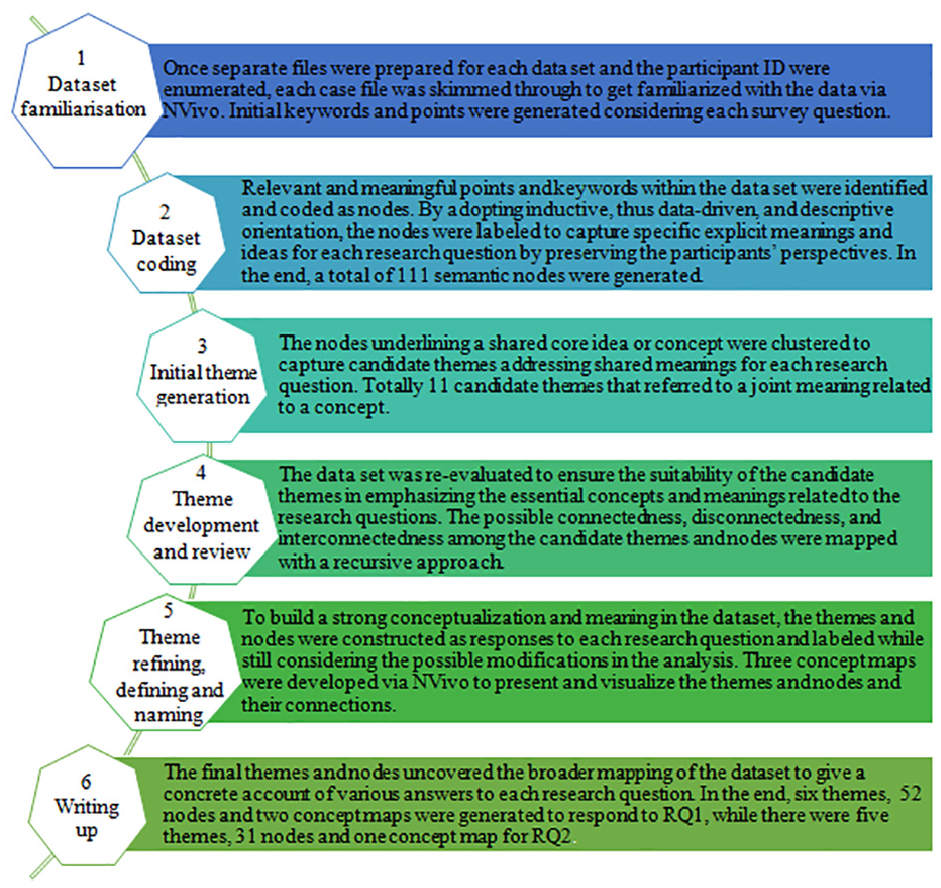
Six phases of the reflexive TA.
Throughout the reflexive TA, three researchers worked collaboratively to generate and label the themes and nodes in the concept maps, which also served for investigator triangulation. The inter-coder reliability was calculated at 97%, which shows a strong consensus among the three researchers. For a comprehensive review of all findings, the labels of all 11 themes for both RQs were outlined (see Appendix 3).
Once each of the interviewees’ reflections on the generated model, AIaEFLtl and its 11 labels were gathered via the interview, the researchers listened to the interview tapes together and transcribed them. For the analysis of the in-depth interview, the appropriateness of the model for EFL settings and key quotations in each interviewee’s reflections were noted and then related to the survey findings to validate and triangulate them.
Findings
The findings conceptually mapped through themes and nodes were presented under three main headings.
AI Versus Human Teachers in the Future
About AI replacing human teachers in the future for RQ1, 72% of the participants dismissed the possibility, whereas 28% responded on the contrary, as presented in Figure 2.
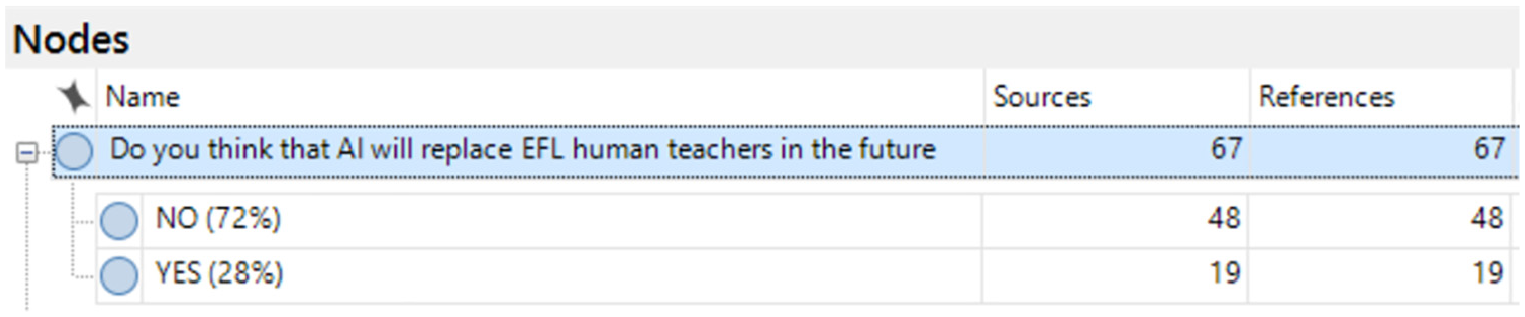
The frequency and percentage of the participants’ responses regarding RQ1.
All participants’ responses for RQ1 were presented in 2 concept maps with 6 main themes and 52 nodes. The participants, who believed that AI would replace EFL human teachers in the future, gave reasons for this risk, and they were grouped under 2 main themes (

Concept map regarding envisions of the participants who said “YES.”
Figure 3 shows that for
Figure 3 displays other strengths of AI over human teachers expressed through the following nodes:
Additionally, some participants observe that AI
Those nodes related to the strong potential of AI to alter educational structures and also provided various reasons for AI replacing human teachers in the future. While participants mostly saw the cost-effectiveness of AI as a benefit, one participant criticized this trait of AI due to its role within the ideology of Capitalism. AI as an alternative subject to enable wide modification in various fields also
In addition to the participants responding positively, some did not think AI would replace human teachers in the future. The meaning and content of the arguments were presented through 4 themes and 37 nodes in Figure 4.

Concept map regarding envisions of the participants who said “NO.”
Figure 4 shows that
Thus, some participants believe that AI is insufficient for engaging with learners and support the idea that teaching
Some participants also think that AI might not provide a sufficiently varied environment for students to enhance the real communication skills required for the nature of teaching, which
The
Additionally, for some, the teacher
Additionally, another feature is that human
In addition to the lack of emotions, the other weakness of AI when it is compared to human nature is that human
The other node that is categorized under the theme
Even with their disbelief in AI replacing human teachers, the participants did not disregard the potential for human beings in regards to the purposeful use of AI, which was a human production. Thus, for the participants, human
In Figure 4,
In addition to those weaknesses of AI stated above, the participants expressed the insufficiency of AI within the following nodes:
Though AI has some potential to achieve various capabilities, it also has some deficiencies in
Moreover, the participants claim that AI is incapable of
In the educational context, participants also claim that AI
The Effects of AI on EFL Learning and Teaching in the Future
For RQ2, the participants’ responses showed that nearly all agreed that AI would influence EFL learning and teaching in the future as shown in Figure 5.

The frequency and percentage of the participants’ responses regarding RQ2.
In Figure 6, the findings regarding the prospective EFL teachers’ perspectives on the effects of AI on EFL learning and teaching in the future were categorized under 5 main themes and 31 nodes.
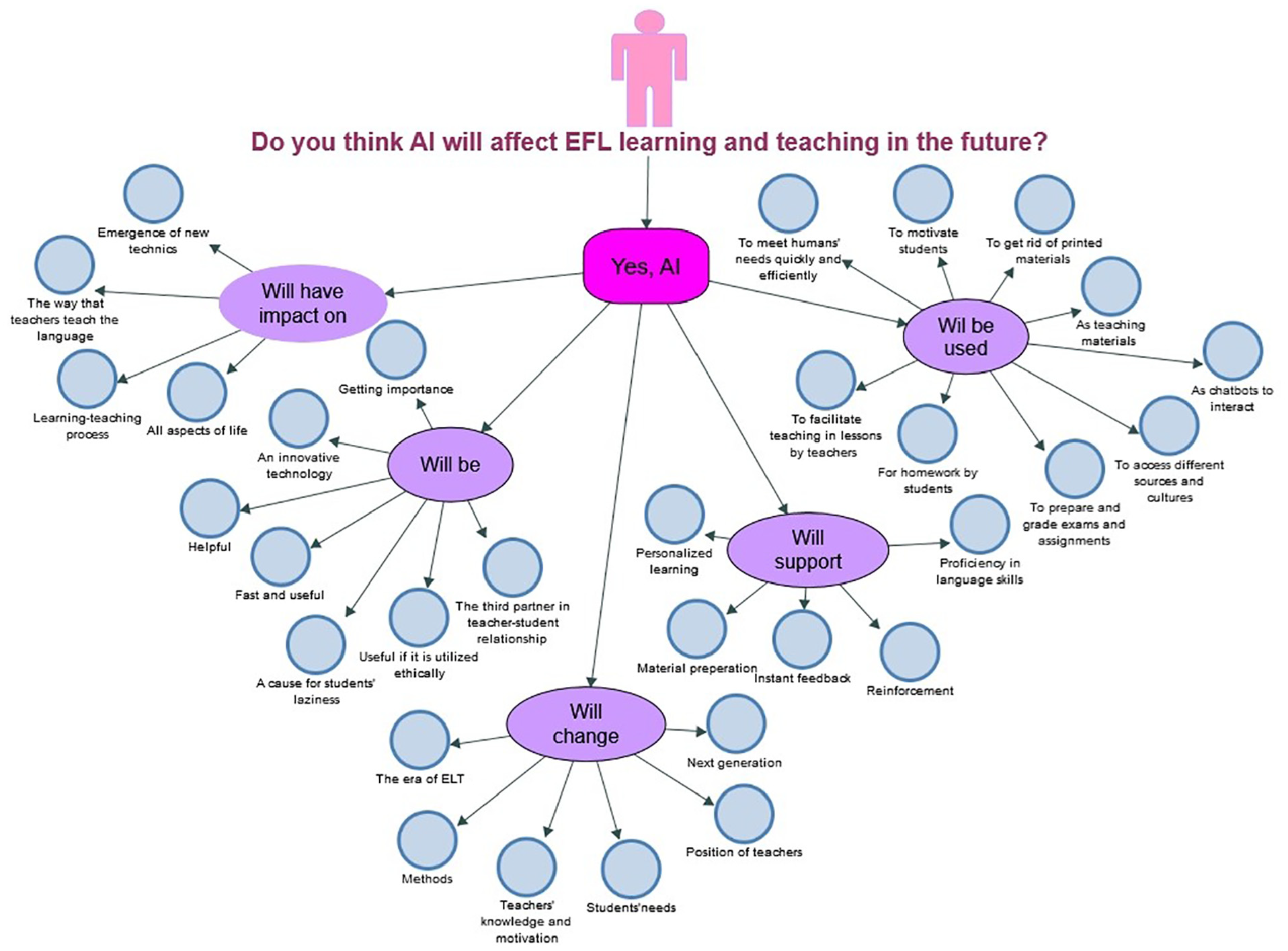
Concept map regarding envisions of the participants (YES) on the effects of AI on EFL learning and teaching in the future.
Figure 6 demonstrates that the first theme describing the various effects of AI is
Considering both the current and future roles of AI, some prospective EFL teachers added responses regarding the efficient use of AI in
Additionally, some others also expressed the positive and wide impact of AI on the l
The second theme,
Moreover, some stated that AI might lead to “
Additional role of AI was stated to be
Figure 6 demonstrates that
Some participants believed that integrating AI into ELT in the future would be associated with
Some participants asserted that those changes would alter the
The fourth theme,
The last node was
The last theme in Figure 6 was
Moreover,
Regarding assessment and evaluation, participants stated that AI would be utilized
The last node under the theme,
An Outline on Envisioning the Future of AI in EFL Teaching and Learning
Based on all 11 themes generated through reflexive TA for both RQs, Figure 7 outlines their labels (see Appendix 2) to summarize the findings:

Envisioning the future of AI in EFL teaching and learning.
The labels in Figure 7 generally do not display the vision regarding EFL learning and teaching only under excessive human control, nor solely under AI control, but with the collaboration of both. First, the findings of RQ1 AI’s wide impacts and strengths might be the sources of the risks AI holds for the presence of human teachers, which refers to a high level of AI control. Yet, the nature of teaching, the expected roles and features of teachers and AI’s weaknesses when it is compared to human teachers are some pedagogical aspects underscoring human presence as an indispensable factor and imply a high level of human control. The causes for high human control are also associated with the nature of human beings, which are different from AI and robots, and AI’s weaknesses when it is compared to human teachers. Thus, the labels for RQ 2 specifically suggest various effects, roles, utilizations of AI, AI-driven aspects, and modifications in futuristic EFL learning and teaching. All these labels denote human-centered AI in the future, a concept that we call AIaEFLtl. To validate AIaEFLtl and triangulate the findings of the survey stated above, an in-depth interview was conducted, and its findings were presented in Figure 8:

Reflections of the interviewees on AIaEFLtl.
As revealed in Figure 8, three interviewees thought that AIaEFLtl would be appropriate for future EFL settings, and those future EFL settings should embrace change by utilizing AI with teacher-AI collaboration. Thus, for the future EFL teachers should collaborate with AI in EFL settings to amplify their ability to support students’ learning. This suggests that effective teacher-AI interactions and collaborations should empower teachers and students, rather than replace teachers in EFL settings. Therefore, as the interviewees expressed, the ones who should control what will happen in EFL settings must be EFL teachers who are efficient users of AI in a collaborative manner. Considering the interviewees’ expressions, the findings of the interviews, which are consistent with the survey findings, verified and strengthened the validation of the AIaEFLtl model.
Discussion
This study aimed to scrutinize the impact of AI on the role of teachers and teaching and learning in future EFL settings from the perspective of 67 prospective EFL teachers. All findings of this study were presented through11 themes with 83 nodes, primarily providing evidence and visions for innovative EFL education, with AIaEFLtl as a key bridge for pedagogy and AI fit. The findings also address the gaps in the related literature, identified by Alshumaimeri and Alshememry (2024) on the reasons for conjoining AI tools into instructional practices and teachers’ perceptions on AI. For future EFL settings, which should embrace change with AI and teacher collaboration, future EFL teachers can utilize AI to enhance their ability to support students’ learning. Effective teacher-AI interaction should empower teachers and students and support their well-being. In line with the study findings, UNESCO (2024b) pointed out that “[i]n education, AI has transformed the traditional teacher-student relationship into a teacher–AI–student dynamic” (p. 4).
Based on AIEd’s endorsement that “teachers are at the epicentre of any learning environment” (Chaudhry & Kazim, 2022, p. 158), the results of the reflective TA for RQ1 addressed 52 nodes through 6 main themes. The findings revealed that most of the participants stated a low risk for AI replacing human teachers, due to the nature of teaching, the expected roles and features of teachers in the EFL context, characteristics of humans, AI’s weaknesses (despite the wide impact of
The future of EFL with AI was also examined through RQ2 by prospective EFL teachers to see their pedagogical understanding of their future jobs with 31 nodes under five main themes. According to study results,
Parallel to the concern that “[i]ncorporation of AI in language learning is prone to the mechanization of the learning experience and reduces human interaction” (Alghamdy, 2023, p. 94). The participants praise the importance of face-to-face human interaction and communication in language teaching as they were witnesses of obligatory, online education during the pandemic. Teacher trainers must get 21st-century teacher candidates prepared for and adapted to prominent alterations in their professions in the upcoming decades. Schmidt and Strasser (2022) fictionalize a language class of the 2040s as being fully equipped with AI-based, digital-learning supporting systems providing resources and tools for learners and teachers that combine digital learning, non-computer based methods, content, and tasks for in class teaching. In these times, they highlight the need for teachers who are well-trained, data-literate and competent, critical, and reflective in their use of technology. In agreement with the AIEd approach, in EFL classes, teachers should support innovative teaching methods and lifelong learning opportunities for their professional development (UNESCO, 2024b). While conducting the required pedagogical adaptations to harness AI’s potential (Eslit, 2023), AI can assist students’ learning, interaction, creativity and performance.
Additionally, the participants claim that
Conclusion and Recommendations
In the 21st century, future EFL teachers must be equipped with the knowledge and readiness to integrate AI tools into their teaching practices. This integration can enhance students’ learning experiences and facilitate teaching by promoting human-centered qualities, such as self-efficacy, creativity, and responsibility (Shneiderman, 2020). A significant challenge in this domain is the lack of preparedness among many pre-service teachers to adopt and effectively utilize new technologies (Savaş, 2021). This study contributes to understanding how language teacher candidates perceive AI’s current and future role in EFL teaching and learning. Despite Gen-Z participants’ digital-native status, they require targeted AI competencies to effectively teach future AI-native students and bridge the digital divide. The findings align with global teacher competency frameworks, emphasizing the importance of ethical, technical, pedagogical, and human-centered knowledge. Participants demonstrated awareness of these competencies and the need for AI integration in EFL contexts. Participants did not perceive AI as a threat to their future employment, but rather as a supportive, educational tool. This perspective aligns with the notion that the use of AI would not terminate educational practices, but a means to improve educational outcomes. The findings highlight the potential for collaboration between AI and EFL teachers, emphasizing the importance of fostering human-AI partnerships. Based on the findings, some implications can be stated for policymakers, educators, and AI developers. Policymakers can define the principles on the utilization of AI tools in educational settings and provide professional development opportunities for teachers on how to use these tools in an ethical manner in EFL classrooms. Educators can find ways to use AI as a third partner to enhance the quality of the EFL context. Lastly, when designing AI-assisted learning environments in a transparent and ethical manner, AI developers can adopt a perspective in which AI is an assistant of EFL teachers, and can provide constant support for teachers as product users. They can also focus specifically on designing AI-assisted language education systems.
The study has two main limitations. First, the findings are limited to the views and expectations of prospective EFL teachers on AI pedagogy, and the study does not focus on their experiences with AI tools as users. Second, the results of the study cannot be generalized due to the qualitative nature of the study. Future research could explore the perspectives of EFL teacher trainers on AI-assisted language teaching to understand evolving pedagogical practices better. The scope of the research methodology can be enhanced quantitatively in further research.
This study proposes the concept of AI-assisted EFL teaching and learning (AIaEFLtl), offering insights into how AI can complement teaching by providing personalized learning experiences, real-time feedback, material preparation, and skill reinforcement. AIaEFLtl envisions a future where AI tools respect the indispensable role of human teachers while supporting new roles and methods. It highlights the importance of designing human-centered AI systems that foster collaboration between pedagogy and technology. Educators can enhance students’ learning, creativity, and performance by adapting teaching methodologies to harness AI’s potential. AI is poised to act as a collaborative third partner in the teacher-student relationship, transforming teaching and learning dynamics in EFL classrooms. This partnership will usher in a new era of AI-assisted methods and techniques, prioritizing human-centered design and pedagogical collaboration.
Footnotes
ORCID iDs
