







Abstract
Keywords
Introduction
Climate change is one of the topical issues on the agenda whenever global leaders meet to talk about factors hampering development. It has been categorized as a global megatrend, responsible for radical societal changes in agricultural practices (Haysom & Paginini, 2023; OXFAM, 2020). According to Grossman (2018), Nyikahadzoi and Mhlanga (2021), what was once thought to be a problem for the far future is now a reality. Climate change related disasters have escalated globally, posing a serious threat to life and livelihoods (Mugambiwa, 2018; Tirivangasi, 2018). Williamson et al. (2021) espoused that in 2020 alone, 2.37 billion people were affected by malnutrition, and 30 million deaths were caused by food insecurity induced by climate change. Approximately 50% losses were recorded in crop yields globally (Williamson et al., 2021). Predictions indicate that by the year 2030, more than 100 million Africans will be vulnerable to droughts, floods and extreme heat (United Nations, 2022). Enhancing climate change adaptation through policy interventions can help to achieve household food security.
Climate change has become a global responsibility (Brazier, 2018). The global agreements on climate change such as; the United Nations Framework on Climate Change Convention (UNFCCC), the Kyoto Protocol, the Paris Agreement and Conference of Parties (COP) Agreements among others, attest to that effect. According to The Global Centre for Adaptation (2022), Africa has set in motion a resilient transformation toward climate change known as Africa Adaptation Acceleration Program (AAAP). The AAAP presented Africa with an opportunity to deliver its flagship from food insecurity through adaptation. However, Africa is the most vulnerable continent to climate change when compared to other regions (African Development Bank [AfDB], 2024). The continent has US$41 billion deficit to climate change adaptation, a global problem to which Africa contributes insignificantly (AfDB, 2022). IPCC (2018) attests to the fact that Africa’s contribution to climate change is a meager 3% of global emissions but is the one suffering the most. Tooze (2019), Alexander (2019), Saliya and Wickrama (2021) strongly assert that the financial systems in most developing nations are highly vulnerable to climate change and need to be arguably strengthened.
International global climate change agreements in which Zimbabwe is a signatory gave birth to the National Climate Change Response Strategy in 2014, National Climate Change Policy in 2017 and Food Systems Transformation Strategy from 2020 to 2025 (Chanza, 2018; Nyikahadzoi & Mhlanga, 2021). These blue prints ensure that the nation engages with good knowledge, signs and information as well as reliable data on adaptation, mitigation and resilience. Irregular rainfall patterns, shifts in traditional growing seasons and reduced water availability, are some of the changes within which communities should adapt to Chanza et al. (2019) and Dhliwayo et al. (2022). Climate change records demonstrate that Zimbabwe is experiencing an incessant threat to livelihoods by making food insecurity worse every day. These noted climate variations have affected both urban and rural populace. The former’s practice of urban agriculture was negatively affected by erratic rain fed agricultural practice whilst the latter has seen the proliferation of spatial pockets of poverty across semi-arid and or communal regions of Zimbabwe (Swinkels et al., 2019; Tirivangasi et al., 2023).
Bhatasara (2017) and The Green Climate Fund (2019) argue that in Zimbabwe, vulnerability to climate change is regionally differentiated into agro-ecological regions from I to V, following a combination of factors such as soil type, rainfall patterns, temperature, average rainfall and vegetation type. The regions progressively deteriorated as they go up from region I to V. Region V is the most arid, driest and unable to sustain rain fed agriculture without any innovations whereas, region I is the most prime agro-ecological region (Bhatasara, 2017; Nyikahadzoi & Mhlanga, 2021). Brazier (2018) espoused that 90% of Mwenezi district is in region V. The agro-ecological zones are volatile to climate change making food insecurity worse due to increased aridification (Manatsa et al., 2020). Nyikahadzoi and Mhlanga (2021) argued that climate change obliterates the sizes of farming regions, prime agriculture ecological regions II and III decreased by 49% and 13% whereas regions I, IV and V increased by 10.6%, 5.6% and 22.5% respectively.
The precarious impacts of climate change are excessive in the rural communities where rain fed agriculture is a key factor (Nyahunda & Tirivangasi, 2020). Figure 1 shows longest dry spells which were experienced in Zimbabwe during the 2023/24 farming season and the magnitude of households negatively affected in terms of food security. The 2023/24 farming season in Zimbabwe recorded the longest dry spell resulting in chronic food insecurity in the majority of districts by more than 50% as shown in Figure 1. The longest dry spells recorded were between 76 and 90 days, having severe consequences on food security. The highest food insecure district in 2024, Buhera recorded 84% household food insecure status (Zimbabwe Livelihoods Assessment Committee [ZimLAC], 2024). Increased aridification and variability put household food security in the semi-arid regions of Zimbabwe at a critical position for several years to come. Aligning agricultural activities through climate adaptation and change in policies to the ever-changing climate becomes a priority (Chitongo et al., 2019; Mavhura et al., 2017).
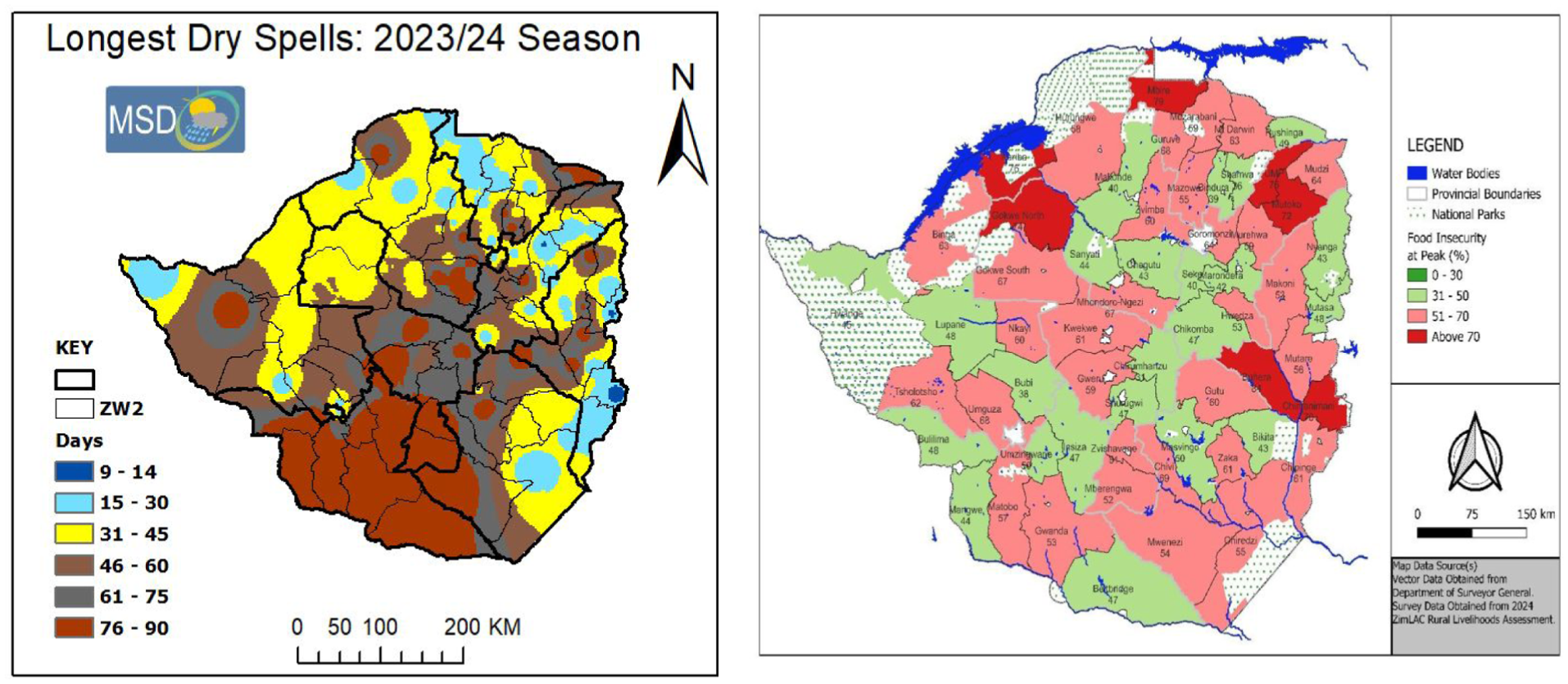
The longest dry spell versus projected food insecurity in Zimbabwe during the 2023/24 farming season.
Hunger and malnutrition have notoriously camped in Mwenezi district despite various adaptation mechanisms by the inhabitants. The benefits of climate change adaptation in Mwenezi district are isolated as evidenced by statistics. The Green Climate Fund (2019) have persistently classified Mwenezi district in the emergency category, implying that its people are persistently food insecure. ZimLAC (2024) indicates that 54% of households in Mwenezi district were food insecure in the year 2024. World Food Program Secretary General David Beasley said, “
The study is guided by three research objectives namely: identifying threats to climate adaptation on household food security among small-scale farmers in Mwenezi district, examining climate adaptation policies related to household food security in Zimbabwe and developing geographic-specific interventions to enhance household food security in Mwenezi district.
Climate Adaptation Challenges Faced by Small-Scale Farmers in Africa’s Semi-Arid Regions
The African region has been affected worst by climate variation (World Meteorological Organization [WMO], 2023). In as much as there are several initiatives that have been introduced to promote climate resilience Mugari et al. (2020), Zagre et al. (2024) posit that a number of challenges have also been noted. Gender inequality in Ghana’s semi-arid regions of Jirapa, Lawra and Nandom, has seen women left worse off (Adzawla et al., 2019). As a result of colonial policies, these semi-arid regions are underdeveloped, with decision making processes centralized to men, emanating from deep trenched patriarchal communities (Ahmed et al., 2016). Women spend more time in agricultural activities, yet categorically described as living in absolute poverty (Food and Agriculture Organization FAO, 2015; Mensah & Fosu-Mensah, 2020). Women barely have land rights in Ghana, and when they do, they specialize mostly with rice cultivation. Where there has been reported cases of bumper harvests, men either cultivate the land themselves or sell the land (Ahmed et al., 2016). Gender inequality as a challenge emanating from climate adaptation has not only affected women in Ghana, but also women in other parts of Africa (Adeola et al., 2024).
Financing climate adaptation initiatives in semi-arid regions of Africa also poses a significant threat to many small-scale farmers (Gannon et al., 2018; Mugari et al., 2020). This has been exacerbated by the fact that land tenure is not clearly spelled, especially on communal land in Africa (Chitonge & Harvey, 2021). Most small-scale farmers in Africa, rely on rain fed agriculture, even though there is evidence of seasonal changes. They are being compelled by climate change to adjust from conventional to modern smart agricultural practices and methods. Climate proof agriculture requires investments in infrastructure and technology that is in most instances, beyond the reach of many (Byanyima & Kalibata, 2019). Implementation of climate adaptation initiatives have been hindered significantly by inadequate financial resources with counties like South Africa, Ghana and Cameroon being typical examples (Sibiya et al., 2023). Local financial institutions are reluctant to lend small-scale farmers for them to make on-farm investments against climate change because of unclear land tenure (Nchu et al., 2019).
The lack of climate information relating to climate variables namely precipitation, temperature, extreme weather events, rates of evaporation, absorption of nutrients, is a challenge in climate adaptation initiatives (Popoola et al., 2020). Lack of comprehensive data on the above factors, result in the dearth of climate change adaptation information, which has become a menace in most semi-arid regions of Africa. Poor agricultural extension services and lack of context specific adaptation mechanisms are some of the contributing factors of dearth in climate change adaptation information (W. L. Filho et al., 2023; Qwabe et al., 2022). “
The biggest challenge to climate adaptation efforts in semi-arid Zimbabwe is scarcity of water resources coupled with high temperatures. Droughts, cyclones, heat waves and other extreme weather events present unique challenges. Mavhura et al. (2017) postulate that droughts in the low veld (semi-arid regions) of Zimbabwe have increased in frequency from decade to decade, to shorter intervals with the most severe droughts in recent times recorded in 1991 to 1992, 1994 to 1995, 2002 to 2003, 2015 to 2016 and 2018 to 2019. Heat waves make food less nutritious, cereals lost 10% zinc, 5% iron and 8% protein in heat stress environment (WFP, 2021). The situation is made worse by cyclones which are also prevalent in these areas. Defe et al. (2024) noted that they are usually unproductive, leave a trail of destruction on crops, animals and infrastructure. Figure 2 clearly portrays a situation that has seen Zimbabwean temperatures fluctuating from 1970 to date, whilst concurrently, the average received rainfall is dropping over the years.

Mean annual rainfall and temperature of Zimbabwe from 1970 to 2016.
The noted climate adaptation challenges, clearly affects food security of Zimbabwe’s populace in arid regions. Not only is food security threatened, the ability of the national government to create an enabling environment for the realization of globally set targets on sustainable development goals (SDG’s) is compromised. The above highlighted that climate change adaptation challenges have far reaching negative consequences on the food security status of the nation.
Legal and Policy Issues Relating to Climate Adaptation
Climate change adaptation and mitigation is a collective responsibility for all stakeholders because business, governments, civic society and citizens have a role to play in building resilience (Filho & Nalau, 2018). Government is there to serve the nation and its citizens. Therefore, the government should be adequately prepared to handle climate change issues.
Climate change governance needs to be strengthened. Collaboration in good faith by all stakeholders can effectively enhance capacity building, resource mobilization and put in place systems that better serve humanity. Africa needs to address development, adaptation and resource management issues urgently in preparation not just for climate change but also for a generally hazardous future (Brazier, 2018). Food insecurity and vulnerability in most developing countries were closely linked to policy implementation (Filho & Nalau, 2018). The level of which desired results are achieved is entirely dependent on existing capacity of those taking action to avert the effects of climate change (Chanza, 2018; IPCC, 2018). Action in the now is paramount, therefore, there is no offense in designing or examining climate change policies for sustainable household food security.
Legal and policy considerations related to climate change are complex and diverse. They encompass various dimensions of governance at both the international and domestic levels. The United Nations Framework Convention on Climate Change (UNFCCC), which was founded in 1992, acts as the primary instrument at the international level. It lays the groundwork for discussions and agreements pertaining to climate action. The Kyoto Protocol, which is an extension of the United Nations Framework Convention on Climate Change (UNFCCC), was formally enacted in 1997. This international agreement imposes legally enforceable obligations on developed countries to achieve specific targets for reducing greenhouse gas emissions. Nevertheless, the aforementioned protocol has predominantly been overtaken by the Paris Agreement, a significant global agreement ratified in 2015. This agreement sets forth the objective of restricting the escalation of global temperatures to a level significantly below 20°C above the levels observed during the pre-industrial era. The Paris Agreement operates on the basis of voluntary commitments made by nations, known as Nationally Determined Contributions (NDCs), which are aimed at the national level, numerous nations have implemented legislative measures to tackle climate change. These measures encompass a range of strategies such as setting objectives for reducing emissions, mandating the use of renewable energy sources and implementing other policies aimed at transitioning to a low-carbon economy. It is important to note that specific characteristics and extent of these policies differ significantly across countries.
Government of Zimbabwe (2020) indicated that it enunciated a National Climate Change Policy (NCCP) premised on adaptation, mitigation, climate education, weather and climate change research, technology and information sharing as well as climate change governance. Brazier (2018) and Chanza (2018) hold the view that the NCCP is supported by the National Climate Change Response Strategy, all with the view to ensure a carbon free Zimbabwe. Mazanhi et al. (2021) espoused that climate change policies which are being used in Zimbabwe were derived from the United Nations Framework Convention on Climate change (UNFCCC) which came into effect in 1992 and the Paris Agreement on Climate Change in 2015. The above facts show that Zimbabwe’s climate change blue prints are confirming to the fact that climate change is now a global responsibility.
Governance is a critical variable in climate issues, as it can create or accentuate vulnerability to the effects of climate change on specific groups (Mazanhi et al., 2021). The government plays a major role in policy formulation, investment, planning and enforcement (Joshua et al., 2014). However, Connell (2018) was quick in pointing out that fighting climate change in Zimbabwe remained ineffective due to complacency by policy makers and lack of participative policy making. Murombo (2019) extrapolates that in the context of Zimbabwe, climate change mitigation, adaptation and action at government level sound elitist since it is focusing on economic recovery and dealing with social inequality. Nyahunda et al. (2019) confirmed that Zimbabwe has an array of good climate policies that are not converted into action due to misplaced priorities. Policy making in Zimbabwe is inconsistent, characterized by “
The World Economic Forum (2019) argued that the government of Mozambique was not designed to deal with climate change because it was in a civil war for more than 20 years. The political system which was in place failed to have climate change policies. Too often, disjointed, sectorial strategies, piecemeal and weak regulations were crafted making it difficult to achieve sustainability at a time when climate change is accelerating (Joshua et al., 2014; Mazanhi et al., 2021). Fuhrer (2020) summed up on what should be done by climate change stakeholders in the aphorism,
International bodies, private sector and civic society ensure that there is climate justice through robust resource mobilization and capacity building. Chingarande and Matondi (2020) argue that there is perpetual congestion of funding by non-governmental organizations in the Southern Low Veld of Zimbabwe yet people are in a constant state of slumber due to extreme hunger. This raises questions on where the money is going. Similarly, climate expert, Andiswa Mlisa from the South African Space Agency is skeptical about African governments’ handling of finances resulting in them not being given financial resources in time to deal with climate change. Prioritization of funding by government should be looked at. Funding in Africa remained the unfinished business because infrastructure on disaster early warning systems is needed to keep developing nations afloat from the effects of climate change. The World Economic Forum (2019) is of the opinion that, resources are needed to carry out capacity building to societies on how to manage disasters and provide relief to help societies become less vulnerable. Whilst resources may be available, what is needed most are policies to build trust in collaboration.
Theoretical Framework
The study anchors on the vulnerability framework. The vulnerability framework in development is often associated with the work of Amartya Sen, an Indian economist and philosopher. Sen’s research has focused on issues related to poverty, social justice and development. He has emphasized the importance of considering the vulnerabilities and capabilities of individuals in assessing development outcomes. Vulnerability framework offers a valuable theoretical perspective for comprehending the challenges faced by marginalized groups, including communal small-scale farmers, in adapting to climate change. This framework takes into account various interconnected socio-economic, political, institutional, and environmental factors that contribute to vulnerability (Eakin et al., 2016; Smit & Wandel, 2006).
The conceptual framework presented in this study considers vulnerability to be the result of multiple factors. These factors include not only the direct exposure to climate impacts, but also historical and ongoing disadvantages that stem from limited assets and capitals, discriminatory institutions and policies, inadequate access to knowledge and technology, poor health and food security, poverty, unequal resource distribution and deficiencies in governance that hinder public participation and collective action (Adger, 2006; Mubaya et al., 2012).
The application of an all-encompassing framework to the inhabitants of Matande communal lands in Zimbabwe provide a clearer understanding of how the absence of natural, financial, human, social and physical resources, along with their exclusion from official institutions and decision-making mechanisms, poses a significant risk to their ability to withstand and adapt to challenges. The utilization of this framework in analysis could additionally facilitate the identification of strategies aimed at enhancing assets and entitlements, improving governance, health and food security, reducing poverty, and empowering civil society. These measures are crucial in bolstering adaptation efforts and reducing vulnerability among indigenous populations in the context of climate change.
Methodology and Study Area
Research Design
The research adopts phenomenology research design. Merriam and Tisdell (2016) argued that phenomenology is a method of enquiry in which the researcher explores reason of human experiences as defined by research participants. The choice of a phenomenological research design allows for an in-depth exploration of the lived experiences of small-scale farmers in Matande communal lands regarding climate change adaptation challenges and household food security. Phenomenology is particularly suited to understanding complex social phenomena from the perspective of those directly experiencing them (Babbie & Mouton, 2012). As climate change impacts and adaptation strategies are deeply intertwined with local contexts and perceptions, this approach enabled researchers to capture the nuanced and subjective experiences of the inhabitants of Matande communal lands. It allowed for rich, and descriptive data to emerge on how individuals interpret and respond to climate change in their daily lives, providing insights that may not be accessible through more quantitative approaches. As rightly observed by Moustakas (1994), researchers also adopted the practice of
Study Area
The research focused on threats to climate change adaptation and household food security among the small-scale farmers in the semi-arid area of Matande communal lands, Ward 2, Mwenezi district in Zimbabwe (See Figure 3). Mwenezi district is situated partly in the agro-ecological regions IV and V (Paenda et al., 2020). These are sometimes referred to as the poorly endowed agro-ecological regions (Chingarande & Matondi, 2020). Rain fed agriculture has become a risk venture due to erratic rainfall patterns and hot temperatures resulting in perpetual harvest failures (Paenda et al., 2020). The area is dominated by infertile sandy soils, receiving an average rainfall of 540 mm annually with temperatures of above 25°C and a minimum of 15°C in the hot summer (Defe et al., 2024).

Location of Mwenezi District, Zimbabwe.
Mwenezi district has savanna type of vegetation. Most households are cereal insecure from January to March (Zimbabwe Vulnerability Assessment Committee [ZimVAC], 2022). Frischen et al. (2020) argued that before the Fast Track Land Reform (FTLR) in 2000, majority of its area was used for cattle ranching. Matande communal lands is under Chief Negari. The inhabitants are both of Shona and Shangani tribes. Amongst the key water sources of Matande communal lands are Runde, Shashe, Chivake and Mamwa Rivers, which for the past years have been affected negatively by climate variations. Soil types within Mwenezi district has three main soil typologies; namely luvisols, leptosols and vertisols. Luvisols are grayish-brown sands derived from granite rock, with low water holding capacity and an erosion hazard that varies. The areas covered with luvisols have a short growing season, roughly 40 to 65 days. Leptosols are shallow soils, characterized by a high erosion hazard, with its water holding capacity varying. Vertisols are brown sandy soils with a low erosion hazard. These soil types have a detrimental effect on crop production and climate change adaptability.
Population and Sample Size
Matande communal lands has a total of three villages with a combined population of 371 households, which include Matande (154), Rutavo (157) and Mashindi (60) villages. A heterogeneous sampling was further utilized to collect data on household heads living with disabilities, small-scale farmers considered successful and those struggling. This was done with a view to capture diverse perspectives on climate adaptation and household food security threats. Participants were purposively selected from different parts (far east, center and far west) of each village to ensure diverse perspectives are captured. Additionally, researchers boosted the sample by including household heads living with disabilities to understand their unique experiences in coping with climate change impacts. This sampling approach minimized bias by ensuring geographical distribution of study participants across village areas and including participants from different socioeconomic background. Expert sampling was used to identify meteorologist, District administration officials, welfare officers, veterinary officers, agriculture extension officers and NGO officials. A sample of 33 participants was purposively selected. This sample size was determined by data saturation point, which is recommended for qualitative research (Kumar, 2011). The 33 participants included 24 small-scale farmers and nine key informants directly involved in climate change adaptation issues.
Data Collection and Analysis
Kvale (2007), Kumar (2011), Creswell and Plano Clark (2018) defined research instruments as measurement tools constructed to get facts on a topic of interest from research subjects. Data was collected using focus group discussions (FGDs), in-depth interviews, key informant interviews and field observations. Multiple data collection tools ensured credibility and transferability of findings. Through collecting data from diverse stakeholders (small-scale farmers, local leaders, government officials, NGO representatives), the study captured multiple perspectives on the research objectives. The use of multiple data collection methods enabled cross-validation of findings. For example, issues raised in FGDs were further explored in individual interviews and verified through observations.
Two FGDs were conducted, each with 10 participants (four males and six females). These were structured around challenges related to climate change adaptation and household food security. The researchers used a semi-structured discussion guide to facilitate conversation while allowing for emerging topics. FGDs were audio-recorded and later transcribed for analysis. All research participants were household heads who made decisions regarding the choice of climate change adaptation strategies at household level who are familiar with the challenges. Interviews were not done through an interpreter or by third party as recommended by N Denzin and Lincoln (2005) ensuring that data collected was in its originality state. In order to keep the researchers on track, all unstructured interviews followed progression of questioning stages as prescribed by Kvale (1996, pp. 133–135). These include introductory questions, follow-up questions, clarifications questions, specification questions, direct and indirect questions, structuring questions, silences and interpreting questions as seconded by Berg (2001, p. 70), Johnson and Christensen (2008, p. 207).
Firstly, data was collected using FGDs as a way of getting wide knowledge on the researched topic. In-depth interviews were used after focus group discussions in order to clarify and exhaust threats to climate adaptation and household food security issues which were by-passed during the FGDs. The research summed up unstructured interviews using key informant interviews so that experts clarify and tie the loose ends on climate change adaptation and household food security issues raised in the former data mining instruments (N. Denzin & Lincoln, 2005).
Researchers used observation to collect data. Silverman (2010, p. 222) posits that, “
The presentation, analysis and interpretation of data were done using the thematic approach. Researchers followed a six phased process in thematic data analysis as recommended by Braun and Clarke (2006). These include data familiarization, generating initial codes, searching for themes, reviewing themes, defining and naming themes and finally production of the reports. The researchers read and re-read transcripts of interviews and listening to audio-recordings as a way of familiarizing with data collected. On the generation of initial codes, labels were given for a feature of the data. Whilst searching for themes, researchers generate themes from raw data which answer research objectives. During the review of themes, an exploration on whether the themes are relevant was done without forcing them to be aligned. The defining and naming of themes was primarily having singular focus of setting out threats to climate adaptation identified. Researchers summed up the thematic analysis by connecting themes logically to tell a coherent story about threats to climate adaptation and household food security in Mwenezi district.
Study Limitations
This study has several limitations that may impact its interpretation and generalizability. The use of a phenomenological design, coupled with purposive sampling was limited to a single district within agro-ecological region IV and V. This restricts the transferability of the findings to other semi-arid regions or Zimbabwe’s prime agricultural ecological regions I and II. In addition, the reliance on self-reported experiences further complicates the ability to fully capture the nuanced complexities of climate adaptation dynamics. Lastly, the study’s focus on climate adaptation threats may have unintentionally overshadowed successful adaptation strategies which could have provided valuable insights for informing positive interventions. In overcoming several identified limitations, there were regular researcher briefing and debriefing sessions as well as data triangulation through multiple collection methods. These strategies provided additional validation where positive outcomes of some adaptation strategies were reported to reduce selection and interpretation biases.
Ethics
Silverman (2010) regarded ethics as conduct of the researcher in relation to rights of those subjects under study or those affected by it. The researchers upheld informed consent, right to privacy, confidentiality, beneficence, respect and being honest with respondents. These ethics ensured smoothness in collecting data on threats to climate change adaptation and household food security in Matande communal lands. Researchers briefed respondents on the purpose of the study and asked respondents whether they wish to participate in the research reflects respect. No sanctions were preferred against those who withdrew as a way of enhancing beneficence. Approval to carry out the study was granted by the university on 01 November 2022 prior to data collection. Informed consent was sought from gatekeepers of Matande communal area and study respondents prior to data collection.
Results
The study identified several key threats to sustainable climate change adaptation and household food security in Matande communal lands. These threats range from individual and household levels to institutional and national levels, encompassing various social, economic and environmental factors.
Threats to Sustainable Climate Change Adaptation
Adaptation to climate change for sustainable household food security in Matande communal lands was being held back by a myriad of legal and policy issues. They are greatly controlled by underlying traditional, societal, economic, past and ecological contexts and practices (L. W. Filho & Nalau, 2018). The section explores the specific threats raised and focused on what can be done about them to attain food security.
Food Aid Dependency
Food aid was hampering adaptation efforts as it created a begging mentality among locals. FGDs and key informants revealed that huge drop outs were witnessed in climate change resilience programs which were being spearheaded by an amalgamation of non-governmental organizations under one program known as Enhancing Community Resilience and Sustainability (ECRAS). During FGDs, a male community member aged 48 alleged,
“The ECRAS program on climate change resilience was not accompanied by food hand-outs as the usual norm, like a son-in- law who came to the in-laws without gifts, majority of us dropped out of lessons”. (Vanhu vazhinji vakaregera zvidzidzo zveResilience nokuti ECRAS mukwasha akauya asina bhasikiti).
Development Practitioners from local NGOs confirmed during key informant interviews that locals misunderstood them when they were no longer giving them food hand-outs for teaching them to be resilient. They dropped out but those attended training workshops were found to be food secure. Food aid can be helpful when communities receiving it are being given productive work to build or repair public infrastructure such as building/ rehabilitation of dams, bridges, roads and solarization/mechanization of boreholes and Matande lower dam was constructed under the food for work program as enunciated by World Food Program (WFP) official.
Over-Reliance on Government Services on Livestock Management
Management of livestock and related infrastructure is government’s responsibility from construction of dip tanks, vaccination, free specialist advice to farmers and running dip tank committees. Although government is welfarist, it was resource constrained resulting in animals not being dipped and vaccinated regularly causing sporadic diseases outbreak in the area. A Veterinary Officer argued that the welfare model which was used at independence in 1980 is the one which is being used for livestock management, however, it remains unworkable considering that government has no adequate resources. He emphasized the need for transitioning responsibility for livestock management to communities to enhance ownership and well-being of livestock. FDGs revealed that cattle were no longer dipping regularly as expected because government is no longer affording. In one of the sessions of key informant interviews, another Veterinary Officer, with years of experience in the field, emphasized the issue of dependency and lack of accountability by small scale farmers resulting from government’s extensive involvement in livestock management. He noted,
While government’s intentions are undoubtedly well-meaning, the problem is that farmers have grown dependent on these services. They no longer see the need to invest in their own livestock management because they anticipate government support. This dependency syndrome has made them less accountable for the well-being of their animals. They expect the government to handle everything, and this has created a culture of complacency among livestock owners.
These quotations highlight the long-term consequences of overreliance on government support, as it fosters a sense of dependency among farmers and reduces their individual accountability for the health and well-being of their livestock.
Mal-Adaptation Practices
Researchers recorded mal-adaptation practices from some of the climate change adaptation strategies. Inhabitants of Matande communal lands relied heavily on wood for multiple tasks. They used poles from indigenous trees such as Mopani to construct houses, fowl runs and kraals. Almost every household traditionally fenced their fields and gardens with thorn bushes from indigenous trees preferably Bhangare tree branches to protect their crops from animals. Bhangare tree thorns are very strong and the fencing lasted for at least two farming seasons. When agricultural livelihoods failed to put food on the table, people in Matande communal lands compliment their livelihoods with gold panning along Runde River and hunting in the Dungugwi mountain range. Gold panning pits along Runde river leads to siltation of seasonal pools along the river such as Chirote and Simbi leading to migration of wild animals (Hippopotamus) and vanishing of marine species (tiger fish). Due to migration of hippopotamus, inhabitants and key informants interviewed lamented the drastic decrease in the number of tourists in the area and tourism income. Study respondents also indicated that people used unlawful hunting techniques during the night by attracting wild animals with light from torches, switched off the light when the animal is closer so that its vision is impaired and they then strike it with homemade weapons to kill. Hares and bush bucks which were common fell victims to this hunting method and they were almost extinct. They also used torch lights to shoot sleeping birds on tree tops during the night. The mal-adaptation practices were significant to the locals in that they depend more on natural community resources for their livelihoods leading to over-exploitation of environmental commons. For example, hunting provides study respondents with relish, timber for the construction of shelter was extracted from indigenous trees at no cost, whereas gold panning gave them supplementary household income.
NGOs Project Visibility Priority Issues
The nutritional community gardens, chicken and rabbit production projects spearheaded by ECRAS enhanced food security and household income. They provided community with relish, disposable income, knowledge or technological transfer and skills in managing small agricultural businesses. However, concerns were raised over the sustainability of solar powered irrigated community gardens due to visibility priority of NGOs. Key informants reported that NGOs in Mwenezi district were undertaking projects in the community for visibility’s sake and to attract more donor funding. Additionally, the two-community solar powered boreholes (Matande and Sizire) for the community gardens in the researched area, have no capacity to pump enough water to be used by its members. A key informant from CARE International championing the ECRAS program strongly asserts,
We aimed at building resilience by means of small community projects. We deploy few resources to achieve targeted results. We proceed to the next project. Communities must develop the projects to suit their needs.
Key informant Interviews, FGDs and observations made revealed that NGOs were congested on small projects. During an in-depth interview, a small-scale farmer aged 37 years who worked as a development practitioner elaborates,
I drilled a borehole at my homestead and installed a solar pump system utilizing four thousand liters water tanks, for my small project as an individual. Various Non-Governmental Organizations have installed a solar powered system on one borehole which they did not drill and installed one five-thousand-litre water tank for irrigational purposes at Sizire community garden, for the whole community. You can go and see for yourself. Does that make any sense?
Top Down Approach in Implementation
People voiced lack of consultation in the initiation and implementation of climate change resilience programs. These include distribution of agricultural inputs, seed varieties, urea cattle feed formulation and chicken rearing projects which were being spearheaded by ECRAS. Government and donors would just bring their own crop varieties and other associated programs without consultation and locals were called to receive them. The ECRAS chicken rearing program of having two fowl runs for the same chickens was unique and unwelcomed by locals who converted the chicken quarantine fowl runs into small kitchens. During FGDs, the majority of respondents felt that a chicken cannot have a quarantine center, hence others converted them into small kitchens which they regarded as environmentally friendly kitchens. A widower aged 52 years said,
You cannot build two fowl runs for the same chickens. A chicken cannot have a quarantine centre. One of it is like a house, it is beautiful and I converted it into a small kitchen. Look, I had killed two birds with one stone. I now have an environmentally friendly kitchen to use when it is too hot and the chicken project is still going on well.
Corruption
Corruption has stifled efforts made by respondents to deal with climate change adaptation in ward 2, Mwenezi district. There was mismanagement of agricultural inputs, equipment and climate change finances as indicated by the majority of study respondents during sessions of FGDs and personal interviews. The respondents appreciated government efforts to address food security through the Presidential Climate Proof Scheme but corruption destroyed the good intentions of such programs. The same people who have political connections such as traditional leaders and highly ranked government officials always benefited from climate proof programs through corruption. During in-depth interviews, it came out that community leaders do not have any system in place to feed their people when disasters strike such as the Chief’s granary despite receiving inputs for such programs from the government. This is where chief’s subjects plant and harvest crops together and have them stored at the chief’s palace for future use such as feeding vulnerable members of the community in times of food crises. Agricultural inputs gather dust at their houses and some ended up selling them at exorbitant prices for their personal gain. In 2019, respondents grew malted sorghum used to brew commercial beer known as Chibuku. In order to raise the minimum tonnage needed for an individual sale, they joined together and send their village head to sell on their behalf at Delta Beverages in Masvingo. Unfortunately, the village head duped and threatened them. Cotton farmers were compulsorily paid with groceries and some were yet to be paid for the deliveries made in the 2021/2022 cropping season. There is high risk of mismanagement of climate change finances by government due to corruption. During Key informant interviews, Government official elaborates,
UNDPP is financing government climate change adaptation programs through UN agencies and likeminded non-governmental organizations, they feared through previous experiences that government is not good at managing finances. The auditing systems of government are not intact.
Vulnerability to climate change was not prioritized or even considered as unanimously agreed during FGDs. Some vulnerable members of the society were left out of government programs by local leadership such as
Lack of Strategic Planning by Government
The government of Zimbabwe through the Presidential Input Scheme was being maize centric and continued to distribute maize seeds in Ward 2, Mwenezi district leading to perennial food shortages. Key informants revealed that although maize is a staple crop, it does not withstand high temperatures, infertile sand soils and low rainfall patterns in Mwenezi leading to perennial dwindled crop yields. During FGDs, the locals testified that they also became maize centric, despite knowing that they need to grow small grains in order to yield good harvests. There is need to proffer geographic specific interventions by government as a way of improving its planning efforts. A key informant recommended need to avoid blunt edge approach to development.
Lack of Capacity Building
There was no or little capacity building for villagers on management of solarized boreholes and irrigation systems in the event of an inevitable breakdown. During FGDs, villagers expressed ignorance on how to repair the solar and drip systems. There were no plans to mobilize funds to trouble shoot the system when it breaks down at Matande and Sizire community gardens. During field work, researchers observed that when drip irrigation system was not properly functioning, members of the community were forced by the situation to carry water buckets on their heads to water their crops.
Traditional leaders lead almost everything causing confusion in the allocation of tasks as revealed during in-depth interviews. Matande dam solarized borehole was not functional for more than a year because it had broken down and no one knew how to repair it from the community. Extracted water from the solar powered borehole at Sizire community garden was not able to service all beneficiaries at once. There was need for a water rationing time table to avoid conflict. The community should put in place a Technical Assessment Committee to enforce a water rationing time table to avert crisis due to increased demand as the crops grow as recommended by key informants.
Lack of Resources
One of the major impediments to successful climate adaptation in Matande communal lands is lack of resources at government and community level. Key informants who were government officials revealed that government has abdicated its full responsibility to do monitoring and evaluation because it was resource constrained. Usually there were no follow ups done on intervention programs resulting in discontinuity or collapse. Transport for officers was the main challenge. During FGDs, small scale farmers insisted that if resources permit, they would have used techno-science adaptation methods at household levels, such as solarization of boreholes and mechanized production in enhancing household food security. The majority of small-scale farmers have abandoned the urea treatment cattle feed formulation taught by ECRAS. The urea cattle feed formulation was expensive due to the fact that fertilizer which is one of the key components needed is beyond their reach.
Unreliable Weather Predictions
Small scale farmers in Ward 2, Mwenezi district used Indigenous Knowledge Systems (IKS) to forecast weather patterns. However, during FGDs they agreed that due to climate change, it was now difficult to predict. They used wind direction, rattling sounds from the Dungugwi mountain range and observing the timing of the fruiting of certain trees such as mobola plum, marula and black monkey. Unique sounds made by wild birds such as Fiery-Necked Nightjar, Fork-tailed Drongo and Ground Hornbill birds and Fish eagle were also used in predicting weather although they no longer have trust in them. They also performed rain making ceremonies. During field work, researchers noted that Ward 2 in Mwenezi district is a mountainous area in which the society experiences relief rainfall. However, Matande Communal lands is in the lee ward area whilst Mboweni village is in the wind ward area hence experiencing more rainfall. This explains variations of rainfall patterns within the same geographical area as explained by a meteorologist who was a key informant. However, Matande inhabitants who participated in FGDs believed rainfall skipped their area because ancestors were angry at them because they were no longer following their tradition such as “
Study findings show that whilst small-scale farmers were employing climate adaptation strategies to secure household food security, they were failing to adapt sustainably. Vulnerability is traced to corruption, food aid dependency, over-reliance on government services on livestock management, visibility priority by NGOs, lack of resources and lack of capacity building for locals on climate adaptation technologies. Mal-adaption practices accentuate rather than ameliorating climate adaptation and household food security. Climate adaptation alone cannot be a panacea to food insecurity in semi- arid regions, robust climate mechanisms should be put in place to eliminate climate adaptation and household food security threats identified.
Discussion
Research indicates that a significant number of people disengaged their livelihoods because they knew that government and donors will chip in to provide food aid like they always do. These findings align with Sen’s vulnerability framework, demonstrating how food aid dependency reduces human capital development and adaptive capacity. The “begging mentality” reflects diminished social capital and agency, core components of vulnerability that perpetuate rather than address underlying food insecurity. Aid is the psychological condition behind poverty and instability in developing countries because it creates dependency syndrome (Hancock, 1999). Hancock (1999, p. 168) concluded that, “Aid is not help.”Cassimon et al. (2023) found a negative correlation between food aid and reduced livestock holdings among small-scale farmers as aid beneficiaries gain confidence in aid as their food insurance. WFP (2020) in Chipinge district Zimbabwe introduced the Food for Assistance Assets (FFA) to assist villagers with self-sustainable projects to move away from giving people food hand-outs. Therefore, one would argue that government must consider other forms of social safety nets other than food hand-outs such as up-scaling climate change resilience programs in the rural communities. This would ensure adaptation to climate change for sustainable household food security. On the other hand, Cassimon et al. (2023), found out that food aid stimulates food security through food price reduction as it supports the domestic food supply chain.
The model being used by government in the management of livestock and related infrastructure is unsustainable. Communities should take full responsibility of the management of their livestock since they are the primary stakeholders. Zvomuya and Mundau (2021) attest to the fact that it is the farmers who incur losses when their animals die. Farmers should sell a few animals and buy vaccines to protect the majority of their animals from diseases. They use less money and have the remainder to meet their livelihood responsibility (Mudzengi et al., 2021). Destocking can be a viable climate change adaptation strategy for smallholder farmers. However, there is a lot of resistance among local communities on destocking since livestock is perceived as a source of wealth and prestige and there are also cultural-significant meanings attached to its availability (Mudzengi et al., 2021).
Research findings are consistent with Nyahunda and Tirivangasi (2019), Zvomuya and Mundau (2021)’s postulations that IKS relating to climate change indicators or weather prediction provide the basis for cost-effective adaptation measures. However, they are threatened by social, cultural and environmental drivers making them more unreliable (Nyahunda & Tirivangasi, 2019). Study findings resonate well with earlier researches by Chanza (2018), who found out that policy directions on climate change were inconsistent. Whilst the national climate change policy for Zimbabwe is in place and the nation is a signatory to the Sendai Framework on Disaster Reduction 2015 to 2030, Zimbabwe has not invested seriously in better recovery, enhanced disaster preparedness and early warning systems (Chanza, 2018). IKS must be used in conjunction with techno-science to predict weather patterns for them to become more reliable.
Even though the Zimbabwe Climate Change Response Strategy is in place, it is far from reaching its intended results. The vulnerability of households in Matande communal lands due to lack of resources continue to deprive their agriculture production performance. Studies by Zvomuya and Mundau (2021) found out that efforts by small-scale farmers in Gokwe to achieve sustainable household food security was thwarted by limited resources. Like any other areas, for any climate change adaptation interventions to be successful and to yield better results, there is need to institute proper monitoring and evaluation measures (Filho & Nalau, 2021). Monitoring and evaluation were not being done regularly by government due to lack of resources resulting in project discontinuity or project progress being lost. Rumenya & Kisimbi, 2020) argued that monitoring and evaluation are diagnostic tools to identify operational problems, and rectify them along the way or during the course of program implementation. Even where resources are limited, Rumenya and Kisimbi (2020) called for monitoring and evaluation by third parties to enhance accountability. Postulations by Saliya and Wickrama (2021) and Zakari et al. (2022), indicate that what is needed to be addressed is rural poverty to achieve sustainable adaptation.
Like Abiddin et al. (2022), Chingarande and Matondi (2020), researchers found out that aid was delivered in a problematic manner, often weakening rather than strengthening local institutions. The services rendered by these local NGOs in Mwenezi district was compromised by lack of capacity building on the community and of the interventions they were rendering. Study results in Matande communal lands demonstrate that traditional leaders almost control everything despite having little or no knowledge of community developmental projects resulting in projects tracking constantly being lost or mislaid. Chingarande and Matondi (2020) found out that in Masvingo province, traditional leaders are so powerful that they coordinate among themselves on issues of food security and development. Historian Denis Mack Smith warned, “by trying to control everything, one ended up controlling very little.” Traditional leadership should be capacitated to avoid the centralization of rural development projects unto themselves. Therefore, there is need for capacity building if adaptation strategies are to become sustainable and adequately address food shortages.
Though NGOs are appreciated for complementing government efforts where it cannot fully provide for its citizens, researchers questioned the sustainability of the two community solarized boreholes in Matande communal lands in addressing food shortages. Murisa (2010) extrapolates that approaches by NGOs were self-defeating as solutions were a mere approximation of peoples’ needs. Abiddin et al. (2022), Tanga and Mundau (2014) have also questioned the accepted wisdom about the levels of poverty-reach, cost-effectiveness and innovation among NGOs. Abiddin et al. (2022) lamented the failure by some NGOs to address structural causes of underdevelopment at local level. Surely, a five-thousand-liter water tank installed at Sizire community garden cannot be enough to cater for irrigation and domestic consumption for Matande village with 154 households. Chingarande and Matondi (2020) found that there was mismanagement of resources by local NGOs operating in Mwenezi district. They operate inefficiently in order to ensure their perpetual stay. Chingarande and Matondi (2020) advocated that they must be held accountable by project beneficiaries. From the foregoing, it can be concluded that it is the characteristic of NGOs to recycle one problem so that it creates a congenial environment which serves to recreate more problems to ensure their perpetual stay. NGOs should therefore, refocus their development agenda on individual households if they do not have resources and build upon each case until communities become food secure. Sporadic and small development projects which are everywhere, amount to nowhere in terms of sustainability.
Study findings in Matande communal lands resonates well with studies by Manyeruke et al. (2013) who argued that lack of strategic planning on the part of government made it to continue distributing maize seeds in drought prone areas. As a result, small scale farmers also suffer from “cognitive biases”’ as argued by Beinhocker (2006). Despite small-scale farmers being entrusted by government to feed the nation, they however, maintained old ways in the new environment which has become unworkable such as being maize-centric in drought risk zone. WFP (2020) worked with the University of Reading came up with Participatory Integrated Climate Change Phase for Agriculture (PICCPFA) to prescribe geographical specific interventions. Manatsa et al. (2020) also called for context specific climate solutions. Government should distribute agricultural inputs which best suit the specific area following a re-definition of agro-ecological regions to achieve sustainable household food security under the everchanging climate.
There was lack of community consultation on the type of seeds cultivars distributed by the government and community projects championed by ECRAS. Chambers (1983) posits that anything for the people without the people is not for the people. Community consultation enhances effectiveness of development projects in Matande communal lands because when people are engaged, programs tend to be relevant. Reference can be made to the Upper Mandrare Basin Development Project, Phase 2 (2001–2008) on garlic, rice and onions in Madagascar where women were main drivers of the program (Baah-Dwomoh, 2016). Gender inclusive consultation made on the locals greatly enhanced the capability of rural communities in terms of planning and advancement of home grown initiatives and assisted to encounter the needs expressed by communities during needs assessments (Baah-Dwomoh, 2016), thereby promoting sustainability of household food security through project continuity.
Despite all the state interventions and support such as the Presidential Input Scheme which provided key inputs for crop production, the majority of smallholder farmers remained food insecure. Looting of agriculture inputs and mechanization equipment was being done at industrial scale by public office bearers and politicians. It can be best described by Idowu (1999)'s aphorism “everybody runs over everybody.” Earlier studies by Shonhe (2022), Shonhe and Mtapuri (2020) reported the use of political connections and patronage in looting of farm mechanization equipment and inputs in state sponsored agricultural schemes which led to the cropping up of the rural bourgeoisie. Hidden motives were being chased under the guise of public cause. Pal (1996, p. 6) aptly stated, “
Although mal-adaptation activities were helpful in providing relish, additional income and protect crops from animals, research also found them impacting negatively on local tourism due to decrease in willingness by tourists and diminished tourism income in line with postulations by Li et al. (2025). The mal-adaptation practices negatively affect biodiversity. L. W. Filho and Nalau (2018) viewed mal-adaptation practices as unintended negative consequences of climate change adaptation practices. The traditional fencing system caused deforestation leading to environmental degradation. Gold panning caused siltation along Runde River, altered suitable habitats for different wild animals and marine species due to the decline in freshwater and drying up of some seasonal pools. Study findings were in agreement with Mwera et al. (2021), Chanza and Musakwa (2022) who found out that tiger fish vanished from Mwenezi River due to poor quality of water. Hippopotamuses and riparian species changed their habitats along Runde River due to siltation (Muzerengi et al., 2023). There is need to formulate and implement adaptation plans to protect natural habitats and ecosystem to boost tourism which is also essential in building community resilience.
The vulnerability framework provides crucial theoretical grounding for understanding these interconnected threats. Sen’s conceptualization of vulnerability as stemming from limited access to assets, discriminatory institutions and deficient governance directly manifests in Matande’s experience. The identified threats; corruption, food aid dependency, over-reliance on government services and mal-adaptation practices represent classic examples of how institutional failures and limited capitals (natural, financial, human, social and physical) compound community vulnerability. Rather than isolated challenges, these threats form an interconnected web that undermines adaptive capacity and perpetuates food insecurity. The framework’s emphasis on entitlements and capabilities reveals why technical solutions alone cannot address climate adaptation challenges without addressing underlying structural vulnerabilities.
Everything being said, climate change is now a reality (Chanza, 2018). Communities in Ward 2, Mwenezi district had to achieve adaptation to climate change for sustainable household food security by living in harmony with the mother earth as spelled in the UN Sustainable Development Goals which became operational by the 1st of January 2016.
Conclusion
This study reveals that sustainable climate change adaptation in Matande communal lands faces numerous interconnected challenges. Key findings include the detrimental effects of food aid dependency which undermines local initiative and participation in resilience programs. Over-reliance on government support for livestock management has led to vulnerabilities when resources are constrained. Mal-adaptation practices, such as deforestation emanating from cutting down trees for construction and fencing exacerbate environmental degradation and siltation of water reservoirs. NGO projects, while well-intentioned, often lack long-term sustainability and community engagement. Corruption and mismanagement of resources significantly hinder adaptation efforts. Lack of strategic planning by agricultural stakeholders renders them failing to address the specific needs of semi-arid regions. Additionally, insufficient capacity building and unreliable weather predictions further complicate adaptation strategies. Due to the identified avoidable threats, the majority of climate change adaptation strategies were in the vulnerable modality of working when things are seemingly normal and collapsed when they are needed the most. These findings highlight the need for a more holistic, community-centered approach to climate change adaptation that addresses both immediate needs and long-term sustainability.
Recommendations
Based on the study’s findings, several recommendations are proposed to enhance sustainable climate change adaptation in semi-arid Zimbabwe in order to enhance community resilience for people whose livelihoods are agriculture centered:
Strengthening governance and accountability issues: To address corruption and mismanagement of resources identified in the study, government should implement robust auditing systems and incorporate artificial intelligence in its financial management. This can help prevent the embezzlement of climate-proof funds and ensure that resources reach their intended beneficiaries. Additionally, decentralizing power in community project management from traditional leaders to project beneficiaries can increase local ownership and accountability.
Enhancing community capacity and engagement: The research revealed there was lack of capacity among community members to manage new technologies and projects. Therefore, comprehensive capacity-building programs should be implemented for both traditional leaders and project beneficiaries. These programs should focus on technical skills for managing solar-powered boreholes and irrigation systems, as well as financial management for project sustainability. Furthermore, shifting from macro to micro-level projects can promote better project ownership and management at the household level.
Improving agricultural strategies: Given the study’s findings on maize-centric policies in drought-prone areas, the government should adopt more context-specific agricultural strategies. This includes distributing climate-resilient crop varieties and promoting diversified farming practices suitable for semi-arid regions. Contingency planning by the government and development partners should also be strengthened to ensure timely and appropriate interventions during climate-related crises.
Promoting sustainable adaptation practices: To address the mal-adaptation practices identified, such as deforestation and harmful gold panning, there is a need for regulation and education on sustainable resource use. The introduction of a Climate Change Act could provide a legal framework for regulating these practices and promoting more sustainable alternatives. Additionally, integrating indigenous knowledge systems with modern scientific approaches can improve weather predictions and agricultural planning.
Reforming livestock management: The study highlighted issues with the current government-centric approach to livestock management. Transitioning responsibility for livestock management to communities, while government provides necessary support and resources, can lead to more sustainable and responsive practices. This could include community-led disease prevention programs and locally managed dipping facilities.
Enhancing climate resilience programs: Given the positive impact of climate resilience programs on food security, as noted in the study, these initiatives should be scaled up and integrated into broader poverty reduction strategies. This could involve expanding successful programs like ECRAS and linking them with other development initiatives to create a more comprehensive approach to building community resilience.
Areas for Further Studies
This study was not funded hence conducted in Mwenezi district, a semi-arid region, thereby limiting the generalizability of the results to prime agricultural ecological regions. Therefore, further research could also investigate threats to climate adaptation and household food security in Zimbabwe’s prime agricultural zones, contributing to a more robust national food security strategy.
Footnotes
ORCID iDs
