







Abstract
Introduction
Global e-commerce revenue was estimated to reach $5.7 trillion in 2023 (Statista, 2023). Additionally, the global e-commerce growth rate was forecasted to be approximately 10.4% in 2024 (eMarketer, 2023). E-commerce continues to expand and remains a crucial component of the international economy. Online shopping is a significant part of e-commerce. Technology, particularly artificial intelligence (AI), has a profound impact on online shopping, bringing advancements, and new experiences to consumers with virtual assistants emerging as one of the most transformative technologies in this domain.
Recent years have seen a fast advancement in artificial intelligence (AI) technology, which is now present in every aspect of modern life. Virtual assistants represent one of the fastest-growing applications of AI technologies (Ahn et al., 2022). Bräuer and Mazarakis (2022) define virtual assistants as conversation systems that often display human-like behaviors, interact with users to complete tasks, support interfaces that adapt to the user’s questions, and act as proactive agents that assist users by mirroring their requests. Virtual assistants like Siri, Google Assistant, and Amazon Alexa are increasingly gaining attention and being widely used. Based on the type of user input, chatbots and voice assistants are the two categories of virtual assistants (Foster & Oberlander, 2007). Voice assistants (VAs) are software systems that utilize natural language processing and speech recognition technologies to interpret and respond to spoken commands from users (Ranganathan et al., 2023). These systems are integrated into various devices, such as smartphones and smart speakers, enabling users to interact with technology in a hands-free manner.
VAs are increasingly used across various domains, including online shopping. Users primarily engage with VAs to find information, list items, compare prices, and read user reviews. The process of synthesizing information and providing responses by a voice assistant begins with converting spoken language into text through speech recognition technology. Subsequently, the system uses semantic processing to understand the request and retrieve relevant information from the database. Finally, the response is converted back into spoken language and delivered to the user (Li et al., 2023; Luo et al., 2019). This tool serves as a valuable search mechanism for shoppers, offering additional information to aid in selecting suitable products.
However, unlike traditional text-based search engines, voice assistants typically select a small, optimized set of information to present to users, and this information is primarily delivered in audio format. Additionally, users often do not directly intervene in the verification of this information due to the inherent nature of VAs. According to research by Luo et al. (2019), customers frequently experience unease and mistrust when they realize they are interacting with an AI-driven system rather than a real online retailer. This may negatively affect users’ purchase intentions when relying on VAs for online shopping.
Recent studies have highlighted various factors influencing the adoption and use of VAs in online shopping. Flavián et al. (2023) found that the perceived credibility and usefulness of voice-based recommendations significantly shape users’ behavioral intentions during the shopping process. Similarly, McLean et al. (2021) revealed that trust concerns, particularly related to privacy and information security, negatively affect consumer engagement with brands through VAs. Additionally, Malodia et al. (2023) demonstrated that both facilitating and hindering factors impact trust in VAs, which in turn influences users’ intentions to utilize VAs for service transactions. These findings emphasize the critical role of trust and perceived value in driving the adoption of VAs in driving the adoption of VAs in online shopping contexts.
However, while these studies primarily highlight the role of trust in the selection of VAs and shopping behavior, they leave a fundamental question unanswered: On what basis is this crucial trust built? Logically, in a system designed to deliver information, trust should fundamentally depend on the quality and credibility of that information. This makes the “information factor” not just another variable but a core prerequisite for the trust emphasized in previous literature. Despite this, there has been limited exploration of the information factor. The information provided by VAs warrants greater attention, as it is a critical aspect of their functionality. The lack of direct research on the information provided by VAs may hinder a comprehensive understanding of their impact on users’ online shopping behavior. This study seeks to address this gap by offering recommendations for designing effective voice assistant systems and clarifying the connection between information quality and users’ intentions. It aims to enhance trust and satisfaction, improve the online shopping experience, and assist sellers in optimizing SEO strategies, ultimately promoting the development and adoption of VAs.
The primary focus of our study is young users (under 30 years old) who are frequent users of online shopping platforms. This demographic is particularly relevant as they are more likely to engage with VAs for making purchasing decisions, and their interactions with VAs play a crucial role in shaping the future of e-commerce experiences.
The following are the research’s objectives:
To evaluate the impact of Information Quality and Information Credibility of VA-provided suggestions on the perceived Information Usefulness among young Vietnamese users.
To examine the mediating role of Information Usefulness in the relationship between information characteristics (quality and credibility) and consumers’ Online Purchase Intention.
To determine the moderating role of key demographic factors, specifically Gender and Education Level, on the relationship between Information Quality and Information Usefulness, thereby identifying the boundary conditions under which these effects are most salient.
Literature Review
Theoretical Background
Voice Assistant in E-commerce
In recent years, voice assistants (VAs) have rapidly evolved into a compelling interface for online shopping. Their ability to enable hands-free, real-time communication has introduced a new way for consumers to browse and select products. Built on AI technology, VAs are now common across a wide range of devices—from smartphones and smart TVs to Amazon Echo and Bluetooth-enabled speakers like Alexa. These systems are designed to respond to specific wake words (such as “Hey Google” or “Alexa”) and interpret user voice commands instantly (Grover et al., 2020). What sets modern VAs apart is their capacity to learn from user behavior and preferences, tailoring recommendations that guide customers toward more informed and convenient purchase decisions (Ling et al., 2021). This shift has redefined the way consumers interact with e-commerce platforms, moving from traditional search boxes to dynamic, voice-driven conversations.
As this technology matures, researchers have increasingly turned their attention to understanding what drives consumers to adopt voice-enabled shopping. Studies informed by complexity theory suggest that perceptions of usefulness, ease of use, and situational relevance all shape consumers’ willingness to try VAs in digital commerce environments (Al-Fraihat et al., 2023). Other scholars, particularly those focusing on intelligent recommendation systems, have pointed to deeper psychological factors—like trust, perceived risk, and personal motivation—as crucial in determining whether users engage with AI-powered tools (Cabrera-Sánchez et al., 2020). These findings are consistent with broader frameworks of AI acceptance, which highlight emotional connection and social influence as significant predictors of consumer intention to use automated service technologies (Gursoy et al., 2019).
Beyond the question of adoption, researchers have also explored how voice interfaces impact consumer behavior and transactional patterns. Empirical findings suggest that VAs can empower consumers by streamlining the decision-making process and minimizing friction during product discovery (Arjuna et al., 2024). Moreover, several studies have shown that the adoption of VAs not only boosts individual spending but also leads to behavioral spillovers across digital and hybrid shopping channels (Sun et al., 2025). These outcomes position VAs not merely as tools for convenience but as influential agents embedded within the consumer journey, capable of driving commercial value.
More recently, the spotlight has shifted toward the experiential side of voice commerce. How consumers feel when using VAs their comfort level, trust in the system, and perception of privacy has emerged as a central concern (Bawack et al., 2021). These subjective factors often dictate whether users continue to engage with voice interfaces after initial adoption. In parallel, studies of AI-powered chatbots in e-retailing environments emphasize the importance of system-level features such as interface usability, responsiveness, and credibility in shaping customer satisfaction (Chen et al., 2021). Interestingly, subtle design elements like human-like tone or adaptive responses can also boost trust and increase purchase intention by making the interaction feel more intuitive and emotionally attuned (Yen & Chiang, 2021).
Purchase Intention
It is believed that conduct has intentions as its direct antecedent. It is thought to include the driving forces behind conduct (Ajzen, 1991). Purchase intention is a critical aspect of understanding consumer behavior. According to Peña-García et al. (2020), the desire to purchase is a crucial indicator of actual actions, as indicated by an individual’s purpose in selecting a brand (Samin et al., 2012). This highlights the importance of examining consumers’ purchase intentions to better predict their buying behavior. Purchase intention is influenced by various factors, among which some research indicates that external factors affecting an individual’s purchasing behavior include perception of quality, price, and certain value, customer knowledge and perceived product value (Pires et al., 2004). Given the rich and dynamic auditory information they provide, voice assistants can significantly impact these factors. According to Wolf et al. (2022), voice assistants directly influence consumers’ purchasing intentions. Therefore, researching and identifying the characteristics and qualities of the informational content delivered by voice assistants with respect to purchasing intent is both relevant and necessary to explore further.
Information Acceptance Model (IACM)
Figure 1 presents the factors and relationships within the Information Acceptance Model (IACM). The IACM is a popular research model that is used to evaluate the overall impact of information influence. The IACM was created by Erkan and Evans (2016) as an expansion of the IAM model, taking into account information-related consumer behavior. The IACM suggests how consumers’ behavior toward information provided by voice assistants influences their purchasing intentions.

Information Acceptance Model (IACM).
Development of the Research Framework and Hypotheses
Quality of Voice Assistant (VA) Information (IQL)
Information Quality (IQL) is a foundational construct in studies of user-generated and system-provided content, broadly conceptualized as the inherent strength and value of informational output as perceived by its recipients (Yeap et al., 2014). This perceptual concept is operationalized through a multidimensional framework. The seminal DeLone and McLean (2003) IS Success Model, for instance, identifies a comprehensive set of attributes for information quality in e-commerce, including accuracy, relevance, understandability, and completeness. In contexts that share a strong analogy to voice assistant (VA) suggestions, such as online reviews, other research has highlighted a more focused set of critical determinants: relevance, understandability, sufficiency, and objectivity (Park et al., 2007). Collectively, these frameworks establish that high-quality information is content that is accurate, relevant, complete, and easily comprehensible, thereby empowering users to make informed decisions.
The theoretical foundation for this proposition stems from strong findings in digital information contexts, particularly electronic word-of-mouth (eWOM). According to Erkan and Evans (2016), the core dimensions of information are key drivers of its perceived utility (C. M. K. Cheung & Thadani, 2012). The justification for transferring this principle to the novel domain of VAs rests on how these core quality dimensions function. Firstly, accuracy engenders the credibility that is a prerequisite for any information to contribute meaningfully to Information Usefulness; users must first trust the information before they can deem it useful (Lăzăroiu et al., 2020). Secondly, relevance ensures direct applicability to a user’s specific query or task, which is a defining characteristic of the Information Usefulness construct itself (Mathur et al., 2021).
Unlike traditional search engines that return a list of options, voice assistants typically provide a single curated response. If this sole response is irrelevant or incomplete, indicating low information quality, users are left without immediate alternatives. As a result, the entire interaction may be perceived as a failure, significantly diminishing the perceived usefulness of the voice assistant. Therefore, the quality demands placed on that single response are exceptionally high. Thus, the following supposition is put forth:
Credibility of Voice Assistant (VA) Information (IC)
Information credibility (IC) constitutes a critical evaluative criterion that significantly influences individuals’ judgment and adoption of information in digital contexts. Conceptually, IC is closely aligned with perceptions of reliability, validity, and believability (Fogg & Tseng, 1999). It is commonly assessed along two fundamental dimensions: trustworthiness, which pertains to the perceived integrity and impartiality of the information source, and expertise, which relates to the perceived competence and domain knowledge of the source. Together, these dimensions shape users’ perceptions of informational quality and relevance.
Extant literature consistently underscores the centrality of IC in determining how individuals process and respond to information. Eagly and Chaiken (1993) emphasize that credible sources tend to communicate persuasive and affirmative content that fosters positive attitudes toward the associated products or services. This underscores the strategic communicative function of credibility in shaping user perceptions and behavioral intentions.
In operational terms, information credibility (IC) is defined by attributes such as accuracy, consistency, trustworthiness, and persuasive capacity (Erkan & Evans, 2018; Weitzl & Hutzinger, 2017), which together enhance users’ confidence in the information and their willingness to act on it. Information perceived as accurate, consistent, and delivered by a competent and unbiased source significantly boosts credibility. Filieri (2015) further affirms that accuracy enhances persuasive power and strengthens trust in the source.
In the context of voice assistants (VAs), information is typically delivered through brief, audio-based tasks such as product search, review retrieval, and comparison. These messages are synthesized by AI with minimal human intervention, ensuring objectivity and consistency. Users can easily trace information sources and apply personalized filters, increasing both relevance and perceived informational strength. These features automation, transparency, and personalization not only streamline information delivery but also reinforce the perception of VAs as reliable and knowledgeable agents. As a result, users are more likely to trust and act upon the assistant’s suggestions, amplifying its influence on decision-making. Thus, the following supposition is put forth:
Usefulness of Voice Assistant (VA) Information (IU)
Information Usefulness (IU) refers to the extent to which individuals believe that adopting specific information will enhance their performance or lead to improved outcomes (Bailey & Pearson, 1983; Davis, 1989; Ku, 2011; Lim et al., 2022). It reflects a cognitive judgment about the utility of information in fulfilling one’s goals. Prior studies by C. Cheung et al. (2008), Gökerik et al. (2018), and Erkan and Evans (2018) further support this notion, portraying IU as an instructive, useful, and supportive cue that guides user decision-making. Importantly, IU is not an objective attribute of the information itself, but rather a subjective psychological perception shaped by users’ evaluation of content quality and source credibility. As suggested by Sardar et al. (2021), when information is perceived as relevant and helpful to an individual’s personal goals and desires, it becomes more likely to be cognitively processed. In this sense, IU acts as a crucial mediator, influencing whether users trust, accept, and ultimately act upon the received information (Chong et al., 2018). This role becomes especially critical in the online shopping environment, where information delivered by voice assistants (VAs) directly shapes consumer decision-making. Consequently, the following theory is put forward:
Research Model
The research methodology is developed to evaluate the impact of information provided by VAs on users’ intentions to make online purchases. The proposed model examines how characteristics of the information provided by VAs affect users’ decision-making processes. Specifically, Information Usefulness directly influences Online Purchase Intention, while factors such as Information Quality and Information Credibility directly influence Information Usefulness. The details of the proposed research model are presented in Figure 2.
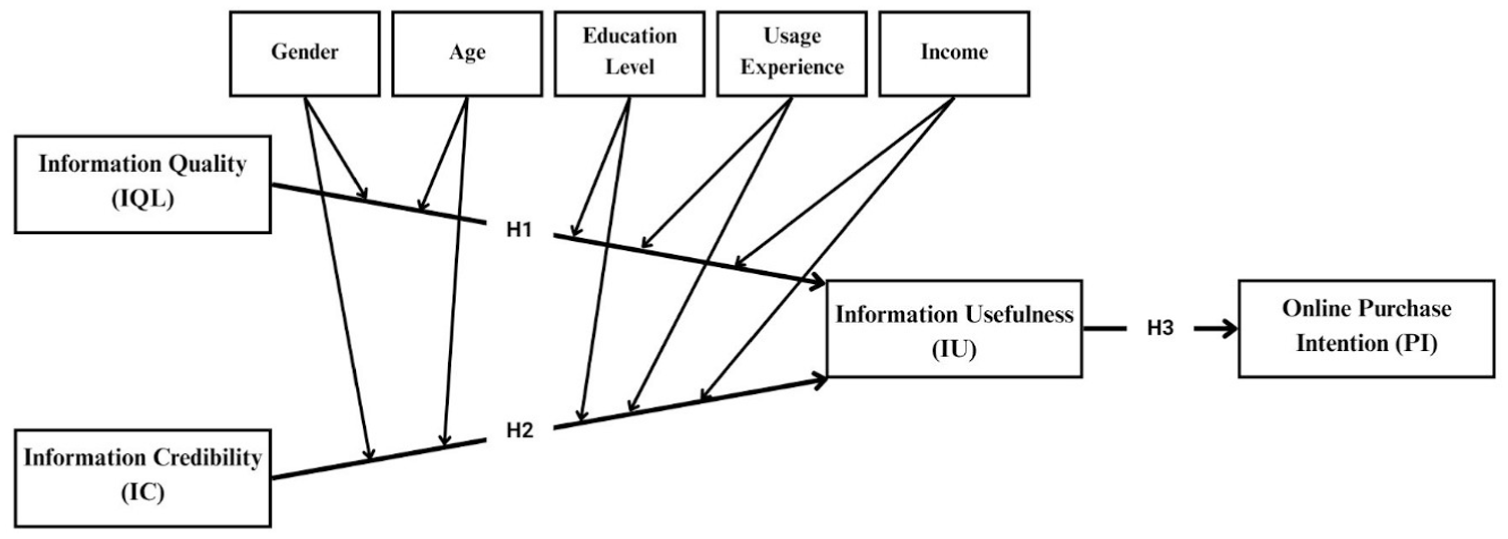
Proposed research model based in part on the Information Acceptance Model (IACM).
Methods
Research Methodology
The objective of the research is to utilize a quantitative approach to evaluate the impact of information provided by voice assistants (VAs) on users’ online purchase intentions. A survey was conducted to collect data, and the SEM analysis method was employed to assess the relationships between variables. This method is particularly suitable for evaluating the direct and indirect effects of Information Quality (IQ) and Information Credibility (IC) on IU and PI. The primary target of the research is the younger generation in Vietnam. The tool used to collect sample responses from survey participants was a Google Form questionnaire. This is a common and effective tool for gathering with participants’ responses. However, SEM analysis requires a minimum sample size to ensure valid and reliable results. A minimum of 10 times the number of indicator variables being surveyed should be the sample size for SEM research (Barrett, 2007). According to certain opinions, 200 or more people should be the minimum number of participants for SEM analysis (Kline, 2016). The research received 247 responses via Google Forms. After excluding responses that provided the same answer for all factors, 234 responses were deemed valid. The data collection was conducted from February 24 to March 26, 2024. This indicates that the number of responses surpassed the minimum threshold required for SEM analysis. The quantitative methods employed in studies (Alnoor et al., 2024; Muhsen et al., 2024) have inspired this research, guiding the use of a quantitative approach to analyze the impact of VAs on online purchase intentions. The details of the questionnaire used for the survey are presented in the Appendix section.
Measurement
To suit the research context in Vietnam and to investigate factors influencing users’ online purchase intentions through voice assistants (VAs), a structured and culturally adapted questionnaire was developed. The original measurement scales from previous studies were carefully revised to ensure content validity and contextual relevance. The finalized English version was then translated into Vietnamese using Brislin’s (1980) back-translation method to preserve semantic and conceptual equivalence. This rigorous process involved an initial translation by a bilingual expert, followed by a reverse translation by a second independent bilingual expert who had no prior exposure to the original. Discrepancies between the adjusted and back-translated English versions were systematically reviewed and resolved to ensure the Vietnamese version accurately conveyed the intended meanings. The final Vietnamese version of the questionnaire was then administered to participants. It was designed to evaluate the influence of information provided by VAs after users engage in typical online shopping behaviors such as searching for products, listing options, reading reviews, and comparing prices. A 5-point Likert scale ranging from 1 (strongly disagree) to 5 (strongly agree) was employed to collect responses (Cox & Isham, 1980), facilitating clear interpretation and effective expression of participant opinions. Key constructs measured include Information Quality, Information Credibility, Information Usefulness, and Online Purchase Intentions.
Data Analysis Tools
Data analysis was conducted using SPSS 25.0 and AMOS 24.0. The study employed the widely accepted two-step analytical procedure recommended by Anderson and Gerbing (1988). The analysis commenced with the assessment of the measurement model to establish its reliability and validity. Specifically, Cronbach’s Alpha was calculated to ensure internal consistency, followed by Exploratory Factor Analysis (EFA) and Confirmatory Factor Analysis (CFA) to confirm the model’s construct validity and goodness-of-fit. Upon establishing a robust measurement model, the analysis proceeded to evaluate the structural model. Structural Equation Modeling (SEM) was then used to test the hypothesized relationships among the constructs.
Results
Overview of Participant Demographic Information
Table 1 provides an overview of the survey respondents’ demographic details. In total, 234 survey samples were analyzed. Based on the response data, 133 participants (56.8%) were classified as female and 101 participants (43.2%) as male. The most common age group was 18 to 22, comprising 201 individuals (85.9%), followed by the 23 to 29 age group with 28 individuals (12%). Overall, the research predominantly involves Vietnamese youth. The majority of participants hold a bachelor’s degree, totaling 191 individuals (89.7%). Most participants have less than 1 year of experience using voice assistants (69.2%). Given the age distribution, the average monthly income for most is below 200 USD (62.8%), with 25.6% earning between 200 and 400 USD.
Basic Information of the Research Participants.

Cronbach’s Alpha Analysis
Cronbach’s Alpha is used to assess the reliability of the measurement variables employed in the study on the impact of VA information on online purchase decisions. A Cronbach’s Alpha coefficient over .7 and a corrected item-total correlation index above .3 are deemed analytically significant, per the recommendations put forward by Nunnally and Bernstein (1994). With Cronbach’s Alpha values ranging from .698 to .844 and adjusted item-total correlations between .459 and .699, Table 2 displays these indices and demonstrates that all factors are over the .6 criterion. This demonstrates that the measurement variables are trustworthy and accurately capture the research’s desired components.
The Analysis of Cronbach’s Alpha Coefficient.

In addition, Table 2 provides the mean and standard deviation (SD). The mean represents the average score for each factor, giving insight into general perceptions. The SD reflects the variability of responses, helping to understand the consistency of opinions. These metrics offer practical insight into how uniformly respondents perceive the factors, which is useful for interpreting the overall trends and reliability of the data.
Exploratory Factor Analysis (EFA)
Exploratory Factor Analysis (EFA) was conducted to assess the construct validity of the measurement scales. Before performing the analysis, the suitability of the data was confirmed. The Kaiser-Meyer-Olkin (KMO) measure of sampling adequacy was 0.899, well above the recommended threshold of 0.5 (Kaiser, 1974). Additionally, Bartlett’s Test of Sphericity was significant (
The EFA was performed using Principal Component Analysis (PCA) as the extraction method and an orthogonal Varimax rotation to achieve a simpler and more interpretable factor structure. The criteria for factor extraction and item retention were based on established guidelines. Specifically, factors were retained based on the Kaiser’s criterion of having an eigenvalue greater than 1. For item evaluation, a factor loading was considered significant if it was 0.5 or greater. For the treatment of cross-loadings, any item loading significantly on more than one factor would be considered for removal if the difference between its highest and second-highest loading was less than 0.3.
As presented in Table 3, the analysis identified four factors that met these criteria. Together, these factors accounted for a cumulative variance of 61.208%, surpassing the recommended 50% threshold (Anderson & Gerbing, 1988). Each of the four factors had an eigenvalue greater than 1, indicating they explain a substantial portion of the variance in the original variables. All final factor loading coefficients were above the 0.5 threshold, and no problematic cross-loadings were observed, suggesting that each variable has a strong and clear relationship with its corresponding factor.
Exploratory Factor Analysis (EFA).

Confirmatory Factor Analysis (CFA)
To validate the theoretical framework developed for assessing the variables influencing users’ intentions to purchase voice assistants, confirmatory factor analysis (CFA) results are presented. The CFA provides strong evidence of convergence and distinctiveness for the theoretical framework underlying the model.
Table 4 presents the key fit indices from the CFA, illustrating that the model meets the recommended thresholds for a good fit. Specifically, the GFI is 0.918, surpassing the suggested threshold of 0.9, and the CMIN/DF ratio is 1.718, which is below the acceptable value of 3. Additionally, the TLI, CFI, and IFI indices are 0.935, 0.947, and 0.948, respectively, all exceeding the threshold of 0.9. The RMSEA index is 0.056, well below the threshold of 0.08. These results confirm that the grouping of components according to the suggested model is well-supported.
Confirmatory Factor Analysis (CFA).

Structural Equation Modeling (SEM)
The SEM is employed to evaluate the correlations between independent, mediating, and dependent variables as outlined in the proposed research model. Figure 3 illustrates the hypothesized model structure and includes the standard regression weights, which are essential for interpreting the relationships among variables.
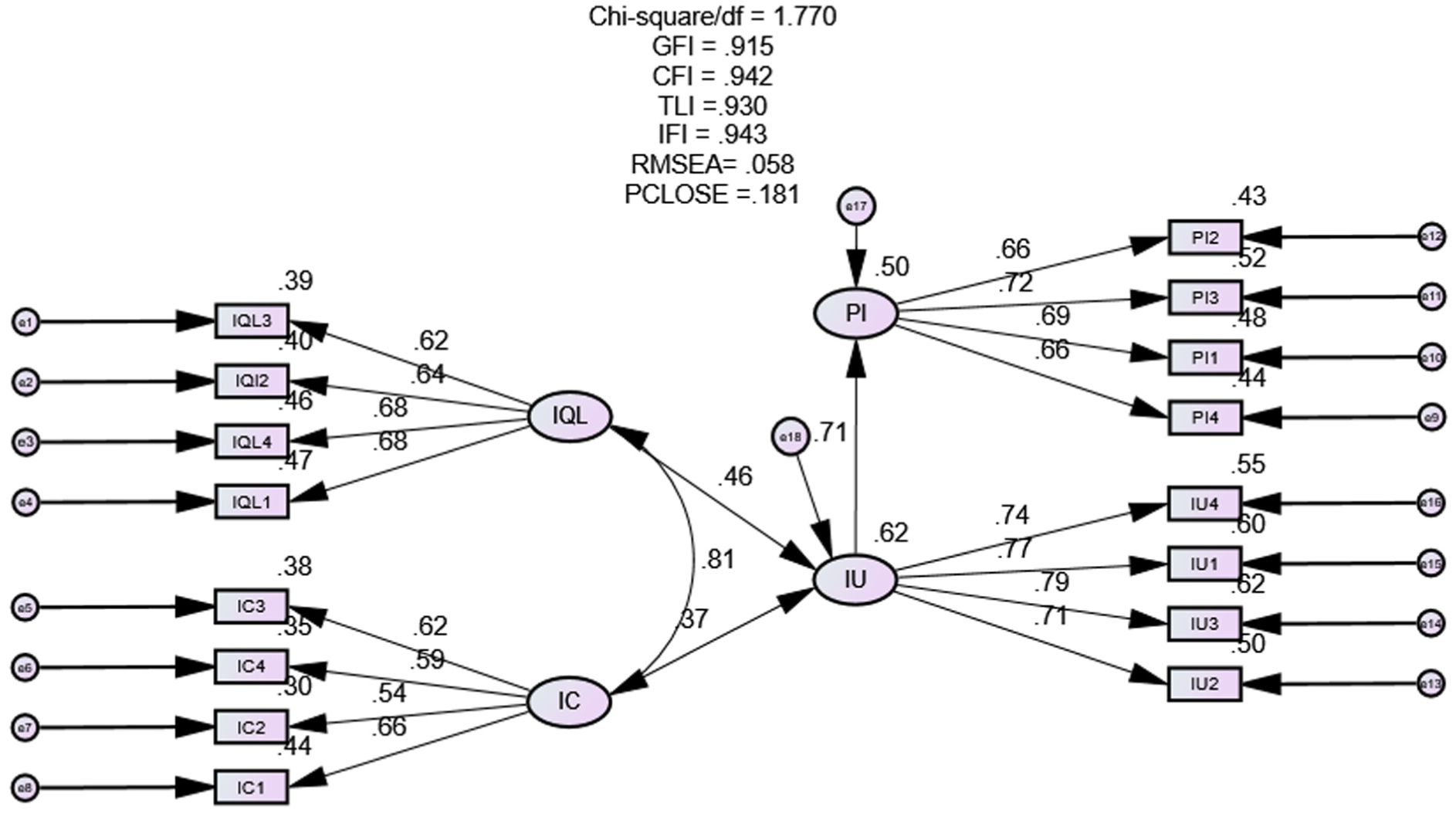
The impact of information provided by voice assistants on the intention to purchase online.
The findings from the SEM analysis, shown in Table 5, indicate that the model satisfies the predetermined standards. At 1.770, the CMIN/DF value is below the suggested cutoff of 3. With corresponding values of 0.915 and 0.942, the GFI (Goodness of Fit Index) and CFI (Comparative Fit Index) both surpass the 0.9 criterion. With values of 0.930 and 0.943, respectively, the TLI (Tucker-Lewis Index) and IFI (Incremental Fit Index) also exceed the 0.9 cutoff. Furthermore, the Root Mean Square Error of Approximation (RMSEA) value is 0.058, which is less than the recommended cutoff of 0.08. The model is suitable for evaluating the correlations between the variables, according to these fit indices.
Model Fit Indices for the Measurement Model.

Table 6 presents the results of hypothesis testing for direct effects. The Quality of Information (IQL) significantly influences Information Usefulness (IU), with a significance value of .005, indicating a substantial relationship. Similarly, Information Credibility (IC) significantly affects IU with a significance value of .024. The relationship between IU and the purchase intention (PI) is also significant with a
Results of Hypothesis Testing (Direct Impact).

Table 7 details the results of hypothesis testing for indirect effects. The analysis supports the hypothesis that IU mediates the relationship between the dependent variable (PI) and the independent variables (IQL and IC). Specifically, IQL has a significant indirect effect on PI through IU, with a Beta of .262 and
Results of the hypothesis testing (indirect impact).

This suggests that IU fully mediates the relationship between PI and IQL, but not between PI and IC.
Moderation Analysis
To further elucidate the boundary conditions of the proposed research model, a series of moderation analyses were conducted to examine whether key demographic variables alter the strength of the relationships between information characteristics specifically, Information Quality (IQL) and Information Credibility (IC) and perceived Information Usefulness (IU). The demographic variables under investigation included Gender, Age, Education Level, Usage Experience, and Income.
Moderating Effects on the IQL → IU Relationship
The first set of analyses, summarized in Table 8, examined the extent to which demographic factors moderate the relationship between Information Quality (IQL) and Information Usefulness (IU). The results present a nuanced picture, with only one demographic variable Education Level exhibiting a statistically significant moderating effect, while all others did not reach significance.
Summary of Moderation Analysis Results for Information Quality (IQL).

Among the demographic factors, Education Level emerged as a statistically significant moderator (λ = −0.22,
In contrast, Gender (λ = −0.09,
Moderating Effects on the IC → IU Relationship
The second set of analyses examined whether the same demographic variables moderated the relationship between Information Credibility and Information Usefulness. The results, displayed in Table 9, present a striking contrast to the findings associated with Information Quality.
Summary of Moderation Analysis Results for Information Credibility (IC).

As indicated in Table 9, none of the demographic variables significantly moderated the IC → IU relationship (all
Although statistically non-significant, this result carries considerable theoretical significance. It suggests that the impact of Information Credibility on perceived usefulness operates as a robust and universal psychological mechanism that transcends demographic differences. Unlike the evaluation of Information Quality which appears sensitive to individual differences such as gender and education the process of attributing trust to information sources remains fundamentally stable and consistent across diverse user profiles.
This distinction underscores the presence of two divergent cognitive pathways through which information characteristics shape perceived usefulness. While the influence of Information Quality is contingent upon user-specific attributes, the effect of Information Credibility appears to be direct, stable, and largely immune to demographic variation.
Discussion and Implications
The ability of voice assistants (VAs) to provide product information significantly impacts consumers’ intentions regarding online purchases. Factors related to the correctness and dependability of the information become even more important since they pose critical concerns when interacting with an AI tool, such as voice assistants. The conclusions of the research have theoretical and practical implications.
Theoretical Contributions
The research examined how the factors of information provided by VAs influence the intention to buy online. Although this topic is still relatively new, its value is persuasive because of previous research. The results of the research indicate that when VAs offer assistance, the quality of the information is the most significant element affecting consumers’ intentions to make online purchases. Trust in VA information is crucial in evaluating its usefulness, with information quality being paramount (Nagy & Hajdu, 2021). Users tend to distrust VAs when notified that they are conversing with a bot rather than a human advisor (Luo et al., 2019). In particular, VA information is synthesized from multiple sources and susceptible to manipulation (Cheng et al., 2019), highlighting the importance of prioritizing information quality. This correlation is reflected in the research’s results, encouraging VAs in general and those used for shopping purposes specifically to provide high-quality information. They may focus on training data, process input data effectively, and improve answer algorithms, especially in online shopping contexts, where this is particularly crucial.
VAs are susceptible to hacking, and the data they offer can be altered for malicious purposes (Alepis & Patsakis, 2017). Therefore, concerns about the reliability of information are paramount. If the information from VAs does not inspire enough trust, it can significantly impact the evaluation of its usefulness. A notable finding of this research is the lack of a significant indirect effect of information credibility on purchase intention via information usefulness (
Management Contributions
This research evaluates the influence of information from VAss on users’ intention to purchase online. Developing these results can help VAs adopt a more effective approach in the shopping context, while sellers can make adjustments to deliver information more effectively through voice assistants.
With a significant impact on a large user base, information from VAs can greatly enhance online store revenue. It is crucial to ensure that VAs provide detailed proposals about online stores and displayed products, while also enhancing the credibility of the introduced products. For example, when the information provided by VAs includes appealing elements such as reasonable prices, advantages over similar products, and promotional offers, it significantly influences consumers’ purchasing intentions. This becomes even more crucial when the communication tool between consumers and VAs is through conversation. Product imagery factors are often considered after essential information. Given the typically short interaction time between users and voice assistants, concise yet impactful descriptions and standout product features become crucial competitive factors in the VA environment.
The algorithm selecting product information from VAs is of great interest from the seller’s perspective. Search Engine Optimization (SEO) is an essential concept for online businesses. According to Husain et al. (2020), implementing an effective SEO strategy can significantly improve website traffic and search rankings within a short period. In particular, in the context of VAs, optimization becomes even more critical due to the need to filter and compete with a higher volume of proposed information. Lopezosa et al. (2023) noted that implementing SEO strategies tailored for VAs helps reduce costs while increasing product visibility, thereby improving customer reach. However, it is essential to note that since the input and output of information are primarily audio-based, implementing SEO strategies also needs to be adapted accordingly. Research by Pase et al. (2020) emphasized the importance of tailoring content to suit voice-based interfaces. This clarifies the role of SEO in increasing access to consumers through voice assistants.
The information provided by VAs to consumers represents a highly relevant and timely topic for research and practice. Moreover, exploring how VAs can be used to boost online sales remains a nascent area that warrants further academic investigation. Given the rapid development of VAs, it is plausible that in the near future, they may partially or entirely replace human advisors. This would position them as a critical element in the evolution of the e-commerce industry.
Managerial Implications
Research has highlighted the crucial role that information quality and reliability play in shaping online purchasing decisions, particularly when users seek recommendations. Integrating algorithms into voice assistants to verify information during the data aggregation process is therefore essential. By ensuring that VAs compile and present information only from reputable or verified sources, the system’s responses will meet users’ expectations for quality and reliability. This approach also helps in preventing the recommendation of low-quality products or those with unreasonable pricing.
Moreover, the implementation of continuous monitoring and feedback mechanisms is vital for improving the performance of voice assistant technologies. Regular performance evaluations and the collection of user feedback allow developers to identify areas needing improvement and to implement necessary updates. This process helps VAs maintain user trust and satisfaction, indirectly influencing product selection through VA recommendations.
Another important consideration is addressing data bias in VAs. When businesses partner with VAs to ensure their products are prioritized, the recommendations provided may not fully represent the entire consumer base, leading to biased suggestions. Therefore, it is essential that product recommendations are aligned with user needs and optimized for their preferences, a key responsibility for VA developers.
Limitations and Future Research
In the field of research on the impact of AI in academia, inherent limitations and delimitations must be carefully considered to accurately assess contributions and suggest future research directions. One of the primary limitations is the moderate sample size with
In addition, the survey samples primarily come from the southern region of Vietnam, making the evaluation from this sample insufficient to assess the overall characteristics of Vietnamese youth. Social bias is another significant factor, as participants may tend to choose responses aligned with socially acceptable trends rather than reflecting their personal perceptions. The research model is also quite simple, especially as the two factors, Need of Information and Attitude to Information, from the IACM model were not considered due to the research’s focus on VAs. The omission of these two factors may have led to missed valuable findings. Another noteworthy limitation lies in the study’s homogeneous treatment of voice assistants (VAs). Platforms like Siri, Alexa, and Google Assistant possess distinct ecosystems, algorithms, and levels of brand trust, which may produce heterogeneous effects on user perceptions and purchase intentions that were not captured in this analysis.
The research results serve as a starting point for investigating how the information provided by voice assistants impacts various fields, particularly e-commerce. However, this research has several shortcomings, and further research is needed to build on these foundational yet preliminary insights. Expanding the sample size is essential, especially in terms of the survey’s scope. A broader survey sample will provide a more comprehensive evaluation by incorporating cultural diversity, income levels, and AI usage experience. Crucially, a larger sample would also enable a more rigorous cross-validation technique. Future research should consider splitting the data, using one portion to develop the model via EFA and the other to test and confirm it via CFA, thereby strengthening the external validity of the findings. This is important as the potential scope of the research is global and aligns with current trends.
Furthermore, expanding the research model is essential to capture more nuanced dynamics. Researchers could incorporate the two factors, Need of Information and Attitude to Information, which were missing from this research, and include additional aspects related to society, technology, and culture. Businesses are a key group to focus on, as they are both directly and indirectly influenced by the trend of voice-based information search. Research into how businesses utilize VAs to reach potential customers is an important aspect to consider.
Conclusions
This study contributes to the body of knowledge on artificial intelligence in e-commerce by identifying key informational factors that influence consumer purchase intentions when using voice assistants (VAs). The findings confirm that information quality and information credibility are strong positive predictors of perceived information usefulness. In turn, perceived usefulness directly and significantly impacts online purchase intentions, while information quality also exerts an indirect influence.
A key implication of these results is the heightened importance of information integrity in audio-based interactions. The inherent nature of VAs delivering concise, audio-only information often while users are multitasking makes independent verification difficult. This context amplifies the role of information quality, positioning it as a major determinant of consumer choice and a critical factor for building user trust in VA-driven shopping environments.
The novelty of this research lies in its specific focus on the “information factor,” an aspect often overlooked in VA literature which has traditionally centered on broader constructions like trust or usability. By demonstrating that users are genuinely sensitive to the quality and credibility of the information presented during shopping tasks, this study serves as a precursor to a growing need for optimized and rigorously verified information within AI-powered recommendation systems.
Ultimately, this research underscores the transformative impact of VAs on the e-commerce landscape. As voice interactions become more prevalent, the emphasis shifts from visual merchandising to the strategic optimization of product information for audio delivery. This presents both a challenge and an opportunity for businesses, requiring them to adapt their strategies to effectively engage consumers in a voice-first ecosystem. The findings suggest that those who prioritize delivering high-quality, reliable, and useful information through VAs will be best positioned to succeed.
Footnotes
ORCID iDs
