







Abstract
Keywords
Transitioning to adulthood is difficult for many students and their families, but youth with disabilities who receive Supplemental Security Income (SSI) and their families face additional hurdles. These include practical obstacles such as accessing needed community services and supports, coordinating fragmented services, accessing vocational rehabilitation services, and social and psychological obstacles, such as combating low expectations, understanding eligibility and benefit rules, and meeting basic needs for food, housing, and security (Anderson & Golden, 2019). As a result, youth SSI recipients experience disparate employment, educational, and economic outcomes when compared to other youth with disabilities who do not receive these entitlements.
Case managers and family coaches play a pivotal role in supporting the successful adult transition of youth SSI recipients. These individuals can support youth and their families by helping them understand their options to make choices that reflect the youth’s values, needs, and abilities, and by resolving problems and crises as they arise. Existing programs that provide case management services often provide an array of services across various job titles that support specific outcomes such as employment, postsecondary education, and community living. Case managers also provide support with daily living issues, transportation, and mobility as well as provide emotional support, crisis management, home visits, and transition supports for students from secondary to postsecondary settings (Balcazar et al., 2012). Demonstration programs that provide broad supports to transition-age youth who receive SSI, such as Promoting the Readiness of Minors in Supplemental Security Income (PROMISE) and the Youth Transition Demonstration (YTD), have also included case management components. PROMISE case managers and family coaches had a somewhat narrower purview, focusing on coordinating services and educating youth and their families (Fraker et al., 2014). The supports provided by PROMISE case managers were essential in connecting youth SSI recipients and their families to local services and played an important role in supporting work outcomes (Anderson & Golden, 2019). However, there is no body of research to document which case management services and supports are most essential to supporting improved employment and education outcomes. Furthermore, there is no consistent catalyst for ensuring access to these services and supports in the current domestic disability policy framework.
Research on the effectiveness of case management strategies with transition-age youth is very limited, in part because programs generally provide a package of services that may be paired with other supports, as is the case with PROMISE and YTD. Project NetWork, a Social Security Administration (SSA) demonstration, tested the effect of case management and referrals and found short-term increases in employment (Kornfeld & Rupp, 2000). However, youth were not the main target of Project NetWork. The College Connection Program, conducted as a research demonstration project for the Rehabilitation Services Administration (RSA), provided some insight into the effect of case management services specifically for transition-aged youth. High school graduates with disabilities were recruited to treatment and control groups, and participants in the treatment group received a set of case management services. Findings indicated that youth in the treatment group were significantly more likely to be employed, to be enrolled in postsecondary education, and to complete their postsecondary programs. These differences were large—74% of the treatment group were employed compared with 23% of control—but it is unclear whether this impact was achieved through the utilization of broad case management supports or parallel employment and college supports (Balcazar et al., 2012).
Case managers for transition-aged youth face many challenges. When working with transition-aged youth, case management practitioners must understand two sets of services—those geared to youth and those focused on adults. This population is also disadvantaged on many dimensions. Garcia-Iriarte et al. (2007) noted that in addition to disability, many youth with disabilities face other barriers to successful employment, including poverty, lack of access to services, and scarce family support. Youth with disabilities are also more likely than their peers without disabilities to be in foster care or homeless (Kang-Yi & Adams, 2017; Zlotnick et al., 2012). In the next section, we describe the National PROMISE Project and further context for this study.
The National PROMISE Project
The PROMISE national research demonstration was conducted between 2013 and 2019 with support from the U.S. Department of Education, Labor and Health and Human Services, and the SSA. The goal of PROMISE was to improve the provision and coordination of services to promote education and employment outcomes resulting in long-term reductions in the child’s reliance on SSI. The national demonstration collectively recruited over 13,000 youth between the ages of 14 and 16 who received SSI across six research sites that included Arkansas, California, Maryland, New York, Wisconsin, and Achieving Success by Promoting Readiness for Education and Employment (ASPIRE), a collaboration between Utah, Montana, Colorado, Arizona, North Dakota, and South Dakota. At enrollment, youth were randomly assigned to treatment and control groups. All youth and their families in the intervention group received access to a set of evidence-based services that included case management, benefits counseling, career and work-based learning experiences, and parent/guardian training and information. States were provided flexibility in the design of the state-specific models as long as the core services identified above were provided. The purpose of this article is to explore the constellation of intervention services provided to youth SSI recipients under the New York State (NYS) PROMISE demonstration and the emergence of the taxonomy of case management within those services, as this is an area that has not been previously well documented in the field. We present research conducted to map the taxonomy of case management strategies considered most effective in supporting positive education, employment, and economic outcomes under the NYS PROMISE research demonstration.
One of the primary goals of the PROMISE project was to inform youth policy and practice regarding the most effective, important, and feasible case management services needed to support postschool success of youth receiving SSI; yet, there is limited research available on the taxonomy of case management practice. This lack of shared meaning and language across the field of case management makes it virtually impossible to compare results between projects or to accurately describe the outcomes to others stakeholders who are interested in continuing the research. To better capture the complex interdisciplinary services that were delivered and accurately describe the process and outcomes to other professionals, the research team engaged in group concept mapping (GCM) to generate, synthesize, and structure ideas. These ideas were then used to formulate a taxonomy of case management, which served as the framework for the creation of a new Case Management Field Guide for NYS PROMISE. Three primary research questions guided this study:
Method
The NYS PROMISE Case Management Demonstration
The NYS PROMISE engaged existing local, regional, and state transition stakeholders in the implementation of the demonstration that included local school-based and community-based case managers, Parent Center family coaches, and a network of community service providers across three distinct regions in NYS. The demonstration was conducted in three geographic locations in NYS—New York City (NYC), Western NYS, and the Capital Region of NYS. Intensive case management required a comprehensive understanding of the unique demographics and factors of each youth and their family in the intervention group and the design of a tailored and customized package of services and supports targeted toward the student and their family’s specific needs and desired outcomes (Golden et al., 2019).
Early in the launch of NYS PROMISE, a center of practice approach was employed to embrace the collective of communities of practice that existed across the project community. This approach elevated the voices of stakeholders at the state, regional, and practice level while at the same time allowing for standardization of methods, continuous quality improvement, and assurance of fidelity across the interventions provided (Golden et al., 2019). Through this heightened engagement with stakeholders, a clear need emerged for fidelity and standardization across the three regions with regard to design and delivery of comprehensive case management. Toward that end, GCM was employed as a structured conceptualization method allowing case managers and family coaches from across the three regional demonstration sites within NYS to develop a conceptual map and taxonomy of those case management services and supports most essential to supporting effective postschool outcomes for youth SSI recipients and their families.
Participants
To ensure sampling of the full spectrum of ideas, all NYS PROMISE case managers and family coaches (
Procedure
The integrative, participatory, mixed methodology of GCM and pattern matching was employed to develop a taxonomy of essential case management services and supports and to better understand the importance of specific services and the degree to which case managers and family coaches felt equipped to implement those services (Kane & Trochim, 2007). Mapping the terrain of those case management services most critical to supporting successful transition outcomes for youth SSI recipients required a grounding in the lived experience and micro-level implementation of case management services by those practitioners engaged in service delivery. From July to September of 2016, Cornell University and the Research Foundation for Mental Hygiene, Inc. invited 69 case managers and family coaches across the three regional demonstration sites in NYS to participate in this GCM study.
The GCM process was supported by an online platform for collecting, managing, and analyzing data. Similar to focus group processes, participants were asked to generate ideas in response to the focus prompt—what are the essential skills, knowledge, and attitudes case managers need to have to support effective postschool outcomes for youth SSI recipients and their families? Participants then created individual categorization schemes to organize all items in groups. Using Likert-type scales, participants rated ideas on two relevant scales that measured the importance of individual structuring mechanisms to achievement of their organizational mission and objectives and the degree to which the respondents thought their behaviors or interactions in response to those mechanisms contributed to organizational transformation of current practices. Participants’ structuring work was then aggregated to develop a conceptual map using multidimensional scaling (MDS), which locates each idea as a separate point on the concept map (Kane & Trochim, 2007). Another statistical technique, hierarchical cluster analysis, was employed to identify where it made sense to draw boundaries around groups of ideas based on statistical similarity, to configure them into conceptual “clusters” (Kane & Trochim, 2007). Finally, the ratings for each idea and each cluster of ideas were averaged across respondents. Pattern matching helped to compare the ratings of the conceptual clusters based on different criteria, such as different stakeholder groups, rating variables, or points in time (Kane & Trochim, 2007).
Data Collection
Data collection occurred across three phases: idea generation and brainstorming, idea synthesis, and idea structuring. The idea generation and brainstorming phase of a GCM project generates a set of statements that ideally represent the complete conceptual domain of the topic of interest (Kane & Trochim, 2007). During this phase, participants were encouraged to generate as many statements as possible in response to the following focus prompt: “What are the essential skills, knowledge, and attitudes case managers need to have to support effective postschool outcomes for youth SSI recipients and their families?” Between July 16 and July 29, 2016, participants were asked to respond to the focus prompt for the structured responses. Respondents were provided an initial e-mail invitation that included a web address for the study-specific website on which they could submit their ideas online. Over the course of the 13-day period, two additional e-mail prompts were sent to study participants to remind them to complete the brainstorming phase. Of the 69 invited case managers and family coaches, 47 contributed to the brainstorming phase.
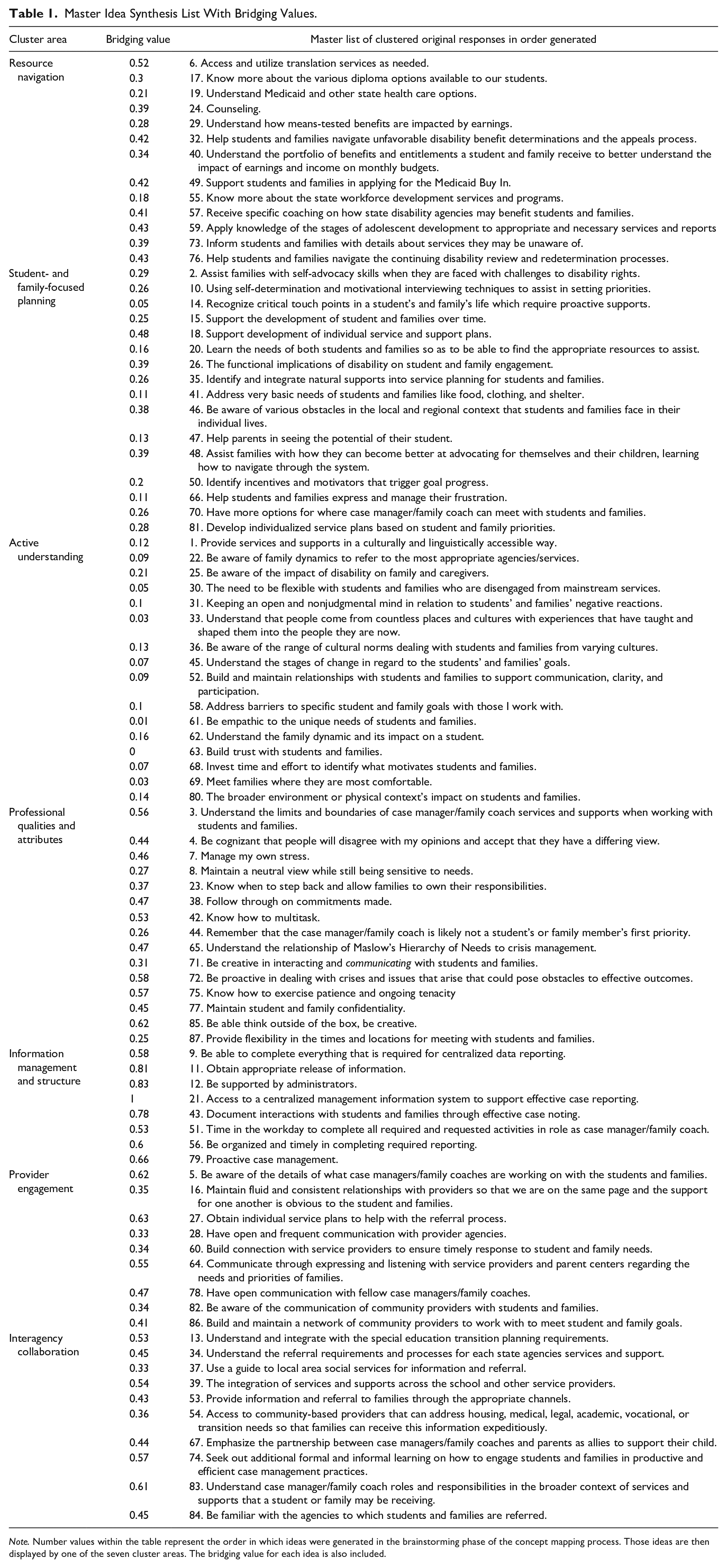
Following the idea generation and brainstorming phase, the study design team engaged in the idea synthesis phase to ensure relevance and validity of initial responses. An initial master list of 112 responses were generated from the focus prompt during the idea generation and brainstorming phase. Select members of the study design team were engaged in subsequent planning to create specific criteria for cleaning the initial master response list. This involved both expansion and reduction of the initial master list. Some respondents did not enter individual concepts in response to the focus prompt but rather made one combined entry that needed to have individual ideas separated. This resulted in the initial list of 112 ideas growing to 130. This master list was then reduced based on the following criteria: relevance to the stated focus question or within the scope of the question at hand; removal of redundancy or duplication; enhancing clarity of meaning; and relative appropriateness for the sorting and rating tasks to be completed. The master list was finally reduced to 87 ideas. Table 1 provides a master idea synthesis list, including a detailed list of responses clustered within broader idea categories and the bridging value of each idea to the cluster category in the order they were generated by respondents.
Master Idea Synthesis List With Bridging Values.
Subsequent to the completion of the first two phases, respondents were asked to participate in the organizing phase, in which they completed two tasks to structure the information—sorting and rating. The sorting and rating tasks were completed between August 4 and August 21, 2016. An initial e-mail invitation to participate was sent with three e-mail reminders to complete the process prior to closing the phase. Of the original 69 invited participants, 28 engaged in the organizing phase by contributing to the sorting and rating processes. For the sorting task, respondents were asked to organize and sort the entire database of ideas into groups or themes based on similarity of ideas. A dedicated website was provided for respondents to complete this task online. The Concept Systems Global Max (CSGM®) employed an MDS algorithm that brought order to group cognitive processes. Each individual respondent’s sort included a grouping of similar items under a descriptive label that they identified. Once entered into the software, each sort was converted into a square binary matrix with as many rows and columns as there were ideas sorted. For the rating task, respondents were asked to evaluate or rate each of the 87 final ideas using two Likert-type scales.
The first scale identified the specific ideas that case managers believed were most important to achieving successful youth and family outcomes. The second scale identified the degree of feasibility for the case manager to implement the idea. Specifically, the importance of each idea was rated by asking, On a scale from 1 to 4, please rate each idea on how important you think it is to achieving successful youth and family outcomes using the following 4-point scale: 1 =
Feasibility of implementing each idea was rated by asking, On a scale from 1 to 4, please rate each idea on how feasible it would be to implement the idea to support effective case management for NYS PROMISE using the following 4-point scale: 1 =
Data Analysis
Data analysis included MDS and hierarchical cluster analysis. MDS was conducted with a two-dimensional scaling selected for interpretation due to two-dimensional solutions producing acceptable stress values and common use of the solution in concept mapping (Kane & Trochim, 2007). The two-dimensional solution yielded a configuration in which statements grouped together most often were located more closely in two-dimensional space than those grouped together less frequently.
The x, y configuration displays each idea in two-dimensional space with more similar ideas located in proximity to one another on the map (Rosas & Kane, 2012). The x, y, configuration resulting from the MDS analysis provided the input for the hierarchical cluster analysis (Kane & Trochim, 2007). To determine the best fitting cluster solution for each idea, a range of possible cluster solutions suggested by the analysis was reviewed, taking into account the fit of the content within clusters as well as the specific desired uses of the results. Simply stated, a cluster is the grouping of ideas with a similar meaning to those engaged in the rating and sorting process. To aid in configuration of the cluster map, a similarity cut off of three was used to clarify the degree of relationship between items. Using the similarity cutoff removes the relationship in the similarity matrix between items that were seldom sorted together—in this case, by three participants. After assessing an array of cluster solutions ranging from five to nine, a seven-cluster solution was retained for interpretation purposes. The seven-item cluster map for this study generated an average stress value of .29, considered to be well within the normal limits of .28 to .34 (Rosas & Kane, 2012). Stress is a statistic typically associated with MDS analyses—illustrating the goodness of fit of the final clusters within the concept map with the original similarity matrix. “Stress is the normalized residual variance for a perfect relationship of a monotone regression of distance upon dissimilarity or similarity” (Rosas & Kane, 2012, p. 240). In short, the stress value indicates the degree to which the visual representation matches the data.
Results
RQ1: What Are the Essential Skills, Knowledge, and Attitudes Case Managers Need to Have to Support Effective Postschool Outcomes for Youth SSI Recipients and Their Families?
The statements generated by respondents provided preliminary information in response to the first research question—identifying a set of skills, knowledge, and attitudes that case managers need to have to support effective postschool outcomes for youth SSI recipients and their families. Figure 1 shows the point map created by the MDS process. Each point in the figure represents one of the 87 brainstormed ideas, with a corresponding number to that statement in the set. The two-dimensional scaling resulting from the MDS analysis provided the input for the hierarchical cluster analysis which resulted in the seven-item cluster map illustrated in Figure 2.

Point map.

Cluster map.
A three-step process was completed to finalize the cluster labels for the concept map. This included (a) software-generated labels based on keyword analysis of individual respondent sorting labels, (b) review and deliberation of computer-generated labels with CSGM® administrators and the study team, and (c) final synthesis of labels with cluster definitions. Table 1 provides a master idea synthesis list, including a detailed list of responses, clustered within broader idea categories, and the bridging value of each idea to the cluster category in the order they were generated by respondents (i.e., Resource Navigation: access and utilize translation services as needed, and counseling). The lower the bridging value or the connection of two ideas on the map, the stronger the relationship between statements within that cluster. Bridging values closer to a value of “1” show greater relationship to a broader number of statements located in clusters across the map and are considered to have a stronger bridging value to other clusters, and are typically located more closely to the center of the map. Taken together, these clusters represent the taxonomy of case management services reported by case managers and family coaches as most essential to supporting the successful postschool outcomes of youth SSI recipients and their families. Table 2 provides a brief definition of each cluster.
Individual Cluster Definitions.

RQ2: What Essential Skills, Knowledge, and Attitudes Are Most Important to Support Effective Postschool Outcomes for Youth SSI Recipients and Their Families?
For the importance rating task, all participants were asked to evaluate or rate each of the 87 final ideas using the Likert-type scale described earlier to assist in developing a response to RQ2. A cluster rating map was generated to assess the relative importance for each cluster. For each cluster rating map, a legend was provided that illustrates the rating value for each cluster layer. The more layers in a given cluster, the higher the average rating—in this case, of Importance. Figure 3 represents ratings across all participants. As illustrated in Figure 3, cluster areas rated most important to supporting effective postschool outcomes for youth SSI recipients and their families included those elements of the cluster map most directly related to understanding student and family needs, planning, and engaging in evidence-based services and supports. These clusters included provider engagement, active understanding, interagency collaboration, and student- and family-focused planning. Elements rated as least important were more directly related to the administrative functions of case management, including the clusters of resource navigation and information management and structure, as well as professional qualities and attributes. As represented in Figure 3, calculating importance across all respondents appeared to identify the relative importance of each of the cluster areas and clearly identified some slight stratification of importance across the clusters as represented by the .39 variance from the lowest to highest rated clusters across the map (

Cluster importance rating map.
RQ3: How Feasible Do NYS PROMISE Case Managers and Family Coaches Feel It Is to Implement Those Essential Skills, Knowledge, and Attitudes They Feel Are Most Important to Support Effective Postschool Outcomes for Youth SSI Recipients and Their Families?
A feasibility rating task was employed to answer RQ3. A cluster rating map was generated to assess the relative feasibility of NYS PROMISE case managers and family coaches in implementing those essential skills, knowledge, and attitudes most important to supporting postschool outcomes. A legend is provided that illustrates the rating value for each cluster layer. The more layers in a given cluster, the higher the average rating—in this case, of Feasibility. Figure 4 represents ratings across all participants. As illustrated in Figure 4, respondents articulated relative feasibility in implementing those tasks associated with cluster areas rated as most important to support effective postschool outcomes for youth SSI recipients and their families. These clusters included active understanding, provider engagement, student- and family-focused planning, and interagency collaboration. Interestingly, those rated as less feasible directly correlated to those tasks and cluster areas identified as being of lesser importance, including resource navigation and information management and structure, as well as professional qualities and attributes.

Cluster feasibility rating map.
Discussion
Through the process of GCM, the NYS PROMISE project was able to identify, describe, and share critical insights into the vast array of knowledge and skills needed to effectively support youth SSI recipients in the transition process. Through GCM activities, the broad areas of resource navigation, student- and family-focused planning, active understanding, professional qualities and attributes, information management and structure, provider engagement, and interagency collaboration (see Table 2) were conceptualized and serve as the foundation of the taxonomy of youth SSI recipients case management services. This taxonomy provided the critical framework to support the implementation of NYS PROMISE case management and family coaching services and supports to ensure implementation fidelity across demonstration sites within NYS.
To support fidelity of PROMISE case management services in NYS, the taxonomy presented in this article informed the development of the NYS PROMISE Case Management Field Guide. The Field Guide was designed to support field implementation and ensure consistent implementation across the three demonstration sites. The field guide incorporated the seven cluster areas identified as most essential to support successful engagement and postschool outcomes for students and families and included student- and family-focused planning, active understanding, professional qualities and attributes (for effective case management), information management and structure, provider engagement, interagency collaboration, and resource navigation. Modules within the field guide included (a) overview of case management, (b) service delivery, (c) youth in transition, (d) self-determination, (e) case planning and service coordination, (f) case recording, (g) counseling, (h) crisis management, (i) engaging families, (j) protection and advocacy, (k) triaging benefits and entitlements to support career development and work, (l) justice-involved youth, (m) community participation, (n) emerging adulthood, and (o) the closeout process. When taken together, these clusters and modules make up the case management taxonomy. As a result, the case management approach emphasized throughout the field guide, training sessions, and other technical assistance provided was designed to be family-focused (Bailey et al., 2012), strength-based (Arnold et al., 2007; Mendenhall & Grube, 2017; Rapp, 1998), resilience-focused (Patterson, 2002), trauma-informed (Bulanda & Byro Johnson, 2016; Keesler, 2014; Koury & Green, 2017; Yatchmenoff et al., 2017), and culturally responsive (Harry et al., 1999; Ortega & Faller, 2011; Yampolsky et al., 2016; Yeager & Bauer-Wu, 2013). In the remainder of this section, we explore the approach NYS PROMISE took to ensure practitioner fidelity, lessons learned, and policy and practice implications.
The journey from initial participant recruitment through the closeout of the NYS PROMISE project involved a variety of both anticipated and unexpected challenges. The center of practice and highly collaborative team approach that was employed, coupled with the taxonomy for case management services and ensuing NYS PROMISE Case Management Field Guide, provided agility that supported ongoing project adaptation and innovation leading toward improved outcomes for youth and their families. Contributing to this adaptation and innovation, the master list of clustered original responses from study participants identified in Table 1 provided the NYS PROMISE project community a better understanding of those specific micro-skills, knowledge, and attitudes that comprised each of the individual clusters in the conceptual map. Further analysis of these micro areas identified regional inconsistencies where some regions had not yet realized the full potential of the complete spectrum of NYS PROMISE case management services represented by the clustered original responses and innovations that emerged over time to resolve challenges and obstacles to youth and family success.
Case Management Responses to Taxonomy Clusters
Across the life of the NYS PROMISE initiative, several case management innovations emerged in response to the taxonomy clusters. These included the following:
Student- and family-focused planning cluster—Evolving a collaborative helping model of family-centered services
Study participant responses to the brainstorming phase of the study clearly identified specific strategies that were most effective in recruiting, engaging, and supporting families long term. These approaches involved meeting families in an area that was familiar and comfortable to them, honoring family wisdom and resources, building on strengths, and building collaborative partnerships with families (Madsen, 2009). When the project launched, the primary designated location for interacting with youth and families was the school and/or other public community settings (e.g., community centers, libraries). The discussions were intended to focus on the pursuit of continued education, work, and career exploration for youth. Due to low attendance at group sessions, the approach shifted to a more family-centered model of service delivery, where meetings often took place within the home or a public community location. Family training sessions were adapted to be delivered individually to families within the home, alleviating some of the stress that families experienced related to transportation, child care issues, work demands, and discomfort related to negotiating unfamiliar environments. Although the shift to individual meetings within the home was much more effective in engaging youth and families, it was very time-intensive for the case managers.
Provider engagement and interagency collaboration clusters: Building networks of service providers to meet youth and family needs
An additional barrier that posed significant challenges throughout the NYS PROMISE project was that many of the service providers that initially signed onto the project lacked the capacity and/or expertise to work with the younger transition-aged youth (14–16 years). Youth who enrolled in the project were between the ages of 14 and 16, and many of the employment providers were typically accustomed to serving transition-aged youth ages 18 to 24. Serving younger youth posed challenges, as some of the employment agencies had policies that prohibited them from engaging in home visits and/or transporting youth, making it difficult for them to work with the youth outside school hours or assist them in attending interviews or meetings. To alleviate some of these initial design challenges, the NYS PROMISE management team took to scale those innovations identified in the provider engagement and interagency collaboration clusters and recruited new providers with proven capacity in serving this population, cultivated a team of internal employment specialists, and enhanced communication strategies and vehicles between case managers and service providers. This aided in enhanced communication and afforded case managers access to increased numbers of providers to address timely service access issues.
Active understanding, professional qualities, and attribute clusters: Supporting project closeout and transitioning long-term needed supports
After a multiyear process of building relationships and trust with youth and families, youth and families grew increasingly concerned about NYS PROMISE ending. Technical assistance and training were provided on facilitating therapeutic terminations, which involved acknowledging and grieving the relationship that was being lost while building hope for the future. Preparation for closeout of the PROMISE grant also involved shifting from a model in which many families and youth were dependent on the case manager to a model in which they were self-sufficient and possessed the skills necessary to access sustainable services within their community (Tahan, 2016). Information and referral was conducted to ensure that youth and families with ongoing support needs were connected to those community services and supports to ensure continued access.
Limitations and Implications for Future Research
Group concept mapping proved an effective research method for initially identifying the essential skills, knowledge, and attitudes that NYS PROMISE case managers believed to be most critical to supporting youth and family employment and educational outcomes. From this framework, the case management taxonomy was enhanced and refined. This taxonomy then laid the foundation for the NYS PROMISE Case Management Field Guide, which allows the taxonomy to be shared with the public to better inform policy and practice. Nevertheless, the study was limited in sample selection to just the 69 PROMISE case managers in NYS. This limited sample was intentional by design to inform the development of NYS’s case management approach. However, this may likely limit the generalizability of the findings to a national scale. Subsequent research, focused on further exploration of a taxonomy for case management services for youth SSI recipients, should employ a more representative national sample. In addition, the PROMISE design and services were provided by funding that was available outside of the options that are available in current domestic programmatic and policy framework. As a result, the generalizability of the model will be challenged without the introduction of a sustainable framework to support the delivery of the cull taxonomy of services.
Implications for Policy and Practice
The primary challenge in the provision of case management services for youth on SSI and their families to support successful employment, educational, and economic outcomes is that there is no consistent vehicle in the current U.S. domestic policy framework to deliver the essential services utilized in the PROMISE project and incorporated into the case management taxonomy. Case management services delivered through the current disability policy framework, workforce development, special education, SSI/Medicaid, or vocational rehabilitation are individual and applicant-centric and, typically, do not include family-centered eligibility and interventions. The federal PROMISE initiative has documented the importance of both youth and family-focused case management services to ensure successful adult outcomes.
While the Individuals with Disabilities Education Improvement Act of 2004 (IDEIA) offers early intervention support to boost a child’s and family’s development through an Individualized Family Service Plan (IFSP) up to age 3, this shifts to an Individualized Education Program (IEP) that only outlines the plan for special education and related services for the student ages 3 to 21. The shift from a family-centered plan in early childhood to a student-centered plan after the age of 3 creates a service gap for families, who are no longer able to receive the same level of support through the child’s educational system. PROMISE was able to help fill that gap by providing a range of services that focused on the needs of both the student and the family. This prioritization of family needs must be addressed to produce similar outcomes. Several options could be explored, including but not limited to amending IDEIA (2004) to allow for IFSP across a child’s entire academic program to include a broadened case management for the entire family. The challenge with this approach is not all youth on SSI are entitled to special education services, leaving a portion of these youth and families to potentially operate in a void of these services. While regional parent centers sponsored by the U.S. Department of Education successfully provided these enhanced services under PROMISE, they were clear that the level of intense intervention was outside the purview of their traditional mandate and required extensive resources that are not currently available. Furthermore, the breadth and depth of the necessary services and supports of the case management taxonomy do not readily fit into the current education system. While special educators and transition coordinators provide components of the taxonomy under the auspices of the IDEIA (2004), the full array of the supports fall outside these systemic bounds.
An additional policy consideration arises in relation to the Ticket to Work (TTW) and Self-Sufficiency Program. First introduced under the TTW and Work Incentive Improvement Act of 1999, the TTW seeks to assist individuals receiving either SSI or Social Security Disability Insurance in finding and maintaining employment. However, the TTW does not apply to youth under the age of 18 who have not been re-determined for eligibility under the SSA disability standard. Experiences under NYS PROMISE showed that intense case management supports were essential prior to the age of 18 to support the student and family to successfully engage in transition planning and preparing for employment. One plausible possibility to bridge the current framework might be to explore development of a youth TTW initiative to include access to these essential services and supports—providing all youth SSI recipients with supports that could be coordinated across both the educational and workforce development systems. If this model was developed, given that the TTW program is an outcomes-based payment model, a hybrid fee-for-service/outcome-based payment model would need to be reimagined to ensure that case management services were available and provided as identified across the taxonomy.
Another complexity identified through the NYS PROMISE case management taxonomy study is that case management and family coaching supports for youth SSI recipients and their families require a highly complex skill set. Case managers need to understand the world of work and adult services as it pertains to transitioning youth with disabilities to provide information to families and to oversee the referrals made for work and career preparation services. Case managers also need to be familiar with a variety of related systems, such as the vocational rehabilitation system, intellectual and developmental disability systems, mental health systems, the SSA, and education systems. However, in addition to employment program knowledge, case managers need to possess basic counseling skills for interacting with youth and families, as many of the youth and families served by human service systems have been exposed to trauma and adverse experiences and are hesitant to trust service providers. Some case managers work with youth and families with significant mental health conditions and are often the first point of contact during a mental health crisis—requiring basic strategies in cognitive behavior therapy, brief solution-focused therapy, trauma-informed care, and motivational interviewing. Unfortunately, the complex specialty skillset represented in the case management taxonomy and required for effective delivery of services to transitioning youth with disabilities receiving SSI is not well represented in the current labor market.
Conclusion
The PROMISE national research demonstration conducted from 2013 to 2019 provided an important opportunity to design, test, and document the impact of a multifaceted intervention that included comprehensive case management and family coaching services leading to successful postschool outcomes for youth ages 14 to 16 who receive SSI. Given the gap between the diverse needs of the youth and families and the accessible services within the community to meet those needs, the NYS PROMISE team continually employed strategies to build high-quality case management and family coaching capacity. Gaining a deeper understanding of the taxonomy of case management and family coaching services and supports that were most essential to ensuring youth and family success was a critical first step to not only ensure fidelity of services provided but also structure the capacity building process for case management and family coaching supports for this population in NY. This study documented the taxonomy of those case management strategies considered most effective in supporting positive educational, employment, and economic outcomes and provides a common frame of reference for future research on effective case management strategies and translation into practice through the NYS PROMISE Case Management Field Guide.