







Abstract
Introduction
The rapid spread of the COVID-19 virus is one of the most important concerns of the World Health Organization (Rahmanian et al., 2020). It is one of the main causes of concern in the health system (Kamineni et al., 2020). Nurses, the largest part of the human resources of the health system and health service providers, have the most interaction with patients and play an essential role in continuing care and promoting patients’ health (Baghianpour et al., 2019). Nurses’ protection against disease, safety, and compliance with preventive guidelines are essential so that they can provide the best care for infected people (Huh, 2020). Therefore, training nurses is important to achieve high-quality performance and maximum knowledge (Wang et al., 2020). Inadequate training can be associated with an increased risk of infection for them in the future (Wang et al., 2020). Nurses can play an important role in preventing the outbreak of coronavirus (Nemati et al., 2020).
As COVID-19 is an emerging disease, nurses and nursing students have little experience in caring for patients with coronavirus disease. Nursing students may have little knowledge about the pathogenicity, complications, and prognosis of COVID-19 and the importance of preventive and protective measures (Elgzar et al., 2020). This can increase their anxiety and ultimately have a negative effect on their learning, clinical education, and quality of life (Savitsky et al., 2020). Nursing students have the closest relationships with the treatment team. They can play a significant role in increasing community awareness and they will be part of the country’s treatment system in the future (Yakar et al., 2020). Therefore, the proper use of medical equipment, the use of masks, and the basic principles of infection prevention should be trained to them (Chopra et al., 2020). Due to the shortage of nurses, nursing students are used as a labor force in some countries (Whitfield et al., 2020). In many countries, all nursing students have been asked during the COVID-19 pandemic to volunteer to care for patients with coronavirus disease (Savitsky et al., 2020). On the other hand, the large number of nurses who were infected with coronavirus and their fatigue has increased the need for nursing workforces (Hayter & Jackson, 2020). In Iran, nursing students along with nurses began to provide care to patients (Nazari, 2020). The nursing students should be normally in hospital wards and hospitals should meet their learning needs. However, they have to meet the operational needs of health (Hayter & Jackson, 2020). In fact, nursing students have been at the forefront of the fight against COVID-19 and there has been little evidence of official plans to support them in the process of transition from education to full-time professional nursing (Daly et al., 2020).
Review of Literature
Face-to-face training is a traditional, teacher-centered, non-interactive, and one-sided method of teaching (Magro, 2012). With the outbreak of COVID-19, how to educate nursing students and clinical education became one of the challenges around the world (Whitfield et al., 2020). It can be said that education is a complex process and its development and transformation requires knowledge of the education process and new methods of its implementation (Salehi et al., 2016). To facilitate teaching and learning, new educational approaches should be identified and implemented in critical conditions (Fernandes et al., 2020). Therefore, due to the changing conditions and methods of teaching medical students during the COVID-19 pandemic, there is a need to increase students’ knowledge of COVID-19 to improve the quality of education, and educational officials of medical universities should have plans to increase students’ knowledge of patients with COVID-19 (Ranjbar Roghani et al., 2020).
The effect of information technology on various aspects of today’s life is undeniable and its growing popularity and use in education cannot be denied (Abbasi et al., 2020). The growth of technology has provided the grounds for people to learn according to their needs and desires by using new methods of teaching and learning. E-learning increases access to information and interactions, facilitates personal training, and leads to the learners’ comfort (Karakus & Ozer, 2014). Social interaction is one of the key features of social networks that can be used as a channel for remote learning and their use in the field of health promotion has increased (Magro, 2012). In the field of nursing, e-learning as a method of education has a great role in students’ learning (Karakus & Ozer, 2014). This role has become more important due to the outbreak of coronavirus diseases and many medical schools and institutions are moving towards e-learning (Abbasi et al., 2020).
One of the e-learning tools is the mobile phone that students have access to and is widely used by students. Mobile phone as a learning tool is very popular and it is used by a wide range of people (Chen, 2014; Lai & Mao, 2014).
With the prevalence of coronavirus disease, the observance of health protocols, quarantine, and closure of universities, the need to use e-learning for nursing students to increase their knowledge of caring for patients with COVID-19 has increased (Jones et al., 2020; Whitfield et al., 2020). On the other hand, due to the unpredictable future and the possibility of the outbreak of various diseases and pandemics in the future, the use of new methods for clinical education of students who provide care services seems necessary (Whitfield et al., 2020). Therefore, it was necessary to develop an effective curriculum using new methods to train nursing students how to care for COVID-19 patients because the students should be trained before facing patients and providing nursing care and the students who are more prepared and have more information are more motivated to cooperate in providing health services (Carolan et al., 2020). Iran, like other countries, was affected by the COVID-19 pandemic and the educational needs and the methods and styles of education changed after the closure of universities due to the outbreak of the pandemic. Thus, the need to be aware of COVID-19, its prevention and treatment methods, and caring for patients with COVID-19 was felt (Nemati et al., 2020; Salehi et al., 2016). Based on the review of literature, no study has been conducted on teaching nursing students how to care for patients with COVID-19. Thus, considering the importance and challenges of the education of nursing students during the COVID-19 pandemic, the present study aimed to investigate the effect of e-learning program for COVID-19 patient care on the knowledge of nursing students in 2021.
Methods
The present quasi-experimental study with an ethics code of IR.SBMU.RETECH.REC.1399.496 was conducted on nursing students (seventh and eighth-semester students) in Tehran, Iran. In this study, a simple random sampling method was used so that after obtaining the list of nursing students from the officials of the School of Nursing and Midwifery, 100 students were selected out of 300 nursing students based on a random number table, and they were included in the study. Inclusion criteria were 7th and 8th-semester nursing students and the students with mobile phones. Exclusion criteria included students who participated in training programs and courses related to COVID-19 during the research.
To develop a curriculum for COVID-19 patient care, David Kern's model was used. This model is a six-step model for curriculum development and includes general needs assessment, targeted needs assessment, goals and objectives, educational strategies, implementation, evaluation, and feedback (Farajallahi et al., 2017). Initially, articles, books, and instructions related to coronavirus disease and the methods of caring for COVID-19 patients were reviewed to assess the general needs. Then, since the first step of curriculum development is to assess the educational needs of the target group (Rassouli & Salmani, 2018), the educational needs of nursing students were assessed. For this purpose, before the implementation of the training program, the Delphi method was used to conduct a needs assessment. The Delphi method is a systematic consensus-based approach that is used to elicit opinions and reach a group consensus (KHoramirad et al., 2022). In this research, a questionnaire including an open-ended question titled “What are the educational needs of nursing students to care for COVID-19 patients?” was provided to 40 nursing students selected using a purposive sampling method. The questionnaire was sent to them through WhatsApp and after explaining the objectives of the research, they were asked to send their opinions. After collecting data and checking the answers, items related to the proposed needs were extracted. The items were scored using a Likert scale and based on their importance (very high: 5 to very low: 1) and were again provided to the students to express their opinions regarding the importance of the needs. The needs that had an acceptable consensus level of 80% were selected as the final needs and were divided into three categories: cognitive, emotional, and psychomotor needs. After collecting data and reviewing articles and instructions related to coronavirus disease and the care required, the general and partial goals of the training program in three cognitive, affective, and psychomotor domains (Table 1) were determined based on the prioritization of the needs by students. Following an exact review of the relevant articles, the topics were determined, and the educational content was prepared. It was provided to the professors of the School of Nursing and Midwifery of Shahid Beheshti University and the nurses of the COVID-19 wards to present their opinions. After confirming the goals and the educational content by the professors and nurses working in the COVID-19 wards, the curriculum was fully developed.
Objectives of the Training Program for COVID-19 Patient Care in the Cognitive, Affective, and Psychomotor Domains.

This study utilized a researcher-made questionnaire, which had two parts, including demographic characteristics and knowledge about COVID-19. Ten professors confirmed the validity of the instrument.
Demographic Characteristics
The first part of gathering data was related to the demographic characteristics that comprised age, gender, care history of patients with COVID-19, working in the COVID-19 sections voluntarily, and history of infection with COVID-19. The answers were in the form of yes-no.
COVID-19 Knowledge Questionnaire
This questionnaire has been developed by Khari et al. (2022) and consists of 30 questions in the form of 10 items. Ten domains included the knowledge about transmission, preventive and protective measures against droplet transmission, clinical presentations and diagnostic symptoms, vulnerable people in times of COVID-19, the clinical course of the disease, knowledge to treat COVID-19 patients, hypoxia and oxygen therapy for COVID-19, nursing care for COVID-19 patients, observation and monitoring of patients with COVID-19 suspected, the sampling of patients with COVID-19 suspected. Each domain had three questions. The answers were in agree, disagree, and I do not know. Point 1 belonged to the correct answer, and point zero belonged to the incorrect or I do not know. The total knowledge score ranged from 0 to 30. In a study conducted by Khari et al. (2022), the validity of the questionnaire was confirmed by experts and the reliability of the questionnaire was obtained using Kuder-Richardson Formula 20 to be 0.82. For the reliability of this study, the Cronbach’s alpha was obtained at 0.80.
To comply with health protocols and social distancing, a telephone call was made to students to invite them to participate in the research. Students were free to withdraw from the research at any stage to observe research ethics. After explaining the objectives of the research, giving information about their membership in the training group on WhatsApp and the presence of other students in the training group, and assuring them of keeping the information confidential, informed consent was obtained from them and they were entered into the study. Additionally, to remain anonymous and not show the contact number of the students in the training group, they were taught to make the necessary settings of WhatsApp in this regard so that the students can hide their names and phone numbers from other members of the group if they wish. Then an online training group was created in WhatsApp Messenger by the researcher, all students had already installed this messenger on their mobile phones, and the reason for choosing it was the possibility of sending photos, videos, and educational files, asking and answering questions, discussing, and exchanging information between all members of the group.
Before beginning the training program, data collection tools were provided to students online and completed by them. Then, students participated in a virtual training program on how to care for patients with COVID-19, which included three sessions of 2 h for 2 weeks. The educational content (definition of disease, transmission pathways, duration of disease, prevention ways, diagnostic measures, nutrition, identification of high-risk patients, treatment, strategies for reducing complications, and quarantine) were provided to students in the form of audio files, videos, photos, educational files, and asking and answering questions about the trained items (Table 2). To prevent students from getting tired, a 15-min break was considered for each online training session. The most important educational information presented in the previous session was reviewed and the students’ questions were answered in each session. Immediately after the online training sessions as well as 4 weeks after the last session, the questionnaires were sent online to the students and completed by them.
Content of e-Learning Program for COVID-19 Patient Care.

Statistical Analysis
The analysis consisted of two parts descriptive and analytical. Mean, standard deviation (Mean ± SD), and frequency (percent) were used to describe demographic variables (age, gender, volunteer in medical centers, experience home care of COVID-19 patient infected with COVID-19) and the COVID-19 knowledge scores scale. The Shapiro–Wilk test indicated the normal disturbing of data was rejected. The Bonferroni post-hoc test was used to investigate the pairwise comparisons of repeated measure times (T1, T2) to baseline time (T0). The generalized estimating equations (GEE) model was conducted to evaluate the mean changes in the response variable (knowledge scores scale) over time (T0, T1, T2) with controlling the covariates (demographic variables) on changes. The identity link function, gamma distribution, and compound symmetry correlation structure were applied in the GEE model (Naseri et al., 2016). All statistical analyses were performed using the Stata software version 16.
Results
Participant Characteristics
One hundred nursing students of the 7th and 8th semesters with a mean age of 22 ± 1.25 years old took part in the study. Sixty-one percent of the participants were female, and 12% had work experience at medical centers related to COVID-19. Also, 47% were infected with COVID-19, and 43% had the experience of caring for their families at home due to COVID-19.
Knowledge Scores About COVID-19
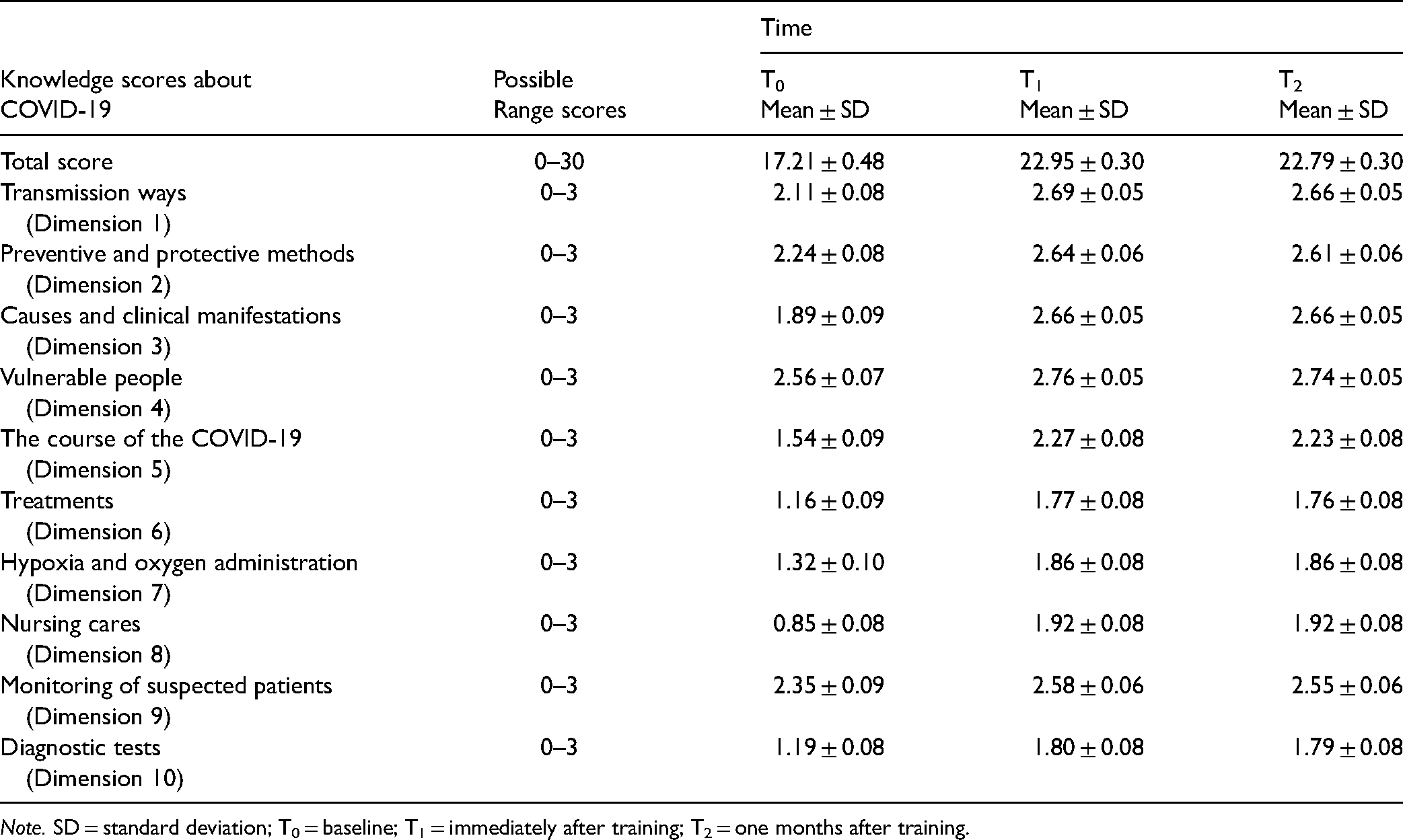
Table 3 indicated the descriptive statistics of the knowledge scores questionnaire. The mean value of the total score at baseline (T0) was 17.21 ± 0.48. The total mean score increased to 22.95 ± 0.30 and 22.79 ± 0.30 immediately (T1) and one month (T2) after the training program intervention. All dimensions scores of the knowledge questionnaire increased at follow-up measurements. The minimum and maximum mean dimensions at T0 were related to dimension 8 (nursing care, 0.85 ± 0.08) and dimension 4 (vulnerable people, 2.56 ± 0.07).
Descriptive Statistics of Knowledge Scores at Three Measurements Times (T0, T1, T2).
Pairwise Comparisons of Knowledge Scores
Table 4 represented the pairwise comparisons of mean scores among different measurement times. Bonferroni-adjusted post-hoc test illustrated a considerable amelioration between T0 and T1. Furthermore, there was significant amelioration among T0 and T2. No significant difference was observed between the T1 and T2 times. For the total mean score, the mean difference between T1 and T0 (5.74) and T2 and T0 (5.58) were significant (
Results of Pairwise Comparison Using Bonferroni Post-hoc Test.

*
The Average Changes in Knowledge Scores Over Time
Table 5 displayed the GEE model results. The main effect of time was significant for all knowledge scores. From baseline to immediately after training (B = 5.79) and one-month follow-up (B = 5.63), the total knowledge score of nursing students increased significantly (
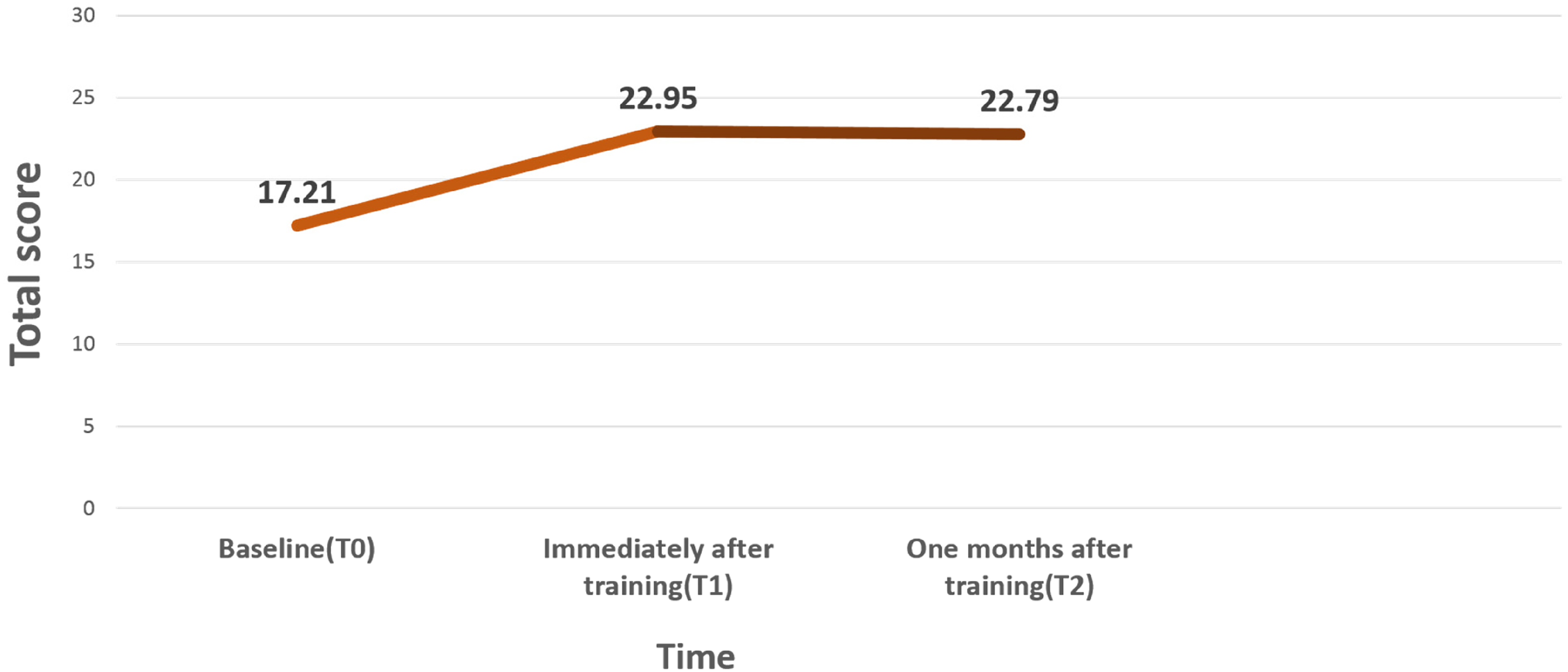
Changes in knowledge score about COVID-19 in nursing students.
Results of GEE Model in Knowledge Scores of Nursing Students About COVID-19.

GEE models were controlled for baseline characteristics (age, gender, volunteer in medical centers, experiencing home care of COVID-19 patient, infected with COVID-19).
Reference category was at baseline time (T0).
*
Discussion
The purpose of this study was to investigate the effect of the e-learning program for COVID-19 patient care on the knowledge of nursing students. The findings of the study showed that the total mean score of the knowledge of students increased significantly in all dimensions after the e-learning program for COVID-19 patient care. This could be due to the effectiveness of the training program.
During the COVID-19 pandemic, information technology has played a potential role in enhancing students’ knowledge and skills by combining real-world and virtual content such as text, audio, and video files (Feng & Mueller, 2019). In the present study, to educate students and hold an e-learning program for COVID-19 patient care, educational content was provided virtually to students. The results of the study showed that the total mean score of students’ knowledge and the scores of students in all dimensions investigated by the knowledge assessment questionnaire were moderate before the training program. In the study by Alsahafi and Cheng (2016), nurses’ knowledge of emerging infectious diseases was weak and the need for training programs on patient care, personal protective equipment, quarantine, and prevention of disease transmission was reported (Alsahafi & Cheng, 2016). Additionally, the results of studies conducted on students of the Universities of South Korea, England, and Hong Kong indicated a high mean score of their knowledge, which contradicts the results of the present study (Park et al., 2010; Rubin et al., 2009; Tang & Wong, 2004). These differences can be related to the different conditions of societies and the application of different educational methods. In this study, there was a significant increase in the total mean score and the scores of students in all dimensions investigated by the knowledge assessment questionnaire immediately and one month after the intervention compared to before the intervention. This could be due to the effectiveness of the training program.
In fact, compared to before the intervention, the total mean score and the scores of students in all dimensions investigated by the knowledge assessment questionnaire increased immediately after the intervention as well as one month after the intervention. On the other hand, the mean scores for knowledge of COVID-19 were not significantly different immediately after the intervention and one month later, indicating the consolidation of learning.
In this study, before the intervention, the lowest level of knowledge was related to the dimension of nursing care. This could be due to the fact that internships were held in a limited way during the COVID-19 pandemic and students did not have experience in clinical patient care. In addition, due to the emergence of the disease, nurses and nursing students had little experience in caring for patients with COVID-19 disease (Elgzar et al., 2020). However, nursing students are the group who has the closest relationship with the treatment team, can play a significant role in increasing community awareness, and will be part of the health care system in the future (Ranjbar Roghani et al., 2020). Due to the high prevalence of coronavirus disease, medical staff should have the necessary skills to diagnose and care for high-risk individuals and take measures to prevent the virus transmission, and the knowledge of COVID-19 plays an important role in the prevention of the spread of the disease (Gustafsson, 2020; Shi et al., 2020). The highest increase in the mean score of students’ knowledge was related to the dimension of nursing care so that there was a significant increase in the students’ score immediately and one month after the intervention compared to before the intervention. This could indicate the effect of the training program on the knowledge of nursing care.
After nursing care, the training program has the greatest effect immediately and one month after the intervention on the knowledge of clinical manifestations, COVID-19 duration, diagnostic and therapeutic measures, hypoxia and oxygen therapy methods, disease prevention strategies, examination and monitoring of the patient, and identification of vulnerable people, respectively. The results of the research show that the medical staff’s knowledge of coronavirus disease, its common symptoms, diagnosis, and treatment, identification of vulnerable people, and the disease prevention and transmission ways play an important role in reducing the disease, educating people in the community, and providing high-quality care (Rahmanian et al., 2021).
In this study, the highest level of the students’ knowledge before the training program was related to the identification of vulnerable people, and the lowest increase in the total mean score was seen in this dimension after the intervention. This is consistent with the results of the study by Rahmanian
Implications for Practice
The most important solution for controlling pandemics is to increase the knowledge of people in the community of infectious diseases because knowledge is a necessary condition for the promotion of preventive measures and the formation of positive behaviors. In the meantime, training nurses and nursing students is important to achieve maximum knowledge, awareness, and skills.
Recommendations and Implications
The training of students was carried out based on the assessment of their needs regarding COVID-19 patient care, which was one of the strengths of the study at a time when society was involved in this pandemic and it was not possible for students to attend hospitals and take care of these patients directly. In addition, virtual training, compliance with protocols to prevent disease transmission, avoiding gatherings for education, and the possibility of group discussions, sharing experiences, questions, and answers in the WhatsApp training group, and answering students’ questions were among the strengths of the study.
Turning the limitations existing for face-to-face education during the COVID-19 pandemic into an opportunity to promote virtual education and investigate the effect of this type of education on students’ awareness, which can be used in the post-Corona era as well, was another strength of the study.
In the design and implementation of the present research, it was tried to avoid any weakness or bias. However, there can be some recommendations for future research, including:
- Investigating the effect of the virtual training program for COVID-19 patient care on the performance and attitude of nursing students. - Investigating the effect of a blended training program for COVID-19 patient care on the awareness of nursing students.
Study Limitations
The traits of students and the psychological states caused by the COVID-19 pandemic during the participation in training courses and the completion of the questionnaire could affect the results of the research.
Students could get more information through the media, the internet, and the study, which could affect the results of the study, and this was beyond the researcher’s control.
Conclusions
Due to the effect of the e-learning program for COVID-19 patient care on the knowledge of nursing students, more training programs that are in accordance with current information and new scientific findings seem necessary because COVID-19 is an emerging disease. While being virtual and complying with protocols, these training programs can be considered a great opportunity for educational systems to improve and develop virtual education infrastructures to lead to better learning and be more effective. Therefore, the use of online education and its integration with face-to-face and traditional education can be effective in increasing students’ skills and competence. Accordingly, more attention should be paid to the issue of information technology and its application in various fields of education, the necessary infrastructures should be provided, and educational spaces should be equipped by the policymakers and decision-makers in this field to achieve the highest effectiveness in the theoretical and practical training of nursing students.
Footnotes
Acknowledgments
Declaration of Conflicting Interests
Funding
Ethical Consideration
ORCID iD
