







Abstract
Introduction
Since the first loans by Muhammad Yunus in 1967, microlending has become a global phenomenon of poverty alleviation, attracting much academic, political and professional attention and commentaries (Al-mamun et al., 2014; Cull et al., 2015; Hulme, 2000; Lopatta and Tchikov, 2016). Microlending, capturing both the original user-based term of ‘microcredit’ and the business term of ‘microfinance’, has been praised for its key innovation of replacing individual collateral by contextualized, social responsibility for repayment. In doing so, it is believed to meet the massive credit gap affecting the poor seeking entrepreneurial opportunities while lacking access to bank credit. For thus achieving ‘financial inclusion’ (Ghosh, 2013; Schwittay, 2011), Yunus and his legendary Grameen Bank were awarded the 2006 Nobel Peace Prize (Yunus and Jolis, 2007). However, microlending has also been criticized for not genuinely addressing the root causes of poverty, and, through its evolution into commercial microfinance, even providing a means for financial business to ‘make a profit out of poverty’, perpetuating unequal distributions of wealth and gender (Johnston, 2020; Worthen, 2012). Besides widespread anecdotal evidence of how microlenders fall into vicious credit traps, critical studies suggest that, on average, the rise and spread of microlending has not made any substantial contribution to wealth creation and more equal wealth distribution (Hickel, 2015; Roodman, 2012). From academic work to popular media, there is a continuous stream presenting evidence and arguments on the pros and cons of microlending, at general as well as detailed level.
Focusing on the multifarious case of microlending, this paper investigates what is called a ‘messy object’ (Blok and Farías, 2016; Law and Singleton, 2005) using the notion of an ‘issue trajectory’. In sharp contrast to (archetypical) consistent and focused objects, messy objects respond to multiple problematizations shapeshifting through time and space, while prompted and fuelled by a globally circulating concept such as an iconic policy model (Peck & Theodore, 2012). Examples of the latter are ‘science parks’ (Massey, 2005), ‘regional-industrial ‘clusters’ or ‘blockchain’ (Lagendijk et al., 2019). What characterizes such messy concepts is that they continuously waver between shapeshifting through local adaptations, and working towards common practices of stabilization and coherence. An important inspiration for understanding such ‘messy object’ manifestations stems from the post-structural angle of social-topological research, notably in the domain of philosophy and human geography (Allen, 2016; Barba-Lata and Minca, 2016; Paasi, 2011; Prince, 2017; Secor, 2013). A specific contribution comes from elaborations of spatial topologies notably by Actor-network theory (ANT) and its follow-up (Post-ANT) (Latour, 2005b; Law, 2004a). Yet, while this literature provides much insights into the ‘glocal’ (local-global) articulations of messy concepts, what appears to be missing is a thorough understanding of the dynamic, political nature of how messy concepts waver between shapeshifting and stabilization/coherence (cf. Farías, 2014; Massey, 2005). To provide such an understanding, this paper will elaborate and apply the notion of ‘issue trajectory’, drawing on the work of Latour (2005a, 2007) and Marres (2013) on ‘material politics’ (or ‘Dingpolitik’). An ‘issue trajectory’ traces the shifts and turns in the development and fate of an object, drawing attention to how objects ‘become invested with specific normative powers through the deployment of particular settings and devices’ (Marres, 2013: p. 419).
By applying the notion of issue trajectory to the messy object of microlending, the paper seeks to make three contributions. Firstly, the paper adopts a fully, ‘unbounded’ geographical approach to the spatiality of messy objects, exploring the ‘glocal’ aspects of topological connections. We thus acknowledge and meet Massey’s (2005, p. 9) call to ‘recognise space as the product of interrelations, as constituted through interactions, from the immensity of the global to the intimately tiny’. We do so by elaborating different conceptual and empirical kinds of mapping. Secondly, the paper provides an understanding of the dynamic political becoming of messy objects, notably of the exemplary case of microlending. To do so, we advance the theoretical bridge between socio-topological thinking and the Dingpolitical notion of ‘issue trajectory’. In our practical approach, this bridge yields a topological canvass used to underpin microlending’s conceptual mapping. Building on these various mappings, finally, we return to the problem that prompted the writing of our paper, namely, the divide between the social and commercial orientations of microlending, and provide one brief but hopeful suggestion for addressing this divide.
Before we introduce our case and approach, a few words on data. Our account is based on intensive engagement with the phenomenon, through processing a vast amount of literature, academic, professional, and media, our own data analysis and local fieldwork. The account focuses on the period 1980–2015. As with genealogical analysis, the study of object-formation focuses on ‘depth problems that swirl around the heart of who we are’ (Koopman, 2013: p. 2), in a way that is well grounded and plausible. Besides an extensive literature review, data collection is also based on numerous encounters with experts worldwide. Complementary ethnographic work has been carried out to zoom in onto ‘nodal’ cases, not covered here.
Microlending’s issue trajectory: The bringing to presence of a messy object
Microlending, as introduced above, entails a practice in which small loans are issued to lenders lacking collateral. Such practices helping the poor have existed for centuries, for instance as loans to young entrepreneurs in the 18th and 19th century across Europe (Hollis and Sweetman, 1998), or in the form of small farmer credit in the 1950s and 1960s (Rice, 1973). Yunus revived the practice through the concept of community-based social collateral (Levin, 2012), implemented by Grameen (‘village’) Bank in a rural area in Bangladesh in the 1980s. The initial success paved the way for decades of global proliferation, notably via global development agencies and charity networks, and prompted by prominent figures such as Bill and Hillary Clinton. Major events were the launch of the global Microcredit Summit Campaigns in 1997, and the spread of Grameen replica projects (Dattasharma et al., 2016; Jain, 1996; Morduch, 2000). Outside Asia, an important role in spreading the message was played by a US grassroots advocacy organization, RESULTS, which, already in the 1980s, supported local microcredit trials. Consequently, RESULTS prompted the Reagan Administration to pass microenterprise poverty lending legislation. Massive exposure resulted when CBS’ 60 Minutes program broadcast a documentary on Grameen in 1990. Global reach was achieved, consequently, through mounting interest from core organizations in development aid, particularly IFAD, the Ford Foundation, USAID, and the UN in general. The microcredit story thus reached out to sites far beyond its Asian cradle, including the ‘developed’ world (Daley-Harris, 2013).
This proliferation strongly affected microlending’s problematization. Through its repetitive implementation and wide circulation, the original problematization (how to provide small amounts of credit allowing villagers to invest in much-needed equipment, in the absence of individual collateral) widened to broader issues of boosting entrepreneurship and sustaining endogenous rural development (including the crucial aspect of maintaining sufficient levels of purchasing power) (Mader, 2015). It also took on global ambitions regarding poverty reduction, community development, and, because of the predominance of female clients, gender equality, without resorting to redistributional subsidies (Johnston, 2020; Rankin, 2002; Worthen, 2012).
Throughout the 1980s, Its rootedness in social development shaped microlending as a more or less ‘coherent’ object, albeit one with increasing flexibility or ‘fluidity’ (Law, 2004a) in its spreading local manifestations. This changed in the 1990s, when microlending started to appeal strongly to financial organizations and businesses. The latter embraced a new problematization, namely whether microlending could become a standard banking practice for the poor. Could microlending turn into new commercial business models enrolling, in mass, less-wealthy customers previously deemed unsuitable for banking? Hence, microlending became subject to financialization, advancing its problematization into two directions. First, the original socio-economic ambitions were juxtaposed with commercial goals with a stronger focus on business interests and gains (Brière and Szafarz, 2015; Cull et al., 2009; Hermes and Lensink, 2011; Krauss and Walter, 2009; Morduch, 2000; Weber, 2004). Second, financialization called for more consistency at the global level, through a more uniform calculative practice (Aagaard, 2011; Aitken, 2013; Canales, 2011; Copestake, 2007; Henriksen, 2013; Marconatto et al., 2016). Organizations such as the World Bank took far-reaching initiatives to standardize definitions, rules and practices of what now became labelled as ‘microfinance’. Because NGO and charity-based practices of microcredit also endured, including calls for flexibility, the result was an increasingly diverse microlending landscape. Indeed, an exploration of the literature on microlending reveals a wide variety of definitions, goals, actors, strategies, effects, actors, over many locations (Bateman, 2012; Bylander, 2014; Hudon, 2008; Marconatto et al., 2016; Radhakrishnan, 2015; Rao et al., 2009; Roodman, 2012; Shaw, 2004; Shoji, 2010; Tavanti, 2013).
With this diversity, microlending turned into a much messier object, with a growing, and increasingly dominant commercial orientation. The result was a divergence in problematization between a social and commercial orientation, and even a mounting gap between what microlending initiatives were doing in practice and which concerns they were expected to meet. We will describe this divergence as a ‘problematization gap’. This gap coincided with another divergence in microlending’s issue trajectory, namely between the opposing tendencies towards standardization and flexibilization. These two divergences (socio-economic versus commercial orientation; standardization and flexibilization) constitute two empirically grounded dimensions which will be used to plot microlending’s issue trajectory, as will be discussed in the sections below and concluded at the end.
(Im)mutable (im)mobile topological dimensions
To further study microlending’s issue trajectory, we develop a topological lens drawing on various relational perspectives, namely ANT, post-ANT, and Latour’s notion of Dingpolitik (Latour, 2005a, 2005b, 2007; Law and Singleton, 2005). The aim is not a theoretical synthesis, but to sharpen our concepts and tools to map and trace the becoming and proliferation of microlending as a highly messy and contentious issue. While topological thinking originates from modern mathematics and philosophy, it has obtained the status of ‘the ultimate engine of relationalism’ in social and cultural studies (Barba-Lata and Minca, 2016: p. 441). Like genealogy, this starts with the question of the becoming of the present, as discussed for microlending in the previous section. How does an issue (object, idea, practice, policy…) acquire global significance, reach and impact? How does this development shape diverse practices, realities and subjectivities? These fundamental questions have been addressed in profound and creative ways from a historical perspective, notably through the work of great scholars such as Braudel, Foucault, Deleuze and Guattari. Foucault, in particular, has played a pivotal role in providing a temporal understanding of the contingency and plurality of the unfolding of society (Koopman, 2013). Yet, while such historical perspectives include geographical details as factual markers, a profounder, relational geographical understanding warrants a deepening of topological thinking (Massey, 2005; Peck and Theodore, 2012). In a nutshell, such thinking critically assesses the becoming of issues (objects, ideas, sites, etc) through the circulation and encounter of practices through time and space, strengthening critical, genealogical research through geography.
Such a geographical orientation to genealogical work means that we go beyond geographical markers such as place, territory, scale and networks. Instead, we take on board the inherent spatial relationality and contextuality of each issue, in line with the work of Law (2004b) and Blok (2010) on ‘situated’ spatialities and globalities. In terms of policy mobility, this poses the challenge of ‘making sense of fast-moving “best practices” without losing sight of prosaic practice’ (Peck and Theodore, 2012: p. 25). In geography, a major contribution comes from Doreen Massey. In her landmark publication ‘For Space’, Massey (2005, p. 9) calls space a ‘sphere of the possibility [based on] contemporaneous plurality’. In such a sphere, ‘there are always connections yet to be made, juxtapositions yet to flower into interaction (or not, for not all potential connections have to be established), relations which may or may not be accomplished’ (Massey, 2005: p. 11). In Massey’s (p.77) rich vocabulary, the world’s ‘coexisting heterogeneity’ produces a ‘throwntogetherness’ of space giving rise to significant encounters and problematizations. That is, through our bodily encounters with other bodies (human and non-human) in places and across space, we sense and give shape to challenges, drives and issues. In more abstract terms, hence, issues are relationally constituted through the influx, translation and alignment of entities and tendencies drawn from multiple places through a variety of socio-spatial practices, investing issues with capacities, meanings, values and normativities (Blok, 2010).
How do we trace and map spatial topologies and their role in issue trajectories? That basically comes down to exploring the connectivities and associations between entities through which issues become and proliferate. Here, we build on ANT’s foundational thinking in terms of (im)mutability and (im)mobility. That thinking is rooted in Latour’s (2005a, 2005b, 2007) seminal work on ‘immutable-mobiles’ in the development of modern, technocratic societies through the proliferation of practices, such as classification, scripting, measuring, filing and tooling. Here, we define (im)mutability and (im)mobility as follows:
•
•
•
•
In line with Latour’s focus on the topological moment of the immutable-mobile, Post-ANT work has identified and studied three further topological moments: mutable-mobiles (‘fluid’), mutable-immobiles (‘fire’) and immutable-immobiles (‘region’, comparable to ‘throwntogetherness’) (Diken, 2011; Law and Mol, 2001; Law and Singleton, 2005). Our emphasis on issue
Dingpolitik
The political, as Latour has fiercely and repeatedly argued, revolves around the way issues (in the broadest sense possible) confront and mess with our collectives. The political turns around ‘questions, issues, stakes, things – in the sense of Res Publica, the public thing – whose surprising consequences leave those who would rather hear nothing about them all mixed up’ (Latour, 2005b: p. 352). Hence, issues are political, based on problematizations and issue trajectories, subject to ‘Dingpolitik’ (Latour, 2005a). Ding stands here for a gathering or assemblage infused by the weird-wired (socio)materiality of our world. Along a trajectory, Dingpolitik assumes different situational moments or modalities, acquiring political sense and meaning (Latour, 2007). Politics is not a site or activity, accordingly, but ‘what qualifies a type of situation’ as an act of politicization and political practice (Latour, 2007: p. 814). Latour tentatively identifies five such moments of political practice: 1. associational politics and the building of new ‘cosmograms’ (spatial-environmental world-pictures), 2. the confrontation of different publics, 3. state (sovereignty) politics, 4. deliberative politics (‘governance’) and 5. governmentality (as matter-of-factual, naturalized technocracy).
Importantly, as emphasized by Blok (2016, p. 110), these five moments should be seen as ‘an open-ended set of modalities for different socio-material worlds’ rather than a ‘well-ordered sequence of contestation and stabilization’. Rather than stages, these five moments present
To enable this and start our investigation, we project these Dingpolitical modalities onto our two-dimensional topological canvass explained before. In theoretical terms, this connection serves to further ground the relational ‘socio-material’ within a Dingpolitical perspective. Or to turn it around: this connection may help to counter the accusation that (post)ANT approaches poorly engage with critical-political thinking (Farías, 2014). Repeating the warning that issue trajectories do not follow simple paths along set moments, we will now discuss each in turn.
‘Throwntogetherness’
Our conceptual journey starts with the (re)prompting of an issue in particular sites of socio-material encounter or ‘throwntogetherness’ (Massey, 2005). Such encounter prompts the sense and articulation of matters-of-concern, shaping a first site and gathering of problematization. In our case, the story starts with the awareness of a community debt problem in some Indian villages and their Village Bank. In the words of Latour (2007, p. 818), such gathering entails ‘new associations and cosmograms’, forming aspirational and generative sets of relations between human and non-human entities, and new forms of agency (Blok, 2016). Crucially, while gathering practices inevitably involve many moments of circulation, for instance of emotions, ideas, and resources (Law, 2004b), what emerges and performs as matter-of-concern is not yet topologically mobile or mutable. In line with Massey’s (2005) vivid description of ‘throwntogetherness’, this is a moment of presence through lived, existential encounter. Issues breed in their microcosmical fold or ‘womb’, of which, topologically speaking, the spherical relations are momentarily fixed (Law, 1999). It is this very fixity which engenders and incubates an issue.
How does an issue trajectory unfold, through which topological moments? How does an issue evolve beyond ‘throwntogetherness’? How does it embark on new associations, bringing itself to presence elsewhere? While there are no set paths, two basic directions can be distinguished (Figure 1). The first path has arguably been the main theme of ANT. An issue’s problematization can be structured through existing social, economic, political and scientific frames, turning into manageable ‘matters-of-fact’. Issues thus transform in well-identified paths, with science as core arbiter, as detailed by Callon (1984, 2009). The main challenge, hence, is to become topologically mobile, enrolling and mobilizing actors, through the hard work of creating mediators and intermediaries (Callon et al., 2004; Latour, 2005b). This paves the road to governmentality, discussed further below. The second trajectory is more open and explorative, in line with Latour’s indicative sequence of Dingpolitical moments. Before turning mobile, it is important for an issue to bring itself to presence to new audiences and publics, thus creating literal Dingpolitik on the topological canvass of (im)mutable (im)mobile moments.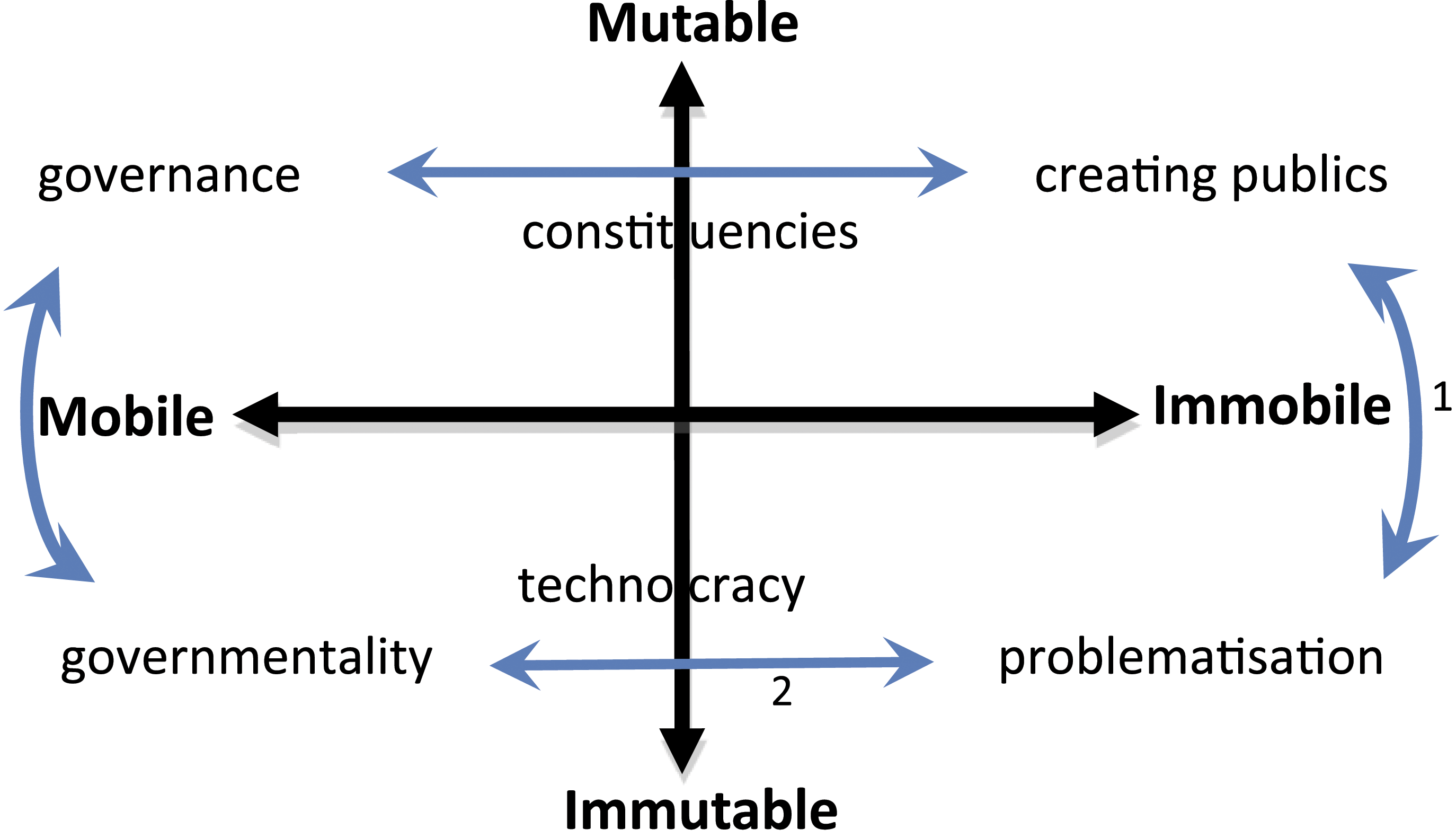
Creating publics
So issues become political by meeting and shaping different ‘publics’. In Latour’s (2007, p. 816). words, this happens ‘[w]henever an issue generates a concerned and unsettled public’. For our case study, the exposure of Grameen’s success to the world of development aid, and the wider world, presents a key illustration. Topologically, such an encounter entails a moment of communication, in the basic sense of making contact, whether through interest, irritation, perturbance or simply awareness. It is not (yet) about building a relation or association. Topologically, the moment can be described as mutable-immobile.
Following post-ANT thinking, the way an issue develops through mutable-immobile moments can be described through notions of ‘fire’ and ‘flickering’ (Law and Mol, 2001). Law and Singleton (2005, p. 347) speak of an object ‘that jumps, creatively, destructively and more or less unpredictably, from location to location. It is an object in the form of a dancing and dangerous pattern of discontinuous displacements between locations that are other to (but linked with) each other’. An important counterpart of such jumpy, unsettled presence is ‘flickering’ absence. In a topological perspective, what becomes present, and how, very much hinges on what remains absent or what is ‘othered’. Othering constitutes an issue by defining what it is
Dingpolitical ‘flickering’ takes the form of enflaming and spreading plural ideas through public arenas and the media, focusing attention and interest (Allen-Robertson and Beer, 2010). In modern societies, matters-of-concern become
Settled politics: Shaping constituencies and governance
We now move from a ‘flickering’ to a modern, organized world meeting ideals and practices of deliberative democracy. Under the latter, publics turn from concerned and agitated, to more settled, visible and expanding. Concerns narrow down to issues featuring at organized political stages with stakeholders, spokespersons, rules, procedures, conventions, paper trails, etc. Political practice becomes enacted in ‘deliberative assemblies’ that frame and order the plurality of voices and the multiplicity of issues (Latour, 2007). Through framing and ordering, ‘presences’ become more articulated and performative, while the flickering of absences is smothered (Micieli-Voutsinas and Cavicchi, 2019). If successful, addressing issues takes the form of puzzle-solving through seemingly ordered and responsible infrastructures of communication and governance. Two political modalities stand out here, namely constituencies formed through and around ‘deliberative assemblies’, and ‘governance’ as an orderly meta-assembly of different constituencies (such as state, business and different groups of civic society), sharing a common ‘neutral’ language.
Topologically, assemblies and governance require an issue to adopt a form that is mobile and can be enacted in different sites, while still presenting, and circulating, as an apparent whole. Governance practices tame and domesticate issues, while keeping them mutable. This can occur, for instance, through consensual expressions, open scripting, and flexible tooling. The quintessential example of such a mutable-mobile entity is De Laet’s and Mol (2000) ‘bush-pump’, adapted to and materializing in different Zimbabwean villages. In our case, such governance will become manifest through the ‘glocal’ networks and organizations shaping and dispersing microlending ideas and practices. As we will detail later, what made microlending whole as a ‘mutable-mobile’ includes a series of macroscopic practices such as organizational membership, cataloguing, and authoritative story-telling underpinning a shared identity.
However, settling into assemblies and governance always runs the danger of turning into, as Latour describes it, a ‘sad dream’ (Latour, 2007: p. 817). Absences extinguished by framing and ordering may flicker again due to impactful events and revelations. Governance practices are both inclusive and exclusive. If sentiments of exclusion and discontent mount, publics may become unsettled and antagonistic. What appeared topologically mobile may then turn immobile again, reigniting more fundamental struggles for publics and ordering. An unruly mob may even try to disturb and occupy an assembly site, including the seats of parliament. Our case will tell of struggles and occupations triggered by severe human and social despair resulting from microlending’s financialization. A critical question, then, is to what extent such frictions open the door to ‘generative othernesses’ mentioned above.
‘Governmentality’
Besides inducing mobility, modern drives to order and control also strive for immutability. In Latour’s words, this final modality displaces the problematization and handling of issues to the ‘daily routine of administration and management’ (Latour, 2007: p. 817). The latter address issues through the rational-frames of economics, managerial politics and science, and the ordered wheels of bureaucracy, as captured by Foucault’s notion of ‘governmentality’. Wherever possible, modern order relies on mathematical metaphors ‘as channels to a transcendental unity (…) picked up and used to represent (but also to enact) the world’ (Callon et al., 2004: p. 4). Variegated matters-of-concern are thus narrowed to fully domesticated and regimented matters-of-fact, circulating and enacting an issue through a highly standardized framing of subjects and objects. The major concern becomes efficiency, defined through single, calculated truth enacting an ordered, coherent and, as far as possible, formalized (axiom-based) reality. Indeed, as Latour (2004, p. 232) argues, the basic problem with matters-of-fact is not a lack of truth, but their partiality: ‘Matters of fact are only very partial and (…) very polemical, very political renderings of matters-of-concern and only a subset of what could also be called states of affairs’.
Topologically, this presents the immutable-mobile moment. Immutability ensures full equivalence of all relevant sites and contexts. Mobility enables full transparency across sites. Together, immutability and mobility support full capacity to scale and calculation. Consequently, the transformation to governmentality is deeply double-faced. On the one hand, as we will also witness in the proliferation of microlending, the scaling and calculation capacities stemming from immutable-mobility can be empowering and highly productive. It allows practices to gain high efficiency and reach (albeit on their own terms). Establishing general equivalence between local microlending practices (MFIs) enables smoother associations with other circuits, like global development aid and financial capital. With a regimented, immutable-mobile presence, an issue can mobilize stakeholders and gain support with more intensity and clout. On the other hand, the closure and partiality of governmentality runs a major risk of creating massive problematization gaps. By its very nature, governmentality severs links to audiences, deliberations, generative othernesses and lived realities outside of its own frame. Taken to its extreme, technocratic closure may lead to a situation in which axiomatic practices of politicization and bureaucratization define how issues are ‘discovered’, ‘identified’ and fixed (Barba-Lata and Minca, 2016; Deleuze and Guattari, 1988). Cut loose from other realities and sites, matters-of-fact may become overwhelmingly self-referential, such as the self-propelling growth of the financial sector (Rahman, 2014). When confronted with pressing problematization gaps, a common response is to retune and recalibrate methods of defining, scripting and measuring, creating ‘better’ calculations. Another response is to turn to governance, by developing more flexible scripts and tools to accommodate variations in contexts. The real challenge for meeting problematization gaps, however, is to reach out to wider (emergent) publics, that is, to see problematization truly from a perspective of those affected (cf. Figure 1). We will return to the latter challenge in the conclusion.
With this issue-based topological lens, the remainder of the paper will focus on three critical directions in microlending’s issue trajectory: (1) financialization through top-down imposition of topological mobility; (2) the fight for more openness and flexibility, meeting the widening problematization gap, and (3) a return to immobility, in attempts to re-root microlending practices in their local settings.
Imposing mobility: Financialization and standardization
As introduced in Section Two, microlending underwent massive change through a process of global financialization. Entering the context of global finance came with new impositions, notably scaling and standardization, through the adoption of standard banking technology and routines: ‘To control costs, microfinance institutions (…) must streamline and routinize the exchange of money between staff and clients. Microfinance must be mass-produced’ (Roodman, 2012: p. 127). Besides the World Bank, standards originated from the compliance and rating agencies in charge of controlling the financial sector across the globe were applied to local microlending practices, now renamed as ‘
Moreover, in order to create ‘transparency’ and a ‘factual’ basis of policy-making, UNCTAD and the World Bank set up a global database, Mix-Market, to code and count MFI activity worldwide. This came with principal criteria and protocols detailing how and which to collect, store, represent and analyse microfinance data. Since its launch in 2002, Mix-Market has played a key role in creating oversight which has been mined for dozens of microfinance studies worldwide (Ahlin et al., 2011; Cuéllar-Fernández et al., 2016; Culley et al., 2010; Hartarska and Nadolnyak, 2008; Hermes et al., 2011). Likewise, microfinance rating agencies appeared and adapted Standard and Poor’s evaluation methods (Beisland et al., 2014; Gutierrez-Nieto and Serrano-Cinca, 2007), whilst standard ratios and benchmarks were developed to measure (financial) performance through comparable, widely accepted, and cost-effective indicators (CGAP, 2006: p. 29). The arguments and rules for central microfinance data collection, storage, and research rules serve to frame the basic mechanisms of lending, risk management and profit-making. Mader (2014, p. 77) writes that ‘the financialization of microfinance is so dominant that it is presented as being part of the transnational financial market, exerting normative power in favour of certain rule-regimes, such as liberalized banking regulations’. Rather than a development tool channelling investment-oriented development aid, microfinance became a practice capable of generating financial yields for investors, creating profit out of poverty (Aitken, 2013; Schwittay, 2011).
In topological terms, financialization imposed a strong drive to the use of immutable-mobile devices and connectivities. However, standardization also hit a barrier. Because of the small size and site-dependent nature of the loans, global compliance continued to warrant national and local adaptation of standardized practices, and customization of rules and norms. So, given major differences between local contexts of microlending, it proved impossible to turn the rules and calculative practice into detailed global scripts. The trend towards financialization, accordingly, resulted in many local versions. An illustration for the practical need for customized practices comes from Canales (2011, p. 103): ‘If the policies are too rigid, we need to be able to provide our clients with different options, we need to find alternative solutions (....) I can’t just go directly against a policy, but I can combine different policies creatively and present my client with options to solve her problem’. What resulted, hence, was a complex, top-down system of global orchestration and circulation of financial practices of standardization and scaling, supported by massive investments, matched by continual adaptation of local practices and forms of microlending.
This mutability, however, was primarily technical and instrumental. It was not an expression of political and policy autonomy. In topological terms, mutability served to prevent financializing microlending practices from rupturing while travelling, giving different sites of microlending a single kind of presence that could be expressed, registered, counted and amassed in databases such as Mix-Market. To use the terminology of Lépinay (2007), mutability endows an issue like microlending with ‘liquidity’, enabling its circulation through the ‘mainstream’ circuits of (socio)economic development and support. In other circuits, however, a different response emerged, as discussed below.
Calling for more mutability: Socio-economic versus financial concerns
Due to financialization, after 2000 microlending’s goal of profit-making overtook its goal of poverty alleviation (Roy, 2010). One of the most prominent signals was the extremely profitable stock offering (IPO) of the Mexican MFI ‘Compartamos’ in 2007, featuring in the international media (Aagaard, 2011; Quayes, 2012; Worthen, 2012). Although this had been preceded by other initial public offerings, for instance the BRI IPO (Indonesia, in 2003), and the Equity Bank IPO (Ghana, in 2006) (Mader, 2014), the Mexican IPO caught global attention due to its intensity and the size of its profits, and triggered an overwhelming interest from financiers in microfinance. Microfinance thus became mobilized as ‘an asset class’ (Daher and Le Saout, 2015), offering an attractive, global opportunity for portfolio diversification (Galema et al., 2011; Janda and Svárovská, 2010). Accordingly, what had started as ‘financialization of microcredit’ advanced through growing ‘commercialization of microfinance’ (Brière and Szafarz, 2015), motivated and justified by its high and safe levels of return. Because of its decentralized nature and relatively strong commitment to repayment, the risk of defaults was seen as slow and the value of expected recoveries as good, turning microfinance into an attractive opportunity for portfolio growth and diversification (Krauss and Walter, 2009).
In time, the growing schism between the poverty reduction approach associated with development aid and the commercial profit-seeking approach gave rise to a mounting problematization gap (Hermes and Lensink, 2011; Hudon, 2008; Morduch, 2000; Roodman, 2012). Around 2000, the problematization gap was framed as a mission drift in which microlending institutions were scaling-up their business and increasingly targeted the ‘better-off’ poor instead of the ‘very poor’ (Hishigsuren, 2007). Serious doubts emerged about the extent microlending practices would be able to truly meet the ‘double-bottom line’ of microlending’s socio-economic and financial ambitions. Turning increasingly financial and commercial, microlending was accused of merely embracing a neoliberal doctrine, to create profit for already well-off investors. It was questioned which place the pursuit of explicit development goals had in the context of increasing specialized commercial microfinance (Aitken, 2013; Cull et al., 2009; Weber, 2004). Following this line of thinking, the problematization gap became framed in terms of a standoff between a commercially oriented ‘Washington consensus’ on microlending, led by the World Bank, and an opposing socially oriented ‘Bangladesh consensus’ on microlending, led by Grameen Bank (Roy, 2010). The director of ASA, one of the biggest microlending institutions in Bangladesh, shared during an interview in 2004: ‘The Bangladesh model has grassroots organizations that serve the poor and that cannot accept the types of commercialization that are being imposed in top-down fashion by CGAP. They think in profits in their banking model, we think of poverty in our NGO model’ (Roy, 2010: p. 101). Topologically, what had become the undercurrent of poverty reduction through socio-economic development thus continued to ‘flicker’ as a ‘generative otherness’.
However, how to address the gap with commercialization proved difficult for the advocates of the ‘Bangladesh model’. A dominant strategy was to extend, rather than counter, the financial side’s use of calculative practices (Kent and Dacin, 2013). For a long time, most MFIs assess their socio-economic performance through the measures in the so-called ‘Yaron’s framework’, equating socio-economic performance with outreach (number of clients) (Gutierrez-Nieto and Serrano-Cinca, 2007; Hartarska and Mersland, 2012). To be sure, the microcredit model has been celebrated for the extent of outreach achieved, as illustrated by the goal of reaching 100 million poor people with credit for self-employment by the year 2005, set during the first microcredit summit campaign in 1997. This focus was later heavily criticized for the fact that ‘reaching’ people with microcredit says little about the effect that it has on poverty (Bateman, 2010). So the call was on for more precise socio-economic impact indicators (Bastiaensen et al., 2013; Henriksen, 2013). However, socio-economic performance assessments proved incapable of achieving the same clarity, consistency, and level of acceptance as financial performance assessments (Copestake, 2007). In 2002, in response, the Social Performance Indicators Initiative was launched. The initiative was administered by CERIS, a platform of France-based microlending support organizations (CIDR, CIRAD, GRET and IRAM), under coordination of CGAP (Gutierrez-Nieto and Serrano-Cinca, 2007). Three years later, a Social Performance Task Force (SPTF) was created motivated by the Argidius Foundation, CGAP, and the Ford Foundation. SPTF has served as a forum for defining socio-economic performance, creating a common framework on the basis of Social Performance Standards (Bédécarrats et al., 2011; Casselman et al., 2015).
As a result, alongside commercial indicators, a number of socio-economic indicators were fine-tuned and included in the performance calculations. These calculative practices thus brought social norms more to presence in the financialized context of microlending. What is more, evaluating socio-economic performance of microlending has been taken seriously in microlending research and ratings (Allet and Hudon, 2015; Cuéllar-Fernández et al., 2016; Gutiérrez-Nieto et al., 2016). However, although this shift prompted some changes in more specific regulatory contexts, it has not produced a coherent, integrative working practice of microlending. While some operational consensus was reached in the form of financial and socio-economic calculative practices, through extending their mutability, no consensus emerged on either the concept of microlending or on overall the values and ambitions. The problematization gap remained.
Battling for immobility: Despair and hope
In many places, the enrolment and mobilization of microlending projects through homogenizing financial practices resulted in major tensions, and even outright failure, hitting at the heart of local communities. Tensions and failure resulted from acceleration of capital injections and lending resulting in excessive rises in client numbers and loan sizes, prompted by the normalization and standardization scripts of commercializing microfinance (Mader, 2014). Interestingly enough, ample warnings and facts of over-indebtedness of microfinance clients surfaced, but these were explained away by blaming the sector through qualifications such as ‘oversaturation of the market’ and ‘unsustainable finance’ rather than to the accelerating financial practices themselves. In time, however, failures turned into spiralling indebtedness and default, bringing to presence what the regulatory scripts of commercializing microfinance should have prevented (Johnston, 2020; Mader, 2015). The primary response to this was to actually reinforce commercial standardization and secure more liquidity for the sector by encouraging linkages between MFIs and banks. Other responses included the transformation of NGO-MFIs into commercial regulated entities, and the improvement of database transparency. Failure was attributed to lenders’ residual dependence on development aid and subsidies, prompting further consolidation of microlending through tightly controlled calculative practices (Schicks and Rosenberg, 2011).
However, such a response proved more difficult for another kind of flickering, namely, social contestation and protest. The 2000s witnessed waves of protests and demonstrations against financialized microlending practices across the world. Demonstrations materialized for instance in Bolivia in 2000 (Rhyne, 2001), in Morocco in 2007 (Miyoshi, 2014), in Pakistan and Nicaragua in 2008 (Bastiaensen et al., 2013; Mader, 2014), and in Andhra Pradesh, India, in 2010 (Ghosh, 2013; Taylor, 2011). Through hunger strikes, payback strikes (‘No Pago’), various small but vocal demonstrations, and ultimately the hostage taking of bank staff in Bolivia in 2001 (Bustelo, 2009), demands were voiced of debt relief, grace periods, longer loan terms, and reduced interest rates. Most dramatically, 2010 saw were various reports of suicides related to over-indebtedness induced by microcredit in India (Biswas, 2010). More than failure, these lived realities of microlending could not be simply regulated away. Rather, these confronting encounters and realities resulted in attempts to re-politicize microlending, that is, to return to the basic matters-of-concern. Bastiaensen et al. (2013, p. 882) state ‘it is crucial that the debate about microfinance and microfinance itself be re-politicized’ (cf.Rankin, 2002). This call re-established a link with Yunus’ original emphasis on social mobilization and the building of alliances among the poor to create counter-establishment forces. Yunus and Jolis (2007, pp. 195–196) considered microcredit as part of a localized system of democracy and joined development, strongly territorialized: ‘Democracy allows the poor to take advantage of their greatest asset: their large numbers. To do so, they must be actively organized. For the 1991 elections I ensured that 100 percent of all adult Grameen family members were registered to vote. I also recommended that each [Grameen] center collectively decide which candidate the members would support and that they parade to the voting booths together as a voting bloc. In 1992, some four hundred Grameen borrowers were elected to union councils, and in 1996, more women voted in the national election than men, which helped to nearly wipe a political party that had taken positions against women’s rights out of the Parliament. In 1997 many Grameen (family) members were elected to local offices, constituting 6 percent of the total elected representatives in all the local bodies in the country’
However, in view of the advanced, globalized and financialized state of microlending, re-politization warrants more than a return to a more locally rooted lending practice. It also requires a fundamental debate about the ‘roots’ and ‘publics’ of the movement itself. Already in 2001, that was an issue raised by Imran Matin, a major NGO-player in the field: ‘Some in Washington DC have the power to say what is appropriate and what is not. They insist that one has to first build financial institutions and then do social development. That is not our history. We did not start out as financial institutions’ (Roy, 2010: p. 102, p. 102)
More recently, a broader set of debates has emerged exploring the (socio)material basis of microlending, and calling for alternative foundations. Prompted by debates on sustainability, a suggestion is to extend commercial and socio-economic norms with an environmental pillar to, thus shaping a kind of ‘green microfinance’ (Allet and Hudon, 2015; Forcella and Hudon, 2016; Moser and Gonzalez, 2015). Other experiments may stem from a growing interest in ‘rent-free’ Islamic microlending practices (Barden, 2010; Kaleem and Ahmed, 2010), the first connections that are made between the circular economy and microlending in popular media (Miyoshi, 2014), or the proposals for a basic income (Hanlon et al., 2010). Such moves are backed by the idea that microlending, through its very nature, is less susceptible to speculative financial wizardry. In the words of Yunus: ‘The simple reason is because we are rooted to the real economy—we are not paper-based, paper-chasing banking. When we give a loan of $100, behind the $100 there are chickens, there are cows. It is not something imaginary’ (Rahman, 2014: p. 957). A problem, however, is that these debates tend to focus on the direct motives and logics of microlending practices, rather the more fundamental question of how underlying matters-of-concern are presented, to which publics, for which constituencies, and through what kinds of dialogues. In hindsight, despite Yunus inspiring words regarding democracy, this has arguably been an omission even in microlending’s early days. Even then as described in Section Two, the phenomenon became quickly captured by leading organizations and global celebs. In other words, the pressing question is to what extent current calls and moves provide enough clout for an open and engaging modality of Dingpolitik to really affect microlending’s issue trajectory. What is hopeful, though, is that microlending continues to confront our deeply financialized economic practices with fundamental, grounded questions of development and territorialization.
Three plots to conclude
Since the late 1960s, microlending (microcredit plus microfinance) has undergone an eventful, jumpy and swirling issue trajectory. This paper has explored that trajectory, using topological mapping inspired by (post)ANT thinking, Latour’s notion of Dingpolitik, and the rich literature on microlending. Our aim here thus was threefold, namely, first, to map a genuinely ‘glocal’ issue trajectory, based on, second, an approach bridging topology and Dingpolitik, considering, third, prospects for change. In this conclusion, each aim will meet a final plot.
Our first plot tracks microlending’s issue trajectory along two tensions, namely standardization versus flexibilization and socio-economic versus commercial orientation. This plot marks what, in our view, are the key moments in which microlending’s glocal events, through their topological makeup and impact, shaping its issue trajectory. The first tension stems from the fundamental drives towards standardized practices, aiming at a globally consistent object through fixity and calculation, and towards flexibilization, aiming at coherence through shared norms, goals and debate. In the microlending case, this critically revolves around the process of, and responses against, financialization (
Using these two axes, Figure 2 shows how microlending’s issue trajectory runs from Grameen’s original site-specific, socio-economic practices, via the global leveraging and homogenization of financial practices (CGAP), and countermovements focusing on social aims (CERIS), to groundswells of reviving, diverse social practices (green, Islamic, etc.). Although our account only provides a digest of the multitude of practices involved, it indicates how the hard and generative work within MFIs worldwide, including calls for flexibility and dialogue (‘bottom up’), meets strenuous efforts to develop and impose frames and devices for stable circulation and scaling (‘top down’). However abridged, Figure 2 gives us a window on, to repeat Massey (2005, p. 9), microlending’s ‘sphere of the possibility [based on] contemporaneous plurality’. Key moments in the microlending issue trajectory (own elaboration).
The second plot charts key parts of the issue trajectory onto the topological canvass of Figure 1 above. It thus marks core moments of (im)mutable (im)mobility, placing them in the perspective of Latour’s Dingpolitical modalities. Based on our review, this yields a threefold trajectory (Figure 3). The first arrow describes the dominant transition from the Grameen’s success and rapid global proliferation to financialization under the top-down orchestration of the World Bank, NGOs and other ‘global’ players. The main aim here was to capture microlending in a neoliberal, technocratic regime of capital accumulation, moving swiftly from problematization (how to ‘bank’ the poor) to governmentality (how to impose and check calculative practices). Yet, because of the nature of microlending (small loans issued across very different sites), successful propagation and amassing of calculative practices warranted a certain level of mutability, pushing the trajectory towards mutable-mobile (hence the split arrow). The second arrow reflects the response to the problematization gap prompted by financialization, extending mutability towards socio-economic concerns. As explained in the section Microlending’s threefold issue trajectory (own elaboration).
Our third plot, meeting the paper’s third aim (prospects for microlending), builds on the third arrow in Figure 3. Our exploration suggests that Dingpolitik may incite a trajectory of hope, through its grounding in lived materiality, and its calls for issue-specific dialogue, publics, and political practices. From a critical geographical perspective, this also meets Massey’s (2005, p. 195) closing words, to embrace space as ‘the radical contemporaneity of an ongoing multiplicity of others, human and non-human; and the ongoing and ever-specific project of the practices through which that sociability is to be configured’. To (re)root microlending practices, it may be useful to conceive MFIs, including the circuits in which they are embedded, as territorial projects. As so well illustrated by Grameen’s early success, this territorialization presents the key context for politicization, for debating matters-of-concern, engaging with publics, developing financial practices etc. However, such territorialization is essentially glocal, involving complex infrastructures inscribing a myriad of political and moral capacities, as well as all kinds of organizational and economic interests (Callon et al., 2004).
So, what could such a territorial project entail? We imagine a scenario drawing from a foundational aspect of microlending, namely the practice of social collateral underwriting individual credit. To counter the perversion and despair caused by financialized microlending, and to re-orient MFIs to communities’ socio-economic ambitions, microlending as a territorial project should start from a political debate on the nexus between trust and credit, and the practice of social collateral. To pursue this issue, the debate can benefit from other forms of community-based credit, like credit unions, and circular and complementary currencies, in which themes of trust, collateral and material practices have received ample attention (Fama et al., 2020; Meyer and Hudon, 2019; Motta et al., 2017). Consequently, mobilizing other publics and organizations may help to develop more socially oriented financial practices with sufficient flexibility and capacity for learning and adaptation. With this final plot, we hope to have further illustrated the significance of topological and Dingpolitical thinking about ‘messy objects’ playing such a multifarious role in meeting key societal challenges.