Although problem posing is rarely mentioned in the German primary school curriculum, it is recognized as a valuable mathematical activity that requires students to formulate and solve their own problems. However, little is known about how problem-posing tasks are integrated into mathematics textbooks, potentially limiting their effective use in classrooms. This study addresses this gap by analyzing the presence of problem posing in German educational standards and the integration of problem-posing tasks in two widely used German textbooks, Das Zahlenbuch, and Welt der Zahl, across Grades 1–4. The textbook analysis focuses on four key aspects: (a) the number of problem-posing tasks relative to all tasks to assess their significance in the implemented curriculum, (b) their distribution across mathematical content areas (numbers and operations; geometry; measurement; and data, frequencies, and probabilities), (c) the structure of problem-posing situations (structured vs. unstructured), and (d) the nature of the posed problems (routine vs. non-routine). A qualitative content analysis revealed that problem posing is rarely mentioned in educational standards and is almost exclusively linked to mathematical modeling. In textbooks, problem posing appears infrequently, with Das Zahlenbuch including more tasks than Welt der Zahl. Across all grades, tasks predominantly occur in numbers and operations, are mostly structured, and evoke routine tasks. These results provide insights into how problem posing is integrated into textbooks and highlight areas for further discussion on its role in primary mathematics education.
In school mathematics, problem posing is valued not only as a means of assessing students’ understanding but also as an instructional strategy that promotes mathematical reasoning, creativity, and flexible thinking (English, 1997; Silver, 1995). Several curriculum standards worldwide emphasize problem posing as an integral part of mathematics education. For example, the National Council of Teachers of Mathematics’ (NCTM) Principles and Standards for School Mathematics highlightsg that students should formulate interesting problems based on various situations, both within and beyond mathematics. Problem posing is presented not only as a valuable complement to problem solving, but also as a means to deepen students understanding of mathematical content and the nature of doing mathematics itself (2000). Asking the question “What if one condition of the problem were different?” (Brown & Walter, 2005) can be pursued within mathematics or in real-world scenarios in the context of mathematical modeling. In Germany, Schupp (2002) took up Brown and Walter's idea. Schupp proposed 24 task variation strategies that students can use to engage in the activity of task variation in a regulated way. These strategies include analogizing, generalizing, and specializing, as well as sense-making, reversing, and iterating.
At the primary school level, problem posing can be beneficial for fostering a conceptual understanding of mathematics. Young learners engage in problem posing when they generate, for example, arithmetic word problems, extend patterns, or create variations of familiar problems. Such activities encourage them to reflect on mathematical structures and relationships, reinforcing their problem-solving skills and deepening their engagement with mathematical concepts. Research indicates that primary school students are capable of posing solvable problems, and analyzing responses from second- and fourth-grade students can provide insights into their mathematical understanding and highlight areas for improvement (Bevan & Capraro, 2021). Furthermore, explicit instruction in problem posing has been shown to enhance both problem-solving and problem-posing skills in elementary students (Kopparla et al., 2019).
Research questions
Because of its importance for teaching, especially for young students, our first guiding question investigates the status and importance of problem posing in the German educational standards for primary school mathematics (Kultusministerkonferenz [KMK], 2022). However, we are aware that the intended curriculum as determined in official documents by the educational organizational system does not necessarily reflect the implemented curriculum, which is enacted at the school level (cf. van den Akker, 2003). Although textbooks do not fully determine what happens in classrooms, they represent a key component of the implemented curriculum as they strongly influence planning and instruction (Johansson, 2003; Rezat et al., 2021). Therefore, our second guiding question relates to the status and importance of problem posing in German mathematics textbooks, examining how and to what extent it is incorporated into instructional materials. To answer both research questions, we perform document analyses.
Theoretical background
Problem-posing tasks: Situations and prompts
In recent years, several proposals have been made to clarify the terminology regarding mathematical problem posing. Cai et al. (2024) suggested explicitly distinguishing between situations and prompts in problem-posing tasks. A problem-posing situation provides the context and initial information that students use to formulate mathematical problems, whereas a prompt directs students on how to engage with that situation. These distinctions are particularly relevant for textbook analysis, as different curricula integrate problem posing in varying ways.
Baumanns and Rott (2021) conducted a systematic literature review categorizing problem-posing situations along two key dimensions: (a) the level of structure in the given situation (structured vs. unstructured) and (b) the nature of the mathematical problem (routine vs. non-routine). The question of problem-posing structure was originally introduced by Stoyanova and Ellerton (1996), who distinguished between free, semi-structured, and structured situations. However, Baumanns and Rott (2021) demonstrated the difficulty of categorizing problem-posing situations into these three rigid categories, instead proposed distinguishing structured situations—with a given initial problem—from unstructured situations, which can be seen as existing along a spectrum defined by the amount of information provided. In this spectrum, some problem-posing situations allow for open-ended exploration, whereas others are more constrained and guide students toward specific problem formulations.
Problem-posing tasks typically consist of two key components: the problem-posing situation and the problem-posing prompt (Cai et al., 2024; Kontorovich, 2023). The combination of these elements influences the nature of the problems students generate and the cognitive processes involved in the posing activity (e.g., Baumanns & Rott, 2025).
A problem-posing situation provides the context and initial information that students use to formulate mathematical problems. Situations can be classified into structured and unstructured categories (Baumanns & Rott, 2021; Stoyanova & Ellerton, 1996).
Structured situations provide a well-defined initial problem. Students are expected to generate new problems based on a given problem. These situations include an explicit problem that serves as a reference point for posing new problems. For example, “My number is bigger than 6 + 7, smaller than 23 – 5, it is even and not the double of 8. What is my number? Come up with your own number puzzle.”
Unstructured situations provide a more open-ended context, often allowing students to generate problems based on their own observations and interpretations. These situations vary in their degree of openness, ranging from problem-posing tasks with hardly any restrictions to tasks that provide a given mathematical input or structure that needs to be explored. For example, Bonotto (2013) used a brochure containing special rates for groups visiting an amusement park with different prices as a problem-posing task for primary school students.
Research suggests that structured situations encourage more creative and diverse problem posing, as they provide more guidance and support, which can also be beneficial for younger students or those with less experience in problem posing (Baumanns & Rott, 2024).
For problem-posing tasks, prompts function as triggers that initiate the problem-posing process and determine its direction (Cai et al., 2024). A general prompt, such as “pose a mathematical problem,” allows for open-ended exploration, whereas a more specific instruction, such as “pose a problem appropriate for a mathematics competition,” imposes specific constraints on complexity and audience. Effective problem-posing prompts can incorporate multiple layers of information, including the number and variety of problems to be posed, their level of difficulty, the target audience, and specific mathematical content or educational goals. By thoughtfully designing prompts, educators can scaffold students’ problem-posing skills, fostering both creativity and deeper mathematical understanding (Baumanns & Rott, 2024; Cai et al., 2023).
Posed problems
Baumanns and Rott (2021) suggested distinguishing between routine and non-routine problems within structured situations. This distinction is dependent on the solver (Schoenfeld, 1992), indicating that what constitutes a routine problem for one student might be non-routine for another. In general, routine problems are tasks for which students already possess a well-established solution schema; these typically involve straightforward applications of known mathematical procedures. An example of a routine problem is: “John has 8 apples. He buys 5 more. How many apples does he have now?”
In contrast, non-routine problems require students to explore unfamiliar strategies, recognize underlying patterns, or generalize mathematical ideas, thus engaging them in higher-order thinking. These problems typically do not have immediately apparent solution methods. An example of a non-routine problem could be: “Find all possible ways to divide 24 candies among four friends so that each friend receives a different number of candies.”
Although the categorization into routine and non-routine problems can be clear in many cases, the distinction itself is inherently flexible and context-dependent. As Schoenfeld (1985) emphasized, the routineness of a task varies according to individual knowledge and prior experience; hence, a task involving fractions may be routine for students familiar with basic fraction operations but non-routine for others who have not yet consolidated this knowledge. Similarly, a problem that initially appears non-routine can become routine after repeated exposure or explicit instruction by the teacher. This nuanced understanding acknowledges that the demarcation between routine and non-routine problems is not sharp but exists along a continuum (Pólya, 1966).
To ensure analytical clarity in this study, we explicitly define routine and non-routine problems based on typical curricular expectations and students’ anticipated familiarity with the mathematical concepts involved. This practical approach allows consistent categorization while acknowledging individual variability.
Basic structure of the educational system in Germany
Following optional educational offerings (Kindergarten and pre-school), obligatory education starts with primary school for all children aged 5 or 6 years. Generally, in all German federal states, primary schools (Grundschule) cover Grades 1–4, except for Berlin and Brandenburg, in which primary school covers Grades 1–6 (KMK, 2023). After primary education, there are three different types of Secondary Level I in Germany, namely Hauptschule, Realschule, and Gymnasium (see Figure 1). There is also a comprehensive school (Gesamtschule) which combines the three different types of secondary schools (Leuders et al., 2005).
Diagram of the regular education system of Germany. The diagram is adapted from KMK (2023).
The Hauptschule has subjects with some vocational-oriented courses. The Realschule leads to part-time vocational schools and higher vocational schools. The Gymnasium prepares students for university study or a dual academic and vocational credential.
Curricula in Germany
After the so-called “PISA shock” following the 2000 PISA study with unfavorable results for the German educational system, the Standing Conference of the Ministers of Education and Cultural Affairs of the Länder in the Federal Republic of Germany published new curricula for all school types and subjects (Faas, 2013; Neubrand, 2018). For mathematics, the new curricula highlight process—as well as content-related competencies oriented on guiding ideas, which are both seen as being characteristic of mathematics and closely intertwined. For primary schools, the six process-related competencies are communicating, modeling, using objects and tools, thinking mathematically, solving problems, and arguing. The five content-related competencies are numbers and operations; sizes and measurements; patterns, structures, and functional context; space and form; and data and chance (KMK, 2022, p. 6). Additionally, three “requirement areas” (Anforderungsbereiche) are distinguished in the acquisition of both process- and content-related competencies, namely (I) reproduction, (II) making connections, and (III) generalization and reflection.
These educational standards of the Standing Conference are the foundation of all curricula of the 16 German federal states. In the state-specific curricula, requirements are specified and sometimes more content is required, but they can never demand less than specified in the national educational standards. The state-specific curricula can also rename the competence specifications and summarize them differently. For the federal state of North Rhine-Westphalia, the five process-related competencies are problem solving, modeling, communicating, arguing, and representing and the four content-related competencies are numbers and operations; space and shape (i.e., geometry); sizes and measurement; and data, frequencies, and probabilities.
Prior research has shown that the presence of problem-posing tasks in mathematics textbooks is limited, even in countries where problem posing is emphasized in the curriculum. Cai and Jiang (2017) examined Chinese and U.S. elementary mathematics textbooks and found that problem-posing tasks constituted only a small proportion of all tasks, despite their curricular importance. Furthermore, their study highlighted that problem posing was predominantly embedded within the Numbers and Operations domain, with little integration into other mathematical areas. They also found that Chinese textbooks included more open-ended problem-posing tasks, whereas U.S. textbooks primarily contained constrained tasks requiring students to pose problems that matched given arithmetic operations. These findings highlight a global challenge in effectively integrating problem posing into instructional materials, providing a valuable point of comparison for the present study's analysis of German textbooks. Divrik et al. (2020) found that Turkish textbooks contain a limited number of problem-posing tasks, unevenly spread across grades. Additionally, none of the textbooks featured different types of problem-posing tasks, with semi-structured tasks being the most prevalent, whereas structured and free tasks appeared less often. A comparative study by Deringöl and Guseinova (2022) extended this line of inquiry by analyzing primary school mathematics textbooks in Russia and Azerbaijan. Their findings revealed that Russian textbooks featured a higher number and greater variety of problem-posing activities compared to Azerbaijani textbooks. Notably, the study showed that problem-posing tasks were particularly limited in the first two school years.
Given the global challenge of integrating problem posing into textbooks (Cai & Jiang, 2017; Divrik et al., 2020), it is crucial to examine its integration in German textbooks. Despite its curricular importance, little is known about its presence in instructional materials. Analyzing German textbooks can reveal whether problem posing is similarly limited, concentrated in Numbers and Operations, or lacks structural diversity. This insight is essential to assess alignment with curricular goals and identify areas for improvement in fostering problem-posing skills in primary education.
Methods
To answer both research questions, that is to analyze the occurrence and significance of problem posing in curriculum documents and textbooks, we conducted document analyses. For each analysis, we roughly followed the steps suggested by Creswell (2014, pp. 197 ff.), as outlined below.
(1) Selection of documents for analysis. To answer the research questions, two document analyses were conducted with two (1a and 1b) and another two (2a and 2b) documents, respectively. The documents are (1a) the educational standards of the Standing Conference of the Ministers of Education and Cultural Affairs of the Länder in the Federal Republic of Germany for primary schools (KMK, 2022) and (1b) the Curriculum for Primary Schools in North Rhine-Westphalia (NRW, 2021). The first document sets minimum standards for all federal states, whereas the second document is the state-specific curriculum for the most populous federal state, North Rhine-Westphalia.
In addition, two textbook series for Grades 1–4 were analyzed: (2a) Das Zahlenbuch and (2b) Welt der Zahl. These series were selected due to their long-standing presence in German primary mathematics education—both have been in use for about or over 30 years—and their widespread distribution (Lenz & Wittmann, 2023; Sievert, 2020, p. 28). They are authorized for use in many German federal states, including North Rhine-Westphalia, as listed in the official state registers of approved teaching materials (cf. Deutscher Bildungsserver: http://www.bildungsserver.de/Zugelassene-Lernmittel-und-Schulbuecher-522.html). Their continued authorization and broad usage across schools ensure that they are representative of commonly used instructional materials in German primary education.
(2) Creation of codes. For the curriculum analysis, we created a list of expressions suggesting the activity of problem posing, including explicit (e.g., “pose problems,” “generate problems,” etc.) as well as implicit references to the topic (e.g., “vary task formulations,” “pose mathematical questions,” “their own task formulations,” etc.).
For the textbook analysis, a similar list was created, containing expressions like “pose X problems,” “create a problem,” “find your own questions,” and so on.
(3) Carrying out the analysis. We carefully read the curriculum documents, marking every sentence that mentioned problem posing (using the list from Step 2 but also coding sentences that referred to the generation of problems using expressions not on the list).
In digital versions of the eight textbooks (two textbook series with Grades 1–4 each), all tasks and problems were read carefully and, for all problem-posing tasks, a screenshot was saved in a spreadsheet. Additionally, the number of all tasks (problem-posing or non-problem-posing tasks) was counted for each textbook.
(4) Checking the consistency of the coding. Both authors coded the curriculum documents independently, which led to identical results (percentage of agreement: 100%).
The textbook analysis was conducted by the first author and two research assistants, with each research assistant coding all four books from either the Welt der Zahl or the Das Zahlenbuch book series. The first author independently coded all eight textbooks. An interrater agreement of 83% was reached with all cases of disagreement being resolved consensually.
(5) Recoding of the data. Regarding the curricula, there was no need to refine the codes or recoding after consensual validation.
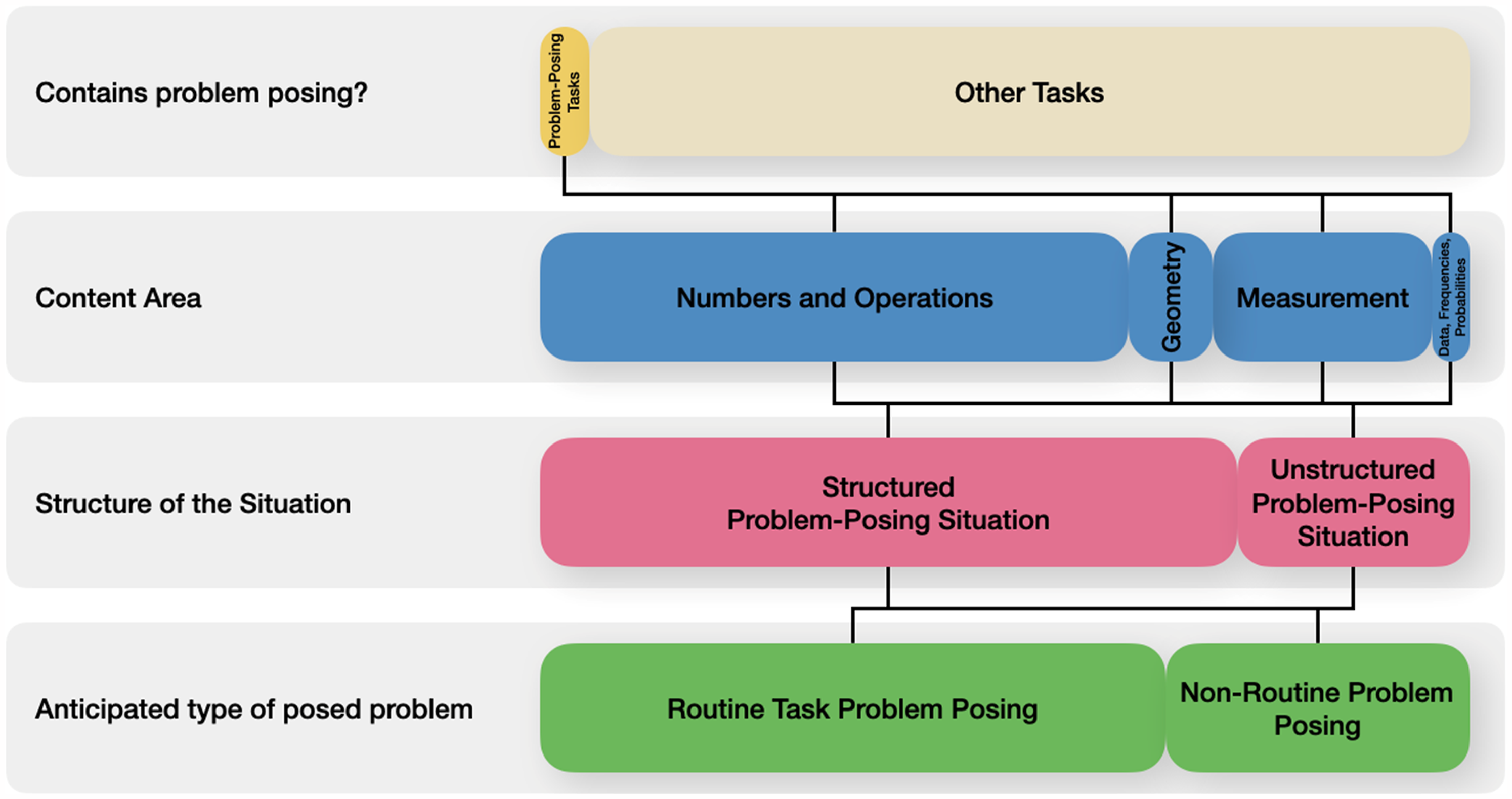
(6) Analysis of the data. For the textbook analysis (see Figure 2), it was especially clarified which of the tasks were to be understood as posing tasks and which as solving tasks. In particular, open tasks (e.g., “Find different ways to create axisymmetric figures”), in which more than one solution is to be found for a task, were initially included in the pool of posing tasks due to their open format. They were removed during the recoding phase as these tasks do not involve posing a task but rather finding multiple solutions to a task. More specifically, drawing on Baumanns and Rott (2021), a task was categorized as a problem-posing task if it presented a situation with an ill-defined answer that invited learners to generate a task requiring a solution and was open for extension. In contrast, tasks were excluded from the category of problem posing if they provided a clearly defined problem situation with all relevant information and a predetermined solution path leading to a single verifiable answer.
Coding procedure of problem-posing tasks.
To further characterize the nature of the problem-posing tasks, the following dimensions were coded:
Content area: The content area of each problem-posing task was coded according to the curriculum of North Rhine-Westphalia (see Section 2.4; the respective content areas are Numbers and Operations; Geometry; Measurement; and Data, Frequencies, and Probabilities) to see whether problem posing was tied to specific content areas of the German primary curriculum. Each problem-posing task was coded into exactly one of these four categories.
Structured versus unstructured: A structured problem-posing situation refers to tasks that are based on a specific given problem (and sometimes its solution). An unstructured situation, by contrast, does not provide a specific initial problem or solution. These range from completely free situations without any information to semi-structured situations with more information, which encourage learners to explore relationships or mathematical structures. No intermediate categories were used; each problem-posing task was coded into one of the two options.
Routine task versus non-routine problem posing: Tasks were classified based on the nature of the problems students were likely to generate. A Routine task was coded when the person posing the problem was assumed to have access to a familiar solution schema (e.g., a typical arithmetic operation). The Non-routine problem, in contrast, was coded when the person posing the problem was unlikely to have had such a schema readily available. Again, each problem-posing task was coded into one of the two options.
The analysis also included coding the number of problem-posing tasks in relation to the total number of tasks. The results are presented separately for each textbook. This is not intended to compare the textbooks but merely to show differences between textbooks in general. To clarify our coding process, Table 1 in Section 4 presents concrete examples of textbook tasks alongside their respective coding assignments.
Examples of problem-posing-tasks used in the analyzed German textbooks.
Problem-posing task
Content
Structure
Routine/
non-routine
Grade
Numbers and operations
Structured
Non-routine
2
Numbers and
operations
Structured
Routine
3
Data, frequencies,
and probabilities
Unstructured
Non-routine
4
Results
RQ1: Problem posing in German primary curriculum
The analysis of the curricular documents revealed very few explicit or implicit mentions of mathematical problem posing at the primary level in Germany.
Problem posing is mentioned in exactly one sentence in the educational standards of the Standing Conference. This sentence is found in the section on process-related competence in mathematical modeling as the last sentence of a broad description of modeling without any specification of grades and so on:
The spectrum [of sub-steps of modelling] ranges from capturing mathematically significant information in a factual [real-life] context to developing and formulating factual tasks [word problems with a real-life context] on mathematical issues. (KMK, 2022, p. 11; translated and highlighted by the authors of this analysis)
In the curriculum specific to North Rhine-Westphalia, four sentences with a reference to problem posing were identified. The first sentence is part of a list of expected competencies at the end of Grade 4 in relation to mathematical problem solving:
[The pupils] transfer relationships to similar situations and their own tasks, e.g. by varying or continuing given tasks. (NRW, 2021, p. 82; translated and highlighted by the authors of this analysis)
The second coded sentence is part of a similar list concerning mathematical modeling:
Articulate their own questions in the context of real or simulated factual situations (e.g. in the form of arithmetic stories, equations, tables or drawings). (NRW, 2021, p. 83; translated and highlighted by the authors of this analysis)
The other two sentences, which mention a form of problem posing, are in a section of the curriculum where process-related and content-related competencies are linked. In a two-part list, divided into Grades 1, 2 and 3, 4, respectively, under the heading “factual situations,” the curriculum for Grades 1 and 2 reads as follows:
[The pupils] formulate mathematical questions and tasks in game situations and factual situations as well as in simple factual tasks (including arithmetic stories or picture tasks) and solve them. (NRW, 2021, p. 93; translated and highlighted by the authors of this analysis)
And, directly next to it, referring to Grades 3 and 4, is the following:
[The pupils] formulate mathematical questions and tasks in real or simulated situations (also in project-orientated problem contexts) and in factual tasks and solve them. (NRW, 2021, p. 93; translated and highlighted by the authors of this analysis)
In contrast to problem solving, which is prominently emphasized as one of a few process-related competencies, problem posing plays a marginal role in the official requirements for teaching mathematics at the primary level in Germany. References to “pupils formulate tasks” are rare and appear almost exclusively in the context of mathematical modeling. This observation holds for the national educational standards of the Standing Conference of the Ministers of Education (KMK, 2022) as well as for the curriculum of the most populous federal state (NRW, 2021). These findings provide a descriptive insight into the current curricular positioning of problem posing in German primary mathematics education.
RQ2: Problem posing in mathematics textbooks of German primary schools
Table 1 presents examples of problem-posing tasks identified in the analyzed German mathematics textbooks. The selected tasks illustrate key characteristics regarding their routine or non-routine nature, structured or unstructured format, and mathematical content area. The first example, drawn from Grade 2, represents a structured, non-routine problem-posing task within Numbers and Operations. This task prompts students to create number puzzles following specific numerical properties (e.g., numbers with a given quantity of ones or equal tens and ones or specific relationships between digits). This task requires exploratory reasoning and encourages students to recognize and formulate number patterns. The second example, from Grade 3, exemplifies a structured problem-posing task for posing routine tasks. Students are required to create division tasks similar to the given examples, which reinforces arithmetic operations. The task structure engages students with problem posing, directing them toward structural arithmetic relationships. The third example, from Grade 4, shows an unstructured problem-posing task in the domain of Data, Frequencies, and Probabilities. Here, students are encouraged to invent their own rules for a dice game and analyze the outcomes by comparing odds in a table. This task is open-ended and exploratory, allowing for greater student inquiry.
Number of problem-posing tasks
Figure 3 illustrates the proportion of tasks that include problem posing (i.e., problem-posing tasks) identified in Das Zahlenbuch and Welt der Zahl across Grades 1–4 as well as the overall percentage of problem-posing tasks in both textbooks. A total of 1,833 tasks were identified in Das Zahlenbuch and 2,695 in Welt der Zahl. Of these tasks, 134 in Das Zahlenbuch and 86 in Welt der Zahl include problem posing. The results indicate that problem-posing tasks appear more frequently in Das Zahlenbuch than in Welt der Zahl at all grade levels. In Grade 1, the proportion of problem-posing tasks is relatively low in both textbooks, with Das Zahlenbuch containing 3.78% and Welt der Zahl at 3.38%. However, in Grade 2, the difference between the two textbooks is more pronounced, as the percentage in Das Zahlenbuch increases to 7.07%, whereas in Welt der Zahl, only 2.26% of the tasks involve posing problems. The highest occurrence of problem-posing tasks was observed in Grade 3 with 9.96% in Das Zahlenbuch, more than double the proportion found in Welt der Zahl (4.03%). This increase may reflect a stronger focus on problem-posing tasks in Das Zahlenbuch in Grade 3, potentially related to the consolidation of number concepts at this stage. A similar trend continues in Grade 4, where Das Zahlenbuch includes 7.85% of problem-posing tasks, whereas Welt der Zahl contains 3.13%. Considering the total proportion of problem-posing tasks across all grades, Das Zahlenbuch incorporates 7.31%, whereas Welt der Zahl includes only 3.19%.
Percentages of problem-posing tasks in each grade and in total for Das Zahlenbuch and Welt der Zahl.
Content areas of problem-posing tasks
Figure 4 illustrates the proportion of problem-posing tasks across different mathematical content areas in Grades 1–4 for Das Zahlenbuch (Figure 4a) and Welt der Zahl (Figure 4b). The patterns observed in both textbooks highlight developmental trends across grade levels.
Percentages (left vertical axis) and absolute numbers (right vertical axis), respectively, of problem-posing tasks in each grade for different mathematical content areas for (a) Das Zahlenbuch and (b) Welt der Zahl.
In Das Zahlenbuch, numbers and operations consistently account for the largest proportion of problem-posing tasks across all grades. This category shows a steady increase from Grades 1 to 3, reaching its peak in Grade 3 before slightly decreasing in Grade 4. The category Measurement follows a different trajectory. It appears frequently in Grade 1 but decreases significantly in Grade 2. However, from Grade 2 onward, problem-posing tasks related to measurement steadily increased, reaching a higher proportion in Grade 4. This suggests that measurement-based problem posing is introduced early but becomes more prominent again in later grades, possibly as students develop more advanced measurement-related skills. Geometry has a relatively low percentage of problem-posing tasks at all grades, with a slight peak in Grade 2. The category of data, frequencies, and probabilities is largely absent in the early grades and remains at a minimal level throughout. However, a slight increase in the later grades suggests that data-related problem posing is introduced later in primary education.
A similar but distinct pattern was observed in Welt der Zahl. Numbers and operations dominate problem-posing tasks in all grades but fluctuate more than in Das Zahlenbuch. A decrease was observed in Grade 2, followed by an increase in Grade 3 and a slight decline again in Grade 4. This suggests that although numerical problem posing remains a central focus, its emphasis varies across grade levels. Measurement in Welt der Zahl follows a different pattern compared to Das Zahlenbuch. It is most prominent in Grade 1, experiences a substantial decline in Grade 2, and then steadily increases again through Grade 4. This may reflect a shift in how measurement concepts are integrated into problem-posing activities across the grades. For Geometry, problem-posing tasks remain limited across all grade levels, though a slight increase was observed in the later grades. Data, frequencies, and probabilities are largely absent within problem-posing tasks in early grades but appear in small proportions in Grades 2 and 4.
Nature of problem-posing tasks (structured vs. unstructured)
Figure 5 illustrates the proportions of structured and unstructured problem-posing situations across Grades 1–4 for Das Zahlenbuch (Figure 5a) and Welt der Zahl (Figure 5b).
Percentages (left vertical axis) and absolute numbers (right vertical axis), respectively, of structured and unstructured problem-posing tasks in each grade for (a) Das Zahlenbuch and (b) Welt der Zahl.
In Das Zahlenbuch, the proportion of structured problem-posing situations increases steadily from Grade 1 to Grade 3, reaching its highest point in Grade 3 before slightly decreasing in Grade 4. Conversely, unstructured problem-posing situations show the opposite trend: They are more prominent in Grade 1, decline sharply through Grade 3, and then rise again in Grade 4. This pattern suggests a shift in emphasis, with early grade problem-posing situations also incorporating situations with less given structure whereas later grades increasingly focus on structured formats. The re-emergence of unstructured situations in Grade 4 may indicate an attempt to encourage more creative mathematical thinking at the end of primary school.
In contrast, Welt der Zahl follows a notably different pattern, with structured problem-posing situations overwhelmingly dominating across all grades. Unstructured situations are nearly absent, with only a minimal presence in Grades 2 and 3. The prevalence of structured problem-posing situations across all grade levels suggests a more rigid approach to problem posing in this textbook.
Nature of posed problems (routine vs. non-routine)
Figure 6 presents the proportions of routine and non-routine problem-posing tasks across Grades 1–4 for Das Zahlenbuch (Figure 6a) and Welt der Zahl (Figure 6b).
Percentages (left vertical axis) and absolute numbers (right vertical axis), respectively, of problem-posing tasks focusing on routine tasks or non-routine problems in each grade for (a) Das Zahlenbuch and (b) Welt der Zahl.
In Das Zahlenbuch, routine problem-posing tasks consistently represent the majority across all grades, but their proportion fluctuates. A slight decrease from Grade 1 to Grade 2 is followed by a peak in Grade 3, after which the percentage declines again in Grade 4. This pattern suggests that Grade 3 marks the strongest focus on routine tasks, possibly reflecting an emphasis on posing exercises to reveal mathematical structures between tasks. Consequently, non-routine problem-posing tasks show an inverse trend. They increase from Grade 1 to Grade 2, decline sharply in Grade 3, and then rise again in Grade 4.
A slightly different developmental pattern was observed in Welt der Zahl. Routine tasks dominate heavily in Grade 1. Although the percentage decreases from Grade 1 to Grade 2, it remains consistently high in the following grades. Non-routine problem-posing tasks remain limited in Welt der Zahl. Although their proportion increases from Grade 1 to Grade 2, it remains stable in later grades without the fluctuations observed in Das Zahlenbuch.
Discussion
This study provides a comprehensive analysis of the integration of problem-posing tasks in the German primary mathematics curriculum and in two widely used textbook series (Das Zahlenbuch and Welt der Zahl). The analysis sheds light on the limited curricular visibility of problem posing and its uneven representation in instructional materials. Although problem posing is recognized as a valuable mathematical activity, it is rarely mentioned and is not explicitly emphasized in national and state-level curricular documents. The few references found primarily link problem posing to mathematical modeling, highlighting its marginal presence in the curriculum—especially when compared to the much more prominent emphasis on problem solving. The limited integration of problem posing in textbooks appears to reflect, at least in part, its marginal status in curriculum standards. Because textbooks are often developed in alignment with curricular prescriptions, the absence of problem posing from national and state-level standards likely contributes to its minimal presence in instructional materials. Interestingly, however, Cai and Jiang (2017) also showed that even in countries such as China and the United States—where curriculum standards emphasize problem posing more explicitly—actual textbook content still includes only a small proportion of problem-posing tasks. This suggests that the implementation of reforms that emphasize problem posing is challenged not only by curriculum design but also by systemic factors. The findings of this study align with this broader international trend: German textbooks, too, feature only a small percentage of problem-posing tasks—7.31% in Das Zahlenbuch and 3.19% in Welt der Zahl. Interestingly, whereas Welt der Zahl closely mirrors the 3.43% of problem-posing tasks reported by Cai and Jiang (2017) for Chinese elementary textbooks, Das Zahlenbuch shows a notably higher proportion. Figure 7 provides a visual summary of the coding scheme used in this study while simultaneously illustrating the distribution of problem-posing tasks across both textbooks and all analyzed aspects.
Visualization of problem-posing task categories and their relative frequencies.
Consistent with findings from other countries (e.g., Cai & Jiang, 2017; Deringöl & Guseinova, 2022; Divrik et al., 2020), the analysis of German textbooks indicates that problem posing occurs infrequently, is mainly limited to the domain of Numbers and Operations, and predominantly involves the posing of routine tasks. This scope may reflect an effort to scaffold students’ initial engagement with problem posing. However, there is a noteworthy absence of more unstructured situations leading to non-routine problems across grade levels. By categorizing problem-posing tasks in German textbooks along multiple dimensions—such as their frequency, content distribution, structure, and routine versus non-routine nature—this research expands existing approaches for analyzing problem posing in instructional materials.
Although the limited presence of problem posing in textbooks may reflect an undervaluation of this competency in the implemented curriculum, alternative explanations should be considered. As prior research has suggested, the enactment of curriculum is shaped not only by written materials but also by teachers’ interpretations and adaptations (Cai & Hwang, 2021). Even in the absence of explicit textbook guidance, teachers may find opportunities to integrate problem posing into instruction by modifying existing tasks or generating new ones. Zhang and Cai (2021) highlighted how teachers can successfully incorporate problem posing into their practice when supported through professional development, even if they initially have limited experience with such tasks. These studies suggest that teachers can act as “curriculum redesigners,” reinterpreting problem-solving activities as openings for problem posing and developing task variations that reflect different levels of complexity (Cai & Hwang, 2021). However, this also implies that without appropriate training, resources, and professional learning structures, the potential of problem posing may remain untapped—especially when curricular and textbook support is minimal. Although this study focused on textbook content and cannot capture these teacher-driven practices, the findings point to the importance of further classroom-based research examining how teachers enact problem posing and how students engage with these activities.
The observed predominance of routine tasks also raises the question of how problem posing is conceptualized in textbooks. A contributing factor may be the often expansive and inconsistently used definitions of mathematical problem posing, which can range from posing entirely new non-routine problems to merely changing values in a given routine task (Baumanns & Rott, 2021). This definitional ambiguity may complicate the systematic integration of problem posing into curricular frameworks and textbook design.
It is important to note that this study focused solely on two textbook series. Although both are widely used, future studies might investigate whether other textbook series offer alternative approaches to problem posing. Moreover, textbook content represents only one component of the implemented curriculum and cannot capture the full range of classroom practice.
A strength of this study is its systematic and multi-dimensional approach, which offers a structured account of how problem posing is currently represented in German primary mathematics textbooks. However, limitations remain: The study does not assess how students interact with problem-posing tasks or the impact of such tasks on their mathematical thinking. Future research could build on this work by investigating how teachers implement problem posing in practice and how students respond to different types of problem-posing tasks.
In sum, this study contributes to the broader discourse on problem posing in mathematics education by documenting its curricular and textbook-based representation in German primary education. These insights provide a valuable starting point for further inquiry into how problem posing is understood, enacted, and experienced in primary mathematics classrooms.
Footnotes
Contributorship
Lukas Baumanns: conceptualization,methodology,formal analysis,writing–original draft and revision,and visualization. Benjamin Rott: conceptualization,methodology,formal analysis,writing–original draft and revision,and visualization.
Declaration of conflicting interests
The author(s) declared no potential conflicts of interest with respect to the research,authorship,and/or publication of this article.
Funding
The author(s) received no financial support for the research,authorship,and/or publication of this article.
Informed consent
Not applicable.
Declaration of generative AI and AI-assisted technologies in the writing process
During the preparation of this work,the first author used Grammarly and ChatGPT in order to improve the readability and language. After using these tools,the authors reviewed and edited the content as needed and took full responsibility for the content of the publication.
ORCID iDs
Lukas Baumanns
Benjamin Rott
Author biographies
Lukas Baumanns an academic advisor at TU Dortmund University,specializing in mathematics education. His research interests include the processes of mathematical problem posing,identifying and supporting primary school students with mathematical difficulties—using innovative methods such as eye-tracking technology—and incorporating generative artificial intelligence into mathematics education. He is also actively engaged in the QuaMath program,a large-scale initiative aimed at improving the quality of mathematics education throughout Germany.
Benjamin Rott did his doctorate at the University of Hanover in 2012. He worked as a postdoctoral researcher at the University of Education Freiburg (2012–2014) and as an assistant professor at the University of Duisburg-Essen (2014–2017). In 2017,he became an associate professor at the University of Cologne. At the moment,he is a full professor of mathematics education,still in Cologne. His research interests include (but are not limited to) mathematical problem solving and posing,giftedness and creativity,digital technology and artificial intelligence,beliefs,as well as teacher professional learning and development.
BaumannsL.RottB. (2024). Problem-posing tasks and their influence on pre-service teachers’ creative problem-posing performance and self-efficacy. The Journal of Mathematical Behavior, 73, 101130. https://doi.org/10.1016/j.jmathb.2024.101130
3.
BaumannsL.RottB. (2025). Unstructured situations as initiation for problem-posing processes: Validation of a descriptive phase model of problem posing. In CaiJ.LeikinR. (Eds.), Mathematical problem posing: New advances and directions. Springer.
4.
BevanD.CapraroM. M. (2021). Posing creative problems: A study of elementary students’ mathematics understanding. International Electronic Journal of Mathematics Education, 16(3), em0654. https://doi.org/10.29333/iejme/11109
BrownS. I.WalterM. I. (2005). The art of problem posing (3rd ed.). Lawrence Erlbaum Associates.
7.
CaiJ.HwangS. (2021). Teachers as redesigners of curriculum to teach mathematics through problem posing: Conceptualization and initial findings of a problem posing project. ZDM – Mathematics Education, 53(6), 1403–1416. https://doi.org/10.1007/s11858-021-01252-3
8.
CaiJ.JiangC. (2017). An analysis of problem-posing tasks in Chinese and US elementary mathematics textbooks. International Journal of Science and Mathematics Education, 15(8), 1521–1540. https://doi.org/10.1007/s10763-016-9758-2
9.
CaiJ.KoichuB.RottB.JiangC. (2024). Advances in research on mathematical problem posing: Focus on task variables. The Journal of Mathematical Behavior, 76, 101186. https://doi.org/10.1016/j.jmathb.2024.101186
10.
CaiJ.LeikinR. (2020). Affect in mathematical problem posing: Conceptualization, advances, and future directions for research. Educational Studies in Mathematics, 105(3), 287–301. https://doi.org/10.1007/s10649-020-10008-x
11.
CaiJ.RanH.HwangS.MaY.HanJ.MuirheadF. (2023). Impact of prompts on students’ mathematical problem posing. The Journal of Mathematical Behavior, 72, 101087. https://doi.org/10.1016/j.jmathb.2023.101087
12.
CreswellJ. W. (2014). Research design: Qualitative, quantitative and mixed method approaches. Sage Publications.
13.
DeringölY.GuseinovaE. (2022). Problem-posing activities in primary school mathematics textbooks in Russia and Azerbaijan. Mimbar Sekolah Dasar, 9(3), 535–551. https://doi.org/10.53400/mimbar-sd.v9i3.44863
14.
DivrikR.TasA. M.PiltenP. (2020). Teachers’ views on the problem-solving & problem-posing tasks in primary school mathematics textbooks. Journal of Curriculum and Teaching, 9(1), 73–85. https://doi.org/10.5430/jct.v9n1p73
15.
EnglishL. D. (1997). The development of fifth-grade children’s problem-posing abilities. Educational Studies in Mathematics, 34(3), 183–217. https://doi.org/10.1023/A:1002963618035
16.
FaasD. (2013). Germany after the ‘Pisa shock’: Revisiting national, European and multicultural values in curriculum and policy discourses. In LittleD.LeungC.Van AvermaetP. (Eds.), Managing Diversity in Education. Languages, Policies, Pedagogies (pp. 43–56). De Gruyter Brill.
JohanssonM. (2003). Textbooks in mathematics education: A study of textbooks as the potentially implemented curriculum. (Licentiate dissertation, Luleå tekniska universitet). Retrieved from https://urn.kb.se/resolve?urn=urn:nbn:se:ltu:diva-18457
19.
JoklitschkeJ.BaumannsL.RottB. (2019). The intersection of problem posing and creativity: A review. In NolteM. (Ed.), Including the highly gifted and creative students – Current ideas and future directions. Proceedings of the 11th International Conference on Mathematical Creativity and Giftedness (MCG 11) (pp. 59–67). WTM.
20.
KontorovichI. (2023). Would specialist problem posers endorse problem-posing situations that we design for learners? Does it matter? In SarikayaD.BaumannsL.HeuerK.RottB. (Eds.), Problem Posing and Solving for Mathematically Gifted and Interested Students. Best Practices, Research and Enrichment (pp. 49–64). Springer.
21.
KopparlaM.BicerA.VelaK.LeeY.BevanD.KwonH.CaldwellC.CapraroM. M.CapraroR. M. (2019). The effects of problem-posing intervention types on elementary students’ problem-solving. Educational Studies, 45(6), 708–725. https://doi.org/10.1080/03055698.2018.1509785
LangS. (1989). Faszination Mathematik – Ein Wissenschaftler stellt sich der Öffentlichkeit. Vieweg.
25.
LeeS. Y. (2021). Research status of mathematical problem posing in mathematics education journals. International Journal of Science and Mathematics Education, 19(8), 1677–1693. https://doi.org/10.1007/s10763-020-10128-z
26.
LenzK.WittmannG. (2023). Zur erarbeitung des teile-ganzes-konzepts im mathematischen anfangsunterricht: Welche lerngelegenheiten bieten schulbücher für die erste klasse? [On developing the part-whole concept in initial mathematics instruction: What learning opportunities do textbooks offer for first graders?]. Journal für Mathematik-Didaktik, 44, 441–469. https://doi.org/10.1007/s13138-023-00218-0
27.
LeudersT.BarzelB.HußmannS. (2005). Outcome standards and core curricula: A new orientation for mathematics teachers in Germany. ZDM–The International Journal on Mathematics Education, 37, 275–286. https://doi.org/10.1007/BF02655815
28.
National Council of Teachers of Mathematics. (2000). Principles and standards for school mathematics. Author.
29.
NeubrandM. (2018). The challenges, reforms, and future prospects of elementary and lower secondary mathematics education in Germany. GDM-Mitteilungen, 105, 34–40.
PólyaG. (1945). How to solve it. University Press.
32.
PólyaG. (1966). On teaching problem solving. In The Conference Board of the Mathematical Sciences. (Ed.), The Role of Axiomatics and Problem Solving in Mathematics (pp. 123–129). Ginn.
33.
RezatS.FanL.PepinB. (2021). Mathematics textbooks and curriculum resources as instruments for change. ZDM – Mathematics Education, 52, 1189–1206. https://doi.org/10.1007/s11858-021-01309-3
34.
SchoenfeldA. H. (1985). Mathematical problem solving. Academic Press.
35.
SchoenfeldA. H. (1992). Learning to think mathematically: Problem solving, metacognition and sense-making in mathematics. In GrouwsD. (Ed.), Handbook of Research on Mathematics Teaching and Learning (pp. 334–370). MacMillan.
36.
SchuppH. (2002). Thema mit Variationen. Aufgabenvariationen im Mathematikunterricht. Franzbecker.
37.
SievertH. (2020). Die qualität von schulbüchern und ihre bedeutung für die arithmetikleistung in der primarstufe: Eine längsschnittliche analyse anhand von drei inhaltsbereichen (Doctoral dissertation).
38.
SilverE. A. (1994). On mathematical problem posing. For the Learning of Mathematics, 14(1), 19–28.
39.
SilverE. A. (1995). The nature and use of open problems in mathematics education: Mathematical and pedagogical perspectives. International Reviews on Mathematical Education, 27(2), 67–72.
40.
StoyanovaE.EllertonN. F. (1996). A framework for research into students’ problem posing in school mathematics. In ClarksonP. C. (Ed.), Technology in Mathematics Education (pp. 518–525). Mathematics Education Research Group of Australasia.
41.
Van den AkkerJ. (2003). The science curriculum: Between ideals and outcomes. In FraserB. J.TobinK. G. (Eds.), International Handbook of Science Education (Vol. 1, pp. 421–449). Kluwer Academic.
42.
Van HarpenX.SriramanB. (2013). Creativity and mathematical problem posing: An analysis of high school students’ mathematical problem posing in China and the USA. Educational Studies in Mathematics, 82(2), 201–221. https://doi.org/10.1007/s10649-012-9419-5
43.
ZhangH.CaiJ. (2021). Teaching mathematics through problem posing: Insights from an analysis of teaching cases. ZDM – Mathematics Education, 53, 961–973. https://doi.org/10.1007/s11858-021-01260-3