







Abstract
Keywords
Introduction
Teachers of mathematics are expected to make positive differences to the learning outcomes of their students (Australian Association of Mathematics Teachers [AAMT, 2006]; National Council of Teachers of Mathematics [NCTM, 2000]). According to the NCTM (2000), “effective teaching requires knowing and understanding mathematics, students as learners, and pedagogical strategies” (p. 17). The AAMT's comprehensive list of characteristics of good teaching has been framed around teacher mathematical knowledge and skills. The construct of teacher knowledge has permeated the literature for decades, with knowledge of mathematics and knowledge of mathematics pedagogy being common constituents (Chick & Beswick, 2018). What is less known is teachers’ mathematical proficiency as part of their mathematical knowledge (Seaman & Szydlik, 2007). With recent educational reforms directed toward mathematical proficiency or mathematical competencies (Boesen et al., 2018; Niss & Højgaard, 2019), this makes it a valuable construct to study in teacher education and development. In this study, we direct our attention to teachers’ strategic competence—one of the five strands of mathematical proficiency identified by Kilpatrick et al. (2001). Strategic competence is a fundamental part of teacher mathematical knowledge and understanding (Copur-Gencturk & Doleck, 2021; Seaman & Szydlik, 2007), potentially impacting on student learning.
The strategic competence construct is difficult to operationalize and measure because of its inherent complexity, and researchers are not yet in agreement regarding its nature. Kilpatrick et al. (2001) defined strategic competence as an individual's ability to formulate, represent, and solve mathematical problems. Copur-Gencturk and Doleck (2021) adapted Kilpatrick et al.'s definition of strategic competence to operationalize an examination of multistep fraction word problems by using three key indicators: devising a solution strategy, mathematizing a problem, and arriving at a correct answer. Egodawatte and Stoilescu (2015) claimed that “strategic competence is necessary to determine the direction of problem-solving and to understand which stages to follow through in order to reach a solution” (p. 292). A closer consideration of strategic competence is important in the sense that it will contribute to its operationalization and measurement.
Strategic competence—or problem-solving—is emphasized in the curricula of many countries. In the United States, problem-solving is underlined as an essential part of mathematical learning and understanding (NCTM, 2000). The Ontario mathematics curriculum emphasizes the need to develop students’ interest in and strategies for problem-solving (Egodawatte & Stoilescu, 2015). The Australian Curriculum: Mathematics highlights problem-solving as a key consideration (Australian Curriculum, Assessment and Reporting Authority [ACARA, 2022]). The capacity to develop students’ capabilities in this area is usually dependent on a teacher's own problem-solving skills and strategic competence (Durkin et al., 2023). Research has shown that teacher professional capability, especially their mathematics and mathematics pedagogy knowledge, can influence students’ learning (Hatisaru & Erbas, 2017). In Australia, candidates are not required to study a large amount of mathematics at university to qualify as primary teachers. Even for secondary or senior secondary teaching, where tertiary mathematics units are required for qualification, the content of these units sometime is unspecified; so, secondary teachers may vary in what topics they know (Wienk, 2020). Compounding this concern is data showing that prospective teachers of mathematics struggle in algebra (Norton, 2019). We would expect such prospective teachers’ mathematical knowledge and strategic competence to be weak in their practice, as far as these have not been improved through in-service trainings. Understanding teachers’ strategic competence can help mathematics teacher educators to decide where to focus their efforts on improving strategic competence skills and to deliver effective teacher education and professional learning programs.
Conceptual Background: Strategic Competence
Kilpatrick et al. (2001) assert that mathematical proficiency captures what they felt was necessary for one to do or learn mathematics successfully. It is a multidimensional construct involving five components: conceptual understanding, procedural fluency, strategic competence, adaptive reasoning, and productive disposition (Kilpatrick et al., 2001). Strategic competence focuses on the ability to formulate, represent, and solve mathematical problems (Kilpatrick et al., 2001, p. 5). This involves knowing and implementing sophisticated solution methods. It requires well-chosen approaches to formulating and implementation based on understanding the problem's “key features” and which approach is best suited for the task. Finally, it involves producing correct solutions in an efficient manner.
Copur-Gencturk and Doleck (2021) adapted Kilpatrick et al.'s definition of strategic competence to focus on multistep fraction word problems. They identified three key indicators: devising a solution strategy (applying appropriate concepts and procedures); mathematizing the problem (choosing specific representations to translate word problems into mathematical expressions); and arriving at the correct answer (executing a solution method correctly). Perhaps unsurprisingly, they found that successfully devising a strategy and mathematizing the problem generally resulted in arriving at the correct answer. However, they also noted that inability to devise a solution strategy reflected shortcomings in conceptual understanding, whereas once a strategy was devised, it was computational errors that led to lack of success with obtaining the answer.
Kilpatrick et al. (2001, p. 124) saw strategic competence as approximately synonymous with “problem-solving.” Pólya's (1957) approach to problem-solving and Copur-Gencturk and Doleck's views on strategic competence identify the roles of understanding the problem and applying appropriate strategies to find valid solutions. Schoenfeld (2011) added planning appropriate actions based on the type of problem, and this focus on devising a plan has become one of the seminal capabilities that make up the mathematical competencies.
We have operationalized the strategic competence construct as including multiple, interconnected criteria. Building on the work of Kilpatrick et al. (2001) and Copur-Gencturk and Doleck (2021), we have developed a scheme to code the data—solutions to the DICE problem. The scheme, presented in Table 1, focuses on evidence of understanding the problem and its key features (SCI #1), formulating the problem (SCI #2), knowing at least one sophisticated solution method (SCI #3), arriving at a correct answer (SCI #4), knowing a variety of valid solution strategies (SCI #5), and demonstrating competency in using an efficient procedure (SCI #6). The use of SCI #2, SCI #3, and SCI #4 (employed by Copur-Gencturk & Doleck, 2021) allows for a determination of capability in dealing with an application-based problem. The remaining indicators are essential for providing insight into the range of approaches that participants can bring to bear for the problem, and the relative efficiency of the strategies they employ. This is particularly important for understanding strategic competence as having a broad repertoire of tools as well as the capacity to utilize effective methods.
Strategic Competence Indicators (SCIs #) Investigated in This Study Apply to the DICE Problem.
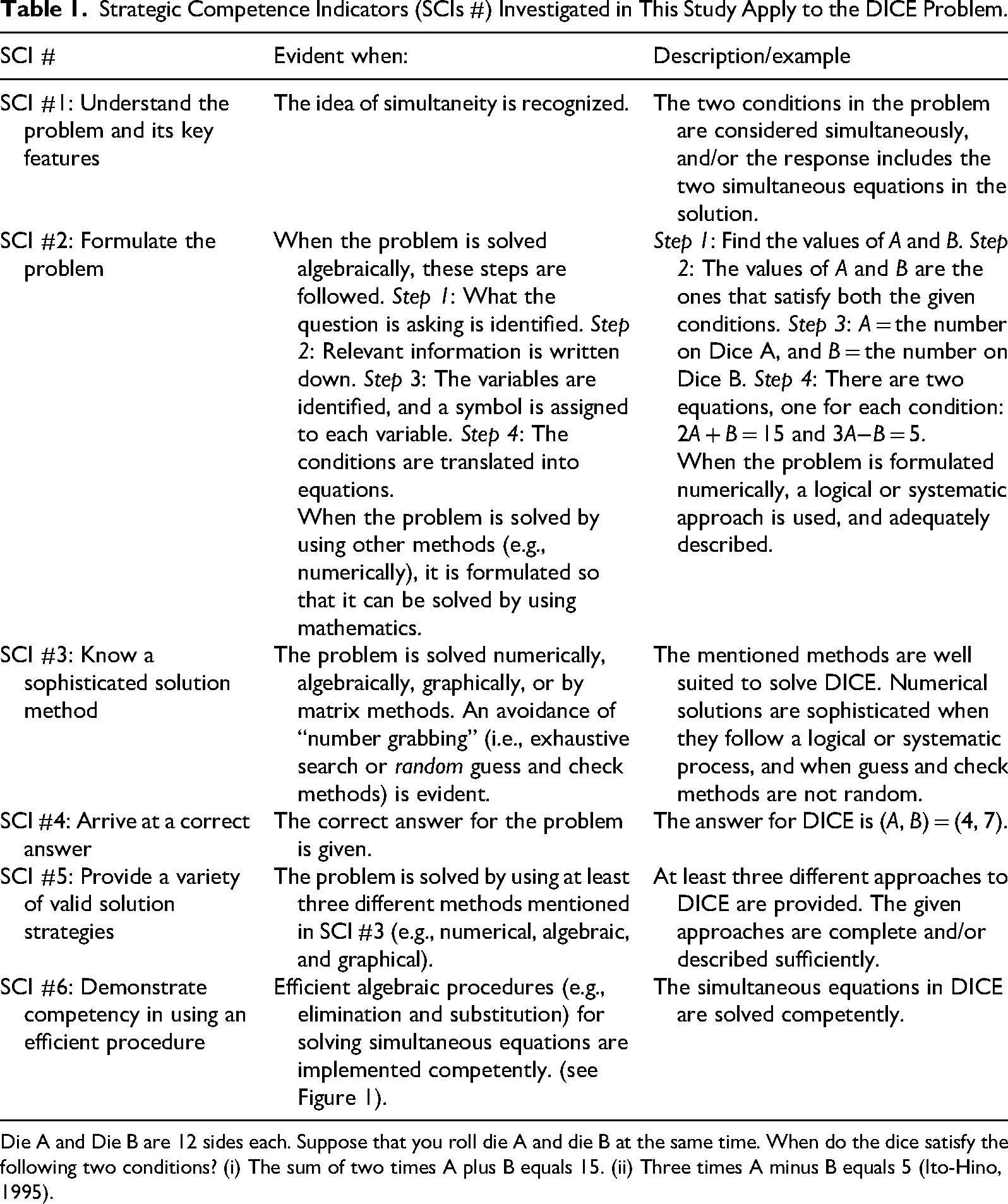
Die A and Die B are 12 sides each. Suppose that you roll die A and die B at the same time. When do the dice satisfy the following two conditions? (i) The sum of two times A plus B equals 15. (ii) Three times A minus B equals 5 (Ito-Hino, 1995).
Strategic Competence Indicators (SCIs #) Investigated in This Study Apply to the DICE Problem.
Die A and Die B are 12 sides each. Suppose that you roll die A and die B at the same time. When do the dice satisfy the following two conditions? (i) The sum of two times A plus B equals 15. (ii) Three times A minus B equals 5 (Ito-Hino, 1995).
Examples of previous research on teachers’ strategic competence with respect to solving algebraic problems has been largely focused on preservice teachers (PSTs) (Baek et al., 2017; Cullen et al., 2017). For example, Van Dooren et al. (2003) found that 97 PSTs’ approaches to algebraic word problems improved during their teacher education, but strategies were not diverse, perhaps because the PSTs were enrolled in the same teaching methods courses. Cullen et al. (2017) examined 85 PSTs and found that their approaches were more related to their content understanding and previous experiences within content courses as opposed to their teacher education courses. Lee (2017) reported that, like PSTs, in-service teachers relied more on their prior experiences than on courses they had taken. Van Dooren et al.'s (2003) study of algebraic word problems found that secondary PSTs utilized more algebra strategies than primary PSTs, whereas the primary PSTs utilized more arithmetic approaches. This may reflect PSTs’ expectations and/or experiences about the ways of working in their anticipated school level of teaching, with some secondary PSTs using algebra strategies for solving word problems when arithmetic was the most strategic and effective approach. Those who were stronger problem solvers could apply varying approaches (algebraic or arithmetic), depending on the nature of the problem. It was also noted that PSTs who were further progressed in their courses, generally performed better. However, this study did not explore what range of strategies a PST could apply to a given problem. Many studies allude to PSTs overly relying on guess and check strategies. Barham (2020) found that 42 elementary PSTs showed weaknesses in the variety of strategies applied to solve problems. Yew and Zamri (2016) reported similar results with eight secondary PSTs. In this study, the outcomes varied due to the diverse approaches, the PSTs’ ability to apply multiple strategies, and their content knowledge. In some cases, PSTs did not use strategies that might be expected to be in their repertoire, based on their educational background. Similar results were also highlighted in a study conducted by Bruun (2013), where 70 elementary practicing teachers approached word problems with only one or two strategies, with drawing a picture as the main strategy.
Where the breadth of research on teachers’ strategic competence with respect to solving algebraic problems has been focused on PSTs, other studies have observed in-service or practicing teachers’ strategic competence. Similar findings have drawn parallels between both PSTs and practicing teachers’ strategic competence with regard to prior experiences and what was deemed efficient problem-solving processes. For instance, Depaepe et al. (2010) investigated how in-service mathematics teachers’ understanding of mathematical structures in word problems influences their strategic competence in formulating and solving those problems. The study found that teachers who could accurately mathematize problems by translating them into mathematical expressions demonstrated higher levels of strategic competence. Much of the approach was influenced more by their previous experiences in their teaching practice and not their educational background. Practicing teachers with a deeper understanding of the underlying mathematical structures of word problems were more capable of identifying appropriate strategies and representations for solving the problems (Depaepe et al., 2010). Similarly, Copur-Gencturk and Doleck (2021) found practicing teachers with strong strategic competence approached problem-solving through algebraic notions or pictorial representations more often, which assisted them solving problems involving unknown quantities better than those with weaker strategic competence. The teachers deemed this method the most appropriate for their students and found the strategy the most effective and strategic. Some secondary teachers in Lynch and Star's study (2014) indicated that using multiple strategies in teaching can be inappropriate for students, causing them confusion, but focusing on a few efficient strategies benefits students’ problem-solving.
Methods
This study focused on secondary mathematics teachers’ strategic competence for solving algebraic word problems, guided by the question:
The study considered a range of indicators of strategic competence (Table 1), which is a measure of what individuals might bring to a problem-solving situation. It focused on a level of granularity that allows for the examination of specific aspects of strategic competence on a particular task. This allowed a set of indicators to be trialed for their utility in distinguishing levels of strategic competence. On that basis, the affordances of the strategic competence scheme for a detailed analysis of teacher strategic competence were also of our interest.
Participants and Data Generation
The study was grounded in a research project wherein secondary mathematics teachers were supported to enhance their content knowledge for teaching algebra. Within that research project, workshops were delivered by the first author of this paper to in-service teachers. The data presented in this paper come from a workshop delivered at a mathematics teacher conference in Western Australia in November 2022. This particular workshop focused on structural conceptions of algebra—that is, “seeing” the algebraic structures and expressing generality with algebraic symbols. Forty-two teachers participated in the workshop and 22 gave consent for their responses to contribute to the research. These teachers had between 2 and 40 years of teaching experience. Most were qualified mathematics teachers, with 14 out of 22 having at least mathematics minor, and most others having some tertiary mathematics units. They were mainly teaching years 7–10 mathematics (ages 12–16).
At the commencement of the workshop, teachers worked on three algebraic problems and completed a problem sheet for each. The DICE problem was the focus of this paper. The teachers recorded their solutions in the problem sheet in response to the prompt question: “Think of and explain as many different possible solutions to the problem as you can. Name the solutions as Solution A, Solution B, Solution C and so on.” They had 15–20 min to attempt the problems and worked individually. After the problem-solving task was completed, the first author presented a short lecture (15–20 min) on algebraic structures and the use of algebra in generalization. During this presentation, possible solutions to the three problems from the problem-solving task were presented and discussed.
The Dice Problem (Hereafter DICE)
Die A and Die B are 12 sides each. Suppose that you roll die A and die B at the same time. When do the dice satisfy the following two conditions?
The sum of two times A plus B equals 15. Three times A minus B equals 5. (Ito-Hino, 1995)
DICE is a typical and simple example of a word problem based on algebraic simultaneity that would be used in high school curricula globally. It is an effective problem for inferring the strategic competence of the teachers for a number of reasons. Firstly, the concept of algebraic simultaneity is not very advanced in the context of high school curricula, and so it is reasonable to assume that any high school mathematics teacher would be familiar with problems of this type. Secondly, DICE can be solved in numerous ways providing the opportunity to demonstrate depth of understanding in connecting inter-related ideas.
The possible approaches to DICE include the ones identified by Ito-Hino (1995) and others that emerged in the solutions of the teachers in this study (see Table 2). Figure 1 gives example solutions illustrating some of these approaches. Taking the common part of conditions (i) and (ii) were barrowed from Ito-Hino and others were generated by the authors of this paper.

Example solutions to DICE.
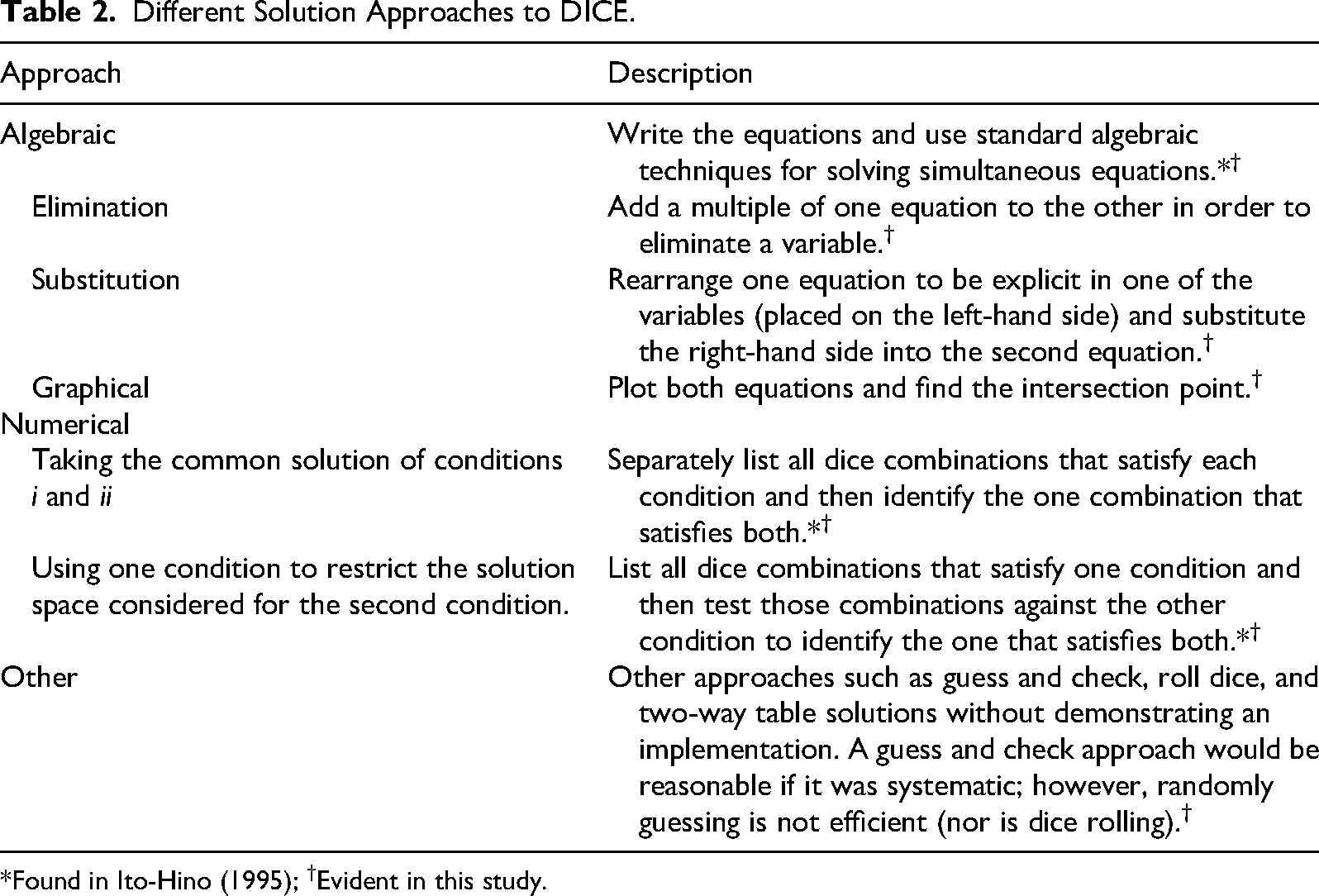
The data were the explanations and solutions recorded on the problem sheets in response to the prompt question mentioned earlier. In the data analysis and reporting, the participating teachers (PTs) are named PT1, PT2, PT3, and so on to ensure anonymity. The analysis was conducted collaboratively (Lincoln & Guba, 1985), by the first two authors, with both authors independently coding the data and engaging in depth discussions to resolve disagreements. The coding was then independently reviewed by the third author; further discussion and refinement resulted in the final coding. The teachers’ responses were examined in depth utilizing the scheme presented in Table 1. The scheme was used to code the indication of criteria in a Likert fashion using the scale: “weak,” “moderate,” or “relatively strong” to explore the extent to which each criterion seemed to be evident in teacher solutions.
In judging SCI #1, we examined if the idea of simultaneity was recognized. For SCI #2, we focused on Steps 2 and 4 (write relevant information and translate into equations) described in Table 1, as we believed the participants might not have considered outlining all four steps when completing the problem sheet. We assumed that those who solved the equations algebraically had formulated the problem correctly, even if they did not carefully define the variables. We, therefore, assessed a teacher's competence in formulating the problem based on whether conditions
Regarding to the efficiency of the solution method—the focus of SCI #6—we believe that using simultaneous equations is the most efficient approach for DICE, and that elimination is marginally more efficient than substitution because it requires fewer steps (see Figure 1). But we note that elimination does require the identification of an appropriate linear combination of equations, and substitution is more generalizable to nonlinear systems of equations. Correct responses using both the elimination and substitution methods were coded as “relatively strong,” whereas using only the substitution or elimination method were coded as “moderate.” Solutions which used simultaneous equations unsuccessfully were classified as “weak.” Where SCI #6 was inapplicable because there was no evidence of use of simultaneous equations, we assigned a code: “limited evidence.”
To get an overall picture of the PTs’ strategic competence, we then classified their performance into one of four levels, “very weak,” “weak,” “moderate,” or “relatively strong” (Table 3). This classification was based on formulating the problem so that it can be solved mathematically (SCI #2), devising a valid solution strategy to solve the problem (SCI #3), and arriving at a correct answer (SCI #4).
Strategic Competence Classifications.
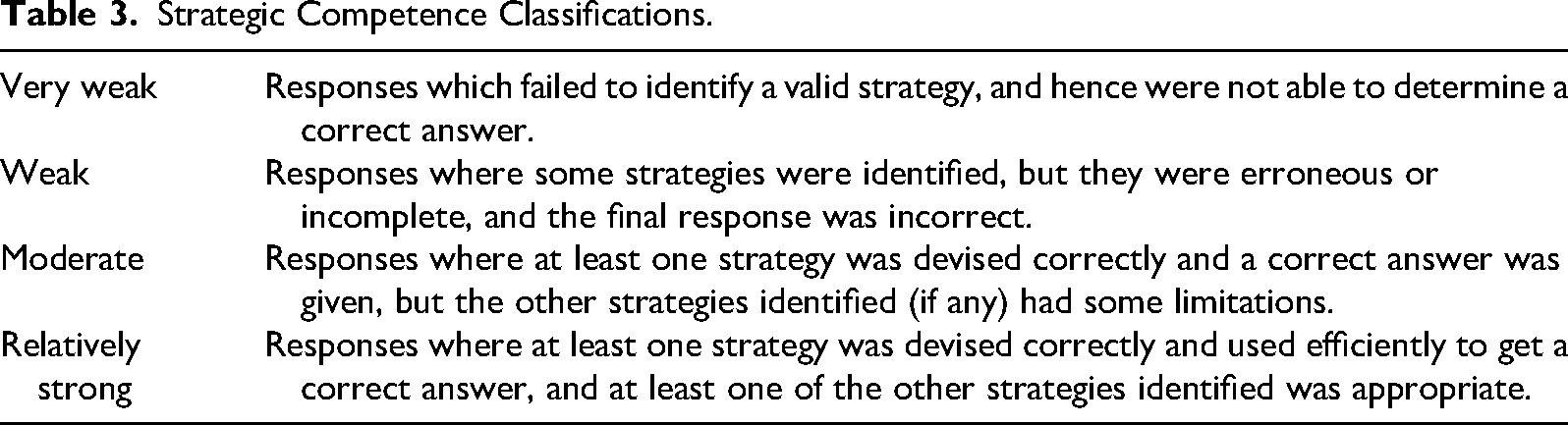
Strategic Competence Classifications.
Table 4 shows the frequency of each SCI for the PTs. Here, the analysis of the component indicators of strategic competence is presented. Results for SCI #4 are presented in the final section. The code “limited evidence,” not shown in the table, was only applicable to SCI #6 and is presented below in the respective section.
The PTs’ Performance on the Strategic Competence Scheme.

The PTs’ Performance on the Strategic Competence Scheme.
Half of the PTs did not interpret the problem to mean that both conditions must be satisfied simultaneously, even though some could generate correct equations. These PTs’ understanding of the problem was considered as “weak” (
The responses of PT9 and PT10 were classified as “moderate” because they recognized simultaneous equations, albeit inconsistently. PT9 could clearly solve simultaneous equations, but only found
Formulate the Problem (SCI #2)
We assessed the competence in formulating the problem based on whether the conditions
Know a Sophisticated Solution Method/s (SCI #3)
Seven PTs did not have a valid approach to the problem, that is, a method that would arrive at the desired conclusion. These approaches were considered as “weak” (PT1, PT4, PT7, PT8, PT18, PT21, PT22). Several tried an exhaustive search and listed all possible solutions to each equation separately or tried
Provide a Variety of Valid Solution Strategies (SCI #5)
The strategic competence of many PTs was “weak” (
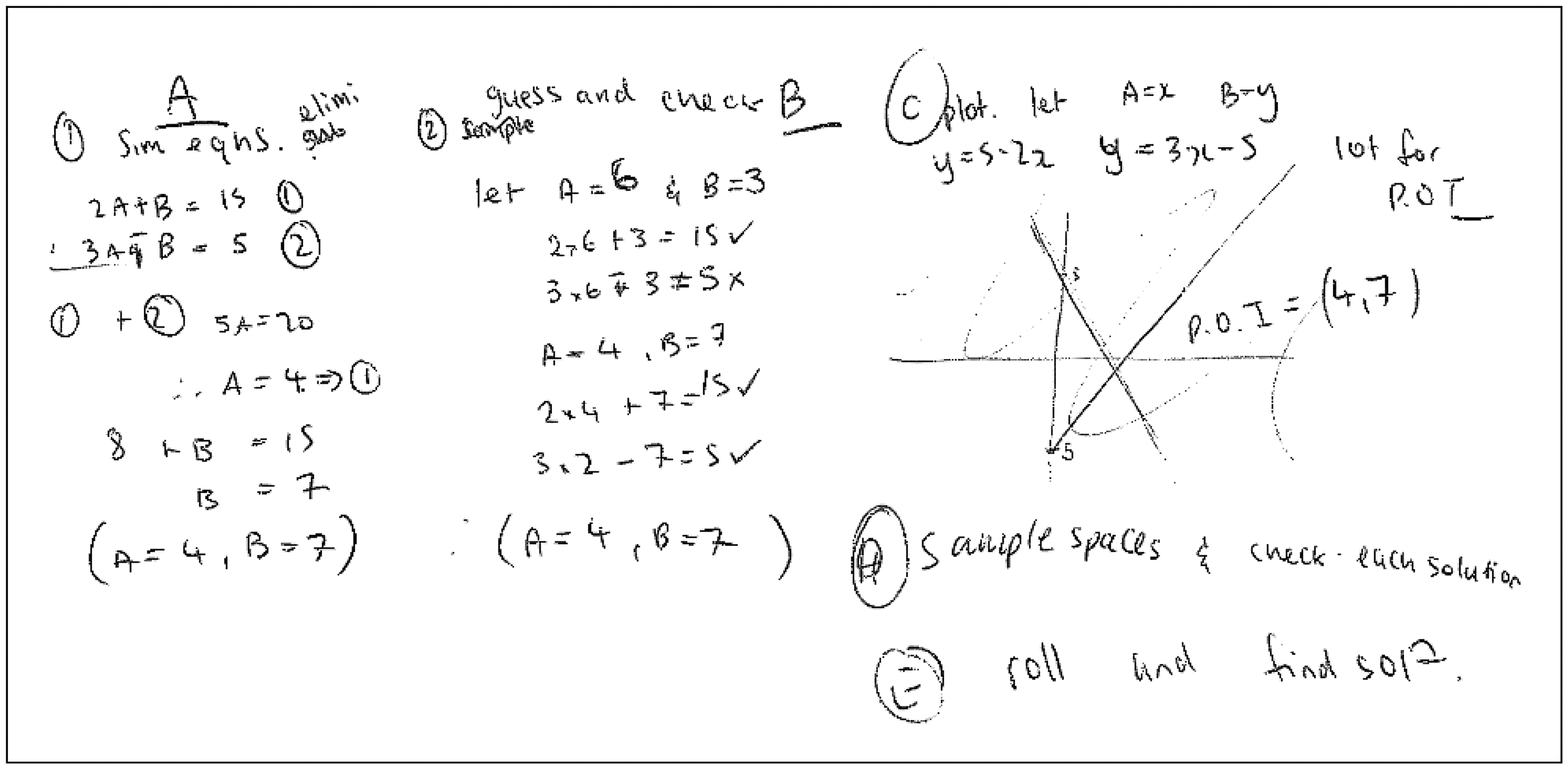
Two PTs approached the problem in two different ways: simultaneous equations, and numerical searches (although sometimes with inadequate explanations), and their strategic competence for this indicator were grouped as “moderate” (PT9 and PT11). Only in three responses—classified as “relatively strong” (PT14, PT15, PT19) on this indicator—were at least three different solution strategies, and they were viable. PT14 used the elimination method correctly and proposed three other methods to solving the problem (Figure 2). Solutions B and C are acceptable approaches, while rolling dice is relatively impractical, akin to random guessing. PT15 implemented two different algebraic solutions and also listed “graphing,” “tables of values,” and “trial and error” as alternative solution strategies, although these were not implemented.

Solution strategies identified by PT14 to the problem.
In the responses where at least one strategy was devised correctly, and a correct answer was given (“moderate” and “relatively strong” groups in Table 3), we found the identified strategies—implemented or suggested—in teacher responses presented in Table 5. According to this data, algebraic (14 occurrences) and numerical (15 occurrences) approaches were identified almost equally; some incomplete solutions were evident in the latter group.
Overview of Identified Strategies in Teacher Responses Where a Correct Answer to the Problem is Given.
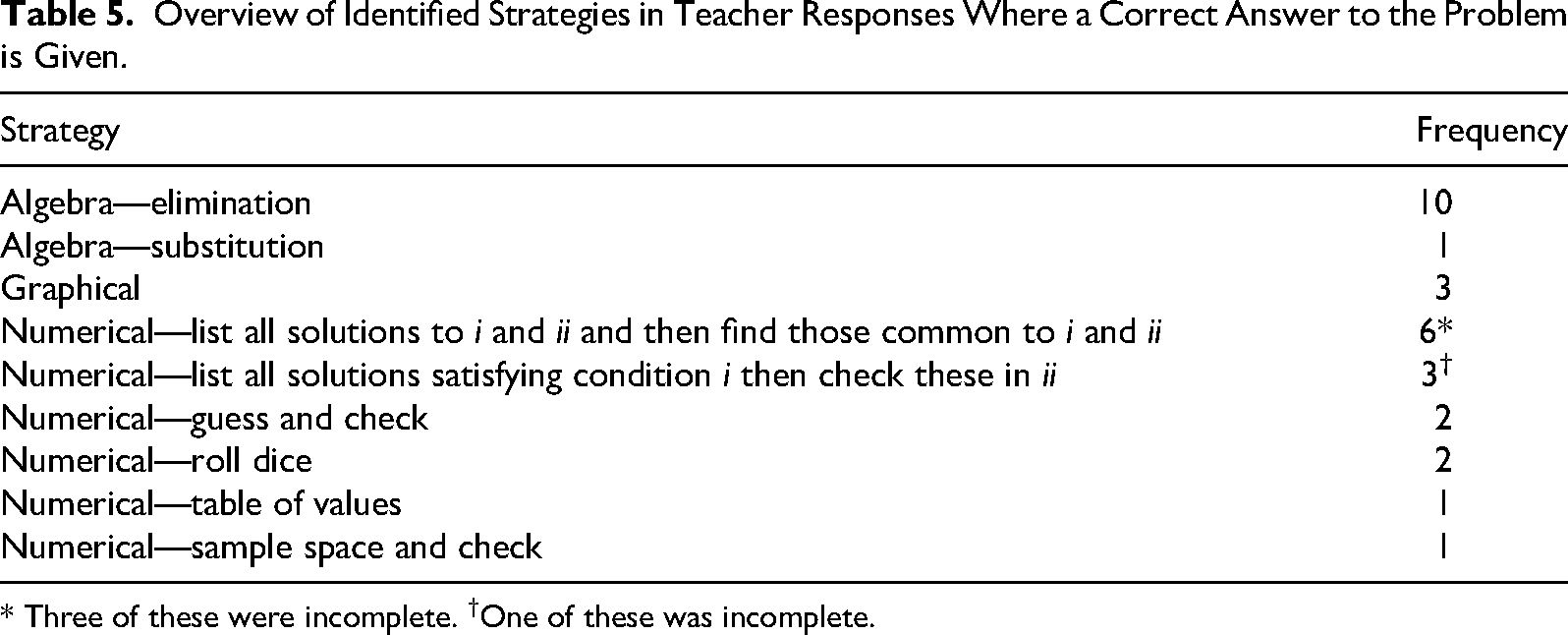
* Three of these were incomplete. †One of these was incomplete.
Among 22 PT responses, in seven cases, there was “limited evidence” to judge this competency for the PTs. PT8 did not approach the problem algebraically. PT20 (see Figure 3, right), PT1, PT4, and PT5 did not use an algebraic solution although they wrote the individual equations. PT10 and PT18 knew that simultaneous equations were involved, wrote the equations, but did not solve them. In three cases, competency in solving equations seemed to be “weak” (PT7, PT21, PT22), involving serious mistakes, or incorrect equations for the problem. In 10 cases, competency in equation solving was “moderate,” with teachers using a concise and efficient procedure to solve the problem, usually the elimination method (e.g., PT13's working out in Figure 3, left). Only in two cases competency in equation solving was regarded as “relatively strong” with teachers (PT15 and PT16) using multiple methods to solve the equations (elimination and substitution).

Responses of PT13 (Left) and PT20 (Right) to the problem.
Out of 22 PTs, 13 arrived at the correct answer. The rest nine PTs did not give a correct answer to the problem. Four of these nine PTs (PT1, PT7, PT8, PT21) did not use a valid approach which could yield the correct answer. The other five (PT4, PT10, PT16, PT18, PT22) were close to a correct solution but their approaches to the problem were either erroneous or incomplete. The criteria in Table 3—knowing a valid solution strategy, applying the appropriate concepts and procedures, and arriving at the correct answer—were used to gauge the PTs’ overall strategic competence for the problem. Out of 22 PTs, the strategic competence of nine of them was classified as “very weak” or “weak,” whereas 13 were classified as “moderate” or “relatively strong.”
The PTs in the “very weak” (
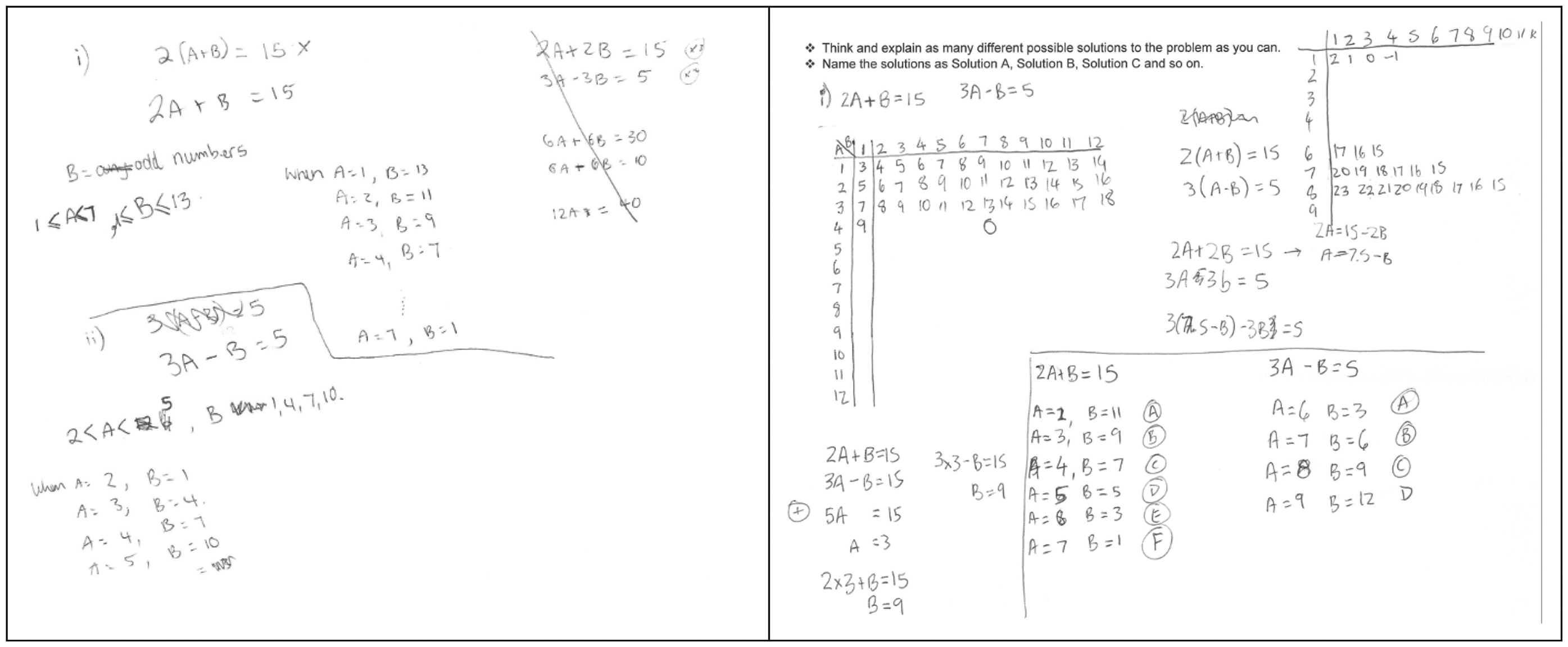
Responses of PT21 and PT22 grouped as “very weak” and “weak,” respectively.
The PTs in the “moderate” category (
Responses of PT19 grouped as “relatively strong.”
In general, the teachers were able to formulate the relationships algebraically. The ability to recognize, and then deal with, simultaneity varied. Some participants did not recognize that both conditions were to be satisfied with the single dice roll, perhaps misinterpreting the two parts to the question as two separate problems to consider. It is interesting to note that for some participants, the context of the dice—one of the “surface features” of the problem (Ito-Hino, 1995)—led to suggestions to consider probability-focused ideas in the solution. Other participants could set up the equations, but then did not have strategies for solving them, or had only less sophisticated strategies (e.g.,
For those who could solve the simultaneous equations, the strategies varied, with both substitution and elimination used as algebraic approaches, and systematic listing of possible numerical solutions was also deployed as a method. The notable absence of graphical approaches in teacher solutions was striking—especially given the well-established association between linear equations and their graphs, and “solving simultaneous equations” often being motivated by the idea of finding the intersection point of two lines (Star et al., 2015). We acknowledge that the low occurrence may be because the variables were
Only 13 of the 22 PTs’ strategic competence were assessed as being “moderate” or “relatively strong” based on SCI #2, SCI #3, and SCI #4 (formulate the problem, know a sophisticated solution method, and arrive at a correct answer). Given that simultaneous equations appear at year 10 in the secondary mathematics curriculum in Australia, it is of concern that there were nine PTs who had only “very weak” or “weak” strategic competence with the problem. This result may be because mathematical study might not be so recent for these nine PTs, or they might not have had extensive mathematical training (see also Barker et al., 2024). Or knowledge decay might have been experienced (Liu & Phelps, 2020). Specifically, some of the PTs may not be involved in teaching the topic currently, with responsibility for teaching other grade levels or different content instead. In any case, this finding implies that teachers do not necessarily gain strategic competence through experience; they may need continuous professional development opportunities (Hatisaru, 2024; Copur-Gencturk & Doleck, 2021; Liu & Phelps, 2020) throughout their teaching careers that allow mathematical development.
Despite their classroom experience, overall, the PTs did not perform strongly on SCI #5—knowledge of a variety of solution strategies. Some teachers relied more on informal strategies, and it is unknown whether they have developed these strategies during teaching (Durkin et al., 2023). Very few teachers could provide more than two valid solution strategies, reflecting the findings of Bruun (2013) and Barham (2020) who also saw limited knowledge of alternative strategies. This may be due to the teachers not being familiar with the idea of producing different solution approaches (see also Bruun, 2013), particularly when they have an adequate and efficient method. Their beliefs about solving a problem in multiple different ways might also have played a role (Lynch & Star, 2014). But it is surprising given the reasonable expectation that they may want to have alternative solution approaches for students (Cai, 2005; Lynch & Star, 2014). This implies that teachers may not identify the validity of different solution approaches, nor highlight to students the important mathematical connections that might exist between them (Star et al., 2015). To us, recognizing, formulating, and solving simultaneous equations should be part of a secondary mathematics teachers’ standard repertoire. It is also vital that teachers appreciate that numerical, algebraic, and graphical approaches are valid and recognize the connections among them. We however acknowledge that time requirements may have reduced the amount of information the teachers provided about their strategies. Also, while the use of a written questionnaire is a promising approach for measuring strategic competence and teacher knowledge (Agathangelou & Charalambous, 2021; Gitomer & Zisk, 2015), other approaches such as interviews could give deeper insight into the findings.
The Affordances of Strategic Competence Scheme
The strategic competence scheme employed here (see Table 1) has allowed for a detailed analysis of the participants’ understanding of a particular class of mathematical problems. It is noted, too, that these indicators are sufficiently generic that they can be applied to a range of problems, not just to a “worded problem involving simultaneous equations.”
One component that is missing from the strategic competence scheme concerns effective communication of mathematical thinking and processes. This seems an important component, both for users of mathematics—since, arguably, care with the presentation of solutions may result in better solutions—and, particularly, for teachers of mathematics. Although there was no intention that the participants were meant to present a “model solution suitable for students,” there was an informality in the presented work. Perhaps reflecting the participants’ judgments about what was expected, but possibly symptomatic of a larger malaise in attitudes to presenting mathematical work, as also evident in Hatisaru, Richardson, and Star (2025). Although their solutions may well reflect the “rough work” that might be engaged with when solving a novel problem, given that DICE is a fairly standard problem involving simultaneous equations, the fact that the various solutions were nonstandard and often disorganized, is of concern.
Several salient observations or suggestions emerged from the discussion. The findings suggest that teacher preparation and professional development programs should place more emphasis on developing strategic competence alongside mathematical knowledge. This is echoed by Copur-Gencturk and Doleck (2021), where such an emphasis can have a higher impact on teachers’ own problem-solving approaches and influence their ability to understand and address student thinking. Similarly, Depaepe et al. (2010) discussed teacher education programs or professional development also need to give additional focus on enhancing teachers’ ability to incorporate metacognitive and heuristic approaches in their instruction. In complement to Durkin et al. (2023), teaching with multiple strategies and discussing multiple strategies with pedagogical coursework or professional development would, in turn, promote more discussion on problem-solving approaches and foster growth in procedural knowledge, flexibility, and a stronger mathematical and conceptual understanding.
Limitations, Implications, and Future Directions
The problem sheets were designed to elicit strategic competence, allowing us to explore teachers’ knowledge of other approaches, and not just the capacity to solve a task using a method they have prioritized. We acknowledge, however, that we could only examine strategic competence based on what the teachers wrote in response, and it may be that they have additional understanding that was not evident in the data (Kahan et al., 2003). We note, too, that this was a small data set, and it would be useful to involve larger cohorts of teachers and to look more deeply at the background of participants.
The task (i.e., DICE), as presented, was purely a mathematical content task rather than a pedagogical one; although for content that is part of the high school curriculum that these participants are teaching. This study did not consider some broader pedagogical implications: do the participants have the ability to evaluate alternative solutions, to make connections among the different solutions and representations, or to assess others’ strategic competence? The consideration of alternative solution methods should be a focus of both initial and in-service teacher education. As for Van Dooren et al. (2003), we see that teachers may not select the optimal strategies for solving a mathematical problem; this suggests that the idea of choosing appropriate strategies and debating their use could usefully be included in teacher professional learning. Especially for teachers who lack adequate formal mathematics education (Wienk, 2020).
One of the issues not addressed in this research is the interrelated nature of “devising a solution strategy” and “mathematizing the problem,” which in the strategic competence scheme are operationalized as SCI #2 and SCI #3 (Table 1). It is not clear to us that these are necessarily sequential as viewed by Copur-Gencturk and Doleck (2021). One suspects that the two may often happen simultaneously, as DICE illustrates: that is, “using algebra” may be identified as a possible solution strategy initially, but it is only after mathematization has begun that the existence of two equations in two unknowns becomes apparent, leading to the more specific solution strategy of “solving using a simultaneous equations strategy.” Even at this point, the full solution strategy may not be decided, as there is a choice to use substitution or elimination, or, indeed, a graphical approach.
One of the powerful features of this study was that it requested multiple solution approaches from the participants. We believe this gave greater insight into the teachers’ mathematical strategic competence than we would have obtained by seeking just one solution (Lynch & Star, 2014) but also gave insight into the repertoire of approaches (see Table 5) that might be used in their teaching. Nevertheless, we did not consider whether the teachers could recognize the validity of solution strategies. It would be of interest to determine whether teachers regard alternative solutions as valid, although this lies in the domain of teacher pedagogical content knowledge (PCK; Chick & Beswick, 2018), rather than strategic competence, which is mathematical content knowledge (Kahan et al., 2003).
We are cautious about generalizing the findings about a sample of secondary teachers’ strategic competence to the broader teacher population in the study country or beyond. What the study has done, however, is develop a method and framework (Table 1) for revealing what strategic competence looks like in mathematical activities, in a detailed way. We believe this level of granularity is useful for identifying strategic competence (Hatisaru, Richardson, & Beckwith, 2025), both for problem solvers generally and especially for teachers of mathematics, who need to model these skills for students. Our findings can inform the content of professional learning in pre- and in-service programs. We add that for the sake of the students—who these teachers are teaching, it is very important that the teachers’ themselves have an appropriate depth of knowledge. The ability to draw connections between different representations (e.g., algebraic and graphical), and thus to be able to propose alternative approaches to problem-solving, is critical. Also, to be able to compare and contrast those methods, and identify strengths, weaknesses, and limitations, does merit. For universities, and professional development providers, it is important to consider activities or assessments that promote the development of these understandings and connections.
Finally, while we used the framework here to analyze responses to a specific algebraic word problem, it can be applied more broadly. For example, although a consideration of teachers’ strategic competence is indicative of their mathematical content knowledge, there is scope for examining and enhancing teachers’ PCK by having teachers interpret students’ strategic competence using a similar task.
Footnotes
Acknowledgements
The authors thank Edith Cowan University which approved the research, the Mathematical Association of Western Australia (MAWA) for supporting the implementation of the study, and the teachers who participated in the study. The authors thank to Barry Kissane for his help on one aspect of data coding. All opinions, and any errors, in this manuscript, however, are those of authors.

Ethical Approval
The research study that underpins this publication was provided by Edith Cowan University. Informed consent was obtained from all participants involved in the research.
Author Contribution
All authors conceived of the work and contributed to writing the manuscript. Investigation: VH and SR. Conceptualization and Methods: VH. Literature review: JS and VH. Data analysis: VH, SR, and HC. Findings: VH and SR. Discussion and Conclusions: HC and VH. All authors read and approved the final article.
Funding
The author(s) received no financial support for the research, authorship, and/or publication of this article.
Declaration of Conflicting Interests
The author(s) declared no potential conflicts of interest with respect to the research, authorship, and/or publication of this article.
Data Availability Statement
The corresponding author does not have permission to share the data.