







Abstract
Introduction
The positive role of history in the teaching of mathematics (Chorlay et al., 2022), as well as in the sciences in general (Matthews, 2014), is consistently reaffirmed through international articles or synthesis works. In the case of mathematics alone, research in this domain is extensive, covering various levels (primary and secondary education, university, teacher training, etc.), addressing diverse questions (motivation, academic achievement, etc.), and employing different and complementary methodological approaches (interviews, questionnaires, films, etc.). It is now well established (Barbin et al., 2020; Clark et al., 2016; Fasanelli & Fauvel, 2006; Fauvel & van Maanen, 2000; Furinghetti & Radford, 2008; Schubring, 2006, 2011) that the history of mathematics represents an interesting approach due to the cultural enrichment and epistemological insight it provides. Numerous authors have documented how students perceive and experience mathematics through history (Bråting & Pejlare, 2015; Bütüner, 2015; Jankvist, 2015; Lim & Chapman, 2015; Marshall, 2000). More specifically, Krussel (2000) demonstrates that having students write a text about the history of a concept they struggle with helps them make progress. Similarly, Liu and Niess (2006) highlighted the value of a course on the history of mathematics in encouraging students to change their conceptions, particularly by enhancing their understanding of the role of creativity and imagination in mathematics. Kaye (2008) reports on a small-scale experiment in which incorporating history into mathematics teaching helped shift some students’ tendency to view mathematics as a dead and boring subject. According to Zhang and Jin (2023), the history of mathematics, primarily conveyed by teachers, should enable students to move beyond a purely utilitarian view of mathematics. Thus, most of the authors all around the word (Chorlay et al., 2022; Lee & Chang, 2024) have emphasized the potential and desirable evolution of students’ beliefs regarding this discipline. In what follows, we are particularly interested in exploring students’ epistemological convictions about mathematics and the development of a reliable measurement tool for such changes.
Beliefs about mathematics
Students’ conceptions of mathematics and their relationships with their involvement and success in academic tasks is a research topic that has seen collaboration in various fields such as psychology and didactics. In a recent synthesis (Hannula et al., 2019), the focus has primarily been on exploring the notions of motivation, engagement, and identity as links between affect and mathematical learning. As Leder (2007, 2019) points out studying students’ beliefs about mathematics poses definitional challenges. Early research on mathematical beliefs mainly demonstrated that these beliefs are not easily grasped (Furinghetti & Pehkonen, 2002), as they are diverse and not necessarily clear-cut within the same individual. According to Pajares (1992), the primary difficulty arises from defining the very notion of belief, which is often used as a generic term to characterize the complex relationships an individual may have with mathematics. To overcome these challenges, Dowker et al. (2016) advocate focusing more on the relationships between different aspects rather than attempting to define an overall attitude. Leder (2019) explains that this methodological choice is currently adopted in large-scale studies such as the TIMSS or PISA, the latter reaffirming explicitly in a dedicated paragraph (Organization for Economic Co-operation and Development [OECD], 2013, 2019) the link between individual psychological dimensions and the liking for mathematics. Given the globally observed decline in students’ interest in mathematics, the study of conceptions has become one of the entry points of numerous studies focusing on motivation (Ng, 2018; Pantziara & Philippou, 2015) and its relationship with other psychological dimensions, such as anxiety (Li et al., 2021). Among the most significant findings observed by Leder in the international literature, it is worth noting that the correlation between attitudes toward mathematics and academic performance is not particularly strong (Zan & Di Martino, 2014), supporting the idea of a rather subtle multidimensional factor. To account for both the multifactorial aspects and the need for an object sufficiently stable to be measured, we will adopt Goldin's (2002) definition of belief as internal representations to which the holder attributes truth, validity, or applicability, usually stable and highly cognitive.
A study without assumptions about students’ knowledge
Our study focuses on conceptions of mathematics historicity, which also represents a multidimensional question, which we will try to define below as the conjunction of general history and mathematics specific conceptions. That is, we are operating within classes in which students have not received specific instruction in the history of mathematics (such as authors, dates, historical documents, etc.). Depending on the context, this lack of exposure to the history of mathematics varies, as it mainly depends on teachers’ choices and pathways. Unfortunately, we have only had very limited access to data on this matter. Therefore, we will operate under the assumption supported by previous studies (Ho, 2008; Moyon, 2022; Siu, 2006) that teachers do not discuss the history of mathematics in their classes or very rarely do so, even if the institutional context encourages them to discuss this topic, as is the case in France. Seeking to study young students in highly varied contexts, where it is not possible to anticipate the presence or absence of historically oriented teaching, our aim is thus to determine whether it is possible to identify epistemological stances without explicitly referencing historical knowledge (authors, facts, sources, etc.) to provide a measurement tool (questionnaire) that can subsequently be used in pretest–posttest-designed experiments that involve the use of the history of mathematics in the classroom. The underlying research question consists in how a better identification of students’ intellectual stance toward mathematics can support the development of tailored and effective learning interventions, particularly when students encounter historical content for the first time. At the end of the article, we also make a few suggestions for implementing interventions aimed at changing students’ conceptions, assuming that a better understanding of the epistemology of mathematics will help improve students’ engagement, motivation, and understanding. However, this last goal is not addressed in this paper and is left for further studies. But before delving into the design of the questionnaire and the results of its implementation, it is important to clarify the connections between beliefs about mathematics and its history.
Frameworks for analyzing students’ conceptions of mathematics and history
As highlighted by Bächtold et al. (2018), epistemology, which is rooted in the history of science, enables an understanding of how knowledge has been constructed, thus facilitating a better grasp of a certain form of scientific culture. Students’ beliefs about mathematics can thus be linked to an inquiry into the nature of mathematics and, further, into its history. As reiterated by Bütüner and Baki (2020), a framework commonly used in international research on students’ beliefs in mathematics was proposed by Ernest. According to Ernest (1989, 2014), there are three major philosophical stances regarding mathematics: experimentalist, Platonist, and instrumentalist. The experimentalist stance views mathematics dynamically, emphasizing problem-solving and constant expansion. The Platonist stance sees mathematics as a static, unified body of interconnected structures and truths, viewed as discovered rather than created. The instrumentalist stance considers mathematics a collection of facts, rules, and useful skills without inherent connections between them. Horton and Panasuk (2011) prefer to group Platonists and instrumentalists into a single class primarily characterized at the epistemological level by the fixity of concepts. They retain the experimentalist view, which they reframe using the term fallibilism, thereby contrasting it more clearly with the epistemological fixism of the first category. From the fallibilist perspective, mathematics is seen as historical and social, acknowledging cultural limitations to their claims of certainty, universality, and absoluteness (Horton & Panasuk, 2011). Ernest was notably interested in the potential role of the history of mathematics (Ernest, 1998) in shaping or evolving students’ beliefs. In our study on students’ beliefs about mathematics and its historicity, we rely, as did Bütüner and Baki (2020), on this dichotomy between a fixed perspective and a sociodynamic viewpoint. This latter stance is supported by contemporary mathematicians of the American Mathematical Society, who perceive mathematics as an ongoing pursuit of solutions to new problems. This perspective emphasizes collaborative work worldwide, grounded in a rich historical and cultural heritage. In the following sections of this article, therefore, we consider a conception of mathematics that acknowledges both its historical and cultural roots and its dynamic evolution through communities of researchers as accurate.
The awareness of the historicity of mathematics is part of a broader engagement with the past encapsulated within the concept of historical thinking. Despite being fairly intuitive, international research (Metzger & Harris, 2018) in the field of history education (here, in terms of school discipline) quickly encountered difficulties in definition. Based on a review of major works in the field, Lévesque and Clark (2018) proposed a potential distinction between two approaches to understanding historical consciousness. First, the historiographical approach refers to the recognition of the historicity of human beings and their knowledge in society, while the second, the educational approach, focuses on how the concept can be used for empirical research and history teaching practices (Boxtel & Drie, 2018). The authors summarize their reflections (Drie & Boxtel, 2008) through a diagram (Figure 1), which illustrates four poles: historical knowledge, interest in history, epistemological beliefs, and meta-historical knowledge.
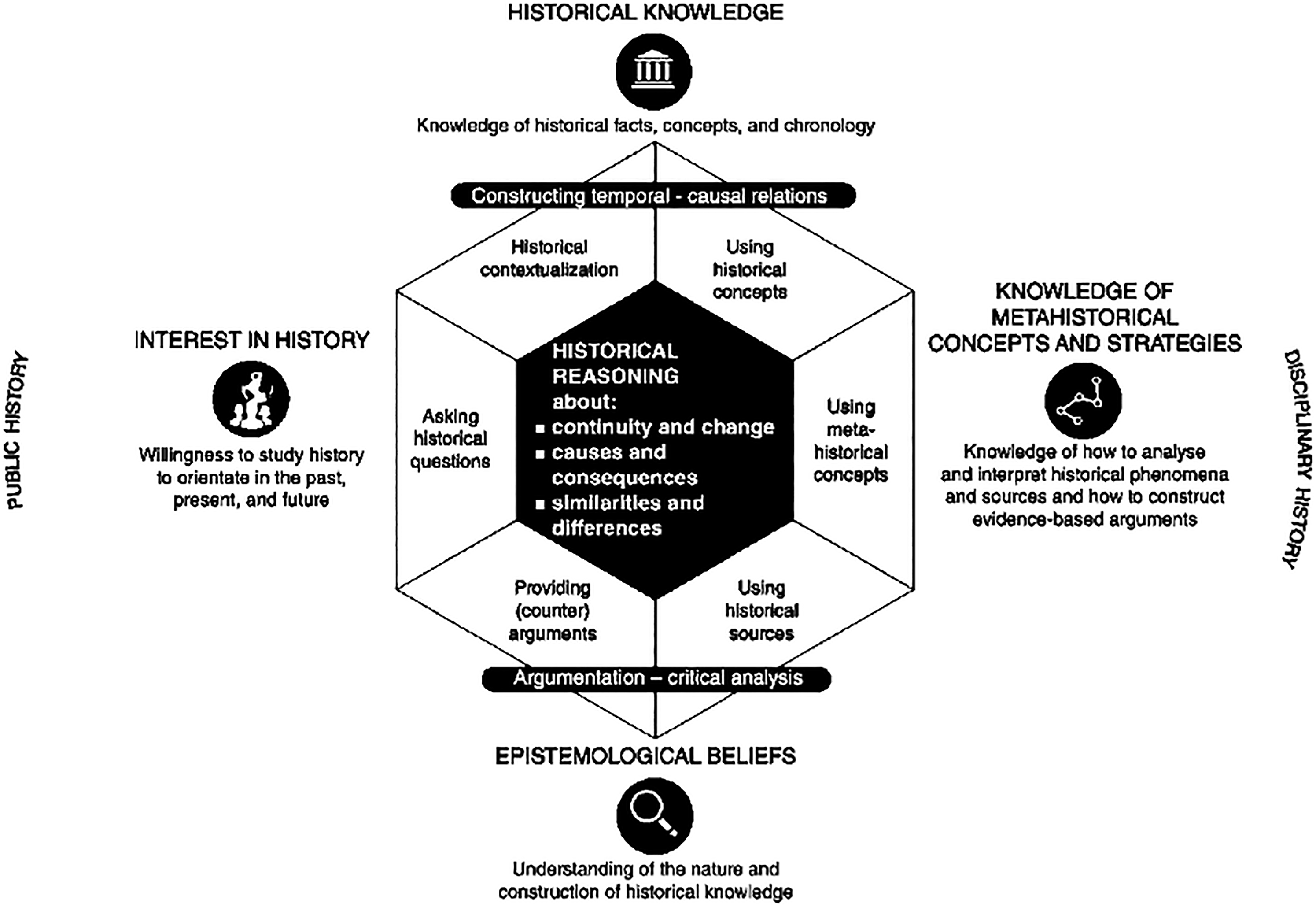
Historical reasoning according to Boxtel and Drie (2018, p. 152).
According to this framework, historical knowledge and epistemological beliefs play a pivotal role in shaping our relationship with the past. Specifically, the epistemological dimension grants access to a critical (or noncritical) perspective on historical sources and facts. Applying this reflection to the specific field of the history of mathematics highlights the role of primary sources and their interpretation, where the risks of errors can deeply influence an individual's mathematical beliefs.
As in general history, the history of mathematics can be subject to misunderstanding (Crowe, 1988), anachronism, and other biases that a well-educated historical consciousness should safeguard against. This same principle is underscored by Kjeldsen et al. (2022) when they describe historical consciousness as based on the notion that both the past and the future are at play in the present. According to the authors, studying the history of mathematics and working with primary sources in math classes can develop students’ historical consciousness in a manner that integrates critical examination and an active stance toward sources. We echo this perspective, and the objective of our study is to explore the level of historical consciousness among students and their adherence or nonadherence to certain common interpretative biases, such as the myth of the solitary genius mathematician and condescension toward ancient mathematics viewed solely through the lens of contemporary knowledge.
Epistemological beliefs are among the poles that constitute historical reasoning when enriched with historical knowledge (Boxtel & Drie, 2018). As outlined by Clark et al. (2019), applied to the case of the history of mathematics, such a questioning should enable a re-examination of mathematics itself and thus lead students to a better understanding of its objects and methods. This is also explored by Liu (2009, 2022) in a qualitative study where he shows that the use of the history of mathematics, through storytelling, allows for a modification of students’ conceptions. In our study, we focus on students’ conceptions of mathematics, not in relation to its immediate utility or its role in future careers, but by considering the historical grounding of this discipline. Through this historico-epistemological lens, our research aligns with the international call, highlighted in the introduction, to document and provide tools for evaluating the effects of introducing a historical perspective into mathematics education.
Methods: measuring students’ historico-epistemological conceptions
Mentioning earlier international studies leads us to discuss the notion of measuring different characteristics to better understand students’ attitudes and beliefs about mathematics through one of the main tools used in psychology, which is the questionnaire. There are numerous lists of questions that have been validated and subsequently used in many studies. For example, one might mention the Fennema–Sherman scale (1976), which comprises 108 items organized around several subdomains, such as self-confidence, perceptions of parents and teachers about the student, motivation, etc. The objective of the entire scale is primarily to identify gender biases in the relationship with mathematics, including the anxiety that this subject can generate. The stabilized question list by Fennema–Sherman (Broadbooks et al., 1981) is sometimes used as is, but most often, it undergoes adaptation for a specific context. Regarding the connections between motivation and mathematical learning, the motivated strategies for learning questionnaire (MSLQ) scale has also yielded numerous research outcomes. Developed by Pintrich and de Groot (1990), this is a 44-item scale aimed at determining a student's attitude toward a school learning domain. The particularity of this questionnaire is that it focuses on a school discipline without specifying it explicitly. Hence, the tool is easily adaptable (Pintrich et al., 1991) for studying students’ feelings toward any field of learning, from language to mathematics, including the sciences or history. As mathematics is one of the core subjects taught in classrooms worldwide, numerous adaptations of questionnaires have been proposed and tested on populations of various sample sizes. For instance, Tapia and Marsh (2004) and Sachs and Leung (2007) aimed to reduce the number of questions from the Fennema–Sherman test to create a final coherent version with 40–50 items. Similarly, Fiorella et al. (2021) developed a questionnaire comprising 19 questions based on the MSLQ, retaining its five main themes: intrinsic value, self-regulation, self-efficacy, utility, and anxiety. These examples, among many others, include adaptations in the teaching context in Hong Kong by Rao et al. (2000), primary education in Turkey (Ersoy & Öksüz, 2015), secondary education in Mexico (Arellano-García et al., 2022), higher education literature (Ménard & Leduc, 2016), and teacher training (Marshman & Goos, 2018). There are countless studies that have relied on early psychology insights and questionnaires that have been developed as a result but none addresses historico-epistemological dimensions. Similar to the adaptations made by Charalambous et al. (2009) for a group of young teachers, for our study on students’ relationships with the history of mathematics, we will focus on two key methodological choices: first, seeking independence of the measuring tool from specific disciplinary knowledge and, second, creating a relatively short questionnaire tailored to the students’ age.
Questionnaire design
The students’ conceptions are generally multidimensional, making access to such conceptions through a single questionnaire complex. However, we attempted to explore several dimensions of beliefs about mathematics and their historicity: mathematics as a heritage (positive belief), epistemological fixism (negative bias), mathematicians as geniuses (negative bias), social interactions between mathematicians (positive belief), mathematics as a culture-dependent product (positive belief), today's mathematicians as more intelligent than those of the past (negative bias), and students’ interest in the history of mathematical concepts (positive trend). These topics were chosen because, although not exhaustive, they offer a broad range of both correct and incorrect ideas that students may have. The different questions were developed with reference to the epistemological categorizations mentioned in the introductory paragraphs, as well as by adapting ideas on misconceptions about mathematics and its history. Even though numerous questionnaires examine mathematical conceptions, they generally focus on teachers (Tu, 2017; Xie & Cai, 2021) rather than students. In these questionnaires, strictly historical dimensions are never included. The questions typically address how mathematics is perceived in everyday life, particularly in the classroom context, but not its connections to the past. This latter aspect is specific to our study. For this first measurement tool, we created twelve questions covering seven epistemological traits. The proper understanding of each question was tested in a 5th-grade class and a 6th-grade class, respectively comprising 25 and 24 students, before implementation. The study was conducted qualitatively through dialogue between the teachers—experienced in using the history of mathematics in the classroom—and the students, as well as through a written request for students to explain their answer choices. Some examples of student work demonstrating a quite good understanding of the questions can be found in the appendix. Two questions focused on the first theme: (Q01) “I think mathematics was invented a very long time ago,” and (Q06) “I think the mathematics I am learning is a legacy of the past.” For these two questions, our objective was to understand whether the student perceived the historicity of mathematics and its connections to contemporary school mathematics. The second dimension of the questionnaire addressed epistemological fixism, which we identified in the first section as one of the common beliefs about mathematics. Three questions relate to this theme. The first is question (Q02), “I think everything in mathematics has already been discovered,” which directly explores fixist beliefs. This question was complemented by two others that also suggested a static nature of concepts, one regarding spatial immutability with question (Q04), “I think mathematics today is the same everywhere in the world,” and another about temporal constancy with question (Q08) “I think ancient mathematics is the same as ours.” The third theme addressed in the questionnaire is a bias that encompasses both historical dimensions and current psychological aspects. It involves the belief that mathematics is produced and accessible only to geniuses in the field. When this bias appears in students, often those who are weaker in mathematics, it hinders their full engagement, as they do not perceive themselves as capable of seeking and finding the right answers to a problem. We explored this bias through two questions, one anchored in the past (Q09), “I think ancient scholars were geniuses who invented mathematics all by themselves,” and the other anchored in the present (Q11), “I think mathematicians currently are geniuses who invent things all by themselves.” Here, the term “mathematicians” was replaced by “scholars in mathematics,” a choice stemming from pretesting the questionnaire on Grade 5 and 6 students. For these students, we observed that the term “mathematician” did not resonate, at best vaguely referring to their math teacher. Given their lack of knowledge about the profession of a mathematician, a more neutral wording was preferred. The fourth theme of the questionnaire explored the social dimensions of mathematical activity. This theme is related to the previous theme and was framed to highlight collaboration among mathematicians. As with the bias of the genius scholar, two questions explore, on the one hand, ancient aspects (Q10), “I think ancient scholars worked with other scholars to develop mathematics,” and on the other hand, contemporary aspects (Q12), “I think mathematicians currently work with other mathematicians.” Finally, the last three themes were addressed through a single item each. First, the connections between mathematics and culture (Q05) “I think, in the past, mathematics differed among countries, cultures, ….” As highlighted by Kroeber and Kluckhohn (1952), after reviewing over a hundred definitions, culture is a complex construct that cannot be captured by a single question. By considering cultural dimensions only through a general and purely intuitive conception, our questionnaire presents a certain limitation. If required by specific contexts, more targeted questions may be added to better identify potential cultural anchoring. The bias of a condescending view of the present over the past is addressed by (Q03) “I think mathematicians currently are more intelligent than mathematicians in the past,” and last, a question about the student's fondness for the history of mathematics (Q07) “I enjoy learning how mathematical concepts originated” is proposed. The questionnaire ultimately consists of twelve questions that are not organized by theme.
For all the questions included in our questionnaire, the students were required to select their response on a four-point Likert scale: “Strongly Disagree,” “Agree,” “Disagree,” or “Strongly Agree,” with the option to refrain from answering in cases of confusion. The choice of a scale without a neutral midpoint aimed to compel students to take a definitive stance.
Context and participants
The study we conducted involved students from three countries, France, Ghana, and a Franco-American school in the USA. It is important to clarify here that this is not a comparative study on representative samples of the population. The research focuses on the development of a questionnaire that should be suitable for a wide range of contexts. It is in this sense that we have focused on students in various educational settings. This research is part of a partnership between France and Ghana
Context 1: France—public schools
In France, students are typically enrolled in public and tuition-free schools. The official curriculum is devised by the Ministry of National Education, but teachers have complete autonomy in its implementation, commonly using numerous textbooks published by private companies. French classrooms exhibit varying socioeconomic profiles depending on the location of the school, resulting in a fairly diverse spectrum. Thus, school situations, which are strongly correlated with social inequalities (Ly & Riegert, 2015), vary significantly. Overall, however, according to the National Statistics Institute (INSEE), all students within a given age group attend school; the enrollment rate for students aged 5 to 11 is 100%. Due to its massive scale, the French school context is complex, particularly because of the concentration of challenges in certain regions or in areas designated as priority education zones. France's performance on international assessments typically falls below the OECD average, and class sizes average approximately 25 students for the levels we are considering here (Evain, 2023). The history of mathematics has a distinct place in the official French curriculum. While extensively present in the mathematics curriculum at the end of secondary education, it already appears in a few mentions within the programs for younger students. As a result, historical elements are present in most textbooks, generally in the form of integrated or standalone inserts within exercises and in certain pathways of initial and ongoing teacher training. For convenience, we will refer to this first group of students solely by their country of origin, France, bearing in mind that this is by no means a statistically representative sample of the French educational system.
Context 2: Ghana—public and private schools
The second context examined in this study comprises public and private schools in the Ashanti region of Ghana. These schools enroll students with a diverse range of abilities, reflecting their sociocultural backgrounds. Many of these students can be characterized as underprivileged. While public basic schooling in Ghana is free, private basic schools generally outperform public ones. As stated by the UNICEF, the school environment is usually not conducive to learning, water and sanitation facilities are inadequate, and trained teachers and school books are in short supply. The student-to-teacher ratio averages approximately one teacher for every fifty students. The poor quality of education is thus reflected in students’ results. Ghana rarely participates in international assessments, but students’ scores are among the lowest. For example, on the TIMSS 2011 (8th grade), the country is in last place, with an average score of 331, where the central point of the scale is 500 and the best countries reach more than 600 points. In Ghanaian basic schools, instruction is conducted in both English and the local language Asante Twi within the study area. There is no national policy regarding the incorporation of the history of mathematics into the teaching and learning of mathematics in Ghana. Similar to the previous group, we will refer to the students in this second set by their home country, Ghana, although they do not represent a controlled, statistically representative sample.
Context 3: USA—a Franco-American private school
The last context for our study is a French school in New York, USA. It is a private bilingual school that typically enrolls high-achieving students. The sociocultural background of children can be characterized as privileged or even very privileged, although scholarships provide access to students from diverse profiles. The institution is known as a prestigious school for which wealthier parents are willing to pay high registration and tuition fees. The student-to-teacher ratio is very high, averaging one teacher for every ten students. The school offers two types of curricula: one primarily taught in English and the other, known as Franco-American, where instruction is mainly in French. Our sample is from this second track, which follows the same curriculum as in France. Students in these classes generally perform very well academically (100% baccalaureate success, 96% with honors) and, as previously highlighted, come from a rich sociocultural background. Within the school, there is no specific integration of the history of mathematics, making the situation very similar to that in metropolitan France. As with the other groups of students, for convenience, we will refer to this group by its country, the USA. However, it should not be considered representative of the country or even this specific type of Franco-American school.
Participant recruitment process
All classes participated in the experiment on a voluntary basis leading to a non-random convenience sampling. Recruitment was primarily conducted through an informal call for participation. In France, a mailing list targeting mathematics teachers was used to contact potential participants. In Ghana, the classes that participated were those who agreed through teacher-trainees studying at the author's institution. Finally, at the French American school in New York, participation came from classes that responded to a call for participation relayed by the head of the mathematics department. In each country, the classes had not previously been involved in any study or experimental program concerning students’ conceptions of mathematics and its history.
Sample studied
In our study, 353 students participated in France, 400 in Ghana, and 100 in the USA, for a total of 853 students, comprising 49.6% boys and 50.4% girls. The students were distributed across various grade levels, with 83 students in Grade 4, 486 in Grade 5, and 284 in Grade 6. The questionnaire was administered in paper-based and data coded manually. As assessment was supervised by the teachers in a regular school setting, there is no missing data in our dataset. The questionnaires were translated into the primary language of each of the three countries: French for France and English for Ghana and the USA. The seventeen classes involved in France in our study were drawn from multiple regions and diverse social situations without an attempt to constitute a representative sample. The seven classes in the Franco-American school in New York align with the school context previously described. In Ghana, the sixteen classes involved were drawn from either public or private schools. By categorizing the three groups by country names—France, the USA, and Ghana—our objective is to acknowledge the highly diverse educational contexts from which the students originate, which is a factor that will be significant in the interpretations that follow. For each of the three educational levels represented, there are approximately 800,000 students in France and 700,000 in Ghana. The calculation of the representativeness of our samples using Slovin's formula is provided in Table 1. Finally, regarding the privileged context of the New York school, it is part of the French overseas education network, which includes approximately 30,000 students per grade level.
Number of participants by grade and by country, in brackets the margin of error due to sample size at 95% confidence level.

Number of participants by grade and by country, in brackets the margin of error due to sample size at 95% confidence level.
After participants’ filtering, the data analysis comprised two main steps. Initially, we conducted
Results
For each question, below, we provide the mean and standard deviation (Table 2). The questionnaire responses were coded from 1 to 4 in ascending order of agreement with the statement provided. With the scale comprising four levels, it is important to note that the mean, representing a neutral level, therefore lies at a value of 2.5.
The questionnaire results and gender bias t -test with μ as the mean, SD as the standard deviation, t -statistic and p -value from the Student's t -test (significance level 0.05).

The questionnaire results and gender bias
The raw data did not show gender bias except for questions Q04 and Q08. For question Q08, 69% of boys and 62% of girls “strongly agree” or “agree.” Thus, even though the t-test is significant, both groups predominantly agree with the statement, indicating no substantial issue. For question Q04, the situation differs slightly: 51% of boys “strongly agree” or “agree,” compared to only 41% of girls. While the gap may be significant, no clear reason explains this disparity for this particular question. Nonetheless, we will see later that this will not impact the distribution of girls and boys across different clusters. For all the questions, due to a very high standard deviation, no specific general trend is observed. Hence, we supplemented these initial data with a detailed representation of each of the four response levels, distinguishing between the three countries (Figure 2).

Detailed results by country, for each graph, on the left, the cumulative percentage of negative responses 1 and 2 is provided, and on the right, the cumulative percentage of positive responses 3 and 4 is displayed.
The graphs show several notable differences in response distribution based on the country considered. There are shifts toward positive responses, as seen in Q05, Q10, or Q12; shifts toward negative responses, such as in Q02, Q04, or Q08; and situations where there is no difference between countries, as observed in Q06 or Q07. These differences will be further investigated.
Overall, the questions were well understood by the students; however, two questions posed issues. These are the last two mentioned in the description above, namely, questions Q03 and Q07. During the large-scale administration, we noticed through multiple inquiries from the students that the notion of intelligence did not truly make sense to them. Students were unable to position themselves regarding the assertion of superiority of current mathematicians over past mathematicians. Question Q03 will thus be excluded from the analysis. Question Q07, on the other hand, proved to be connected too closely to whether students had experience with a historical approach to mathematics in class. As seen in the description of the different study contexts, many students simply had never encountered the history of a mathematical concept. Students mainly responded based on their general interest in mathematics. The slightly different formulation of the question, starting with “I enjoy …” rather than “I think …,” certainly contributed to accentuating this effect. For reasons similar to question Q03, question Q07 will be excluded from the analysis, resulting in a better focused questionnaire of ten themed questions about five dimensions: historical legacy, epistemological fixism, genius biases, mathematics as a social activity, and mathematics as a product of culture. The omission of two questions could potentially compromise data consistency, but as we will see below, this is not the situation here. With a refined dataset, we now proceed to clustering analysis to identify student response patterns.
Data filtering and consistency
The questionnaire we developed was administered in a school context and was delivered by teachers to their students. In this situation, students might tend to respond not based on their own personalities but by attempting to anticipate a presumed response expected by the teacher. This represents a specific case of so-called social desirability bias (King & Bruner, 2000), which is nearly impossible to eliminate (Fisher, 1993; Fisher & Tellis, 1998), especially when investigating the presence of an authority link, such as in the teacher‒student relationship. Anticipating response drift across a set of questions such as ours on students’ perceptions of mathematics and its history is not necessarily straightforward. Nonetheless, it is possible to verify a certain form of consistency for responses that are semantically opposed, such as the idea of a solitary scholar versus collaboration within a collective. It is also important to note that the questionnaire was administered to very young students and employed a response scale without a central point. In such a context, the questionnaire might resemble a search for rather dichotomous responses, hovering between a fairly generic agreement and disagreement. Several studies (Boseovski, 2010; Brady et al., 1999; Fritzley et al., 2013) have shown that very young children tend to respond more frequently in a positive manner when presented with only two options, yes and no. As our analysis focused on identifying profiles that are distinct from one another, overrepresentation of either category can indicate biased responses, either due to the desire to please the teacher (a high rate of positive responses) or to take a stance against the school (a high rate of negative responses). In the context of our study, such a bias may mainly lead to a potential loss of data consistency. We attempted to mitigate these effects by removing extreme outliers (too many positive/negative answers). Participants’ responses were thus grouped into two categories (Table 3): one positive for responses originally coded as 3 and 4 (“agree” and “strongly agree”), and the other negative for responses initially coded as 1 and 2 (“agree” and “strongly disagree”).
Number of positive responses (indistinctly coded as 3 or 4), by country with the data retained after filtering in bold.
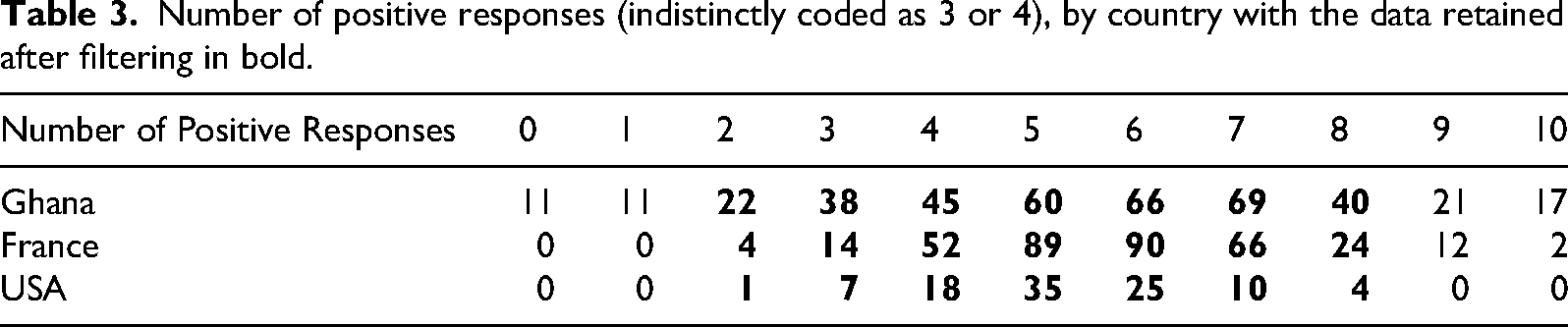
Number of positive responses (indistinctly coded as 3 or 4), by country with the data retained after filtering in bold.
The extreme data on the right (left) in Table 3 show that certain students indeed responded entirely positively (negatively) to all the questions. Given that the questionnaire comprises dimensions designed to be inversely related to each other (especially individual genius versus teamwork opposition), these students presented inconsistent responses. A notable difference is observed among the three countries, with coherence seemingly associated with the socioschool context, as Ghanaian students exhibit more extreme situations than do those from France or the French-American school in the USA. To maintain sufficiently consistent data for further analyses, a compromise must be found by removing the least amount of data. After several attempts, we reduced the number of participants to N = 779 (91% of the initial respondents) by limiting the dataset to the core of the response distribution (in bold in Table 3), consisting of responses that presented positive values for at least two questions and, at most, eight questions.
On this dataset, the coherence is acceptable (Béland & Michelot, 2020); McDonald's omega coefficient (McDonald, 1999) which is based on factor analysis and can account for the hierarchical structure of items where different items may load differently on one or more factors yields ω = .70. A Shapiro-Wilk test shows that multivariate normality is not assumed (W = 0.9906, p-value < .05), so the confirmatory factor analysis (Bollen, 1989; Li, 2016) was performed with a maximum likelihood estimation with robust standard errors and a mean- and variance-adjusted test statistic MLMVS (χ2(26) = 44.729, p value (χ2) = 0.013, RMSEA = .030, p-value (RMSEA < .05) = .987, CFI = .972, TLI = .951, factor loadings given in Table A1 in appendix). The confirmatory factor analysis thus validates the five dimensions proposed in the questionnaire. Nonethless, the Cronbach's alpha value for each dimension is very low, indicating that each trait is not perfectly captured by the questionnaire. This is a limitation that may be due to the young age of the students.
To explore student profiles regarding their beliefs about mathematics and its history,

For better interpretation, the questions were grouped into the five validated dimensions of the questionnaire, namely, mathematics perceived as a form of heritage from the past (Q01, Q06), a fixist view of their evolution (Q02, Q04, Q08), the perception of the mathematician as a solitary genius (Q09, Q11), the understanding of mathematical research as a collective effort (Q10, Q12), and finally, sensitivity to the cultural dimensions of mathematics (Q05). For each of these dimensions, the average scores obtained for each cluster are provided in Table 4.
Average scores, reported on a scale of 1 to 4, by cluster for each dimension of the questionnaire.

A comparison between clusters using Dunn's test with the Bonferroni method shows significant differences for each of the five dimensions, except for Clusters 2 and 3 on
Cohen

|
***,
The centroid distance Δ for all pairs of clusters is above 4, which, according to Dalmaijer et al., ensures a statistical power of 100% for the separation given our sufficiently large number of participants. Clustering can therefore be considered to reflect a certain reality of different student profiles.
We supplemented these tables with a visualization of the distribution of responses on the different dimensions for each cluster (Figure 4) to interpret the trends within each of them.

Distribution of responses across the five dimensions and by cluster (from left to right, 1, grey; 2, white; 3, black).
For the
The specific characteristics of each cluster will be studied in more depth in the discussion section, but we can already observe a predominance of certain traits within the groups. Cluster 1 shows a very low consideration of the
Using the
Number of students by gender and by cluster.

Number of students by gender and by cluster.
Number of students by grade and by cluster.

We conclude the results section by providing the distribution of the different clusters by country. According to these data (Table 8), a significant disparity appears in the distribution of different clusters. Specifically, the proportion of students in Cluster 3, i.e., those who exhibit an accurate understanding of mathematics and its history, is 24% for students in Ghana, 50% for students in France, and 76% for students in French schools in New York, USA. There is a distinctiveness in each subsample based on socioeducational contexts. These values invite several points of interpretation that we will delve into in the next section of this article.
Number (percentage) of students by country and by cluster.

After processing, the data from the questionnaire suggests the feasibility of analyzing students’ perceptions of mathematics and its historical aspects. Upon filtering, the data shows consistency, enabling validation of the various epistemological dimensions covered in the questionnaire and facilitating the study of student clustering based on specific mathematical perspectives. Consequently, we have identified three clusters whose traits appear to align with the contexts in which the questionnaires were conducted.
The goal of our experiment was to study students’ beliefs regarding mathematics and its epistemology in a general sense, without specific prior knowledge about individuals or historical facts. The postfiltering questionnaire we developed (see revised version in appendix) comprised ten questions aimed at identifying students’ conceptions of five aspects of mathematics: the correct understanding of mathematics as an inheritance from the past (Q01, Q06), rejecting fixism as an erroneous conception (Q02, Q04, Q08), debunking the notion of a solitary genius mathematician (Q09, Q11), understanding mathematical research as a collective effort (Q10, Q12), and finally, the correct perception of the cultural dimensions of mathematics (Q05). The analysis of the data obtained from our total sample demonstrates the validity and structuring nature of these five domains, allowing for interpretation of the clustering.
Three historico-epistemological profiles
Our clustering revealed three distinct profiles that can be interpreted through Horton and Panasuk's categorization (2011) and the variations developed from the initial works of Ernest (1989, 1998, 2014). The first cluster comprises students exhibiting an

Percentages of students by country and by cluster (from bottom to top, 1, grey; 2, white; 3, black).
In France, where classes from diverse socioeconomic backgrounds are represented, Cluster 1 comprises only 13% of the total. In addition, for French schools in New York, which represent a highly privileged social environment, only 5% of students exhibit a fixed mindset. Historical awareness is not activated among students in Cluster 1. However, within the framework proposed by Drie and Boxtel (2008), we can emphasize the pivotal role of epistemological beliefs in shaping our relationship with the past. These beliefs also play a role in the ability to interpret historical sources. Teaching based on the interpretation of ancient mathematical documents can serve as a way to change students’ conceptions. However, an individual may encounter obstacles if too few students have the appropriate mindset to engage in it. Bütüner and Baki's study (2020) on a small sample (N = 24) revealed a reduction in students’ absolutist beliefs about mathematics. The questionnaire we proposed aims to measure this proportion on a larger scale, track its potential evolution, and assess its impact on implementing historical-based activities in class. An examination of threshold effects would be relevant to shed light on the potential of using the history of mathematics in the classroom based on students’ profiles. This leads us to the second cluster, which encompasses students with a completely different profile.
The proportion of Cluster 2 ranged from 19% (USA) of the total to 35% (Ghana) and 38% (France), indicating a relatively stable representation across our samples. For these students, historical consciousness is indeed activated. Mathematics is perceived as a heritage from the past, a product of human work and culture. Cluster 2 does not display a biased fixist-type view. The epistemological stance of these students aligns closely with what would be desirable. However, the clustering also reveals a strong adherence to the idea of the genius mathematician, in a vision that we might call
As highlighted earlier, the third cluster displays responses that are consistent and, as we will now clarify, align with a
The study of students’ conceptions we have just presented prompts us to reflect on how they are taken into account, particularly those that are less aligned with the desired ones, in the context of classroom interventions. In this way, we can consider the various epistemological-historical biases that can be identified in some students, as well as some well-documented stereotypes in general mathematics education, such as gender or sociocultural background (Nguyen & Riegle-Crumb, 2021). Research on these topics has shown that targeted interventions can change pupils’ conceptions (Bonne & Johnston, 2016), enabling them to gain a better understanding of contemporary mathematical issues. Gijsbers et al. (2020) noted, in particular, that a course with new context-rich curriculum materials enhances students’ beliefs about the relevance of mathematics. Among the possible challenges, we might also mention the importance of a correct conception of mathematics for a successful transition to university (Geisler, 2023). Positive interventions are also possible in the case of the history of mathematics, where for example, Liu and Niess (2006) shifted students’ beliefs from mathematics as a product to mathematics as a process. Subsequently, Liu (2022) demonstrated that the use of a historical narrative about mathematics also leads to a better epistemological understanding of mathematics. In the study we have proposed, we have pointed out several dimensions of an erroneous epistemological-historical conception of mathematics. Choosing to act on one or another would undoubtedly lead to different outcomes. At this stage, we can only make proposals that will need to be validated by dedicated research, but we present a few examples (Table 9) relating to the five dimensions of our questionnaire.
Proposals for interventions aimed at changing students’ beliefs.

Proposals for interventions aimed at changing students’ beliefs.
For a well-targeted intervention, we would take advantage of the opportunity to connect historical thinking (Boxtel & Drie, 2018), in the general sense, with the specific context of mathematics. The objective would be to use sources, preferably authentic ones (Barbin et al., 2020; Clark et al., 2016), to help students rethink the main epistemological dimensions of mathematics. This could be beneficial, in the sense that it would be worth describing in detail, for any student who presents a more or less erroneous conception of mathematics and its history. In so doing, as noticed by other studies (Liu, 2009), we can hope to help students move toward a better understanding of the place of mathematics in society and, consequently, in their own education. The impact on students can then be measured, particularly using our questionnaire, supplemented by other tools or approaches that provide a more in-depth understanding of changes in students’ perceptions as part of a pretest–posttest approach.
The study we presented aims to explore students’ conceptions on historical and epistemological dimensions. In order to facilitate implementation across different contexts with young students, several choices have been made, which leads to several limitations in the results. First, it should be noted that the collected data cannot cover the entire range of variables to be studied. In particular, alongside the variables tested in the questionnaire, other confounding variables, whether hidden or not, could have played a role. Here, we can mention, for example, students’ general interest in mathematics, their academic performance, their cultural background, etc. The initial analyses presented previously tend to show a relationship between these variables and students’ conceptions. Therefore, it would be appropriate to add items that allow for the consideration of these elements. The second limitation concerns the studied sample. Even if students from France, Ghana and USA are involved, our study did not aim to compare countries (as our sample is not representative of any of them) but rather to validate a measurement tool that is applicable across various socio-educational contexts. While we had the opportunity to work in the three contexts presented, they do not encompass the full range of possible contexts. Before conducting any new studies based on our questionnaire, it will be important to ensure that the questions remain meaningful for students from different socio-cultural backgrounds by testing them on a pilot sample. As for the method, our study of students’ conceptions relies on a post hoc quantitative analysis and interpretation of a questionnaire. This approach aligns with methods used in many psychological studies mentioned earlier in this article, but it would be valuable to complement these findings with qualitative elements to ensure, on a case-by-case basis, the relevance of the categorization. Finally, it would be interesting to have data from a longitudinal study, at least over several months (one school year) or even multiple years. Our study only involves a single measurement at one point in time, which validates a tool, but does not provide information on the stability of students’ conceptions. This is crucial for measuring the effects of the suggested interventions. Finally, it is worth noting that the limited size and non-representativeness of the sample may lead to some variations in the results. More specifically, a larger sample could reduce the contrasts between the different epistemological profiles we have attempted to identify. Nevertheless, we remain fairly confident in the existence of the various traits, as our study involves over 800 participants, which is considered a very good sample size (Comrey & Lee, 1992; Gunawan et al., 2021).
Conclusion
In this study, we specifically examined the mathematical conceptions of young students (grades 4-5-6). The classes we worked with originated from three countries, France, Ghana, and the USA, offering three very different contexts (N = 853). To characterize the students’ beliefs in the three contexts, a questionnaire was developed and refined around five dimensions, capturing desirable stances such as the historicity of mathematics, their cultural and social embeddedness, and undesirable biases such as fixist or individualist views. Consequently, we were able to identify three distinct student profiles:
Footnotes

Ethical declaration
The analysis was fully anonymized, and there was no possibility of reconstructing the identities of the participants from this study. The authors stated that ethical review and approval were not required for the study of participants in accordance with the General Data Protection Regulation (Regulation (EU) 2016/679 of the European Parliament).
Informed consent
Informed consent was obtained from all subjects involved in the study.
Contributorship
Thomas De Vittori designed the research protocol and drafted the article. Yarhands Dissou Arthur contributed to the implementation and assisted with data analysis. Both read and approved the final manuscript.
Funding
The authors disclosed receipt of the following financial support for the research, authorship, and/or publication of this article: This research was supported by the University of Artois, Arras, France.
Declaration of conflicting interests
The authors declared no potential conflicts of interest with respect to the research, authorship, and/or publication of this article.