







Abstract
Keywords
Introduction
This characterization study of ∼2400 artifacts from 50 + archaeological sites in Calabria 1 is the first major obsidian sourcing study in the region for over three decades. Previously, 52 artifacts had been chemically analyzed and all assigned to the Lipari obsidian source in the Aeolian islands.2,3 The purpose of this study was to identify the specific obsidian sources and subsources represented in the analytical dataset, and what this information infers about the socioeconomic characteristics of both the local population and those near the sources themselves, the capabilities and perhaps regularity of maritime transport, and whether there were changes over time (Figure 1). Much more work was needed filling geographic and chronological gaps in the obsidian assemblages tested. Furthermore, the documentation of obsidian mobility may reflect parallel and opposite direction movement of other materials such as ceramics, chert and other lithics, domestic animals and their secondary byproducts, as well as ideas, knowledge, and people.

Map showing obsidian sources in Italy (in Italics) and sites in Calabria with 10 or more artifacts tested (in red).
The relative proximity of Calabria to Sicily and the Aeolian islands makes the Neolithic period (ca. 6200–3000 BCE) use of Lipari obsidian unsurprising, following its geological formation about 8.7–8.4 kya in the later Mesolithic.4–7 Lipari is about 90 km2 in area and just 30 km from Sicily, with archaeological evidence of occupation at least by the Early Neolithic (ca. 5500 BCE). In general, there are visual (transparency, color, phenocrysts) and physical (sharpness, brittleness) differences between obsidian sources in the Central Mediterranean, but significant variation within some sources as well. Despite apparent selection based on these properties in some cases, the small quantities found at great distances from their sources would not have resulted from local preferences but more likely the occasional availability of such unusual lithic material from intermediate communities (Figure 2). 8

(a) Pictures of obsidian artifacts in the Lamezia Museum from Acconia. (b) Obsidian artifacts are mostly blades with little if any retouch.
Archaeological Sites with Significant Obsidian Finds
Descriptive information follows about the archaeological sites in Calabria where ten or more obsidian artifacts have been found and tested in this study. Details as to the exact number of artifacts from these sites, were they recovered by survey or excavation, and the sources/subsources represented in their assemblages, are detailed in Table I.
Sources of obsidian artifacts tested.
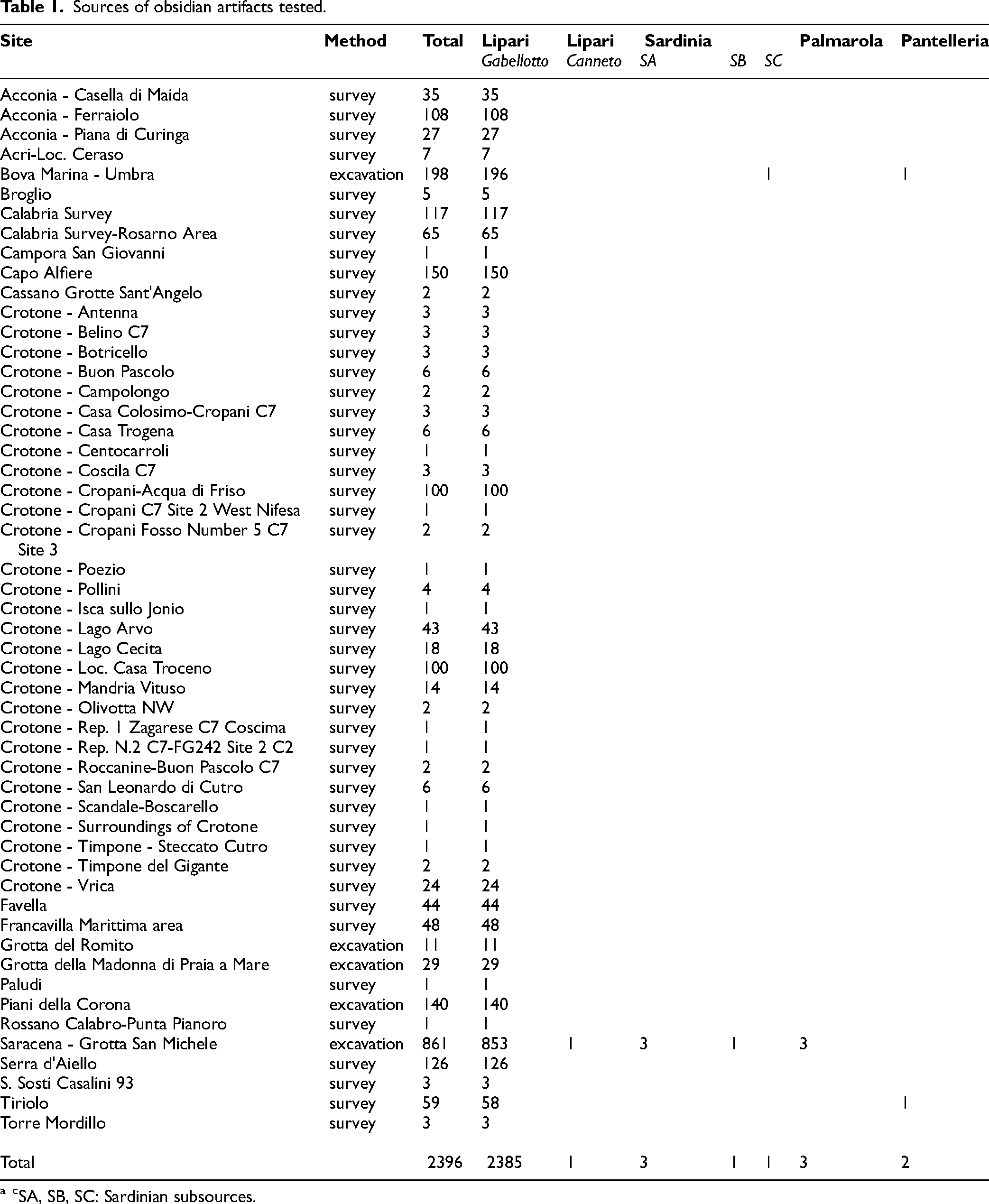
a–cSA, SB, SC: Sardinian subsources.
Acconia
The Acconia Survey, centered on the modern village of Acconia, was run from 1980 to 2007. 9 Multiple Neolithic “settlements” have been identified, including Casella di Maida, Ferraiolo, and Piano di Curinga. 10 This was an area with a more significant density of materials attributed to Stentinello and other Neolithic cultures than other areas surveyed in Calabria, and therefore it must have been economically important despite the sparse population that has been detected. The area, then as today, is fertile and intensively used for agriculture. Low-density occupation might correlate here with more intensive agrarian use of larger portions of land, given the expected type of economy based primarily on agriculture.
Bova Marina
Bova Marina is also part of a survey, but four major areas have been excavated. The landscape is mountainous, with terraces above 1000 meters above sea level rapidly decreasing to a thin coastal lowland. Obsidian at earlier Neolithic sites, including Umbra, were concentrated on lower areas (<900 m), which had a low density of population. 11 Researchers have emphasized that, “there seems no particular impetus to live coastally. As elsewhere in Southern Italy, there seems to have been little economic use of marine resources in the Neolithic”. 12 Contrary to their conclusions, we think that in addition to local non-commercial exchanges, the area was intersected by a long-distance exchange network that crossed the Aspromonte to provide a direct sailing route to Apulia and its plains
Calabria Survey (Raganello Archaeological Project)
Materials from the Raganello River area survey in the Sybaris Plain have been very important because they extended the presence of Neolithic people into a vast plain.13,14 The materials do not identify a specific settlement, rather they confirm the use of land and possible presence of low-density populations. They appear similar to the sites of Favella and Francavilla Marittima, which are also open-air sites.
Capo Alfiere
Capo Alfiere is a significant Middle Neolithic site in the Crotone area, characterized by Stentinello pottery and notable for its large sandstone wall and cobbled pavements, which suggest a well-established settlement. 15 The site reveals a rich assemblage of small finds, including daub fragments, obsidian, and pottery, indicating active trade and a dense community utilizing local resources. Additionally, the site's architecture and material culture provide insights into the social and economic practices of Neolithic communities in southern Italy.
Crotone
A strategically located area that much later became one of the most important cities during the Greek colonization. 16 Thousands of sherds and blades of obsidian were found in the hills surrounding the modern town, mostly at the six sites of Acqua di Friso, Lago Arvo, Lago Cecita, Loc. Casa Troceno, Mandria Vituso, and Vrica. They were associated with Stentinello pottery (Middle Neolithic). 17
Favella
An open-air settlement in the Sybaris Plain, linked to Apulia by pottery styles in use there. This differs from the nearby Saracena Cave, which has more links with Sicily and the Tyrrhenian coast. The site is in use from the Early Neolithic, but obsidian is recognized in levels associated with Middle Neolithic and later materials. 18
Francavilla Marittima
This is an important Bronze Age site with traces of use during the Neolithic period. 19 The Raganello Archaeological Project reported low density presence of Neolithic pottery from the surrounding territory. Francavilla is located approximately 10 km from the sea, on a hill.
Grotta del Romito
Excavations at the Romito Cave show it was in use for a long period before and after the Neolithic. 20 A key site on the Tyrrhenian coast, it remained in use while open-air settlements appeared in the landscape.
Grotta della Madonna di Praia a Mare
The Madonna Cave is a site with a long history of use, and substantial evidence from the Middle Neolithic. 21 It is located near the Tyrrhenian coast.
Piani della Corona
This settlement is located near the Strait of Messina, the shortest crossing between Sicily and Calabria. Excavations yielded obsidian in layers associated with the Early Bronze Age, but the site was active also during the preceding Late Neolithic. 22
Grotta San Michele di Saracena
The Saracena Cave site provides one of the best-preserved long-term sequences for prehistory in the nearby Sybaris Plain (Figure 3a, 3b). Neolithic sequences in the area range from the earliest Impressed Wares (early sixth millennium BCE) to the Spatarella pottery style (end fifth–early fourth millennium BCE), that is the full Neolithic. 21 This makes the site ideal to verify changes in the trade of obsidian at different times. 23 The cave site was connected primarily to cultures on the Tyrrhenian coast according to the pottery found.

Grotta di San Michele Arcangelo di Saracena.
Serra d’Aiello
The site is located on a small hill close to the Tyrrhenian Sea, located approximately opposite the Aeolian Islands, which are visible some days from the site. The site acquired greater importance in later times, as was the case for Tiriolo. It is located on a route that connected the Aeolian Islands to the Sybaris Plain and Apulia. 24
Tiriolo
No settlement in the area is published yet, but there have been sparse findings of Neolithic materials. Tiriolo is along the route active at least since the Iron Age (especially the pre-Roman Oscan–Brettian period) that connected the Tyrrhenian coast to the Ionian coast of Calabria. 25 Tiriolo is located in the highlands, where Neolithic population density is thought to have been very low.
Experimental
Materials and Methods
Over the past 20 years, the use of portable handheld XRF (pXRF) spectrometers has revolutionized the analysis of obsidian in Italy and the central Mediterranean,7,26–33 and many other parts of the world. Previous analyses on obsidian from Calabria were conducted by neutron activation analysis (INAA) and other methods requiring a sample taken from the artifact.2,3,34 The homogeneity of obsidian is part of the success of non-destructive surface analyses. In this work in museums and other facilities in Calabria, the pXRF is mounted on a plastic stand, running on a battery, and attached to a laptop computer (Figure 4). The small size of pXRF instruments has make them transportable in a backpack and as carry-on luggage on airplanes.

Picture showing pXRF analysis.
For this study, most pXRF analyses were conducted using a Bruker Tracer III-SD, with the elements specifically used for obsidian source identification including major element Fe, and trace elements Rb, Sr, Y, Zr, and Nb. The beam size of the X-rays is ∼8 mm in diameter while the length of time necessary for analysis using the III-SD for trace element analysis was 60–90 s. The use of a filter (12 mil Al, 1 mil Ti, 6 mil Cu) reduces the background for these elements, with detection limits for trace elements in single digit parts per million (ppm). 26 For one site (Saracena), some of the analyses were done with a Bruker Tracer 5i, with run times of 30 s.27,30 For homogenous obsidian, one analysis per artifact was sufficient in nearly all cases. For small bladelets just a few mm in width and fewer in thickness, with lower than usual total secondary X-ray counts, trace element ratios were used in assigning specific sources. In most cases, the highly precise measurements of the K-lines of just a few of the trace elements are sufficient not only to distinguish obsidian sources in the Mediterranean (Figure 5a) but even subgroups for Sardinia and Lipari (Figure 5b).

(a) XY graph of three trace elements distinguishing obsidian sources. (b) XY graph distinguishing two Lipari subsources.
The museums and government agencies in Calabria were open to collaboration and access to their archaeological collections, with analytical research facilitated when done without necessary permissions for destructive sampling, and movement (of intact artifacts or samples) to laboratories, even within the same country. The homogeneity of obsidian, the relatively flat areas on stone tools that may be tested, and little if any surface weathering made it a perfect material for non-destructive XRF analysis.
Obsidian calibration software was developed and shared by the Archaeometry Lab, University of Missouri Research Reactor Center, based on 40 geological obsidian samples analyzed by INAA, laser ablation inductively coupled plasma mass spectrometry (LA-ICP-MS), and XRF. 35 The specific Bruker Tracer III-SD model employed a T3S1329 calibration curve, while the 5i model used a calibration on that specific instrument. Separately, the pXRF users analyzed sufficient geological samples of known origin and make a direct comparison with that from the archaeological samples that they analyzed with the same instrument. For archaeological obsidian artifact studies, nearly all research is conducted by scholars with geological samples from their region of interest. Yet, the use of calibrated data is provided in the Supplemental Material.
In total, 2455 artifacts from >50 sites in Calabria have been analyzed (2403 in this study; see Supplemental Material). All of the obsidian artifacts excavated or otherwise in the museum collections were analyzed. This includes 10 or more artifacts analyzed for 22 of these sites. In most cases, the entire assemblage of archaeological artifacts from the site were analyzed, avoiding a statistically limited subset. Those from the excavated sites of Bova Marina (Umbria), Grotta del Romito, Grotta della Madonna, Piani del Corona, and Saracena (Grotta San Michele) have specific cultural and temporal associations, as shown in the list below, while many of the sites were surveys (Table I).
Results and Discussion
In this study, 2403 obsidian artifacts from archaeological sites in Calabria were tested, and all but 10 were assigned to geological sources on Lipari (five Sardinia, three Palmarola, and two Pantelleria). The identification of some obsidian artifacts from Palmarola 36 and Sardinia 37 at sites in the southernmost region of mainland Italy was unexpected, although some have been found previously in the regions to the north of Campania 29 and northeast to Puglia, e.g., Acquafredda and Muntoni. 38
The first discovery of “non-local” obsidian in Calabria was more than 20 years ago, when excavations had started at the site of Bova Marina on the Ionian side of the toe of Italy. 11 Those analyses were done using an electron microprobe, on tiny (1–2 mm) samples removed from the artifacts. Of 13 artifacts tested, 11 were assigned to Lipari, one to the Sardinia (Monte Arci) C subgroup, and one to Pantelleria. Subsequent excavations of this site, which spans the Stentinello (Early–Middle Neolithic) and the beginning of the Diana (Late Neolithic) periods (5700–4500 BCE), 39 produced many more obsidian artifacts, but with all of the 183 tested by non-destructive pXRF assigned to Lipari (and specifically the major Gabellotto Gorge subsource).
The inland site of Grotta di San Michele Arcangelo di Saracena, at 750 m asl and dating to the Early through Late Neolithic, was excavated from 1998 to 2007. Some 861 obsidian artifacts from Saracena comprised more than two-thirds of the chipped stone material recovered in chronological contexts (Table II). 23 For the Stentinello period (later Impressed Ware phase), three of the obsidian artifacts were assigned to Palmarola. This tiny island source is more than 300 km to the northwest, and the travel to Saracena represents both open-water and over-land travel, likely involving at least two different carriers. For the Diana (Middle Neolithic) period, four came from Sardinia including three from the Sardinia A and one from Sardinia B2 subgroups. 37 Travel to Saracena began inland at Monte Arci, overland to coastal Sardinia, along the coast and past Corsica, across past multiple small islands to peninsular Italy in the Tuscany region, and southeast a great distance over both water and inland, a total distance of nearly 1000 km. Saracena is the only site in Calabria where one piece of the Lipari–Canneto Dentro subsource was recognized, with its high Sr value. 7
Saracena obsidian groups.

The only other site in Calabria with non-Lipari obsidian is Tiriolo, about 30 km inland from the Tyrrhenian Sea and 20 km from the Ionian Sea, in the narrowest part of the foot of Italy. 25 Of the 59 obsidian artifacts recovered during a survey of this site, one was assigned to Pantelleria, specifically the Lago di Venere subsource. The absence of Pantelleria obsidian artifacts in eastern Sicily suggests a longer maritime route to Calabria, with the first part over at least 80 km open water to southern coastal Sicily and a total of about 500 km to Tiriolo along Sicilian and Calabrian coasts. 40 In general, coastal sites have yielded larger amounts of obsidian in the prehistoric central Mediterranean. 8
None of the many other sites tested in our study, including the excavated sites of Piani del Corona (Late Neolithic), see Marino et al., 22 Grotta del Romito and Grotta della Madonna (both Middle Neolithic), 20 had any obsidian artifacts that were not assigned to Lipari. Overall, the analysis of a statistically large number of artifacts from many sites in Calabria indicates that only Lipari was a practical and regular source of obsidian in prehistoric times. 41 The 10 non-Lipari obsidian finds identified in Calabria are nevertheless significant findings regarding our understanding of long-distance travel and the socioeconomic characteristics of cultures spanning four thousand years (ca. 6000–2000 BCE). These occasional long-distance distributions most likely are part of the down-the-line type exchange of materials that was practiced for a long time during the neolithic and earlier.
To fully understand the significance of obsidian in Calabria, it is essential to consider the use of all lithic materials in this region. Many sites are primarily known from surface surveys, which often yield materials out of context. Obsidian, being highly distinctive, is easily recognized in these surveys, making it a diagnostic material alongside pottery. This allows for the deduction of chronological periods and estimation of quantities. In general, experience shows that during surveys obsidian and diagnostic pottery are more thoroughly collected than other materials.
In Calabria, there are sites where obsidian has been found in large quantities and other areas where it clearly is present. Its scarcity or absence in some regions is also noteworthy, as some surveyed areas have yielded few or no obsidian tools. Figure 1 shows a preference for coastal sites, with only two inland settlements, Saracena and Tiriolo, where obsidian is present. These sites are located along routes between the Tyrrhenian and Ionian seas.
The Aspromonte (north of Bova Marina) and Sila (north of Tiriolo) mountain ranges posed significant obstacles to the diffusion of obsidian in non-coastal Calabria. The Aspromonte, in particular, created a long stretch of mountainous territory along the coast, largely excluded from intense exchanges until the Bronze Age due to the greater difficulties in early farming compared to the fluvial valleys east of the Sila. 42 Neolithic people seemed to avoid the eastern coast of the Aspromonte, preferring to transport materials to the Ionian coast via routes north and south of the Sila range. The absence of obsidian finds between Bova Marina and Capo Alfiere appears not due to a lack of surveys but to the actual absence of materials.
Caves were important from pre-Neolithic times and remained in use throughout the Neolithic period. Sites in the Sybaris Plain, closer to the sea, did not replace sites like Saracena. 43 Neolithic sites such as Saracena and Favella are located on high terraces and demonstrate a trend to settle outside caves, but not replace them. There were no coastal sites of any importance in the Sybaris Plain until the Greek colonization, and this further argues for a lack of population density on the southern part of the Ionian coast of Calabria. Finally, sites on the southern Tyrrhenian side, from Serra d’Aiello southwards, appear more typologically distinctive than other sites in Calabria. There was more experimentation in obsidian production, and it seems that while established technology spread through other areas, this region received sufficient partly worked material (cores) and local interest to adopt the technology independently.
The typical lithic assemblage dominated by bladelets, including obsidian both transparent and opaque with phenocrysts, is consistent for Lipari obsidian across Italy. However, the area from Serra d’Aiello to the south is where assemblages deviate from the standardized Neolithic package of Lipari obsidian. For instance, shapes such as arrow points are present in the area, but almost unknown elsewhere. The presence of that shape in particular suggests local craftmanship of raw obsidian blocks, which have not been found, or possibly the use of larger cores not specifically prepared for small blades. Such cores are present in Sicily (for long blades), but have not been noted or found elsewhere, including Calabria. But the non-blade shapes were not produced in Sicily and could not be produced with the typical-sized cores for bladelets. Further work is needed to confirm some of these observations, as they will require a broader analysis of the consumption of obsidian in the Italian peninsula.
Conclusion
The utility of pXRF for identifying the geological source of obsidian artifacts used in prehistoric Calabria has enabled the study of 2396 artifacts from >50 archaeological sites, while previous studies had totaled just 65 artifacts from three sites.2,3,11 This has resulted in the discovery of 10 artifacts from unexpected sources from hundreds of kilometers away. The identification of obsidian traveling a few hundred kilometers from the tiny island of Palmarola, from the small island of Pantelleria southwest of Sicily and traveling mostly overseas more than 500 km, and from Sardinia traveling about 1000 km, demonstrates the great long-distance, down-the-line connections around the Central Mediterranean during the Neolithic. While representing only a handful of irregular activities, the finds of non-local obsidian likely represent the movement of other material not preserved in the archaeological record (e.g., livestock, clothing). The identification at Saracena of Palmarola obsidian during the Early Neolithic, and from two Sardinia sources during the Middle Neolithic further supports the hypothesis about cultural changes over time in socioeconomic complexity. The determination of the precise provenance of obsidian artifacts enables us to reveal an ancient world that was more interconnected than expected. In particular, we realize now that an exchange route marked by sites with obsidian connected the Tyrrhenian and Ionian Sea across two short sections of Calabria (from Grotta Romito to Favella; from Acconia to Tiriolo and on to Crotone). This implies a substantial knowledge of the territory and ability to organize long distance exchanges.
Supplemental Material
sj-xls-1-app-10.1177_27551857251363557 - Supplemental material for Non-Destructive Portable X-ray Fluorescence to Study Long-Distance Obsidian Exchange in Prehistoric Calabria, Southern Italy
Supplemental material, sj-xls-1-app-10.1177_27551857251363557 for Non-Destructive Portable X-ray Fluorescence to Study Long-Distance Obsidian Exchange in Prehistoric Calabria, Southern Italy by Robert H. Tykot and Andrea Vianello in Applied Spectroscopy Practica
Footnotes
Acknowledgments
Permissions for these studies were obtained from the Soprintendenza per i Beni Archeologici della Calabria, museums, and local curators of antiquities. We thank in particular Dr. Rocco Purri, who welcomed us and introduced us to local scholars and amateur archaeologists that had gathered precious information on contexts, the presence of obsidian in the territory and memories of old excavations. We also thank Gregorio Aversa, Cinzia Forgia, Felice Larocca, Martijn van Leusen, Elena Natali, Rocco Purri, and others. Kyle Freund studied the lithic typology of the artifacts from some of the sites.
Declaration of Conflicting Interests
The authors declared no potential conflicts of interest with respect to the research, authorship, and/or publication of this article.
Funding
The authors received no financial support for the research, authorship, and/or publication of this article.
Supplemental Material
Supplemental material for this article is available online.

References
Supplementary Material
Please find the following supplemental material available below.
For Open Access articles published under a Creative Commons License, all supplemental material carries the same license as the article it is associated with.
For non-Open Access articles published, all supplemental material carries a non-exclusive license, and permission requests for re-use of supplemental material or any part of supplemental material shall be sent directly to the copyright owner as specified in the copyright notice associated with the article.
