







Abstract
Keywords
Introduction
In recent years, Linked Open Data (LOD) has been widely acknowledged and data rich institutions have generated a large volume of LOD. As of May 2020, the LOD Cloud website reports 1,301 datasets with 16,283 links.1
In this paper, we explore the problems of LOD quality from the user’s point of view. In particular, we analyse the linking quality of LOD from a research perspective in the field of cultural heritage and Digital Humanities (DH). Our study on this fundamental aspect of LOD should be able to provide a better understanding of a bottleneck of LOD practices. Although we concentrate on these domains, we believe that our analysis is equally valuable in other domains, because the analysed data is highly generic.
In cultural heritage and DH, many projects create and use a wide range of LOD for research purposes. In the course of populating and improving LOD, they often execute curatorial tasks such as Named Entity Recognition (NER), entity extraction, entity/coreference resolution, and Named Entity Linking (NEL) [7,10,16,41,46]. These are the tasks to identify, disambiguate, and extract entities/concepts from data, and to reconcile and make references to entities in another data. Thus, we can find more information on the web. In this article, we use NEL as a catch-all term for all these tasks.
For example, Europeana executes NEL in a large number of cultural heritage datasets and creates links to widely known LOD sources including GeoNames, DBpedia, and Wikidata that this paper discusses [35,37]. Jaffri et al. [28] echo this view, stating that many datasets are linked with DBpedia entities through the
What is not investigated in cultural heritage and DH is, what impact NEL and subsequent data integration have for future research? Currently, there is a tendency for entity linking to become a purpose by itself, without examining the consequences of the linking. Due to the relative infancy of LOD in the field, perhaps most effort has been put into the aspect of data discoverability on the web, which NEL also facilitates. This function of LOD may not require extensive use cases after NEL is performed. In any case, data producers are often not fully aware of the next steps for research using LOD, as well as the needs of the data users. Although not limited to these domains, Data on the Web Best Practices2
Currently, the benefit of data integration using NEL is often restricted to the data sources within a single institution or domain. For instance, an advanced semantic search is developed for the historical newspapers in the Netherlands [42]. In fact, the investigation of the aggregation and integration of heterogeneous LOD from different data providers is rather rare [16], or done with relatively small multiple sources. A few exceptional cases are found in museums and institutions in France [1] and Spain [29]. Still, the formation of new knowledge based on complex queries across distributed LOD resources is not easily implemented. As such, the full potential of LOD has been neither fully explored nor verified. The practice of LOD-based research using distributed data still faces many challenges.
In terms of data linking quality, computer science communities have intensively worked on this issue in the past years. Critical quality issues of linking have been frequently raised and discussed in the studies of LOD [3,4,9,11–15,23,31–34,43,45]. We discuss this in Section 2 in more detail. However, one specific aspect helps here to explain our motivation. Most previous research regards
Taking this background into account, this article aims to evaluate the quality of widely known (referential) LOD as the target resources of NEL. In particular, the linking quality and connectivity is analysed in detail in order to provide an overview of the current “state of NEL ecosystem”. To this end, we examine LOD entities/instances through lookups. With a special emphasis on multi-level traversability in the LOD cloud, we can estimate the impact of NEL for end-users. In other words, our research questions are as follows.
As LOD potentially enables us to undertake machine-assisted research with the help of more automated data integration and processing, this project serves as a reality check for the current practices of LOD in the field.
The structure of this paper is as follows. Section 2 explores the related research. Section 3 describes objectives, scopes, and methodology. Section 4 presents the analysis of 100 entities in five categories relevant to cultural heritage data integration and contextualisation. The final section summarises the discussions and outlines ideas for future work.
Over the last years quantitative research has been carried out intensively for the LOD quality. The landscape of previous studies is examined in an in-depth survey by Zaberi et al. [45]. They analyse 30 academic articles on data quality frameworks and report 18 quality dimensions and 69 metrics, as well as 20 tools. Many studies investigate the linking quality, but some aim to assess broader aspects of LOD quality. For instance, Färber et al. compare DBpedia, Freebase, OpenCyc, Wikidata, and YAGO with 34 quality criteria [20]. They span from accuracy, trustworthiness, and consistency to interoperability, accessibility, and licences. Schmachtenberg et al. [34] update the 2011 report on LOD, using the Linked Data crawler, analysing the change of LOD (8 million resources) over the years. Debattista et al. [13] provide insights into the quality of 130 datasets (3.7 billion quads), using 27 metrics. However, the linking on which this paper would like to focus is a small part of the metrics. Mountantonakis and Tzitzikas [31] have developed a method for LOD connectivity analysis, reporting the results of connectivity measurements for over 2 billion triples and 400 LOD Cloud datasets. A rather unusual project has been conducted by Guéret et al. [22]. They concentrate on the creation of a framework for the assessment of LOD mappings using network metrics. They specifically look into the quality of automatically created links in the LOD enrichment scenario.
In parallel, a number of valuable contributions have been made to scrutinise
There are also a few examples of “semi-micro” research, using domain specific datasets. Ahlers [3] analyses the linkages of GeoNames (11.5 million names). He reveals some cross-dataset and cross-lingual issues and distribution biases. Debattista et al. [11] inspect the Ordnance Survey Ireland (50 million spatial objects) in order to identify errors in the data mapping for the LOD publishing and check the conformance to best practices. Although the datasets pass the majority of 19 quality metrics in the Luzzu framework [12], the low number of external links (only DBpedia) is clearly our concern.
The studies for the cultural heritage domain are relatively new. Candela et al. state that there has been so far no quantitative evaluation of the LOD published by digital libraries [8]. They systematically analyse the quality of bibliographic records from four libraries with 35 criteria covering 11 dimensions to provide a benchmark for the library community. The research on the LOD quality for a broader cultural heritage including museums and archives is scarce.
Apart from Mountantonakis and Tzitzikas, macro research projects oftentimes treat data sources (or corpora) as a whole, when investigating
In addition, most macro analyses are not designed for multiple graph traversals. One of the exceptions is Idrissou et al. [26] who indeed claim that gold standards for entity resolution do not go beyond two datasets. Interestingly, they develop hybrid-metrics that combine structure and link confidence score to estimate the quality of links between entities for six datasets from the social science domain. Although we agree that accurate automated evaluation of links is much needed, our study aims to gain deeper understanding of smaller sampling entities.
Going back to our analogy, we currently cannot know how much and what kind of data we can find by following a link from Mozart in data source A to an entity in source B, which provides links to an entity in source C. Therefore, a close observation of instances is needed. The instance level maneuverability indicates whether and how users can navigate themselves in the knowledge graphs and can obtain related information from various data sources, and potentially integrate them.
Objectives and methodology
We explain the process of defining objectives and methodology in four sub-sections. The first section describes the scope of the linking quality evaluation. The second section discusses the nature of research in cultural heritage and DH in relation to conceptual models and ontologies, in order to specify the object of analysis. The third section details the data sampling. The fourth section deals with the technical methods of a wide range of analyses.
Scope of analysis and graph traversals
This paper will not repeat the comprehensive statistical analyses on the LOD quality according to the existing or newly created comprehensive metrics. In contrast to previous research, we deploy a micro analysis. Our research deals with a small ecosystem of LOD in the cultural heritage NEL, based on an empirical qualitative and quantitative method. In particular, it focuses on user maneuverability for arbitrary LOD entities. We analyse multi-level graph traversability using standardised properties, especially bearing the automatic data traversals and integration in mind.
The primary goal is to create “traversal maps” of major LOD data sources at an instance level. “Traversal maps” are maps illustrating all possible routes of graph traversals in the LOD cloud (RQ3). We specialise in the route of standardised properties including
The use case for the LOD traversals in this article is the following: we/user manually look up a LOD entity/resource identified. Then, they follow available links in the entity to reach identical and/or the most related LOD resources. For example, one may traverse an RDF graph from a resource in DBpedia to a resource in Wikidata via
Hyperlinks are documented and counted to generate traversal maps. To support the link quality analysis, information about other content is also documented and counted (RQ5). It includes the amount of
Regarding the link types, the W3C recommended properties, One property per ontology is selected.
Since
When assessing the quality of LOD, proprietary properties cannot be ignored. They often contain interesting and specialised information. However, we put less emphasis on them. Compared to standardised properties, these properties may not be frequently used as a means to connect the data sources within the core part of the LOD cloud. Another reason is extensively explained in Section 3.4 in the context of difficulties in the data quality comparison, and our compromised approach is described.
Documentation on an instance is recorded in separate tabs in a spreadsheet for each source. VBA scripts are created to aggregate and/or facet datasets. Subsequently, various types of tables and charts are generated. In order to increase the research transparency and reproducibility, our datasets and documentation are fully archived in the Zenodo Open Access repository (
In order to narrow the scope of the LOD evaluation, this article focuses on addressing typical and generic core questions for cultural heritage and DH alike. For instance, one of the largest cultural heritage data platforms is Europeana. It has created the Europeana Data Model (EDM)5
The importance of the four core questions is also reflected in other cultural heritage ontologies. CIDOC-CRM “provides the “semantic glue” needed to mediate between different sources of cultural heritage information, such as that published by museums, libraries and archives”.7
Therefore, the evaluation of LOD in this article concentrates on these four questions and use them as categories of our investigation. We employ the following terminology to be more specific: agents (for Who), events (for What), objects and concepts (for What), dates (for When), and places (for Where). Due to the genericness of the categories, investigating the five categories not only helps us to answer our research questions, but also makes our analysis valuable for research outside the cultural heritage field.
Our study introduces two basic strategies for the selection of datasets/data sources. It examines LOD in (1) RDF/XML with (2) unrestricted look-up access (i.e. no API keys). Although there are other RDF serialisation formats, RDF/XML is the only commonly available one for all the data sources described below.10 This is mainly due to GeoNames that only provides RDF/XML, KLM, and HTML representation for lookups. This is already a discovery of LOD quality in terms of standardisation.
There are two exceptions for the selection criteria. Wikipedia delivers its articles in HTML, but it may be studied as an indicator, because it has a unique position as a global reference on the web inside and outside the LOD context [2,3,30,41]. Indeed, the data in DBpedia and YAGO are derived from Wikipedia.11 YAGO2 is used for our study.
100 entities in five categories selected for analysis
The priority is given in the following order: page rank, 2Drank (24 languages), and page rank (female).
International events are prioritised, thus a couple of specific events such as US censuses are removed.
Top 20 places are extracted from the general list.
As this study deploys a qualitative analysis, a manageable level of data sampling is considered. It selects twenty representative instances/entities from five categories defined in the Section 3.2 (Table 1), resulting in 100 entities in total.13 For practical reasons, it concentrates on the English version as the primary resource of an entity when multiple language versions exist (e.g. DBpedia). Nonetheless, other language versions are documented as a reference.
It is not trivial to nominate 20 objects and concepts, because cultural heritage and DH cover an extremely broad field. In fact, there are countless numbers of material entities such as museum objects and buildings. Moreover, millions of archaeological objects are even unnamed. Indeed, many object entities are not globally and uniquely identifiable, because they have not (yet) been created in the global references. As such, it is much more challenging to implement entity linking for those entities. Nevertheless, we manually selected 20 entities from the featured articles of Wikipedia.16 This research investigates tens of thousands of global entities that are reasonably well known and one could look up and refer to as sources for NEL, rather than millions or billions of instances of cultural heritage objects that could be hard to refer to globally. On one hand, encyclopedia-based and authority-file based LOD sources such as Wikidata and VIAF deal with the former and generate LOD by a top-down approach. On the other hand, Europeana takes a bottom-up data aggregation approach to build LOD for over 50 million digital objects from the records held by thousands of cultural heritage organisations. Most of them are unique and not well known. Next to their instance-level LOD, Europeana offers a highly limited amount of entity lookups relevant to their LOD that our study evaluates.
The actual number of entities analysed is 836 (859 occurrences), since some sources do not have the entities the others have. Full details of the entity coverage per data source are provided in Appendix A. Statistically speaking, in case of missing entities, they are included in the calculation and the data values are counted as null.18 For example, WorldCat does not seem to have entities 1976, 1979, and Europa League. This article only tries to identify the data about the same entity without judging if the data contents are duplicated or not. It seems that the double identity is a leftover of merging entities during data aggregation. Such examples include Aristotle in VIAF ( During the entity identification process, we already recognise interesting patterns in the coverage of entities across the data sources. A typical case is the mosaic of availability for the objects and concepts. In the Getty Vocabulary, Ukiyo-e would be included as an artistic style, not an individual artwork, whereas Book of Kells, Garden of Earthly Delights, Sgt. Papers, Blade Runner, Uncle Tom’s Cabin, and the King and I are not, because they are unique. Symbolically the latter group is all included in WorldCat, the Library of Congress, and VIAF as well as BabelNet, DBpedia, and YAGO. It seems to make sense to consider this pattern as the coverage difference between record-orientated library authority files and concept-orientated museum vocabularies. For example, unfortunately Italy in BebelNet has constantly returned HTTP 500 error during our analysis (
In practice, it is not feasible to fully automate the analysis process. In order to properly document the data quality, it is required to search, identify, and verify the same entity across 11 data sources. The quality of each entity needs to be manually double-checked. The main problem of our analysis is semantic disambiguation. It is even not always possible to accurately find an entity. For instance, the challenges of disambiguation and entity matching across multiple LOD sources are presented by Farag [19]. In our case, three reasons are worth mentioning: (a) the lack of cross linking between data sources makes it hard to find all available entities, (b) the entities are confusingly organised and hidden from the mainstream contents, especially in aggregated LOD, and (c) the search functionalities on the website of the data sources may have limited capacity and have not been optimised. In these cases, lookups are executed on a best-effort basis.22 In addition, it is noted that this study does not guarantee technical feasibility of traversing via lookup services in reality. The project only documents and analyses the availability of links, not the validity of links. For example, it is the responsibility of LOD providers to adequately implement and maintain content negotiation and HTTP redirect.
In this study, we conduct both qualitative and quantitative analysis. As for the qualitative approach, this paper presents some examples that are found during the manual inspection of LOD instances. As for the quantitative approach, we generate chord diagrams in R23
Furthermore, this paper also analyses other data content (such as literals) in addition to the links. This is important, as we cannot obtain a full picture of link quality without studying the content of the link destination. In an RDF graph, there can be three types of nodes: IRIs,26 Internationalised Resource Identifier is the generalisation of URI that supports Unicode characters. For our convenience, URI is used as a synonym of IRI in this paper.
The challenge is how to objectively compare and evaluate the content quality of different LOD sources. The major problems are: (a) there is no standard theory about what is regarded as high quality, and (b) it is hard to evaluate the quality of semantics. In terms of (a), for example, the number of links (edges) or labels/literals (strings) alone would not be able to indicate the data quality. In terms of (b), the same hyperlinks and labels can be found in different context. For example, the link “
To minimise the impact of a biased evaluation, Python scripts28 Available at
It is anticipated that a broad mix of above-mentioned methods can provide new insights into the linking quality at different levels.

Chord diagram illustrating the amount of link flows between 11 data sources (left) and after removing inverse links (right).
The total and average number of outgoing links (to the 11 data sources) held by the data sources
Overall traversal map
The first analysis starts with chord diagrams. Figure 1 primarily focuses on the number of links and their origins and destinations within the 11 data sources. The source data which produce Fig. 1 is found in Appendix B.
The total number of links amounts to 10474. The dominance of DBpedia is obvious, occupying over 66.2% of the entire linkages (Fig. 1 left). It is also noticeable that self-links significantly contribute to the volume of the links. YAGO supplies a substantial amount of links to DBpedia and Wikipedia. This results in the influential position of Wikipedia (5.2%), although it is not LOD. Surprisingly, Europeana comes fourth, despite the significantly limited amount of available entities (Appendix A). WorldCat, the Library of Congress, and VIAF somewhat share similar numbers of links. The outgoing and incoming links are unbalanced for Europeana.
From these numbers we can derive the following: the average number of links in all sources is 952.2, whereas the medians are 2.1 and 149 for both outgoing and incoming links. In fact, the amount of outgoing hyperlinks found in each source is moderate, given the entire size of those datasets (i.e. millions of triples); on average it is mostly under four links per entity (Table 2). These small figures are alarming, because this survey focuses on well-known sources often used for NEL for the cultural heritage datasets. It is clear that there is a great deal of room for improvement. Nevertheless, DBpedia, Europeana, and YAGO stand out, showing more promising quality for LOD with high number of links per entity.
When inverse traversals are removed from the statistics, the situation looks largely different (Fig. 1 right). The sum of the links decreases to 6166. DBpedia loses an ample number of links (47.3%), whereas YAGO gains most (24.2%). Such a dramatic shift is an evidence of abundance of inverse properties described in DBpedia. If we scrutinise the data closely, we notice that this is mostly due to the inverse use of
Figure 2 is the simplified overall “traversal map” for all data sources. It is a network diagram, illustrating all possible paths between the 11 data sources. However, since we observe a very high volume of links in DBpedia, YAGO, and Europeana, volumes and self-links/loops (i.e. links pointing to the same data source/domain) are not included in this figure. Thus, the diagram concentrates on the routes of traversals (i.e., the users’ mobility and traversability).

The overall “traversal map” shows available links/paths through four standardised properties between the 100 entities in 11 data sources (after self-links to the same domain is removed).29
It In traversal maps (Fig. 3, 4, 5, 6, 7, 8), the sizes of the vertices correspond to their volumes of the available entities. Colours are assigned by the origin of the edges. The widths of edges represent their weights (except Fig. 2). 192 self-links are omitted.
It is particularly remarkable that reciprocal links are quite rare. There are several nodes/vertices which can be reached via only particular edge(s)/path(s). This implies that network is not desirably populated by the standard properties, and that the users would not be able to efficiently obtain information through these properties. They need to follow the best paths to retrieve the identical or closely matching information. It is possible for data publishers to use other RDF properties, but it would be an irregular practice.
Idrissou et al. [26] stress that a full mesh (fully connected network) has the highest quality in their link quality metrics. When they compare different structures (e.g. ring, line, star, mesh, tree), the more a network resembles a fully connected graph, the higher the quality of the links in the network for all metrics (bridge, diameter, closure). One might argue that a full mesh is not necessarily a prerequisite of high data quality. This may be true for much LOD, however, let us remember that we focus on the most well-known data sources that many other LOD tend to link to. Therefore, it helps the connectivity of LOD on the web as a whole. Guéret et al. [22] use clustering coefficient and
Figure 3 depicts traversal maps faceted by four link types. From now on, inverse properties are included but loops are excluded for the traversal map visualisation. Thus, the distortion of the “route diagram” that we avoided in Fig. 2 is minimal. However, the rest of the statistics (matrix data and in the texts) include both inverse properties and loops, so that they reflect the actual situation.
Although we decided to avoid discussions on interpretations of link semantics, there is at least a clear difference between
Figure 4 depicts the traversal map for agents. Appendix B includes the source matrix data and the traversal maps for all four properties. In general, agents have much less influence from loops than from other categories, because 72.4% of links are still present after removing recursive links, compared to the overall 42.0%. The most eye-catching result is Europeana. Especially, it uses
In Table B3 in Appendix B, the role of DBpedia is expectedly prominent for incoming links, attracting 1555 links (80%). Unlike the outgoing links, Wikidata captures 121 referrals, making it the second highest source. Manual examination found that VIAF had only 72 incoming links, however, it contains more links which connect its entity to data sources outside the 11 sources, than any of the other sources. For instance, only four links with

The overall traversal map by each standardised property (after removing self-links to the same domain).

The overall traversal map for agent entities.
The amount of outgoing links held by 11 data sources in each entity is visualised in Table 3. When comparing the total amount in this table and in Table B3 in Appendix B, we notice that 1945 incoming links are received within the 11 data sources, out of 2412 outgoing links (80% ).31 In the coming sections, we will compare outgoing links (the tables in the text) with incoming links (the overall tables in Appendix B).
The amount of outgoing links that the 11 data sources hold in each agent entity (* means duplicate consolidation)

WorldCat holds exactly three links per entity.32 There is the forth link (
Whilst most data sources cover all 20 agents, Jesus Madonna, Benedict XVI, and Mary are totally missing in Getty vocabularies. Similarly, the number of VIAF links is sharply reduced for Jesus and Mary. This is understandable since Getty ULAN and VIAF are typically orientated toward artists and authors in the context of libraries and museums, and religious figures are harder to be recognised as agent entities. Indeed, Jesus has the lowest number of links for five data sources (Mary for four data sources). As such, it is remarkable that Jesus is relatively high in DBpedia (59 links). It is also interesting that non-artists figures such as Einstein, Elizabeth II, and Obama are found in ULAN.
Figure 5 clearly illustrates the lack of links. Bilateral links are extremely rare: only between YAGO and DBpedia. As a result, it is not possible, for example, to move from the Library of Congress to Wikidata. This implies that the entry point to a network determines the movement within it. DBpedia contains far more links than other sources. Although Europeana has only one entity in this category (i.e. World War I), it manages to draw a thick line (

The overall traversal map for event entities.
In general, events were not found in VIAF during the manual data exploitation, however, it turns out that WorldCat and the Library of Congress refer to it seven times each. For example, the former links to the World Series in French (
In terms of each entity (Table 4), the most appealing entity is World War II, followed by World War I and the Iraq War. Europeana’s contribution to World Wart I is considerable. Although the EFL Cup is the lowest, the gaps between entities are relatively subtle except the top three (i.e., median 49.5, average 57.5).
The amount of outgoing links that the 11 data sources hold in each event entity (* means duplicate consolidation)

The principal reason for the prominence of DBpedia for the World War II is
It is striking that the volume of links is very low (Fig. 6). Out of 881 outgoing links, 863 links are consumed within the 11 data sources, implying a high level of closure in the network. In addition, only three sources are referenced: DBpedia, Wikidata, and the Library of Congress. Although YAGO provides many links to DBpedia and Wikidata via

The overall traversal map for date entities.
The economy of the creation of date entities may show serious issues. 1978, 1979, and 1976 do not seem to exist in YAGO, the Library of Congress, and WorldCat, while other consecutive years in the 1970’s are available (see Appendix A). Such inconsistency would become problematic, when queries are constructed to look for answers to research questions on years and periods. In semantic queries, erroneous links and data omissions require careful presentation to LOD users in the future, in order to avoid misinterpretation and misjudgment.
One reason for this phenomenon is the lack of recognition and/or needs for numeric date instant entities, in comparison with other date representations, including textual dates (e.g. “End of the 17th century”), numeric durations (e.g. “1880–1898”), and periods and eras (e.g. “Bronze Age” and “Roman Republic”). For example, a quick search indicates the entity for “Neolithic” exists in all our data sources except GeoNames, VIAF, and Europeana.
In cultural heritage, numeric dates are often stored in a database as string/literal data type, when encoded in XML or RDF. They can be typed as date in the XML Schema (e.g.
The amount of outgoing links that the 11 data sources hold in each date entity

Traversability for places is better than in other categories. YAGO dominates the scene for outgoing links (Fig. 7). Interestingly VIAF comes third despite its focus on agent entities. The Library of Congress, Getty TGN, and GeoNames contain an almost consistent number of links, each typically pointing to DBpedia. Users need to be careful regarding Europeana, because it does not provide the entities for the USA at all (USA, California, New York, and New York City). This type of inconsistency may be problematic for NEL implementers. They should scrutinise the occurrences of their place entities in their local datasets before selecting the right NEL targets. Strangely, no outgoing links are found for Australia, Canada, France, Germany, Italy, Japan, and Russia in Wikidata.
The presence of GeoNames, in particular, facilitates more fluid movements in the network. Although Ahlers [3] claims that it is the largest contributor to geospatial LOD and is intensely cross-linked with DBpedia, it is a disadvantage that it only connects to DBpedia. This makes the overall mobility less ideal. Apart from a link to VIAF, Getty TGN only contains 20 self-links mostly in the form of
Therefore, it is a dead end in terms of network traversals, of which the users need to be aware during their traversing. Europeana is disappointing including only 17 outgoing links only to GeoNames.
If loops are included, DBpedia holds 86% of all outgoing links. This is caused by a vast number of inverse links. For example, in case of Australia, 255 out of 266 outgoing links in DBpedia are those inverse
On one hand, the DBpedia loops may be confusing, especially due to the use of ambiguous

The overall traversal map for place entities.
In Table 6, the lowest entities are surprisingly: the Netherlands, United Kingdom, and United States. This is chiefly attributed to fewer numbers of DBpedia links. However, the reason for this is unclear. On the contrary, the top entities receive a large quantity of links, which include Germany, France, and Poland.
The amount of outgoing links that the 11 data sources hold in each place entity

The outgoing links are the lowest for United Kingdom, followed by the Netherlands, and United States. In contrast, Poland, Germany and France are the top three. The cause is obvious: the numbers are affected by the uneven pattern of links in DBpedia. The amount of links in other sources are instead more or less evenly spread across different entities. It would be intriguing to investigate the reasons by inspecting the corresponding entities in Wikipedia articles and the linking mechanism behind the DBpedia transformation. It would reveal pros and cons of a crowdsourcing approach to LOD, as opposed to authority approach such as the Library of Congress, VIAF, and Getty from libraries and museums.
Objects and concepts are the subject matter in which cultural heritage researchers would be most interested. To a large degree, they are the target entities of contextualisation which is substantiated through data integration and inferences, thus, the contextualised entities are out of our scope. Rather we analyse them as the entities supporting contextualisation (Fig. 8). 1844 outgoing links are recorded of which 91% are bounded for the 11 data sources. Network closure also persists in this category. 81.3% of all incoming links concentrate on Wikipedia (1085), with DBpedia (100) and Wikidata (43) lagging far behind. The same can be said for outgoing links: YAGO (1212) and the rest. This happens, because YAGO provides a considerable number of links to Wikipedia.

The overall traversal map for objects and concepts entities.
Although Europeana produces LOD out of digital cultural heritage objects, its entity API is merely an experimental reference point, thus, no contribution is observed in our traversal scenarios. Interestingly, VIAF plays an authoritative role for this category. It serves a small number of links to five sources. Although the number of outgoing links from BabelNet is not high, it performs better in this category.
During the process of identifying and collecting the entities, some data quality issues are recognised. The significant concepts of cultural objects in FRBR, namely Work, Manifestation, Expression, and Item, are not easily conceptualised and encoded in the LOD observed. For example, taking a book as an example, we consider a single physical copy of a book as Item. Then, all published copies of the book which share the same ISBN are defined as Expression. Manifestation is considered as a book in a specific language by a specific author, whereas Work is a higher level of abstraction to cover the idea or the fundamental creation of the book by an author. Therefore, for instance, VIAF holds records on The King and I as Expression (motion picture) and Work (the original artwork). However, partly due to the technical mechanism of VIAF, Work may not be easily created. Similarly, Wikipedia has a disambiguation page for the King and I to distinguish the original musical from films and music products associated to the musical. This implies some difficulties in terms of co-reference resolution during NEL, as well as graph traversing.
As this category is deliberately broad and vague in principle, it is not possible to see clear-cut results. For example, GeoNames has entities for Palazzo Pitti and Angkor Wat, which could be classified as places and object simultaneously. Nevertheless, it reminds us that the data modelling for cultural heritage entities is intentionally complex. There could be entities that have multi-types. Depending on the perspective, the data modelers and users would need to find a common view on both practical use and theoretical truth and/or fuzziness of datasets. For instance, Palazzo Pitti could be a geographical place, as well as a building structure, concept, or organisation. However, complicated roles may introduce unnecessary complexity for real usage, confusing end users.
Another interesting finding is that Mars appears in TGN of the Getty vocabulary. It is normally considered that the vocabulary contains place names on earth, as one expects from GeoNames. There could be some surprise for LOD users in terms of how data is conceptualised and modelled, and from where data is obtained, especially when automatic data collection and integration are implemented in the future.
Regarding the individual entities (Table 7), Byzantine Empire and Tamil language in YAGO display a distinct pattern. The cause of this pattern seems to be clear; it includes links to language orientated resources such as language codes, maybe suggesting an important role of language resources in the LOD scenario. For other entities in YAGO it is hard to find exact causes and correlations between the entities with more links (Rosetta Stone, Ming Dynasty, Angkor Wat) and the ones with fewer links (Uncle Tom’s Cabin, Influenza, King and I). The results from Getty imply the exclusion of specific objects.
The amount of outgoing links that the 11 data sources hold in each object and concept entity

We deploy a network analysis using R to supplement the so far relatively subjective impressions and interpretations of the traversal maps (Table 8). Although the work of Idrissou et al. [26] is highly relevant here, unfortunately we are unable to use their metrics, because they are based on undirected weighted graph with link strength (confidence scores). As seen in the traversal maps, reciprocity is generally low. The unavailability of bilateral links are obvious for dates and events. Mean distance is short, mostly under 2.0. Diameter is the length of the longest geodesic. We have rather short diameters, implying connections are limited within a small circle. Edge density is the ratio of the number of edges and the number of possible edges. Here we observe low density.
Network analysis measurements by category
Network analysis measurements by category
In addition, centrality is calculated, using three methods: Closeness (in and out), Eigen Vector, and Betweenness (Fig. 9). The Closeness statistically suggests the LOD hubs of outgoing and incoming links. The overall Closeness is similar across 11 sources. However, the contrast between Wikidata and Wikipedia as an incoming source and BabelNet and Europeana as an outgoing source can be observed. It is rather unexpected that there are no big differences between the sources for the centrality by Eigen Vector. Thus, the dominance of DBpedia (and to a less extent YAGO) is not clearly visible in the chart. VIAF and DBpedia seem to sit in-between position, mediating the linking flows. Moreover, a radar chart (Fig. 10) shows the indicator by R for the roles of vertex. The vertex is called a “hub” if it functions as a node to hold many outgoing edges, while it is called “authority” if it serves as a node to attract many incoming edges. Whereas YAGO, WorldCat, and Europeana are hubs, Wikidata and GeoNames are authorities. DBpedia has both characteristics, and is, therefore, a strong influencer for the analysed LOD sources.

Closeness (above) and centrality (below, left

Indicator by
Generally speaking, the overall situation shows a mosaic of segmentation even in a small LOD cloud. It is far from a full mesh network, if not data silos, which LOD is supposed to resolve. Our result simultaneously indicates a couple of tightly connected LOD clusters at best. Thus, it is currently hard to implement automatic traversals among the datasets without studying non-standardised properties (i.e. ontologies) and traversal maps.
In order to better understand the overall connectivity of LOD datasets, we additionally generated more segmentation and detailed statistics.
Figure 11 illustrates how close the 11 data sources are connected to each other through four standardised properly links. It displays the ratio of the hyperlinks bounding for the domains of the 11 datasets. Thus, it should represent the openness or closure of this small network. A high level of exclusivity for our data sources is observed. On average, 87.8% of links are within the 11 dataset boundary. Except Wikipedia, VIAF remains the lowest source in terms of links to the other datasets, but still holds over 37.3%. The statistics clearly indicate the closed and close connections of the 11 data sources in terms of standardised traversability.
When combing with analysis in the previous sections, this closure and the homogeneity and centrality of the 11 datasets are a worrying sign in the sense that the users of 11 datasets are not able to identify and explore new and unknown datasets beyond those giants of LOD, hampering serendipity for users’ research. This phenomenon would also decrease the diversity of the LOD cloud. Our analysis indicates that the identical entities in local cultural heritage datasets cannot be effectively connected to each other through NEL via the 11 global LOD sources. Data integration and/or contextualisation would only be possible if the users know the connectivity of datasets in advance and conduct a federated SPARQL query at known endpoints.

The ratio of the four standardised property links going within and outside 11 data sources.
In fact, Ding et al. [15] note that the typical size of
Now, let us take a close look at link types. Figure 12 presents the percentage of the four standard properties used within
The overall percentage is, unsurprisingly, low because the four properties are normally a small part of RDF content. Nevertheless, the range varies from 30% to close to 0%. An exception is Europeana. 90.6% of links use them, demonstrating a high conformity to the standardised RDF properties and highly limited use of proprietary properties. The result suggests relatively high importance of the four properties in the WorldCat and BabelNet datasets. In contrast, Getty vocabularies and Wikidata use other properties almost exclusively. Indeed, a query on WDProp35
For example, the entity of France contains 9500
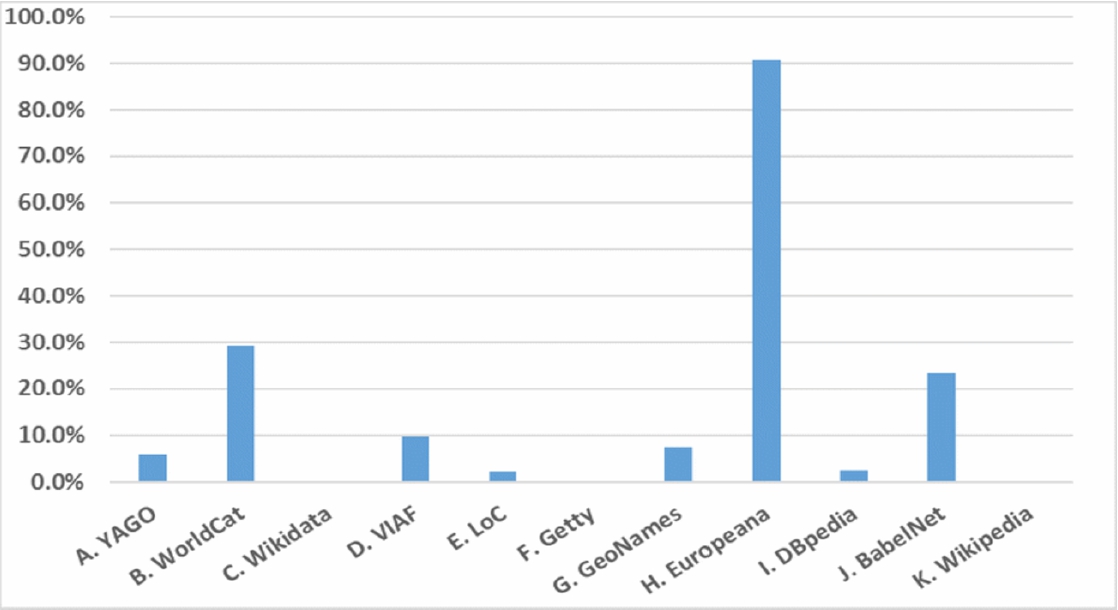
The percentage of four srandardised properties used for the purpose of rdf:resource linking in 11 data sources.
On the one hand, proprietary properties in Wikidata enable the users to refine the semantics of outbound links. It is useful in some cases where one needs to identify a particular link among tens of
Another issue is that the Wikidata entities do not use human “guessable” URIs, even if they are not absolutely opaque URIs such as hash. For instance, the syntax of the entity URI for Cold War is In this context, hacking means the manipulation of URIs to access another data, for example, by changing prefix or suffix. See also
When we manually examined France in Getty, we found that there were 1783
Figure 13 illustrates the ratio of each property among the four properties. Despite the wide spread of research concerning
From Fig. 12 and 13, it becomes clear that some data providers set different strategies to design their ontologies in spite of the W3C recommendations. The results indicate that it is not feasible to traverse LOD and collect information, if the users specify only one type of property. As seen throughout Section 4, the need of traversing strategies is also verified from this perspective.

The ratio of each property among the four standardised properties used in 11 data sources.
This section examines the quality of other data content to supplement the analysis of link quality. The content-related four W3C standard properties are analysed, namely,

The ratio of each content-related property among the four content-related properties used in 11 data sources.
Here one can also observe the characteristics of data sources. The contrast between

The library sector (VIAF, the Library of Congress, and WorldCat) uses
We further investigate the core constructs of RDF/XML. The use of
Similarly, each entity in GeoNames contains it exactly twice (2.0 for
The second
Moreover, we investigate the amount of literals. However, they have to be treated carefully, as they may include less relevant information about the entity. Despite the caveats, the figures do provide a rough idea of how much content is described in each LOD instance. Manual inspection indicates that the number of literals in some LOD is extremely high. This is not only due to an enormous amount of technical metadata, but also to repetitions (e.g. literals expressed in several schemas) and language variations in them. For example, there are in total over 4.5 million literals and, on average, more than 50 thousand for the 100 entities in Wikidata.
The average number (per entity) of rdf:resource, rdf:about, and literals for each data source
The number of unique data content per data source in each category (values in parentheses indicate coverage in percentage)
This section presents our attempt to further enhance the results of Section 4.9. Our Python scripts compare the content differences of the 100 instances across the 11 data sources (see Fig. C.1 in Appendix C). The amount of unique content of a single entity and the ratio are automatically calculated, and the aggregated view for the 11 data sources is shown in Table 10. In theory, they should represent the coverage and diversity of content (for a data source). The table is grouped by categories (i.e. all entities within are aggregated), because the instances tend to show similar patterns within the same category. “Full coverage” indicates the total amount of the unique content that 11 data sources hold as a whole (thus 100% coverage). It means that overlapping content is calculated once. The percentage of a data source indicates the ratio of the unique content against the full coverage.
In the overall column of Table 10, YAGO holds the largest amount of unique content (56.2%), which also implies that it is the data source with the most diverse content. It is nearly double the size of DBpedia. It may be also surprising that Wikidata contains just over a half of the DBpedia data. When we look at this from a cross-domain LOD perspective, the Library of Congress and WorldCat are considered as small-scale datasets, while the number of BabelNet content is even smaller. Obviously, data sources containing fewer entities provide less content.
Regarding the agents category, DBpedia exceeds YAGO and Wikidata. As expected VIAF is also prominent. However, the number is rather disappointing, compared to these three sources.
With regard to events, the reasons why the Library of Congress has relatively high number of contents is mostly due to
In the dates category, DBpedia has substantial advantage (88.1%). Other sources are unlikely to offer highly informative content. We also conducted manual inspection on our data sources. We discovered that the high volume of DBpedia in general was most likely due to a large number of links (derived from Wikipedia article
YAGO shows strength in the places category, given that the ratios are more evenly distributed across all sources due to the availability of the entities in this popular category. Interestingly, Getty Vocabularies (TGN) performs relatively well, whereas GeoNames is not as good as we expected. New and diverse information may not be found in the latter.
As for objects and concepts category, the strength of DBpedia persists. It seems that it extracted a great deal of data from Wikipedia. Understandably, Wikipedia articles would be more exciting for human users than a collection of factual data in LOD.
In general, this analysis suggests: (a) the concentration of (diverse) content in DBpedia, YAGO, and Wikidata, and (b) data richness in specific proprietary properties. A critical question is how the 11 LOD producers facilitate users to find them among hundreds of properties, in order to access rich information, especially if they are unfamiliar with their ontologies. The hurdle could be higher for the data integration by federated queries in multiple LOD sources.
Table 11 illustrates the amount of data overlaps per category. While the one-source column indicates the number of non-overlapping content for the source (i.e., unique content), other columns indicate the number of overlapping content (i.e, two to ten sources hold identical string). Interestingly, the content covering all data sources does not exist at all. This implies that even the most standard English label cannot be found in every source. Over 75% of content is unique. However, overlaps in two sources are relatively high for agents, events, and objects and concepts. The numbers drop sharply for the overlap in more than two sources. However, very high coverage is also seen for agents, places, and objects and concepts. One reason for these phenomena would be the contrasting volume of data sources. As we have seen earlier, the disproportionately high volume of DBpedia, YAGO, and Wikidata makes the rest of the sources look insignificant. Therefore, although there are some highly overlapping content, the percentages remain very low.
The amount of ovelaping content per category
1
“1 source” column indicates the number of content without any overlap (unique content). From the “2 sources ” column to “10 sources”, the number of overlapping content is seen. Values in parentheses indicate percentages within each category. Due to the lack of entities in data sources, some celles are blank.
The amount of ovelaping content per category 1
“1 source” column indicates the number of content without any overlap (unique content). From the “2 sources ” column to “10 sources”, the number of overlapping content is seen. Values in parentheses indicate percentages within each category. Due to the lack of entities in data sources, some celles are blank.
Our assumption is two-fold: (1) the higher the coverage, the more accessible the data, yet the more redundancy in the LOD cloud, and (2) the lower the coverage, the more serendipity with unique content, yet redundant traversals. From this perspective, it is too early for us to judge how much users benefit from a large amount of unique content, and/or how much they suffer from redundant information in multiple sources, because we do not have gold standard for data quality.
We additionally created intriguing views of the amount of unique content per entity for each category. Figure 15 provides a view for the events category. In this case, content diversity is clearly visible, ranging from the rich volume of Byzantine Empire and Mars, to poor volume of Traja and Like a Rolling Stone. The details of other categories and short comments are found in Appendix C.
Challenges for cultural heritage datasets
This research strives to uncover gaps between the data producers and consumers. Indeed, our evaluation of 11 LOD providers reveals a clear sign of data quality issues from a user perspective, which have neither been examined in this detail nor on an instance level by other studies. While it verifies some results of the previous research, it also pinpoints additional issues, in particular, issues specific to the cultural heritage domain, as well as the different types of link properties and literals.
Our analysis confirms the observations of Ahlers and Debattista et al. [3,11] that a limited number of links are found for major LOD datasets, with the exception of the relatively ample amount for DBpedia (RQ1). A large proportion of LOD sources may not be fully connected and unevenly interlinked for the representative entities (RQ2, 3). This result also reflects previous LOD studies on the overall quality and

The amount of content for events entities per data source.
“High-volume and high-quality” datasets are biased toward a couple of data sources, especially generic knowledge bases (RQ3). Consequently, it is uncertain if users and researchers would be able to find new information, let alone to answer more specialised questions that they are interested in. As Zaveri et al. pointed out [45], assuring data quality is particularly a challenge in LOD as the underlying data stems from multiple autonomous and evolving data sources.
Some valuable information about the same entity is not easily reachable due to the lack of links, and/or redundantly long traversing (RQ2). For example, it is not possible for a user looking at Beethoven in Getty ULAN to obtain relevant artists and songs in BabelNet. Generally speaking, due to the heterogeneity of LOD quality and linking patterns, it seems that the automation of graph traversals and the subsequent data integration currently require more human effort than necessary (RQ4).
Those are serious shortcomings for our research scenarios. In other words, the quality of a hundred representative entities from major LOD providers has not yet met the basic needs of researchers.
From a user’s perspective, our analyses also provide an insight into LOD that previous research has not been able to deliver. For example, it became clear that some objects and concepts may introduce complication, because links between LOD resources may be missing and/or confusingly created (RQ3, 5). There seem to be a different number of corresponding records, depending on the type of concepts in FRBR (work, manifestation, expression, and item). Unlike skilled librarians, average users on the web would not be able to distinguish four types of FRBR resources and solve co-references on their own. However, this is not a technical problem of LOD, but an issue about the different perceptions and/or understanding of users about the conceptualisation of entities. This “semantic gap” between the data consumers and data producers has the potential to cause problems for research in the future.
As we have seen, an obstacle for interoperability and data processing automation is proprietary properties. LOD is not as powerful as it can be, as long as human users analyse related data every time when traversing data, because they are not initially aware of data sources and their ontologies in their query time [40]. This is particularly true for a large amount of data for which manual analysis is unrealistic. According to Bizer et al. [6], it is a good practice to reuse terms from well-known RDF vocabularies wherever possible, and only if they do not provide the required terms should data publishers define new, data source-specific terminology. In the interoperability metric of Candela et al. [8], the use of external vocabularies is also favoured for the LOD quality assessment. At the same time, we found that rich information tended to be “hidden” in proprietary properties among many other properties (RQ1, 2). Without close manual examination of ontology and data itself, it would not be easy to automate data processing (RQ4).
Admittedly, this article has some limitations. It focuses on the analysis of LOD entities which provide a context for cultural heritage research. For example, as mentioned earlier, Europeana has enriched its digital object datasets with named entities. One may find cultural heritage objects with
In addition, in case of external entity linking, federated queries are required to investigate the data integration across different LOD sources, which is slightly out of the scope of this paper.43 There is also a serious technical problem with scalability for federated SPARQL queries on the web, which makes it hard to conduct analysis of our kind.
Furthermore, largely due to the manual-based methodology, the sample size remains the bare minimum. However, LOD is oftentimes populated programmatically, although crowdsourced LOD such as Wikidata would have more manual curation by human users. In fact, we show that much LOD content is relatively standardised or normalised; the number of links at a data source is relatively similar and consistent across entities in the same category (RQ5). It is therefore doubtful that if a large-scale sampling would make our results considerably different.
Nevertheless, our research should aim for the fusion of manual and automatic evaluation in the future. As Idrissou et al. [26] stress, we agree that the links must often be human validated, since entity resolution algorithms are far from being perfect. We also consent to computer support that can accurately estimate the quality of LOD, because the manual analysis is both a costly and an error-prone process.
It is also worth mentioning that there are some technical challenges concerning the automatic analysis of LOD. We encountered many small problems to collect and analyse the data. For example, data is sometimes not consistent (RQ1, 2, 4, 5). YAGO has an issue with special characters in the data. We observed this for Uncle Tom’s Cabin and Sgt Peppers Lonely Heart Club Band. In case of the former, YAGO’s URI is different from that of the DBpedia URI, while all other URIs are identical for the two sources. Thus, error handling was required for those exceptional entities in Python scripts. In addition, the stability of URIs is extremely important, but not always guaranteed. If we look at a broader range of LOD resources, we know that, for example, there was certain impact, when the GND, the German integrated authority records, changed their entity URIs from HTTP to HTTPS in 2019.44
Despite those caveats for limitations, the investigation in this paper clearly indicates that NEL in local databases may not be as sufficient as one may think (RQ1). Our study observes an iceberg of a large variation in data quality on the web [45]. Thus, it would be wrong to expect that NEL automatically generates synergies for LOD data integration. Indeed, successful projects applying such data integration are highly limited so far in our field. Careful strategies are required to identify efficient traversals and obtain data such as multilingual labels and links to global and/or local databases, and integrate heterogeneous datasets in a useful fashion (RQ2, 3). One recommendation for the NEL strategy would be to refer to hubs such as YAGO, DBpedia, and WorldCat as much as possible, from where the W3C standardised links to other major LOD resources are available. At the same time, one should be aware that YAGO and WorldCat would be the best choice to find information in Wikipedia. While WorldCat is not connected to DBpedia, it has links to the Library of Congress, which DBpedia does not. Contrary to many practices of NEL in cultural heritage, links to Wikidata would be recommended if the users have a good understanding of its proprietary properties to access other data sources. In addition, our traversal maps can be used as an orientation guide for the NEL implementers.
It is ironic that although Wikidata generally receives high numbers of incoming links from other sources and holds a substantial amount of information, it does not offer the standardised way of providing outgoing links at all. This could be a controversial issue for the efficiency and/or “democratisation” of LOD. A limited amount of new data could be obtained from WorldCat, BabelNet, and GeoNames. It is therefore not promising to carry out serious research with such data as it seems that some datasets tend to serve merely as global identifiers, rather than new sources of information (RQ1).
Simultaneously, the use of opaque URIs and a large number of proprietary properties in Wikidata should be more intensively discussed by the LOD publishers and consumers, especially by the NEL implementers, because Wikidata is becoming a NEL standard in cultural heritage [36].
In any case, providing multiple links during NEL will increase interoperability, because it may avoid redundant traversals and give us more flexibility (RQ2). At the same time, we can also advise the maintainers of 11 LOD sources to fully link to each other, as well as to provide more links to other local datasets as much as possible. The reciprocal links will allow users to integrate truly interdisciplinary and heterogeneous datasets. In a way, our study identifies the myth of NEL and verifies the obstacles of LOD (RQ1). NEL is a step necessary to the use of multiple datasets in LOD [26]. However, linking is the means, not the goal.
Discussions on local datasets
The connection between local datasets and globally known reference resources that this paper deals with has been largely uninvestigated (RQ2). This entails that the local-to-local (L2L) connections via global sources are not well known, although LOD and NEL are designed to perform this task. One exception is demonstrated by Waagmeester et al. [44], describing four cases with federated SPARQL queries to connect Wikidata with local datasets. Yet, our research clarifies that the 11 global LOD sources do not easily enable us to integrate local datasets due to the lack of links to them (RQ1). In addition, if two local datasets point to different global sources, they need to traverse more than one graph in order to link each other. This means that the destination of NEL determines the usability of L2L data integration. In any case, a feasibility study on the L2L data integration would be one of the next tasks for our research. We could extend it further by exploring what innovative research we could actually do after NEL and federated queries. Pilot use cases are needed to simulate and evaluate data aggregation, contextualisation and integration as the outcomes of NEL in the cultural heritage field, followed by semantic reasoning and creation of new knowledge. Otherwise there is a risk that LOD would end up with an idealistic vision without concrete impact on our society.
Related to this, there are also problems with local datasets. It is known that some LOD in cultural heritage is not adequately and sufficiently published. For instance, Francorum Online45
To enhance the analysis carried out in this article, it would be interesting to investigate the LOD traversability in comparison with all the LOD properties actually used. For instance, Linked Open Vocabularies49
As Berners-Lee states [5] that “statements which relate things in the two documents must be repeated in each” and further, “a set of completely browsable data with links in both directions has to be completely consistent, and that takes coordination, especially if different authors or different programs are involved.” As such, reciprocal links and lookups need to be added with care. For the next step, it seems necessary for the web community to help major LOD dataset maintainers to identify incoming LOD as much as possible, and enrich the datasets to create reciprocal links. Even if a full mesh network is not an aim for many LOD data sources, it would be critical for the LOD creators to be aware of and interconnect with other LOD data sources in order to provide a way to find as much new information as possible (RQ1, 2, 3).
Python analysis let us remember that data overlaps across data sources are duplicate information (RQ1, 5). On the positive side, fewer traversals are needed to find the same information. On the negative side, data is redundant. As the size of the LOD cloud grows, it may confuse users in the vast amount of information like a needle in a haystack. Use cases by researchers would help to evaluate the pros and cons of the LOD’s distributed data approach. In this regard, we also need to find a way to adequately manage and use aggregation services of LOD.
One example which enables the users to compare LOD sources is SILK [43]. Although it is limited to two data sources, it provides support to create and maintain interlinks. Their update notification service is also particularly valuable. It is also possible and realistic that third-party services would be developed for the integration of LOD data sources [21,27]. However, there are limited numbers of web applications capable of crawling the web and detecting incoming links of LOD. Some projects offer data dumps containing such information. Yet, they often do not provide an interactive interface. Furthermore, research on LOD search engines is advancing somewhat slowly. Although there are some projects including Swoogle, Sindice, and LODatio [12], many are experimental, out-of-date, or un-user friendly. It is hoped that next generation of search engines for LOD will be developed.
This paper highlights the reality of a reasonable set of LOD datasets in cultural heritage, but the discussion is applicable for other domains. By removing the obstacles found in this article, LOD traversing and date integration become more feasible for end-users with help of automatised tools.