







Abstract
Keywords
Introduction
Benzene is an important industrial chemical that has been used in numerous production and synthesis processes in the chemical, petrochemical, paint, plastic, adhesive, rubber, and dye industries. Mineral oil, products of gasoline combustion, and cigarette smoke are the other main sources of widespread environmental and occupational exposure.
1
Exposure to benzene has serious adverse health effects. Long-term exposure to benzene damages the bone marrow and can cause leukemia; benzene exposure is also associated with other blood cancers and precancers of the blood.2,3 The International Agency for Research on Cancer (IARC) classifies benzene as a group I carcinogen.
4
ttMA, catechol, phenol and hydroquinone, and
Liquid-liquid extraction (LLE) has been used to prepare the samples prior to the analysis of ttMA in biological fluids. In this technique, ethyl acetate or diethyl ether is used as an extraction solvent for sample cleanup. In several studies, solid-phase extraction (SPE) on strong anion-exchange sorbents was used to achieve purification and preconcentration of the ttMA in urine samples.9–11,15–22
However, these conventional extraction techniques have disadvantages such as coextraction of interfering substances and the use of highly toxic and expensive organic solvents. In addition, these techniques are time and labor intensive. In recent years, hollow-fiber liquid-phase microextraction (HF-LPME), a new miniaturized format of LLE, has been developed for separation and preconcentration of target analytes. Its advantages are high selectivity and specificity, low consumption of organic toxic solvents, and low cost. This method is quick, easy, and has no carryover because of the single use of fiber, high preconcentration, and automation. 23 29 In order to promote the extraction of hydrophilic compounds from the donor aqueous phase into the organic phase, carrier-mediated liquid-phase microextraction is used as an active transport mode. 30 In biological and environmental applications, carrier-mediated HF-LPME in its two- and three-phase modes has been used to identify analytes and contaminants such as volatile organic compounds, aromatic amines, herbicides, phenols, pesticides, inorganic compounds, and polar drugs in different matrices. 31 38
However, till now no studies have been based on application of carrier-mediated HF-LPME technique to the extraction and determination of ttMA in human urine. In this study, carrier-mediated three-phase hollow-fiber microextraction method prior to HPLC-UV was applied to develop a method for extraction, preconcentration, and determination of ttMA in human urine as a biological exposure index for evaluation of environmental and occupational exposure to benzene. Important factors such as the type of organic membrane solvent and carrier concentration, stirring rate, sample and donor pH, sample temperature, and sampling time were optimized, and a simple protocol of HF-LPME method for the assessment of exposure to benzene is represented.
Experimental
Chemicals and reagents
TtMA, tri-
HPLC system
Separation and determination of the analyte were accomplished on a Knauer HPLC system equipped with a K-2600 variable wavelength UV detector, a K-1001 piston pump (Knauer), an online D-14163 degasser, a 6-port/3-channel injection valve fitted with a 20 μL sample loop and ChromGate software (EZChrom Elite). All injections were performed manually. Chromatographic separations were performed using a C18 analytical column (Eurospher, 25 cm × 4.6 mm i.d., 5 μm).
The isocratic run was performed at a constant flow rate of 1.0 mL minute−1, the mobile phase was water/methanol/acetic acid (69:30:1 (v/v/v)), and the ultraviolet detection wavelength was adjusted at 259 nm with an injection volume of 20 μL.
Supported liquid membrane preparation and extraction procedure
Hollow fibers were manually cut into 8.8 cm pieces with an internal volume of 24 μL, washed with acetone in an ultrasonic bath for five minutes to remove any contaminants and then dried. For each experiment, 24 μL of receiver phase was drawn in to a 25 μL Hamilton HPLC syringe and its needle was inserted into the channel of the hollow fiber. Then, the end of the hollow fiber was soaked in organic solvent for 15 seconds. The hollow fibers were rinsed with distilled water for 10 seconds to remove excess organic solvent from their surfaces. The acceptor phase in the microsyringe was introduced into the lumen of hollow fiber, and one end was sealed with a segment of aluminum foil. During extraction, the membrane portion was immersed in the 11 mL aqueous sample that was contained in a 12 mL sample vial. The sample vial having a 4 mm × 14 mm magnetic stirring bar was placed on a heating magnetic stirrer with 0-1000 rpm (Italy) in a U-shaped configuration. After removing the hollow fiber from the aqueous sample, the end of the hollow fiber was cut and the receiver phase was drawn into the syringe and injected into the HPLC system for analysis. To minimize the memory effect, each piece was used only once.
Preparation of standard solutions and real samples
Stock standard solution of ttMA (1000 μg mL−1) was prepared in HPLC-grade methanol-water (1:1) and stored in a refrigerator at 4°C until use. The working solutions containing analyte of interest were prepared daily by diluting the standard solutions prior to use.
To perform the experimental study, urine specimens were taken from nonsmoking healthy subjects living in a rural area that was not exposed to benzene. Spot urine samples from nine workers who had been occupationally exposed to benzene (in a petrochemical plant, car painting, and gasoline station) were collected. All of the subjects were nonsmoking males with an average age of 43.2 ± 9.7 years and had an average of 13.9 ± 10 years on the job. Urine samples were collected at the end of the shift and at the end of the work week, refrigerated and immediately sent to the laboratory, and kept frozen until analysis. Spot urine samples were collected using 200 mL plastic containers. To protect the containers and specimens from contamination, leak-resistant cups were utilized and each was used only once.
Spiked urine samples with ttMA were made freshly from the stock solution prior to analysis. All subjects gave their written, informed consent to participate in the research, which was conducted in accordance with the principles of the Declaration of Helsinki. The research was approved by the Research Ethics Committee of Hamadan University of Medical Sciences and Health Services.
Results and Discussion
Effect of the carrier and its concentration
An effective organic solvent as a supported liquid membrane should be compatible with hollow fiber, be able to dissolve target analytes, have a low viscosity to increase mass transfer through the membrane, and low volatility to prevent loss of solvent in the extraction process.
In this paper, three extractants were used as a carrier. Tri-

Effects of different carriers (
TOPO in xylene showed the best performance efficiency, but not the best extraction efficiency, because the TOPO in xylene was unstable.
In order to improve their extraction efficiency, the solutions of dihexyl ether containing various concentrations of TOPO immobilized in the pores of the porous polypropylene hollow fiber, in the range of 5%-25% (w/v), were investigated.
The best extraction performance was obtained using 15% (w/v) TOPO in dihexyl ether (Fig. 1B). It is assumed that the high dielectric constant or polarity and extremely low solubility in TOPO water are the most important properties and allows for hydrogen bonding between the acidic hydrogen atoms of nonionized ttMA and the phosphoryl oxygen of TOPO to establish efficient extraction of the target analyte into the organic liquid membrane. 39
Effect of donor pH and acceptor composition
The pH of the aqueous donor and acceptor phase should be adjusted to a value that preserves the analyte in the proper form for improving the extraction recoveries. The ttMA is a compound with a p

Effects of sample PH (
Effect of stirring speed
The sample stirring rate in carrier-mediated HF-LPME can increase extraction efficiency so that it promotes mass transfer and diffusion of the analyte from the donor phase into the receiver phase and reduces the time required to reach thermodynamic equilibrium. 41
In this work, stirring speeds from 300 to 1100 rpm for a 60-minute extraction were studied. The extraction performance increased with stirring rate up to 500 rpm, but decreased at higher rates (Fig. 2B) because high speeds produce air bubbles that cause loss of solvent and reduced precision.
Effect of temperature
Temperature affects the kinetics and the thermodynamics of the distribution process of analytes during extraction and have important effects on the performance of extraction process. Moreover, high temperature increases the loss of organic membrane phase and decreases precision.31,34,42 In order to observe the effect of temperature on extraction efficiency, the temperatures in the range of 20-60 were studied and 40°C was observed to be the best temperature for the experiments (Fig. 3A).

Effects of sample temperature (
Effect of extraction time
Liquid-phase microextraction is an equilibrium process. At equilibrium time, analytes in the acceptor phase are in the steady state and stand at their maximum concentration. Moreover, extraction at longer times than the balance time can lead to a decrease in extraction effectiveness because of a loss of organic solvent in pores of hollow fiber or receiving phase.26,41,43 The peak area in the chromatogram of target analyte increased with extraction time up to 120 minutes. So, a sample extraction time of 120 minutes was chosen for the next study (Fig. 3B).
Method validation and application
Under optimized experimental conditions (15% (w/v), such as TOPO in dihexyl ether as organic liquid membrane, sodium carbonate 0.05 M (pH 8) as acceptor phase, and donor pH 2.0, stirring rate of 500 rpm, 120 minutes as the extraction time, and donor temperature of 40°C, the performance and practical applicability of the three-phase carrier-mediated HF-LPME configuration for extraction of ttMA were investigated. SPE method prior to HPLC-UV analysis was used to confirm the detected analyte according to the validated method of Shahtaheri et al. 9
Method validation was evaluated on the spiked urine samples comprising the desired amount of the metabolite at various concentrations. Calibration curve of the ttMA was plotted using six spiking samples from 0.005 to 1.2 mg mL−1. To investigate figures of merit of the method, limit of detection (LOD), limit of quantification (LOQ), linearity, linear detection range, repeatability, reproducibility, relative recovery, and enrichment factor (EF) were calculated. The spiked urine calibration curve for ttMA was detected to be linear in the range of 0.005-1.2 μg mL−1 with a correlation coefficient (
Interday precision was carried out on three consecutive days at three concentrations of the analyte with 18 replications in relative standard deviation (RSD). Intraday precision and accuracy were studied at low, medium, and high concentration levels and with six replications. As shown in Table 1, the RSD% of intra-and interdays were 2.7%-7.3% and 3.4%-8.1%, respectively. The relative recovery, calculated as the ratio of the concentration of the ttMA in the sample solution, was determined with the proposed method to initial concentration of the metabolite in the sample solution, which was 83%-92%. Under optimized conditions, the EF was 153-182 according to the following equation.
Optimization of carrier-mediated HF-LPME coupled with HPLC-UV for quantitative extraction of ttMA in human urine.


The results of validation experiments indicated that the carrier-mediated three-phase HF-LPME followed by HPLC-UV are suitable and feasible for extraction and analysis of urinary ttMA.
Applicability of the Method for Analysis of Real Samples and Comparison with other Methods
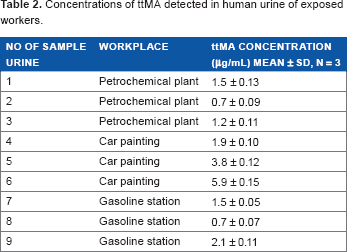
The proposed carrier-mediated HF-LPME-HPLC-UV method was applied to the biological monitoring of benzene exposure. Nine urine samples were obtained from volunteers at different work environments in Hamedan and Asaluyeh, Iran (collected at the end of the shift and at the end of the work week). The ttMA in these real samples were determined. All of the workers were nonsmoking males with an average age of 43.2 ± 9.7 years and had an average of 13.9 ± 10 years on the job. It was reported that these workers are directly exposed to petroleum products or organic solvent vapors containing benzene in the course of the workday. Before the extraction, the real urine samples were diluted 10-fold with deionized water and, under optimized conditions, extracted and analyzed by using the proposed technique. The results of three replicate analyses of each real urine sample are presented in Table 2. However, a simple dilution of sample prior to analysis is sufficient and desirable when the concentration of the metabolite in the sample is already very high. As illustrated in Table 3, this method is more sensitive and precise than the other published methods (LOD and RSDs). Figure 4 shows typical chromatograms obtained by carrier-mediated HF-LPME for the spiked (0.1 μg mL−1) and real urine samples.
Concentrations of ttMA detected in human urine of exposed workers.
Comparison of the carrier-mediated HF-LPME-HPLC-UV method with other preconcentration techniques for extraction and determination of ttMA in human urine.


HPLC chromatograms of ttMA after the extraction under optimized conditions as described in the text. (
Conclusion
In this work, we presented a new pretreatment method for the quantitative determination of ttMA in urine, which can be used to evaluate occupational and environmental monitoring of exposure to very low concentration of benzene. The factors influencing HF-LPME based on carrier-mediated transport were optimized through this research, concluding that it is an efficient, reliable precision, simple, accurate, and less expensive procedure than conventional extraction methods like LLE, SPE, and derivatization for sample preparation of ttMA as a biomarker of benzene exposure. This method exhibited an EF of around 182, good relative recoveries of 83-92, a very low LOD of 0.001 μg mL−1 with wide dynamic linear ranges (0.005-1.2 μg mL−1) and good reproducibility (RSD, less than 8.1%). All these are great advantages over other sample preparation procedures. With this simple extraction procedure, multifold extractions can be performed at the same time with a multistirrer.
Author Contributions
All the authors contributed extensively to the work presented in this article. They discussed the results and implications and commented on the manuscript at all stages. Performed all experiments and wrote the manuscript: FG. Supervised all stages of the project: AB. Designed the experiments and analyzed the data: FGS. Responsible for the chemical aspects of the project: YY. Interpreted the data and performed the statistical analysis: AM. All the authors read and approved the final manuscript.