







Abstract
Collective memory constitutes one key symbolic resource in public discourse capable of evoking powerful emotions and inspiring, justifying, and legitimizing actions (Olick and Robbins, 1998; Schwartz, 1996; Zerubavel, 1995). Traditionally closely tied to the realm of the nation, there is growing consensus among memory scholars that in a world that is increasingly connected and in which ideas, cultural products, and people are in constant movement, collective memories also come untied and begin to travel (De Cesari and Rigney, 2014; Radstone, 2011). In this article, we build upon Erll’s (2011b) concept of “traveling memories” to comparatively investigate how memories of other nations (MON) are recruited to relay messages to domestic publics. Specifically, we focus on the particular role of heads of state in importing other nations’ memories into their own nation’s public discourse.
With this study, we contribute to an ongoing discussion over the progressing transnational and transcultural transformation of collective memories, delineating key processes in their re-negotiation and appropriation within political discourse. Based on a review of the scholarly debate, we argue that memories do not travel of their own accord; rather, they do so because they are drawn upon by a wide range of key social actors, including political leaders, and inserted into their public communication to become part of other nation’s memory discourse (Whitlinger, 2015). In this process, political leaders occupy a special position not only because of their role in formulating highly visible collective narratives addressing the nation but also as unusually resourceful actors who are in close contact with foreign and global affairs (Olick, 2016; Simko, 2015). As such, importation is comparatively unconstrained by pre-existing memories: political actors can use imported memories strategically and selectively, thus subordinating them to current political debates and agendas.
Accordingly, our focus on the strategic importation of other nations’ memories calls into question not only existing notions of collective memories bound to specific national debates but also notions of traveling or cosmopolitan memories developed in response to the progressive erosion of national discursive boundaries (Erll, 2011b; Levy and Sznaider, 2002). In their place, we argue that foreign memories can be imported, but that they undergo consequential transformation during the process that adapts them to their new surroundings. As a result, these memories may be foreign with regard to the memorialized events, but are attributed new and different roles within the context of the domestic debate. To refer to such memories that originate from or actively involve other nations and are rendered meaningful within the context of a public sphere that remains nationally bounded, we introduce the term “memories of other nations (MON).” 1
In order to study how such MON are imported in the speeches of political leaders, we began from a corpus of over 9000 speeches given by heads of state in the United States, the United Kingdom, Israel, and Germany over seven decades (1945–2018) to domestic audiences. Focusing on speeches that evoked MON, we conducted a qualitative comparative discourse analysis to identify both common patterns and country-specific differences in how these memories were presented and rendered relevant to the domestic context. Through a grounded-theory analysis, we identified three primary paths of travel, each of which is associated with distinct functions served by the foreign memories. We show that foreign memories are not imported as meaningful wholes, but arranged selectively and recontextualized, with their role confined to supporting predetermined domestic agendas and debates. While progressive transnationalization may have expanded the repertoire of memories available for public sense-making, the use of memories—both domestic and foreign—remains firmly rooted within the national context.
Theoretical background
Collective memories, which can be defined as shared recollections of the past that are constructed to serve present needs and purposes (Schwartz, 1996), are formulated and negotiated in public discourse (Halbwachs, 1997 [1950]). Given that most public discourse is bounded by the realm of the national public sphere, collective memories are also predominantly associated with the national public and develop in close connection to the nation as a whole. Accordingly, most existing research on collective memories focuses on national collective memories (see Olick and Robbins, 1998; Olick et al., 2011, for reviews) and the analysis of sites of memory embedded in a world of nations (Nora, 1989). Memory researchers commonly approached collective memories as embedded within a given “container-culture” (Erll, 2011b; Zelizer and Tenenboim-Weinblatt, 2014), adhering to the previously held notion that “memory, even cultural memory, is local, egocentric, and specific to a group and its values” (Assmann, 2010: 113).
Following globalization processes and hand-in-hand with the 1990s “memory boom” (Huyssen, 2000; Winter, 2001) in both public discourse and research, major changes occurred in the configuration of media, culture, and politics, which led to intensified exchange of ideas and meanings across cultural and national borders. In a progressively transnationalized environment, especially with regard to globalized media spheres, cultural products from one nation become increasingly available to populations beyond the original context, enabling audiences around the globe to be exposed to and relate to memories that “belong” to other nations. Globalized interaction patterns, including tourism and travel, trade, and the exchange of (pop-)cultural products, contribute to the blurring of mnemonic spaces’ previously assumed boundaries. To the extent that memories “travel” across national borders, this progressively enables both the entrance of notions of otherness and the export of self to foreign spaces. 2 In a related process, international political and economic interactions created a growing class of internationalized elites who are fluent in other cultural repertoires and facilitate their exchange between collectives.
Recognizing these shifts in the configuration of mnemonic processes, Erll (2011b) criticized memory studies’ continuing emphasis on nationally bounded memories. Instead, she suggested a need to emphasize the “transculturality” (Welsch, 1999) of mnemonic processes and products as a research perspective and a point of departure from which to study memory. Specifically, her critique directs attention toward the globalized dynamics “on the move, transcending time and space” (Baer and Sznaider, 2015: 3), unfolding as transnational (Huyssen, 2000; Rothberg, 2009;) and transcultural (Garde-Hansen et al., 2009; Hirsch, 1997) mnemonic forms.
In particular, over the past years, researchers suggested various ways in which collective memories can transcend national boundaries (De Cesari and Rigney, 2014; Welsch, 1999). Several scholars proposed novel ways to conceptualize the transcultural shape of collective memories: Volkmer (2006) focused on what she called “globalized” memories, which are shared, at least in some rudimentary form, around the globe. Focusing on memories of the Holocaust, Landsberg (2004) emphasized the importance of “prosthetic” memories that embody other’s suffering and extend these experiences across both space and time to un-experienced collectives; relatedly, Levy and Sznaider (2002) argued that “cosmopolitan” memories can encompass moral and ethical lessons that enable global audiences to evaluate other nations’ sufferings. More recently, Rothberg (2009) proposed a notion of “multidirectional” memories that provide a space for societies to better understand the hardships of foreign collectives.
Memories of Other Nations
What these reconceptualizations have in common is that they fracture existing, often unquestioned notions of a memory “belonging” to one particular nation. At the same time, the ways memories are appropriated and mobilized still respond to domestic memory cultures and political needs: as memories travel, they multiply and assume different shades of meaning that include both elements of their “original” memorialization and new elements acquired on their journey. In this way, for instance, memories of the Holocaust seem to belong to everyone (Stein, 2014), they are “at home” in many nations; alas, despite their reference to the same historical events, German memories of the Holocaust are quite different from Israeli or Polish ones and infuse domestic political debates in different ways. 3 Through being imported into diverse national debates and contexts, memories are thus transformed in ways that are better understood as hybrid. They neither “belong” exclusively to their place of origin nor to their new environment, but are shaped in important ways by both (De Cesari and Rigney, 2014; Radstone, 2011). While this dilutes the sense of ownership a collective has for its memories, their specific perspective on the memorialized events is still very much dependent on the original collective, its memory culture, and domestic political discourse.
To capture this dependency, we focused on the use of imported memories as those not (yet) fully memorialized in domestic cultural settings (as opposed, for instance, to memories raised in the context of commemorative events). Furthermore, we appraised such memories from the vantage point of the importing actor and addressed collective, to whom these appear as “memories of other nations.” This deliberately polysemic term captures two key variants of the ways in which foreign past events may play a role within a society’s political discourse: On one hand, societies may remember their own views on or experiences with other nations, such as memories of witnessing the 9/11 terror attacks on a television screen thousands of miles away from the actual event. On the other hand, they may become aware of other nations’ collective memories, such as foreigners consuming US pop-cultural references to 9/11. These variants are not strictly separate: For instance, Israeli publics can relate to the 9/11 attacks by simultaneously remembering their own emotions at viewing the television footage and relating to the shock remembered among US citizens over their country being attacked by Islamist terrorists. MON encompass both these options: in the first case, we can read the “of” in MON as designating the foreign object of our own recollections, describing hybrid collective memories in which other nations play a constitutive role. In the second case, the “of” designates the foreign ownership of collective memories that are imported to become part of the domestic debate. Either way, the memorialization of foreign past events is critically filtered through the importing collectives’ present concerns and memories.
Both variants also open up the possibility that imported MON may not be entirely foreign, but may involve the domestic collective’s role or perspective (e.g. Ronald Reagan taking center stage in Americans’ memories of the fall of the Berlin Wall). Other memories are augmented by including foreign perspectives, such as incorporating non-Western societies’ memories of oppression during past colonial rule into the narratives of the Western nations that colonized them. Inversely, nations may remember other nations’ roles in their own memories (e.g. US recollections of the Gulf War that credit the importance of British and multinational involvement). Each of these cases constitutes a different variant of hybrid collective memories that are neither strictly domestic nor entirely foreign. Hybrid collective memories thus comprise all cases wherein foreign and domestic perspectives on remembered events are integrated and thus inextricably intertwined.
By contrast, we regarded as foreign all memories of events in which neither the memorialized events themselves nor the primary process of memorialization involved the domestic collective. To be imported, both foreign and hybrid MON need to be actively appropriated and embedded within current public debates (e.g. South African apartheid in Israeli collective memory). To adequately understand the transnational diffusion of mnemonic products and their social implications, we need to comprehend the mechanisms involved in the appropriation of MON.
Importation of memories
Collective memories are not imported for their own sake. Each mobilization of memory serves a purpose in the present (Hobsbawm and Ranger, 1992 [1983]; Schwartz, 1982; Tenenboim-Weinblatt and Baden, 2016)—most commonly, sense-making or justification, affirmation of collective identity and norms, and so on (Olick and Robbins, 1998). Accordingly, in our investigation our key question focused on how heads of state import memories of
Scholarship on strategic framing has long recognized the role of collective memories in informing present sense-making processes and rendering political claims more persuasive (e.g. Verhoeven and Tonkens, 2013)—a practice referred to by Brändström et al. (2004) as “govern[ing] by looking back” (p. 191). To date, however, most scholars investigated such practices with regard to existing domestic memories, whose attributed meanings are already available to the public. In the process of importing memories, internationalized elites and politicians—often with the help of speechwriters, whose job it is to identify suitable narratives and symbolic resources to advance present ideas (Waheed, 2013)—play an important role. As key “primary definers” (Hall et al., 1978) of public issues, political leaders draw upon a wide range of semantic and cultural resources to interpret current situations and advocate policies and choices. Their influential role gives them power to position hitherto unfamiliar information in the public debate and use it to endow their constructions with relevance. In addition, political leaders tend to be unusually networked internationally and hence more enculturated than others in other nations’ belief systems, enabling them to draw upon memories that lie beyond the awareness of present domestic audiences. Accordingly, political leaders may strategically mobilize and adapt selected MON with the purpose of supporting specific frames that benefit their purposes. To do so effectively, however, it is not sufficient to merely present MON to a domestic audience; rather, speakers need to actively create resonance among existing cultural memories, appealing to the existing beliefs and norms of domestic audiences (Whitlinger, 2015). One key benefit of importing MON is that they permit the speaker to tactically select ideas and meanings, using them as transformative metaphors (Brugman et al., 2019; Gavriely-Nuri, 2014) to tweak existing meanings toward supporting their present points. 4
Within public communication, political speeches are critical venues in which political actors construct the meaning not only of their policies but also of wider societal challenges (Druckman and Jacobs, 2015; Waheed, 2013). Yet, most research in memory studies focuses on media and cultural products as the space in and through which memory can travel, transform, and trigger emotional and subconscious associations. The role of deliberate political constructions and speeches has received less attention, mostly concentrating on domestic memories invoked in the context of commemorative speeches (e.g. Olick, 1999, 2016; Sierp, 2014). In the context of traveling memories, Karakaya and Baer (2019) documented the still-strong power of the nation-shaping mnemonic practices of traveling memories, analyzing commemorative speeches delivered at local Holocaust Remembrance Day ceremonies in Spain and Turkey (see also Adams, 2020, on the deployment of the memory of the Holocaust in non-commemorative settings across different national contexts). While there is some recognition of the instrumental uses of memories for achieving specific political goals (e.g. Simko, 2015, focusing on the invocation of memories to console distraught publics), the specific ways in which memories are thereby transformed have so far eluded scholarly scrutiny.
In the following, we set out our strategy for studying the specific ways in which Western heads of state import MON into their speeches. Our analysis emphasizes the specific linkages drawn to render MON relevant to domestic audiences and present issues, as well as the particular functions addressed by this importation within the context of the constructed political meaning. In doing so, our analysis contributes both to the scholarship on the formation and evolution of traveling memories and to the study of political meaning-making and justification in political communication.
Method
Sample
For our study, we investigated how MON are imported into public speeches given by heads of state of four Western countries—the United States, the United Kingdom, Germany, and Israel. This selection aimed to include countries that play major roles in the postwar international order and maintain active ties with other regions and cultures both as potential importers of mnemonic products from all over the world and as sites of memory production themselves. Specifically, the United States as a leading Western power not only plays an active role in many major events commemorated around the globe, but through its ongoing and diverse immigration culture is also in a privileged position for gaining access to memories from a wide variety of nations. As a globally dominant producer of popular culture, furthermore, US memories are disproportionately available beyond its borders. Similar things can be said about the United Kingdom, albeit on a lesser scale, owing to the lasting legacy of the British Commonwealth and the special role of English language in global communication. At the same time, British involvement in the European unification process and its close ties to its many European neighbors provide it with an additional source of importable foreign memories. As a key site for numerous major events, including the world wars, the Holocaust, and the end of the Cold War, Germany plays a unique role in global mnemonic processes. (West) Germany experienced access to foreign memories through its close and prolonged exchange with the United States, the United Kingdom, and France through their military presence as part of the postwar occupation. What makes Germany specifically interesting for our study is its firm commitment to European integration and multilateralism, which includes a particular receptivity to other nations’ memories of suffering caused by the German role in the world wars and the Holocaust (Olick, 2016). Inversely, Israel plays a unique role as a nation constructed at least partly in response to the Holocaust and with the participation of many Western countries. Moreover, Israel has experienced substantial amounts of immigration, bringing with it a disproportionate exposure to foreign cultures and their memories and some heightened attention to events in selected foreign nations, above all, the United States (Schuman et al., 2003). As home to globally revered religious sites and through its role in the highly salient Israeli–Arab conflict, Israel furthermore occupies a special place in the consciousness of many other nations.
Unlike other forms of mediated communication (e.g. radio, television, social media), political speech as a genre remains comparatively stable throughout the years, rendering it highly suitable as a site for comparative and longitudinal study. Our investigation took a long-term diachronic perspective that covers all seven decades since World War II. For Israel, we included speeches from the 1948 founding of the state until 2018. The German sample commences one year later, with the founding of the Federal Republic of Germany (West Germany) and excludes the German Democratic Republic (East Germany), which was part of another, Soviet-dominated international public until its reunification with West Germany in 1989.
Retrieval
For our analysis, we first retrieved all speeches held in public by the incumbent heads of state of the respective countries. Subsequently, we excluded all speeches that, by their nature, would be unsuitable for importing MON into a domestic political debate, notably because they were not fully public (e.g. greetings), addressed foreign audiences (e.g. on state visits, foreign or international memorial events), primarily covered technical matters (e.g. parliamentary budget debates), or focused on memories already memorialized in a domestic setting (e.g. commemorative events). For the United States, our entire data retrieval could be based on a single comprehensive digital online resource, the American Presidency Project at the University of California, Santa Barbara, 5 which comprises all relevant speeches by US presidents for the entire duration of our time frame. In the other countries, equivalent resources were unavailable. For the United Kingdom, we relied on three online archives: GOV.UK, the official website for all government departments and many other agencies and public bodies; Hansard Online, which holds the official reports of all parliamentary debates; and GALE CENGAGE Learning, 6 which includes a vast digital archive of research databases. While the inclusiveness of documentation varies somewhat over time, especially regarding minor speeches (addresses, greetings), this corpus provided adequate coverage for most major speeches of all postwar prime ministers. In Germany, most documents were retrieved from the Adrien Barbaresi collection, 7 which stores a wide range of German political speeches since 1998, and the archive of the federal government, which extends back to 2009. Additional speeches given by chancellors before 1998 were retrieved from several smaller archives dedicated to their respective incumbents (Konrad Adenauer, Willy Brandt, Helmut Kohl, Gerhard Schröder); for the remaining chancellors (Ludwig Erhardt, Kurt-Georg Kiesinger, Helmut Schmidt), no adequate online archives were available. For Israel, we primarily relied on the digital archive of the Prime Minister’s Office, which dates back to the early 1990s, as well as collections offered by the Yitzhak Rabin Center and the Peres Center for Peace and Innovation. For Israel’s earlier prime ministers (David Ben Gurion, Moshe Sharett, Levi Eshkol, Golda Meir, Menachem Begin, Yitzhak Shamir), no adequate digital archives were found, so the Israeli sample covers a somewhat shortened time span. While our corpus thus comprised a somewhat uneven representation of speeches reflecting the different qualities of available archives, each national corpus contained sufficient variation for our qualitative analysis. Table 1 summarizes the composition of our sample.
Sample composition.

Analysis
Our first task was to review existing literature on transnational memories in order to identify globally relevant mnemonic events, focusing specifically on the works of collective memory scholarship about the four sampled nations, as well as global/transnational memories. To be included in our list, mentioned events had to be referenced recurrently in different contexts and in works by different authors. All together, we identified 46 major events from ancient to recent history (e.g. the biblical Exodus, the British Empire, the crisis in Darfur) and 125 notable historical figures (e.g. Marcus Aurelius, Marie Curie, Malcolm X). For each event, we constructed a list of possible discursive references, including common nicknames or short names for personalities (e.g. JFK). In addition, to capture foreign locales and actors that were referenced, we collated a dictionary of nations, demonyms, capitals, and other major locales around the world (e.g. Kurdish, Vietnam, Paris). Using the AmCAT software platform for computer-assisted text analysis, we screened each speech for references to the foreign events and figures on our list, as well as the foreign locales and actors. We were able to exclude from further analysis a total of 3753 speeches that made no such references.
Subsequently, for each country, we discounted all domestic references (e.g. “Siege of Masada” would count as foreign reference in German but not Israeli speeches) and scored each document based on its inclusion of relevant terms. To analyze, we started from those speeches in each country that contained numerous references to foreign entities and proceeded down the list to systematically add speeches addressing different kinds of occasions and audiences, by different speakers, and at different times.
We first identified all references to collective memories in the selected speeches, classifying them as domestic, foreign, or hybrid: We regarded all memories that speakers attributed to foreign nations, cultures, and sources without any direct role or relation to the speaker’s own nation as foreign. By comparison, hybrid memories were those that attributed active roles both to foreign nations, cultures, and sources and the speaker’s own nation. Attributed roles might appear as part of the memory itself (e.g. a US president recalling US involvement in a crisis experienced by some foreign nation) or as part of the memorialization of events (e.g. a US president evoking foreign events as they were experienced or recalled by Americans). Classification strictly followed the speaker’s own presentation, such that the same commemorated events could constitute domestic, hybrid, or foreign memories, depending on their explicit characterization (e.g. a German chancellor recalling the allied victory in World War II as the meeting of US and Soviet troops (foreign) defeating the last defenders (hybrid) or the capitulation of German units (domestic)). Domestic references were discarded for the present study.
For all memories that included at least some degree of importation, we subsequently performed a qualitative analysis of their discursive construction and appropriation. Our analysis applied a grounded theory (Glaser and Strauss, 1967) approach, following the development of constructivist grounded theory (Bryant, 2002; Charmaz, 2006). Specifically, we examined the various uses of imported memories with regard to three key sensitizing concepts derived from the existing scholarship: to access shifting notions of ownership, we examined how memories were tied to actors either as part of the memorialized events or their memorialization; to study the process of importation, we determined how imported memories were rendered relevant and relatable for domestic audiences; and to investigate the purposive use of the memories, we examined their use as justifications, illustrations, or other functions. Identifying recurring themes and patterns, we inductively developed a typology of rhetorical practices relating to each of our sensitizing concepts. We evaluated and iteratively refined our understanding of these practices by applying them to additional speeches from the other countries, other contexts, and times that had not yet been analyzed. Based on the systematic copresence of specific uses, we subsequently synthesized a taxonomy of importation paths and rhetorical uses (see, for example, Strauss and Corbin, 1990). Through comparative analysis, we investigated similarities and country-specific differences in the prominence of importation paths and rhetorical uses. At each stage, all discovered patterns were systematically validated and cross-referenced. Specifically, we relied on constant comparison, systematically varying the country, speaker, timing, and thematic context 8 of considered speeches and probing for disconfirming instances until theoretical saturation was reached. In the following, we will discuss our findings, using carefully selected examples to represent the identified patterns.
Findings
In our analysis of imported MON, it was helpful to distinguish between two separate operations that jointly constituted the process of importation: first, speakers brought other nations’ pasts into their own nation’s present; that is, they related temporally and spatially distant events that constituted imported memories to their present audiences. Next, they made those imported memories relevant to the issues and concerns addressed by their speeches; that is, they endowed the memories with meaning that contributed to their communicative intention. The operations are to some extent interdependent, since they jointly contribute to the construction of meaning in the present.
Presentation of MON
Across the analyzed speeches, we distinguished between three recurrent paths by which past events from beyond the realm of domestic collective memory were brought into present consciousness. In line with our distinction between the two possible meanings of MON, one path,

Three paths of presentation.
Importation of foreign memories
In the first case, past events are relayed through the memories attached to them in the nations that originally experienced them. For such importation, speakers drew upon texts expressing other nations’ memories of their past, citing foreign leaders, writers, or other producers of culturally relevant narratives. In doing so, the speakers asked their audiences to tap into another collective’s understanding, and especially its appraisal of the events. Accordingly, these imported memories already contained a good deal of interpretation, constraining the meaning that could be conferred on the event by the present speaker. Consider, for example, former US President Bill Clinton (arguing for the need for a European perspective to overcome the rifts of the Kosovo war; 15 April 1999) recalling the horrors of World War II through the words of former British Prime Minister Winston Churchill:
It is hard to visualize today, hard to remember, when you drive across Belgium and Holland, across the border between France and Germany, that twice in this century millions of people spilled blood fighting over every inch of that land. It is hard to imagine the immediate postwar Europe Winston Churchill described as a rubble heap, a charnel house, a breeding ground of pestilence and hate.
Despite there being readily available US memories of World War II, Clinton’s importation conveyed a much more acute sense of destruction and despair that is rendered through the experience of the European nations on whose soil the war was fought. While US memories of World War II tend to foreground the heroic role of the liberators, using the imported British memory of the same events emphasized the enmity and devastation of war.
Representation of remembered experiences
In the second case, past events were perceived through the eyes of members of the speakers’ own nations who experienced them at the time. Typically, this meant that such memories were not purely foreign, but rather included some hybrid components: speakers relayed foreign events by citing the recollections of compatriots who participated in or were otherwise affected by them, or they relied on the recollections of outside observers who witnessed foreign events from a distance (e.g. “We became witnesses of the Balkan wars, in which more than 200,000 people died”; German Chancellor Angela Merkel; 9 September 2011). In this sense, the MON were not strictly imported, rather, they already existed within the speaker’s own collective. The speakers’ main contribution consisted of updating collectively remembered experiences regarding other nations, or amplifying not yet collectively shared memories of such events into collective memories. For instance, former US President G. W. Bush (in an effort to legitimize the ongoing War on Terror; 28 January 2008) recalled how Americans witnessed and were impressed by foreign events in the past:
In the last seven years, we have witnessed stirring moments in the history of liberty. We’ve seen citizens in Georgia and Ukraine stand up for their right to free and fair elections. We’ve seen people in Lebanon take to the streets to demand their independence. We’ve seen Afghans emerge from the tyranny of the Taliban and choose a new President and a new parliament. We’ve seen jubilant Iraqis holding up ink-stained fingers and celebrating their freedom. These images of liberty have inspired us.
Each sentence emphasized the centrality of Americans as agents of memory (Vinitzky-Seroussi, 2002), mobilizing their perceptions and interpretations of foreign events. For this representation, it is immaterial how Afghans at that time recalled the demise of the Taliban rule or how Iraqis then interpreted the legacy of the first elections after the dictatorship. Meaning was contributed exclusively by the American observers, who felt “inspired” by their own interpretation of the observed events.
Memorialization of foreign events
In the third case, the entire presentation of remembered events rested on the speakers’ own construction. Neither foreign collectives nor domestic observers contributed to the representation of remembered events. Accordingly, the speakers themselves narrated what (allegedly) happened, without recourse to citations or other intertextual imports of meaning. It is therefore often not entirely clear whether the speakers were referring to an existing collective memory, or if the presented events were being memorialized within the speech itself. For instance, some speakers referred to foreign events in the past that were already part of collective memory, both in the nation where it happened and in the speakers’ own nations. Consider, for instance, former British Prime Minister Margaret Thatcher’s following address (justifying British participation in the Gulf War; 12 October 1990):
This year the world seems to have relived the opening sentence of
In such cases, the omission of explicit references to existing collective memories served to naturalize meaning, which appeared as a reified property of the event itself. Most commonly, events were referred to by their conventional labels (e.g. “the toppling of the Berlin Wall”) or highly abstracted summary (e.g. “a tyrant struck down a small country”) without much further elaboration. This form of use thus assumed the audience’s familiarity with the memorialized event, but permitted the speaker to attribute new meaning to the events by means of its presentation. At the same time, speakers could introduce events not yet part of collective memory, exemplified by Israeli Prime Minister Benjamin Netanyahu’s remarks at the Holocaust Remembrance Day Ceremony at Yad Vashem (27 April 2014):
In 1933, for example, the year Hitler rose to power, a meeting was held by the students of Oxford University, an institution which produced generations of British leaders. Following a heated debate, the students voted for a resolution stating that they “
While such references required considerably more elaboration, the meaning was presented as arising directly from the event and not subject to particular perspectives or interpretations. This path thus offered the speakers the widest freedom by far, both with regard to the presentation of relayed events and their interpretation.
Rendering MON relevant
By itself, presenting MON in political speech remained insufficient to endow them with specific relevance and meaning. Rather, it remained up to the speakers to clarify how the presented memories related to discussed issues, not to mention the domestic audience. In our analysis, we can distinguish between three main constructions that served to embed past, foreign events meaningfully within the context of a present, domestic debate: in a first variant, speakers constructed analogies between the remembered events and some present challenge or choice; in a second variant, they constructed some specific role their own nation played in the past events, or inversely, constructed an impact these events had on their compatriots in the past. In a third variant, the speakers positioned those involved in the foreign event as part of a wider collective, rendering them similar to the speakers’ own nations. As illustrated in Figure 2, each variant foregrounded a different kind of similarity or connection that enabled various inferences about the present situation. While the comparative analysis again showed that all three variants were found in all four countries, many German speeches—and some American ones, notably those relating to notions of freedom and democracy—documented a preference for identity-based constructions of relevance. American presidents most commonly pointed to past entanglements between the United States and other nations, usually by highlighting Americans’ involvement in other nations’ pasts. In both British and Israeli speeches, relevance was most commonly constructed by means of analogy, focusing on lessons to be drawn from the pasts of others.
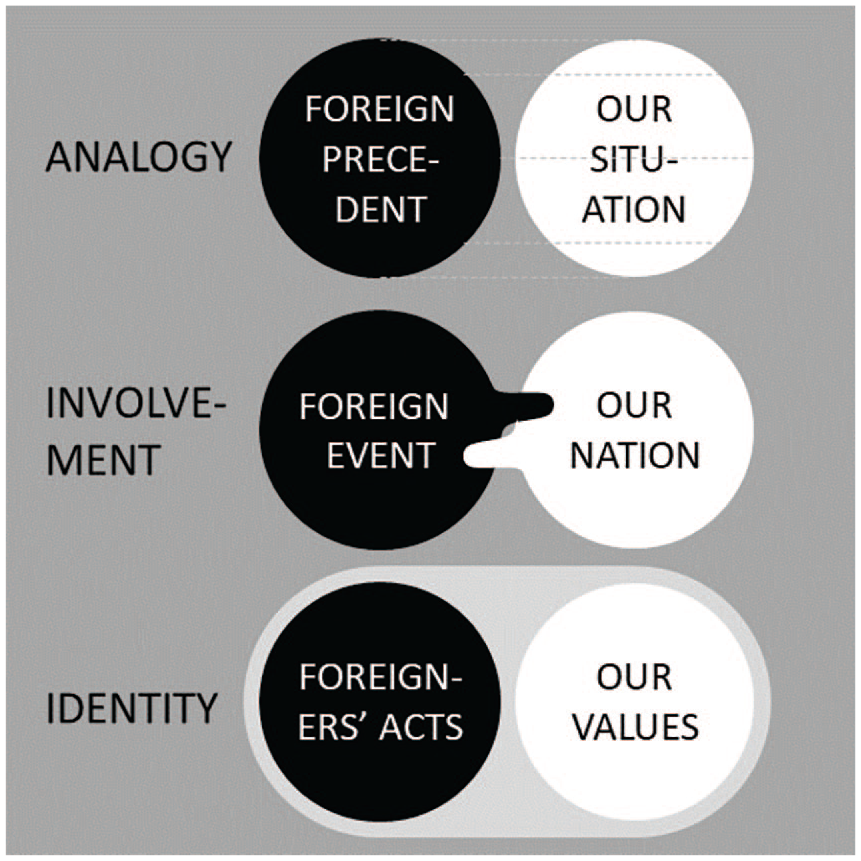
Three renderings of relevance.
Relevance by analogy
In the first variant, speakers used memories to construct the present situation as similar in important ways to past events so as to draw lessons from what was done and happened in the past. For this construction, it was not important if a memory was foreign, hybrid, or domestic—any memory could serve. The speakers used analogies both to argue that specific decisions were needed or must be avoided: by invoking a memory, they implicitly constructed some sense of a social “natural law” sustaining the expectation that what worked (or failed) in the past would work (or fail) again. Such constructions necessarily presumed it was understood what were successful or unsuccessful outcomes in history and thus invoked memories that almost exclusively carried strong and widely accepted valence. To establish such analogies, the speakers emphasized selected aspects of the memory that resembled aspects of the present as choices and critical junctures that defined the happy (or unhappy) past outcome. Consider, for instance, German Chancellor Merkel’s remarks from (in which she argued in favor of an international reconstruction effort in Afghanistan; 19 November 2007):
[former U.S. Secretary of State George C.] Marshall recognized that there was a need for a massive push in order to—and I quote from his speech—“achieve the return of normal, healthy economic relations in the world, without which political stability and an ascertained peace cannot exist.” [. . .] We in the Federal Government say: No reconstruction without security, no security without reconstruction. This is the concept of “networked security.” I think this concept should become the standard of our engagement in Afghanistan and also elsewhere.
Only infrequently did the speakers fully explicate the specific lessons drawn; rather, they built the analogies to speak for themselves. Constructed as analogies, MON served as evidence legitimizing claims about the likely outcomes of specific policy choices.
Relevance by involvement
In the second variant, MON were turned into hybrid memories by pointing out specific ways the speakers’ nations participated in the remembered events. Such constructions generally served to position their nations in a particular role that was informative about its nature and moral standing. Leaders presented how “we” (or specific actors among “us”) did good in the world (e.g. US troops liberating World War II Europe) or—less frequently—the ways “our” actions caused harm and suffering to others (e.g. German guilt for the Blitz). Again, there needed to be some consensus on what were positive or negative events, although speakers sometimes pointed out specific positive contributions in overall negative events, or vice versa. They referred to well-known involvements, present details that were not yet part of collective memory, or simply claimed a role without providing further elaboration—such as in former British Prime Minister David Cameron’s remark, “But we found a role, took on communism and helped bring down the Berlin Wall” (5 October 2011). Moreover, involvement could refer to both active roles, wherein domestic actors helped achieve certain outcomes elsewhere, and more passive ones, wherein their compatriots were affected by foreign events. For instance, former German Chancellor Helmut Kohl said (2 July 1991, underscoring the significance of the just concluded treaty of good neighborship with Poland),
It was Polish and also French patriots who stood by our side here in our homeland at the Hambach castle in 1832. It was the parliamentary assembly of Frankfurt’s St. Paul’s church of 1848 that declared the liberation of Poland to be a “Sacred duty of the German people.”
By presenting their own nation’s role in the context of clearly evaluated foreign events, speakers derived moral validation—either for their nation as a whole or the specific position advocated by the speaker. Kohl continued,
These experiences, the joint struggle of Poles and Germans for freedom, have been partly buried by the crimes of our century, but their memory must not be lost. We must restore them to life in the memory of the people.
In this way, MON enabled speakers to derive moral orientation that could inform present and future policy choices. Despite the constitutive role of foreign actors and events, the speakers drew moral lessons primarily from the typically self-elevating experiences and actions of their own nations: The memory primarily served to establish the speakers’ own nations’ enduring commitment to specific values, as well as the capacity and determination to act in accordance with them.
Relevance by shared identity
In the third variant, speakers rendered MON relevant to their domestic audience by constructing a fundamental similarity between their audiences and those involved in the remembered event. They thus constructed a wide collective encompassing both their own nation, wherein these others remain foreigners, and the foreign actors’ nation. By identifying certain actors involved in foreign events with values and ideas that already defined their own nations, the former were included in an extended “nation” of good people anywhere, who were committed to “our” shared values (former German Chancellor Conrad Adenauer; 2 February 1957):
The desire for freedom among the residents of the [Soviet] satellite states cannot be suppressed in the long run. This has been most strongly documented by the events in Hungary: A heroic people has fought against the suppression with unprecedented bravery. The torch of freedom, which Hungary has lit among the satellite states, will never go out again. [. . .] We have to support this development, but with wisdom, patience, and perseverance. [. . .] Law and justice, peace and freedom are the strongest forces in this world, and these forces are on the side of Germany and its friends.
Accordingly, foreign actors’ experiences and the memories thereof became appropriated into the realm of “domestic” memories in an extended sense. Speakers thus relayed moral insights drawn by foreign speakers from their nations’ memories as if they were spoken (also) to the domestic audience, as did former Israeli Prime Minister Ehud Olmert (appealing to Israel’s National Security College graduates’ sense of responsibility 29 July 2008):
Nelson Mandela, who is currently celebrating his 90th birthday, an image who is a great source of inspiration, once said that “our deepest fear is not that we are too weak. Our deepest fear is that we are powerful beyond measure.” Indeed, engaging in national security and studying its mysteries and insights largely relates to the delicate manner in which we should use our power and the means at our disposal.
Alternatively, speakers made the experiences remembered by other nations relatable to their domestic audiences, as did former US President Dwight D. Eisenhower (legitimizing US participation in the war in Korea as part of a global struggle for freedom; 20 January 1953):
The faith we hold belongs not to us alone but to the free of all the world. This common bond binds the grower of rice in Burma and the planter of wheat in Iowa, the shepherd in southern Italy and the mountaineer in the Andes. It confers a common dignity upon the French soldier who dies in Indo-China, the British soldier killed in Malaya, the American life given in Korea.
To render these memories and experiences relatable, speakers characterized relevant foreign actors or populations using value references commonly associated with the domestic collective (e.g. freedom-loving people, courageous leader, great thinker). In this way, MON served to establish and naturalize a moral order shared by the speakers’ respective nations and other well-meaning people in the world. Similar to the previous variant, such constructions typically served to validate and enhance positive self-perceptions and orient political choices; however, as the moral order appeared more or less universal, the focus was less on the specific commitment of the speakers’ respective nations and more on the natural choice of any decent people.
Discussion
In our above analysis, we addressed the transforming role of collective memories in an increasingly connective world, focusing on the importation of foreign collective memories into high-profile political speech. Across all four countries studied in this article and over a time range of up to seven decades, we identified a range of enduring patterns that accounted for the specific ways in which MON were presented and made relevant to a domestic audience. Chiefly, we distinguished between strategies employed to present foreign pasts to a domestic audience and the ways in which such memories were connected to present issues and agendas to render them relevant. We showed how various presentations of foreign events implied different degrees of freedom for the speakers in endowing these events with meaning, which in turn supported different kinds of policy-oriented or wider, identity-oriented lessons for the present.
While each of the described importation paths occurred in speeches from all four countries, the differences in their salience reflect well-known broad political commitments deeply embedded in each nations’ political culture. Over the course of seven decades, leaders’ preferences for diverse importation paths appear to be rather consistent within the same nation, with only minor variations attributable to political ideology, individual personalities, and tastes.
While all uses of MON are dominated by the strategic purposes and political cultural context of the importing nation, both the US and German paths of appropriation remain in an important sense invested in the imported memories. At the same time, both countries’ very different—interventionist versus multilateralist—approaches to global politics structure their perspective upon these memories, emphasizing US global involvement and Germany’s desire for amity, respectively. In this sense, German leaders’ ostensive identification with neighboring nations’ collective memories, which relies more heavily than other constructions of relevance on the first path of importation, can be understood against the background of Germany’s active efforts at reconciliation following the end of World War II. Such constructions convey not only a present commitment to European integration and a shared future but also an expression of empathy for the suffering of others and Germany’s acceptance of its historic responsibility. This use of identification as a path for rendering MON relevant was markedly different from its use in most American speeches, in which the inclusion of MON primarily served to underscore the universalism of American values, in particular, all peoples’ desire for freedom and democracy. Likewise, the American predilection for involvement-based constructions reflects the country’s self-recognition as a global power. In a similar vein, American uses of representation (the second path of importation) as a way to recall its foreign involvement are more likely to maintain an US-centered perspective upon the world, whereas German uses of the same path were more commonly paired with identity constructions of relevance.
What is less clear is what drives the similarities identified between the British and Israeli paths of importation, both of which lean heavily on direct memorialization (the third path) and the construction of lessons from others’ pasts by means of analogy. These uses largely sever the connection to pre-existing memories elsewhere, affording greater freedom for the reinterpretation of past events in light of these countries’ domestic mnemonic discourses. In the Israeli case, the motif of policy informed by learning from the past is closely connected to Israel’s own existence as a nation born from the aftermath of the Holocaust, as well as its deep-running narrative of collective victimization. At the same time, many British uses of the same pattern appear to reflect more the UK’s lingering self-perception as a power that remains mentally present in many regions around the globe.
Our analysis ties into a rapidly growing body of scholarship pertaining to what is called the third wave of memory studies (Feindt et al., 2014), which emphasizes the progressive erosion of boundaries and increasing fluidity of mnemonic practices. Over the past 70 years covered in our study, communication, cross-cultural interactions, and the exchange of cultural products and ideas accelerated on a global scale (Assmann and Conrad, 2010)—especially in the context of the 1990s “memory boom” following the end of the Cold War and the rise of global communication technologies beginning in the early 2000s. These transformations precipitated the increasing erosion of the confinement of collective memories to only domestic debates. Given the previously primarily nation-focused study of collective memories, these processes resulted in urgent calls for a new, transcultural perspective on memory (Erll, 2011a; Radstone, 2011). While most research focuses on the traveling of memory in media content and other cultural products, this, to our knowledge, is one of the first projects to focus specifically on the importation of collective memories into political speech. By highlighting the deliberate and strategic importation of foreign memories for the purpose of addressing domestic audiences, our article raises new concerns about the political implications and agency involved in the transnationalization of mnemonic practices.
In particular, our investigation challenges traditional conceptions regarding the boundaries of collective memories as well as their ownership by specific cultures or nations, but also their capacity to travel as relatively intact wholes. While Levy and Sznaider (2002) demonstrated how the Holocaust has gained an increasingly salient role as a cosmopolitan memory (see also Alexander, 2002, 2004), subsequent research has mandated some important modifications to their claims. Specifically, Olesen (2015) argued that global cultural forms and global political icons still “acquire meaning for audiences in multiple national contexts” (p. 39). Likewise, Alexander and Dromi (2012) claimed that the historical account of the Holocaust “rests on a self-justifying, narrowly particularistic, and deeply primordial reconstruction of the Holocaust trauma” (p. 17) and varies widely across contexts and uses. Our findings tie in with these observations, elucidating how the transposition of memory from one site to another is accompanied by a transformative process of particularization and adaptation.
Many of the uses of collective memories documented above do not fit neatly into existing frames of reference: Where do memories of past interactions and involvements belong, given that “we” remember the same events quite differently from those others who participated in them, and consign them with divergent implications? Can we speak of a “foreign” memory when domestic actors retell foreign past events without recourse to how they are remembered where they happened? How can we conceptualize the incongruities that arise between different versions of related memories, and how does this spark new debates about their acceptable forms and content? Even where actual mnemonic products are imported from abroad, the speakers’ strategic selection, presentation, and recontextualization still permits a considerable amount of domestication and repurposing of the imported memories. At the same time, none of these processes completely dissolves the boundaries between mnemonic spaces because the specific presentation and domestication of memories prevents them from morphing into truly transnational memories (Assmann, 2008). By marking the underlying ambiguity by referring to these phenomena with the polyvalent term “memories of other nations,” we proposed a viable strategy for distinguishing the ways in which memories cross national boundaries. Following Wagner-Pacifici (2017), our distinction between memorialized events and the meanings attributed to them highlights the important role of perspective on collective memories: while accounts of actors, sites, and nations involved in past events can travel without too much adaptation, the meanings and memories attached to these events generally require interpretation by the remembering agent.
In our investigation, multiple memory agents could be involved in a memorialization—a speaker may quote a foreign author who in turn draws upon foreign cultural memories, or a speaker may refer to the experiences of compatriots who were somehow involved in foreign events. Depending on the path followed to render the MON relevant, existing memories of collectives other than the speakers might inform or constrain the memory, while in other cases, the speaker might control the constructed meaning more or less at will. Speakers select memories to support their arguments, subordinating recounted past events and their interpretation to present agendas and purposes (Tenenboim-Weinblatt and Baden, 2016). While our focus on heads of state as agents of memory (Vinitzky-Seroussi, 2002) naturally emphasizes the strategic use of memories for political purposes (Hodgkin and Radstone, 2003), our findings suggest that speakers not only can, but generally need to actively shape their presentation of foreign memories and define the ways they are relevant to their present audience. MON do not “speak for themselves,” but instead depend on the speaker to explain how foreign pasts inform the present domestic debate. This process of domestication may involve the abstraction of general normative or functional principles that apply to both the memorialized and present situations, similar to the transformation of the Northern Irish memory of Bloody Sunday into a transnational symbol, as described by Rigney (2016). Alternatively, distant events may be rendered relatable through the foregrounding of specific (historical, ideological, etc.) connections between the present collective and the recounted memory (Schwartz, 1996, 2008; Schwartz and Schuman, 2005).
In our study, we find there are two broad purposes served by the importation of foreign memories. Presented as analogies resembling present challenges, MON can serve to legitimatize specific policy choices by suggesting certain social “natural laws” that justify the expectation that what succeeded or failed elsewhere in the past will succeed or fail again, here and now. In line with extant scholarship, MON appear little different from domestic memories in their capacity to serve as justifications for advocated policy positions (Liu and Hilton, 2005; Schuman and Rieger, 1992; Zelizer, 1995). In addition, the capacity of memory work to strengthen collective identity is amply documented in the literature on national (domestic) memories (Anderson, 1991; Assmann and Czaplicka, 1995; Gillis, 1994). As we showed, when MON are directly related to the speaker’s country—because of its involvement in the foreign events or identification with those involved—they can serve to construct and foreground enduring characteristics or values shared by the collective. They do so typically to elevate its moral position (Zerubavel, 1995). Other than domestic memories, however, which often serve to reaffirm the unity and uniqueness of the speaker’s country, MON enable the speaker to extend the collective toward all “decent people” who share its values: within this encompassing society of moral people, the speaker’s nation may still assume an exalted or leading role, while its values are naturalized.
On one hand, imported memories contribute to the ongoing redefinition of the boundaries delineating national collectives, cultures, and memories. By highlighting how events retrieved from foreign pasts can inform our understanding of ourselves, our choices, and present situation, MON contribute to the construction of a more permeable world that is interconnected both by its underlying rules and its normative ideas. On the other hand, however, the functions performed by the importation of memories closely follow those that are amply documented in the study of domestic, nationally confined memories. In this way, traveling memories may be part of a fundamental reconfiguration of the resources available to contemporary societies trying to make sense of their social world; however, in order to understand the impact these changes have on the evolution of collective memories, the critical question is how some memories and not others are selected as relevant and informative for public sense-making. The specific uses of those selected memories, by contrast, appear to remain relatively unaffected by the underlying transformations.
As in all research, our study is not free from limitations. With our focus on heads of state, we primarily relied on uses of memory that are both strategic and instrumental in supporting specific political agendas. Other routes of importation—such as those used by cultural industries or travelers—are expected to be less driven by the desire to justify specific choices, elevate collective identities, or support societal meaning-making in a much wider sense. Our reliance on Western nations, which tend to be aware of one another’s political discourses, limits the variability of imported MON. Likewise, this study may have omitted possible additional or different paths of importation that exist in other cultures. At the same time, the processes and uses we detected appeared with high regularity across all four cases, despite their considerable variation regarding mnemonic and political cultures. Based on our data, which was constrained by the availability of suitable archives and the diligence applied to the documentation of all relevant speeches, we cannot make claims about quantitative distributions or shifts over time. Only for the United States, where long-standing archiving routines ensure the exhaustive coverage of all relevant material, could we obtain a complete timeline of relevant speeches. Through our qualitative sampling process, which relied on the explicit marking of foreign references, we may have missed highly oblique uses of MON. That said, our analysis reached theoretical saturation in the sense that we were unable to identify counterexamples to those patterns laid out above.
Conclusion
This study aims to contribute to memory studies by proposing an empirically grounded theoretical framework capable of explaining how foreign memories can be imported and rendered meaningful for domestic audiences. Focusing on practices employed by heads of state importing foreign memories in their speeches, we examined the patterns that recur with high regularity across a wide range of speakers addressing four different nations over a long period of up to seven decades. Based on our analysis, we distinguished between two fundamental achievements constitutive to the importation of foreign memories, which must be both presented and rendered relevant to an unfamiliar audience. Both achievements hand considerable control to the speaker over the specific meaning gleaned from the imported memories, underlining the critical role that strategic memory agents perform in the ongoing transnationalization of collective memories. Our study shows that despite the dissolution of boundaries constraining the availability of memories for societal sense-making, the use of foreign memories remains firmly grounded in the domestic context, arbitrated by actors tied to the nation-state, addressing domestic debates, and supporting domestic agendas: “Foreign inspirations are used to strengthen national values” (Adams, 2020: 16).
In the ongoing reconfiguration of collective identities and political discourses that increasingly transgress national, cultural, and political boundaries, the importation of ideas from beyond the domestic debate does not necessarily broaden the diversity of available perspectives. Rather, there is a need to closely examine the specific transformations applied to foreign ideas in their process of domestication, and beyond this, their possible resonance and naturalization in local collective thought. In this endeavor, our study can be no more than a first step that points to the importance of processes that merit closer examination in the future.
Supplemental Material
sj-pdf-1-cos-10.1177_0020715220983391 – Supplemental material for The memories of others: How leaders import collective memories in political speech
Supplemental material, sj-pdf-1-cos-10.1177_0020715220983391 for The memories of others: How leaders import collective memories in political speech by Tracy Adams and Christian Baden in International Journal of Comparative Sociology
Footnotes
Funding
ORCID iD

Supplemental material
References
Supplementary Material
Please find the following supplemental material available below.
For Open Access articles published under a Creative Commons License, all supplemental material carries the same license as the article it is associated with.
For non-Open Access articles published, all supplemental material carries a non-exclusive license, and permission requests for re-use of supplemental material or any part of supplemental material shall be sent directly to the copyright owner as specified in the copyright notice associated with the article.
