







Abstract
Keywords
Introduction
This study focuses on the level of women’s representation by examining the potential link between descriptive and substantive representation. The former refers to those who are elected (e.g. women) to political assemblies such as parliaments (similarity between representatives and those who are represented); the latter refers to representatives who pay attention to group interests in their policymaking (similarity between representatives’ actions and the interests of the people they represent) (Childs and Krook, 2009; Franceschet et al., 2012; Lawless, 2004; Pitkin, 1967; Schwindt-Bayer and Mishler, 2005). More precisely, we will examine whether a higher level of political descriptive representation of women will improve women’s substantive representation in terms of policy spending in areas that are known to be prioritized by women. We contribute to a rapidly expanding field by drawing on high-quality data covering more than two decades and test various configurations of substantive representation in the subnational arena. We do so in three areas of policy (childcare, elderly care, and culture) where variations in policy spending have the potential to significantly influence people’s daily lives.
Focusing on this potential linkage builds on two intertwined arguments that are supported by empirical evidence. First, that women have different policy preferences to men; second, that women are more inclined to represent the preferences of female voters. If leveraged jointly, these arguments could explain female politicians’ pathways regarding policy spending. It is well known that female politicians prioritize different political issues from men (e.g. Lloren and Rosset, 2017) by taking a more liberal stance regarding the cultural dimension of politics and giving a higher priority to welfare issues (Funk and Gathmann, 2015). In general, women are more progressive. Moreover, some research indicates that women tend to possess a deeper understanding of their identities as women compared with their male counterparts, influenced not solely by partisan or ideological factors (Chattopadhyay and Duflo, 2004; Lawless, 2004). This finding is different from the previous understandings of politicians’ policy preferences, which have suggested that they tend to lean toward the preferences of the median voter (Downs, 1957). Instead, it has been made evident that female politicians on various political levels place an important value on representing the views and opinions of women in general (Gilljam et al., 2010; Karlsson and Gilljam, 2014), such as supporting policy proposals put forward by women or groups supporting issues specifically relating to women. Although it is true that it is not only women who can represent women’s interests, shared perspectives within a group do increase the likelihood that common interests can be articulated (Franceschet and Piscopo, 2008). Ultimately, and as Mansbridge (1999: 629) expresses it, “‘Being one of us’ is assumed to promote loyalty to ‘our’ interests.”
As women tend to prioritize issues that are closely connected to their identity as women, it is not far-fetched to theorize that a linkage between the descriptive representation of women and their influence in such areas can be expected. We therefore ask the following research question: Does the level of descriptive representation of women have consequences for policy spending in areas that are closely related to women’s interests?
Our contribution starts from the fact that no convincing answer to this question exists. Although we know that women are usually marginalized in political assemblies, it is not clear whether this affects spending in areas prioritized by women. Scholars in this field struggle to agree on what differences increased representation of women could be expected to make (Dahlerup, 2006), and it has been pointed out that there are contextual differences between high- and low-income countries (Hessami and Da Fonseca, 2020). In short, any solid evidence regarding whether descriptive representation can be linked to how the expected policy areas are prioritized is lacking (Bratton and Ray, 2002; Cabaleiro-Casal and Buch-Gómez, 2020; Geys and Sørensen, 2019; McBrayer and Williams, 2022), which is what motivates us to make a contribution to a still-evolving field.
Our empirical scene is the subnational level in Sweden. We argue that the country is a suitable case because we can see great variations on both sides of the equation:
(a) The representation of women in local councils;
(b) The scope of the policies that are delivered concerning childcare, elderly care, and cultural policy.
Starting with (a), the first side of the equation, we examine whether the level of female political representation has any linkages with policy spending in what has been one of the most gender-equal countries in the world for a long period of time, namely, Sweden, as reported by several worldwide gender equality indexes (the Gender Development Index, the Gender Inequality Index, and the Global Gender Gap Index), and by scholars (Inglehart and Norris, 2003: 33). When it comes to political representation, Sweden is also one of the most gender-equal countries in the world and has been that for a long period of time (e.g. Freidenvall, 2013; Norris and Inglehart, 2001). For example, since 1994 women’s representation in the Swedish national parliament has been more than 40 percent, which is unique in a global comparison (Inter-Parliamentary Union, 2023), and the average across local councils has also been above 40 percent since 1994. Accordingly, Sweden is a unique case concerning gender equality in general but also in terms of female political representation. However, surprisingly large variations exist behind these aggregated numbers, most prominently at the local level. Across local councils, these variations are extensive: the difference between top performers and those at the bottom has been quite stable for decades, at around 30 percent, and a substantial proportion of municipalities have a level of female representation that is below 30 percent.
The second side of the equation, (b), is operationalized by focusing on three policy areas that allow municipalities to have significant discretion and that are prioritized differently by men and women: childcare, elderly care, and cultural institutions and programs. Previous studies have emphasized a gender bias in these policy areas (Funk and Gathmann, 2015; Slegten and Heyndels, 2020), and in Sweden this bias is known to be more prominent subnationally than nationally (Karlsson and Gilljam, 2014). Local female politicians in Sweden prioritize childcare and elderly care more than male politicians do (Karlsson and Gilljam, 2014; Svaleryd, 2009) and they are more engaged in committees managing these issues as well as those dealing with questions concerning cultural policy (Karlsson, 2001). We theorize that budget prioritizations would reflect the preferences of politicians and the procedures followed in decision-making processes in assemblies (Jones et al., 2009), thereby expecting female councilors to have an impact on patterns of spending (Baskaran and Hessami, 2023; Bratton and Ray, 2002).
To specify this potential linkage further, we also pursue two additional configurations. First, we account for the relevance of a possible nonlinear relationship stemming from the imperative for a “critical mass” of female representation to translate into discernible effects (Dahlerup, 2006). Second, we examine whether female representation in leading political positions, rather than women only being in councilor positions, influences policy spending (Hinojosa and Kittilson, 2020).
We use data from a pooled sample of all of the 290 Swedish municipalities covering the years from 1994 to 2021. We make at least four contributions to the research field: we use multiple measures of (1) women’s political representation and (2) policy spending, and (3) test assumptions at the subnational level, where policy spending matters most, and (4) assess them over a longer period of time, stretching across almost three decades. In contrast to our expectations, the findings show that the descriptive representation of women has no influence on policy spending. Economic circumstances and the demographic composition of municipalities, however, do carry explanatory power and trump a gender effect. Although the descriptive representation of women in Sweden may not directly correlate with councils’ prioritization of expected policy areas, more subtle inquiries can offer insights into how women in leading positions and across different age groups can influence changes in policy spending.
Theoretical framework and literature review
Although modern democracies build on the idea of representation, representation is in itself a convoluted theoretical concept (Manin et al., 1999; Mansbridge, 1999, 2003, 2011; Phillips, 1995; Pitkin, 1967). It is multidimensional and comprises, potentially, four dimensions: formal representation, descriptive representation, substantive representation, and symbolic representation (Franceschet et al., 2012; Lawless, 2004; Pitkin, 1967; Schwindt-Bayer and Mishler, 2005). As previously stated, in this study we direct our attention toward descriptive and substantive representation and their potential intrinsic linkage.
Descriptive and substantive representation as crucial for democracy
Theoretical arguments and suggested mechanisms for how linkages between descriptive and substantive representation are important for liberal democracies are commonly presented through two different arguments. The first argument is that descriptive underrepresentation of certain groups risk weakening the legitimacy of a political regime. If elected bodies consist of a mix of individuals that adequately reflect who they represent, this will have a positive effect on the legitimacy of the political system (Lawless, 2004: 81; Mansbridge, 2015: 265). If political assemblies resemble the composition of the voters, a sense of fairness can more easily be rooted in the electorate. One of the challenges is knowing which traits of an individual’s characteristics should be given priority (Elsässer and Schäfer, 2022).
The second line of argument is that the inclusion of marginalized groups in elected bodies can be seen as an indicator of the strength of democracy (Reynolds, 2013: 259). Phillips (1995: 66–67) argues that when there is a one-sided representation, such as when elected bodies mostly consist of middle-aged men, certain interests can be forgotten or overridden. Arnesen and Peters (2018) have empirically verified this view and Sundström and Wängnerud (2017) have indicated that there is a relationship between local female representation and the quality of subnational institutions. Representation of marginalized groups also brings a different voice to the legislative process so that other questions can be put on the agenda (Childs and Krook, 2009: 134; Lawless, 2004: 81).
Women’s descriptive and substantive representation
Not only has it been argued that more women in politics will alter the character of the political game, imposing a kinder and gentler politics (Norris, 1996), but also that greater priority will be given to issues that women are more interested in. There are consistent findings on gender gaps in policy preferences and priorities (Hessami and Da Fonseca, 2020). Dahlerup (1988: 292) asked all women’s organizations in political parties in the Nordic countries whether they believed that having more women in politics would lead to different political issues being on the agenda. According to Dahlerup (1988: 292), most of the organizations answered that if there are more women in politics, “more emphasis will be put on family matters, environment, equality between the sexes, child policies, and sexual policy.” Studies on local politicians in both Norway and Sweden confirm that there are differences between how male and female representatives grade political areas; the latter prioritize culture, elderly care, and childcare more than male politicians do (Geys and Sørensen, 2019; Karlsson and Gilljam, 2014).
The recurring theme in current research is whether a linkage exists between descriptive representations of women and substantive ones and whether this affects relevant policy areas. Studies that draw on observational data or experimental settings have focused on this question but the answers they provide are ambiguous. Subnational contributions from various European contexts establish patterns between female representation in councils and prioritization of welfare and cultural policy (e.g. Bratton and Ray, 2002; Svaleryd, 2009), while US research struggles to find such a relation (Ferreira and Gyourko, 2014; McBrayer and Williams, 2022). Studies applying experimental methods verify the presence of causal connections for the same linkage, although the empirical scene is different (Beaman et al., 2007; Chattopadhyay and Duflo, 2004). And the findings are not consistent among the European studies that take such an approach (Baskaran and Hessami, 2023; Geys and Sørensen, 2019).
Ultimately, such a linkage could require that female politicians are willing to form alliances with other councilors outside their own party or coalition. Although some studies have shown that women politicians appear to be more loyal to the party line than men (Clayton and Zetterberg, 2021), this has not been found to be the case in all contexts (Shomer, 2016). This research exclusively covers national parliaments, but given that most local governments are characterized by more pragmatism and consensus than are found nationally (Oliver et al., 2012), such results must mean that it is possible that similar alliances can occur in municipalities.
Policy spending as a conceptualization of substantive representation
Although the understanding of descriptive representation is made complicated by the large number of potential characteristics that need to be considered, substantive representation is theoretically even more convoluted. When scholars have conceptualized the substantive representation of women and other marginalized groups, they have used a wide range of approaches and indicators, such as studying bill sponsorship, minority-supported legislation, and membership of relevant committees, and analyzing parliamentary speeches (see Kroeber, 2018). However, the potential consequences of substantive representation can also be pinpointed using policy outcomes that likely are in the interest of women, such as spending on education, health, and welfare (e.g. Clayton et al., 2019; Clayton and Zetterberg, 2018; Miller, 2008; Schwindt-Bayer and Mishler, 2005; Wang, 2023). For example, Clayton and Zetterberg (2018) use data on spending on health, education, and the military when they examine the effects of gender quotas. Theoretically, we perceive spending as a valid measurement of substantive representation because budget prioritizations are embedded in the preferences of incumbent politicians and in the processes of decision-making in political assemblies (Jones et al., 2009). Thus we follow the same approach as the one applied by, for example, Clayton and Zetterberg (2018).
Next, we proceed with our argumentation and consider three policy areas that we expect to be of quintessential importance for women compared with other political groups: childcare, elderly care, and culture.
Female representation and childcare
Childcare is perhaps the most discussed policy area that has been associated with female politicians’ interests (Phillips, 1995: 69). As women still bear the greatest responsibility for families and homes, this is not unexpected. Childcare that functions well enables women to pursue their professional ambitions more easily. Hence, it could be expected that female politicians are more likely to deliver on this issue. Representatives on boards handling such issues are younger and are more likely to be female than typical representatives on other boards. It is also known that female local politicians see childcare as being more important than their male counterparts (Gilljam et al., 2010; Karlsson and Gilljam, 2014). Whether descriptive representation of women also influences the output of this policy area has been the focus of several studies. In a famous contribution, Bratton and Ray (2002) show that there is a linkage between female representation in Norwegian municipal councils and the provision of childcare measured as childcare coverage. Others provide similar evidence from completely different contexts such as in India, exposing how women’s political empowerment increases public goods and increases preschool attendance (Beaman et al., 2007). One key finding, though, is that this relationship is nonlinear, interpreted as a need for a “critical mass” that will be necessary to ensure policy change. Schwindt-Bayer and Mishler (2005) and De Siano and Chiariello (2022) establish similar patterns, although the empirical scene is the national level, and Svaleryd (2009) notes similar patterns across Swedish municipalities. However, it should be emphasized that the findings are not consistent. Although Geys and Sørensen (2019) show that female local councilors in Norway prioritize spending on childcare compared with their male counterparts, the imposition of gender quotas and the increased representation of women have not translated into higher spending on childcare.
Nonetheless, recent contributions have strived to clarify the mechanisms that could lead to increased spending on childcare when there are more female politicians present. Baskaran and Hessami (2023) coded council meetings in Bavarian local governments, which revealed that one additional woman being elected increases the likelihood of any female councilor speaking during meetings by 11 percentage units. Unraveling details of political processes provides information not only about how an increase in female descriptive representation influences the political discourse but also about how it is linked to the results of policymaking. Baskaran and Hessami (2023) show that having more female councilors, up to a certain limit, is linked to the expansion rate of childcare.
Female representation and elderly care
The importance of descriptive representation of women for elderly care fits well into the narrative of female councilors being more strongly geared toward softer and more caring policy areas, which has been shown in several studies (Geys and Sørensen, 2019; Slegten and Heyndels, 2020; Svaleryd, 2009). Such tendencies are also manifested from another perspective, such as where there is a higher proportion of female councilors than male ones on boards that are responsible for elderly care, and the former also describe this area as one of their top priorities (Gilljam et al., 2010; Karlsson and Gilljam, 2014).
Empirical studies examining a linkage between the descriptive representation of women and the prioritization of elderly care are ambiguous, though. De Siano and Chiariello (2022) verify such a pattern in their inquiry into European countries’ welfare policies, and although their examination is performed on the national level, there are no reasons to believe that the results cannot travel vertically. However, validating these types of findings in subnational contexts has not been possible, thus leaving such assumptions in a state of uncertainty. Focusing on the distribution of public spending across a number of policy areas, Svaleryd (2009) does not find any support for such an effect. Geys and Sørensen (2019) reach similar conclusions in their study of the consequences of gender quotas.
Female representation and culture
There are arguments that explain why a linkage between female politicians and a prioritization of culture (such as spending on public libraries, music and art schools, and support to study associations) could be expected. It is known that in the local arena, women are more inclined than men to be a representative on committees that handle cultural policy (Karlsson, 2001). It appears that this leads to actual consequences. Findings relating to Norwegian municipalities show that female politicians are much more prone to increase spending in this area than men are (Geys and Sørensen, 2019). Although mechanisms linking the descriptive representation of women to the output of policy are seldom discussed in the literature, there is one aspect that is clear. In general, women engage with publicly accessible cultural institutions and activities more than men do (Eurostat, 2019). However, gender differences are much more pronounced regarding the locally financed cultural institutions. In Sweden, women are much more inclined to visit public libraries than men are (Söderholm et al., 2022), and a higher proportion of girls than boys attend music and art schools (Kulturrådet, 2019). It is assumed that this evident gender pattern in which women both participate in and prioritize cultural activities translates into female politicians aiming for a more ambitious policy spending on cultural institutions and programs.
Empirical evidence from central Europe verifies such assumptions. Funk and Gathmann (2015) expand on this from their studies of women’s voting in Switzerland, disclosing that female voters favored areas such as spending more on culture. Such tendencies are consistent even when controlling closely for party differences. Slegten and Heyndels (2020: 785) examined expenditure preferences among Flemish local politicians and found that female politicians were 5 percent more likely than men from the same party to argue that more should be spent on culture.
Complementary types of representation
Although a relationship between a higher level of descriptive representation of women in legislative assemblies and increased effort being put into the three discussed policy areas could be expected, there are two complementary configurations of representation that might influence such patterns, namely, a critical mass of women’s representation and the level of women in chairperson positions.
Although it is evident that female politicians, in general, prioritize different issues from men, having more female members in an assembly will not automatically lead to a change in what is delivered by such political systems. Ideas about how reaching a critical mass will facilitate the influence on marginalized groups have been discussed for a long time (e.g. Kanter, 1977). Dahlerup (1988) has paved the way for decisive studies in political science, not only by showing that female politicians in the Nordic countries expect changes to be made regarding issues on the agenda when they have stronger representation but also by illustrating that it is deemed crucial to have a certain number of women involved for real changes to be implemented. Although this ultimately leads to policy changes that are more aligned with women’s preferences, another effect is the alteration of the social climate of political life and the political discourse, which makes female politicians more effective (Dahlerup, 2006). It has been noted in several empirical studies that this is not only a theoretical conception and that reaching certain thresholds of female representation is prone to affect the influence that female councilors have on the output of policy (Baskaran and Hessami, 2023; Bratton and Ray, 2002; Homola, 2022).
It is also expected that when women hold leading roles in councils, this improves their opportunities to influence policy. Theoretically, this assumption increases expectations of these roles, because the mere presence of female representation is not perceived to be enough; it is their actual function or visibility that is the most important aspect (Hinojosa and Kittilson, 2020). We can expect two versions of this mechanism. First, gaining increased formal power as chairperson or vice-chairperson in a committee could, all things being equal, be expected to create leverage that could be used to influence policy output. Since women tend to have different preferences from men, leaning more toward welfare issues, it is not surprising that female political leadership has also been linked to better resource provisions for welfare commitments (Cabaleiro-Casal and Buch-Gómez, 2020; Priyanka, 2022). However, empirical results are not consistent (Ferreira and Gyourko, 2014) and are also geographically limited. The second mechanism occurs via a more secondary causal chain. There are some assumptions about how incumbent female political leaders can inspire other women to get engaged in politics and this could foster an upward spiral that in the long run could strengthen female representation (Campbell and Wolbrecht, 2006). Empirical results concerning this matter have varied in different contexts (Bhalotra et al., 2013; Broockman, 2014).
Hypotheses
Drawing on the literature discussed previously, we expect that the descriptive representation of women will influence policy output and spending. Hence, we formulate the following hypothesis as our baseline scenario:
H1:
Although we formulate this as our principal assumption, we are aware that there are ambiguous findings to it and, further, that there are theoretical and empirical findings that pose nuances to it. Additional conditions appear to have a positive influence on the establishment of the linkage presented in H1. We expect that reaching a certain threshold of descriptive representation of women will be crucial for forming the critical mass that is required to be able to influence policy (Dahlerup, 1988). Thus, we assume the following hypothesis:
H2:
However, it is not necessarily the level of the descriptive representation that is relevant but the character of it. Studies have shown how female politicians in leading roles can be directly (McBrayer and Williams, 2022; Priyanka, 2022) or indirectly linked to prioritized policies (Bhalotra et al., 2013). Based on this, we hypothesis as follows:
H3:
The Swedish political system of local government and three areas of policy
Before we move on to the method and data section we discuss and clarify the local Swedish political system and the three areas of policy that are included in the study. Sweden is often characterized as a decentralized unitary state with a somewhat contradictory setting where strong elements of centralization are combined with local governments having far-reaching autonomy and crucial welfare commitments. In accordance with how the Nordic welfare model has been depicted (Esping-Andersen, 1990), the provision of welfare services in Sweden has emphasized uniformity and equality that, at least traditionally, have been handled by public actors. Among them, the municipalities have a key role as being responsible for important areas, such as education (up to upper secondary education), social services, and care for people who are elderly and/or disabled. The provision of these services constitutes the main mandatory task of municipalities. They also have general competence to pursue policies in other areas they are interested in, as long as they do not intrude on the responsibilities of other public actors (Lidström, 2011). The different revenues in municipal budgets vary but generally consist of three parts. For almost all municipalities, the main income is the revenue from municipal taxes, and the rest consists of specified government grants. The government directs considerable proportions of its support to municipalities through the municipal system of redistribution. The redistribution of assets is built on a Robin Hood-based principle and contains, in addition to models of government funding, some elements of the redistribution of wealth generated in local governments. Municipalities can charge fees for some of their welfare services (Högström and Lidén 2023).
Although welfare services must follow national regulation, their provision is ultimately in the hands of the political will of the local rule. Every fourth year, the municipal council (
Electoral system and parties’ nomination of candidates
Sweden uses a proportional electoral system (List PR): the adjusted odd-number method (the Sainte-Laguë method with an adjustment of the first divisor (1.2 instead of 1)). General elections, held on the second Sunday in September every 4 years, consist of elections to the national parliament and to the municipal and regional assemblies. At the local level, the new municipal council takes office on 15 October after the election in September. Each party has a list of candidates and voters choose between parties and the parties’ candidates (but voting for a party candidate is voluntary). Several political parties in Sweden have adopted voluntary party quotas by using alternated lists. For example, in 1993, the largest party in Sweden, the Social Democratic Party, introduced “Every second for the ladies” (
The governance of childcare, elderly care, and culture in Swedish municipalities
In this study, the focus on childcare concerns preschools, that is, the care available for children between the ages of 1 and 5 that aims to stimulate development and learning and offer children a safe environment. All children residing in Sweden are offered childcare, which is organized at the municipal level. In 2022, 86 percent of all children in this age group attended childcare. Parents pay a subsidized fee and grants are paid to the municipalities (Skolverket, 2023). Although national regulations provide the objectives of the preschool system in Sweden, it is highly decentralized and gives local decision-makers significant discretion (Garvis and Lunneblad, 2018). The ratio of children to teachers varies across municipalities and variations also exist regarding whether the municipality offers childcare during times other than the standard working hours.
Municipal elderly care comprises several forms of support: domestic care, companion care, support for relatives, daycare activities, and homes for the elderly, and on average use one-fifth of municipalities’ budgets. The dominant strategy of this policy area has been to promote home care as far as possible, though the implementation of this objective varies across municipalities (Persson and Olofsson, 2022). Some municipalities allow private companies to supply domestic care or homes for the elderly, for example. And some scholars have pointed out that it is local politicians that decide on the allocation of funding and local officials assess the needs of the individual. This has created a system that is known for its broad variations in terms of the understanding, organization, and availability of elderly care (Nyhlen and Giritli-Nygren, 2016).
Spending on cultural institutions and programs make up a minor part of municipalities’ general commitments but still represents a substantial share of public expenditure on culture. In general, it encompasses three major activities of public spendings: on public libraries, on music and art schools, and on support to study associations. Provision of public libraries in all municipalities is required by national law. However, the evident trend is that the number of public libraries is diminishing. Libraries are mostly funded by municipal budgets, but a smaller share of the financing is made up of government grants. Funding given to public libraries has diminished as a proportion of the total municipal budget over recent years, but municipal variations are vast (Svensk biblioteksförening, 2021). Providing music and art schools is a voluntary municipal commitment, but almost all municipalities offer them. Recently, the way in which municipal costs are distributed has been quite constant, although there are noteworthy differences in the extent and scope of this activity across municipalities (Kulturrådet, 2019). Beyond these three activities, which in themselves are prioritized differently, other costs within the cultural sphere that are initiated by the municipality constitute a fourth aspect. This can encompass spending on various cultural institutions (e.g. museums, concert halls, art galleries), or more temporary support on cultural programs and activities (e.g. festivals or events). This area of policy includes regulated welfare provisions that municipalities must provide for their citizens but other aspects that are voluntary. It therefore permits local politicians to design the scope and content of welfare output to a large degree.
Method and data
We argue that it is important to test theories in environments where the structural and cultural context is similar, such as at the subnational level in a single country (for similar views see e.g. Dahl and Tufte, 1973; King et al., 1994; Przeworski and Teune, 1970). The advantage of doing so is that the units are institutionally, historically, and culturally similar, which means that we can hold these potentially decisive factors constant. Our research strategy is to compare politics in all municipalities in Sweden. Initially, we use the Hausman test to determine whether to use the fixed or random effect model. The chi-square test was statistically significant at
Dependent variables
We include three dependent variables that directly measure policy outputs in the municipalities. All account for the population size to create comparability. The first dependent variable quantifies the spending on culture and is operationalized as the cost of cultural activities on a yearly basis measured in Swedish kronor (SEK) per inhabitant. The second dependent variable is related to the spending on childcare and is operationalized as the cost of preschool per enrolled child measured in thousands of SEK. The third dependent variable measures the spending on elderly care and is operationalized through the cost of elderly care per inhabitant measured in thousands of SEK. We measure our dependent variables at the fourth year of each term, which means that the elected bodies have served a full term and have had 4 years to influence and change policy outputs. For example, for the term 2014–2018 that starts on 15 October 2014 and ends on 14 October 2018, the dependent variables are measured in 2018. 1
Independent variables
In this study the independent variable of interest is descriptive representation of women, and it is operationalized through three different measures, in line with our hypotheses.
The first and main independent variable consists of the percentage of women’s representation in the municipality councils in Sweden. The second measure is related to the critical mass theory, and we examine whether there is a linkage with policy when women reach a certain level of representation, a critical mass (see Childs and Krook, 2009; Dahlerup, 2006). The level of female representation in the municipality councils is reasonably high over the whole period, though some councils’ female representation is lower than 30 percent (see Figure 1). Accordingly, the norm is that women hold more than 30 percent of the seats in the councils, and therefore we suggest that there is a need for a higher level of female representation before the critical mass of women is reached that may have a specific influence on policy. Thus, we derive 40 percent of female representation as a threshold for reaching this critical mass. The variable is operationalized using a dummy variable; the municipality councils that have female representation of 40 percent or more are coded as 1, and the municipality councils that have female representation of lower than 40 percent are coded as 0. The third and final measure is the proportion of women that have chairperson positions in the municipality (includes the municipal executive board and board committees organized directly under the executive board). The independent variables are measured at the beginning of each term. For example, this means that the assemblies that were elected during the election in autumn 2014 and started their term on 15 October are used as the measure for the term 2014–2018. We expect that all three independent variables will have a positive effect on the dependent variables.
Control variables
In addition to the independent variables discussed above, we add a battery of control variables that might confound the relationship between descriptive and substantive representation. We present them in four blocks.
The first two controls concern the characteristics of local councilors and emphasize their age. In line with what recent research has revealed, we expect that there is a tendency that politicians from the same age groups share experiences that can influence their priorities regardless of which party they represent (Baskaran et al., 2022; McClean, 2021). Older councilors can be expected to be more likely to give additional resources to elderly care, while a corresponding mechanism could be inferred in relation to younger councilors, who are more likely to have young children and therefore more likely to prioritize childcare. The first control variable is the share of the representatives that are 29 years old or younger, and the second variable is the share of the representatives that are 65 years old or older. We expect that a higher share of representatives that are 65 years old or older has a positive effect on cultural policy and on elderly care, and we expect that a higher share of representatives that are 29 years old or younger will have a positive effect on childcare.
As a third control we include the ruling government in the municipalities. Ruling governments are operationalized using three dummy variables: right-wing governments, left-wing governments, and mixed governments, and right-wing governments are used as the reference category. In line with classic ideas about how parties located on the left side of the political spectrum strive for a more extensive welfare sector (Lipset, 1960), we expect that left-wing governments and mixed governments have more far-reaching ambitions when it comes to local welfare policy and cultural policy than right-wing governments do.
The fourth control variable is a demographic variable; it measures population density and is operationalized as the number of people per square kilometer of the municipality. We expect that a higher population concentration will affect the dependent variables negatively. The variable has a highly skewed distribution, so we transformed it to a logarithmic scale. Despite the redistribution system, the demographic composition is known for influencing costs related to welfare provisions (Dagens Samhälle, 2022). In the models where the elderly care policy is used as the dependent variable, we also include a control for the level of the population that is 65 years old or older. It is expected that a higher level of the population that is 65 years old or older increases demand for elderly care. In the models where the childcare policy is included as the dependent variable, we correspondingly include a control for the level of the population that is in the age group of 1–5 years.
Finally, we also include a set of economic controls: first, a variable that measures the average income in the municipalities. We derive from the scenario that if the inhabitants in a municipality have a higher-than-average income, the municipality has a higher-than-average taxable income per capita and therefore has more resources to spend on policies concerning areas such as culture, childcare, and elderly care. Thus it is expected that a higher average income will affect the dependent variables positively. The variable is operationalized as the average yearly income per inhabitant (for the age range 20–64 years) in each municipality, measured in thousands of SEK. Finally, we think it is relevant to include a control variable that measures the current internal economic conditions of the municipalities. Therefore we include the financial solvency ratio as a control, and this variable indicates the extent to which municipal assets are financed by the municipality’s own capital and is displayed in percentages. As a higher proportion indicates a better economic situation for the municipality, we expect that the variable will have a positive effect on the dependent variables.
Analyses and results
Descriptive statistics
We start this section with a description of the main independent variable, women’s representation in municipality councils. As mentioned before, the term of office for the municipality councils is 4 years, and we measure women’s representation in percentages for the first year of each term in office. The box-and-whisker plot in Figure 1 shows the distribution of women’s representation in municipality councils during the terms in office from 1994 to 1998 up to and including 2018–2022. The figure shows that the mean of female representation (1994–2018) is above 40 percent in all terms in office. In 2 percent of the councils, female representation was below 30 percent. This indicates that women’s representation in the municipality councils was high for the whole period that is being examined, even if great variations exist. The tendency is positive as female representation increased marginally by 2.1 percentage units from 1994 to 2018. Although the mean is high, there is a substantial variation in the level of female representation as it varies between 20.0 percent and 58.8 percent. This variation has not diminished over the time period; in 2018, for example, women’s representation varied between 25.5 percent and 58.8 percent.

Women’s representation in municipality councils.
We continue with descriptions of the three dependent variables. The box-and-whisker plots in Figure 2 show the distribution of the three dependent variables across Swedish municipalities.

Distribution of the three dependent variables policy spending on culture (top-left), policy spending on childcare (top-right), and policy spending on elderly care (bottom).
To make comparisons over time easier in the plots, we recalculate the values, taking inflation into account, which we value using the monetary value for 2021. 2
Starting with a presentation of the costs of the Swedish municipalities devoted to culture, it amounts to 1244 SEK on average per inhabitant. Even when we recalculate the costs to take inflation into account, the variation is substantial, as has been reported elsewhere (Svensk biblioteksförening, 2021), and the costs vary between 519 SEK and 4690 SEK, a range of 4171 SEK. The mean cost increased by approximately 350 SEK from the 1994–1998 term in office to the 2014–2018 term, and has only diminished marginally since then.
Next, we turn to the descriptions of costs for childcare, drawing on the measurement of the annual cost of preschool per enrolled child measured in thousands of SEK. Again, noteworthy variations are captured as the minimum cost was 84,000 SEK and the maximum amounted to 220,000 SEK. The mean for different terms in office has the same pattern as the cultural variable. Accordingly, the mean increased quite considerably until 2014–2018, but decreased thereafter. The mean cost for childcare increased by around 40,000 SEK over the period.
Finally, we explore the descriptions of the cost of elderly care (measured in thousands of SEK per inhabitant). The mean for the variable is 14.86 and the range is close to 32,000 SEK. As the boxplot in Figure 2 shows, the mean in the first term in office (1998–2002) is around 12,800 SEK and increases by around 3800 SEK until the final term in office (2018–2022).
Multivariate analyses
We will now examine the potential link between descriptive (similarity between representatives and those who are represented) and substantive representation (similarity between representatives’ actions and the interests of the people they represent), with a focus on women’s representation. We use a consequent strategy when examining whether the three independent variables have any linkages with the three dependent variables. Hence, we start each inquiry with a model that includes one of the independent variables and the following controls: the share of the representatives that are 65 years old or older (alternatively 29 years old or younger), the dummies for the ruling governments, and the demographic control population density. In the models where elderly care policy is used as the dependent variable, we also account for the level of the population that is 65 years old or older, and in models where the childcare policy is applied as the dependent variable, we include the control for the level of the population that are in the age group of 1–5 years. In a second model we add the economic controls average income and financial solvency. We examine our second hypothesis, which concerns the importance of a threshold of female representation, by applying the same alternations of the set of control variables. Finally, we inquire our final hypothesis, which is about the importance of a female chairperson.
Explaining variations in policy spending on culture
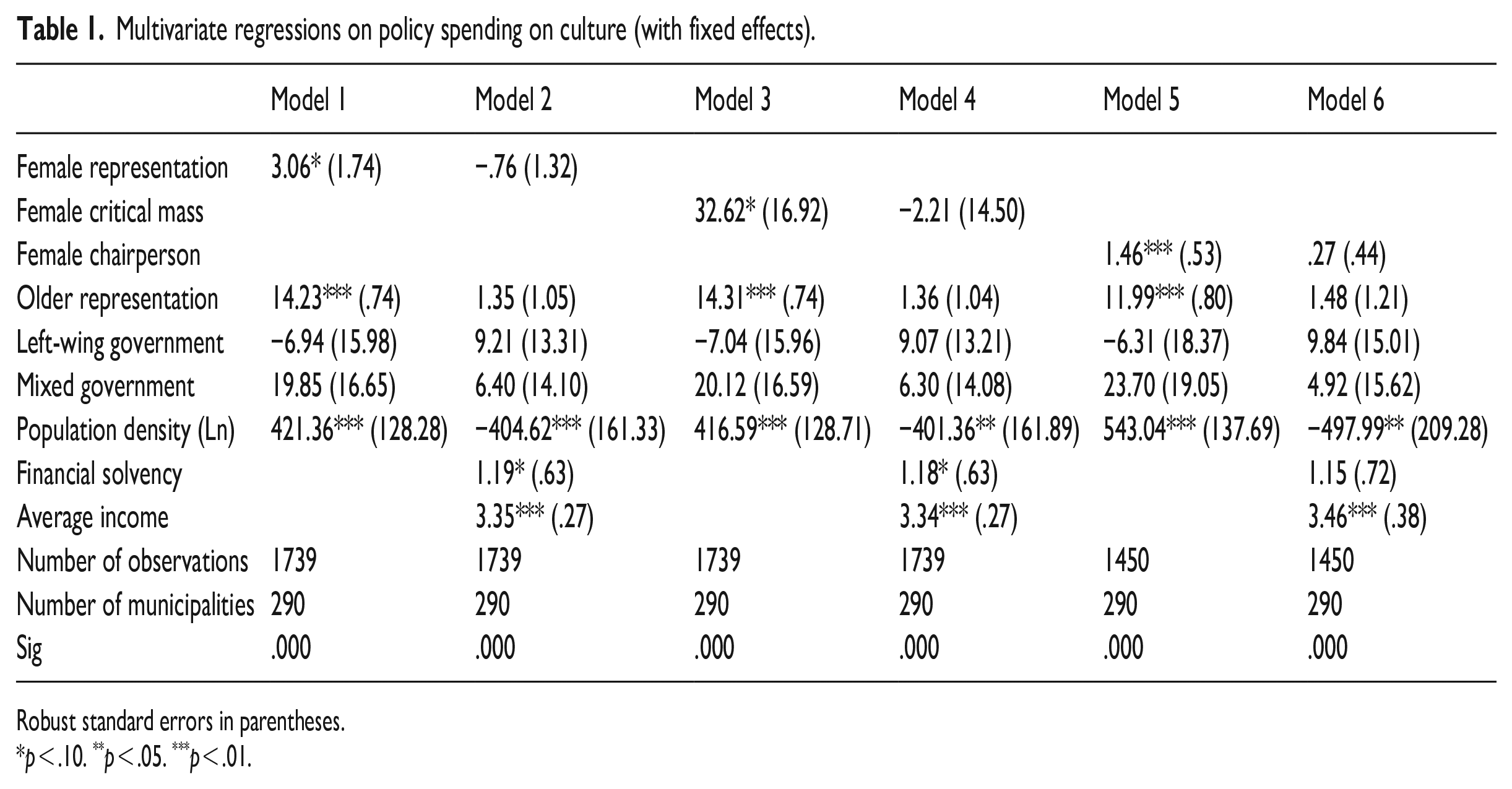
We start the multivariate analyses to examine whether women’s representation has any effect on spending on cultural policy. As shown in Model 1 in Table 1, the coefficient for the independent variable women’s representation in the municipality councils is positive and statistically significant. The result provides some initial support for our expectation that a higher level of female representation in the municipality councils results in prioritizations of cultural policy. However, when the economic controls are added, the effect of the predictor vanishes (Model 2).
Multivariate regressions on policy spending on culture (with fixed effects).
Robust standard errors in parentheses.
Next, we examine whether a critical mass (40%) of female representation in the municipality councils can be linked to prioritizations of cultural policy. The results show the same pattern as in the first two models. The critical mass variable is statistically significant and positive in the first model (Model 3) but has no importance when we add economic controls (Model 4). In Models 5 and 6, we examine whether more descriptive representation of women in leading roles leads to an increase in the prioritization of the policy area cultural policy. Again, the same pattern is repeated and the representation variable is statistically significant in the first model (Model 5), but when the economic controls are added it turns out to be statistically insignificant (Model 6). The results for the controls indicate that the economic variables, especially the predictor of average income, are of great importance for explaining the variation in cultural policy and, as expected, a higher level of financial solvency and a higher average income yield a positive effect.
Explaining variations in policy spending on childcare
Proceeding to the next policy area, in Models 7 and 8 we include the variable women’s representation in the municipality councils as the independent variable and childcare spending as the dependent variable; see Table 2. Where the first set of controls is included, the coefficient for the representation variable women’s representation in the municipality councils is statistically significant with the predicted positive sign. However, in Model 8, where the economic variables are added, the coefficient for the representation variable turns out to be insignificant.
Multivariate regressions on policy spending on childcare (with fixed effects).

Robust standard errors in parentheses.
In the subsequent estimations (Models 9 and 10), we include the critical mass variable as the representation variable and then examine the effect of representation of women in leading roles (Models 11 and 12). These results echo prior ones, meaning that the effect of the predictors of interest vanishes when economic controls are added. However, these results contrast with what has previously been found in the Swedish context. Svaleryd (2009) established this very linkage in relation to local spending on childcare during an earlier time period (1976–1999).
Explaining variations in policy spending on elderly care
Finally, we examine whether a larger representation of women has a positive effect on prioritizations of elderly care; see Table 3. In Model 13 the representation variable achieves statistical significance and, as expected, the coefficient is positive. However, in Model 14, where the economic controls are added, the representation variable has no effect. We also run models with the critical mass variable (Models 15 and 16) and the variable women in leading roles (Models 17 and 18) included as independent variables, and again the results are consistent with previous estimations. Accordingly, these predictors are statistically significant in the models where the first set of controls is included, but when the two economic variables are included, the coefficients for the representation variables lose their influence.
Multivariate regressions on policy spending on elderly care (with fixed effects).

Robust standard errors in parentheses.
Summary of the results
The results are consistent regardless of the policy area being investigated and the hypothesis being examined. We struggle to establish any influence of the independent variables when the set of control variables is added. In particular, the economic control average income in municipalities appears to be a crucial variable for explaining the variation in the three policy variables. Omitting that predictor produces results in which the three representation variables are statistically significant and positive, which indicates that it is mainly the inclusion of the average income variable which causes the representation variables to be statistically insignificant.
We can comment briefly on the results for the other controls. Population density is statistically significant in 17 of the 18 models. The direction of the coefficient changes, from a positive coefficient in the models where the first set of controls is included to a negative coefficient in the models where the economic controls are added. In the reestimated models (see the Online Appendix) the coefficient for the population density variable is also negative, and on the basis of all the results, we conclude that a higher population density is expected to have a negative effect on the three policy areas. Controlling for the age structure of the councilors also yields important results. An older representation has a positive and statistically significant effect in 9 of 12 models. Likewise, younger representation is statistically significant with positive coefficients in 3 of 6 models. That the age of the representatives has an impact on policy is an interesting result, and we suggest that upcoming research should explore this topic further. Regarding the dummies for the ruling government, the results show that left-wing governments affect elderly care policy and to some extent childcare policy negatively compared with right-wing governments, which is contrary to our expectations. Finally, as expected, a higher share of the population that is 65 years old or older affects elderly care policy positively, and a higher share of the population that is aged 1–5 affects childcare policy positively.
We conclude that our three hypotheses are rejected. The results imply that better economic conditions in the municipalities are of greater importance regarding the prioritization of the policy areas of culture, childcare, and elderly care than higher levels of female representation.
Robustness controls
To control the robustness of the results, we performed several robustness tests, and we present them in three sections.
Robustness tests mainly related to the estimation of the models and the dependent variables
To start with, we think it is relevant to test alternative operationalizations of the three dependent variables. We apply library costs per inhabitant measured in SEK as an alternative measure of cultural policy. As an alternative operationalization of childcare policy we use the cost of preschool, leisure centers, and educational care per enrolled child measured in thousands of SEK. For the dependent variable elderly care, we apply the alternative operationalization cost of elderly care for each inhabitant who is 80 years old or older, measured in thousands of SEK. We include these three measures as dependent variables in the models instead of the original dependent variables, and the results from the alternative models were similar to the results from the models with the original dependent variables.
We also recalculate the values for the dependent variables and the independent variable average income, taking inflation into account (which we value using the monetary value for 2021), and reestimate all models with the recalculated variables included. Again, the main results did not change compared with the results from the original models. Next, we apply the change in the dependent variables between elections as another alternative operationalization of the dependent variables (e.g. the difference between the spending on elderly care in thousands of SEK in 2002 and 1998). However, using these alternative measures of the dependent variables did not alter the results.
One solution to tackling problems arising from possible endogeneity is to use an instrumental variable. De Siano and Chiariello (2022) argue that female enrolment in secondary schools is a suitable instrumental variable for women’s political representation. It is linked to female representation but not directly to public spending. Therefore, we include a similar instrumental variable in the models to the one suggested by De Siano and Chiariello (2022), namely, the percentage of the female population that has completed postsecondary education (for a minimum of 3 years). We ran the models again using two-stage least squares (2SLS) regression analysis. When we included the instrumental variable, our main results did not alter. We also include a lagged dependent variable in our models as a way to address endogeneity bias relating to reversed causality, but this did not alter our main findings either. As mentioned previously, all models have also been reestimated with fixed effects excluded (ordinary least squares (OLS) with panel-corrected standard errors), and in these models the representation variables are statistically significant in further models compared with the models in which fixed effects are included. However, the effect of the representation variables turns out to be statistically insignificant when a lagged dependent variable is added to each of the models (see Online Appendix). We also reestimated all models with random effects (instead of fixed effects) and the independent variable female chairperson is statistically significant in two further models (Models 12 and 18) compared with the models in which fixed effects are included. However, the results for the other two independent variables did not change in any model, and thus we conclude that the random effects models did not alter our main findings either.
We also think it is relevant to examine whether the results are similar over the whole time period, and therefore as a robustness test we divided the sample into two subsamples (early time period and later time period). We ran all the models again (with each sample), and with one exception the results show that the effects of the independent variables are similar in the two time periods. The one exception is that in the later period (2010 onwards) the proportion of women that have chairperson positions in the municipalities has a positive effect on the second dependent variable, spending on childcare.
Robustness tests mainly related to the independent variables
We also apply alternative thresholds of female representation (both lower and higher than 40%) and include them (one by one) as independent variables in the multivariate models. However, none of the alternative thresholds have a positive effect on any of the dependent variables. As the second hypothesis implies a curvilinear relationship, we conducted a set of variable transformations, but the findings did not alter our estimations. We also think it is relevant to examine whether the results for the independent variables and the economic controls are similar in municipalities with better economic conditions and in those with less good economic conditions. Therefore, as a robustness test, we split the sample into two groups according to the average income (below or above the average income), and ran all 18 models again (with each sample). The results demonstrate that the third independent variable, the proportion of women that have chairperson positions in the municipalities, has a positive effect on the second dependent variable, policy spending on childcare in municipalities with better economic conditions. However, the other results show that the effect of the independent variables and the economic controls is similar in the two samples. The results suggest that the economic variables outperform the female representation variables both in municipalities with better conditions and in municipalities with less economic recourses.
We also use the change in the three independent variables between elections as an alternative operationalization of the independent variables, and again we reestimate all models. However, the main results did not change compared with the results in the original models.
Robustness tests mainly related to the control variables
To examine whether the seat shares of the parties that have adopted voluntary party quotas could affect the results, in alternative models we include the seat shares in the municipal councils for the three parties (the Social Democratic Party, the Left Party, and the Green Party) that use voluntary party quotas (with the dummies for ruling governments excluded). The results from these alternative models show that the third independent variable, the proportion of women that have chairperson positions in the municipalities, has a positive effect on the third dependent variable, the cost of elderly care per inhabitant. Otherwise, the results did not alter compared with those from the original models.
As a further robustness test, we also examine whether the share of female representation in left-wing parties affects policy spending (Beckwith and Cowell-Meyers, 2007). Thus, we include the level of female representation for the Social Democrats, the Left Party, and the Green Party and run the models again. However, including the share of female representation in left-wing parties as controls did not affect the main results. We also ran the 18 models in which we used a different operationalization of the age controls variables and included them in the multivariate models instead of the age controls that are used in the original models, but that did not affect the main findings of the study. On the basis of the robustness tests we have applied, we conclude that the results we present in the study are robust.
Conclusion
In this study, we have focused on the potential linkage between women’s descriptive and substantive representation. Although recent research has been ambiguous on this matter (Hessami and Da Fonseca, 2020), we have theorized a linkage by following two lines of argument: first, that women have different policy preferences to men, and, second, that women are more inclined to represent the preferences of female voters. We assumed that such conditions would translate into certain patterns of policy spending, because processes for settling budgets would reflect such preferences. However, we find no convincing support for this argumentation when examining the subnational level in Sweden. We reject our hypotheses and answer our research question negatively and instead thereby heighten the uncertainties of such effects, though also discussed in the theoretical section. We still end up with a number of conclusions that engage with our null results.
First, the analyses show that there are other predictors of institutional and economic character that dominate the explanation of the prioritization of policy issues. Our interpretation of the results is that such circumstances put so much pressure on municipal budgets that only on rare occasions would it be possible for female representatives to gain enough support to implement their ambitions. Similar discussions can be found in recent studies (Geys and Sørensen, 2019; McBrayer and Williams, 2022). Not unexpectedly, we find that higher income levels translate into more resources to spend on policies concerning areas such as culture, childcare, and elderly care. Even more intriguing is the discernible pattern observed in the age distribution of representatives serving on municipal councils. The results suggest that politicians from similar age groups regardless of which party they represent build alliances to pursue policies that influence their priorities, and the theoretical assumption that older councilors prioritize additional resources to elderly care, and younger councilors prioritize additional resources to childcare are confirmed (Baskaran et al., 2022; McClean, 2021).
Second, the contextual circumstances appear to be a highly sensitive aspect of the potential linkage between women’s descriptive and substantive representation. Experimental studies from low-income nations have found convincing evidence that female political leaders prioritize differently from their male counterparts regarding the provision of the public goods that are in general more necessary for women (Beaman et al., 2007; Chattopadhyay and Duflo, 2004). However, similar patterns have proven to be harder to establish for high-income countries, including the Nordic countries (Cabaleiro-Casal and Buch-Gómez, 2020; Ferreira and Gyourko, 2014; Geys and Sørensen, 2019; McBrayer and Williams, 2022). There may be several reasons for the puzzling finding that this pattern does not appear to be as salient in the Nordic region. One could be that the already comparatively high representation of women in local councils reduces any potential effects of additional female representation in councils, making them harder to verify analytically. Similarly, in a country like Sweden, where the overall level of gender equality is high, women are ingrained in the political establishment. This diminishes their incentive to differentiate themselves in a gendered way by acting as a group in the political sphere compared with in other contexts. In line with the point made by Geys and Sørensen (2019: 8), we can verify that in the Swedish context, the council often takes a secondary role in policy change as the decisions have already been made by the executive board. Furthermore, the general sense of pragmatism prevailing in the local arena (Oliver et al., 2012), which is often exemplified by grand coalitions among parties (Montin, 2016), could confine ambitions to support certain marginalized groups in society, such as women, and their preferences. At the same time, the great variation in women’s representation across Swedish municipalities is also in itself a potential problem, and it is accentuated in those municipalities where the proportion of female politicians is below 30 percent. Although any direct relation has not been found between descriptive and substantive representation in our examination, we agree with Baskaran and Hessami (2022) that female underrepresentation can have adverse consequences for welfare areas that are prioritized by women and that the challenges regarding recruiting women politicians should be taken seriously (Baskaran and Hessami, 2022; Wasserman, 2023).
Finally, we are aware that this aggregated analysis of female representation and the prioritization of policy areas risk overlooking crucial nuances. Women are not a homogeneous group and they have multiple identities that are constituted not only by gender but also by identities such as ethnicity, race, class, and sexual orientation, and as a result the issue of political representation by gender can be theoretically simplified when it is in reality much more complex. Although we have tried to deal with the details of female representation and leadership as well as how prioritization of policies is quantified, there are other decisive elements of this topic that can be developed. The assumption regarding the need for a critical mass also stems from criticism of this idea (Beckwith and Cowell-Meyers, 2007; Franceschet and Piscopo, 2008). For example, Beckwith and Cowell-Meyers (2007) argue that the theory about critical representation thresholds is both problematic and undertheorized. They mean, for example, that scholars have not specified why an increase in women’s descriptive representation to a certain level (threshold) should suddenly affect women’s substantive representation. And previous studies have not theorized what the critical threshold of women needs to be before the descriptive representation has an effect on the substantive representation (Beckwith and Cowell-Meyers, 2007). We agree that the critical mass theory is undertheorized but still acknowledge important recent contributions (Baskaran and Hessami, 2023).
To move the research field forward and gain a better understanding of when and how descriptive representation affects substantive representation, we argue that there is a need to complement statistical or quasi-experimental approaches with qualitative analyses. Here, the contribution of Baskaran and Hessami (2023) can function as an entry point. They not only establish a linkage between female victory in a mixed-gender race in Bavaria and spending on public childcare but also disclose how such linking mechanisms are formed: successful results for policy are products of childcare being discussed more during council meetings and female politicians negotiating more space for themselves in these discussions. We suggest that future research should elevate this area of research further by conducting interviews with local councilors to get a better understanding of how budget-related issues are handled in political assemblies. Interviews with female politicians would provide knowledge about women’s agency, either in an isolated form or in collaboration with others. We argue that contributions of that character would be amplified if two additional concerns were taken account of. First, as shown in several of the robustness tests (alternative models) conducted in this study, women in leading positions may have a greater impact on policy spending than other female politicians, a distinction that is possible to highlight in qualitative studies (Cabaleiro-Casal and Buch-Gómez, 2020). Second, conflating qualitative inquiries with the importance that age groups of the representatives has for policy-related preferences, as emphasized in this and other studies (Baskaran et al., 2022; McClean, 2021), would create substantial leverage with both a theoretical and an empirical character.
Finally, to summarize the main contribution of the study, the results show that a higher level of political descriptive representation of women at the local level in Sweden does not improve women’s substantive representation in terms of policy spending in areas that are known to be prioritized by women.
Supplemental Material
sj-docx-1-cos-10.1177_00207152241263493 – Supplemental material for Does the level of descriptive representation of women have any consequences for policy spending?
Supplemental material, sj-docx-1-cos-10.1177_00207152241263493 for Does the level of descriptive representation of women have any consequences for policy spending? by John Högström and Gustav Lidén in International Journal of Comparative Sociology
Footnotes
Author contributions
Data availability statement
Declaration of conflicting interests
Funding
ORCID iD

Supplemental material
References
Supplementary Material
Please find the following supplemental material available below.
For Open Access articles published under a Creative Commons License, all supplemental material carries the same license as the article it is associated with.
For non-Open Access articles published, all supplemental material carries a non-exclusive license, and permission requests for re-use of supplemental material or any part of supplemental material shall be sent directly to the copyright owner as specified in the copyright notice associated with the article.
