We construct a model of the consequences of terrorism on trade, where firms in trading nations face different costs arising from domestic and transnational terrorism. Using a dyadic dataset in a gravity model, we test terrorism’s effects on overall trade, exports, and imports, while allowing for disaggregation by primary commodities and manufactured goods. While domestic and transnational terrorism have marginal or no significant influence on the overall trade of primary products, both types of terrorism significantly reduce the overall trade of manufactured goods. This novel finding for a global sample indicates the avenue by which terrorism reduces trade and suggests why previous global studies that looked at all trade generally found modest impacts. Moreover, both domestic and transnational terrorism have a detrimental effect on manufactured imports. The larger apparent reduction for transnational terrorism is not statistically different from that of domestic terrorism. A more mixed picture characterizes the effect of terrorism on exports. Domestic terrorism reduces manufactured exports and increases primary exports, while transnational terrorism reduces primary exports. Placebo tests support our hypothesized causality.
To date, there are few studies that empirically examined the effects of terrorism on bilateral trade based on a gravity model, where trade volume increases with the product of the trading countries’ economic sizes and decreases with their distance from one another. Gravity models incorporate other trade facilitators (e.g. common language, regional trade agreement, and past colonial relationship) and inhibitors (e.g. landlocked country or conflict) (Blomberg & Hess, 2006; Glick & Rose, 2015). Terrorist attacks in trading partners result in larger transaction costs, greater transportation costs, increased uncertainty, lost income, and larger business costs (e.g. greater border controls and higher insurance rates), which negatively impact trade (Nitsch & Schumacher, 2004). Past studies generally indicated a significant, but modest, effect of transnational terrorism on overall trade. Mirza & Verdier (2014) showed that a 1% increase in the number of past terrorist events reduced US imports from the terrorist perpetrator’s country by 0.01%, while Nitsch & Schumacher (2004) found that a doubling of terrorist attacks in trading partners cut their bilateral trade by almost 4%. Such a doubling corresponds to a large increase in transnational terrorism. At the monthly level, Egger & Gassebner (2015) discerned no short-term effect of transnational terrorism on imports and exports for OECD countries and their trading partners.
The analysis here differs from that of the extant literature in a number of crucial ways. In particular, we estimate the differing effects of domestic and transnational terrorism (see next section) on trade. Because domestic terrorist attacks far outnumber transnational terrorist attacks (Enders, Sandler & Gaibulloev, 2011), earlier studies that solely investigated transnational terrorism ignored the potential effect of most terrorist attacks on trade. We estimate the impact of terrorist attacks on total trade, exports, and imports; many of the previous terrorism studies focused on total trade. In contrast to earlier studies, our study’s sample period corresponds solely to the dominance of the religious fundamentalist terrorists during 1995–2012 when terrorist incidents are associated with more casualties and greater intent to adversely affect the economy (Sageman, 2004). For example, Egger & Gassebner (2015) investigated 1970–2008; Blomberg & Hess (2006) examined 1968–99; and Nitsch & Schumacher (2004) studied 1960–93. These earlier sample periods include mostly years where the leftist terrorist groups were the main actors (Hoffman, 2006; Rapoport, 2004). We focus on bilateral trade for a world sample of 151 countries over the period 1995–2012.2 In contrast to most of the literature, we present an explicit formal model to underlie and inform our empirical estimates.
Our article is rich in findings. The augmented gravity model’s variables possess the anticipated signs and are robust for the alternative specifications including pooled cross-section (PCS) and country-pair fixed effects (FE) models. For the latter preferred model, both types of terrorism reduce trade of manufactured goods, while they have marginal or no significant effect on trade of primary products.3 Generally, both domestic and transnational terrorist incidents have detrimental influences on manufactured imports. The coefficients of these detrimental effects on manufactured imports do not differ significantly between terrorism types even though transnational terrorism has the larger coefficient in absolute value. This is an interesting finding. Domestic terrorism has a negative influence on manufactured exports and a positive influence on primary exports, while transnational terrorism has a negative impact on primary exports. These alternative effects may stem from asymmetric costs considerations involving domestic and foreign firms trying to do business in a terror-plagued nation. Generally, there is more terrorism pressure to reduce imports from terrorism-plagued countries than exports to terrorism-plagued countries.
Preliminaries
‘Terrorism is the premeditated use or threat to use violence by individuals or subnational groups to obtain a political or social objective through the intimidation of a large audience beyond that of the immediate victims’ (Enders & Sandler, 2012: 4). This political-inspired violence may be directed at people or property.4 A terrorism campaign of multiple attacks may cause a constituency to pressure its government to concede to terrorist demands in order to achieve greater tranquility. Terrorist attacks also induce governments to allocate resources to counterterrorism, which in the case of responding to transnational terrorism may create a need to enhance border protection. This then increases the costs of imports and exports by slowing the flow of trade.
Terrorism comes in two varieties. In defining the two types of terrorism, we appeal to the definitions in Enders, Sandler & Gaibulloev (2011), which were used to decompose the Global Terrorism Database (GTD) data into domestic and transnational terrorist incidents for this and other recent studies (e.g. Gaibulloev & Sandler, 2011). Domestic terrorism is perpetrated by a country’s citizens and affects only the host or venue country, its institutions, citizens, property, and policies. The perpetrators and victims are all citizens from the venue country (Enders, Sandler & Gaibulloev, 2011). Instances of domestic terrorism include the bombing of the Alfred P Murrah Federal Building in Oklahoma City by Timothy McVeigh and Terry Nichols on 19 April 1995; the bombing of Centennial Olympic Park in Atlanta by Eric Robert Rudolph on 27 July 1996; and the bombing campaign in the United States by the Unabomber from 1978 to 1995. A terrorist attack that impacts the property of another country, such as its FDI, is a transnational terrorist incident. If the nationalities of one or more victims or perpetrators differ, then the incident is a transnational terrorist attack. If, moreover, a victim’s or perpetrator’s nationality is not that of the venue country, then the attack is transnational. The kidnappings and subsequent beheadings of American, British, and Japanese hostages by Islamic State (IS) terrorists constitute transnational terrorist attacks. Domestic terrorist attacks outnumber transnational terrorist attacks by at least six to one, but empirically do not have the same economic consequences (see e.g. Gaibulloev & Sandler, 2008).
Why may terrorism negatively affect trade between trading partners?5 First, both forms of terrorism increase economic uncertainty, which raises the costs of traded goods, especially relative to these goods produced in a less terrorism-plagued country. Second, terrorism increases the costs of doing business by raising wages in terrorism-prone industries, augmenting insurance premiums, and increasing security costs, which decrease the competitiveness of goods. Third, terrorism, especially of the transnational kind, likely slows the flow of goods and resources owing to greater inspections and safeguards. Fourth, trade may be reduced from losses in income or assets that result from terrorist attacks. Fifth, terrorism may divert government expenditures from more productive public investment to less productive security activities, thereby reducing economic growth, export production, and import demand (Blomberg, Hess & Orphanides, 2004; Blomberg & Hess, 2006). This diversion is particularly onerous for transnational terrorism, not only because borders must be protected, but also since military power may have to be projected to a foreign country that harbors a terrorist group.
Terrorism coming from a trading partner or occurring in the territory of a trading partner requires more safeguards of all imports from this partner, because weapons and operatives may come via a third country. The attacks of 11 September 2001 caused the United States to scrutinize shipping containers from all trading partners (Enders & Sandler, 2012). These extra security measures raised the costs of all imports. US exports are presumably less scrutinized by its trading partners, since there is no significant transnational terrorist group in residence. This security asymmetry can result in forces that reduce imports relative to exports.
Theoretical model: Effects of terrorism on bilateral trade
We adapt a standard heterogeneous firm monopolistic competition model (see Helpman, Melitz & Rubinstein, 2008) to the analysis of the effects of terrorism on trade flows,6 where there are J nations. Nation i trades with nation j by exporting some varieties of a differentiated product to nation j, while importing other varieties of the differentiated product from nation j.7 Consumers in j consume a continuum of products, indexed by k, where the set of available products is Bj. The standard utility function that characterizes consumers’ preferences in nation j is:where ∊ is a constant elasticity of substitution between products, while is the consumption of product k in nation j. Standard utility maximization yields the demand function,where Yj is nation j’s total expenditure (income) and Pj is its aggregate price index, such that
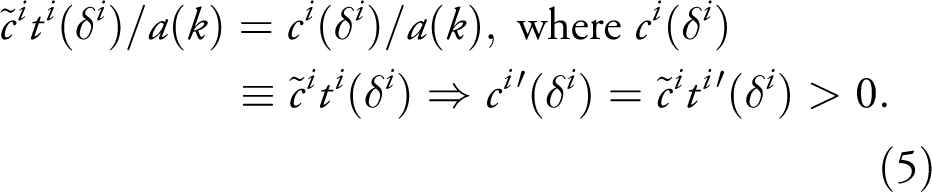
Marginal input costs of any good produced in nation i is a constant , while productivity of firm k is , so that the firm’s marginal production costs are . However, domestic terrorism can raise domestic transaction costs. Let domestic terrorism amplify the terror-impacted nation’s marginal costs by ti, where
Thus, the effective marginal costs of selling in the domestic market are:
In addition, an exporting firm also incurs standard iceberg transportation costs between international borders, and terrorism-impacted transaction costs in the destination nation. These costs are denoted as , where for each unit exiting nation i’s border for nation j, the firm needs to produce units, since units melt away in the process of being transported from i to j’s market. Transportation networks between trading nations involve citizens of both nations, naturally making such transportation costs sensitive to transnational terrorism incidents in both nations. In addition, the networks that move the imported goods to the markets in the destination nation are susceptible to domestic terrorism. These considerations indicate that
Following Melitz (2003) and Helpman, Melitz & Rubinstein (2008), we assume that there are fixed costs, Fij, for an i’s firm to export to nation j.8 These costs are likely to be affected by transnational terrorism in the destination market. For example, a Japanese car maker that wants to sell in India must set up dealerships in Indian cities. Terrorist attacks that affect such dealerships involve domestic and foreign interests, thereby making these attacks transnational. Hence, we have
The profit, πij, of a firm in nation i that exports to nation j is:where is the level of exports by this firm. The demand function in Equation 2 implies that this firm perceives its price elasticity of demand in the export market as ∊. Hence, equating marginal revenue and marginal cost gives the profit-maximizing export price levels as:
Substituting Equation 9 into Equation 2, we obtain nation i’s firm k export volume to nation j. Furthermore, the export revenue of this firm is:
Using Equations 9–10 in Equation 8, we can express firm k’s profit from exports to nation j as:where
Positive (or zero) export profit (i.e. ) can be obtained if and only if
where is the minimum (or threshold) productivity level, required for i’s domestic firm to profitably export to country j. Firms below this threshold sell only in the domestic market.9 Let firms’ productivities be distributed as is a standard probability density function with support . The probability mass of i’s firms exceeding this productivity threshold to export to nation j is is the cumulative distribution function associated with . Let the mass of i’s firms be . Then the number of firms that can successfully cross the export threshold is . This determines the extensive margin of exports, where firms exit the export market if the threshold rises, thus reducing . Nation i’s aggregate revenue from exporting to nation j is:
For clarity of exposition, let us now assume that terrorism affects only the country-pair (i, j), meaning that we assume that terrorism does not impact the remaining J − 2 nations. Using Equation 9 in Equation 3 and also noting that domestic terrorism in nation j must raise its own firm’s domestic prices, we denote the aggregate price level in j as:where aggregate price is increasing in all its arguments. Substituting Equation 14 into Equation 13, we have
Equation 15 can yield a form of the gravity equation that involves incomes and terrorism parameters of both nations i and j.10 Also, Equation 15 provides an expression for bilateral trade flows in both directions, because is the export flow from i to j, while represents the export flow in the other direction. The latter denotes i’s import expenditure on j’s goods. Differentiating Equation 15 with respect to a change in any terrorism-related parameter θ and suppressing non-terrorism parameters from the functional forms, we get
The first term on the right-hand side (RHS) is the change in the value of exports due to changes in the intensive margin, where firms faced with higher terrorism-related (marginal) costs raise their prices and scale back their sales. The second RHS term is the change in exports due to the exit of country i’s exporting firms from country j’s market because terrorism-related costs increase the threshold productivity level required to enter the export market. Equation 16 is quite general, but rather opaque in terms of empirical predictions. To throw more light on these predictions, we evaluate this expression for specific cases where the country-pair is .
Transnational terrorism
From Equation 9, an increase in i’s transnational terrorism, ρi, raises i’s export price pj through the transportation costs τij. Recalling that nation i’s exports is likely a small subset of all products in j’s market, we can ignore the effect on the price index, Pj. Thus, the relative price of i’s exports in j’s market, rises, which reduces i’s export revenues from j (Equation 10). Accordingly, the first term in Equation 16 is negative. From Equation 12, must rise as transportation costs rise. In other words, fewer of i’s firms can export, implying a negative second term on the RHS of Equation 16. Thus, a rise in ρi reduces nation i’s bilateral export revenues from nation j.
Next, we turn to the influence of transnational terrorism in j on i’s export revenues. A rise in ρj must increase i’s export price by increasing the transportation costs τij (see Equation 9). Finally, from Equation 12, we see that increases as both fixed costs and transportation costs tend to increase for nation i due to greater transnational terrorism in j. Hence, the last RHS term in Equation 16 is also negative. Therefore, a rise in transnational terrorism in j will reduce i’s exports to j. Alternately, an increase in i’s transnational terrorism reduces its imports from j.
Domestic terrorism
We first investigate how an increase in domestic terrorism in i (δi) affects export revenues from country j. The aggregate price level in j includes prices from its firms as well as prices from all its trading partners, so that a change in the price of i’s exports is unlikely to have a major impact on the aggregate price level Pj. Using this fact in Equation 10 and noting from Equation 9 that rises as δi rises, Equation 2 shows that export demand for good k in j’s market must fall. Given that demand is elastic, this implies that export revenue must fall (see Equation 10). Thus, the value of exports falls on the intensive margin. Additionally, the rise in δi increases the threshold productivity level (see Equation 12). Fewer firms in i can export to nation j; this decline in the extensive margin also reduces exports.
Next consider the influence of an increase of j’s domestic terrorism (δj) on i’s export revenues, while controlling for Yj. A rise in domestic terrorism in nation j will raise transaction costs for firms exporting to nation j. In Equation 9, this is reflected as a rise in pj. Domestic terrorism in j will also increase the price of goods sold by j’s firms in their domestic market. Given that domestic firms usually constitute a significant portion of any nation’s market, one should expect that the rise in prices of domestic firms’ products will increase the price level Pj in nation j. This means that both the numerator and the denominator in the expression must rise. Depending on the relative sensitivities of transaction costs of imports from different nations and also the sensitivity of transaction costs of domestic production, one can infer the direction of change for . If transaction costs of imports of nation j (from nation i) are more sharply raised than the aggregate price level in nation j, then rises, and Equation 10 dictates that domestic terrorism in j reduces its imports from i. From Equation 12, we note that the threshold productivity is also affected in conflicting ways. The threshold must drop when Pj rises, which allows for more entry of i’s firms in j’s market. However, an increase in δj raises τij, thereby lifting this threshold. Accordingly, because of opposing effects of domestic terrorism on both the intensive and the extensive margins of imports, the net effect of domestic terror on imports is, a priori, ambiguous.
To summarize, controlling for income levels, transnational terrorism has unambiguously negative effects on both imports and exports, while domestic terrorism tends to reduce exports but has an ambiguous effect on imports.
Methodology and data
Traditional gravity model
In the empirical trade literature, the gravity model is used extensively for estimating the impact of a variety of policy implications, such as currency unions, trade agreements, patent rights, and political blocs. The general formulation of a trade gravity model includes the following multiplicative terms:
where Xij is the monetary value of trade between countries i and j. G indicates the influence of global factors, such as world trade liberalization, which does not depend on i and j. Sij indicates all exporter-specific factors that influence country i’s exports supplied to country j, and Mji represents all importer-specific factors that affect country j’s imports demanded from country i. θij denotes myriad factors associated with bilateral trade costs. In traditional gravity models, most of these bilateral relationships and costs are captured using dummy variables. Thus, we first employ a PCS model with time dimension to identify the impact of different types of terrorism on trade by main trade components (i.e. primary commodities and manufactured goods). The following model is estimated using the ordinary least squares (OLS) method with robust standard errors clustered at the country-pair level:11
where i and j denote countries, and t denotes time. Tradeijt indicates real exports plus imports between i and j at time t. The effects of different types of terrorism, for domestic and transnational terrorism, respectively, are estimated together for total product trade, primary commodities, and manufactured goods. These terrorism effects are also examined together for exports and imports. By estimating these influences in the same equation, we can make relative statements about which type of terrorism may or may not have the larger effect. This allows us to capture the sensitivity of domestic production and demand for foreign goods in response to terrorism risk under varying sets of local environmental conditions. αt indicates year dummies to account for the impact of global economic shocks on the trade–terrorism relationship for a given year in a country.
Our bilateral data for total product trade, primary commodities trade, and manufactured goods trade come from the online statistics of United Nations Conference on Trade and Development (UNCTAD, 2014). These data present merchandise trade in thousands of US dollars by trading partners and products, based on SITC Revision 3 commodity classification. UNCTAD secretariat carried out calculations to present the data in their final form based on the information assembled by the UN COMTRADE and the IMF’s Direction of Trade Statistics. A unique feature of this dataset is that it contains information on exports and imports of primary and manufactured goods. We converted these nominal values into real values (constant at year 2000) by dividing each country’s exports and imports by its export value index and import value index, respectively. Data for these two indices are taken from the World Development Indicators of the World Bank (2014).
Our terrorism event data are drawn from the GTD, which records domestic and transnational terrorist incidents (National Consortium for the Study of Terrorism and Responses to Terrorism, 2014). GTD draws its data from media accounts and indicates key variables for each terrorist incident that include incident date, venue country, victim nationality (up to three per attack), number of casualties (i.e. deaths and injuries), and other characteristics. GTD does not record the nationalities of perpetrators for transnational attacks; hence, we cannot match such attacks to an origin country. Until 2013, GTD did not separate terrorist incidents into domestic and transnational incidents; hence, we rely on the partitioning of terrorist incidents into domestic and transnational attacks, devised by Enders, Sandler & Gaibulloev (2011). These authors engineered a five-step procedure, based on the nationality of the victims, target types (e.g. diplomatic target, non-governmental organization, and multilateral institution), targeted entities, US-specific attacks, and the venue country, to distinguish between domestic and transnational terrorist attacks. For 1995–2012,12 we derive annual counts for domestic and transnational terrorist events for each sample country, because our unit of analysis is that of a country-year.
In Equation 18, the coefficients of primary interest are β1 and β2, which represent the partial trade impacts of domestic and transnational terrorism, respectively. Based on the information in the GTD dataset, we construct two terrorism variables: the numbers of domestic and transnational terrorist attacks. Both terrorism measures are continuous variables that provide significant heterogeneity across countries and variation across time. We treat terrorist incidents equally without accounting for their severity; most terrorist incidents have only a single death so that severity in terms of casualties is rather homogeneous across most incidents. We believe that the distinction by terrorism types offers a more informative analysis of their trade consequences, especially because transnational terrorist incidents may affect trade flows differently than domestic terrorist incidents when such flows are disaggregated. In order to ensure that terrorism risk is captured in both trading partners, we take the log of 1+ terrorist incidents in country i multiplied by 1 + terrorist incidents in country j, where both terms are evaluated at time t – 1. Past studies have also used a somewhat similar transformation of the terrorist variables for trade–terrorism analysis in the gravity model (e.g. Blomberg & Hess, 2006; Nitsch & Schumacher, 2004). The addition of 1 ensures that taking the log does not drop any observation with a zero count. This transformation of the terrorism variables ensures that trade between trading partners can be influenced by a terrorism incident in either country or in both countries during a given year. For clarity, let us assume that country i is Pakistan, which experienced lots of terrorism over the sample period, and that country j is United Arab Emirates (UAE), which experienced little terrorism over the sample period. Then, all else equal, trade between the two may be mainly influenced by the terrorism risk in Pakistan, especially since the two countries are not politically at odds with one another. Civil conflict may also affect the trade–terrorism relationship. However, any influences of civil conflict are assumed to be captured by country-specific, fixed-effect dummies in our model.
We favor displaying results when terrorist incidents are lagged by one year. This strategy reduces contemporaneous correlation between trade and terrorism and allows terrorism-induced trade consequences to take effect with some lag.
Data for all other variables in Equation 18 are taken from Glick & Rose (2015). These variables are defined as follows: RGDP is real gross domestic product, P is population, Border is a dummy variable for whether the countries share a common border, Language is a dummy variable for whether the countries share a common language, and Dis is the log of distance between trading countries. Moreover, Llock is a dummy that equals 1 if a trading country is landlocked, and 0 otherwise; RTA is a dummy variable that equals 1 if both trading countries belong to the same regional trade agreement, and 0 otherwise; CUR is a dummy variable that equals 1 if both countries use the same currency, and 0 otherwise; Colony and Common colony are dummy variables that equal 1 for either of these two colonial heritage aspects, and 0 otherwise; and Island is a dummy variable that equals 1 if a trading country is an island, and 0 otherwise.13 Note that RTA and CUR reflect the change from 0 to 1 in the year when a country entered a trade agreement or started using the same currency as a trading partner, respectively.
Gravity model with country-pair fixed effects
Anderson & van Wincoop (2003) showed that a well-specified gravity model is crucial for capturing relative trade costs between trading partners. They argued that relative trade costs, that is, country j’s propensity to import from country i is determined by j’s trade costs with i, relative to its overall weighted average trade costs of imports. They labeled this phenomenon as the ‘multilateral trade resistance’ (MTR) term, which is faced by every country in the world. For example, USA–Norway trade is affected by the specific trade barrier between them, relative to the average trade barrier each of them faces with other countries in the world.
Although both the time-varying and time-invariant factors largely capture most of the MTR term in Equation 18, they do not account for all unobserved factors because of heterogeneity at each country-pair level. Comparing various specifications of the gravity model, Cheng & Wall (2005) state that, while the PCS model is employed in nearly all gravity models, the PCS model fails to capture many considerations that may influence bilateral trade. The variant of historical, cultural, ethnic, political, or geographical factors that affect the level of bilateral trade can be correlated with the right-hand-side variables. Since we have a total of 10,596 country-pair dyads in our dataset, ignoring country-pair fixed effects will not only result in biased estimates, but will also overestimate the impact of terrorism on trade. Thus, our fully specified gravity model takes the following form:
where αij represents country-pair fixed effects for each trading partner. Because these fixed effects capture unobserved heterogeneity bias, all time-invariant variables are automatically dropped from the regressions.14 Thus, vector Z only retains time-variant variables, that is, real GDP, real GDP per capita, regional trade agreement, and currency union.
One may argue that trade may influence the likelihood of terrorism in a country, so that taking a lagged value of terrorism may not appropriately address the reverse-causation problem. If, for example, trade boosts domestic production and employment, then trade may mitigate some economic-related grievances that may fuel terrorism. Moreover, trade-induced economic activity increases individuals’ opportunity costs of engaging in terrorism. Counter to this argument, the empirical literature finds no robust evidence supporting that socio-economic factors, such as lack of education or employment, spur terrorism in a country (Enders & Sandler, 2012).
Nonetheless, we test whether our results are robust to treating such endogeneity bias. The conventional strategy to address endogeneity is to employ instrumental variable methods. However, finding unique instruments for both types of terrorism, given our multiple trade dependent variables, is an insurmountable task. Moreover, the validity of the instruments may always be called into question. In lieu of the instrumental variable approach, we conduct a number of placebo tests. In particular, we re-estimate all regressions by randomly rearranging terrorism variables for each country-pair, while maintaining all other control variables. Of course, there are an infinite number of ways that one may reshuffle terrorism data for each country-pair. To show that the results are not artifacts of a particular statistical procedure, we try a number of ways through which terrorism data for each country-pair can be reshuffled. For example, in one of several cases, we divide all country-pairs into three parts and reshuffled terrorism data for one-third of country-pairs randomly. The idea of this exercise is that if our assumed causal direction is correct, then our ‘false’ setup of repositioning terrorism variables for each country-pair should seldom reveal any statistically significant and negative effects of terrorism on trade.
Results
For total trade (exports plus imports), Table I indicates the effects of last year’s domestic and transnational terrorist attacks on trade in all products, primary commodities, and manufactured goods. The sum of the number of trading pairs for the 18 sample years determines the varying number of observations.
The results of the PCS model (columns 1–3) show that both lagged domestic and transnational terrorism have negative and significant effects on the trade of all products, primary commodities, and manufactured commodities. The magnitudes of these terrorism coefficients show that for trading partners, a 1% change in last year’s domestic (transnational) terrorism results in a 0.093% (0.068%) reduction in all products trade, a 0.080% (0.059%) reduction in primary commodities trade, and a 0.085% (0.088%) reduction in manufactured goods trade. This follows because the double log form means that the coefficients are elasticities.
The gravity variables are robust over all PCS models with the anticipated signs. The estimated coefficients of the log product of real GDP of trading dyads are positive and significant, with elasticities that range from 1.054 to 1.190. For the log product of real GDP per capita, the size of the coefficients ranges from 0.036 to 0.209. The estimated positive coefficients of common borders and common language indicate trade facilitation, while the negative coefficients of dyadic distance indicate trade inhibition; both findings are consistent with the augmented gravity model’s prediction. The results show that trading dyads including a landlocked country are less likely to trade in contrast to trading dyads including an island country. Regional trade agreements greatly promote trade among trading partners, with manufactured goods displaying the largest impact. Currency union coefficients also foster trade in the three PSC models, but the elasticity is smaller than for regional trade agreements. Finally, colonial relationship and common colonizer among trading dyads promote trade.
In columns 4–6 of Table I, we include country-pair FE to account for all types of unobserved influences of trade at each trading-partner level. The negative coefficients of domestic terrorism remain significant at the 0.01 level for trade in total products and manufactured goods trade, but these coefficient sizes in absolute value are greatly reduced, as anticipated, to 0.014 and 0.025, respectively. Interestingly, the coefficient of domestic terrorism in primary commodities becomes positive with the magnitude of 0.010% and marginal statistical significance at the 0.10 level. In Tables II and III, we will further explore whether this somewhat anomalous finding arises because of domestic terrorism’s impact on primary commodities exports or primary commodities imports. The negative coefficient of transnational terrorism remains significant in manufactured goods; however, its size in absolute value declines to 0.013%. In the three models, both the real GDP product and the real GDP per capita product terms display
Terrorism effect on total trade
Pooled cross-section model
Country-pair fixed effect model
All
Primary
Manufactured
All
Primary
Manufactured
products
commodities
goods
products
commodities
goods
(1)
(2)
(3)
(4)
(5)
(6)
DV is log (real total trade of the above variables)
(log product) 1+ Domestic
–0.093**
–0.080**
–0.085**
–0.014**
0.010†
–0.025**
terrorist incidents, t–1
(0.010)
(0.012)
(0.011)
(0.005)
(0.006)
(0.005)
(log product) 1+ Transnational
–0.068**
–0.059**
–0.088**
–0.005
–0.011
–0.013*
terrorist incidents, t–1
(0.011)
(0.014)
(0.012)
(0.006)
(0.007)
(0.006)
(log product) Real GDP
1.170**
1.054**
1.190**
0.461**
0.414**
0.392**
(0.009)
(0.010)
(0.009)
(0.083)
(0.105)
(0.081)
(log product) Real GDP
0.144**
0.036*
0.209**
0.252**
0.305**
0.294**
per capita
(0.013)
(0.016)
(0.013)
(0.080)
(0.103)
(0.078)
Common border
0.749**
1.242**
0.662**
(0.142)
(0.137)
(0.140)
Common language
0.746**
0.640**
0.875**
(0.053)
(0.059)
(0.053)
(log) Distance
–1.328**
–1.180**
–1.344**
(0.027)
(0.031)
(0.028)
Landlocked
–0.644**
–0.884**
–0.459**
(0.034)
(0.041)
(0.034)
Regional trade agreement
0.968**
0.977**
1.105**
0.075**
0.112**
0.088**
(0.057)
(0.063)
(0.055)
(0.025)
(0.033)
(0.025)
Currency union
0.514**
0.481**
0.483**
0.007
0.173**
–0.015
(0.132)
(0.136)
(0.139)
(0.049)
(0.063)
(0.042)
Colonial relationship
1.273**
1.504**
1.301**
(0.134)
(0.139)
(0.138)
Common colonizer
0.771**
0.703**
0.732**
(0.082)
(0.097)
(0.081)
Island
0.295**
0.298**
0.272**
(0.043)
(0.052)
(0.044)
Year dummies
Yes
Yes
Yes
Yes
Yes
Yes
Pairwise fixed effects
No
No
No
Yes
Yes
Yes
F-test of the equality of
0.163
0.334
0.897
0.298
0.045
0.185
domestic vs transnational
No. of country-pairs
10,596
10,055
10,478
No. of observations
152,352
132,971
145,415
152,352
132,971
145,415
R-squared
0.718
0.602
0.724
0.5897
0.4538
0.5827
Robust standard errors clustered by country-pair are presented in brackets. **, *, and † represent significance at the 0.01, 0.05, and 0.10 levels. Adjusted R-squared for pooled cross-section model, overall R-squared for country-pair fixed effects model, and p-values for F test are reported. DV stands for dependent variable.
positive influences on trade as anticipated in a gravity model. Regional trade agreement has the anticipated positive sign for the three country-pair FE models, while currency union is only positive and significant for primary commodities. Since we estimate the separate effects of domestic and transnational terrorism, it is important to test whether the difference in the size of their coefficients is statistically significant. Based on the F-test’s p-values reported in Table I, the differential effect of the two types of terrorism on trade is only significant for primary commodities.
The above findings show that gravity models that do not account for heterogeneity bias at each trading-partner level overestimate the impact of terrorism on trade. In addition, we find that the main negative impact of domestic and transnational terrorism on trade is from their harmful effect on trade of manufactured goods. Terrorism’s effect on trade of primary commodities
Terrorism effect on exports and imports, separately
All
Primary
Manufactured
All
Primary
Manufactured
products
commodities
goods
products
commodities
goods
(1)
(2)
(3)
(4)
(5)
(6)
DV is log (real exports of the above variables)
DV is log (real imports of the above variables)
(log product) 1+ Domestic
0.003
0.021**
–0.013*
–0.019**
0.001
–0.013*
terrorist incidents, t–1
(0.006)
(0.007)
(0.006)
(0.006)
(0.007)
(0.006)
(log product) 1+ Transnational
–0.01
–0.023**
0.000
–0.001
–0.008
–0.025**
terrorist incidents, t–1
(0.007)
(0.008)
(0.007)
(0.007)
(0.008)
(0.007)
(log product) Real GDP
0.694**
0.617**
0.411**
0.162
0.068
0.088
(0.092)
(0.116)
(0.089)
(0.101)
(0.119)
(0.103)
(log product) Real GDP
–0.047
–0.105
0.197*
0.691**
0.674**
0.643**
per capita
(0.091)
(0.115)
(0.090)
(0.099)
(0.120)
(0.100)
Regional trade agreement
0.085**
0.179**
0.101**
0.164**
0.174**
0.212**
(0.031)
(0.037)
(0.030)
(0.030)
(0.039)
(0.033)
Currency union
0.083†
0.234**
0.035
0.039
0.192*
0.058
(0.044)
(0.070)
(0.037)
(0.054)
(0.086)
(0.060)
Year dummies
Yes
Yes
Yes
Yes
Yes
Yes
Pairwise fixed effects
Yes
Yes
Yes
Yes
Yes
Yes
F-test of the equality of
0.177
0.000
0.154
0.102
0.498
0.275
domestic vs transnational
No. of country-pairs
10,182
9,511
9,887
10,254
9,282
10,023
No. of observations
138,293
117,189
128,405
135,905
109,524
126,479
R-squared
0.5248
0.3961
0.5225
0.3427
0.1958
0.2995
Robust standard errors clustered by country-pair are presented in brackets. **, *, and † represent significance at the 0.01, 0.05, and 0.10 levels. Adjusted R-squared for pooled cross-section model, overall R-squared for country-pair fixed effects model, and p-values for F test are reported. DV stands for dependent variable.
appears to be mixed. Countries may be unresponsive to terrorism’s impact on primary commodities because there are often fewer alternative sources of supply for many primary products.
Table II drills down deeper to distinguish the impact of the two forms of terrorism on exports and imports for 151 sample countries by dyadic trading partners. The number of observations varies according to the number of trading partners for the six models. A 1% increase in domestic (transnational) terrorism increases (decreases) primary commodities exports by 0.021% (0.023%).15 These effects are statistically significant at the 0.01 level. However, the effects of both types of terrorism on primary commodities imports are insignificant. This suggests that the positive impact of domestic terrorism on primary commodities trade arises because of its influence on primary commodities exports alone. A 1% increase in domestic terrorism reduces manufactured exports by 0.013%; but, the impact of transnational terrorism on manufactured exports is insignificant. In addition, a 1% increase in domestic (transnational) terrorism reduces manufactured imports by 0.013% (0.025%). Interestingly, the average numbers of domestic and transnational terrorist incidents per year faced by an average country stand at 7.6 and 1.2, respectively. Thus, a 1% increase in domestic terrorism would be much larger in terms of incident numbers. Nonetheless, transnational terrorism may have a greater per incident impact than domestic terrorism. To better understand their relative influence, we resort to the F-test, which shows that their differential impact on manufactured exports or imports, as revealed by the size of their coefficients, is statistically insignificant. Therefore, these results cannot reliably establish that the detrimental effect of one type of terrorism is larger than that of the other. The gravity controls are robust in the predicted direction.
We further explore the relationship between both types of terrorism and primary commodities exports by
Further investigation of terrorism’s effect on export of primary commodities
Pooled cross-sectionmodel
Country-pair fixed effectmodel
Primary commodities
Primary commodities
(excl., fuel)
(excl., fuel)
(1)
(2)
DV is log (real exports of the above variables)
(log product) 1+ Domestic
–0.074**
0.022**
terrorist incidents, t–1
(0.012)
(0.007)
(log product) 1+ Transnational
–0.061**
–0.023*
terrorist incidents, t–1
(0.014)
(0.008)
(log product) Real GDP
1.013**
0.617**
(0.010)
(0.111)
(log product) Real GDP
0.032†
–0.13
per capita
(0.015)
(0.112)
Common border
1.293**
(0.131)
Common language
0.629**
(0.059)
(log) Distance
–0.965**
(0.030)
Landlocked
–0.746**
(0.040)
Regional trade agreement
1.169**
0.134**
(0.061)
(0.036)
Currency union
0.323†
0.212*
(0.132)
(0.072)
Colonial relationship
1.593**
(0.142)
Common colonizer
0.585**
(0.095)
Island
0.262**
(0.052)
Year dummies
Yes
Yes
Pairwise fixed effects
No
Yes
F-test of the equality of
0.550
0.000
domestic vs transnational
No. of country-pairs
9,437
No. of observations
131,563
115,446
R-squared
0.59
0.40
Robust standard errors clustered by country-pair are presented in brackets. **, *, and † represent significance at the 0.01, 0.05, and 0.10 levels. Adjusted R-squared for pooled cross-section model, overall R-squared for country-pair fixed effects model, and p-values for F test are reported. DV stands for dependent variable.
excluding the fuel values. Fuel can make a substantial portion of total primary commodities exports for the main oil-exporting countries in the Middle East and North Africa region. These results for the country-pair FE models in Table III provide support to our findings in Table II that domestic terrorism positively influences primary commodities exports, while the effect of transnational terrorism remains negative. The statistical significance of the F-test suggests that the effects of both types of terrorism on primary commodities exports are different from one another.
Finally, we run a number of placebo tests to support our presumed direction of causality. Table IV applies the falsification tests involving trade of all products, primary commodities, and manufactured goods, as mentioned in the methods section. Past studies on terrorism have used several approaches to construct a false set up to check robustness of their findings including the impact of future
Placebo tests
Placebo test 1(a)
Placebo test 1(b)
All
Primary
Manufactured
All
Primary
Manufactured
products
commodities
goods
products
commodities
goods
(1)
(2)
(3)
(4)
(5)
(6)
Panel A: DV is log (Real total trade of the above variables)
(log product) 1+ Domestic
–0.002
–0.003
–0.005
0.000
–0.004
–0.003
terrorist incidents, t–1
(0.005)
(0.006)
(0.005)
(0.005)
(0.006)
(0.005)
(log product) 1+ Transnational
0.003
–0.001
0.008
0.016†
0.017†
0.007
terrorist incidents, t–1
(0.006)
(0.008)
(0.007)
(0.007)
(0.008)
(0.007)
No. of country-pairs
10,588
10,042
10,469
10,254
9,282
10,023
No. of observations
151,958
132,542
145,084
135,905
109,524
126,479
R-squared
0.588
0.455
0.58
0.3427
0.1958
0.2995
Panel B: DV is log (Real export of the above variables)
(log product) 1+ Domestic
–0.005
–0.007
–0.009
–0.01
–0.006
–0.005
terrorist incidents, t–1
(0.006)
(0.007)
(0.006)
(0.005)
(0.007)
(0.005)
(log product) 1+ Transnational
0.011
0.000
0.019*
0.013
0.015
0.008
terrorist incidents, t–1
(0.007)
(0.009)
(0.007)
(0.007)
(0.009)
(0.007)
No. of country-pairs
10,199
9,492
9,877
10,163
9,481
9,866
No. of observations
137,876
116,816
128,063
137,675
116,602
127,729
R-squared
0.528
0.4
0.523
0.531
0.4
0.52
Panel C: DV is log (Real imports of the above variables)
(log product) 1+ Domestic
–0.002
–0.007
0.003
0.002
0.006
–0.002
terrorist incidents, t–1
(0.007)
(0.008)
(0.007)
(0.006)
(0.007)
(0.006)
(log product) 1+ Transnational
–0.008
0.003
–0.003
0.016†
0.004
0.005
terrorist incidents, t–1
(0.008)
(0.009)
(0.008)
(0.008)
(0.009)
(0.008)
No. of country-pairs
10,248
9,272
10,013
10,242
9,252
10,003
No. of observations
135,549
109,165
126,156
135,249
108,780
125,827
R-squared
0.364
0.214
0.314
0.346
0.182
0.3
Robust standard errors clustered by country-pair are presented in brackets. **, *, and † represent significance at the 0.01, 0.05, and 0.10 levels. Adjusted R-squared for pooled cross-section model, overall R-squared for country-pair fixed effects model, and p-values for F test are reported. DV stands for dependent variable.
terrorist attacks on current variables of interest (i.e. Berrebi & Ostwald, 2015, 2016). Because future attacks can be highly correlated with past attacks, we engineer other ways for constructing a false set up to conduct these tests. In particular, we randomly reshuffle data of our terrorism variables in a number of different ways. To save space, we show results for regressions where we divide all country-pairs into three equal parts and reshuffle only terrorism data for each one-third of country-pairs. There are of course a number of ways one can carry out such reshuffling. For the placebo tests 1(a) and 1(b) in Table IV, we report results by reshuffling terrorism data in two different ways. In the first reshuffling, we move data for the terrorism variables of the first one-third countries to the third one-third countries; we move data for the terrorism variables of the second one-third countries to the first one-third countries; and we move data for the terrorism variables of the third one-third countries to the second one-third countries. In the second reshuffling, the terrorism data movement involves a different perturbation among the three thirds of the sample countries: first one-third to second one third, second one-third to third one-third, and third one third to the first one-third. These placebo results show that only four of 36 coefficients of both types of terrorism are marginally significant with all four displaying positive signs. These placebos add further support to the largely significant and negative effects of both types of terrorism on manufactured trade in our ‘true’ country-pair FE set-up in Tables I and II.
Concluding remarks
This article investigates both theoretical and empirical aspects of the potential effects of domestic and transnational terrorism on total trade, primary commodities trade, and manufactured goods trade. Trade is further disaggregated by imports and exports. The theory elucidates the role that transaction costs, fixed costs, and other considerations (e.g. the intensive and extensive margins regarding exporting and importing firms) play in the trade–terrorism relationship, which is rather complex. Our theoretical model indicates that transnational terrorism has an unambiguously negative influence on trade flows, including exports and imports. Domestic terrorism is also anticipated to decrease overall trade flows; however, domestic terrorism is more apt to reduce exports than imports. A number of findings characterize our empirical models. First, we show that heterogeneity bias at the trading-pair level must be taken into account by country-pair fixed effects to avoid overestimating terrorism’s adverse effect on trade flows. This bias is highlighted in Table I when PCS and country-pair FE estimates are compared. Second, gravity model controls are significant and robust with signs in the anticipated direction (Blomberg & Hess, 2006; Glick & Rose, 2015; Nitsch & Schumacher, 2004). Third, domestic and transnational terrorism generally reduce overall trade, manufactured goods imports, and manufactured goods exports, consistent with the theory. Fourth, domestic terrorism has an unanticipated positive influence on primary commodities exports; however, transnational terrorism displays the anticipated negative influence on primary commodities exports. Fifth, for manufactured goods, the adverse marginal effects of domestic and transnational terrorism on overall trade, exports, and imports are not significantly different from one another. Thus, the associated differences in transaction and other costs, identified in the theoretical model, are not sufficient to create significant marginal differential impacts between the two types of terrorism. Sixth, our placebo falsification tests support our presumed direction of causality.
Footnotes
Replication data
The Online appendix and the execution files and data to produce the tables can be found at .
Acknowledgements
We have profited from helpful comments provided by two anonymous referees and Han Dorussen. The views expressed are those of the authors and do not necessarily represent the official positions of the Federal Reserve Bank of St Louis or the Federal Reserve System. Younas completed much of his work when he was a research fellow at the South Asia Institute at Harvard University from August 2015 to January 2016.
Funding
Sandler acknowledges funding from the Vibhooti Shukla Endowment at the University of Texas at Dallas.
References
1.
AbadieAlbertoGardeazabalJavier (2003) The economic cost of conflict: A case study of the Basque Country. American Economic Review93(1): 113–132.
2.
AbadieAlbertoGardeazabalJavier (2008) Terrorism and the world economy. European Economic Review52(1): 1–27.
3.
AndersonE Jamesvan WincoopEric (2003) Gravity with gravitas: A solution to the border puzzle. American Economic Review93(1): 170–192.
4.
BandyopadhyaySubhayuSandlerToddYounasJaved (2014) Foreign direct investment, aid, and terrorism. Oxford Economic Papers66(1): 25–50.
5.
BerrebiClaudeOstwaldJordan (2015) Terrorism and fertility: Evidence for a causal influence of terrorism on fertility. Oxford Economic Papers67(1): 63–82.
6.
BerrebiClaudeOstwaldJordan (2016) Terrorism and the labor force: Evidence of an effect on female labor force participation on the labor gender gap. Journal of Conflict Resolution60(1): 32–60.
7.
BlombergS BrockHessGregory D (2006) How much does violence tax trade?Review of Economics and Statistics88(4): 599–612.
8.
BlombergS BrockHessGregory D & Athanasios Orphanides (2004) The macroeconomic consequences of terrorism. Journal of Monetary Economics51(5): 1007–1032.
9.
BrandtPatrick TSandlerTodd (2010) What do transnational terrorists target? Has it changed? Are we safer?Journal of Conflict Resolution54(2): 214–236.
10.
ChengI-HuiWallHoward J (2005) Controlling for heterogeneity in gravity models of trade and integration. Federal Reserve Bank of St Louis Review87(1): 49–63.
11.
DrakosKonstantinosKutanAli M (2003) Regional effects of terrorism on tourism in three Mediterranean countries. Journal of Conflict Resolution47(5): 621–641.
12.
EcksteinZviTsiddonDaniel (2004) Macroeconomic consequences of terror: Theory and the case of Israel. Journal of Monetary Economics51(5): 971–1002.
13.
EggerPeterGassebnerMartin (2015) International terrorism as a trade impediment?Oxford Economic Papers67(1): 42–62.
14.
EndersWalterSandlerTodd (1996) Terrorism and foreign direct investment in Spain and Greece. Kyklos49(3): 331–352.
15.
EndersWalterSandlerTodd (2012) The Political Economy of Terrorism, 2nd edition. New York: Cambridge University Press.
16.
EndersWalterHooverGary ASandlerTodd (2016) The changing nonlinear relationship between income and terrorism. Journal of Conflict Resolution60(2): 195–225.
17.
EndersWalterSandlerToddGaibulloevKhusrav (2011) Domestic versus transnational terrorism: Data, decomposition, and dynamics. Journal of Peace Research48(3): 319–337.
18.
EndersWalterSandlerToddPariseGerald F (1992) An econometric analysis of the impact of terrorism on tourism. Kyklos45(4): 531–554.
19.
GaibulloevKhusravSandlerTodd (2008) Growth consequences of terrorism in Western Europe. Kyklos61(3): 411–424.
20.
GaibulloevKhusravSandlerTodd (2011) The adverse effect of transnational and domestic terrorism on growth in Africa. Journal of Peace Research48(3): 355–371.
21.
GaibulloevKhusravSandlerToddSantifortCharlinda (2012) Assessing the evolving threat of terrorism. Global Policy3(2): 135–144.
HelpmanElhananMelitzMarcRubinsteinYona (2008) Estimating trade flows: Trading partners and trading volumes. Quarterly Journal of Economics123(2): 441–487.
24.
HoffmanBruce (2006) Inside Terrorism, revised edition. New York: Columbia University Press.
25.
JacksonBrian ADixonLloydGreenfieldVictoria A (2007) Economically Targeted Terrorism: A Review of the Literature and a Framework for Considering Defensive Approaches. Santa Monica, CA: RAND.
26.
LawlessMartina (2010) Deconstructing gravity: Trade costs and extensive and intensive margins. Canadian Journal of Economics43(4): 1149–1172.
27.
MelitzMarc J (2003) The impact of trade on intra-industry reallocations and aggregate industry productivity. Econometrica71(6): 1695–1725.
28.
MirzaDanielVerdierThierry (2014) Are lives a substitute for livelihoods? Terrorism, security, and US bilateral imports. Journal of Conflict Resolution58(6): 943–975.
29.
National Consortium for the Study of Terrorism and Responses to Terrorism (START) (2014) Global Terrorism Database (http://www.start.umd.edu/gtd).
30.
NitschVolkerSchumacherDieter (2004) Terrorism and international trade: An empirical investigation. European Journal of Political Economy20(2): 423–433.
31.
RapoportDavid C (2004) Modern terror: The four waves. In: CroninAudrey KLudesJames M (eds) Attacking Terrorism: Elements of a Grand Strategy. Washington, DC: Georgetown University Press, 46–73.
32.
SagemanMarc (2004) Understanding Terror Networks. Philadelphia, PA: University of Pennsylvania Press.
33.
SandlerToddEndersWalter (2008) Economic consequences of terrorism in developed and developing countries: An overview. In: KeeferPhilipLoayzaNorman (eds) Terrorism, Economic Development and Political Openness. Cambridge: Cambridge University Press, 17–47.
34.
United Nations Conference on Trade and Development (UNCTAD) (2014) Trade matrix by partner, product, or service-category (http://unctadstat.unctad.org/EN/).
35.
World Bank (2014) World Development Indicators. Washington, DC: World Bank.
Supplementary Material
Please find the following supplemental material available below.
For Open Access articles published under a Creative Commons License, all supplemental material carries the same license as the article it is associated with.
For non-Open Access articles published, all supplemental material carries a non-exclusive license, and permission requests for re-use of supplemental material or any part of supplemental material shall be sent directly to the copyright owner as specified in the copyright notice associated with the article.










 .
.