







Abstract
Introduction
Recent work has made significant progress towards understanding the effect of repression on dissent by moving away from decision-theoric models, and focusing instead on the strategic interaction between governments and dissidents (Moore, 2000; Pierskalla, 2010; Ritter, 2014; Ritter and Conrad, 2016). Dissent and repression are strategic; both governments and their opponents choose their actions in anticipation of the other’s behavior. Dissidents expecting repression refrain from mobilizing in the first place. Governments anticipating dissent repress preemptively to deter the masses from mobilizing against them in the first place (Danneman and Ritter, 2014; Nordås and Davenport, 2013; Ritter and Conrad, 2016; Slantchev and Matush, 2020; Sullivan, 2016; Truex, 2019).
I build upon this insight by focusing on mechanisms linking
Although these two channels might be complementary, they need not be. The model demonstrates that uncertainty about the government’s strength or resolve can either decrease or increase observed repression. When the opposition lacks information about the government’s cost to repress, they have to infer it from the level of preemptive repression they observe. This gives rise to interesting signaling behaviors. Weaker governments get the opportunity to deter the opposition either by repressing at lower levels than they would have to under complete information, or not repressing at all. As the opposition’s capacity increases, governments need to repress at higher levels in order to deter the opposition. Because they cannot rely on their strength to deter the opposition, stronger governments engage in increasingly higher repression to deter challengers.
The model also shows that increased cost of repression can make it more effective at deterring dissent and vice versa. As the cost of repression decreases, weaker governments can repress at higher levels. This means that even after suffering some deterioration of their capacity, the opposition expects a higher likelihood of victory if they mobilize. Thus, governments are forced to repress at higher levels in order to prevent mobilization. Similarly, increased costs of repression make it more effective at deterring dissent.
I start with a baseline model with complete information, where preemptive repression works purely through the direct, functional channel. I then introduce uncertainty about the government’s strength to demonstrate how the informational channel interacts with the functional channel. Finally, I extend the model to a two-sided asymmetry setting, where the opposition’s capacity is unknown to the government. The extension provides an explanation to why governments acting rationally often resort to preemptive repression that proves to be ineffective in deterring mass mobilizations.
Examining
This article makes two contributions to the literature on repression and dissent. It clearly distinguishes between preemptive and responsive repression by modeling these as distinct choices, with different goals and effects. This distinction has been brought up in recent empirical (Danneman and Ritter, 2014; Nordås and Davenport, 2013; Ritter and Conrad, 2016), and formal work (De Jaegher and Hoyer, 2019; Dragu and Przeworski, 2019; Rozenas, 2020; Slantchev and Matush, 2020) but different forms of repression have been analyzed separately. Modeling these choices together helps reveal how the informational role of preemptive repression interacts with its functional role.
The analysis presented here also highlights some of the challenges facing observational empirical work in the study of repression and dissent. Besides highlighting the different likelihood and severity of repression, it argues the data generating process can be different even when the observed level of repression and outcome – deterrence or conflict – are similar. Depending on why it is used, repression can have a different aggregate effect on dissent.
Low levels of repression can be effective in deterring the opposition when used by strong governments under complete information. Yet, the same level of repression will have a different effect under asymmetric information when it also has an informational effect.
Scholars of repression and dissent should focus not just on endogeneity, but also different mechanisms linking the level of repression to its outcome (Ritter and Conrad, 2016). Thus, future empirical work should be more explicit and precise about the expected functional form between repression and its effects (Davenport and Armstrong, 2004; Davenport and Loyle, 2012; Jones and Lupu, 2018).
Repression, preemption, and signaling
Governments repress strategically to deter and counter opposition (DeMeritt, 2016). Repression typically takes the form of First-Amendment-type rights violations such as political arrests, torture, or restriction of movement and expression in an effort to inhibit the capacity to mobilize against the state (Davenport, 2007a; Ritter, 2014; Tilly, 1978).
One important direction in the study of the repression–dissent nexus in recent research has been to factor in that governments, being rational forward-looking actors, will repress preemptively to prevent challenges from materializing. Nordås and Davenport (2013) find that governments experiencing ‘youth bulges’ become more repressive, even when controlling for the levels of actual protests. Because young populations are more likely to challenge authority and participate in rebellion – a fact known to governments as well – governments that face rising populations of young adults increase their repressive activity to preempt challenges. Similarly, Danneman and Ritter (2014) point out that governments repress preemptively when their geographic neighborhood is experiencing civil conflict. Because civil conflicts tend to spread – which is, again, a phenomenon recognized by state authorities – governments use preemptive repression to deter challenges at home.
This line of research provides important evidence that governments repress preemptively, but it does not examine whether or how preemptive repression works. For example, preemptive repression viewed against the backdrop of a relatively slow-moving trend such as youth bulges might simply be a functional response as the governments target an opposition’s potentially increased recruitment pool. However, in a setting where neighboring governments are forced to face the opposition in open civil conflicts – such as the Arab Spring – they might resort to preemption both for functional and signaling purposes. On one hand, preemptive repression might be necessary to decrease the capacity of domestic opposition as it gains access to cross-border flows of recruits, arms, and other resources (Salehyan, 2007). On the other hand, governments might also resort to repression for informational purposes. Authorities can also use preemptive repression to signal to the opposition that they are more capable in facing challengers than their neighboring states, thus deterring their citizens from rebellion.
Like the aforementioned empirical work, formal literature on repression–dissent has either not distinguished between different channels of repression’s effect, or treated them in isolation. Pierskalla (2010) examines a setup in which a government is facing an opposition that can potentially threaten the regime. In his model, similar to the model presented below, governments differ in their capacity, or resolve, to employ repression, which cannot be directly observed by the opposition. One of Pierskalla’s key arguments is that strong governments repress protesters to signal their resolve, while weak governments accommodate, fearing escalation to open conflict by the opposition. In his model, repression primarily has a signaling purpose, because it has no effect on the likelihood of government victory in open conflict, and thus should not happen under complete information. The model presented here not only incorporates the direct, functional effect of repression, but also distinguishes between preemptive and reactive repression. Furthermore, it relaxes the simplifying assumption that repression is binary, and yields insight into the probability and severity of repression and its effect on the likelihood of dissent.
In contrast, Ritter (2014) presents a bargaining model between opposition and government domestic conflict contexts, where both accommodation and conflict influence the likelihood of the political survival of the government. She demonstrates that while strong leaders are less likely to be challenged, they will face higher levels of dissent and, thus, respond with more severe repression when challenges do arise. As executive security decreases, challenges become more common and are met with less severity. While linking the likelihood of observed challenges to severity of repression, this model only considers a complete information setting where repression is not employed until bargaining breaks down and conflict starts. Consequently, it only considers reactive repression with no informational content.
More recent formal works focusing on preventive or preemptive repression typically do not feature reactive repression. De Jaegher and Hoyer (2019) focus on the interaction between the government’s expected tenure length and its preemption efforts. They argue that only governments with sufficiently long expected tenure successfully adopt preemption strategies. Dragu and Lupu (2021) examine the effect of information and communication technologies on the severity and success of preventive repression. Rozenas (2020) analyzes a situation where a government facing potential dissent from two different groups chooses a repression policy preventively. In this model, the key dynamic is how a government can undermine collective action by discriminating against one group through more repression. Finally, Dragu and Przeworski (2019) focus on moral hazard by security forces tasked with preventive repression and whether they will put the resources allocated to the survival of the regime. Thus, they do not consider the interaction of informational and functional channels that is the focus of this article.
Slantchev and Matush (2020) consider both preventive and reactive repression, but in their model preventive repression has no informational content: it increases the cost of mobilization, but the government’s preventive capacity is independent of its reactive capacity. Consequently, repression does not provide information about the strength of the government, which is the focus of my model.
In order to keep the focus on the relationship between the different effects of preemptive repression on dissent, the model presented here focuses only on the very first interaction between the government and the dissidents in the onset of conflict. It highlights a particular mechanism that previous research has not addressed, rather than capture all determinants of the repression–dissent nexus or details of particular empirical cases. Thus it should be taken as a complement to existing work that focuses on other dynamics within the repression–dissent nexus. For example, recent work has highlighted how repression can be followed by dissent through backlash mobilization (Aytaç et al., 2018; Demirel-Pegg and Rasler, 2021; Shadmehr and Boleslavsky, 2022): repression leads to further dissent by mobilizing otherwise passive bystanders. Others focus on the effect of different forms of repression such as targeted arrests, indiscriminate violence against protesters, or the use of more institutional coercion such as courts (Demirel-Pegg and Rasler, 2021; Earl, 2011; Koopmans, 1997). The formal theory presented does not necessarily contradict these arguments but rather provides a distinct dynamic that can also provide a framework to interpret these empirical findings.
The model
Setup
I analyze a setting with two actors: a government (G, it), and an opposition (O, they). The government has a value of 1 for holding office. Similarly, the opposition’s value for overthrowing the government is 1.
The government’s privately known type
After observing
To sum up, the sequence of the game is:
Nature chooses
G chooses
O chooses to mobilize at a cost
The outcome of conflict is decided and payoffs allocated.
The utilities are:


where
Complete information: Purely function preemption
I begin with the complete information analysis. The complete information case illustrates how both actors would behave if repression had no informational content. This provides a baseline for comparison for the incomplete information case. It also helps builds intuition for the incomplete information case. In addition, as I argue in more detail below, it captures the dynamics of preemptive repression in certain empirical cases. Put differently, the complete information case provides a better explanation of some empirical cases and should be considered as an alternative, rather than simply a baseline to the asymmetric information case.
Under complete information, the opposition mobilizes if their remaining capacity after a level of preemption

Rearranging gives us the minimum level of preemptive repression that a government of type

This points to an important result: strong governments are more effective at preemptive repression, but they also need less of it under complete information. If the government’s capacity is sufficiently high,
Finally, the government must be able to repress at a level


Conditions 1 and 2 together provide the equilibria of the baseline model, which is summarized in the Proposition below.
Opposition only mobilizes if
Government chooses
Proposition 2 is depicted in Figure 1 below. In Region I, the government deters mobilization without resorting to preemptive repression. Below this region, the government has to preemptively repress at level

Equilibria ranges of the game under complete information as a function of Government Type,
The complete information setting explains the use of preemptive repression under relative certainty. For example, Truex (2019) finds that the Chinese Communist Party (CCP) increases the use of preemptive repression in dates corresponding to ‘focal events’, such as the anniversary of the Tiananmen Square Massacre. Focal dates increase the capacity of opposition groups by making it easier to organize. Expecting this, the government increases repression preemptively before these dates to avoid public mobilization. Furthermore, CCP uses a ‘catch and release’ strategy, detaining potential dissidents for short periods of time without formal charges or overt public displays of force. As Proposition 2 points out, when its strength is known by the opposition, a government with a vast coercive apparatus requires lower levels of preemptive repression. This regular, cyclical pattern of low-level preemption is a stark contrast to other instances of CCP’s use of coercion, such as the harsh, public and unapologetic targeting of Uighurs or the crack down against the Falun Gong movement (Lorentzen, 2014, 2017). Indeed, the extensive crackdown on the Falun Gong movement provided a clear, lasting message to potential protesters in China by providing a clear demonstration of strength. 5
Preemption with asymmetric information
Having examined the model where preemptive repression is only used for the purpose of reducing opposition capacity, I now turn to the asymmetric information setting, where
If the opposition mobilizes to challenge the government, the results are the same as in the complete information case. However, because they cannot directly observe the government’s strength,
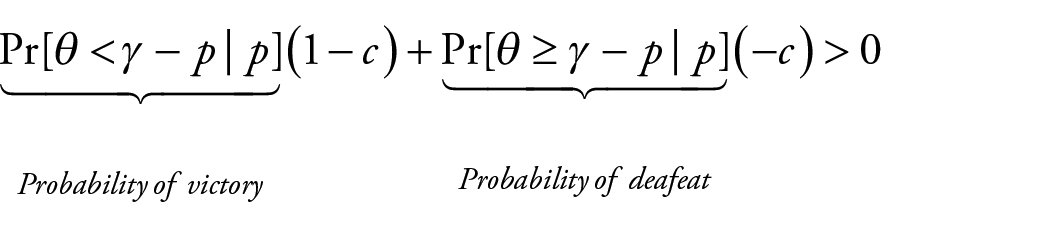

The right side of Condition 3 is simply the opposition’s cost of mobilization. The left side of Condition 3 is the opposition’s expected chance of victory after observing
Expecting the opposition’s response, the government chooses a level of preemptive repression. While preemption is preferable to an open conflict and defeat, it is costly. Thus, the government has no reason to repress any more than necessary. In some cases, the necessary repression can be low or even zero. Suppose all governments pool on no repression at all, the opposition gains no additional information and thus acts on their prior. If their capacity is low enough, the fear of facing a stronger government will have pacifying effect even after observing no repression. Formally:


This is Region I in Figure 2. For the government, this is an ideal situation because it gains the benefit of holding on to power without paying the cost of repression. Consequently, no type of government has any incentive to deviate. This is especially good news for weaker governments who would be forced to employ high levels of repression or lose power in the complete information setting.

Equilibria ranges when the government’s strength is private information; when
γ ⩽ c:
All governments pool on
The opposition does not mobilize
When the opposition is stronger, pooling stops being effective as it would lead to the opposition mobilizing. In this case, the government has to weigh the cost of sufficient repression and the benefit of holding on to power. Let
For a government with type


Given the government’s incentives in repressing, the opposition updates their belief. After observing a level of repression

Rearranging gives us the level of preemptive repression that will deter an opposition with capacity

Plugging


As any government with
Taken together, Conditions 5–7 provide the other equilibrium of the incomplete information game where the government’s strength is private knowledge. This equilibrium is summarized in Proposition 4 below and is depicted in Regions II and III in Figure 2:
Opposition only mobilizes if
All governments with θ ⩾ θ‡ choose
Having explored the equilibria when both functional and informational elements of repression are at play, we can examine the implications of the model more closely. Equation 6 points to an intuitive result that the complete information setting also has: as the opposition’s capacity increases, the level of preemptive repression required to deter them also increases. However, Equation 6 also includes a counterintuitive result that the complete information setting does not feature. As the marginal cost of preemption,
To see the logic underpinning Proposition 5, recall how the opposition updates their belief about the government’s strength after observing repression. The higher the observed repression is, the stronger the government must be in order to deploy it. As the marginal cost of repression goes up, the opposition changes their estimation of government strength accordingly. When the costs are high, the opposition correctly infers that the government must be a stronger type to be able to use the same level of repression. Similarly, when the cost of repression is low, the opposition expects higher levels of repression from weaker governments, and becomes more willing to mobilize after suffering any level of repression.
Importantly, this change in the effectiveness of repression occurs even when the functional effect of repression remains constant. Repression still deteriorates opposition capacity at the same level regardless of its costs. However, because the level of repression also provides information about the government’s capabilities, the aggregate effect of a given level of repression changes. This dynamic is depicted in Figures 3 and 4. When repression is costlier, the opposition is deterred with

Level of deterrent preemptive repression

Minimum strength of governments that can employ
Recall from Proposition 5 that when governments have to signal strength through repression, the effectiveness of any given level of repression depends on its cost. Knowing this, governments adjust their level of repression accordingly as best they can. If the cost of repression is low, governments use higher levels of repression to deter the opposition. This might seem obvious. After all, one would expect governments to use more repression when it is cheaper.
However, the logic presented here is quite different. Governments do not simply use more repression because they can, but because they have to. Similarly, when the costs of repression are higher, governments can signal their strength with relatively lower levels of repression. Under incomplete information, repression’s effect, and thus its equilibrium level, do not only depend on its cost. They also depend on what the opposition can infer from observing the government paying the said cost.
Furthermore, uncertainty about the government’s strength changes the level of repression in another way. Recall from the complete information setting that stronger governments need less preemption to deter the opposition’s mobilization (Proposition 1). If the government is sufficiently strong, they can even forego repression, knowing the opposition will not mobilize. However, this dynamic disappears when the government’s strength is unknown to the opposition. Because they cannot observe the government’s strength, the opposition has to condition their decision to mobilize on what they can infer from government’s use of repression. This creates new dynamics that can either decrease or increase the level of preemptive repression.
The opposition’s uncertainty about the government’s strength can have a pacifying effect on the opposition. If the opposition’s capacity is low enough, they can be deterred with low, or even no preemptive repression. The logic is as follows: after observing any level of preemption, the opposition evaluates their chances of victory should they mobilize. The weaker they are, the more likely they are to meet a strong government that can defeat them in conflict. This means that even when repression was low, the opposition becomes more hesitant to mobilize for fear of facing a strong government. This creates an opportunity for weaker governments to bluff strength by using less repression than they would need to under complete information.
The pooling equilibrium described in Proposition 3 demonstrates this dynamic most clearly. In this parameter range, all governments pool on
Research studies on repression and dissent have argued that governments can often induce cooperation and obedience through the threat of violence rather than its application (Chenoweth, 2021; Davenport, 2007a; Ritter, 2014). Of course, in many cases the opposition does not have information about the strength of their government. Provided they are sufficiently pessimistic about their prospects in conflict, the government can hide its weakness by refraining from repression. Even though the opposition could take advantage of the window of opportunity, their expectation that the government is likely to be too strong to defeat leads them to refrain from mobilization.
As the opposition’s capacity increases, signaling – or bluffing – strength through not repressing preemptively stops being effective. This is the equilibrium described in Proposition 4 and depicted in Regions III and IV of Figure 2. This means that the strongest governments – those with
While uncertainty forces the strongest governments to preemptively repress, their presence still creates hesitancy for the opposition. This proves beneficial for weaker governments, who now can use less repression compared to the complete information case. The dynamic at play is the same as the zero preemption case described above. Of course, in this parameter range the aggregate effect of uncertainty is ambiguous. While strong governments have to repress preemptively, weaker governments repress less than they would have to under complete information.
Uncertainty forces governments to use more preemption as the opposition’s capacity gets higher, leading to higher levels of observed repression than the complete information case. That is,
Two-sided asymmetry
I now extend the model to have two-sided asymmetry, where the government lacks information about the opposition’s capacity

In equilibrium, an opposition with type
Expecting the opposition’s strategy, but unaware of the threshold

So that

Combining these results we get the equilibria of the game with two-sided asymmetry, summarized in Proposition 7:
A government of type
An opposition with capacity
The two-sided asymmetry extension features the same key insight with the single-sided case. In updating their belief about the strength of the government, the opposition factors the cost of repression. Formally,
Furthermore, two-sided asymmetry captures the repression–escalation dynamic that precedes many major uprisings. Governments repress preemptively as best they can, hoping they will deter the opposition. When their repressive efforts prove sufficient, repression is observed but not mobilization (Ritter and Conrad, 2016). In other cases, both repression and mobilization are observed. Note that this mechanism is different from the ‘backlash hypothesis’ (Aytaç et al., 2018; Francisco, 1995) which is often invoked to explain the positive association between repression and subsequent dissent. According to this hypothesis, repression fails when it motivates otherwise neutral bystanders to join the opposition, making the opposition even stronger than before.
The mechanism at work here is in line with the arguments of Ritter and Conrad (2016) highlighting selection effects: governments repress preemptively in expectation of dissent. Consequently, conditional on observing preemptive repression, the opposition groups that mobilize will be systematically more resolved than those who do not.
For example, leading up to the 2013–14 campaign that led to the removal of former Ukrainian President Yanukovich, activists were targeted by pro-government militias and plain-clothes police. The regime resorted to tactics such as arrests, kidnapping and torturing activists and journalists but fell quickly once the masses took to the streets (Chenoweth, 2021; Chyzh and Labzina, 2018). Preemptive repression in this case, while certainly cruel, was not sufficiently severe or consistent enough to deter mass mobilization (Popova, 2014). The model presented here gives a theoretically consistent explanation for why governments would use low or moderate levels of repression even when they lack the resolve or strength to follow it up or escalate. Rather than treating Yanukovic’s use of repression as a simple blunder, we should see it as an ex-ante rational effort to to preempt mass protests.
A similar process played out in the Arab Spring, where the quick fall of Tunisia’s Ben Ali led to other authoritarian leaders ramping up repression in their own countries to prevent challenges at home (Bellin, 2012). The model explains why authoritarians were quick to ramp up repression even when they ended up failing to nip the protests in the bud. Both the authoritarians and their opponents generally lacked informational and organizational structures such as well-organized political parties or civil society organizations. As a result, they operated under great uncertainty (Bellin, 2012; Svolik, 2012; Weyland, 2012). This uncertainty led to a quick rise in repression, which proved effective in deterring uprisings for regimes such as Saudi Arabia. In others, such as Syria and Bahrain, the large increase in repression failed to deter the masses, leading to civil war in the former, and harsh reactive repression with foreign help in the latter. While the interactions subsequent to mobilization are outside the scope of the the model, it nevertheless provides a strategic explanation as to why all regimes in the region were quick to ramp up repression, despite having different repressive capabilities. It also explains why repression had different varying outcomes.
Empirical implications
The model can be employed to make better theoretical sense of empirical findings on the study of repression and dissent. As previous research highlighted, one reason for the lack of robust evidence in the relationship between repression and dissent is endogeneity arising through strategic interaction: governments repress in expectation of dissent (Hill and Jones, 2014; Pierskalla, 2010; Ritter, 2014; Ritter and Conrad, 2016). Failing to account for the endogenous process that leads to repression has led to support for ‘almost every possible relationship between protest and repression’ (Carey, 2006). Yet endogeneity is not the only challenge to the study of repression and dissent. Repression is used under different contexts and has different effects depending on its intended purpose.
When their strength is well known to the opposition, strong governments need less preemptive repression to deter challenges (Proposition 1). When governments need to signal their strength through repression, it can lead to more or less repression depending on the context (Proposition 5). Put differently, the same level of observed repression can have a different effect depending on its purpose. Overlooking distinct dynamics that lead to repression is one potential reason why previous research has found inconsistent effects. Nevertheless, the predictions of the model are in line with several empirical findings.
For example, slow moving population trends such as youth bulges (Nordås and Davenport, 2013) or cyclical patterns such as focal dates (Truex, 2019) can increase the opposition’s capacity to mobilize by increasing their recruitment pool or by reducing coordination problems. Similarly, exogenous changes to resources such as oil discoveries can make opposition groups in the region more eager to mobilize because the value of success is higher. Or, the prospective power shift in the government’s favor makes mobilization more attractive now than it will be in the future (Bell and Wolford, 2015; Carey et al., 2022). These phenomena potentially shift the balance of power between the opposition and the government – they do not by themselves create uncertainty about the government’s strength.
In these cases, we would expect repression to be used for purely functional effect. Thus, the model expects these shifts should only lead to significant increases in repression where the governments are not sufficiently strong. With regards to oil discoveries, Carey et al. (2022) find empirical evidence that this is indeed the case: oil discoveries only lead to increased repression in weaker states. Furthermore, relatively lower levels of repression can be effective at deterring dissent when signaling strength is not a concern. This helps explain why China does not deploy its vast coercive apparatus to its full effect on focal dates (Truex, 2019), in contrast to their crackdown on Falun Gong (Lorentzen, 2017).
Other phenomena, most notably democratization (Crescenzi, 1999; Pierskalla, 2010) or fall of similar, neighboring regimes (Bellin, 2012; Weyland, 2012, 2014), both shift the balance of power and create uncertainty. Opening up to political contestation, for example by allowing opposition parties, increases the opposition’s capacity to mobilize (Slantchev and Matush, 2020; Vreeland, 2008). These periods are also riddled with uncertainty for the opposition, as they do not know whether it is the hard-liners or soft-liners in control of the regime, and thus its true commitment to liberalization and willingness to repress. In these cases, dynamics leading to preemptive repression and, thus its effect, will be different.
When repression is used to signal strength – when it has an informational effect – its aggregate effect changes with its cost. Repression becomes more effective in signaling strength when it is costlier (Proposition 3). For example, authoritarian regimes that signed the United Nations Convention Against Torture (CAT) do engage in less torture than those who did not (Conrad and Ritter, 2013; Hollyer and Rosendorff, 2011). Signing CAT increases the cost of repression for signatory regimes by opening possibilities for litigation. As the model predicts, this increase in costs makes repression more effective against the opposition when they are uncertain about the government’s strength. Hollyer and Rosendorff (2011) find that authoritarian signatories to CAT do indeed repress less, but they also enjoy longer tenures and face fewer protests. The opposition adjusts their expectation to the increased cost of repression, and infers that the government is not any weaker even after they suffer less repression. Conrad and Ritter (2013) find a similar result: strong governments – those with higher expected tenures – are more likely to sign CAT and reduce repression afterwards.
The opposite is also true. When the cost of repression is low, as it is for authoritarian, resource-rich regimes, governments repress more (Davenport, 2007a; Davenport and Armstrong, 2004; Hill and Jones, 2014; Jones and Lupu, 2018). While the relationship is well established, the existing explanations are choice theoretic in nature. It is doubtful that governments repress more, simply because they can. It is more plausible that they respond to the expected behavior of the opposition, ramping up repression to maintain deterrence.
This is not to suggest that increases in the cost of repression, whether through democratization or international human rights treaties, are bound to be ineffective. As the model demonstrates, increasing the cost of repression makes it more effective precisely because only stronger governments are able to employ it. This means that the functional relationship between cost of repression – such as democracy – and observed repression can both be linear and have a threshold effect (Davenport, 2007a; Davenport and Armstrong, 2004; DeMeritt, 2016; Jones and Lupu, 2018). Modest increases in the cost of repression can make it more effective, allowing governments to keep deterring the opposition with lower levels. As the costs mount up, governments can suddenly find repression too costly, and be forced to switch to alternative strategies (Slantchev and Matush, 2020).
Put differently, under uncertainty, increased costs of repression can steadily decrease human rights violations while still allowing the government to deter challenges. However, preemptive repression can suddenly collapse if the costs reach beyond a certain point (
An important path forward for future empirical work is to distinguish and specify different data-generating processes that lead to changes in preemptive repression. Repression can be a result of uncertainty, either the opposition’s or the government’s, but need not be. As the model presented here highlights, the challenge for empirical work is not just endogeneity but also specifying the correct functional form for the expected relationship between observed repression and dissent. While it is intuitive to expect lower probability of mobilization after more repression, the relationship can be less straightforward.
One way to tackle this empirical challenge is to look for conditions that approximate ‘ideal experiments’ as proposed by Bueno de Mesquita and Tyson (2020). A necessary condition required for this approach is for repression to have no informational content so that the direct of repression effect can be estimated more accurately (Bueno de Mesquita and Tyson, 2020). This is quite the challenge for observational, or even quasi-experimental research that seeks to identify the effect of repression. However, it is not necessarily impossible. For example, repression during periods of regularized contentious politics (Lorentzen, 2013; Truex, 2019) within longstanding regimes during focal dates is less likely to have informational content. In these cases repression rarely provides new information to its targets.
For example, many authoritarian regimes routinely increase repression preemptively during focal dates through tactics like barricades, curfews, detainments or internet blackouts as a way to respond to decreased coordination problem for protesters. In these cases, repression becomes regularized and is expected by the opposition. Thus, it typically has no informational content. Similarly, institutions such as political parties can provide information about the government to the opposition, reducing the necessity of signaling strength through violence (Svolik, 2012). Focusing on identifying the effect of repression in these similar cases, rather than comparing the effects in different settings where other dynamics are at play, is likely a fruitful path forward for future empirical work.
Conclusion
The effect of repression depends on its purpose and how it is perceived by its target. In this article, I have suggested two distinct channels through which repression, used preemptively, can help governments deter challenges. These channels have either been lumped together or studied separately. However, to understand the relationship between repression and dissent, they need to be studied together in a way that focuses on their interaction. When asymmetric information about the strength of governments is a factor, the expected relationship between preemptive repression and dissent becomes much less straightforward.
Repression affects dissent through two distinct channels: reducing opposition capacity before it can mobilize, or by convincing the opposition that the government is strong enough to put down any challenges. As the model presented here demonstrates, these channels are not always complementary and can interact in different ways. Governments can show strength by not repressing at all, or repress at higher levels to credibly signal their strength.
Finally, the challenges of inference from observational data in the study of repression and dissent might be beyond the presence of endogeneity and censoring. Governments expecting dissent will repress preemptively, but the severity and the effect of repression will inevitably depend on its function. Repression used during periods of relative certainty for its direct function is likely to have different effect than when it is used under asymmetric information. Consequently, even though researchers might observe the same severity of repression, they will not necessarily observe the same effect (Bueno de Mesquita and Tyson, 2020). Even when the observed effects on dissent or likelihood of conflict show similar relationships, researchers should be wary of making causal arguments when not accounting for different mechanisms at play.
Footnotes
Funding
Replication data
 .
.ORCID iD