







Abstract
Introduction
Commuting patterns are produced and maintained by the relationship between individuals’ places of residence and work. The status of being a commuter is sometimes a temporary one; it can be seen as part of a search process in which individuals evaluate different factors related to their local housing and labour markets and the transport systems that link the different markets to each together. With a longitudinal view, changes in an individual’s commuter status can occur either by a change of workplace or by a migration event. Evidently, the mobility of commuters is a complex process; it is affected by a commuter’s individual characteristics, his or her links to other family members and social networks, and his or her opportunities to act on different local and regional markets related to housing, work and transportation (e.g. van Ommeren, 2000; see also next section). In some sense, commuting help to ease the functioning of these markets. In our study, we view the commuter status and any changes in this status as an indicator of different areas’ and municipalities’ levels of attraction. By studying the behaviour of commuters in a prospective manner, we assess the characteristics that make some areas more prone to attract commuters in terms of changing the workplace to the municipality where the commuter lives, and the characteristics that make them prone to change the place of residence to the municipality where he or she works. To this end, we draw on longitudinal and prospective register data on commuters in the extended capital region of Sweden. We formulate our research questions based on our experience in the regional planning business of this region (e.g. Office of Regional Planning, 2010). During the last few decades, this region has witnessed strong population growth and ambitious investments in infrastructure. Vivid discussions have been held concerning settlement structures and regional development. In general, most municipalities and municipality planners aim at increasing their population. In some cases, the question for planners may be whether it pays better to invest in infrastructure for new dwellings, to support the expansion of workplaces, or rather to invest in transport networks. One indicator of which strategy to pursue may be derived through the study of the behaviour of commuters: To what extent do they stop commuting by moving to the municipality where their workplace is located or by changing the workplace to the municipality in which they live? What individual- and municipality-level factors drive these decisions?
Consequently, we set out to analyse the factors related to commuters’ mobility, as to their changes of residence and workplace. Various demographic and socio-economic individual-level factors influence the propensities to make a move or change workplace. By standardising for these individual-level factors we are able to study the impact of different municipality characteristics on commuter mobility. This enables us to detect which type of municipalities are attractive for in-migration and which are attractive for workplace re-location. First, we provide a literature overview, which is rather brief because there are relatively few studies on commuter behaviour that take the combined effects of migration and change of workplace into account (cf. Haas and Osland, 2014). We then proceed to present our data and the multivariate analyses of how different individual-level and contextual variables relate to commuter mobility in urban Sweden.
Background and study context
There is a vast literature on commuters and the many aspects of commuters’ lives. The demographic literature covers topics such as how commuting is related to childbearing (Huinink and Feldhaus, 2012; Kotyrlo, 2017) and divorce (Sandow, 2014). Evidently, commuting is closely related to changes in the place of residence and there is a large literature that focuses on how commuting may precede or compete with domestic migration (e.g. Cameron and Muellbauer, 1998; Eliasson et al., 2003; Schmidt, 2014). In a study on migration between regions in Sweden, Anderstig et al. (1989) demonstrate elevated migration rates of commuters, and hint at the possibility that commuting may precede and sometimes trigger migration events. Many studies have been carried out on migration from cities to more sparsely populated areas and how such migration affects commuting patterns (e.g. Champion et al., 2009). Other literature deals with how commuting relates to labour markets and job changes (e.g. Russo et al., 2014). For example, empirical research on Germany demonstrates a positive association between long-distance commuting and career achievement (Viry et al., 2014). Precious little research deals with the combined aspects of migration and labour-market transitions in commuter mobility (Haas and Osland, 2014). In our subsequent review we deal with some of the literature that takes this approach to commuting and how it relates to housing and labour markets.
Gordon and Vickerman (1982) and Gordon (1988) describe mobility in models where locational adjustments of either residence or workplace are seen as a search process. They argue that this process may be conceived of as a sequential process in which opportunities are evaluated as they arise. Vickerman (1984) formulated a choice model of commuter mobility where individuals are faced with a triple-level decision of (1) whether to enter into a search process for improvement of the workplace-residence position; (2) identifying what, if anything, should be changed in terms of workplace and residence, and (3) establishing a decision rule for the change to be made. He notes that there are different sequences of actions the commuter can make in terms of workplace change and residential mobility. Based on empirical data from Greater London, he showed that there is little evidence of simultaneous changes of workplace and residence and that the frequency of workplace changes was about double that of changes of residence. With the data at hand he had difficulties in properly detecting the order of events and he concluded that it is hard to formulate a disaggregated model that properly describes this decision process.
In later research, van Ommeren et al. (1999) developed a search model that assumes simultaneous search of workplace and residence locations. In arguments based on theoretical economics they note that behaviour on the labour and residence markets are related, as every job change or residential move also imply a change in the commuting costs. In their model ‘workers search continuously for better jobs and dwellings, maximizing the discounted future flow of wages, place utilities, minus commuting costs, taking into account the costs of changing jobs and residences’. Changes in behaviour are due to a combination of chance – the arrival of an offer – and the decision-making process related to searches of different intensities and the acceptance or rejection of offers. Their search models were based on data on the durations to stay at a given residence and given job, respectively. They argue that job mobility and residential mobility are
Van Ommeren et al. (1999) suggest that job moves may also trigger residential moves. Their discussion was based on the assumption that the probability of receiving a job offer is much smaller than the probability of receiving an offer to change residence. If this situation holds it may be rational for individuals to first change job and subsequently change residence. This holds in particular when the change of residence is related to decreased commuting costs. In contexts with housing shortages other dynamics may hold. Zax and Kain (1991) studied the effects of commuting distance in Detroit on the propensities to change place of residence and workplace, respectively. They found that in an area with conventional wage and housing price gradients migration often tends to lengthen commuting distances while a change of workplace tends to shorten such distances.
Champion et al. (2009) make the argument that the quality of future research on commuter dynamics relies on the availability of appropriate longitudinal data. Previous research has often been hampered by the lack of such data. In our case, we are fortunate to have access to longitudinal data on commuters in Sweden and their changes of workplace and residence, if any. We base our study on data from Swedish population registers, which is a data source with very accurate information on Swedish people’s registered places of residence and workplace, and thus on their commuter status. The registers are updated prospectively and cover any changes in commuter status for every person with de jure residence in Sweden.
Swedish authorities sometimes argue that these data have been under-used in empirical research on commuting, but that the availability of high quality data of this kind provides the opportunity to develop more research in this area (Statens Offentliga Utredningar (SOU), 2007). A Swedish government commission provides an overview of available facts on commuting and domestic migration in Sweden (SOU, 2007). However, since the turn of the century, this research field has developed in a positive direction. In her PhD thesis, Sandow (2011) addresses several aspects of commuting behaviour in Sweden. Öhman and Lindgren (2003) provide background data on commuters over very long distances in this country; Eliasson et al. (2003) study how commuting relates to inter-regional migration in Sweden. Östh and Lindgren (2012) study how the business cycle relates to commuting behaviour in the country. Our study adds to previous empirical research on commuter dynamics in Sweden by focusing on the interrelated processes of workplace changes and changes of residence among commuters. Our empirical research is inspired by the theoretical considerations of Vickerman (1984) and van Ommeren et al. (1999). We also extend previous Swedish research by focusing on commuter behaviour in the largest and most dynamic urban region of Sweden.
We locate our study in the
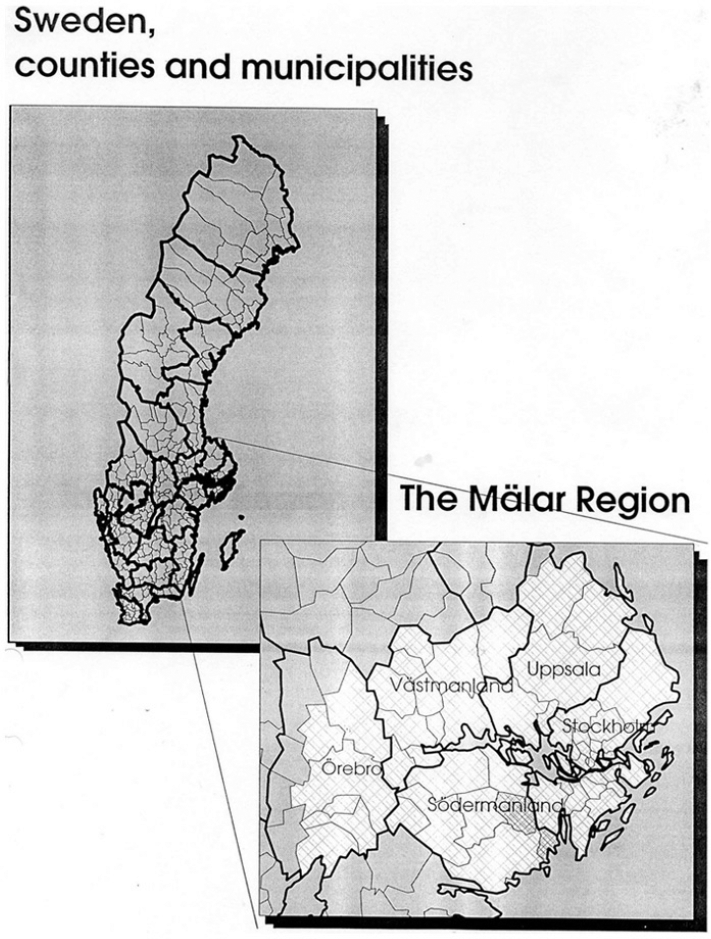
The Mälardalen of Sweden.
Data and methods
Individual-level data and data on commuting distances
We base our study on all individuals who were registered with legal residence in one of the municipalities of the Mälar region on 31 December 2005 and were gainfully employed with a given workplace location also in Mälardalen in November the same year. According to the register on employment at Statistics Sweden, a person is gainfully employed if he or she worked at least one hour per week during November in a given year. Those with several workplaces were excluded from the data. For some people, for example farmers, the workplace may be located at the same address as that of their residence. In the registers, all individuals are registered with the location of their residence being specified at a detailed geographical level. Workplaces are specified with similar degree of geographical precision. In our case, the data on employment and residence are provided to us with the accuracy of Small Area Market Statistics (SAMS) areas: the region has about 2600 such areas in total. This level of geographical precision is used as the basis for our data on travel distances for the commuters in the region. Our definition of being a commuter, however, is based on municipality borders: An individual is defined as being a commuter if his or her place of residence is located in one municipality but the workplace is located in another municipality. The reason for choosing this definition is that the municipality often is perceived by both residents and commuters as the most critical geographical demarcation; further, a motivation for our study is to provide input for actions taken by municipalities in terms of planning. With our definitions, there were 1,225,697 employed residents within the Mälar region at the end of 2005; 502,546 of them were commuters.
Our study provides a prospective follow-up of commuter behaviour during one subsequent calendar year, i.e. 2006. The reason for choosing 2005 as our baseline year is that we have access to data on distances and travel time by car, and travel time by public transport between each single SAMS area in that year; these transport data were provided to us by The Office of Regional Planning and Urban Transportation at the Stockholm County Council. The actual travel distances are important to consider as the lake Mälaren acts as a barrier in the region and makes the use of any Euclidian distances inappropriate.
In our models, we define three competing outcomes to describe any changes in commuter status from 2005 to 2006. By means of multinomial logistic regression, we study the propensities of each of the 502,546 commuters to stop being a commuter during the one-year follow up, by either a (1) change of residence, (2) change of workplace location, or (3) change of both workplace and residence during 2006. The baseline outcome is to remain a commuter. We estimate our models based on a set of individual and contextual independent covariates that help us provide insight into what factors are associated with the propensity to stop commuting in one way or the other or to remain a commuter.
Our data bring additional longitudinal depth: One variable depicts the
Contextual data
Municipality types
In our models, we also introduce different contextual variables to study how they relate to individual decisions to stop or remain being a commuter. We link a range of variables that describe different characteristics of the municipalities where the commuters live and work to the data. Our first variable describes the type of municipality according to its type of settlements, as defined by the Swedish Association of Local Authorities (Sveriges kommuner och landsting, 2010). This variable covers different dimensions of the size of the municipality, its density, general commuting patterns and, to some extent, its type of industry (see Appendix 1). About one-third of the region’s population live in ‘suburbs to Stockholm’. About 30% is found in Stockholm itself; other ‘large cities’ cover an additional one-fifth of the region’s population. The remaining municipality categories have much lower fractions of inhabitants.
Accessibility and housing prices
One important characteristic of a municipality is the accessibility for its inhabitants to workplaces in the municipality itself and the region that surrounds it. There are many different definitions of accessibility; for background literature on these measures, see, e.g. Hansen (1959), Handy and Niemeier (1997), Östh (2011) and Reggiani et al. (2011). The accessibility measure that we apply describes how many workplaces that an individual who lives in a given area can reach within reasonable time and cost limits. Our measure is defined as follows. The travel cost between a given SAMS area and any other area in the region is measured in terms of a generalised cost, which amounts to a weighted sum over transport modes that cover both monetary and travel time costs. For a given area of residence all reachable workplaces are summarised by means of a weighted indicator of accessibility as computed by an exponential function with a negative parameter. The accessibility in area

where
Higher accessibility for a municipality is in general related to higher prices on housing and real estate in the area. This could have a negative effect on the municipality’s attraction and we apply this factor as an additional covariate in our model on commuter mobility. The mean taxation value of single-dwelling houses in 2005 is taken as our variable. This value reflects the prices of housing in the municipality. The statistics are derived from Statistics Sweden (www.statistikdatabasen.scb.se).
Housing construction, employment growth and municipality tax rates
Investments in new dwellings and the expansion of new workplaces are two indicators of a municipality’s development. We apply two variables on these dimensions to study how these factors may relate to commuters’ mobility. Data on the supply of new dwellings are derived from statistics on completed dwelling units during the five-year period 2002–2006. There are no exact statistics on the number of new physical workplaces by municipality. Instead we use statistics on the annual changes in employment in each municipality as an indicator of the supply of new workplaces. The average of annual statistics during a five-year period is chosen as single year statistics are heavily affected by random fluctuations.
Taxation rates also differ by municipality; income taxes are paid in a person’s municipality of residence. The taxation rates in 2005 are used as an additional variable to explain changes in commuter status. We expect higher taxation rates to be negatively associated with a municipality’s possibility to attract new residents. The background data for all our contextual variables are provided in Appendix 2.
Summary statistics: Commuters and non-commuters in the Mälar region
Commuters versus non-commuters
In 2005 in the Mälar region, there were 1,225,697 employees for whom both the residence and the workplace were localised to a specific SAMS area of the region. Of those, 41% were commuters with the residence in one municipality and the workplace in another. Women were commuting to a slightly lesser extent than men: Among employed men the share was 44% and among employed women it was 38%. Further, men had on average larger commuting distances than women. Table 1 provides statistics on the distribution of commuters and non-commuters by our individual-level variables. The distributions are provided for women and men, separately. The statistics reveal, for example, that the age structure is very similar for commuters and non-commuters, both for women and men. Male commuters are more frequently married/cohabitating and less often single than non-commuting men. Commuters have in general higher educational attainment than non-commuters. They are less often found in the lowest earnings quintiles and more often in the highest quintiles. Male commuters have the highest earnings profile of all groups. Our data on the duration of commuting in years reveal that the number of commuters decreases with increasing commuting duration, but close to 30% of commuters had still been commuting for ten years or more.
Distribution of commuters and non-commuters, employed men and women, by socio-demographic variables. The Mälar Region of Sweden, 2005.

The distribution of travel to work distances shows that the distance between residence and workplace is less than 10 km for more than half of all employees. For non-commuters a great majority, 85% of men and 84% of women, has such a short travel distance. Even among those defined as commuters, 12% of men and 16% of women have a distance between residence and workplace that is less than 10 km. Further calculation reveals that the mean distance between home and workplace is 5 km for non-commuters and 30 km for the commuters. Furthermore, but not shown in Table 1 and not used as covariates in our analyses, the mean travel time by car from home to workplace is 12 minutes for non-commuters and 36 minutes for commuters. The mean travel time with public transport is 21 minutes for non-commuters and 59 minutes for commuters. The travel time with public transport includes access time, waiting time and time in vehicle.
Finally, Table 1 provides the distribution of employed residents by their municipality types of residence and workplace, respectively. In the Mälar region, the most common municipality of residence is a suburb to Stockholm (34%), followed by the city of Stockholm itself (28% of the working population) and the other large cities of the region (21%). Two-thirds of the non-commuters live in Stockholm or the other large cities of the region, whereas for commuters the same fraction is found in suburban municipalities or municipalities defined as commuter municipalities. In the region as much as 39% of the workplaces are located in the city of Stockholm. There are thus a tendency of workplaces to be disproportionally located in the centre of the region and dwellings to be located in suburban municipalities. This pattern is maintained by the distribution of commuters across municipalities of workplace and residence.
Commuter mobility
Next, we proceed to calculate statistics on changes of residence and/or workplace for employed people in the Mälar region during the calendar year we study, i.e. 2006. We focus on changes that involve a change in location across a municipality border and find that commuters were much more prone than non-commuters to either migrate (5% versus 2% mobility) or change their workplace (13% versus 4% mobility) during our study year. To change both municipality of residence and workplace during the same year was made by 1% of commuters and non-commuters alike. These patterns underline that commuting may not be a person’s most desired status but can rather be seen as part of a search process for better work and living conditions.
Our data also allow us to calculate a survivor function of the status of being a commuter based on the duration-specific data of 2006 and the notion of a synthetic cohort (Blossfeld et al., 2007; see also Shorrocks, 1975). The survivor function is calculated from the rates of ending commuting during 2006, by the duration of being a commuter and regardless of the mode of ending commuting. The calculations demonstrate that the intensity of ending commuting is highest at the shortest durations since becoming a commuter (data not shown but available on request). About one in five commuters quit commuting within one year since becoming a commuter. After five years, around half of the commuters have stopped commuting. Still, almost 40% of new commuters remain commuters after ten years of commuting with the same residence and workplace municipality constellation.
Multivariate analyses
Multivariate analysis with individual-level covariates
We now proceed to study how our different individual-level covariates are associated with the propensity of ending the status of being a commuter during our one-year follow-up. This is done by means of a multinomial logistic regression model that covers the following three competing exits as compared with the outcome of remaining a commuter:
migration to the municipality where the workplace is located;
change of workplace to the municipality of residence;
both migrate and change workplace to any other municipality (including any municipality outside the Mälar region) and become a non-commuter.
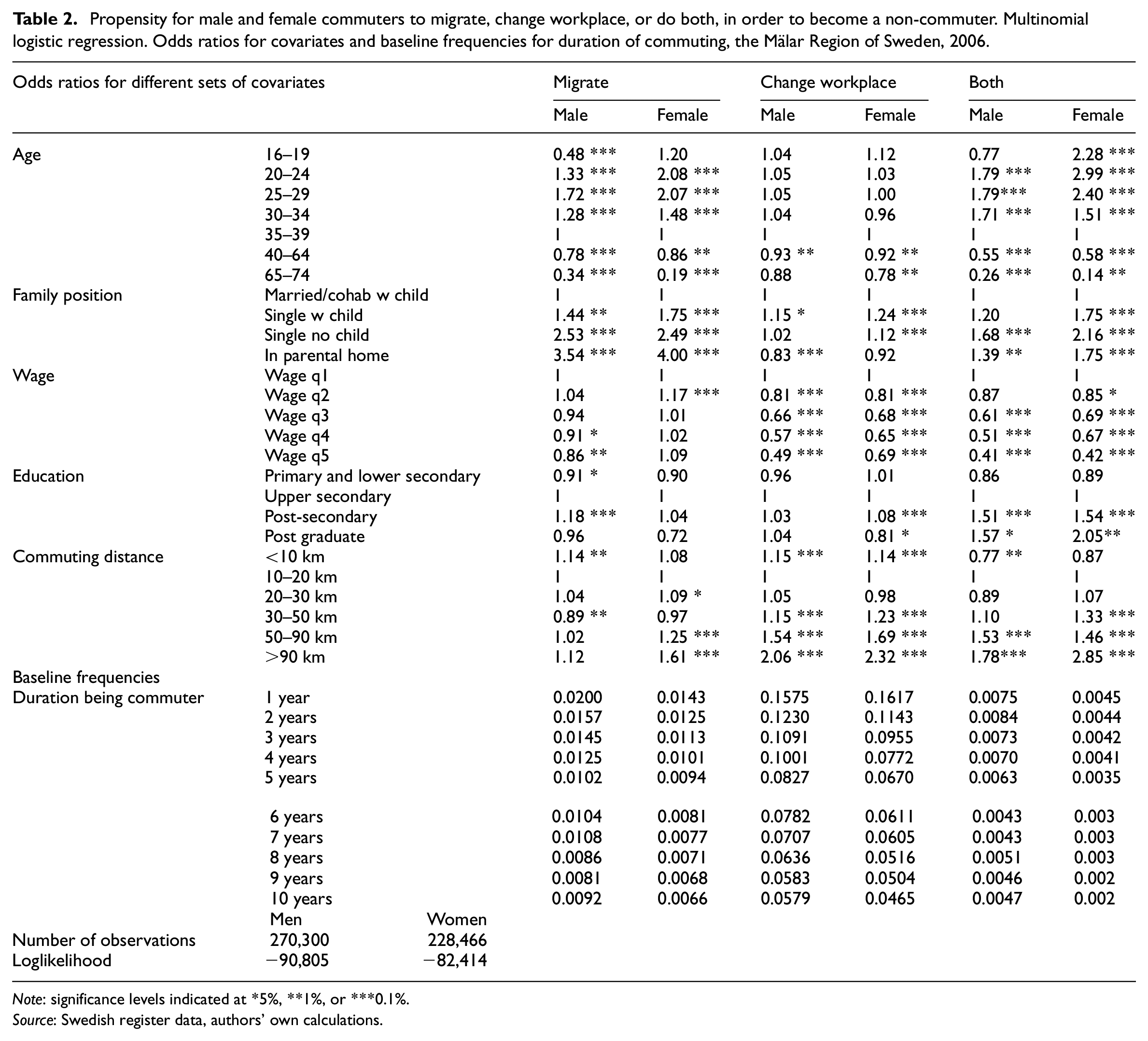
In Table 2, the results from our models are presented in terms of odds ratios for the individual-level covariates at our disposal. We present separate models for women and men.
Propensity for male and female commuters to migrate, change workplace, or do both, in order to become a non-commuter. Multinomial logistic regression. Odds ratios for covariates and baseline frequencies for duration of commuting, the Mälar Region of Sweden, 2006.
Ending commuting by means of migration
In general, patterns in the migration dynamics of commuters resemble those for domestic migration overall (e.g. Andersson and Schéele, 1998). Migration intensities are highest for women and men in their 20s, the intensities peak somewhat later for men than for women. At higher ages these intensities decline monotonically with age. As to family position the most common commuter is married or cohabiting with children in the household (Table 1). Compared with commuters in other family positions these persons are less likely to migrate (Table 2). Commuters who still live in their parental home have the highest odds to become a non-commuter by moving to the municipality where his or her workplace is situated. Singles with no children also have high odds of migration. Family position is the covariate with the strongest impact on a commuter’s migration risk (cf. Mincer, 1978).
In contrast, the levels of income and educational attainment are not much associated with the propensity to change residence. There is only a weak negative association with male commuters’ very high earnings and the odds of domestic migration while men with post-secondary education have a somewhat higher propensity to end commuting by a migration event. For women there is no clear association of either earnings or educational attainment with their migration intensity.
For commuting distance in kilometres we note that women with very long travel distance have elevated migration odds. However, in general commuting distance shows a very weak association with migration propensities. We note that these odds are mainly influenced by the demographic variables, i.e. family status and age, and that patterns for women and men are fairly similar.
Changes of workplace
In contrast to the patterns found for migration the relative odds of workplace change mainly depend on the economic variables, i.e. travel distance and earnings. Like the case of migration, patterns in associations are fairly similar for women and men.
In particular, the odds of changing workplace does not vary much with age. To some extent, this is related to the declining odds of workplace change by increasing duration of commuting experience in years, which is correlated with age. The family position of women and men is also not much associated with the odds of changing workplace but single individuals with children have slightly higher odds than others.
The odds are also not much associated with commuters’ educational attainment. In contrast, the relative odds depends very much on women and men’s earnings: low-income earners are much more likely than high-income earners to end their commuting status by a change of workplace. Men in the highest earnings quintile have only half the odds of men in the lowest quintile. Another striking pattern is that the relative odds of changing workplace increases continuously with increasing commuting distance. Evidently, for long-distance commuters it is much more common to end the stress related to commuting by changing the workplace than by moving to the municipality where the workplace is located.
Change of both workplace and residence
Based on much fewer outcomes the relative odds of changing both workplace and municipality of residence shows strong associations with each of our variables. It seems this behaviour picks up the dynamics of both processes and adds them to each other. In this part of the model, the commuters’ educational attainment also comes out as a significant variable: highly educated commuters have much higher odds than others to pursue this very drastic termination of their commuter status. Young age, singlehood, low earnings, and long commuting distance are all positively related to this outcome.
Contextual variables: Municipality attraction
We now proceed to our main research question, that is to study the characteristics of the municipalities in the region that make them more or less attractive to the commuters in terms of their choice of residence and workplace location. By standardising for all individual-level covariates analysed in the previous section we study how different contextual covariates influence the propensities to stop commuting. We add covariates that describe the characteristics of the two municipalities where the commuter carries out his or her daily life: the municipality of residence and that of his or her workplace.
Four models with alternative combinations of contextual variables are analysed. In our Models 1–4 we add variables for: (1) municipality type of residence and workplace, (2) taxation rates in the two municipalities, (3) the supply of new dwellings in the workplace municipality and the employment growth in the municipality of residence, and (4) the accessibility and values of properties in the two municipalities. As the different municipality variables all are related to each other we chose to study each set of contextual factors separately. As baseline, a Model 0 includes only the individual covariates analysed above, with gender as an additional covariate. As the patterns for women and men were very similar for the three outcomes we study (Table 2), we estimate joint models for women and men for the three competing ways of ending commuting (Tables 3 –5).
Propensity for commuters to

Propensity for commuters to

Propensity for commuters

The municipality types of residence and workplace enter as straightforward categorical variables in the multinomial logistic regression (Model 1 of Tables 3 –5). In Model 2 we include the difference between the actual taxation rate in the municipality of interest and the lowest rate in the region, which we call the ‘excess taxation rate’. It is a continuous variable. The level of income taxes are set by the municipalities and varied between 29.85% and 33.05% of taxable earnings.
In Model 3, we include data on new dwellings and the expansion of workplaces. Data on new dwellings are of interest to determine how much this type of investment increases the commuters’ propensity to move to the municipality where the workplace is situated. Data on new workplaces makes us able to study the extent to which this type of development is related to increased propensities to change workplace to the municipality where the commuter lives.
For investments in transportation systems it is argued that high accessibility to workplaces is positively related to a municipality’s possibility to increase its population. However, high accessibility may also increase the values of a municipality’s properties, which could have a counteracting effect on its attraction as it makes it more expensive to live there. Our Model 4 includes an accessibility index measured in terms of thousands of workplaces and the taxation values of single-family housing in the municipality. Both are entered as continuous variables.
Migration dynamics
Table 3 demonstrates the role of individual-level and contextual covariates in the migration decisions of commuters. We note that patterns in odds ratios for the individual-level variables are stable across different specifications of contextual characteristics. The one exception holds for the semi-contextual variable that depicts an individual’s commuting distance. When adding municipality types in Model 1 or accessibility in Model 4, the longest commuting distance – more than 90 km – is no longer related to significantly elevated migration propensities. Evidently, the stabilising role of high job accessibility can outweigh the migration-stimulating impact of long commuting distance.
Model 1 further shows that migration rates are much higher for commuters with their workplace in Stockholm or any of the ‘large cities’ of Mälardalen. This also holds for commuters who work in any of the two ‘tourism municipalities’ in the region. This means that these municipalities have a high possibility to attract people who are already working there. In contrast, people who commute to work in a suburb to Stockholm have the lowest odds to move to the municipality in which they work.
Model 1 also reveals that commuters who live in Stockholm or any of its suburbs have a reduced propensity to move to the municipality where their workplace is located. Commuters who live in other types of municipalities have higher risks of leaving their municipality of residence. Taken together, these two municipality variables highlight the attractive role of Stockholm for residents in the Mälar region.
Model 2 demonstrates that a higher taxation rate in the municipality of residence increases the risk of out-migration from that municipality while a higher taxation rate in the municipality of workplace decreases the risk of migration to that municipality. These directions of effects are as expected.
Model 3 shows that investments in new housing in the workplace municipality increase the propensity of commuters to move there while an expansion of new workplaces in the municipality of residence decreases the propensity to move from that municipality. These directions of effects are also in the expected direction.
Finally, Model 4 demonstrates the extent to which more expensive housing in the municipality of residence increases the propensity to move away from that municipality: this effect is not statistically significant. In contrast, higher accessibility in the municipality of residence is related to lower propensities of out-migration. Higher housing prices in the municipality where the workplace is located are related to a lower propensity for commuters to move there while a higher accessibility increases its attraction for commuters to move to that municipality.
Changes of workplace
Table 4 demonstrates the patterns of ending an individual’s status of being a commuter by means of the competing event of changing his or her workplace to the municipality in which he or she lives. The individual-level variables have the same patterns of associations with that outcome across models with different specifications of municipality contextual variables (Models 1–4).
There are few differences across the different categories of workplace municipalities in their attraction to keep their commuters working there (Model 1). In contrast, commuters who live in Stockholm or any of the ‘large cities’ of the region have very high propensities to change their workplace location to the municipality in which they live. This demonstrates the strength of the labour markets in these municipalities. The lowest odds of finding a workplace in the municipality of residence is found for commuters who live in suburbs to Stockholm and the large cities.
Model 2 demonstrates that higher tax rates in the municipality of residence decreases the propensity for commuters to also change their workplace to that location, whereas higher taxation in the workplace municipality increases the propensity to change the workplace away from that municipality. These patterns mirror the considerations that are made when commuters decide whether to make a relocation of their workplace or their residence.
Model 3 further shows that investments in new housing in the workplace municipality decrease the commuters’ propensity to change their workplace away from that municipality. Evidently, this mirrors the increased migration propensities to the same municipality (Table 3). Similarly, employment growth in the municipality of residence increases the propensity to change workplace to that municipality.
Finally, the propensity to change workplace decreases with increasing job accessibility in the workplace municipality and with higher prices of housing in the municipality of residence; similarly, the propensity to change workplace increases with increasing job accessibility in the municipality of residence and higher housing prices in the municipality of the workplace (Table 4, Model 4). Again, this mirrors the patterns we observed in Table 3 and reflects the situation where commuters weigh factors that influence the decision whether to change workplace or place of residence.
Change of both residence and workplace
Finally, Table 5 shows how different contextual factors relate to our most drastic way of ending a person’s commuter status, i.e. that of changing both municipality of workplace and that of residence during a calendar year. It shows that people in the city of Stockholm have depressed odds of leaving their municipality, be it for work or for living. The odds of this double relocation increases with increasing housing prices in the two municipalities involved and decreases with increasing job accessibility in any of the two municipalities.
Conclusions
Commuters are more mobile than non-commuters. This holds not only on a daily basis but also as concerns migration rates and propensities to change workplace. In our study, we examined the behaviour of commuters in the dynamic Mälar region of Sweden. Our window of observation was located in 2006, a calendar year with fairly typical patterns in terms of regional development in early 21st century Sweden. The main contribution of our study is that we had access to longitudinal data on commuter behaviour and were able to produce empirical evidence of commuter dynamics as manifested in the combined and competing outcomes of migration and workplace relocations. Very little previous research has addressed both of these outcomes simultaneously (van Ommeren et al., 1999; Vickerman, 1984; for a discussion see Haas and Osland, 2014); the necessary longitudinal data are rarely available to researchers (Champion et al., 2009). The most common action of commuters to change their status to that of a non-commuter was by means of change of workplace (cf. Vickerman, 1984). This event as well as that of change of residence is highest for commuters at relatively short durations of the status of being a commuter. The frequencies of each of the three types of commuter mobility we study all decline with increasing length of commuter duration. Evidently, long-term commuters are a select group of people who have adapted themselves to their status as commuters.
We note that the propensity of commuters to pursue a change of residence depends very much on their lifecycle stage in terms of age and family status. Migration itself is a demographic event and it is mainly associated with other demographic variables. In contrast, economic variables, such as earnings and travel costs, have only weak or no association with commuters’ migration rates. For the odds of workplace change, the opposite holds. The demographic characteristics of male and female commuters have no influence on this type of behaviour while instead the economic factors come out very strongly, with elevated odds of workplace change for commuters with low earnings and long travel distances. To both pursue a migration and change of workplace during a calendar year is very uncommon, but the odds of this event depends on all variables considered. Evidently, it adds the dynamics of both processes involved. Another interesting feature from our models on individual commuter behaviour is that all covariates tend to work in the same direction for women and men. The gendered nature of the factors that affect commuter behaviour is thus quite weak. To some extent, this may reflect the relatively advanced stage of gender change and related gender equality in Sweden and Scandinavia (Goldscheider et al., 2015).
In our study, we used the behaviour of commuters as an indication of the relative attractiveness of the municipalities in the Mälar region. One of our purposes was to provide input to municipality planners for more efficient regional planning (Office of Regional Planning, 2010). Most municipalities aim at increasing their residential population in order to strengthen the basis for taxation and services. In terms of commuter behaviour, municipalities would thus benefit from as little out-migration as possible of the commuters who live in the municipality, and as much in-migration as possible of its working population with residence outside the municipality borders.
From our analyses we could observe that an employee who is a commuter has a higher propensity to move to the municipality where his or her workplace is located if it is situated in Stockholm or another large city of the region, and a higher propensity to change workplace to the municipality of residence if he or she lives in Stockholm or another large city. Taken together, this demonstrates the attraction and dominance of the large cities, and of Stockholm in particular, in this economically viable region.
In addition, the municipality contextual variables provided valuable insight into the considerations of commuters when choosing whether or not to quit commuting. In many respects, the impact of these variables on the propensity to stop commuting by means of a migration event mirrors those of the process of changing workplace. We found, for example, that the accessibility to workplaces has a positive impact on a municipality’s population growth, both in terms of decreased out-migration propensities of its commuting residents and increased in-migration rates of people who work in the municipality but do not live there. Further, high housing costs may have a depressing effect on population growth, but its effects turned out relatively weak. Evidently, more expensive housing acts both as an economic constraint for people who want to move to an attractive municipality and as a reflection of the area’s attraction in itself. In contrast, we found that higher tax rates indeed have a negative effect on net migration rates. This may not be surprising as such but we note that other empirical research often fails to find such straightforward relationships between taxation and the outcomes we study (e.g. Deskins and Hill, 2010; Liebig and Sousa-Poza, 2006).
Finally, we could demonstrate that an increased supply of new dwellings has a stronger positive impact on population growth than an increased supply of new workplaces. An inspection of the effects on odds ratios by a supply of, for example, 100 new dwellings in the workplace municipality and of 100 new workplaces in the municipality of residence, respectively, reveals that investment in new housing construction has the largest effect in terms of increasing a municipality’s population. We note that this holds in a region which is dominated by Stockholm and its very strong labour market and where the metropolitan area of Stockholm and its suburbs are characterised by a shortage of housing. It may not hold in other contexts with other labour and housing market structures. Evidently, many different factors are at play in making some cities and municipalities more attractive than others (e.g. Buch et al., 2014). Yet, the finding of a positive impact of better accessibility to workplaces may be of more general nature. As advice to municipality and regional planners, we feel safe to encourage continued investments in infrastructure. For municipalities in the wider Stockholm region who aim at increasing its population it also a safe bet that it pays to support additional investments in new housing construction.
Evidently, the process of terminating commuting is mirrored by the process of other people to begin commuting. We leave for future research the study of the different avenues of entering into commuting and the various individual-level and contextual factors that may trigger this behaviour.