







Abstract
Introduction
China’s rapid and ongoing urbanisation has encouraged the expansion of the local state (Chen et al., 2021; Wong, 2015). In addition to transforming the population and the countryside, the process of mass urbanisation has involved sweeping changes in local governments due to territory administrative redistribution and rural-to-urban reclassification (Cartier, 2015; Chen et al., 2021; Kan and Chen, 2022). Scholars argue that subjective measures of well-being complement the more established objective indicators of economic and social status, progress, and achievements (Chen et al., 2015; Helliwell and Huang, 2008) and can provide valuable input for government decision- and policy-making (Bok, 2011; Diener et al., 2009; Layard, 2010). Therefore, improving citizens’ subjective well-being has been a key objective of reforms in many countries, especially those experiencing social transitions (Rogers et al., 2012). China is no exception; the central government first pronounced ‘people-centred’ urbanisation in the National New-Type Urbanisation Plan (2014–2020) and continued to emphasise and promote it in the following National New-Type Urbanisation Plan (2021–2035). It is, therefore, apposite to determine how the expansion of the local state affects citizens’ subjective well-being during China’s ongoing ‘new-type’ urbanisation nationwide (Chen et al., 2023; Guan et al., 2018; Wang et al., 2015).
Research on the factors contributing to human subjective well-being has flourished in recent years. In addition to defining the issues and devising the measurements, the early literature identified relevant variables, including health, socio-economic status, organisational activity, beliefs, and psychological state (Palmore and Luikart, 1972). More recently, another factor – the influence of the state – has been considered in studies of citizen’s subjective well-being. In the literature on the effects of the state, survey-based measures of subjective well-being are generally regarded as reliable indicators (Woo, 2018). The most widely accepted and administered survey measure, which has become readily available worldwide in recent years, is the global cognitive assessment of life satisfaction (Appleton and Song, 2008; Diener et al., 1985, 2015; Woo, 2018). Translated as
While the state traditionally bears the characteristics of the bricks-and-mortar institutions of government, that is, the physical presence of the state (Chang and Wang, 2021; Chen et al., 2023; Mann, 1984), in recent years, it has also appeared virtually as the product of complex network infrastructure systems, such as social media platforms, relying on web-based technologies (Garson, 2006; Wong and Welch, 2004). The term ‘virtual state’ has been used in existing literature to refer either to the online networks and services provided by government institutions and accessed by citizens, businesses, and other agencies or the information technology and networking that infuse every level of government and every domain of government service (Garson, 2006: xii). In this article, we use the term the ‘virtual presence of the state’ or the ‘state’s virtual presence’ in contrast to the ‘physical presence of the state’ to refer to the online systems developed by the government through network infrastructures. These virtual systems aim to coordinate and integrate information dissemination and service provision and optimise the use of the state’s resources (Wong and Welch, 2004). Scholars have argued that a robust physical government infrastructure improves government function and can increase citizens’ life satisfaction (Rothstein, 2011; Soifer, 2008; Steinberg, 2018). They have also maintained that, as it is dependent on the physical infrastructure, the state’s virtual presence is unlikely to have an independent significant influence (Kraemer and Dedrick, 1997; Torres et al., 2006; Wong and Welch, 2004). In this contribution, we combined innovative measures of the state’s presence with survey data to estimate how the local state’s physical and virtual presence is associated with citizens’ life satisfaction and how these associations differ between newly urbanised areas and potential sites of urbanisation in the context of China’s urbanisation. We drew on data from the 2018 Urbanisation and Quality of Life Survey to measure self-reported life satisfaction using the Chinese version of the Satisfaction with Life Scale (Appleton and Song, 2008; Diener et al., 1985, 2015).
In contrast to the arguments offered by existing scholarship, our study reveals that the physical and the virtual presence of the local state is associated with citizens’ life satisfaction in distinct ways, while the local state’s virtual presence is positively associated with citizens’ life satisfaction, its physical presence is negatively associated with citizens’ life satisfaction in potential sites of urbanisation. The differences in the interactions between the presence of the state and citizens’ life satisfaction suggest that, in the course of the national new-type urbanisation, local bricks-and-mortar state institutions fail to satisfy the expectations of Chinese citizens; instead, local government’s establishment of a web-based, cost-effective, transparent, and coordinated state presence is correlated with a greater sense of life satisfaction among citizens. Given the Chinese government’s continuous commitment to ‘people-centred’ urbanisation in the new era of urban development (Guan et al., 2018; Wang et al., 2015), this study’s findings offer insights into strategies that local governments could employ to improve their governance capacities and enhance citizens’ subjective well-being.
China’s unique path to urbanisation has avoided many of the pitfalls experienced by other developing countries in Africa, Asia, and South America. Recently, China’s strong economic presence in some of these developing countries has influenced their paths to urbanisation and their methods of local governance (Guan et al., 2018). Like China, other developing countries are also experiencing rapid and unplanned urban growth, exacerbating inequalities and threatening sustainable development (Ren, 2020). While developed countries have already reached a high level of urbanisation, 95% of future urban expansion will occur in developing countries (United Nations, 2015). Therefore, this research will further stimulate the exploration of comparable measures in developing countries and the assessment of local governance and its impact on citizens’ well-being.
China’s urbanisation and the expansion of the local state
The Chinese government has set clear goals for its urbanisation reforms. The National New-Type Urbanisation Plan (2014–2020; hereafter ‘the Plan’), launched in March 2014, emphasised people-centred urbanisation (Wang et al., 2015). The Plan aimed to increase the urban population so that by 2020, it would represent 60% of the total population. This goal entailed the relocation or reclassification of 100 million villagers. The Plan stressed that China’s future urbanisation should be people-oriented and designed to improve citizens’ quality of life through investment in infrastructure and
The urbanisation process has been accompanied by the expansion of the local state. China’s local government comprises four levels: provincial, prefectural, county, and township. At the county level, administrative divisions are categorised as urban districts, regular counties, county-level cities, and other county-level units, including banners (
The local governments aim to increase the state’s reach and capacity by converting old institutions and creating new organisations and agencies in rapidly urbanising areas. In so doing, they hope to facilitate economic growth, mitigate potential social unrest, reduce rural–urban inequalities in welfare and service provisions, and enhance citizens’ livelihoods and well-being (Kan and Chen, 2022; Wong et al., 2021). However, scholars researching urbanisation in China have found that decentralising state power has encouraged local governments to focus on pursuing economic growth and urban development through avaricious land appropriation rather than improving citizens’ livelihoods, well-being, and access to welfare and services. This has resulted in ‘urbanisation of place’ rather than ‘urbanisation of people’ (Cartier, 2015; Heberer and Göbel, 2011; Ong, 2014). After all the administrative reclassifications, infrastructure development, spatial restructurings, and population transformations, it remains unclear whether the changes associated with the national new-type urbanisation have actually improved Chinese citizens’ access to urban employment, services, welfare, their livelihoods, well-being, or overall life satisfaction.
The presence of the state and citizens’ life satisfaction
The physical presence of state institutions has long been considered a source of power (Mann, 1984). This argument relies upon the social theory promoted by Michael Mann, of which a broader theoretical orientation can be traced back to Marxism and the functionalist traditions of state theories (Cohen, 2000; Mann, 2005). Mann holds that the power of the state infrastructure is evident in its influence on localities and the people within them (Goldstone, 2006). Since the state can control the delivery of economic and other policy outcomes, it can also affect citizens’ livelihoods and well-being. Scholars have employed data on GDP, public expenditure, and the density of public infrastructure to measure the state’s physical presence (Fearon and Laitin, 2003; Goodwin, 2001; Snider, 1987). However, existing research regarding the relationship between the state’s physical presence and citizens’ life satisfaction mostly relies on national or regional/provincial data and has found only weak connections that do little to explain local variations (Herrera and Kapur, 2007). In this study, we followed Soifer (2008), who argues that the optimal measure of state influence is the physical presence of the state infrastructure at the local level because this best captures variations in state presence (Steinberg, 2018). Specifically, we collected geo-referenced points-of-interest (POI) data on state institutions in China and calculated the total number of state agencies at the county and subordinate levels (Chang and Wang, 2021).
The power of the state infrastructure is determined by the extent to which it exercises power over local regimes (Soifer, 2008). Infrastructural power properly applied can promote economic development (Dincecco, 2017; North, 1981), prevent political violence (Fearon and Laitin, 2003; Kalyvas, 2006), and facilitate the delivery of public goods (Rothstein, 2011). These contributions are very likely to positively affect citizens’ livelihoods and well-being, and self-reported life satisfaction. However, the state’s physical presence is uneven; there are more government organisations and agencies in some regions than others (Soifer, 2008; Steinberg, 2018), leading to imbalanced economic development, political stability, and public service provision. Our first hypothesis, therefore, was:
Other scholars, however, argue that the physical presence of state infrastructure is likely to impact citizens’ life satisfaction negatively. According to public choice theory, the utility-maximising behaviour observed in the market can also be observed in the government’s non-market activities (Bjørnskov et al., 2007); government administrators will pursue their own interests by maximising their budgets and fostering excessive government agency growth (Brennan and Buchanan, 1980). Thus, the cost overruns on massive state building projects will lead to increased taxation rather than public spending benefiting citizens. Consequently, citizens’ life satisfaction will decline. This trend is likely most evident in areas considered for potential urbanisation with limited finances and resources (Wallace, 2013). These considerations lead to a competing hypothesis (
The state’s virtual presence through network infrastructure systems has helped improve governance capacities, a particularly prominent phenomenon through certain social media platforms (Wong and Welch, 2004). Studies of government use of social media in Western countries have focused on Facebook and Twitter (Tursunbayeva et al., 2017). In the past decade, growth in the Chinese government’s use of social media has been rapid – first through online broadcast microblogging on Weibo, more recently via mobile app WeChat, and most recently through the video-sharing platform Douyin (Jiang et al., 2021; Lu et al., 2016). Different social media platforms are often designed to serve different purposes in China (Stockmann et al., 2020; Stockmann and Luo, 2017). For instance, Weibo is often used by the government to propagate official messages, whereas WeChat is appropriated to provide digital public services, for example, by being linked with government mini-programmes – a feature not available on Weibo.
As the only mobile app with over 1 billion active users in China, WeChat outperforms many other social media in service delivery through its public account platforms (Jiang et al., 2021). A wide range of services have been made available through local governments’ WeChat public accounts, including booking appointments, paying taxes and fees, filing complaints, etc., facilitating direct interactivity between the government and citizens. Scholars claim that WeChat has become the most widely used information and communication technology (ICT) in China and has transformed government communication with citizens (Pan, 2020). Therefore, in this study, we focused on Chinese local governments’ use of WeChat platforms and collected and coded data on the county-level governments’ WeChat public accounts. Specifically, we used the length of time since the establishment of each county’s WeChat platform as a measure of the local state’s virtual presence.
Studies have found that network infrastructures enhance government efficiency and empower citizens (la Porte et al., 2002). They can create a new virtual government – citizen interface and a participation-friendly atmosphere (Enserink and Koppenjan, 2007). Studies of government use of social media platforms to extend state reach and capacity show that adopting social media has improved government efficiency by promoting customer-oriented service delivery (Stamati et al., 2015). Greater interactivity between the state and its citizens can increase government transparency, enhance citizens’ participation in policy development and decision-making, and improve government responsiveness to public demands (la Porte et al., 2002; Wong and Welch, 2004). Empowered citizens who believe they can influence the policy process are likely to report higher overall life satisfaction. Therefore, we hypothesised that virtual state presence contributes to higher levels of life satisfaction:
Because improvement in the virtual presence of the local state can enhance government capacities in both urban and rural areas, we did not foresee a difference in this association between newly urbanised areas and potential sites for urbanisation.
Data and methods
Measuring the presence of the state
We developed measures to assess the presence of the physical and virtual state infrastructure using data from multiple sources. While the literature on the state’s presence and citizens’ well-being generally deals with large areas (countries and regions/provinces), our research examined the effects of the smaller and lower-level governments of Chinese counties and urban districts. Recent government documents specify county-level administrative units as ‘the important carriers to promote urbanisation’, taking increasing responsibility for providing public goods and playing a major role in state rescaling initiatives (Jiang et al., 2023). They also vary widely across the country (Chang and Wang, 2021; Lü and Landry, 2014). Thus, focusing on the county level can better capture the dynamics of the local state and its associated variance in citizens’ life satisfaction.
The physical presence of the local state
We obtained geo-referenced points-of-interest (POI) data on state institutions provided by map service companies and constructed a unique spatial dataset to measure the local state’s physical presence. We used Python to scrape the POI data from Amap.com– a navigation and location-based service provider in China and one of the largest in the world. Amap’s POIs are more detailed than those of other map service companies. We used the codes provided by Amap to identify all local government organisations and agencies. To ensure reliability and validity, we repeated the data construction procedure for various years and different sources to check the correlations between different measures (for details please see Chang and Wang, 2021).
We coded the total number of agencies at the county and subordinate levels, mapping these agencies into four categories: administrative, coercive, legal, and fiscal. We calculated the total number of state infrastructure units at the county and subordinate levels and the number of institutions in each of the four categories per 100,000 residents. As Table 1 shows, the total number of state infrastructure units at the county and subordinate levels ranged from 27.893 to 259.335, with an average of 97.058 per 100,000 residents. Of the four categories, administrative infrastructure had the highest number, followed by coercive, fiscal, and legal infrastructure units.
Descriptive statistics of county/township-level variables and descriptions.

Government administration includes the executive branch and its various functional departments (labour, education, environmental protection, etc.). Coercive agencies include those dealing with stability maintenance (a dispute-resolution body established in the early 1990s to arbitrate civil disputes) and the police force, which controls and represses social unrest. Legal institutions include the procuratorate (i.e. public prosecutor), courts, and notaries. Fiscal institutions cover licensing agencies for commerce and industry, regulating economic activities, and taxation collection agencies (Chang and Wang, 2021).
The local state’s virtual presence
To measure the local state’s virtual presence, we checked whether the county-level government maintained a WeChat public account and, if so, when it was opened. We calculated the number of months between the establishment of the WeChat public account and April 2018 (immediately before the implementation of the 2018 Urbanisation and Quality of Life Survey). We coded those without a WeChat account as zero. As Table 1 shows, the average length of the county WeChat public accounts was 23.275 months, ranging from 0 to 51 months.
The 2018 urbanisation and quality of life survey
Sample and data collection
We linked the measures of state presence to data from the 2018 Urbanisation and Quality of Life Survey, which covers 40 primary sampling units (PSUs): 32 township-level administrative units in newly urbanised areas (i.e. areas classified as rural before 2000 and subsequently reclassified as urban or incorporated into urban districts or urban centres) and eight townships that were potential sites of urbanisation (within a close radius of the nearest prefectural centre). Half of the PSUs were drawn from the 2014 National New Urbanisation Comprehensive Pilot Programme. The other half were selected from non-pilot areas employing the Coarsened Exact Matching (CEM) technique (Iacus et al., 2012). Each PSU was located in a different county, county-level city, or urban district, thus representing 40 county-level administrative units.
We created a detailed geographical information system (GIS) aggregating information at the arc-minute level and organising spatial sample frames of physical areas (Landry and Shen, 2005). Within each PSU, we randomly selected four SSUs that were half square minutes of latitude and longitude – roughly the size of a rural village or urban neighbourhood. Because one PSU contained only three SSUs, a total of 159 SSUs were included. Within each SSU, we further selected households. One eligible respondent was randomly selected from each household. The target population was adults aged 18–75, regardless of
Measures
Life satisfaction was assessed using the Chinese version of the Satisfaction with Life Scale (Appleton and Song, 2008; Diener et al., 1985, 2015). Respondents indicated their level of agreement on a seven-point scale (1 = strongly disagree, 7 = strongly agree) with five statements. Cronbach’s α was 0.942 for the sample. We took the mean of respondents’ answers on the five items, with a higher score indicating greater life satisfaction. The weighted mean was 4.636.
Other covariates included age, gender, marital status, education, occupation, Communist Party membership, household wealth, homeownership, and
Descriptive statistics of survey respondents and description of variables.

We referred to the county GDPs for the 40 PSUs covered in the survey from 2014 to 2017 to control variations in local economic development. The National New-Type Urbanisation Plan was first implemented in 2014, and 2017 is the year preceding the implementation of the household survey. We also controlled county public expenditure and the number of medical beds as measures of the government’s fiscal capacity and public service provision for robustness checks. To account for the survey sampling design effects, we controlled two variables: the urbanisation status of the townships (in newly urbanised areas or areas considered potential sites of urbanisation) and their inclusion in or exclusion from the 2014 National New Urbanisation Comprehensive Pilot Programme. Table 1 outlines the descriptive statistics of the county/township-level variables.
Analytical strategies
We merged the measures of the local state’s physical and virtual presence with the relevant data from the 2018 Urbanisation and Quality of Life Survey. The dependent variable was respondents’ self-reported life satisfaction. To better illustrate the results, we employed three-level mixed-effects linear regressions to estimate the basic models, treating life satisfaction as a continuous measure. Individual-level covariates and controls of local economic development and sampling design effects were included in the baseline model. We then added the measures of the local state’s physical and virtual presence, first separately and then together. To determine whether the relationship between the local state’s presence and citizens’ life satisfaction differed between newly urbanised areas and potential sites of urbanisation, we included the interactions of the two variables measuring the physical and virtual presence of the local state with the townships in newly urbanised areas versus in potential sites of urbanisation.
Results
The local state’s physical and virtual presence and citizens’ life satisfaction
Table 3 shows the results of the three-level mixed-effects linear regression models. Model 1 is the baseline model, including both individual-level and county/township-level controls. In Model 2, we added the measure of the local state’s physical presence and the number of county government agencies per 100,000 residents. Other things being equal, the physical presence of the local state was not statistically associated with citizens’ life satisfaction (coefficient = −0.147,
Three-level mixed-effects models of the local state’s presence and citizens’ life satisfaction.
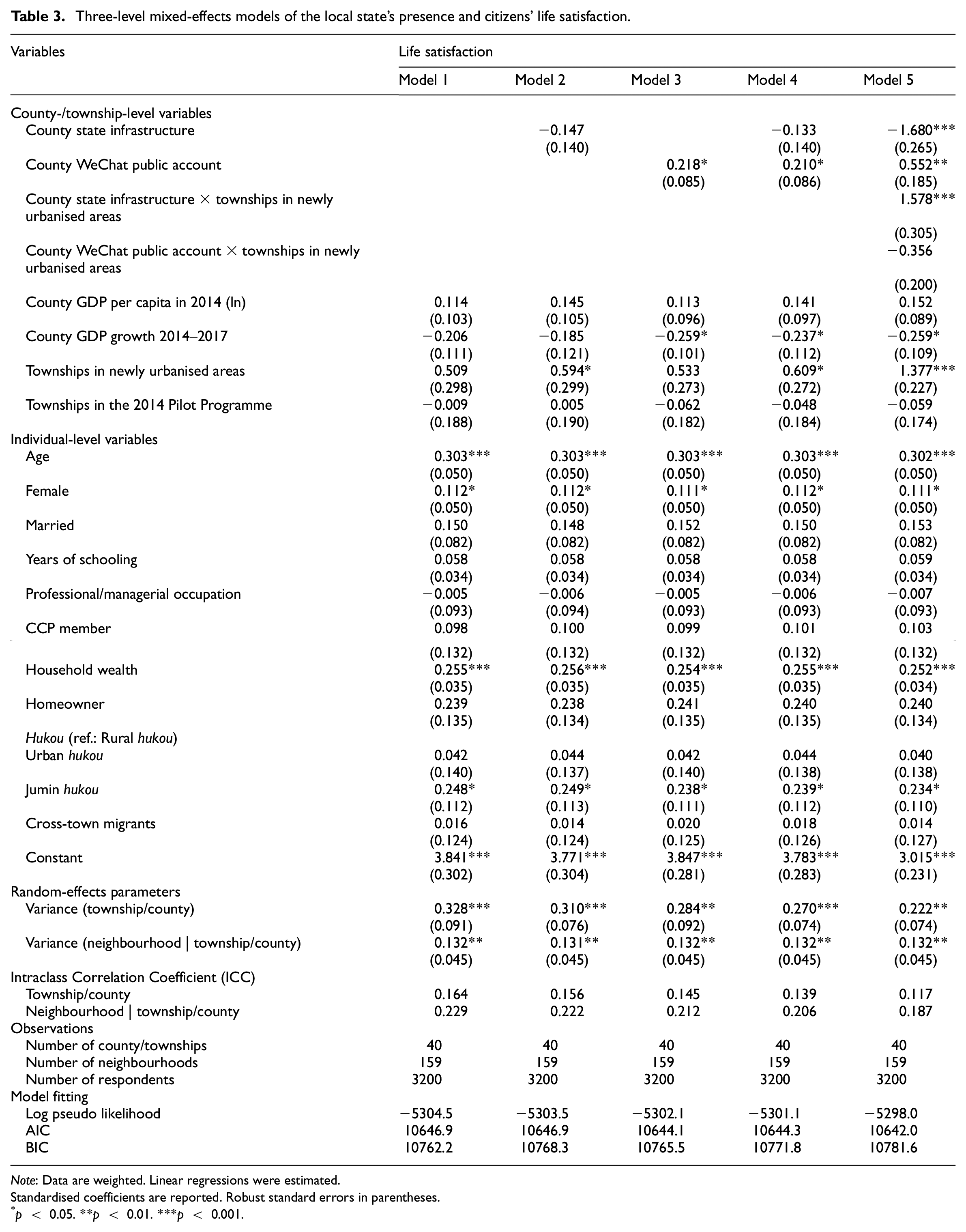
Standardised coefficients are reported. Robust standard errors in parentheses.
The moderating effect of urbanisation
We investigated the moderating effect of urbanisation by adding the interactions of two variables measuring the physical and virtual presence of the local state in townships in newly urbanised areas and potential sites of urbanisation. Table 3, Model 5, reports the results. We also computed the standardised interaction terms to deal with the potential problem of multicollinearity and report the results in Appendix Table A1. To illustrate the interaction effects, Figure A1 in the Appendix plots the physical versus virtual presence of the local state and citizens’ life satisfaction for potential sites of urbanisation and newly urbanised areas, respectively.
The association between the physical presence of the local state and citizens’ life satisfaction was negative and much stronger in potential sites of urbanisation than in newly urbanised areas. In potential sites of urbanisation, citizens’ life satisfaction decreased drastically as the number of county government agencies increased. Hypothesis 2b was thus confirmed. Conversely, the pattern for the virtual presence of the local state shows that citizens’ life satisfaction increased significantly with greater virtual presence (as measured by the length of the government’s WeChat account) in potential sites of urbanisation. In newly urbanised areas, citizens’ life satisfaction also varied, though only slightly, according to the local state’s virtual presence.
Robustness checks
In the above analyses, we used citizens’ life satisfaction as a continuous variable and employed linear regression models to illustrate the interaction effects. To check the robustness of our findings, we treated citizens’ life satisfaction as ordinal and estimated ordered logistic regression models. Table 4, Model 1, is the baseline model. Its results are consistent with those of Table 3, Model 4. The association between the local state’s physical presence and citizens’ life satisfaction was statistically insignificant, but the coefficient on the local state’s virtual presence remained positive.
Robustness checks of three-level mixed-effects models of the local state’s presence and citizens’ life satisfaction.

Standardised coefficients are reported. Robust standard errors in parentheses.
The full table is available upon request.
To check for any trade-off between the physical and virtual presence of the local state, we added an interaction of the two measures in Table 4, Model 2. The coefficient is statistically insignificant, indicating that the local state’s virtual presence did not moderate the association between its physical presence and citizens’ life satisfaction.
The positive association between the local state’s virtual presence and citizens’ life satisfaction may be moderated by region. Because the East region, including three municipalities and seven provinces, has a relatively higher level of economic and social development, in Table 4, Model 3, we added an interaction term between the local state’s virtual presence and the East region. The coefficient of the interaction term is positive and statistically significant, implying that the positive association between the local state’s virtual presence and citizens’ life satisfaction was much stronger in the East region than in the other regions.
Individual social media use may also be the mechanism of the positive association between the local state’s virtual presence and citizens’ life satisfaction. In Table 4, Model 4, we further added an interaction term between the frequency of individual-level social media use and the local state’s virtual presence. The association between the local state’s virtual presence and citizens’ life satisfaction was not affected by the frequency of individual-level social media use, implying that the local state’s virtual presence is a form of macro-level state power that citizens’ individual behaviour may not moderate.
We used the length of time county WeChat public accounts had been in existence as the measure of the local state’s virtual presence. We added two measures of county WeChat public accounts to check the robustness of our findings: whether the account had the petition function (Table 4, Model 5) and whether it had published contents related to welfare (Table 4, Model 6). The positive association between the local state’s virtual presence and citizens’ life satisfaction was maintained consistently. Other things being equal, the life satisfaction of citizens living in a county whose WeChat public account had the petition function was lower than those living in a county without a WeChat public account. Whether or not the account had published content related to welfare had no association with citizens’ life satisfaction.
Recognising that the association between the local state’s presence and citizens’ life satisfaction may be confounded by the provision of public goods, we included variables measuring county public expenditure and the number of medical beds in Table 4, Model 7, as additional controls. The results of Model 7 are consistent with those of Model 1, with only slight changes in the coefficients of interest. In Model 8, we further considered each of the four infrastructure categories: administrative, coercive, legal, and fiscal. As was the case with Model 1, none of the four coefficients were statistically significant.
Discussion and conclusion
By linking individual-level data from the 2018 Urbanisation and Quality of Life Survey and measures of the local state’s presence in 40 carefully selected sampling sites undergoing rural – urban transition, this study assessed the association between the local state’s physical and virtual presence and citizens’ self-reported life satisfaction. Our results do not support prevailing views that a robust government infrastructure improves government function and can increase citizens’ well-being (Rothstein, 2011; Soifer, 2008; Steinberg, 2018) and that the state’s virtual presence is unlikely to independently correlate with citizens’ well-being because of its dependence on the physical infrastructure (Kraemer and Dedrick, 1997; Torres et al., 2006; Wong and Welch, 2004). Conversely, our study demonstrates a marked difference between the local state’s physical and virtual presence in terms of their associations with citizens’ life satisfaction. In addition, the patterns of association differ between newly urbanised areas and potential sites of urbanisation. Specifically, the local state’s physical presence is negatively associated with citizens’ life satisfaction in potential sites of urbanisation, but the association is not statistically significant in newly urbanised areas. The local state’s virtual presence is positively associated with citizens’ life satisfaction, and the difference between potential sites of urbanisation and newly urbanised areas is statistically insignificant. The coefficients of interest remained stable after we estimated alternative regression models, coded the measures differently, and added additional controls.
Our findings provide empirical evidence of infrastructural power as theorised by Mann (1984) and demonstrate that the negative relationship between the local state’s physical presence and citizens’ life satisfaction is only evident in areas of potential urbanisation. This is understandable, given that financial capacity and urban development resources are relatively low in these still-rural regions (Wallace, 2013). Residents in these regions may be more sensitive to public expenditure; they expect the government to spend more on social welfare programmes with direct benefits than on state agencies. In urbanised areas, however, expenditure on government infrastructure is not resented because the citizens have already achieved the benefits associated with urbanisation. It is not surprising, therefore, that our results show that the negative association between the local state’s physical presence and citizens’ life satisfaction is much weaker and not statistically significant in newly urbanised areas.
Conversely, the local state’s greater virtual presence positively correlates with citizens’ self-reported life satisfaction. As virtual governance has become the present-day reality in China, studies have produced inconclusive results regarding its impact on society (Liou, 2007; Wong and Welch, 2004). Our findings highlight the enhancement of citizens’ life satisfaction by the local state’s virtual presence on social media in localities undergoing rural–urban transition. These echo previous literature suggesting that the improvements in state reach and capacity as a result of social media platforms can lead to better-targeted social service provision, improvements in governance openness and transparency, corruption reduction, and greater citizen involvement in the government policy-making process (Stamati et al., 2015). According to the recent report of the China Internet Network Information Center (2023), the number of Chinese Internet users is continually rising and has reached 1.067 billion (75.6% of the total population) in December 2022. Government-related communications on WeChat continue to grow in number and reach (Pan, 2020). Such websites could benefit citizens residing in both areas of potential urbanisation and newly urbanised areas as the new-type urbanisation continues nationwide.
There are four levels of local government in China: provincial, prefectural, county, and township (Cartier, 2015; Landry, 2008). Studies on state presence and citizens’ well-being mostly aggregate data at national or regional levels, whereas our analysis focused on the local state’s presence at the county and township levels. Our robustness checks confirm that aggregating the local state’s presence according to counties’ geographical boundaries presents more significant results than aggregating this information according to townships’ geographical areas. The results confirm that county-level administrative units have more political jurisdiction and influence than township-level administrative units to promote urbanisation and enhance citizens’ well-being (Landry et al., 2018; Lü and Landry, 2014).
Our findings indicate that people value the accessibility of infrastructure applications more than the quantity of infrastructure buildings. From a policy perspective, it is important that policy-makers are aware of the interrelation between the local state’s presence and citizens’ life satisfaction and adjust governance strategies and practices accordingly. In particular, improving the local state’s virtual presence through social media platforms enhances government efficiency and empowers citizens (la Porte et al., 2002), improving citizens’ life satisfaction, as this study shows. At the time of our survey, nine of the 40 county-level administrative units had yet to set up a WeChat account. The accounts of those that had done so ranged from 7 to 51 months. Opportunities remain for local governments to improve the state’s virtual presence and enhance the efficacy and positive impact of local governance.
Our study contributes to the literature on the state’s presence and its impact on citizens’ subjective well-being. The findings suggest strategies to improve local governance quality and citizens’ life satisfaction as China’s urbanisation progresses. Globally, the number of people living in urban settings exceeds 4 billion (over half of the world’s population) and is projected to reach 5 billion by 2030 and 7 billion by 2050 (Ritchie and Roser, 2020). As the world becomes increasingly urbanised, this research also has implications for comparative analysis of polities facing similar transitions and challenges. Future studies can link the developed measures of state presence to household surveys conducted in selected rural–urban interfaces, estimate its impact on citizens’ livelihoods and well-being in other developing countries, and propose potential approaches to improve local governance accordingly.
In conclusion, the study’s limitations should be noted. First, the indicators measuring the local state’s physical and virtual presence are innovative but limited. In particular, employing county WeChat public account history as an indicator of the local state’s virtual presence only taps the early development in the government’s online engagement but does not indicate the strength or extent of this presence. As government information and public services are increasingly provided to citizens via social media platforms, future research with more variables, such as the activity levels of the WeChat public accounts, would enrich the measurement and improve the robustness of the results. Second, our analysis was based on a survey conducted in specific localities undergoing rural–urban transition. Further research is required to determine whether the findings can be applied to established urban centres or rural areas. Third, we undertook our survey in 2018, before the COVID-19 pandemic. Citizens’ views of the local state’s virtual presence may be more ambivalent following the digital health app’s use to constrain citizens’ lives in various ways during the pandemic, such as domestic travel, attending school, shopping, etc. (Hou et al., 2020). Updated longitudinal data will be needed to examine the changes and trends of the local state’s virtual presence and its impacts on citizens. Fourth, although the county/township-level variables used in the analysis were measured before undertaking the survey, the data are still cross-sectional and issues of self-selection and reverse causality potentially exist. For example, local government may be more likely to establish a web-based, cost-effective, transparent, and coordinated virtual state presence in localities where citizens are more satisfied with their lives. Experimental or longitudinal data would be required to address such possibilities. Finally, we did not clearly identify the mechanisms by which the greater virtual presence of the local state improves citizens’ life satisfaction; these mechanisms will need to be explored with appropriate data and analytical strategies.
Footnotes
CRediT authorship contribution statement
Declaration of conflicting interests
Funding
ORCID iDs
