







Abstract
Keywords
Since the 1980s, people who use drugs have formed national and regional unions and activist groups, borrowing the slogan “nothing about us without us” from the disability justice movement (Bartoszko 2021). Drug-user-led 1 groups distribute vital information and strategies throughout their communities. With few exceptions (e.g., Jozaghi et al. 2018; Simon et al. 2022), this information is not disseminated more broadly through formal research studies. One reason is that some people who use drugs, such as members of other marginalized groups, distrust research (Christopher et al. 2008), leading to research disengagement.
This project arose to address emerging issues faced by drug users during the COVID-19 pandemic. At the pandemic’s onset, in-person research limitations coincided with urgent pandemic-related problems for directly impacted people and their organizations. Due to these issues, our project built on sociological methods for digital qualitative research (Murthy 2008; Small 2022), citizen science approaches for involving people without formal research training (Robinson et al. 2018; Tauginienė et al. 2020), and sociological scholarship calling for the inclusion of alternative knowledge sites (Sweet 2020). Because of mistrust in researchers, we drew on long-standing research traditions committed to ensuring that research aligns with community needs (Brown et al. 2019; Montoya and Kent 2011; Wallerstein et al. 2020). We developed and implemented a community-driven research (CDR) model for virtual collaborative research with drug-user organizers during the pandemic. In CDR, community members drive the study, from initiating research questions to full inclusion in data analysis and dissemination.
This article examines a primarily virtual CDR project in collaboration with the National Survivors Union (NSU), the American drug-users union. We discuss lessons learned and strategies developed while implementing two projects during the COVID-19 pandemic on methadone treatment issues. We developed processes to reduce participation barriers, facilitate research on emerging issues, and disseminate information that is distributed within drug-user networks to a broader audience. CDR approaches to drug-use research are critical in times of rapidly shifting knowledge and practices due to rising fatal overdose risk and emerging drug-related harms.
Research Issues for Marginalized Groups
People who use drugs have long been considered a hard-to-reach population. Difficulties researchers encounter include struggling to recruit representative samples, low survey response rates, and the effect of stigma on disclosure (Heckathorn et al. 2002; Watters and Biernacki 1989). Some people who use drugs refuse research participation due to fears of negative experiences, including researcher insensitivity, prejudices, and questions that are stigmatizing or unaligned with community needs (Bell and Salmon 2011; Neufeld et al. 2019). More broadly, research without full engagement has been criticized for extracting knowledge and resources without directly benefiting marginalized communities and for focusing on policy outcomes and interventions misaligned with impacted people’s priorities (Boulware et al. 2003; McCracken 2019; Wallerstein et al. 2020).
Community-Engaged Approaches
In response to these issues, a substantial history of community-engaged research has worked with marginalized groups to advance knowledge in an ethically appropriate manner (Anderson et al. 2012; Jones 2018; Lester and Nusbaum 2018; Mikesell, Bromley, and Dmitry 2013; Torre 2009). One approach to community-engaged research is community-based participatory research (CBPR), in which community members ideally share decision-making powers and participate in all research stages (Tremblay et al. 2018; Wallerstein et al. 2020). Its basic principles include building on community strengths and resources, equitable partnership, co-learning and capacity building, increasing knowledge while benefiting community partners, and an iterative long-term commitment beyond single projects (Israel et al. 2012).
A long-standing global tradition of fully collaborative CBPR drug-use research includes work in North America, Australia, Asia, and Europe (e.g., Ashford et al. 2019; Chang et al. 2021; Elkhalifa et al. 2020; Figgatt et al. 2021; Hayashi et al. 2012; Meyerson et al. 2021; Nieweglowski et al. 2018). However, CBPR spans a broad spectrum of engagement. As in other fields using CBPR (see Carras et al. 2023; Minkler 2005; Guta, Flicker, and Roche 2013; Sweeney et al. 2009), some CBPR drug-use research projects do not fully involve community members (Brown et al. 2019). Participation can be limited to recruitment, survey administration, and membership in infrequent community advisory board meetings (Simon et al. 2021). Some participants feel disempowered or tokenized by limited engagement (Damon et al. 2017), and distrust and stigma remain, limiting CBPR participation (Travers et al. 2008).
Modified CDR
This project’s CDR approach builds on CBPR principles and community partnership models used extensively by Indigenous communities and sex-working communities (Coombes et al. 2022; Fullwood et al. 2009; McTighe and Haywood 2018; Simonds and Christopher 2013). Although CBPR encompasses a broad engagement spectrum, CDR emphasizes knowledge coproduction, community leadership during all stages, and participation in community projects beyond the research focus, benefiting research with marginalized populations who may distrust researchers (Montoya and Kent 2011).
Throughout the development of this project, we sought ways to facilitate involvement of people and organizations that usually refuse research participation. Our approach draws on the work of Benjamin (2016) on members of marginalized groups’ research participation refusal. Such refusal can change the terms of research, including whose knowledge and skills are valued, who is considered a researcher, and how knowledge is transmitted. Engaging with participation refusal can help shift from research omitting directly impacted people’s agency from the scholarly record (Carrera and Key 2021), moving from damage-centered views of marginalized communities as “depleted, ruined, and hopeless” to instead “reimagin[ing] how findings might be used by, for, and with communities” (Tuck 2009:409).
This project’s CDR approach inverts top-down methods for generating research questions. This approach alters the research structure by changing what knowledge is valued and produced, what is considered data, who is allowed to collect data, and how data can be used (Albert 2021; Fricker 2007). It aims to support the flow of knowledge and expertise across boundaries (Downey and Zuiderent-Jerak 2016) and to leverage the experiences and community advocacy of directly impacted people. Our approach draws on the work of Haraway (1988) on situated knowledge, which examines how knowers’ social structural position influences research processes and findings. This framework resists claims of detachment and centers partial, embodied knowledge situated in the experiences of marginalized people. This method arises from and uses emotion to drive the work.
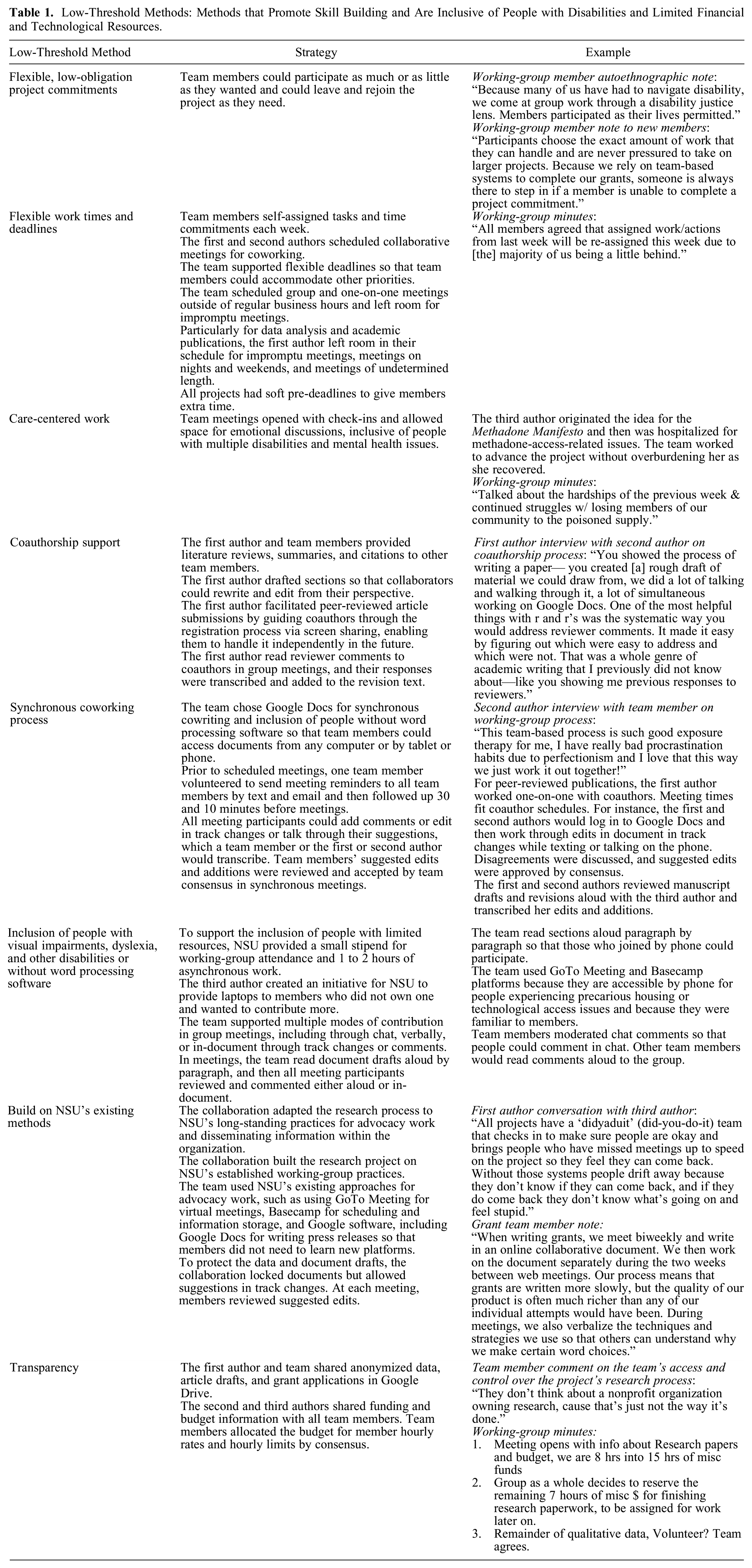
Throughout this project, we developed granular methods tailored to drug-user-led organizations’ needs, strengths, and practices. Our approach prioritizes community-initiated research questions, skill building, full research engagement, and multiple dissemination forms. It emphasizes directly impacted perspectives, transparency, and low-threshold methods, which we define as methods that promote skill building and are inclusive of people with disabilities and limited financial and technological resources (see Table 1). This CDR method shifts the knowledge-production process to impacted people, treating team members as community researchers, not representatives. It advances community involvement from participation to decision-making authority.
Low-Threshold Methods: Methods that Promote Skill Building and Are Inclusive of People with Disabilities and Limited Financial and Technological Resources.
Project Background
The project driver, NSU, is a coalition of about thirty drug-user unions, drug-using sex-worker-led organizations, and affiliate groups in 23 states, including regional unions, multiservice syringe service program health hubs, and patient advocacy organizations. People who use drugs lead the union and perform all its functions. NSU’s membership includes diverse race, class, and gender identities; drug-use types; social and educational capital; and levels of chaotic use or self-defined recovery. Most members represent hundreds of impacted people through affiliate-group leadership.
Members distribute information through NSU’s national network using primarily virtual platforms: GoTo Meeting and Basecamp. These platforms enable isolated or disabled drug-user activists to participate remotely and are accessible without video by phone for people experiencing precarious housing or technological access issues. NSU hosts webinars multiple times a year and weekly calls teaching organizing skills and providing harm-reduction tips on issues such as contaminants such as xylazine. Weekly and biweekly working groups include methadone advocacy, sex-worker organizing, and grant writing. NSU provides members with media and advocacy training. Its online network fosters solidarity between groups, skill building, and rapid information sharing. NSU also holds annual in-person meetings with team-building exercises, strategic planning, member talks, invited speakers, and rallies. It offers low-threshold project employment and subsidizes meeting travel for low-income members. However, volunteers maintain most projects.
During the COVID-19 pandemic, members of NSU’s methadone advocacy working group wanted to research health risks methadone patients were experiencing during the pandemic to show that their experiences were not anecdotal (Simon et al. 2021). Methadone, a safe and effective treatment for opioid use disorder, is heavily regulated in the United States (Connery 2015; Jaffe and O’Keeffe 2003). Patients typically receive doses in-person daily under direct supervision, with regular drug testing and counseling required (Bell 2014; Stitzer and Vandrey 2008). Although in-person treatment requirements were relaxed for sheltering in place, many NSU members reported clinics offering fewer take-home doses than federally allowed, rescinding take-home doses shortly after relaxations, or never offering additional doses. Some members felt that clinic staff dismissed their experiences or blamed them on patient failings. Members sought evidence to support their observations that methadone patient in-person requirements were not uniformly relaxed in the United States, increasing their COVID-19 exposure risk.
However, the NSU had not previously conducted research as an organization. Some members distrusted research collaborations due to previous affiliate-group experiences with researchers who they felt extracted their knowledge and did not share results. NSU members described difficulties interacting with institutional researchers due to not knowing academic norms. They reported feeling disempowered, being relegated to subsidiary roles, and receiving insufficient training to move out of unskilled positions. The first author, having volunteered extensively with NSU and sharing an interest in methadone reform, was invited to collaborate. NSU members stipulated full inclusion throughout the research process to address concerns about control over research questions, data, representation, and dissemination.
Project Methodology
Our collaboration aimed to develop a modified CDR approach for research with drug-user organizations. One team member said, “It may have been lucky for us that we had such negative experiences with researchers that we ran our own research because there is little literature on drug-user-run studies and the world needs more.” 2 The second aim was to create an infrastructure of NSU members with research collaboration experience and methodologic literacy, enabling them to contribute to NSU’s CDR projects and collaborate with researchers through their primary organizations. The goal was, as one member said, to “leverage situations where we can truly be treated as equals.”
In May 2020, the collaboration began developing the CDR model. First, the project conducted an online survey of methadone patients on in-person clinic requirements during the first wave of COVID-19 (Brothers et al. 2023). The next project, the
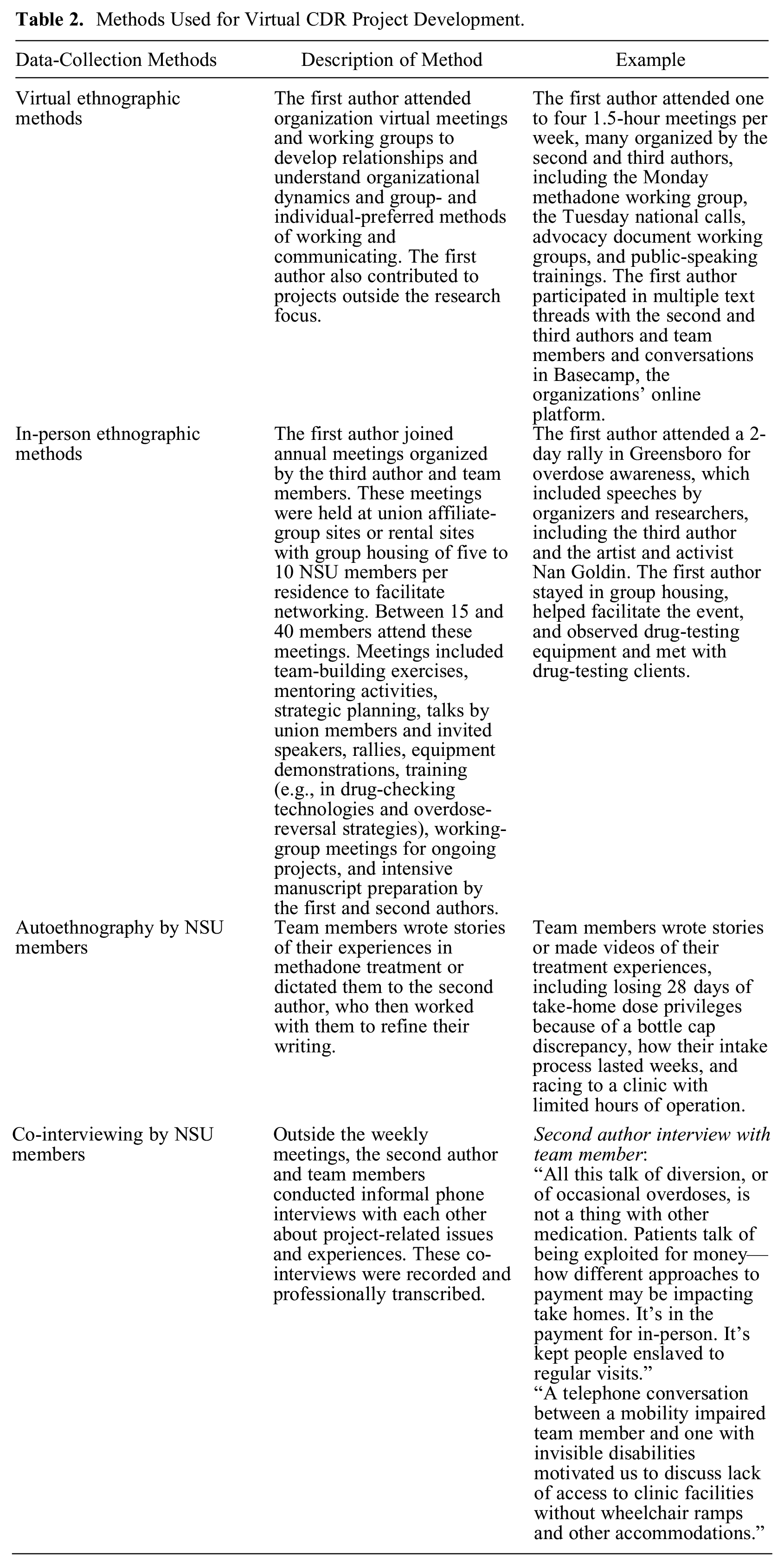
Methods Used for Virtual CDR Project Development.
NSU and the first author received seed grants to partially fund publication costs and member stipends. NSU members received $20 to $40 per hour for 2 to 5 hours per week of meeting attendance, group work, and solitary work. Team members and organizations volunteered time and resources to support the project.
The first author attended meetings, provided NSU members with training, contributed to NSU projects outside the research scope, and supported organizers considering other research collaborations (see Table 1). Engagement helped the first author understand NSU’s concerns and collaboration styles, aiding methods development. NSU members’ experiences on other research projects also informed the model; members critiqued and assessed prior experiences. As a result, the project developed ways to ameliorate issues with research collaborations.
Application of Method
Project 1: Online Methadone Patient Survey
During the project’s first stage, NSU, in collaboration with the first author, conducted an online survey of U.S. methadone patients to support their advocacy work. One member said, “It needed to be a combination of research and advocacy, to provide people like us with the truth. All this evidence is there, supporting everything we say, and we still aren’t doing it right because of stigma. We’re walking away from all this evidence and doing all these awful things to people, even though we know none of it does any good. And we’re letting them die.”
Community-Initiated Research Questions
From the first survey-development meetings, people were angry, scared, and frustrated. Emotional responses and members’ personal and organizing experiences were integral to the work. The project researched methadone treatment issues during the COVID-19 pandemic while members were experiencing these issues themselves. One member said, “We’re not crazy. We’re not imagining, or just behaving this way because we’re angry. It’s what everybody’s experiencing.” Team members attended project meetings after seeing staff in masks when they lacked them or lining up in crowded clinic waiting rooms where social distancing was impossible.
The work grew from personal to broader experiences as the collaboration collected topics to address in the survey (see Table 3). In weekly meetings, team members added their experiences and those of their organizations’ members. The first author converted topics into survey questions, which team members rephrased into accessible language. To address concerns about asking people to answer the survey without compensation, the collaboration limited the fixed-answer survey to 7 minutes but included write-in responses so that respondents could choose to spend time writing about their experiences, which many did.
Strategies for CDR.

Transparency
Anxiety about intellectual property and unfamiliarity with academic norms, including research and publication processes and timelines, were issues for team members (Simon et al. 2021). Members feared that findings would be misconstrued or disseminated without their say due to their experiences in past collaborations with researchers who made unilateral decisions or pursued different aims once projects began. To address this, after deidentifying the data, 4 the first author involved members in the entire process, from survey design, including question phrasing and survey length; to survey implementation, including targeted recruitment; to data analysis, including the qualitative write-in responses; and to coauthorship.
Low-Threshold Methods
The project used low-threshold approaches for data collection and analysis, collaborative writing and coauthorship practices, and dissemination, as described in Table 1. Our methods build on NSU’s existing low-threshold practices for virtual collaboration with people with varying degrees of substance use, disabilities, skills, education, economic disadvantages, and technological access.
The first author prioritized coworking over solo-written work to involve team members in data analysis (see Table 3). For instance, the first author read write-in survey responses to some members aloud in one-on-one meetings and presented some data to the working group for discussion and interpretation. The work was communal and accepting of tangents. This process, although time-consuming, helped deepen the first author’s understanding of data. Talking through the data with members with deep experiential clinic system knowledge exposed issues, norms, constraints, and possible harms that had not occurred to the first author, who had second-hand methadone-treatment knowledge. Analysis emerged that was only possible by working directly with people who experienced the clinic system daily. The information gathered during this process contributed to later projects. The first author learned that involving people with living experience throughout the process enriched data analysis and facilitated innovative research questions more than anticipated, in addition to engaging people and organizations that usually refuse research participation.
The first author found that a flexible schedule was necessary to accommodate members’ methadone program requirements, drug-use-related health issues, and organizational obligations. Meetings occurred at organizers’ chosen times, sometimes last minute or late at night. Sometimes a 1-hour session lasted 20 minutes or 2 hours. The first author joined scheduled team meetings and left open blocks on 1 or 2 days for impromptu meetings of variable length. The article-writing process also supported multiple low-threshold forms of contribution (see Table 1). For instance, the first and second authors coworked one on one in real time in collaborative documents, often while texting, or reading drafts and revisions aloud on phone calls or in virtual meetings.
The collaboration flattened hierarchies by including members in all project aspects, providing training and low-threshold approaches, and supporting under-resourced team members, but power imbalances arose. People with learning disabilities or limited technological skills or access experienced reduced inclusion. Those with more education and skills were likelier to make project decisions, give talks, and receive coauthorship because time constraints and minimal infrastructure diminished the support the authors and team could provide.
Throughout this process, the first author and team members developed practices to fit platforms, schedules, and collaborative approaches that NSU members preferred (see Table 1). The collaboration held meetings in NSU’s regular spaces and outside the business weekday schedule. The project supported the contributions of people with verbal versus written acuity and group work over individual writing.
Rapid Dissemination to Directly Impacted People
The collaboration prioritized disseminating findings quickly, in media and language accessible to NSU members. NSU held several live webinars and advertised nationally through its listserv and social media, where team members, the first author, and other academic researchers presented findings and related topics, including sharing autobiographical stories and showing short autoethnographic documentaries illustrating methadone-treatment issues, followed by question-and-answer sessions with up to 200 attendees. For skill building, the first and second authors helped project members write and rehearse talks on the project.
Project 2: The Methadone Manifesto
The project’s methods for the
Unstructured Focus Groups
The project modified NSU’s methadone working group’s structure to serve as a synchronous online focus group (Stewart and Shamdasani 2017) on methadone-treatment issues. During 1- to 2-hour weekly meetings, four to 12 members discussed treatment issues they had experienced or encountered during advocacy work in states including Massachusetts, Illinois, Indiana, California, New York, North Carolina, and West Virginia. Using NSU’s existing meetings and platforms minimized online focus group issues by ensuring group rapport, platform familiarity (Kite and Phongsavan 2017), and nonintimidating meeting spaces.
Focus groups often use structured, preestablished questions and center on moderators who ask questions for groups to address (Cyr 2016; Krueger 2014). Instead, our approach, which we call
During sessions, one member moderated and another recorded minutes and pasted chats into a shared document. Members guided conversations back to interrupted participants to mitigate some individuals’ tendency to dominate group conversations (Smithson 2000). People who were more comfortable writing than speaking contributed chat comments that moderators or other members read aloud. The team encouraged participants to add experiences and perspectives to other members’ comments and examples. The first author and members asked follow-up questions to elicit details and returned to novel examples if conversations moved quickly. Using methods for analyzing emotional expressions as emerging themes (Charmaz 2006; Saldaña 2013), the first author looked for taken-for-granted experiences; noted emotionally tinged responses such as expressions of anger, fear, or helplessness; and then asked follow-up questions to elicit specific incidents leading to these feelings.
The unstructured approach left room for tangents, which were useful for exploring experiences people were working on articulating, creating space for sharing examples, and fostering new insights outside existing literature (Stewart, Shamdasani, and Rook 2009). The participant mix, with participants speaking freely because of shared experiences and multiyear relationships (Weinreb 2006), helped uncover treatment issues nationwide. Issues some participants took for granted, such as daily dosing fees, drug-testing frequency, and in-person counseling requirements, the group noted as unusual, drawing on their experiences at clinics with different policies. This approach emphasized interactive processes where information emerged through discussion (Cyr 2016), building on the group dynamic as a generator of knowledge.
Co-created Low-Threshold Methods
Team members collected potential topics from meetings and group texts. Some members recorded phone interviews with each other, which the first author reviewed. The first author also interviewed coauthors who were more comfortable speaking than writing. Interviews were recorded and transcribed. The first author took detailed notes during conversations and meetings, transcribing words verbatim for articles.
The collaboration then decided on focus topics, created an outline, and added relevant literature. Members collected some literature during advocacy work; academic collaborators added citations. The first author taught short classes on skimming, evaluating, and citing peer-reviewed work; members also shared literature and taught each other. Group discussions of articles included critiques and supportive and contradictory examples based on members’ lived experiences and advocacy work.
The category of people who use drugs includes many intersectional identities, shaping embodied knowledge, experiences, interests, representation, and the knowledge produced (Alcoff 1991). Thus, the project prioritized contributions from people with direct experience with specific issues such as sex work, homelessness, pregnancy, and parenting. For example, a parent took on the sections about issues faced by pregnant or parenting people.
Besides the weekly working-group meeting, many weeks included 1 to 3 hours of subgroup work. Each member reviewed the literature on assigned topics and exchanged ideas on literature to cite and experiences to add. Group work included synchronous commenting and editing on shared documents during conference calls. The first author and three team members edited the entire document multiple times.
Foregrounding Directly Impacted Perspectives
NSU published the
Skill Building
Skill building, described in Tables 1 and 3, focused on helping members gain basic research skills, including collaborative decision making, data collection, data analysis, and project development, to participate in other research projects. The first author supported team members’ other projects by suggesting literature and editing documents. For oral presentations, the first author rehearsed and coscripted talks by the second author, who rehearsed and structured multiple members’ talks.
Conclusions
This project adapted a CDR design for drug-use research during the COVID-19 pandemic, engaging directly impacted people in all research stages (see Table 3). Through co-created projects and low-threshold methods, this approach facilitates the inclusion of valuable information and practices.
Research participation can extract resources from directly impacted people without providing clear benefits. To ameliorate this issue, the first author provided research training, promoted transparency, and collaborated on projects outside the research focus, in line with suggestions for knowledge-translation projects (Jacobson, Butterill, and Goering 2003). This project’s patient and advocate involvement and multicomponent dissemination strategies (see Table 3) exemplifies integrated knowledge translation (Banner et al. 2019; Chapman et al. 2020). Dissemination plans guided by directly impacted individuals ensure that tailored messages in accessible language and media can effectively reach key publics, such as patients and advocates, enhancing credibility and relevance (Grimshaw et al. 2012).
Community-engaged approaches are increasingly called for in the social sciences, particularly with marginalized groups. CDR expands methods for centering embodied, experiential marginalized knowledge (Collins 2000; Sweet 2020), which intersects with, complements, and sometimes conflicts with scientific knowledge and public policy on drug use. It involves reflexivity and openness to multidirectional communication flows and knowledge making, enabling new approaches and innovative results to aid responses to unprecedented crises. Our approach contributes to the sociological literature on research with online communities united by interests instead of geography, digital approaches to knowledge coproduction with marginalized groups (Lane and Lingel 2022; Marzi 2023; Small 2022), and methodologic approaches concerning representation (Jerolmack, Murphy, and Reyes 2024; Rios 2015).
Citizen science projects demonstrate that full research participation helps ensure that research addresses community concerns (Robinson et al. 2018). This project adds to sociological contributions to citizen science methods for inclusive participation, alternative approaches to knowledge production, and increasing research’s relevance to marginalized people’s needs (Tauginienė et al. 2020). With this method, the people affected by research and policy shape aims and dissemination, contributing to a more equitable research landscape, reducing power imbalances through co-created knowledge, and aligning with ethical research practices (Banner et al. 2019; Clark-Parsons and Lingel 2020).
Community involvement can expand research engagement and produce novel findings and methodologic approaches, but CDR is not ideal for all qualitative research with marginalized groups because of the time commitment and strain on community and academic researchers’ intellectual and emotional resources. Despite inclusivity efforts, the project may have excluded people lacking housing, a cellphone, or internet access. Additional funding for under-resourced members could increase inclusion.
Because methodologic approaches were co-constructed, the project deviated from some academic norms. Academia and funding agencies should support emerging methodologies and recognize that full engagement may add time and resource needs. CDR requires protected time for academic collaborators, training support for team members, and funding for community organizations’ infrastructure costs. Furthermore, project elements relied on long-standing working relationships. Future projects could extend this approach to groups without preexisting relationships.
These methods can help integrate marginalized knowledge into research and policy. Studies with marginalized populations, including people experiencing homelessness, poor rural communities, people with disabilities, criminalized groups, and virtual community-led organizations and patient groups in many fields, could benefit from this approach. For drug-use research, applying these methods is critical during rapidly adaptive community responses to emerging threats. For example, broad dissemination of community overdose-protection strategies and xylazine information could reduce harms substantially. This model facilitates in-depth collaboration with people navigating these challenges firsthand, leading to innovative research questions and findings that address current needs, concerns, and practices. This is a step toward developing new approaches to reduce morbidity and mortality during multiple crises.
Footnotes
Funding
ORCID iD
