







Abstract
The photographs in Figure 1 share distinctive commonalities: of content and form, and – less obviously – of provenance. Some are “faceless” selfies, depicting the photographer’s body rather than her face, showing her outfit or limbs with particular items of clothing or accessories. Some present apparently fleeting and private scenes from personal life. In formal terms, many of them suffer from “bad” lighting or cropping “errors”; others seem to be filtered by non-professional graphic software. Almost all are characterized by spontaneous-seeming composition and minimal technical precision, where everything from power sockets to poorly painted walls are visible. The overarching impression is of vernacular photographic practices that emphasize immediacy and intimacy over formal meticulousness: “user-generated” images made on-the-fly by ordinary individuals – photographic amateurs – for non-professional purposes.

Exemplars from the dataset of Instagram fashion brand account images 2014–2018.
Yet despite their casual veneer, all of these images were published on the official Instagram accounts of leading fashion brands such as American Eagle, Gap, and Forever 21. In addition, many were actively produced for such accounts by media professionals. In other words, they are examples of the
In this article we argue for a renewed critical examination of the overt and direct representational practices of commercial brands on social media, in particular their appropriation of user-generated “amateur” or “vernacular” cultural styles. Without this renewed attention our understanding of the connections between social media and consumer culture are overly skewed toward
Hence by focusing on the aesthetic “vernacularization” of brand images on social media, this article investigates a crucial parallel process to the increasing “professionalization” of users in digital networks and social media through micro-channel networks, influencers and micro-celebrity (e.g. Abidin, 2016; Cunningham et al., 2016; Kim, 2012; Lobato, 2016; Marwick, 2015). Indeed, the vernacularization of brand-produced images on social media constitutes a vital missing link between these other widely-researched phenomena. Abidin (2016: 87) notes that everyday users model themselves on influencers by taking up their “cultural scripts” in posts, tags etc.: we argue that brands themselves are utilizing the same “cultural scripts” of sociability, cultural knowledge, and physical-world action as ordinary users. Self-branding is thus systematically complemented and completed by brand-“selfing.”
To conceptualize and analyze this intersection, we examine the corporate appropriation of vernacular photographic styles on Instagram, focusing on an arena of commercial photography that has long been connected to professional stylization – fashion. For reasons we set out below, we begin with the assumption that fashion is likely to be distinctive, both as a sector in consumer culture and as a field of photography in its own right. We see fashion images on Instagram (a primarily photographic social media platform) as offering a rich site for examining the intersection between brand initiatives, social media culture, and digital photographic conventions.
While aesthetic vernacularization is most clearly linked to discussions about the character – and even the continued relevance – of “user-generated content” in contemporary digital culture, it is also connected to broader dynamics in cultural production, consumer culture, and of course photography. Hence we draw on several fields of research for our theoretical background: literature on “user-generated content” and popular cultural forms on social media, the professional-amateur divide in cultural production studies, and the histories of visual styles and generic conventions in photography, as well as research on photography on Instagram.
Following our theoretical and methodological frameworks, we present a qualitative visual analysis of the photographs posted in official Instagram accounts of 12 leading fashion brands, delineating an initial typology of prevalent vernacularizing practices – regramming, vernacular celebrity, and “brandfies” (selfies
These three practices, we argue, show how user-generated content can be detached from its primary authorial configuration (being generated by non-professionals) and solidified into recognizable patterns, or “user-generated aesthetics,” that can be easily appropriated. Together, then, the practices present a new kind of “context collapse” that blurs the boundaries between the representations and actions of brands and of people in online spaces. Context collapse often characterizes interactions on social media in other respects (Boyd, 2002; Davis and Jurgenson, 2014), and its causes are usually associated with technological shifts in the interactional frameworks that underpin the routine communicative assumptions of participants. The corporate appropriation of vernacular photographic styles that we identify, however, are resonant of the sub-category of deliberate collapse that Davis and Jurgenson (2014) call “context collusion,” whereby “social actors intentionally collapse, blur, and flatten contexts, especially using various social media” (p. 480). When performed by a brand, the “context collusion” between commercial entities and people has far reaching social and political implications, indicating the erasure of conventional distinctions viewers rely on to infer the source, milieu, and purposes of an image or content. Moreover, we argue that these styles are more than simply mechanisms by which brands transform networked connections into commercial gain. They are scripts through which brand-“selfing” occurs, performing the “life” of brands online in ways that imply social intimacy, the cultural and technical savviness of everyday users, and embodied physical existence.
User-generated content: from participation to professionalization
“If I read one more time about how Time magazine nominated ‘you’ as person of the year in 2006, and how this marked the beginning of a new era of user-generated content, I think I’ll post a video on YouTube. It will be of me holding my head in my hands and screaming” (Hesmondhalgh, 2010: 268). Underpinning Hesmondhalgh’s imagined nervous breakdown was the widespread perception that the first decade of the 21st century was overwhelmingly good for ordinary “users” of new digital frameworks, especially as content creators. One prominent view saw UGC as game-changing because it allowed consumers to become active producers, and thus created a more democratic and participatory culture (e.g. Benkler, 2006; Jenkins, 2006). Critics, however, argued that no substantive change in power-relations was occurring, since users’ participation did not impact the decision-making structures of media systems themselves (Saxton and Anker, 2013). “Participatory culture” was further criticized for concealing modes of exploitation through prosumption. While “putting costumers to work” (Ritzer and Jurgenson, 2010: 18) predates the digital era with techniques such as self-service gasoline pumps at filling stations, or the substitution of bank tellers by ATM machines, Web 2.0 cultivated an extensive “prosumer” culture through the unpaid production of content by users for their own consumption. This “digital labor” (Schols, 2013; Terranova, 2000) contributed to the commodification of User-Generated Content and to its exploitation as “User-Generated Data” (Andrejevic, 2009), turning users into a “creative proletariat” (Arvidsson, 2007).
More recent research has focused on the professionalization of UGC: turning amateur YouTube content into television series (Morreale, 2014) and other commercialization strategies that seek “to convert vernacular or informal creativity into talent and content increasingly attractive to advertisers, brands, talent agencies, studios and venture capital investors” (Cunningham et al., 2016: 178). This shift has been described as the “institutionalization of YouTube from user-generated to professional-generated content” (Kim, 2012). While user professionalization is mainly studied in the arena of YouTube as a whole, fashion content has been specified as especially attractive to commercial YouTube agencies, since it aligns with core consumer “verticals” and is more likely to be professionalized at a faster rate than other parts of YouTube (Lobato, 2016). At the same time, a similar process of user-professionalization has been observed in other contexts (beyond YouTube) of user-generated fashion content, such as amateur fashion blogs and influencers’ Instagram accounts: Countering beliefs that bloggers are just “regular people with passion for fashion” (Duffy, 2015: 52), researchers highlight the skills and knowhow actually required to manage such media outlets successfully (Titton, 2013). More to the point, the mainstream beauty ideals of slim body, light skin tone, and youthfulness propagated by established media have been reproduced by non-professional fashion bloggers (Duffy and Hund, 2015). The content was found to have been made less “for fun” than for profit – either actual payment for advertising goods, or in the hope of gaining future income (Abidin, 2014, 2016; Duffy, 2017).
There is, however, a complementary dynamic to user-professionalization occurring on social media, which we highlight in this article. While users’ working methods and content frequently do approach professional production norms, brands in turn are adopting
“Professional” and “amateur” aesthetics
How, then, is amateurism manifested within contemporary visual photographic aesthetics? In pre-Web 2.0 contexts, amateur and professional photography took place in two parallel domains, which rarely overlapped. Amateur photography was chiefly associated with “home mode” (Chalfen, 1987) practices undertaken in private and family contexts. Professional photography, in contrast, involves meticulous working methods, expensive equipment, studios, assistants, photo agencies, clients, competitions, awards, professional associations, and established frameworks of professional training and accreditation (Frosh, 2020; Rosenblum, 1978), as well as specified venues and media for the display of professional images.
This clear (though not hermetic) separation between professional and amateur publication venues was radically challenged by the emergence of online platforms such as Flickr and YouTube. These allowed professionals and amateurs to easily share content, a key characteristic attributed to the rise of Web 2.0 systems in the early 2000s (Hjorth and Hinton, 2019; O’Reilly, 2007). The establishment of common display spaces also characterized social networks like Facebook and Instagram, where private individuals, editorial organizations, and commercial brands can upload content and share platform space as co-tenants. This co-tenancy has contributed to the professionalization of users, as discussed earlier, particularly through the active intervention of the platforms and third parties in professionalization projects. Yet it has also helped motivate a shift in the perception of amateurism: “Although amateur new media producers are sometimes criticized for their lack of quality or failure to adhere to particular standards, their efforts have also been interpreted as advancing the cause of democratizing media” (Hamilton, 2012: 178). Amateurs are frequently perceived as empowered, independent agents engaging in “everyday creativity” as part of a “making and doing culture” (Gauntlett, 2011). It is these positive associations that companies like Google or Facebook now aspire to through “symbolic amateurism”: “adopting the pose of the amateur even while inhabiting the sphere of the professional” (Hamilton, 2013: 182). Analyzing the visual aesthetics developed by family influencers on social media, Abidin makes a distinction between “anchor” content demonstrating influencers’ creative talent – which adheres to semiprofessional standards – and “filler” content revealing everyday routines or domestic life, which come across as raw, spontaneous, and more intimate, calling the latter “Calibrated Amateurism”: “a practice and aesthetic in which actors in an attention economy labor specifically over crafting contrived authenticity that portrays the raw aesthetic of an amateur, whether or not they really are amateurs by status or practice” (Abidin, 2017: 1). These shifts in both the aesthetics and attribution of amateurism are increasingly pertinent, as we show below, to leading fashion brands on Instagram.
Resistance, appropriation, and Instagram photography
Lev Manovich distinguishes between three photographic modes on Instagram: casual, professional, and designed. Casual photography is roughly continuous with “home mode” photography. Its “visual characteristics such as contrast, tones, colors, focus, composition, or rhythm are not carefully controlled, so from the point of view of proper
This negotiation with commercial aesthetics works as follows: If creation of something new by small subcultures or modernist art movements represents a first stage, and later appropriation and packaging for the masses represents a second stage in modern cultural evolution, then the ‘cultural logic’ of Instagramism represents a third stage: Instagrammers appropriating elements of commercial products and offerings to create their own aesthetics (Manovich, 2017: 138).
Manovich’s (2017) analysis of Instagram, while comprehensive, nevertheless involves a significant omission: “We leave out from our analysis accounts of companies and brands and individuals directly advertising products or services that are often created with professional photo and studio equipment and professional models” (p. 50). The omission is important since it is our contention that the practices of such brands reveals a “fourth stage” in the production logic of Instagram without which the previous stages remain incomplete and even, to a degree, culturally incoherent. This fourth stage is the
Adding this fourth stage to Manovich’s Instagram-focused analysis creates a model similar to the “dialectic of resistance and appropriation” proposed by Peterson and Anand (2004) for commercial cultural production more generally. The dialectic begins with cultural industries flooding the market with new products, which then allows individuals to “pick and choose among the goods on offer to construct an ‘authentic’ expression of themselves” (p. 325). This in turn enables the creation of subcultural practices and identities which are “resistant” to mainstream consumer fashions. In the final stage, however, “the industry coopts and denudes the resistance of any symbolic force, converting revolt into mere style. The sanitized symbols are then mass marketed back to the many followers who want to buy into the form of the resistance without committing to its subversive potential” (p. 325).
Is this dialectic of appropriation now happening to user-generated content? Content produced by non-professionals can certainly be perceived as creative self-expression, signaling its value outside the “crass realm of the market” (Banet-Weiser, 2012: 10). Yet as we will now show, commercial brands also seek to be included in this “celebration of the sloppy and the amateurish” (Douglas, 2014: 314). Since “casual” and “designed” Instagram genres already articulate elements of commercial culture, their subsequent corporate adoption and calibration can appear seamless. Professional and amateur content not only borrow features from one another, but seem to be merging together. Thus UGC morphs into a stylistic repertoire that is available for broader exploitation, separate from its initial context of creation: it becomes a “user-generated aesthetic.”
Methodology
Our study focuses on Instagram as a key contemporary arena for the intersection of “ordinary” and “amateur” individual cultural production and professional branded production: what Hund and McGuigan (2019) call “the social media storefront.” It focuses specifically on fashion brands based on the premise that fashion, as Sombart (1902) wrote over a century ago, is “the favorite child of capitalism” (p. 316). Or, as Lipovetsky (1994) argues, “the generalization of the fashion process is what defines consumer society in properly structural terms” (p. 134).
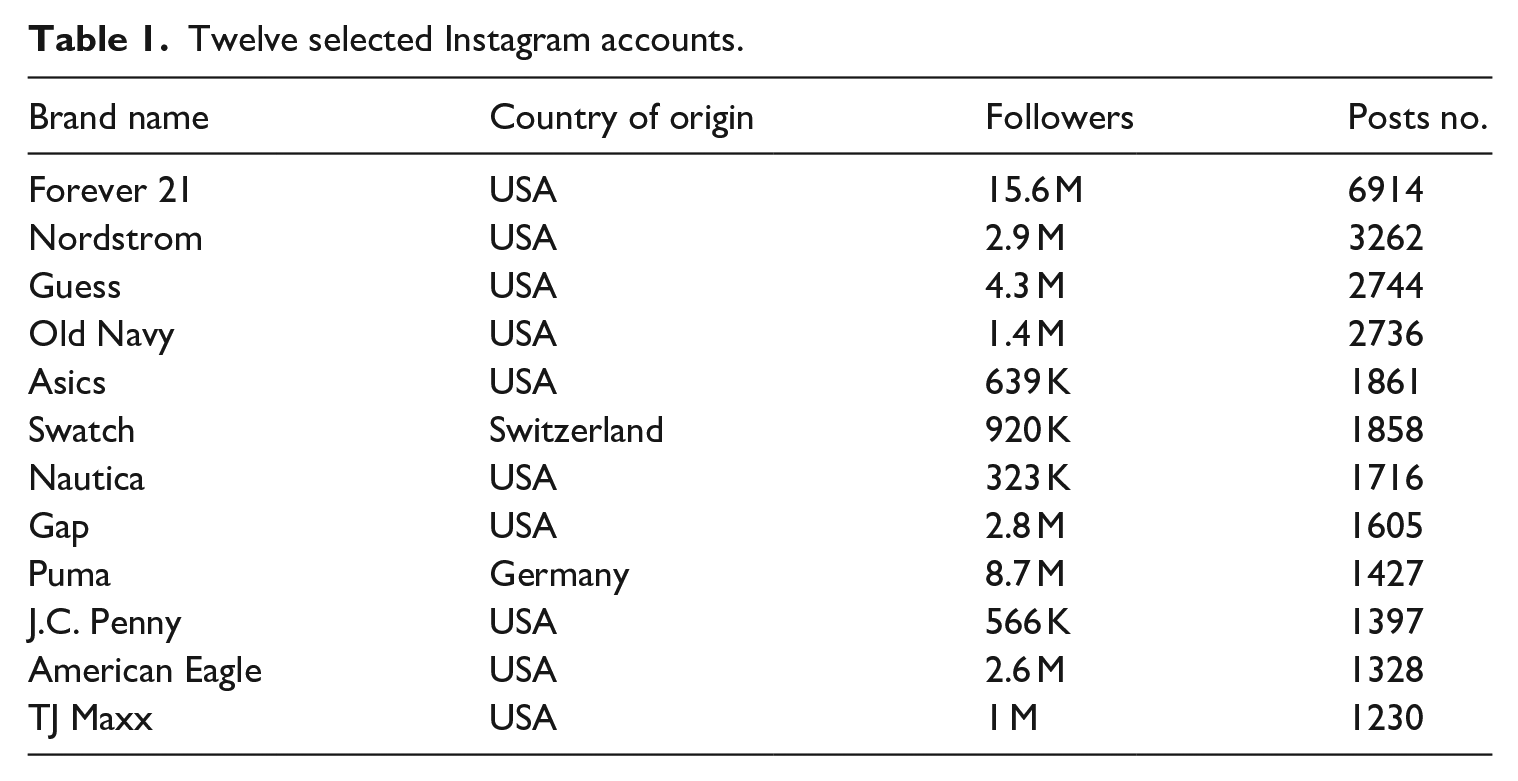
The corpus was designed to enable us to identify, characterize in detail, and interpret the visual and semiotic mechanisms whereby vernacular styles are used by corporate brands. Our qualitative visual and textual examination was based on a multi-stage process of corpus construction and analysis. The first stage established a list of Instagram accounts from which to gather photographic posts (videos and brand events were excluded) over a 5-year period, from January 2014 to December 2018. In contrast to Abidin (2016), whose analysis of fashion on Instagram focused only on brands set up by influencers, we selected 12 leading globally-oriented corporate fashion brands for our corpus: 10 headquartered in the US, and two in Europe (see Table 1). This selection was based on the lists of “leading fashion brands” published annually by the business press (e.g. Forbes and Fashion United International). We also took into consideration questions of sectoral and product variety, aiming for a corpus that included different branches of the mass apparel market (such as female-oriented or male-oriented brands, sportswear, accessories, fashion-orientated department stores, teen-fashion etc.). The selected brands were then checked for their activity volume on Instagram (number of posts during the entire research period), and the number of followers. Only accounts exceeding an activity threshold of 1000 posts in total, and a popularity threshold of a quarter of a million followers were selected. All 12 accounts chosen for the research are marked with the Instagram verification badge (which appears as a white check/tick mark against a circular blue background). This initial stage of corpus construction yielded a total of 28,087 photographic posts from the 12 brands in the research period.
Twelve selected Instagram accounts.
This primary corpus included both professional and amateur-looking images. To produce a corpus of
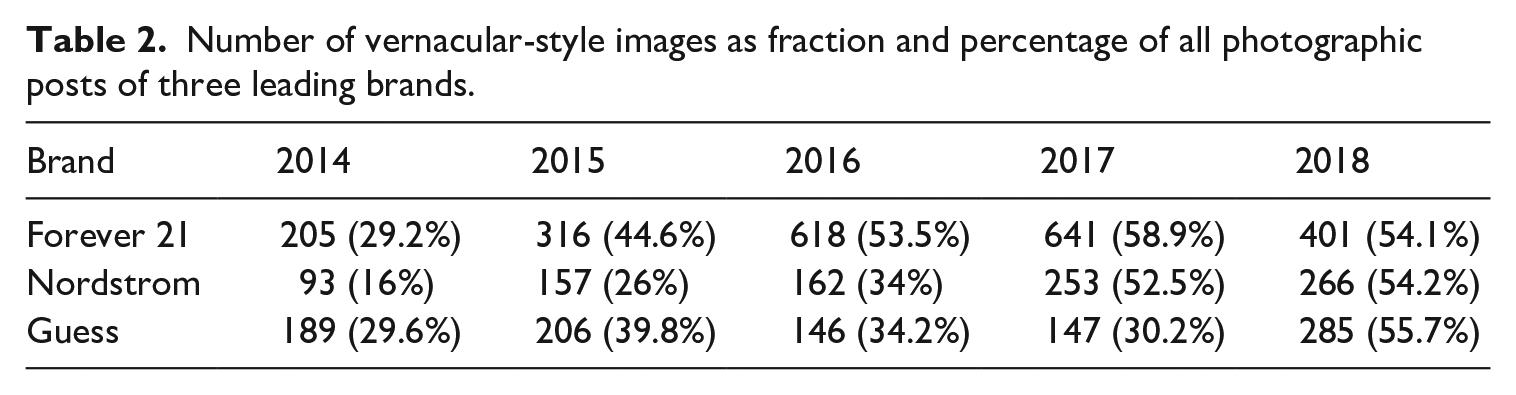
Notwithstanding our inductive and qualitative approach, we did seek nevertheless to gather an initial indication of how extensive vernacularization was, and whether it had increased in frequency over the 5-year period. We therefore counted the overall number, and the frequency of publication, of images we had identified as “vernacular” in the three brands with the largest number of posts overall (Forever 21, Nordstrom and Guess). As Table 2 shows, vernacular images constituted between 16% of photographic posts at the beginning of the period (2014), and over 50% at the end (2018). The rise in the proportion of vernacular images to
Number of vernacular-style images as fraction and percentage of all photographic posts of three leading brands.
Three of a kind: types of user-generated aesthetics
The three main patterns of user-generated aesthetics (UGA) that we identified are: (1)
Regramming
The most widespread form of integrating a UGC aesthetic into professional Instagram accounts is by regramming: featuring a user’s images in the company’s official feed right next to professional images, and tagging the user as the image-creator.
Since users are image-creators, regramming can be seen as yet another form of UGC, though it is clearly shaped by the processes of deliberate corporate monetization and professionalization described by Kim (2012) and Lobato (2016). The users are the credited image-creators, but the motivation to produce the content in the first place is increasingly generated by professional companies. Given the generality of this process, two key attributes of regramming are significant:
There is, however, a catch: in order to be featured in a brand’s feed, users have to tag the brand’s name and its specific hashtag in the original post, and also wear the brand’s items. Hence the “win-win” deal favors one party more than the other. Brands reap both material and marketing profit from regramming users’ images: with the exception of recognized “influencers,” users have to spend money to buy the brand’s products to wear in their own Instagram photos, potentially inspiring their Instagram followers to do the same, in a chain reaction of networked acquisition and citation. In contrast, the profit gained by the user is more obscure: there is no guarantee that the brand’s Instragram account managers will even notice the image, let alone regram it. Even if the image is regrammed – as in Figure 2 – the path from online popularity to material profit is long, hard, and far from certain (Duffy, 2017).
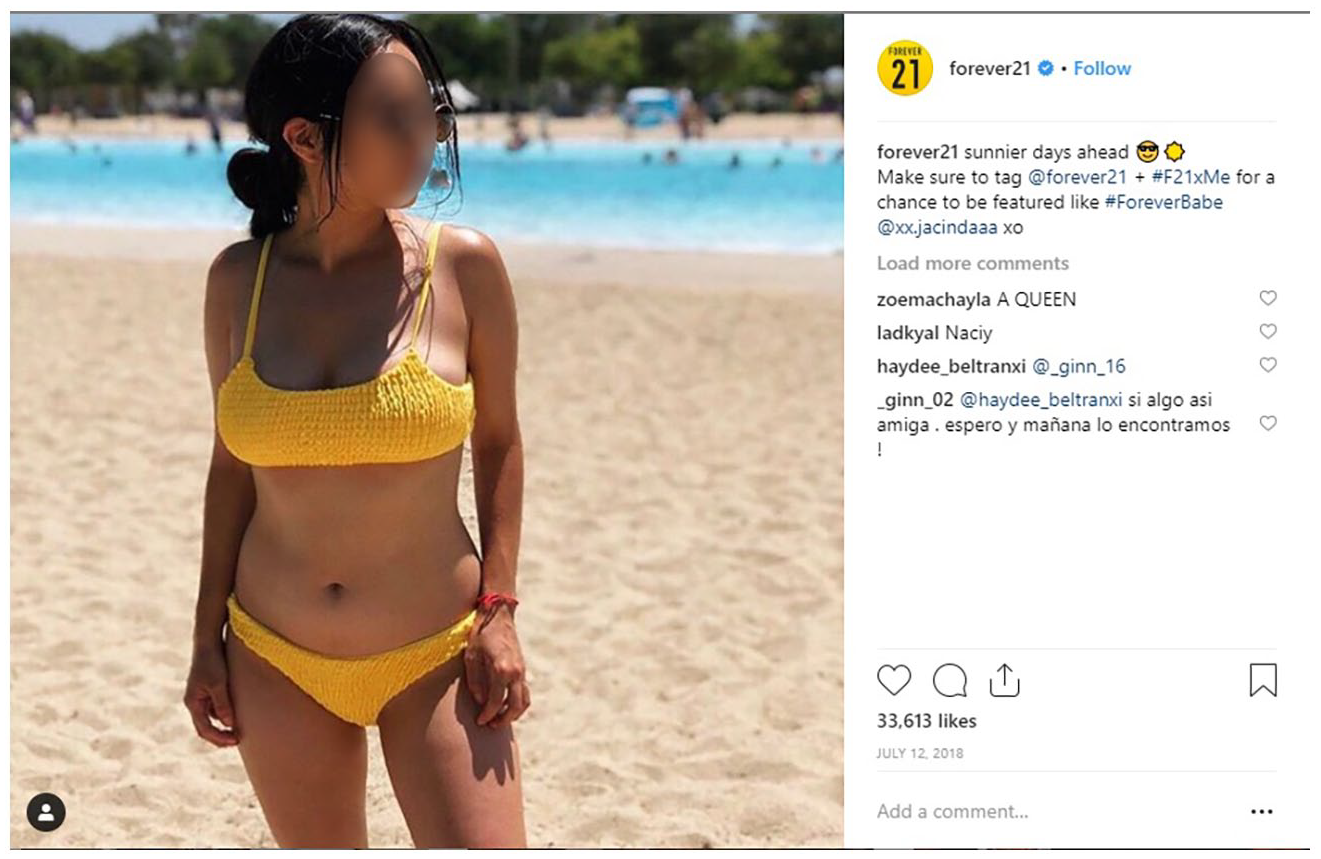
Regramming: a user’s photo in Forever 21’s Instagram account.
Moreover, with the rise of “influencer” culture in Instagram and other monetized social media, many regular users are increasingly eager to collaborate with brands, since collaboration can confer and confirm influencer status – and regramming expresses that motivation. Therefore, users’ images are designed to be brand-friendly, eminently
Vernacular celebrity
“Vernacular celebrity” designates the appearance, within a brand’s official Instagram account, of the vernacular images – blurred, poorly lit, badly composed etc. – taken by, and depicting, a celebrity closely associated with the brand (see Figure 3). Such celebrities usually appear in professional images as the “face” or “ambassador” of the brand: in contrast, here the brand utilizes their (apparently) personal photographs.
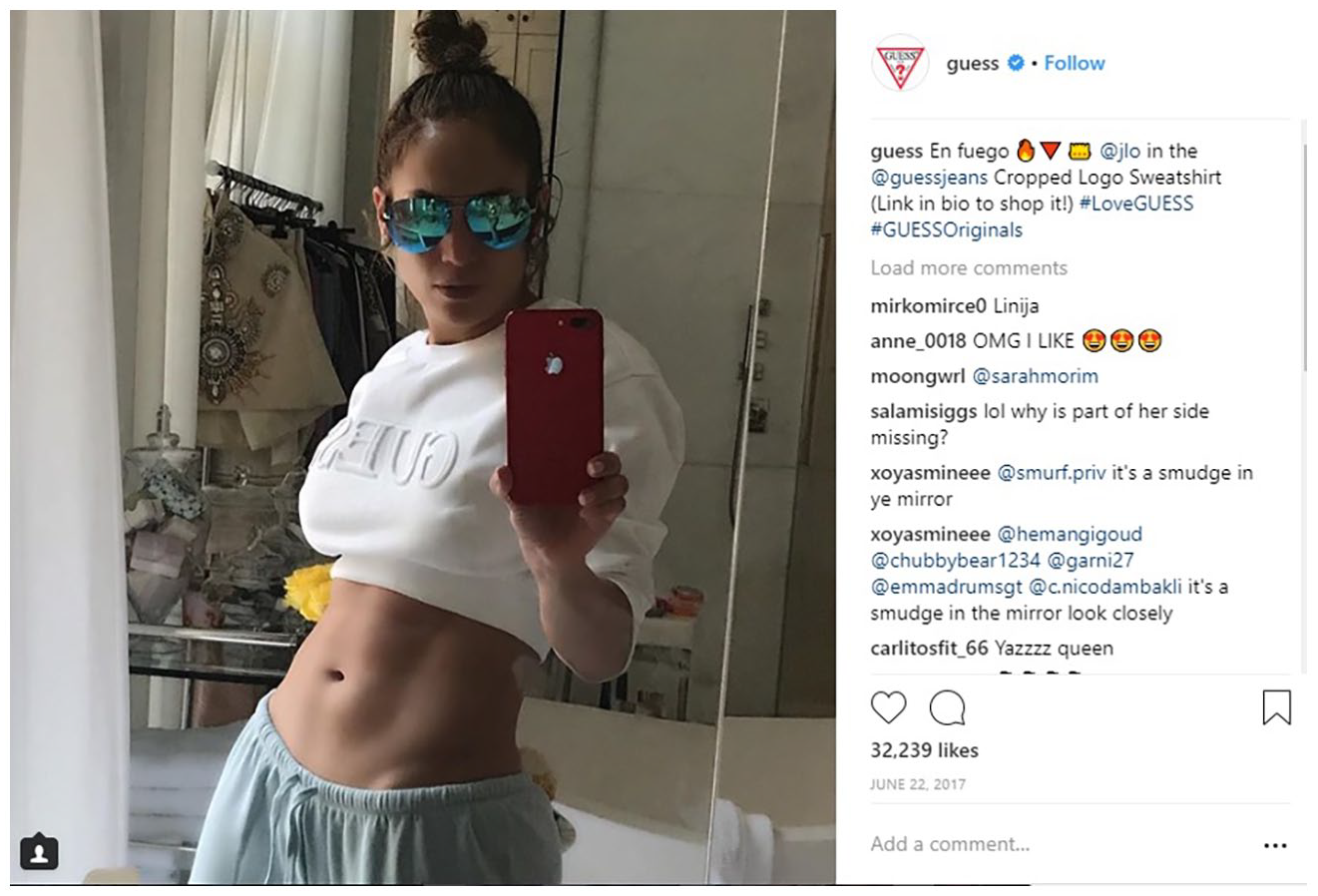
Vernacular celebrity in Guess’ Instagram account.
While less common than regramming, this practice occupies and exploits the unstable ground of the celebrity paradox as being both exceptional and ordinary (Marwick and Boyd, 2011; Turner, 2004). On the one hand celebrity is a highly commodified status category cultivated, promoted, and managed by publicity and media industries; on the other hand, and especially on social media, contemporary celebrities will allow and often encourage “backstage” access to what appears to be a more candid and intimate view of their everyday lives.
Vernacular celebrity promotes both aspects of this paradox simultaneously. It offers personal, spontaneous, non-commercial, and backstage content while maintaining brand supremacy through the unreachability and scarcity of the photographed object: after all, it takes a mega-brand to provide primary access to the mirror-selfie of Jennifer Lopez. Although seemingly more authentic, vernacular celebrity maintains the conventional separation between the brand’s visual “assets” and those of regular users. What is new, however, is the currency in which this separation is expressed. While the superiority of a brand’s visual assets used to be performed solely through the framework of professionalism – including control over image-creation and strict conventions of “good photography” – here the brand’s supremacy is achieved by exploiting access to the celebrity’s backstage as an object of
Although not “professional” looking, vernacular celebrity does not really qualify as “user-generated content” since it is hard to think of Jennifer Lopez as an “ordinary” user. Additionally, the massive “GUESS” logo on her T-shirt suggests that the image is part of a contractual obligation between brand and superstar that was agreed months in advance, rather than a spontaneous mirror-selfie. Vernacular celebrity is therefore a form of user-generated esthetic: an aesthetic style that has roots in user-generated content, but is not necessarily generated by users. When looking at such examples it is no longer entirely clear who produced them, how much time or thought went into their planning, and whether they were made primarily for branding purposes. What we can say is that the image possesses aesthetic characteristics appropriated from UGC.
Brandfies
The third pattern of UGC-style images we identified were selfies that were
Advertising and marketing research has already noted the instrumental value of selfies to brands in what are called “brand selfies”: selfies taken
“Brandfies,” however, are different to “brand selfies.” Here brands do not simply encourage others to takes selfies that support the brand; rather, the brand itself is the creator of the image. Yet since the image is a selfie, the brand is also the visible

A legfie in TJ Maxx Instagram account.
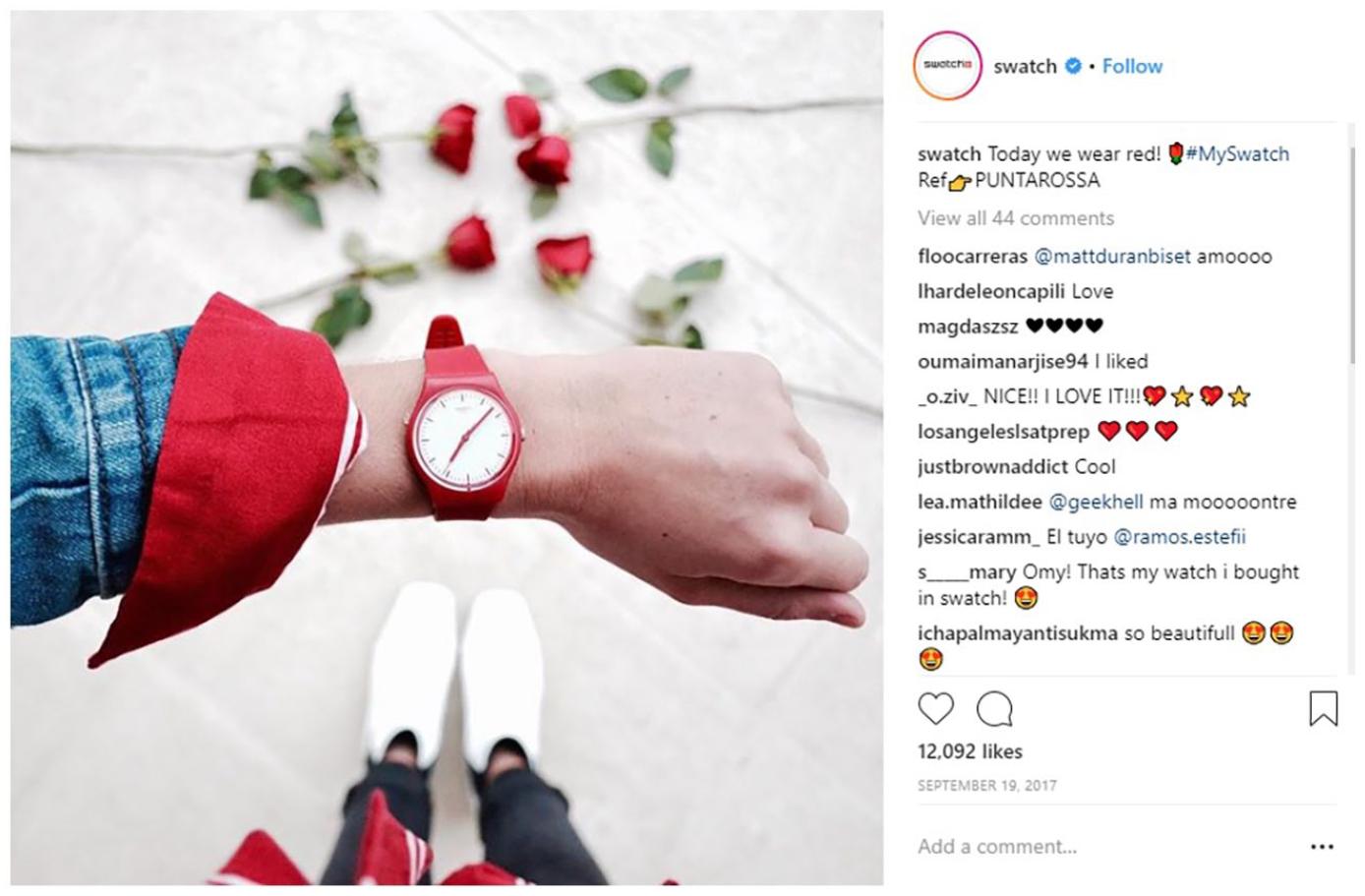
A brandfie in Swatch’s Instagram account.

Brandfie as a memetic template.
Why would brands, who have access to user-generated content and can easily regram the images of real users, bother to create
Another reason for brands to create selfie-style images is to invite users to create similar content. For instance, a brandfie was uploaded to Guess’ official account on February 3rd 2016 with the caption: “We wanna see you #LoveGUESS. Snap a pic on Instagram or Twitter in your GUESS best with #LoveGUESS #GUESSContest + @guess tagged in the caption for a chance to win a $250 USD gift card + other treats!.” Produced as a
The brandfie also suggests important connections between the brand as an entity and the self. Selfies are “gestural images” that perform selfhood in the context of invitations to social interaction with others via a mediated gesture (Frosh, 2015). Brandfies employ this language of gestural sociability to create connective interactions with consumers that are, however, fundamentally commercial. This is not to say that they are not social: but rather, that the social and commercial are performatively fused through the brandfie as a form.
The selfie is a genre of personal reflexivity. What kind of “self,” however, is being enacted in the case of a brandfie – and by “what” or “whom” (even the language one uses here becomes tricky)? The brandfie, while deceptively simple as a corporate appropriation of a vernacular cultural practice, has a complex ideological and semiotic structure that reveals the “deep grammar” of contemporary consumer culture:
As such, the brandfie has a threefold significance. First, it reinforces the idea that brands are not abstract concepts or merely bundles of meanings, but are increasingly constructed as persons and as personalities. It therefore instantiates Lury’s thesis that brands are concrete entities that uphold relationships with clients and other brands, and engage in social relations with consumers (Lury, 2004). Brands, then, are not merely objects, but new kinds of social
The final and perhaps most startling significance of the brandfie is that it presents the brand as a social subject through an overtly
Conclusion
Brands have several advantages over “regular people” in the creation and distribution of content: they have substantial budgets, employ professional creatives and social media managers, and use strategy and research teams to analyze and locate trends. Yet there is one thing that any random “ordinary” user possesses and that Coca-Cola, Apple, or Dior don’t: the regular user has “a life” – cute babies, romantic marriage proposals, passionate kisses, and intimate physical moments to share with followers and viewers online.
The three main patterns of user-generated aesthetics (UGA) we identified are thus scripts through which brands can perform life online. Brands have friends and regram their shared images: by doing so, brands appear to “hack” Instagram’s no-sharing platform affordances, using “low-tech” manual solutions to suggest bottom-up virality. Additionally, much like the celebrities associated with them, brands are well known, yet by their use of vernacular practices they remain accessible and vulnerable, apparently just like ordinary individuals. Finally, through “brandfies,” brands begin to reveal not just their social lives and personalities, but their physical appearance and viewpoints – their embodied selves – as though they do indeed have a life, in all dimensions of existence.
Our research focused on Instagram and fashion brands, for reasons outlined in the methodology section; it is therefore limited to one (albeit extremely popular) social media platform, as well to one field of production and branding (albeit highly significant for consumer culture): fashion. Hence it is important to ask whether UGA is restricted to Instagram, and how prevalent it is among non-fashion brands. Answering these questions requires further investigation, and the patterns of UGA we have identified can function as a baseline for such future comparisons, including across larger corpuses, in other digital arenas. UGA serves as a useful baseline, we contend, because it exemplifies and extends several strands in contemporary theorizing about social media and consumer culture. It constitutes an example of the corporate appropriation of everyday vernacular practices, and furthers understanding of the mechanisms whereby brands act as social subjects who create and maintain relationships with individuals and other brands (Lury, 2004).
In the context of digital culture, UGA contributes to ongoing research on “amateurism” as a value and performative strategy (Abidin, 2017; Hamilton, 2013). It also very clearly complements and contrasts with the “professionalization” of non-professional content production (e.g. Cunningham et al., 2016; Kim, 2012; Lobato, 2016). Together these dual movements – professionalizing user-generation and vernacularizing professional images – create a form of novel “context collapse” as previously discussed, between the representation of commercial entities and the of individuals online. If Instagram is indeed the “social media storefront” where “sociality unfolds within platforms that encode marketplace logics” (Hund and McGuigan, 2019), then UGA is an important mechanism by which brands transform networked connections into commercial gain.
Speaking more broadly, UGA exemplifies the expansion of branding beyond the purview of marketing, advertising, and celebrity into virtually all aspects of social life (Banet-Weiser, 2012; Marwick, 2015; Wernick, 1991). If everyday social media practices of self-representation and communication (such as photography) are already largely produced within the discursive and performative structures of marketing, their actual appropriation by marketing and branding companies is likely to be both ideologically seamless and generative of new content. Under these conditions, the activities of users and brands may “collude” to the point where it becomes hard – or even experientially irrelevant – to differentiate between their modes of action and expression. In an arena where users practice self-branding, and brands perform private life, engage in social interactions, and present emotional and physical selves, what signifies the difference between the two?
Such a blurring of distinctions between professional commercial entities and everyday life has been some years in the making – with, for instance, “real people” performing as models, and “street fashion” being transferred to the runways of elite fashion brands. Yet previous borrowings from everyday culture have been deliberate and overt
Footnotes
Funding
ORCID iD
