







Abstract
Keywords
Introduction
An adsorption potential well refers to a location with lower potential energy on the coal surface, which exhibits methane adsorption ability (Gürdal and Yalcin, 2001; Wang et al., 1996, 2013). The adsorption potential well depth is related to the mutual attraction between coal and methane (Ma et al., 2011a, 2011b). Owing to the variety of the oxygen-containing functional groups (Lu et al., 2014; Zhong, 2004) and side chains on the coal surface (Liu and Feng, 2012; Zhou et al., 2017a), as well as the fractal characteristics of coal surface morphology (Liu et al., 2003; Zhou et al., 2017b), the methane adsorption potential wells on natural coal surfaces exhibit obvious heterogeneity (Karacan, 2000; Wang, 2000). Similar to potential energy, adsorption sites with different adsorption capacities form rough equipotential adsorption potential surfaces (Fu et al., 2005). The sunken part is known as the potential well, and the depression potential energy is referred to as the potential well depth (Figure 1). Obviously, the depth of the potential wells (−

Equipotential line of solid surface.
Coalbed methane (CBM) is an unconventional natural gas that exists in coal reservoirs. Methane adsorption in coal is dependent on two factors: the adsorption potential well parameters (potential well depth and number of potential wells) and methane gas state parameters (such as adsorption pressure and temperature). CBM thermal recovery technology has been developed in recent years. In the CBM thermal recovery process, the variation rules of the methane adsorption heat of coal are not clear, which makes accurate evaluation of CBM thermal recovery efficiency challenging. Therefore, the variation law of the adsorption heat of methane and coal with inhomogeneous potential wells is studied in this paper. This will provide a new theoretical basis and application foundation for the accurate evaluation of CBM enrichment characteristics, CBM production and exploitation efficiency improvement, and popularisation of new methods and technology for CBM exploitation.
Kinetic process of methane adsorption by coal
In 1916, the state equation for monolayer adsorption was deduced by Langmuir, based on statistical thermodynamics (Yan and Zhang, 1979). The temperature-dependent adsorption parameters were obtained as follows

Compared to 
Then, substituting 
From equations (2) and (3),
From a microscopic viewpoint, methane adsorption in coal is the process of the potential energy of methane molecules being converted to coal surface energy and thermal energy by means of collisions between the methane molecules and adsorption site. In heterogeneous potential wells, when an adsorption site has a potential well depth that is smaller than the energy of the collided methane molecule, the adsorption site cannot trap the methane molecule, and adsorption cannot occur. However, when an adsorption site has a potential well depth that is larger than the energy of the collided methane molecule, the adsorption site can trap the methane molecule, and adsorption can occur, while the coal surface energy is reduced, and the remaining energy is converted into heat energy and released. Therefore, methane adsorption in coal is an exothermic process. Moreover, as the distributions of potential wells differ, the heat released from the equivalent methane adsorption varies.
Relationship between adsorption site coverage and adsorption heat
During methane adsorption in coal, the coverage of the heterogeneous potential wells on the coal surface mainly depends on the temperature and adsorption pressure. For all adsorption sites with a potential well depth of −
Substituting equation (1) into equation (4), we obtain

From equation (5), in the coal and methane adsorption equilibrium, the coverage of the potential wells with different depths obeys the law of the logistic (
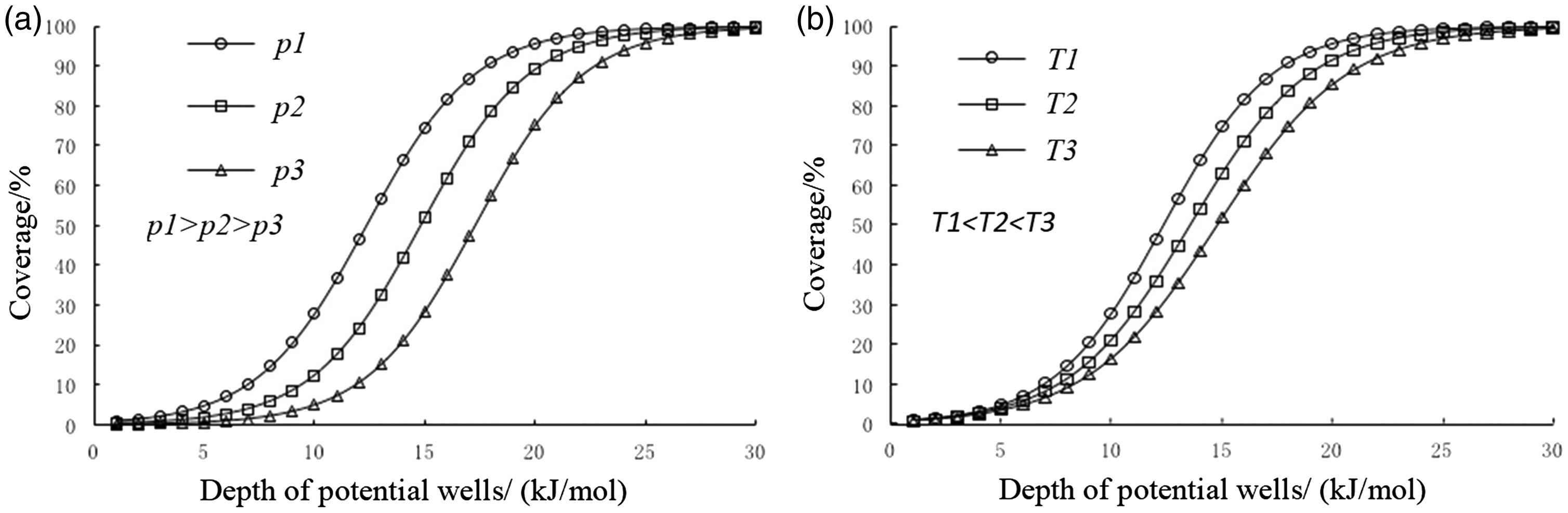
Coverage rate of (a) isothermal and (b) isobaric adsorption at different potential well depths.
Experimental study on adsorption characteristics of heterogeneous potential wells
The test systems for measuring methane adsorption by coal at high temperatures include an inflation device or stable system, precise heating device, adsorption chamber, methane storage cylinder and system for gas measurement. The inflation device or stable system is used to load the methane adsorption container, and the axial pressure is controlled by the stable device. The precise heating device used for heating the adsorption container has an accuracy of 0.1 K and the maximum attainable heat is 873 K. The dimensions of the cylindrical coal mass sample taken from the 3# coal seam (Tunliu mine, Lu'an Mining Area) were 100 mm (diameter) × 150 mm (length). The internal dimensions of the stainless steel absorption container were the same as those of the coal sample, and it was connected to both the methane storage cylinder and gas measurement system by means of a steel pipe with an internal diameter of 4 mm. The experimental system principles are presented in Figure 3. The equipment is thermally stable and can be used in a controlled environment; therefore, very high accuracy is provided by the temperature supply and measurement. The system operates from room temperature (RT) to 573 K.

Schematic of test system.
In order to study the methane adsorption characteristics in coal with inhomogeneous potential wells, isothermal and isobaric adsorption experiments at different temperatures were carried out by the test systems. Seven different temperature points between 333 and 513 K were set in the experiment. In the isothermal adsorption experiment, methane was injected into the adsorption container at the required pressure after achieving a vacuum. The injection valve was closed and the container was heated at the adsorption equilibrium gas pressure. Each temperature stage lasted for 6 h after achieving the stabilised methane pressure before moving to the next stage. Five gas pressure points were recorded at each temperature point. In the isobaric adsorption experiment, the constant desorption pressure was set after adsorption equilibrium at 333 K, following which methane desorption was carried out under each temperature point. During this process, each temperature point was maintained above 8 h, and the methane desorption equilibrium was reached when the pressure was maintained constant. The methane adsorption amount was calculated by measuring the initial adsorption amount and methane desorption amount under a constant pressure at different temperature points.
Phenomenon of coal-adsorbing methane adsorption in coal with heterogeneous potential wells
The adsorption amount, temperature and adsorption pressure of the isothermal and isobaric adsorption experiments are displayed in Table 1. Firstly, the isothermal adsorption process at different temperatures was analysed. The curve fitting of the isothermal experiment data is displayed in Table 2, based on the Langmuir formula (equation (4)). It is indicated that, in the temperature range from 333 to 513 K, the lean coal adsorption capacity during isothermal methane adsorption increased with an increasing adsorption pressure, and the increasing rate slowed. The adsorption curve is similar to the Langmuir curve. The parameter
Adsorption capacity and pressure of methane in coal at different temperatures.
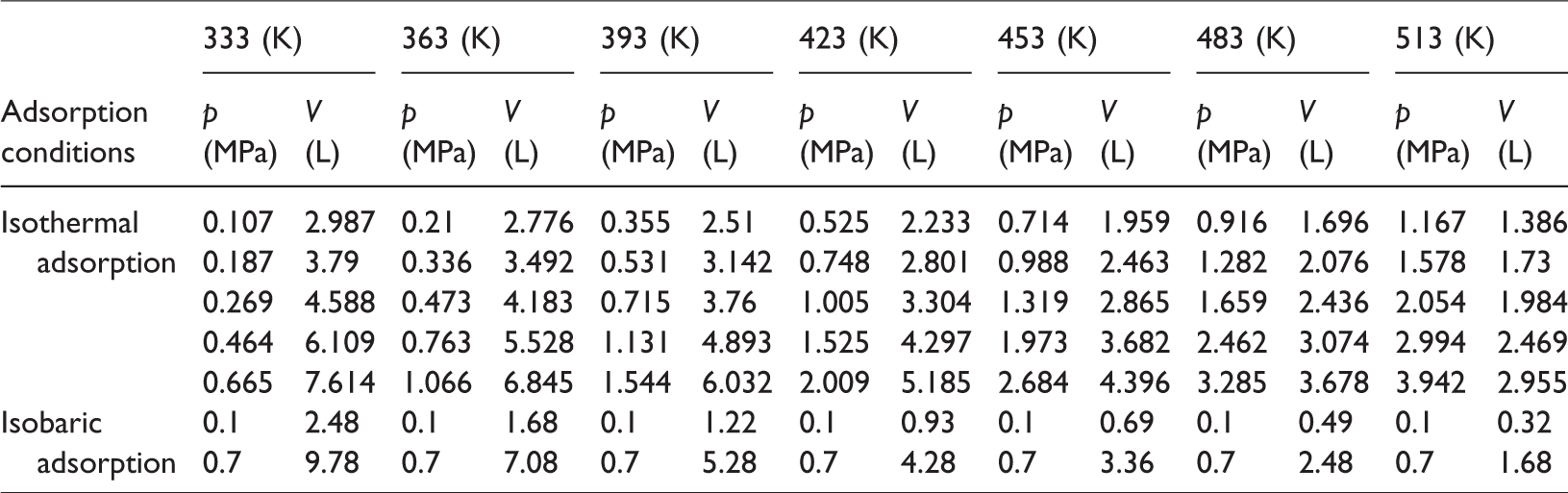
Curve fitting of adsorption capacity and pressure of methane at different temperatures.

The methane adsorption amount variation with the temperature increase in the isobaric adsorption experiment is illustrated in Figure 4. It is indicated that the coal methane adsorption amount decreased with the temperature increase. When the adsorption pressure changed from 0.1 to 0.7 MPa, the adsorption amount variation decreased with the temperature increase; that is, the sensitivity of the methane adsorption amount to the adsorption pressure decreased with an increasing temperature.
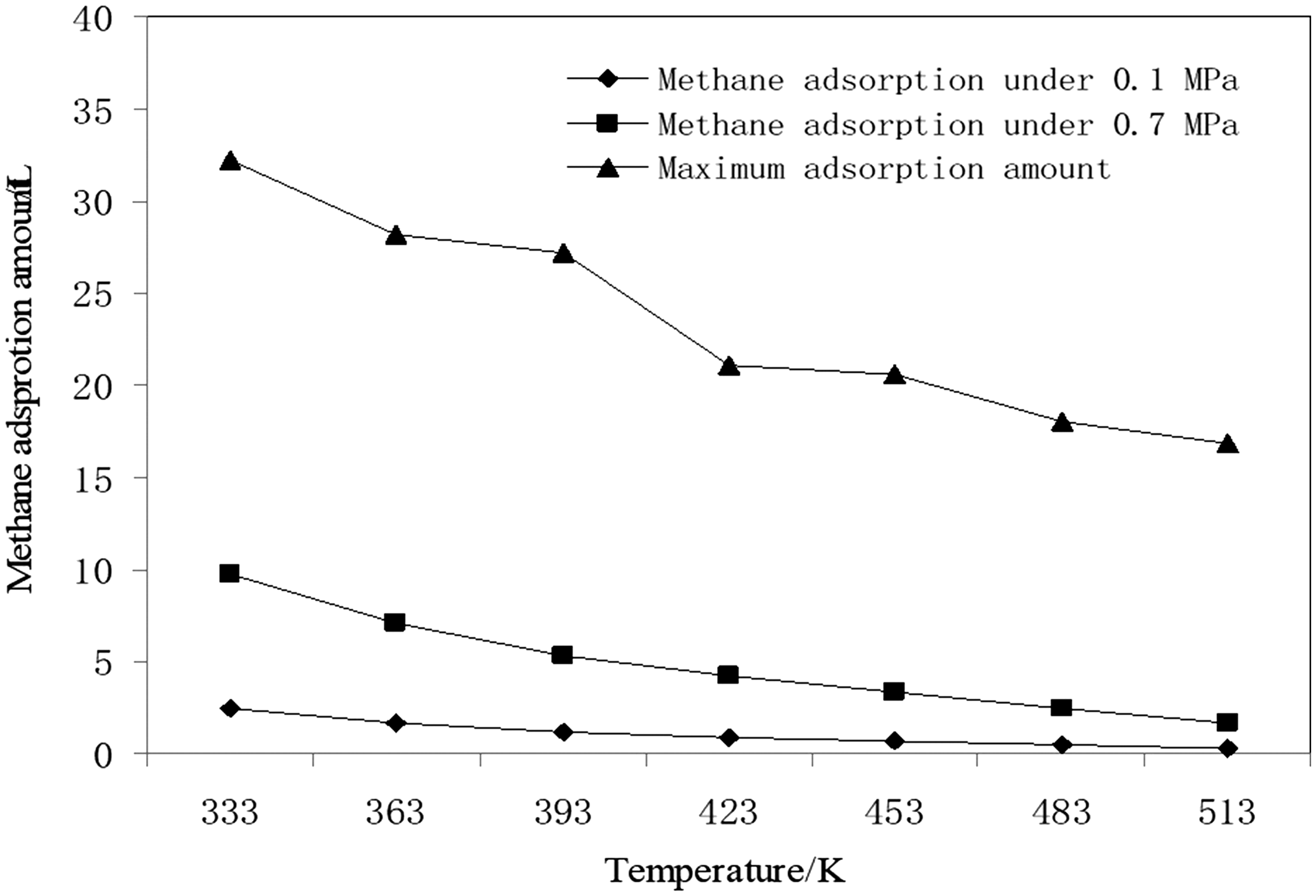
Variation of adsorption capacities with temperature at different adsorption pressures.
This is one of the main reasons for the low efficiency of CBM extraction by means of adsorption pressure reduction. For methane molecules that are tightly bounded in deep potential wells, only changing the methane molecule energy distribution through increasing the temperature by means of the CBM thermal recovery technology can effectively cause their adsorption state to change.
Influence of temperature and adsorption pressure on coal and methane adsorption heat
Owing to the differences in the adsorption sites of potential well depths and coverage priority, the methane adsorption heat in coal varies with changes in the system temperature Adsorption heat variation in isobaric adsorption process
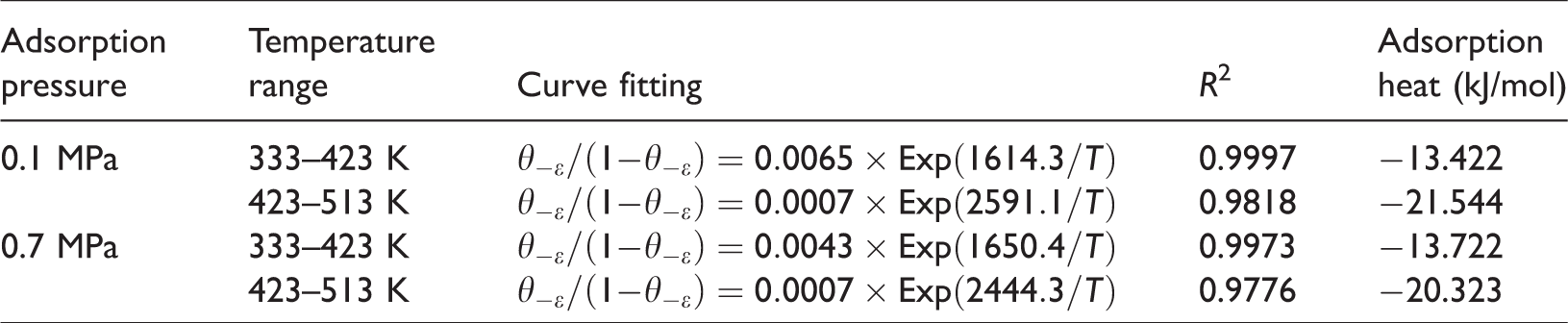
The influence of temperature on adsorption heat can be analysed by curve fitting in stages during the isobaric adsorption experiment. As illustrated in Figure 5, the temperature section of the 333 to 423 K was regard as the low-temperature stage of the isobaric adsorption experiment. Conversely, the temperature section of 523 to 513 K was regarded as the high-temperature stage of the isobaric adsorption experiment. From equation (2)

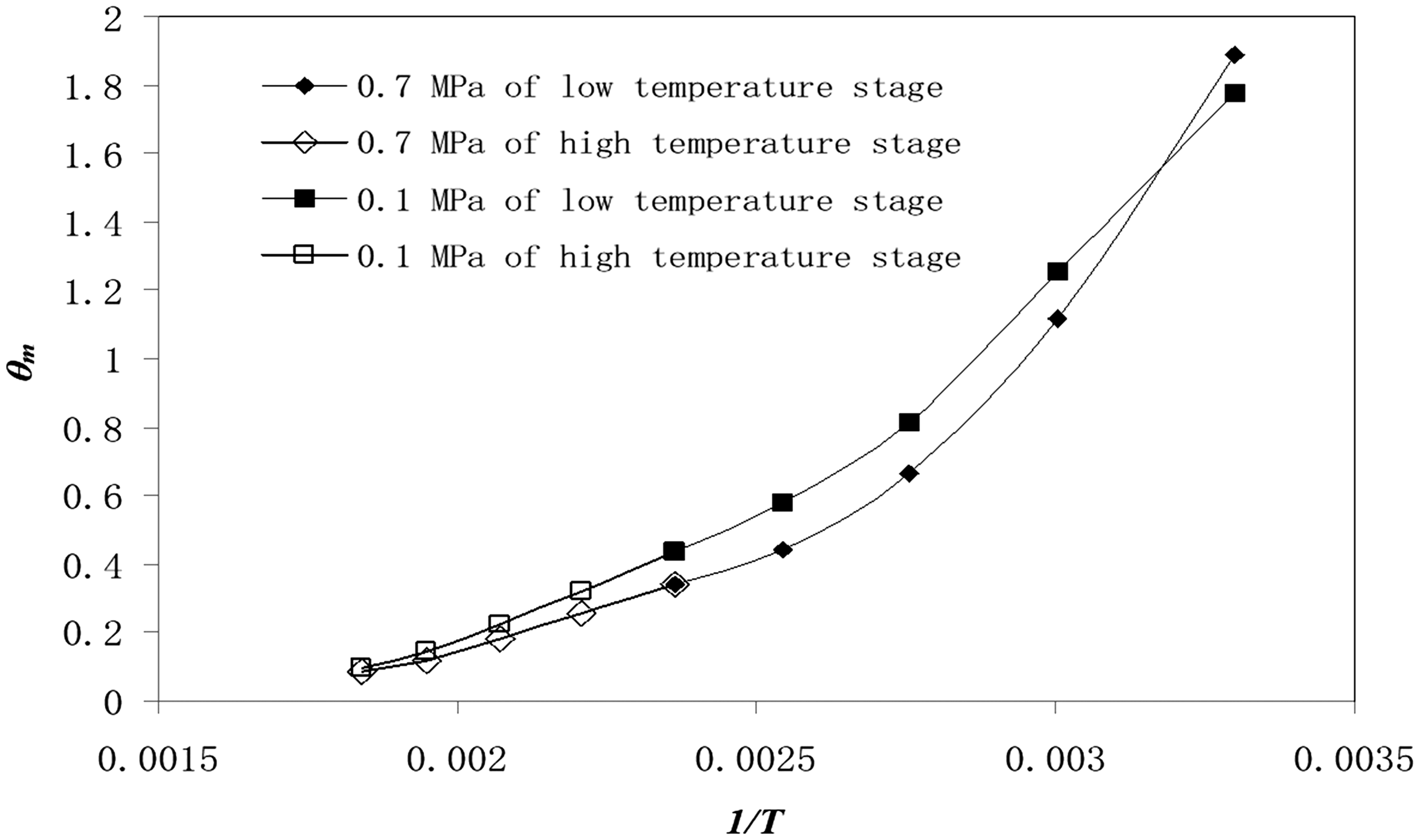
Curve fitting of isobaric adsorption of methane at different temperatures.
Here,
Curve fitting of isosteric at different temperatures and adsorption heats.
2. Adsorption heat variation in isothermal adsorption process
The influence of adsorption pressure on adsorption heat can be analysed by the curve fitting in stages of the isothermal adsorption experiment. From equation (4)

As illustrated in Figure 6, the adsorption pressure section from the first to third measuring points was regarded as the low adsorption pressure stage of the isothermal adsorption experiment. Conversely, the adsorption pressure section from the third to fifth measuring points was regarded as the high adsorption pressure stage of the isothermal adsorption experiment. The adsorption heat of the different adsorption pressure stages can be obtained by substituting the curve fittings and temperature

Curve fitting of isothermal adsorption at different adsorption pressures.
The proportionality constant
Curve fitting of the adsorption capacity and pressure of methane in coal at different temperatures.
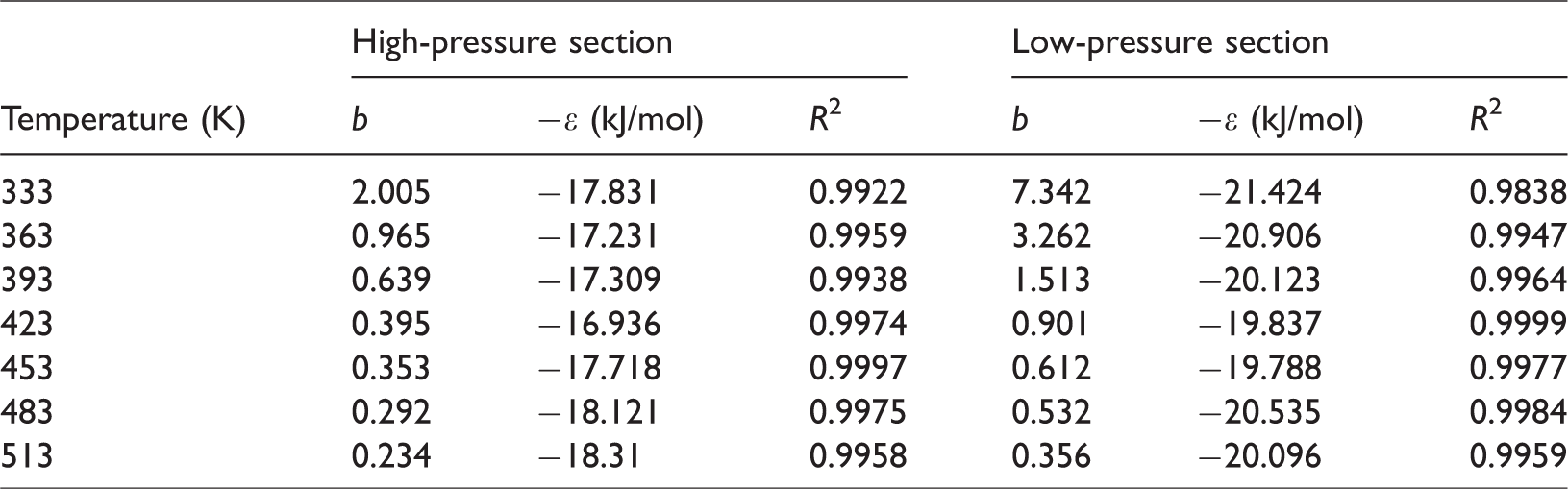
The curve fittings of the isothermal adsorption experiments exhibit high correlation coefficients. In the isothermal adsorption of 333 to 513 K, the calculated coal and methane adsorption heat ranged from 1.686 to 3.593 kJ/mol. Both the adsorption rate
Conclusions
For heterogeneous potential wells, methane adsorption in coal exhibits the following characteristics.
In the methane adsorption process, methane molecules prefer to be adsorbed by deep adsorption potential wells, rather than shallow adsorption potential wells. When the adsorption pressure increases or the temperature decreases, the adsorption occurs from the deep to shallow potential wells at the adsorption sites. Conversely, when the adsorption pressure or temperature decreases, methane desorption of the adsorption sites occurs from the shallow to the deep potential wells. Owing to the heterogeneity of the adsorption potential wells on the coal surface, a smaller adsorption amount results in a greater potential well depth being occupied by the adsorbed methane molecules, and the sensitivity of their adsorption states to adsorption pressure is weakened. During isobaric adsorption, the adsorption heat in the high-temperature stage is significantly higher than that in the low-temperature stage. A lower adsorption pressure results in greater adsorption heat variation during the temperature increase. During the isothermal adsorption process, the adsorption heat is higher in the low-pressure stage. As the adsorption pressure increases, the coverage rate of the adsorption sites with shallow potential wells increases gradually, leading to a decrease in the adsorption heat.