







Abstract
Keywords
Introduction
Both in terms of visibility and promotion international student mobility is currently among the most prominent features in the efforts to internationalise higher education across European, national and institutional levels (Teichler, 2017). Symbolised by its crucial role in both the ERASMUS-programme and the Bologna Process student mobility has over the past decades been an activity surrounded by intensifying political interest and promotion at the European level (Papatsiba, 2006). In parallel the mobility of teacher students has apparently become a more prominent issue over the past decades (Zgaga, 2008). Indeed, this was made a priority in the European Higher Education Area in 2015, the highest-level and perhaps most influential European policy cooperation for student mobility, which stated that: ‘
Arguably, the strong political focus on mobility contributes to creating effects and contexts for thinking about it (Brooks, 2018; Robertson, 2010), but to this date there is a lack of research which critically addresses potential implications of political ideas and discourses that legitimate the intensified political promotion of teacher student mobility. Drawing on inspiration from the theoretical framework of discursive institutionalism (Schmidt, 2008), this paper explores and compares the development of contemporary European and Norwegian policy discourses on student teacher mobility as promoted in key policy texts over the past decades. It specifically asks
Situating the study: Norwegian teacher education context and the policy prominence of international student mobility
The study presented in this article aims to analyse and contrast ideas about teacher student mobility conveyed in European and Norwegian policy discourse. While mapping the European discourse(s) alone would suffice as a way of gaining insight to institutionalised ideas about mobility from crucial policy actors in the field, including a comparative national case is arguably highly relevant with teacher education being the main focus of the study. Although the Bologna Process and the EHEA as well as the EU strategies in education and research influence teacher education and are international by nature, ‘
More generally Norway provides for an interesting national case due to the significant amount of resources which has been put into ensuring the opportunity for all higher education students to undertake study periods abroad (Stensaker et al., 2008; Vabø and Wiers-Jenssen, 2014). The still stronger emphasis placed on mobility is evident by the number of white papers, strategies and initiatives initiated by policymakers over the past decades which promote mobility (Meld. St. 7, 2020–2021; Meld. St. 16, 2016–2017; St. Meld. 14, 2008–2009; St. Meld. 27, 2000–2001). Today it is a stated long-term objective that 50% of all students taking a degree in higher education should have had a stay abroad when finishing their degree (Wiers-Jenssen, 2019), and while the reality of this ambition can be discussed, it illustrates the commitment to this agenda in Norway. It thus provides the study with a rich national case for studying ideas about student mobility and their development over time.
Though not being a member of the EU, Norway participates fully in the EU education and research programmes in terms of rights and duties, and it has been argued that its higher education internationalisation policy shares many common ambitions with the European agenda on this matter. This is illustrated by the fact that Norway both joined the ERASMUS-programme and signed the Bologna Declaration in their early stages, and its general keenness to implement the associated changes (Gornitzka and Langfeldt, 2008; Wiers-Jenssen, 2019). This serves as an important backdrop for exploring ideas about mobility specific to teacher education, which has only formally/legally been included in the Norwegian higher education system since the mid-1990s (Garm and Karlsen, 2004). Thus, the comparative temporal analysis of the two discourses respectively allows for a rich analysis of the variety of ideas employed to promote teacher mobility, as well as how such ideas have gained legitimacy and become prominent – on the policy level – in the institutional context of teacher education.
Existing research: Discursively oriented perspectives on mobility policies
The intensified policy focus on teacher students’ mobility has been observed and commented on by more scholars (Pedersen, 2021; Wernisch, 2016; Zgaga, 2008). Yet to this date the ideas and discourses supporting it have not been critically explored. In the general higher education literature, a number of studies have attended to the underlying political ideas about student mobility (e.g. Brooks, 2018; Courtois, 2018a, 2019, 2020; Papatsiba, 2009), but for teacher education as a sub-field of higher education, internationalisation issues are left rather unexplored (Pedersen, 2021; Zgaga, 2017). Arguably, this is problematic because these issues concern and cut across higher education and the disciplines in general, as well as teacher education specifically, for instance in terms of how to enable teachers to handle the increasing internationalisation in schools. Thus, following the call made by other scholars in the field to approach teacher education from the perspective of higher education at large (Zgaga, 2013), the present study aims to shed light on the discourses specific to teacher education by
Existing studies have demonstrated how policy texts are replete with claims about the benefits and qualities of mobility for the individual student, higher education institutions, society and the economy more generally (Powell and Finger, 2013; Teichler, 2017). It has been argued that policies tend to emphasise the individual competences supposedly developed through mobility such as language acquisition, intercultural competence, and self-confidence, but that these qualities are often promoted within a framework conceptualising them as a useful instrument for the economy and society (Courtois, 2020; Dvir and Yemini, 2017; Papatsiba, 2006, 2009). In this vein, more scholars have argued that the past decades have witnessed a shift in internationalisation policies towards commercialisation symbolised by the focus on student mobility (Castro et al., 2016; Chankseliani and Wells, 2019; Robson and Wihlborg, 2019), as well as an instrumentalisation of student mobility itself, where economic aspects are emphasised at the expense of social, academic and intercultural aspects (e.g. Abdullah et al., 2017; Courtois, 2019, 2020; Dvir and Yemini, 2017; Findlay et al., 2017; Pedersen, 2021; Powell and Finger, 2013).
In the broader context of education policy this discursive shift has also been observed in relation to compulsory schooling, in terms of how the capacities mentioned above can be developed among
As policy meets the context in which they are to be implemented (in this case teacher education, and subsequently schools), such discursive positionings can become challenged, as actors ‘
Discursive institutionalism and the role of ideas in policymaking: An analytical framework
The paper approaches the study of mobility discourse by drawing on inspiration from the theoretical framework of discursive institutionalism (Lynggaard, 2019; Schmidt, 2008, 2010). This framework aims to understand policy in context by linking a perspective on the
Within this framework ideas are approached as being crucial for political discourse, because they are seen as shaping our understanding of political problems, contributing to defining our goals and strategies and are used to communicate about politics thereby providing guides for action (Béland and Cox, 2010). When ideas are promoted in discourse, a collective discursive context can be formed, which actors can draw on and act within to legitimate their political choices (Lynggaard, 2019: 12). Inspired by this framework, the present study aims to map ideas about mobility for teacher students across various policy texts, and how they link together in discourses which legitimate the political actions being taken on this issue. To do so, the concept of ideas is operationalised by differentiating between
As the two types of ideas can be mobilised at the same time to shape policies, they are not easily separated (Courtois and Veiga, 2020). Analytically, however, they can serve as useful categories for mapping
Analysing policy texts: Materials and methods
While the paper treats policy texts as a valuable empirical source for exploring the development of mobility discourse, they are not transparent representations of an underlying social reality, but rather
The selection of texts is first of all based on them being publicly available online (EU and national libraries, official government websites etc.) and was supported by active engagement with secondary research literature as well as a range of criteria. There had to be either an explicit mentioning of (a) teacher education/training/students (thus excluding in-service teachers 1 ), (b) international student mobility, or related terms such as exchange, study abroad, etc. ‘Internationalisation’ and ‘globalisation’ were also included as more general concepts to support the selection. Given that the aim is to map a discursive development, the timeframe is circa 1990-present, which is a period in time marked by a stronger political interest in mobility; in Norway by a more prominent focus on quantitative objectives of mobility (Elken et al., 2015: 65), and on the European level by the launch of the ERASMUS programme in 1987 (Papatsiba, 2006). However, this does not suggest that this is the ‘historical origin’ mobility discourse, but mainly serves as an analytical starting point. An overview of the analysed documents can be found in Table 1. Though not all cited in the findings sections, detailed information about the policy texts can be found in the reference list. Not all the Norwegian policy texts exist in English versions, but when they do, these are used as references, though their content is often more compact than the original version.
Analysed documents (issuing body, title, year. For full reference see bibliography).

Analytical process: Mapping ideas and discourse
After the selection process described above, the documents were coded and analysed using NVivo software through a series of steps. Table 2 provides an overview of these analytical steps and how they were operationalised in the analysis. The analytical process moved abductively and iteratively between the insights gained from the literature review, the analytical framework and the empirical material itself, thus allowing both for using the theoretical backdrop as sensitising lenses, as well as an empirical openness towards unexpected and puzzling findings calling for other theoretical perspectives (Alvesson and Sköldberg, 2018; Lynggaard, 2019). To substantiate own interpretations, they were continuously discussed with other researchers and contrasted with findings from existing studies in the general context of higher education.
Analytical concepts, identification in the data and example from analysis.

Specifically, the first step of analysis was to map the ideas expressed across the documents, focussing on
Hence, the three discourses of professionalisation, harmonisation and instrumentalisation broadly capture crucial features of both the European and Norwegian discourse, though they also differ in some respects. Thus, as the last analytical step, the findings from both respective contexts were compared in terms of the normative/cognitive ideas employed, their temporal development, and ultimately how they presuppose the role/function of future teachers. Focussing on both similarities and differences provided a rich picture of the ideas employed to promote teacher mobility, and thereby contributed to a more comprehensive understanding of how the (seemingly similar) contemporary discourses promoting teacher mobility have gained legitimacy in this particular institutional context.
Findings: Teacher student mobility between professionalisation, harmonisation and instrumentalisation
This section presents the findings of the study first by outlining the identified ideas and how they form discourses in the European and Norwegian context respectively. The three discourses labelled
Mapping the European discourse
In the European context, the promotion of mobility of teacher students is found to have accompanied the general mobility discourse as it accelerated in the late 1980′s (Table 3). The general discourse foregrounded mobility as an instrument to strengthen internal market and support the political project of a single union by fostering a feeling of ‘European belonging’ among young people (Papatsiba, 2006). In light of this, teacher student mobility is found to be promoted as a way of disseminating European values into schools by providing students with both a European knowledge- and value foundation, as for instance identified in the Green paper on the European dimension of education:
Ideas and discourse in the European policy texts.
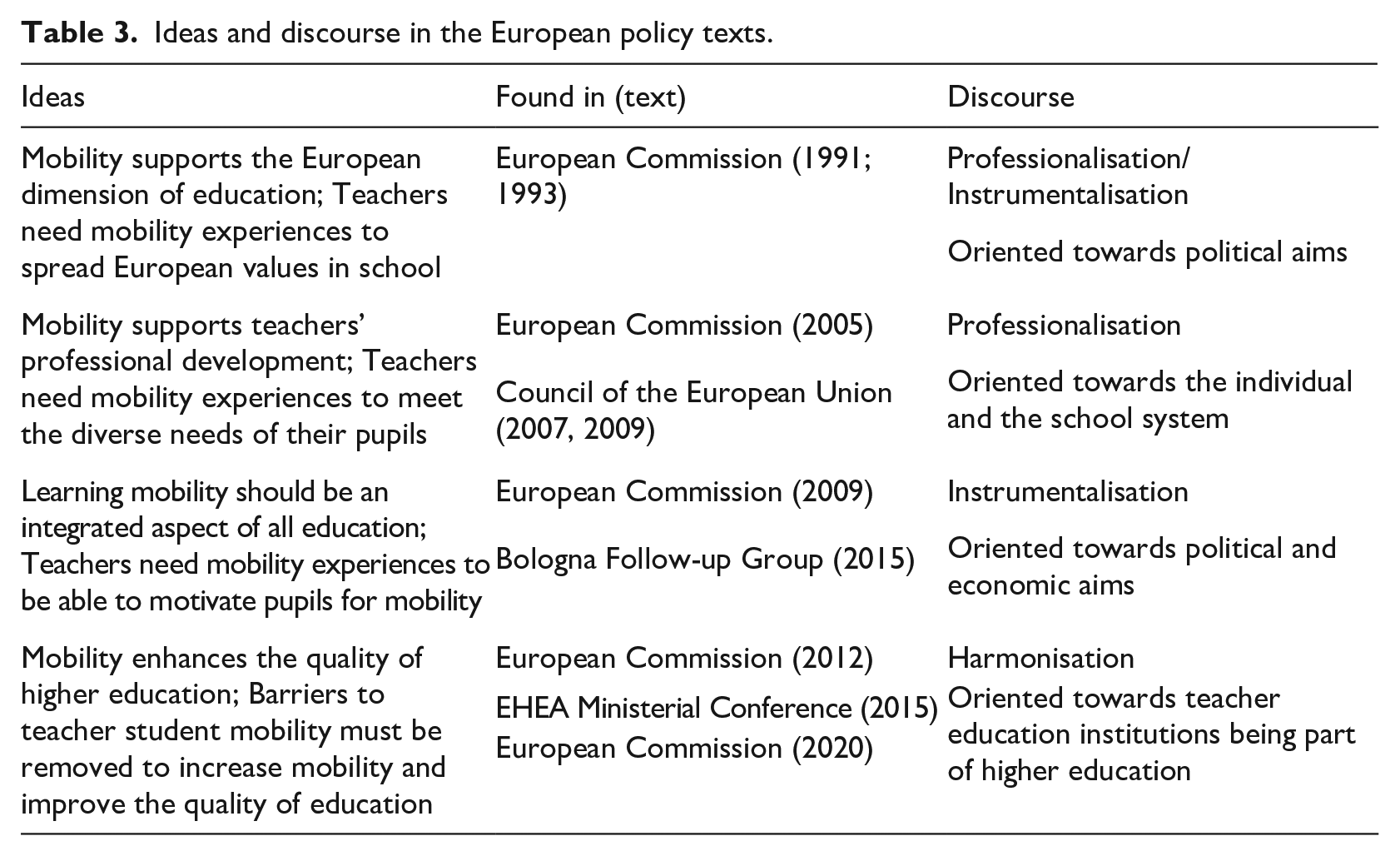
As indicated in the extract, mobility is both promoted as a ‘practical solution’ to realising the normative ideas about the European project by drawing on the professional mandate of teachers in relation to the school system, yet, also on a somewhat instrumental idea about teachers as passive political levers for realising political agendas. In a similar vein, in the 1991 Memorandum on Higher Education in the European Community, the idea that teacher student mobility could contribute to some harmonisation of the various European education systems is also found to be promoted:
Thus, in light of education otherwise being outside of formal EU competence, teacher student mobility represents a ‘practical solution’ to support the emerging aims of convergence between education systems. Arguably, such ideas contribute to the formation of a discourse of instrumentalisation, which instates an ambiguous relationship between teachers’ professional practice and overall societal aims far beyond such practice, and in which mobility is both a means and an end. Generally, the instrumentalisation discourse with its ambiguous set of ideas about teacher professionalism, is found to characterise several policy texts, in particular in the wake of the EU’s Lisbon Agenda in 2000. With the ambition of ‘becoming the most competitive and dynamic knowledge-based economy in the world’, enhancing the quality of the European education systems was a crucial aspect which subsequently pulled teacher education into the political limelight (Zgaga, 2013). This is found to shape mobility discourse in terms of a new emphasis on ideas about foreign language acquisition and intercultural competences, which are justified as being an essential part of teacher professionalism in the increasingly multicultural European schools. Such ideas are for instance identified in the Common European principles for teacher competences and qualifications, where mobility is promoted as one out of four principles expected to:
Yet, this professionalisation discourse is clearly also linked to the lifelong learning discourse in which employability is the ultimate goal and learning mobility a key instrument to achieve it. As for teacher students, this implies that mobility is also promoted as a solution to how to provide young people with skills and knowledge for competing in the global knowledge economy. Thus, while at the level of cognitive ideas, mobility is promoted as essential to teacher professionalism, substantially, this is closely intertwined with ideas about how to support economic success and prosperity in Europe. This instrumentality is found to be further reinforced as ideas about teachers as ‘
Finally, a shift introducing a harmonisation discourse is identified in the wake of the initiation of the Bologna Process and the ambitions of creating a European Area for Higher Education. This discourse conveys normative ideas about the quality of European higher education as supported through harmonisation and in turn, cognitive ideas about student mobility as a crucial instrument to this. Hence, student mobility emerged as both one of the decisive reasons for establishing the EHEA, and at the same time its expected outcome, and as such became a goal in itself (Papatsiba, 2006). Arguably, by instating mobility as a proxy of quality in higher education (among many others), this promotes a view on mobility as an activity with inherent value irrespective of its paedagogical content. In the context of teacher education, this is found to imply a continuous problematisation of structural barriers hindering mobility, which is thus assumed to stand in the way of enhancing quality, however, arguably also for the presumed function of teachers as multipliers of mobility. Thus, as illustrated in the following extract from a report by the Bologna Follow-Up Group, the ‘lack of mobility’ promoted with the harmonisation discourse is linked with ideas about teachers’ multiplier function rather than ideas pertaining to the professionalisation discourse:
As such, this also illustrates that the ‘problem solutions’ promoted in the harmonisation discourse are mostly of a practical character related to recognition and removal of structural barriers. In this vein it seemingly reinforces a view on the purpose of mobility as mobility
Mapping the Norwegian discourse
Although various policy texts on internationalisation of higher education have been introduced in Norway since the late 1980s, a particular focus on teacher education cannot be identified before 2003, where the Bologna Process was implemented with the Quality Reform. Looking specifically at teacher education policy before this (marked with grey colour in Table 4), there are no references to mobility, and as a normative idea, aspects of internationalisation/globalisation is mainly referred to as an external force which challenges and has consequences for society. In this vein, the ‘solution’ is to strengthen teacher students’ national cultural awareness as part of their professionalisation, and as something which can support the development of an increasingly necessary international identity.
Ideas and discourse in Norwegian policy texts.
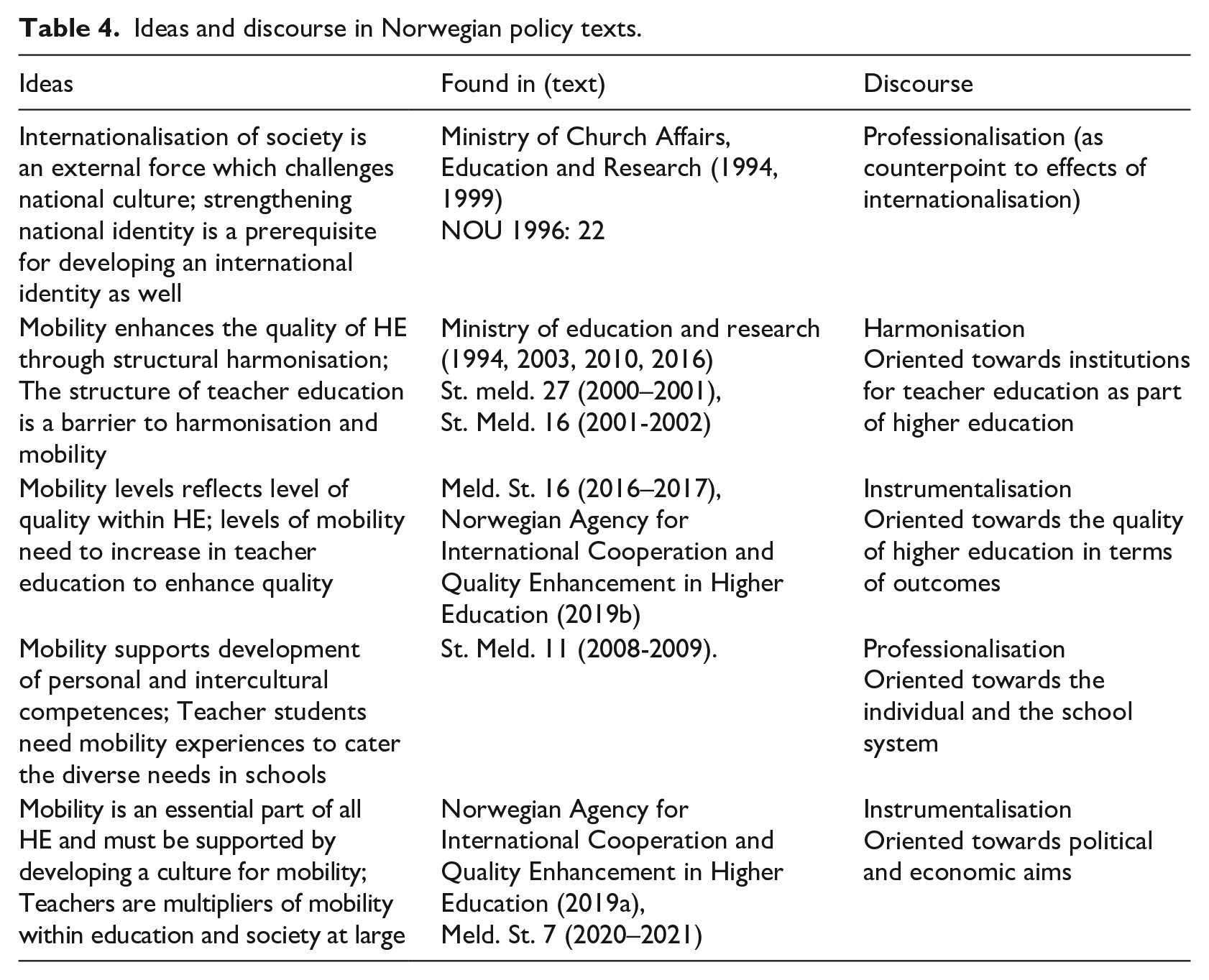
Notably, then, the emergence of a mobility discourse in this context is found to be linked to higher education at large and ideas about structural adaptions, rather than substantial ideas about the educational purpose and content of mobility or teacher students as such. Arguably, this discursive shift is made possible
Given that this is the only justification of mobility present in the text, it arguably draws on scarcely substantiated ideas about the purpose of mobility, and also continues to emphasise the national orientation of teacher education. However, in the wake of a new reform in 2008, a shift towards a professionalisation discourse is identified which promotes mobility (and internationalisation more generally) as central aspects to teacher professionalism, as illustrated in the following extract:
Notably, this discursive shift should be seen in light of another parallel white paper (St. Meld. 14, 2008–2009), which outlined a new comprehensive strategy for internationalisation of the education system at whole. This indicates that more substantial paedagogical ideas about teacher mobility are legitimised with regards to the institutional context of the school system and teachers’ future professional practice. Yet, the professionalisation discourse is not found in any of the other analysed texts, which rather seem to reinforce the harmonisation discourse, and thus take for granted that mobility in teacher education does not differ greatly from higher education at large. This discourse is found to increasingly convey more instrumental ideas about mobility, such as stronger output-orientation in terms of instating levels of mobility as a proxy for educational quality. Arguably, this marks a discursive shift towards an instrumentalisation discourse drawing on normative ideas about mobility as a ‘deficit’ in teacher education in the sense that mobility levels are too low, and by implication, the quality of the education as well. This problem definition is found to have become predominant in the past decade and has therefore allowed for continuous political and institutional measures to be taken. This is illustrated by how several of the more recent policy texts emphasise the need to
Thus, this rather self-reinforcing set of ideas linking internationalisation, mobility, and quality together discursively, draws on a ‘problem definition’ where
Arguably, rather than addressing potential underlying explanations or challenges to mobility in teacher education, the contemporary instrumentalisation discourse seems to allow for continuous political action to be taken on the matter, that is, new pressures, incentives and sanctions can be put on teacher education institutions to meet the aims of increasing mobility levels. The initiation of the new funding programme for internationalisation projects in teacher education mentioned above illustrates this very well.
Discussion
Paving the way for mobility and the ‘mobility deficit’
As argued above, the discourses of professionalisation, harmonisation and instrumentalisation can be found in both the European and Norwegian policy texts. Yet, the comparison also shed light on their different trajectory over time and the multiplicity of ideas conveyed. This suggests that despite the apparent similarity and shared ambitions of fostering more student mobility in teacher education present in policy today, student mobility have not always had a self-evident status as valuable in the institutional context of teacher education. Rather, though the study finds a strong interest in the mobility of teacher students on the European level drawing on a wide range of ideas, in the Norwegian context mobility ‘found its way’ into policy mainly by being justified in terms of the structural adaptions following Norway’s implementation of the Bologna aims. As such, it is a common pattern that reforms of teacher education in Norway related to higher education mainly concern general changes, such as degree structures or quality work, whereas changes linked to the compulsory education system revolve around the specific content and work forms in teacher education (Expert Group on the Teacher Role, 2016). Thus, while it is not surprising that the harmonisation discourse ‘paves the way’ for mobility in teacher education, the analysis sheds light on how this discourse is scarcely substantiated with regards to the educational/professional purpose inherent to the activity of mobility and the potential complexities arising from this.
As noted by Papatsiba (2006) ‘
Thus, as argued by Zgaga (2013), in this particular context, there is much more at stake concerning internationalisation than students going abroad; it is a discourse which implies demands about flexibility and other ways of organising education, which can have fundamental implications for the education itself (Zgaga, 2013). For instance, Pedersen (2021) discusses this challenge from the perspective of ground-level policy actors in teacher education and argues that while the predominant understanding of mobility is linked to the professional relevance for teacher students, it increasingly competes with academic and bureaucratic conceptualisations of mobility, that is, resembling the discourses of harmonisation and instrumentalisation. Ultimately, the increasingly instrumental discourse reflects a one-size-fits-all version of internationalisation, where student mobility is the predominant activity and symbol of otherwise complex processes across higher education (Courtois, 2019). It can therefore be further discussed whether the institutionalisation of mobility through discourses of harmonisation and instrumentalisation potentially contributes to obscuring both the purpose and characteristics of teacher education in a way which leaves little room for addressing the preconditions and challenges concerning mobility at institutional ground-level.
Mobility for teachers or teachers for mobility?
While the above discusses how the mobility of teacher students became an issue of interest for both European and Norwegian policymakers in relation to general changes to higher education, another central finding of the study concerns how these changes discursively position teachers as crucial actors for accelerating the mobility agenda. The study finds that the professionalisation discourse, though being the one conveying the most substantial ideas about mobility, is closely intertwined with the instrumentalisation discourse promoting ideas about mobility as something of essential value in
Emphasising the need for student teacher mobility can on the one hand be seen as an important contribution to supporting equal access to – and participation in – mobility for all higher education students. However, being linked to still more instrumental ideas, this discourse implies a view on teachers as political levers rather than professionals. Thus, while teacher education is obviously mandated to provide students with the appropriate knowledge and skills needed to prepare pupils for participation in a rapidly changing society at any time, the instrumentalisation discourse contributes to narrowing the purpose of teacher education, and hence future teachers, to being instruments whose function it is to ‘deliver’ various political agendas (Biesta, 2017; Robertson, 2012), in this case, fostering mobility. As argued above, this instrumentalisation is currently being strongly reinforced by various ideas about teachers as
This is a discourse which thus construct teachers as ‘policy enthusiasts’, that is, policy actors who ‘
As such, it is not surprising that the present study confirms the instrumentalisation of mobility suggested in other studies (e.g. Abdullah et al., 2017; Brooks, 2018; Courtois, 2019, 2020; Dvir and Yemini, 2017; Findlay et al., 2017; Papatsiba, 2006). In a similar vein, the study by Dvir and Yemini (2017) critically discusses how policy texts on mobility often take an ‘
Concluding remarks
This paper set out to explore the hitherto understudied observation that an intensifying promotion of teacher student mobility can be detected in European and Norwegian policy texts, and that this involves a positioning of teachers as central policy actors to the realisation of the political aims of mobility. The study finds that the political promotion of mobility for teacher students draws on a range of ideas pertaining to
Footnotes
Declaration of conflicting interests
Funding
ORCID iD
