







Abstract
Introduction
A new generation of ubiquitous body-centric systems, wireless body area networks (WBANs),1,2 is expected to reduce the healthcare stress. As a healthcare provider, WBANs are required to ensure privacy and confidentiality of patients’ health records. However, due to the natural characteristics of wireless communication, the broadcase transmission in the air can be monitored easily by attackers. The security problem has become a bottleneck to be overcome in the application for WBANs.
For protecting the message safe, current wireless networks have established some security mechanisms. Such as IEEE Standard for local and metropolitan area networks Part 15.6, there has been an architecture of information security for WBANs. 3 In this standard, messages are transmitted in secured authentication and encrypted frames, which provide measures for message authenticity and integrity validation, confidentiality, and privacy protection. Based on the Advanced Encryption Standard (AES), these security mechanisms are built on the Media Access Control (MAC) layer. Impersonation attacks and man-in-the-middle attacks can be defensed in this security policy. However, these higher layer policies are hard to resist the risks from physical layer, such as spoofing attacks. Because of the small cost and easy to launch, spoofing attacks is one of the most serious risks, and it is often used as the foundation of many senior attacks, such as denial-of-service (DoS) or man-in-the-middle attacks. Therefore, how to effectively resist spoofing attacks is a crucial issue in the security of WBANs.
Recently, a variety of physical layer authentication schemes have been proposed in previous studies,4–17 by exploiting the properties of wireless channels, where they generally contain received signal strength (RSS), 4 carrier frequency offsets (CFO), 6 channel state information (CSI),7,8 channel frequency responses (CFR), 9 channel impulse responses (CIR),10,11 channel power-delay profile (PDP), 5 and power spectral density (PSD). 12 Generally speaking, RSS is easy to obtain but more susceptible to channel stability and communications noise. PDP 5 and PSD 12 need accurate estimation which will increase the complexity of the communication system. CFO 6 has a risk which can be imitated by the advanced signal transmitter. In WBANs, considering indoor movement with low-speed and low-complexity requirement of biosensors, channel response is applicable to the communication environment since it is a reliable characteristic information and easily obtained. Xiao et al.13,14 have investigated the channel-based spoofing detection for time-variation channel and terminal mobility by exploiting channel response.
However, in order to develop authentication schemes which are applicable in practical systems, these physical layer authentication approaches have also taken into account a variety of enhancement techniques. For example, Xiao et al. 15 explored CFR and used multiple antennas to combat the mobility of wireless terminals for improving the reliability of physical layer security, 16 investigated two-dimensional quantization, which include channel amplitude and path delay, to improve the authentication performance, and 17 proposed a game theory and machine learning–based spoofing detection approach to further enhance the spoofing detection. However, previous research has neglected to exploit the potential of the primary signal to enhance the detection, that is, previous studies generally focused on the statistical properties of original signal and used some advanced tools (such as multiple antenna, multiple dimensional, or advanced algorithm) to improve the performance of authentication, while they ignored the deeper distinction of the original signal.
Different from current literatures, in this study, we present a new physical layer spoofing detection scheme based on a deeper feature representation of original signal, where the distinguishability of original signal is further highlighted to enhance the authentication performance. Furthermore, considering current security protocols, we present a cross-layer approach for message authentication in WBANs, in which we take both the physical layer security and higher layer security into account simultaneously. Thus, in this article, our main contributions can be mainly summarized as follows: (1) we proposed a new physical layer spoofing detection scheme based on sparse representation to enhance the detection performance and (2) for practical application, we give a feasible cross-layer approach to message authentication for WBANs.
The rest of this article is organized as follows. In section “Physical layer authentication and sparse representation,” the theory of physical layer authentication and sparse representation is given. Section “Proposed cross-layer approach” introduces the proposed cross-layer scheme. The experiment and simulation for evaluating the physical layer security strategy is introduced in section “Evaluation of spoofing detection.” Section “Performance analysis of the unite authentication” shows the analysis of the cross-layer approach. Section “Conclusion” concludes the article.
Physical layer authentication and sparse representation
Physical layer authentication
Being different from the digital credentials in conventional authentication, physical layer authentication is a keyless security scheme. Considering a general physical layer authentication, when an initial transmission between the legitimate users is first established where the authentication is based on a higher layer security scheme, the receiver can obtain the characteristic information of the legitimate channel. Due to the uniqueness feature of wireless channel, many studies have exploited this characteristic to distinguish Eve from Alice (here, using the traditional terminology, we consider that Alice is a legitimate transmitter who wishes to communicate with Bob, and Eve is a would-be intruder who transmits to Bob with the aim of impersonating Alice), and this scheme is called channel-based (or location-based) authentication. Channel-based authentication is mainly depended on spatial location which is hard to imitate, and the security basis is not limited by computational complexity. Hence, it is a rather potential authentication for the resource-constrained scenario, such as WBANs.
Sparse representation theory
Sparse representation
18
is a rapidly developing signal processing technology, which is aimed at searching for the most compact representation of a signal in terms of linear combination of atoms in an over-complete dictionary. Suppose that we have an over-complete dictionary

Thus,

where

where
Many algorithms can solve this optimization problem, such as gradient projection 19 and greedy pursuit algorithms. 20 In this study, we use the popular orthogonal match pursuit (OMP) algorithm 21 to solve this problem.
Proposed cross-layer approach
Scheme overview
As shown in Figure 1, our mechanism includes three major components: physical layer strategy, higher layer strategy and unite authentication.

Flow chart of the proposed cross-layer approach.
Physical layer strategy
In this subsection, we present the details of physical layer strategy, which includes signal preprocessing based on sparse representation, RSA, and binary hypothesis test.
Signal preprocessing based on sparse representation
Sparse decomposition is based on the sparse representation theory, and it uses the sparse representation coefficients to represent the received signal in over-complete dictionary. The selection of a proper dictionary is a significant procedure, since this dictionary should not only sparsely represent the input signal but also contains the features of interest. In this study, standard multi-resolution dictionary is an effective option, such as those based on wavelets, which have represented the nature scene images in previous works.
22
The wavelet function

where
In this study, Symlets wavelets are used to construct the over-complete dictionary. According to equations (1) and (3), we can obtain the sparse representation coefficients of the raw data. In other words, the received signals can be decomposed to sparse vectors based on OMP algorithm and wavelet dictionary.
Subsequently, to avoid the larger memory requirement and higher computational complexity, we use principal component analysis (PCA) 24 to decrease the dimension of the sparse coefficient vectors.
Suppose that the input sparse vector is

where
RSA
In order to establish the quantifiable characteristics space that can detect the spoofing attacks, we choose the following prominent features.
The first feature is the concentration ratio
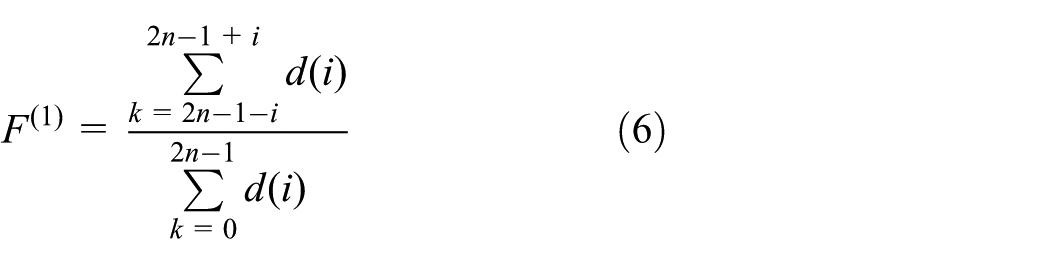
Practically,

Second feature is the middle section variance

The third feature is the shape imbalance

By taking full advantage of the developed characteristic waveforms, we have constituted a feature space

where
Up to now, we have already established an integrated feature

where
Hereinafter, we utilize an unsupervised approach to search the optimal threshold (denoted by

where,

In equation (13),

and

According to equations (13) and (15), we can solve this optimization problem, that is, equation (12), and the optimal threshold
Binary hypothesis test
After signal preprocessing and RSA, the spoofing detection can be formulated by a binary hypothesis test. First, we use Pearson’s correlation coefficient to describe the relationship between the received signals

where
Based on the uniqueness of the channel states, the receiver authenticates the
In this study, the goal of spoofing detection is to determine whether there is another sender which is different from Alice. We establish a hypothesis test to achieve the spoofing detection
There are two types of errors: false alarm,
Since the original channels’ state information obeys Gaussian distribution, the target sparse coefficients after preprocessing and RSA still obeys Gaussian distribution. As a result, the binary hypothesis test can be represented by the correlation rate

where,

where
Then, we have


where,

Higher layer strategy
To resist impersonation attacks and man-in-the-middle attacks, we still consider cryptographic schemes based on IEEE Standard 802.15.6. During IEEE Standard for local and metropolitan area networks Part-15.6, security paradigm is established between nodes and hub, and they need to activate a pre-shared mater key (MK) and create a pairwise temporal key (PTK) for secured communication.
As shown in Figure 2, the protocol generates the MK and PTK with the benefit of assisting in keeping third parties from launching man-in-the-middle attacks or impersonation attacks. In addition, since this protocol is based on MAC frames, this security is built on MAC level. For more details, refer to IEEE Standards Association. 3

Flow chart of the higher layer security structure.
Unite authentication
In order to enhance the security of WBANs, we employ a unite authentication scheme, in which we consider the physical layer detection and higher layer authentication, simultaneously. Figure 3 shows the schematic diagram of the unite message authentication.

Illustration of the unite message authentication. ⊕ is the bitwise exclusive-OR and ⊗ is the bitwise AND operator.
For higher layer, that is, MAC layer, the message integrity code (MIC) field in an authenticated frame can be calculated, that is


where
Meanwhile, through sparse representation and RSA, the physical layer spoofing detection can give an indicator which contains the information of detection result. This indicator is sent to the MAC level. Whereafter, the bitwise AND operator is performed to achieve the unite message authentication, where if the calculated MIC value is equal to the received MIC value, and the physical layer indicator is positive, the authentication is accepted; otherwise, the current received signal contains risk information.
Evaluation of spoofing detection
Data acquisition
In order to validate the feasibility of our proposed physical layer spoofing detection, we set up our evaluation scenario and conduct experiments to obtain corresponding data. Herein, we configure two mobile nodes (homemade hardware) worn on the chest and the arms as signal transmitters. And software-defined radio (SDR) platform is used to emulate the controller. The SDR is Microsoft research software radio, also known as Sora. 27 Sora is a high-performance fully programmable software radio based on general-purpose processors (i.e. CPU) in commodity PC architecture. Figure 4 shows the mobile nodes and the SDR platform in our experiments.

Mobile node and software-defined radio platform (Sora) in the experiment.
In this experiment, mobile nodes send pulse signals and the SDR platform receives these signals. Propagation measurement is performed in a workplace where there is a typical indoor scenario. The distance between the mobile nodes and the SDR platform is about 2 m, and the speed is about 1 m/s. Table 1 indicates the composition of the simulated scenarios.
Composition of the simulated scenarios.

In Figure 5, we report the example of the obtained results after the signal preprocessing and RSA. We observe that the correlation coefficients under attacking and normal scenarios are significantly different. In normal scenario, the correlation coefficient curve is mostly above 0.5, while in attacking scenario, the curve is generally less than 0.25. Next, based on these experiment data, we will analyse the performance of the proposed scheme.

Correlation of the sparse coefficients.
Performance comparison between traditional and proposed schemes
To verify the superiority of the proposed signal preprocessing and RSA-based sparse representation, we estimate the detection performance relative to the previously developed method. The proposed method is given in section “Physical layer strategy,” and the reference feature includes RSS and original CIR, which are used in Shi et al. 4 and Xiao et al., 14 respectively. Note that RSS is the most commonly used features, and since our proposed scheme is also a CIR-based method, it is necessary to compare with original CIR feature. For consistency, we consider that they have the same original signal sets which are obtained in the experiment, and the detection schemes are similar, where the Neyman–Pearson detection theory is utilized.
Receiver operating characteristics (ROC) curves show the accuracy of the detected signal against false alarms. We use the ROC curves to show the authentication performance under different feature extraction methods. The results are shown in Figure 6, and it is demonstrated that better detection rates can be achieved when the requirement of false alarms is decreased. From Figure 6, we can see that under the same false alarm rate (

ROC under different feature extraction.
Complexity analysis
After the comprehensive performance evaluations, we now investigate the computational complexity of this presented spoofing detection scheme. In our discussion, we simply employ the total number of multiplication operations as a rough indication of the computational complexity. Based on the derivations of the characteristic space, we find that the total multiplications of our algorithm in feature construction which is based on sparse representation is approximately
Performance analysis of the unite authentication
In order to demonstrate the performance of the cross-layer scheme, we use a hypothesis testing to investigate the final unite authentication. Let

where
Let


where
The proposed cross-layer system has four possible error states. Based on equations (25) and (26), we can calculate the probability of the system error. Let


Because 0 <
Consequently, we find that the advantage of the proposed cross-layer system shows on miss detection rate, that is, it far exceeds separate parts. Meanwhile, false alarm rate of unite authentication is closer to the original higher layer authentication. Generally, the risk of miss detection is higher than that of false alarm. Therefore, the security level of cross-layer scheme is superior to only physical layer strategy or only higher layer strategy.
Conclusion
As stated previously, this study is sought to integrate the physical layer security technology and existing security protocol to enhance the performance of message authentication for WBANs. Based on sparse representation, a new spoofing detection method, that is, RSA, was proposed to enhance the physical layer authentication. Furthermore, in order to achieve the aim of improving security level, a simple and feasible cross-layer approach was presented. The effectiveness of the physical layer scheme was validated through experiments and simulations, and the performance of the cross-layer approach was analyzed by hypothesis testing. In conclusion, the results showed that the proposed approach is able to improve the security of authentication.