







Abstract
Introduction
Grounded Theory Methodology (GTM) remains a popular research strategy that can be used across several disciplines
Understanding concepts: Grounded Theory Methodology and Grounded Theory
This section provides full insights about defining and differentiating the key related terms of GTM and GT. It also offers some historical and philosophical perspectives on the subject.
Grounded Theory and Grounded Theory Methodology: what is the difference?
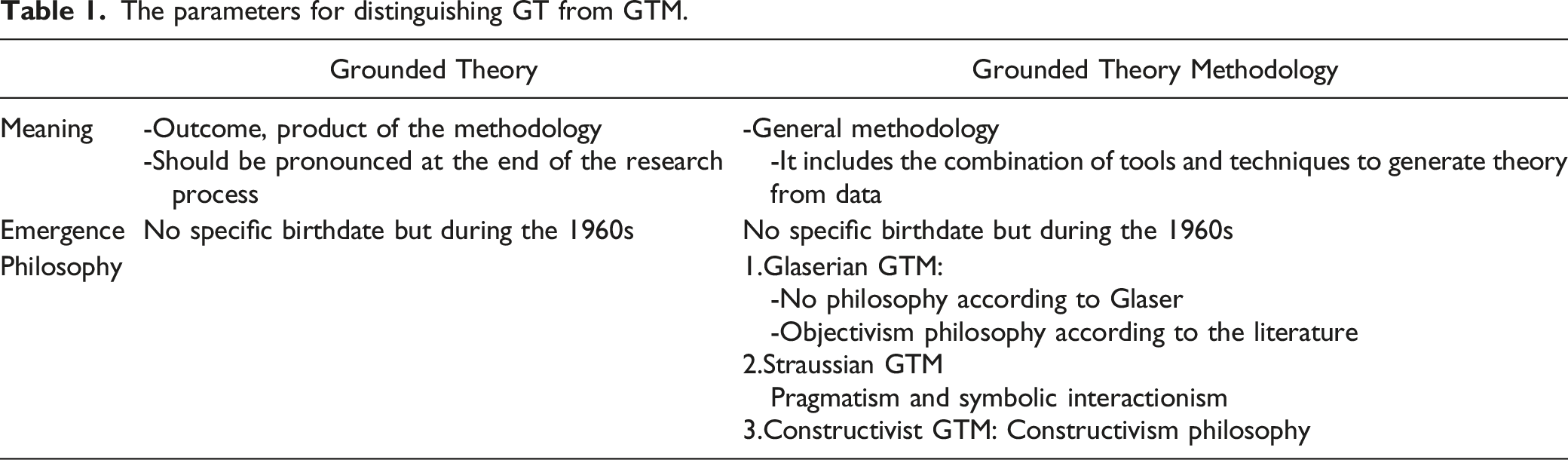
The two terms Grounded Theory and Grounded Theory Methodology are always confused and used to define the same thing: they seem interchangeable. But taking a look at the existing literature allows affirming that they are not substitutable and do not give the same meaning: “
Historical perspective of GT and GTM
Philosophical underpinnings in Grounded Theory Methodology
The parameters for distinguishing GT from GTM.
Clearing up the Ambiguities About GTM as a Method or a Methodology
GTM is often considered as a method and sometimes confused with other qualitative methods. It is now necessary to clearly indicate what GTM is and what it is not, and to show why the term ‘Methodology’ is preferred over ‘Method’ in a Grounded Theory Study.
What Grounded Theory Methodology is?
Grounded Theory Methodology is a general methodology that stands on its specific tools and rules through high level of conceptualization (Glaser, 2016). In opposition to the descriptive nature of many qualitative approaches, Grounded Theory Methodology is deeply embedded in conceptualization:
What Grounded Theory Methodology is not?
How to conceive Grounded Theory Methodology.

From the Causes Behind ‘The discovery of Grounded Theory’ to its Usefulness
Urquhart and Fernandez (2006) assert that one of the main reasons behind
How the Theory was discovered?
Glaser and Strauss (1967) studied the phenomenon of dying in several hospitals in the united states. They examined how medical staffs and their terminally ill patients perceived the new that they are going to die and how they reacted (Charmaz, 2006). Glaser and Strauss (1967) early set aside both the logico-deductive approach and the traditional qualitative method which consisted of using preconceived ideas and previous experiences related to the area under study. They delay the literature review and initially engaged in a systematic data collection and analysis. Doing so
From the Big Split to the Emergence of Three Schools of Grounded Theory Methodology
The history of Grounded Theory Methodology (GTM) has been marked by heated debates and certain cleavages between the co-founders. This has further turned the methodology into three forms: Glaserian, Straussian and Constructivist GTM. We first get inside the big split prior to focusing on the emergence of the three schools of GTM.
Inside the big split
It is sometimes argued that Glaser and Strauss have been separated and worked independently since their successful collaboration that backs in 1967. This idea is inaccurate and a misleading one. Many years after
The emergence of three Schools of Grounded Theory Methodology
Making differences between GTM and true GTM.

Conclusion
This paper makes an overview of the History of Grounded Theory Methodology by stressing its purpose and addressing some misleading ideas. From a broader perspective, there is no doubt about the growing body of research that intends to legitimize the methodology since its birth date during the 1960s but the way in which it is conducted may be critical due to a lack of rigor in understanding the methodological principles. Confusions about GTM and its purpose should now be out of date and we urge junior researchers to renew their endeavors in terms of making significant strides towards understanding the use of GTM’s full package of guidelines in their studies since it may be a potential tool for theory generation in management and social inquiries. Definitely, all forms of disagreement derived from the Glaserian, Straussian and Constructivist stances may be seen as a cue of maturity of the methodology rather than an obstacle (McCann & Clark, 2003). There is no reason to adopt a radical stance while choosing one of the three grounded theory approaches because despite a central issue related to the use of literature and their philosophical underpinnings, they share the same purpose of building theory from data.
Footnotes
Declaration of conflicting interests
Funding
ORCID iD
