







Abstract
Introduction
Hemorrhoids are a very common anorectal disease, characterized by the symptomatic swelling and/or distal shift of anal cushions. 1 Based on location, hemorrhoids can be classified as internal, external, or mixed types. Clinical manifestations include bleeding, prolapse, pain, and itching. 2 Although hemorrhoids are benign, their recurrent and progressively worsening nature seriously affects patients’ quality of life. 3 Moreover, the high postoperative recurrence rate makes hemorrhoids a major clinical concern. 4 Studies in the twenty-first century have shown a continuous rise in the global prevalence of hemorrhoids. 5 In China, hemorrhoids account for 50.28% of adult proctology outpatient diagnoses, highlighting a substantial disease burden in the country. 6 Notably, widespread diagnostic inconsistency and overtreatment in clinical practice further exacerbate the socioeconomic burden. Reports indicate that the United States spends tens of billions of dollars annually on hemorrhoid management, making it a public health issue that cannot be ignored. 7 Current treatment options mainly include pharmacological interventions and surgical procedures, 8 while dietary adjustments and lifestyle optimization are crucial for the prevention and treatment of hemorrhoids. 9 Therefore, providing evidence-based health education and self-management guidance to the public is clinically important.
In the digital health era, the Internet and social media have reshaped how the public obtains health information. 10 With the advancement of instant messaging and the widespread adoption of social media, people are increasingly relying on digital platforms to access health information, share personal experiences, and obtain treatment guidance. As a sensitive condition that involves privacy, patients with hemorrhoids are more likely to search for information via anonymous networks. The high number of online searches for hemorrhoids shows that the Internet has become a major health information resource. 11 TikTok, as the most popular short-video sharing platform in China, plays a key role in disseminating health information. As of March 2025, its monthly active users have exceeded 1 billion. 12 In 2024, 13,000 new medical professionals joined the platform to create public health education content. They produced 3.7 million videos that received 3 billion likes and 1.93 billion saves, 13 showing strong public demand for health information.
In addition, hemorrhoids are one of the most common health issues in the United States. 5 They also placed fourth in Chinese TikTok's top 10 disease search terms for 2023, as reported. 14 This indicates that hemorrhoids, as a current hot public health topic, are widely disseminated on Chinese TikTok. However, the video content on Chinese TikTok varies in quality and is often filled with non-professional folk remedies and misconceptions, which may mislead patients’ personal medical decisions.15–17 Therefore, systematically evaluating the accuracy, completeness, and reliability of hemorrhoid-related information on social media platforms is crucial for the effective dissemination of health information.
Previous studies have evaluated the quality of online information about hemorrhoids in foreign-language environments on the Internet.18–20 However, systematic investigations into hemorrhoid-related content on social media remain scarce. In particular, few studies have evaluated the quality of information about hemorrhoids on the Chinese version of TikTok. Thus, this study aims to assess the most popular hemorrhoid-related videos on TikTok, analyze their quality and provide empirical evidence for understanding the dissemination of health information and user engagement mechanisms on social media. The objective of this research is to identify the sources of videos with varying quality levels by analyzing their characteristics. Furthermore, we aim to draw useful insights by comparing parameters such as user engagement across these videos.
Methods
Ethical considerations
The study did not involve clinical data, human specimens, or laboratory animals. All data were obtained from publicly accessible TikTok videos, ensuring no personal privacy concerns. Since the study did not interact with any users, no ethics review was required.
Search strategy and video collection
In this study, we aimed for a systematic and comprehensive search. On August 7, 2025, we used the keywords “hemorrhoids”, “internal hemorrhoids”, “external hemorrhoids”, and “mixed hemorrhoids” to search for short videos on Chinese TikTok ranked by most likes (Figure 1). These keywords are consistent with previous studies.21,22

Flowchart of video collection.
Since browsing videos on TikTok requires verification, a new account was registered before data collection to simulate typical user behavior. Considering that users outside mainland China cannot access Chinese TikTok, we registered using a mobile number starting with 86 that had never been registered before. Additionally, all cookies and browser history were deleted prior to searching to minimize personalized search bias. Videos were organized according to TikTok's “most likes” sorting configuration to filter out the most popular videos. Based on this, after searching using the four keywords, we initially retrieved 160, 113, 129, and 125 videos, respectively. After removing duplicate videos (n = 335) across keywords, a total of 192 videos entered our inclusion and exclusion process.
First, we collected all videos with more than 1000 likes, as the number of likes can indicate video popularity. 23 Next, irrelevant videos (unrelated to hemorrhoids), similar videos (duplicate videos from the same user), non-original videos (reposted videos), advertising videos, and videos with only images and no narration were excluded. Finally, a total of 87 videos were included in the analysis, which collectively received 6,599,153 likes during the data collection period.
For included videos, the characteristics of videos were recorded: source, web address, content topic, name of uploader, title, presentation format, user engagement metrics (total count of likes, comments, saves, and shares), length, upload date, duration (days since publication), daily user engagement metrics (average daily likes, comments, saves, and shares), and certification status. All data were documented in an Excel spreadsheet.
Video classifications
Based on our research verification, all physicians were licensed to practice in China and had undergone formal verification of their professional qualifications by TikTok. Based on this, video sources were divided into five categories: (1) certified physicians, (2) general users, (3) self-media, (4) science communicators, and (5) traditional mainstream media. Certified physicians refer to practitioners possessing recognized professional qualifications in the medical field, whose credentials can be verified through personal documentation—such as colorectal surgeons, gastroenterologists, and endoscopists. General users denote individuals lacking recognized medical qualifications, primarily sharing personal experiences or perspectives related to illnesses. Self-media refers to individuals who publish medical or health-related content. They typically lack formal medical training, and their published content takes diverse forms. Science communicators refer to practitioners specializing in scientific fields whose mission is to disseminate and popularize medical knowledge. Finally, traditional mainstream media refers to established television outlets such as
The video content topics were classified into seven groups as follows: (1) treatment, (2) hazard, (3) symptom, (4) diagnosis, (5) etiology, (6) personal experience, and (7) prevention.
The video presentation formats were divided into the following six categories: (1) monologue, (2) dialogue, (3) animation, (4) background music, (5) educational course, and (6) television program.
Video content assessment
We utilized three validated evaluation tools, namely, the Global Quality Score (GQS), the modified DISCERN (mDISCERN) score, and the Journal of the American Medical Association (JAMA) score to assess the content of the 87 videos. These tools have been widely used in previous research.24–26
The GQS score evaluates video quality on a five-point scale, where 1 represents the lowest and 5 the highest quality. 10 Higher scores indicate better video quality.
In the study, videos were categorized into low quality (1–2 points), intermediate quality (3 points), and high quality (4–5 points) based on their GQS scores. 27
The mDISCERN score is used to assess video reliability, employing a binary scoring system where each criterion is scored as 0 or 1, with a maximum score of 5 indicating excellent reliability. 28 Higher scores reflect greater reliability.
The JAMA score is used to evaluate the accuracy and reliability of videos, focusing on authorship, attribution, disclosure, and currency. 29 Similar to the mDISCERN score, each criterion is scored 0 or 1, with a maximum of 4 indicating high accuracy and reliability.
The detailed scoring criteria for all tools are presented in Supplemental Appendix 1 (Table S1-S3).
The evaluation process followed a systematic, multi-stage approach to ensure accuracy and reliability. Initially, two independent, blinded evaluators (Mingqiu Lu and Danna Shen) scored each video. Their scores were then analyzed to identify discrepancies and resolve uncertainties. If disagreements persisted, a third researcher (Jiazi Yu) adjudicated the final score. Cohen's kappa (
Statistical analysis
The analysis started with the Shapiro-Wilk test to check data normality. For non-normal continuous variables, two-group comparisons employed the Mann-Whitney
Results
Video characteristics
A total of 192 videos were initially identified, and after applying exclusion criteria, 105 were excluded, leaving 87 videos for analysis. As shown in Table 1, the median engagement metrics for the examined videos were as follows: likes 10,071.00 (3117.50, 28,143.50), comments 993.00 (184.50, 2119.00), saves 3842.00 (964.50, 11,524.50), and shares 3501.00 (1242.50, 17,054.50). The average video length was 57.00 (40.00, 91.00) seconds. The most recent video was uploaded 6 days prior to data collection.
Baseline features of the analyzed videos on TikTok.

IQR: interquartile range; n: number; %: percentage; GQS: Global Quality Score; mDISCERN: modified DISCERN; JAMA: Journal of the American Medical Association.
Additionally, the scores of the GQS, the mDISCERN, and the JAMA for these videos were 3.00 (2.50, 4.00), 3.00 (2.00, 3.00), and 2.00 (1.00, 2.00), respectively, indicating a moderate overall quality and reliability of hemorrhoid-related short videos on Chinese TikTok.
Video sources and content
Table 2 illustrates the distribution of video uploaders, topic, and format categories on TikTok. As detailed in Figure 2, most uploaders were certified physicians (65/87, 74.71%), including western physicians (50/87, 57.47%) and TCM physicians (15/87, 17.24%). The others were non-physicians, including general users (13/87, 14.94%), science communicators (4/87, 4.60%), traditional mainstream media (4/87, 4.60%), and self-media (1/87, 1.15%). Among certified physicians, 76.92% (50/65) were Western physicians, while 23.08% (15/65) were TCM physicians. Regarding authentication, physicians, science communicators, and traditional mainstream media were certified by TikTok, whereas general users and self-media were not.

Percentage of videos on hemorrhoids from different sources.
The characteristics and content of videos about hemorrhoids on TikTok.

n: number; %: percentage; TCM: traditional Chinese medicine.
When categorized by content, the primary focus was on treatment (71/87, 81.60%), especially the necessity of surgery. Diagnosis (4/87, 4.60%), etiology (4/87, 4.60%), and prevention (4/87, 4.60%) were occasionally discussed. In contrast, symptoms (2/87, 2.30%), hazards (1/87, 1.15%), and personal experiences (1/87, 1.15%) appeared less frequently.
When categorized by format, the dominant video format was monologue (68/87, 78.15%). Other formats included background music (6/87, 6.90%), dialogue (5/87, 5.75%), animation (3/87, 3.45%), television program (3/87, 3.45%), and educational course (2/87, 2.30%).
Video quality and reliability
Inter-rater agreement was good: GQS (
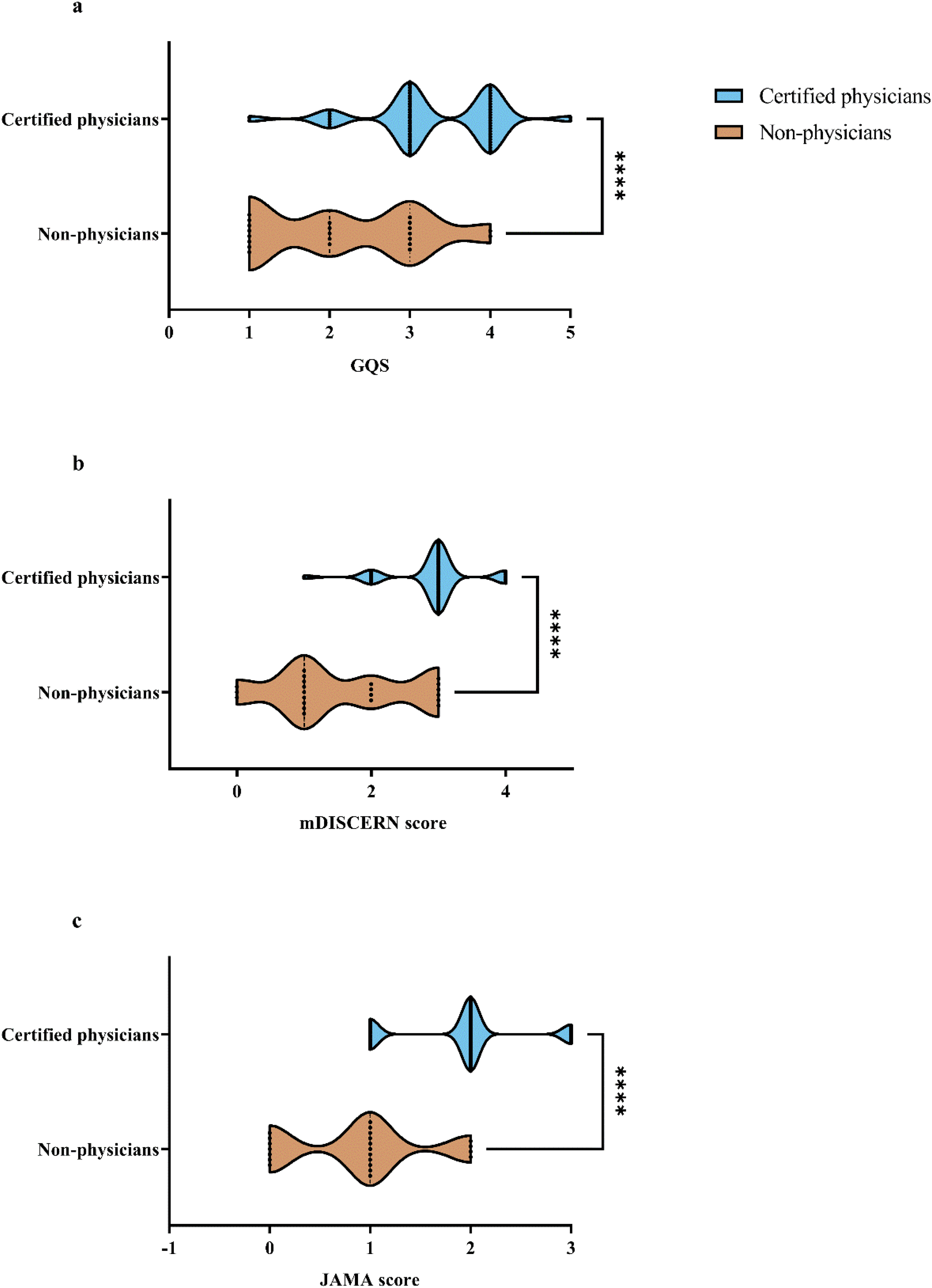
Comparison of assessment scores between certified physicians and non-physicians. ****
Comparison of video features across sources on TikTok.

IQR: interquartile range; GQS: Global Quality Score; mDISCERN: modified DISCERN; JAMA: Journal of the American Medical Association.
Mann-Whitney
According to the GQS scores, videos were classified into three quality levels: high, intermediate, and low. In the assessment, the majority of the videos demonstrated intermediate quality (35/87, 40.23%), followed by high-quality videos (30/87, 34.48%), while the proportion of low-quality videos was 25.29% (22/87) (Table 4). Analysis of video sources indicated that certified physicians (28/30, 93.34%) were the primary source of high-quality videos. In contrast, general users (12/22, 54.54%) were the main source of low-quality content (Figure 4).

Classification of video sources across different quality groups.
Categorization of the videos according to sources.

n: number; %: percentage.
Fisher's exact test.
Table 5 shows that the quality groups differed significantly in daily likes, comments, and shares (
Comparison of the video metrics between different quality groups.

IQR: interquartile range; GQS: Global Quality Score; mDISCERN: modified DISCERN; JAMA: Journal of the American Medical Association.
Kruskal-Wallis
Because of the small sample size, videos categorized as educational courses (n = 2), animation (n = 3), and television programs (n = 3) were excluded. Quality analysis of videos focused solely on narration, dialogue, and background music. The results showed that narration-based videos provided significantly higher-quality content than other video formats (
Comparison of quality groups according to video presentation format.

n: number; %: percentage.
Fisher's exact test.
Correlation analysis
Given that the data distribution was non-normal, Spearman correlation analysis was applied to evaluate relationships between variables. The analysis revealed that video length demonstrated significant positive correlation with the GQS (r = 0.56,
Correlation analysis between content scores and video metrics.

GQS: Global Quality Score; mDISCERN: modified DISCERN; JAMA: Journal of the American Medical Association.
Discussion
Principal findings
This study conducted a comprehensive and systematic evaluation of the most popular hemorrhoid-related short videos on Chinese TikTok. The evaluation primarily focused on content characteristics, quality, and reliability. The findings offer valuable insights into the current landscape of hemorrhoid-related short videos and highlight areas for improvement to advance the dissemination of credible hemorrhoid health information.
The analysis of 87 videos revealed a total of 6,599,153 likes and 3,972,591 shares, underscoring Chinese TikTok's substantial influence in health-related content dissemination. 31 No video achieved full scores across all three quality assessment tools, and the overall content quality remained moderate. Specifically, 34.48% of videos were high quality, 40.23% were of intermediate quality, and 25.29% were low quality. Most content creators were platform-certified physicians, whose videos generally demonstrated superior quality. Certified physicians produced most of the high-quality content, while low-quality videos mainly came from general users. Furthermore, the study showed that narration-based presentation videos met higher standards than those with background music only. A significant positive correlation was found between video length and quality ratings, implying that longer videos tend to offer more comprehensive knowledge and clearer explanatory structures. Notably, lower-quality videos achieved higher levels of engagement in terms of daily likes, comments, and shares. This inverse relationship indicated that user interaction metrics did not necessarily reflect scientific validity, highlighting the need for improved algorithmic prioritization of quality and enhanced health literacy among users.
Quality of the short videos
The evaluation of videos showed that 34.48% were high quality, 40.23% intermediate quality, and 25.29% low quality. This distribution is consistent with prior studies that have reported significant variations in the quality of medical content on TikTok.24,32,33 Our analysis showed that physicians produced the majority of high-quality videos. Since all physician accounts were platform-verified, this combination reinforced professionalism and credibility, underscoring the synergy between expertise and authentication in health communication. These videos adhered closely to medical guidelines and were generally evidence-based. In contrast, videos posted by general users generally demonstrated lower overall quality. Their limitations stemmed from excessive reliance on personal experience, overemphasis on symptomatic descriptions, or a lack of authoritative literature support. Moreover, narration-based videos (78.15%) scored significantly higher in quality than those dominated by background music (6.90%), suggesting that voice-over visualization more effectively supported the dissemination and understanding of complex medical content.
Relationship between video quality and user engagement
Spearman correlation analysis revealed a positive relationship between video length and all three quality evaluation metrics, supporting prior findings that longer videos typically deliver superior information quality. 24 However, no significant correlation emerged between the number of likes and quality measures, indicating that audience engagement does not necessarily reflect content quality. This phenomenon aligns with the rise of “infotainment,” a communication model where users prefer entertaining content regardless of accuracy. 34 Furthermore, the duration showed no significant correlation with video quality indicators.
Notably, low-quality videos received the highest engagement, suggesting that viewers struggle to distinguish health information quality or are more attracted to superficially presented content. Algorithms reinforce this tendency by promoting sensational or simple content, creating a cycle in which popular but poor-quality content is continuously amplified. Although certified physicians were the primary providers of high-quality videos, 13.85% (9/65) of videos they posted were classified as low quality, indicating that professional credentials do not constitute an absolute guarantee of content quality. Further analysis indicated that content uploaded by physicians exhibited higher technical rigor yet attracted lower engagement, possibly owing to a mismatch between its language and the public's comprehension level. Consequently, engagement metrics should not be the primary measure of video quality. They are also heavily influenced by number of followers (base effect), posting frequency (balancing exposure and fatigue), and prior viral content (historical effect and algorithmic preference). These factors form a dynamic system (e.g., viral content increases followers, while follower growth permits higher posting frequency) that collectively shapes engagement metrics, making them difficult to isolate and control in research practice. 35 Moreover, changes in watch-time and completion-rate metrics may have complex effects on both video quality and user behaviour.
Given these findings, and recognizing that interactive and entertainment-oriented digital media—such as gaming and spatial-cognition tasks—have been shown to enhance learning even in technical domains like surgical training, 36 we advise certified physicians to maintain clinical accuracy while boosting content accessibility and appeal. By integrating educationally sound design with engaging dynamics, such as those effective in health-related digital learning, physicians may increase audience engagement and promote the wider dissemination of high-quality health information on TikTok.
Limitations and future directions
This study has several limitations. First, while the three well-validated scoring tools may introduce evaluator subjectivity—having been developed for traditional text—their high inter-rater reliability shows this bias to be minimal. A more fundamental limitation is their potential inability to capture distinctive aspects of short videos, such as visual accuracy, emotional persuasiveness, and comment section interactions. Nevertheless, we retained these tools to ensure research continuity and data comparability. Their prior extensive validation in YouTube video analysis allows for direct cross-platform comparisons under a unified standard. 26 Second, the analysis exclusively used data from the Chinese version of TikTok, so it remains uncertain whether the conclusions are applicable to other popular social media platforms in different regions. For instance, Chinese short videos often rely on atmosphere and music to convey emotions, emphasizing collective resonance with subtly implied dialogue, whereas Western content is more direct and individualistic. These differences may influence user engagement and the types of video content produced. Third, due to the time-sensitive nature of TikTok content and the opacity of its algorithms, both content availability and audience engagement metrics may change over time. Selection bias in sampling strategies could favour older or heavily promoted videos, while excluding recent content with fewer likes but potentially high quality. Thus, the findings only reflected data characteristics captured at a specific point.
Future research could focus on the following improvements. First, a specialized hybrid evaluation tool for short videos should be developed by integrating the DISCERN instrument, the JAMA criteria, and social media-specific dimensions. Evaluation dimensions for short videos’ visual accuracy (e.g., anatomical diagram correctness) and interactivity (e.g., physician response quality) should be added. Second, cross-platform comparative studies incorporating international platforms like YouTube could help analyze heterogeneity in hemorrhoid-related health communication across cultural contexts. Finally, leveraging TikTok's global reach, researchers could extend the analysis to multilingual video content to establish a more comprehensive digital health communication evaluation framework.
Measures to improve video quality
Public awareness of hemorrhoids remains low, with a survey indicating that only 21.4% of respondents possessed basic knowledge, while nearly 80% had knowledge gaps. 37 Although social media has greatly improved public access to health information, content quality varies widely, making it difficult for users to distinguish accurate health education videos from misinformation.38,39 Patients depend on reliable health advice, and misleading content can cause poor medical decisions. Therefore, improving the quality of medical videos is crucial for disseminating evidence-based information. We recommend that Chinese TikTok optimize content quality through the following measures: (1) Develop efficient artificial intelligence (AI) moderation tools: the successful application of AI-assisted tools in assessing gastrointestinal endoscopy video quality provides a basis for developing efficient review tools for health-related short videos. 40 By utilising technologies such as natural language processing, these tools can identify misleading content like exaggerated efficacy claims, thereby supporting large-scale content review and quality control; (2) Adjust algorithm parameters: reduce the recommendation weight of non-professional content and prioritize evidence-based medical information; (3) Establish short-form clinical guidelines: standardize essential elements of hemorrhoid-related content (e.g., mandatory inclusion of complication explanations); (4) Enhance collaboration with medical institutions: ensure the accuracy of professional content and develop cross-cultural adaptation strategies to provide the public with correct and reliable health information.
Conclusion
This study systematically evaluated the quality and audience engagement of the 87 most popular hemorrhoid-related short videos on Chinese TikTok. The findings showed a moderate overall quality of the videos. Videos uploaded by certified physicians demonstrated significantly higher quality than those from non-physicians. The research also indicated that narration-based videos generally demonstrated superior quality. Despite Chinese TikTok's potential in medical education, its content quality and reliability require improvement. It is recommended that the platform could consider extending the video length at an appropriate time in the future, to create more space for in-depth and diverse content. Meanwhile, regulators may encourage the platform to optimize algorithmic parameters, thereby achieving a better balance between recommendation efficiency and societal value. Moreover, integrating medical expertise is key to developing it into a trusted tool for enhancing digital health communication.
Supplemental Material
sj-docx-1-dhj-10.1177_20552076261425515 - Supplemental material for Assessment of the most popular short videos about hemorrhoids on Chinese TikTok: A cross-sectional study
Supplemental material, sj-docx-1-dhj-10.1177_20552076261425515 for Assessment of the most popular short videos about hemorrhoids on Chinese TikTok: A cross-sectional study by Mingqiu Lu, Danna Shen, Liye Zhuang and Jiazi Yu in DIGITAL HEALTH
Footnotes
Abbreviations
Acknowledgments
The authors would like to thank all participants for having given their invaluable contribution in the study.

Ethics approval and consent to participate
All data used in this study were collected from social media platforms in full compliance with Chinese TikTok's terms of service. As the dataset contained no personally identifiable or sensitive information, and in accordance with standard ethical guidelines, an ethics review was not required.
Author contributions
Mingqiu Lu, Danna Shen, and Liye Zhuang designed the study. Mingqiu Lu did data curation, data visualization, and writing the original draft. Liye Zhuang did data investigation. Mingqiu Lu, Danna Shen, and Jiazi Yu involved in conceptualization and the videos scoring. Liye Zhuang and Jiazi Yu involved in formal analysis. Jiazi Yu did reviewing and editing. All co-authors take full responsibility for the integrity and accuracy of all aspects of the work.
Funding
The authors received no financial support for the research, authorship, and/or publication of this article.
Declaration of conflicting interests
The authors declared no potential conflicts of interest with respect to the research, authorship, and/or publication of this article.
Data availability
The datasets generated during and/or analyzed during the current study are available from the corresponding author on reasonable request.
Supplemental material
Supplemental material for this article is available online.
References
Supplementary Material
Please find the following supplemental material available below.
For Open Access articles published under a Creative Commons License, all supplemental material carries the same license as the article it is associated with.
For non-Open Access articles published, all supplemental material carries a non-exclusive license, and permission requests for re-use of supplemental material or any part of supplemental material shall be sent directly to the copyright owner as specified in the copyright notice associated with the article.
