







Abstract
Introduction
Gonorrhea, caused by
In recent years, digital platforms, particularly social media, have become crucial tools for disseminating health information.15,16 Short video platforms like TikTok, with its massive user base and interactive nature, offer a unique opportunity to deliver health-related content to a broad audience.17,18 The platform's efficient video delivery system enables users to consume information quickly, making TikTok an important platform for public health education. However, the quality and reliability of health content on these platforms remain a concern. These videos are often created by a diverse group of contributors, including healthcare professionals, social media influencers, and individual users, leading to variations in the accuracy, depth, and medical reliability of the information provided. Previous studies have shown that short videos on TikTok related to diseases such as hypertension, vitiligo, thyroid eye disease, and esophageal cancer tend to have relatively low quality and reliability, with significant variations in content accuracy and reliability.18–21
Although the number of gonorrhea-related videos on TikTok is gradually increasing, there has been no specific assessment of the quality of these videos. This issue is concerning because the public's understanding of gonorrhea significantly influences preventive behaviors and decisions to seek medical assistance. This study aims to assess the content, quality, and reliability of gonorrhea-related videos on TikTok, and to provide recommendations for improving future health communication strategies.
Methods
Data source
Data collection was completed between 26 and 28 July 2025, to assess the content, quality, and reliability of gonorrhea-related videos on TikTok (https://www.douyin.com/). By searching for “淋病” (Gonorrhea) in the search bar, the first 100 videos sorted by default at the time of the initial search were collected, of which 71 met the inclusion criteria and were analyzed. The flowchart of this study is shown in Figure 1.

Flowchart of the selection process for gonorrhea-related TikTok videos.
Inclusion and exclusion criteria
Videos were screened based on the following inclusion criteria: (1) primarily focused on gonorrhea-related medical information; (2) presented in Chinese; and (3) publicly accessible at the time of data collection. Videos were excluded according to the following criteria: (1) unrelated content (
Data collection
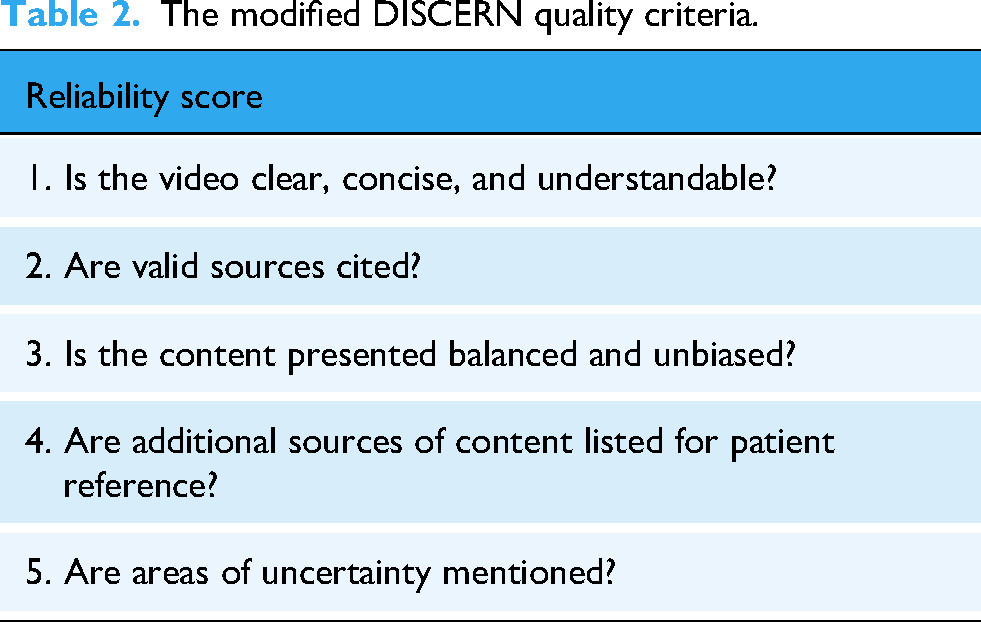
Selected videos were evaluated on multiple dimensions, including video length, view counts, and user engagement metrics such as likes, comments, shares, and saves. Uploaders were categorized into the following groups: dermatologists, urologists, individual users, gynecologists, reproductive specialists, gastroenterologists, traditional Chinese medicine doctors, and intensive care specialists. All categories except individual users were defined as healthcare professionals. The video content was analyzed for key themes, including epidemiology, etiology, modes of transmission, clinical manifestations, diagnosis, treatment, prevention, and prognosis. Video quality and reliability were assessed using the Global Quality Score (GQS) 22 and the modified DISCERN (mDISCERN) tools. 23
Quality and reliability assessment
The GQS is a widely used tool for assessing the overall quality of health-related videos, with scores ranging from 1 to 5, where 1 indicates
The Global Quality Score quality criteria.

The modified DISCERN quality criteria.
Statistical analysis
Descriptive statistics were employed to summarize video characteristics. For variables with nonnormal distribution, the results are presented as medians with interquartile ranges (IQR). The Mann–Whitney U test was applied to compare video quality scores across different uploader categories. To assess the relationships between engagement metrics (likes, collections, comments, shares), video duration, and quality scores (GQS and mDISCERN), Spearman's rank correlation coefficients were calculated. All statistical analyses were conducted using R software (version 4.3.2), with a significance level set at
Results
Baseline data of gonorrhea-related videos
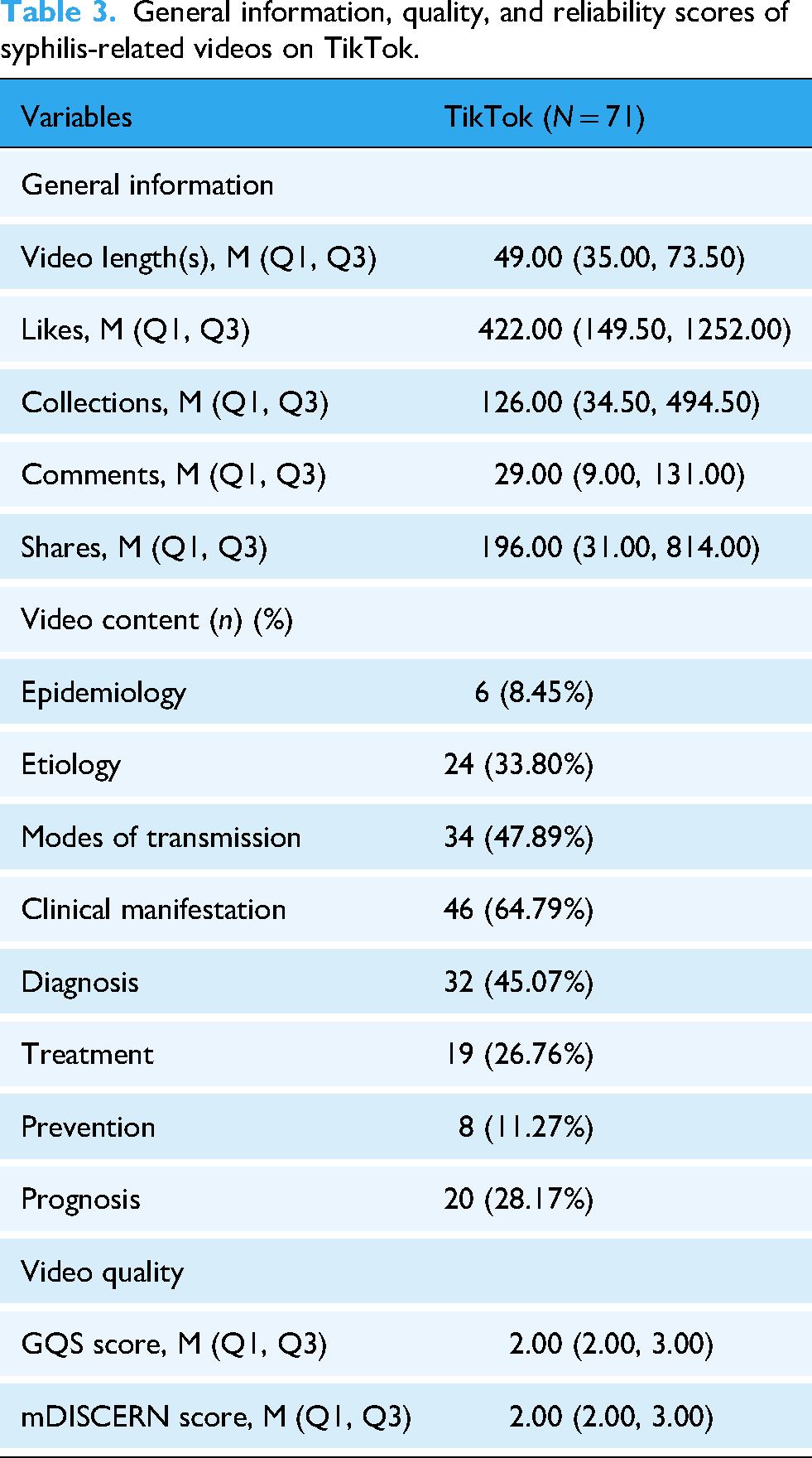
This study included 71 gonorrhea-related short videos from the TikTok platform. The duration of these videos was typically short (median: 49.00 s, IQR: 35.00–73.50 s). The videos displayed a high level of interactivity, with median values for likes (median: 422.00, IQR: 149.50–1252.00), favorites (median: 126.00, IQR: 34.50–494.50), comments (median: 29.00, IQR: 9.00–131.00), and shares (median: 196.00, IQR: 31.00–814.00). The GQS was 2.00 (median: 2.00, IQR: 2.00–3.00), and the mDISCERN score was 2.00 (median: 2.00, IQR: 2.00–3.00). Further details can be found in Table 3.
General information, quality, and reliability scores of syphilis-related videos on TikTok.
Uploader information for gonorrhea-related videos
The top three categories of uploaders for gonorrhea-related videos were dermatologists, urologists, and individual users (Figure 2). The detailed uploader information is presented in Table 4.

Distribution of video uploaders.
Uploader of short videos.

Content of gonorrhea-related videos
The most commonly mentioned topics in gonorrhea-related videos were clinical manifestations (64.79%), modes of transmission (47.89%), and diagnosis (45.07%). Epidemiology, preventive measures, and treatment were less frequently discussed, as shown in Figure 3.

Content distribution of gonorrhea-related videos.
Differences in video quality and reliability between uploaders
This study compared the video quality and reliability of videos uploaded by healthcare professionals versus individual users. Videos uploaded by healthcare professionals had significantly higher GQS scores (median: 2.00, IQR: 2.00–3.00) than those uploaded by individual users (median: 1.50, IQR: 1.00–2.00), with statistical significance (

GQS and mDISCERN scores for healthcare professionals and individual users. (a) GQS scores were significantly higher in videos uploaded by healthcare professionals. (b) mDISCERN scores were higher in videos uploaded by healthcare professionals.

Distribution of GQS and mDISCERN scores between healthcare professionals (HPs) and individual users (IUs). (a) Distribution of GQS scores between HPs and IUs. (b) Distribution of mDISCERN scores between HPs and IUs.
Differences in video characteristics and quality between individual user and healthcare professionals.

Correlation between video baseline data and video quality and reliability
The analysis revealed a significant positive correlation between video duration and interaction metrics, including likes (

Correlation matrix of video length, engagement metrics, and video quality scores.
Discussion
This study systematically evaluated the content, quality, and reliability of 71 gonorrhea-related short videos on the TikTok platform. The results showed that although these videos demonstrated high user engagement, their overall informational quality and reliability were relatively limited. The most frequently covered topics were clinical manifestations, modes of transmission, and diagnosis, while prevention and treatment received significantly less attention. Notably, videos uploaded by healthcare professionals had significantly higher GQS than those from individual users. However, engagement metrics such as likes, comments, and shares showed no significant correlation with video quality. These findings underscore the urgent need to enhance professional involvement and strengthen content oversight in the dissemination of sexually transmitted disease information on social media platforms. This study offers new insights into the content quality and topic distribution of gonorrhea-related TikTok videos, supporting health communication strategies and content optimization
Video baseline characteristics and engagement analysis
The results showed that gonorrhea-related TikTok videos were generally short, with a median duration of 49 s (IQR: 35–73.5 s), which aligns with the overall trend of video lengths on the TikTok platform. 25 The short video format caters to the platform users’ preference for quick content consumption, facilitating the rapid dissemination of information.26,27 Despite the brevity, these videos exhibited strong engagement, with high median values for likes, comments, favorites, and shares, indicating that they performed well in attracting audience participation and interaction.24,28 However, the quality and reliability of the videos were found to have certain limitations. Both the GQS and mDISCERN scores were relatively low (median: 2), indicating that most videos did not meet high standards in terms of medical content accuracy and overall quality. Despite high engagement, the medical information in these videos may be inaccurate, incomplete, or lack citation of authoritative sources, potentially leading to biased health information for the public. These findings are consistent with Rosenberg's study on TikTok videos related to vitiligo, which also showed a lack of quality and reliability. 19 Another study evaluating the quality of TikTok videos on hypertension also pointed out the low quality and reliability of videos on the platform. 20 Therefore, although the short video format provides a convenient channel for disseminating health information, the quality and medical accuracy of the video content still need to be improved.
Differences in video quality among different uploader
Regarding uploader identity, this study found that videos uploaded by healthcare professionals had significantly higher quality than those uploaded by individual users. This finding suggests that healthcare professionals, due to their professional background, are able to produce videos with greater scientific accuracy and medical correctness. Specifically, videos uploaded by healthcare professionals had significantly higher GQS than those uploaded by individual users, and this difference was statistically significant. This indicates that professional background plays a positive role in improving video quality, particularly in terms of the accuracy, reliability, and completeness of medical content.29,30 A study analyzing short videos on brain tumors also found that videos uploaded by healthcare professionals had higher quality and reliability. 31 Another study on videos related to premature ovarian failure also showed that healthcare professional-uploaded videos were of higher quality than those uploaded by individuals. 32 However, despite the higher quality of videos uploaded by healthcare professionals, those uploaded by individual users had greater engagement. Videos from individual users may be more relatable and personable, allowing them to establish a stronger emotional connection with viewers. Therefore, future short video creation should aim to combine the medical knowledge of healthcare professionals with the interactive features of individual users, thereby encouraging greater audience participation in the dissemination of health knowledge.
Coverage of video content
From the perspective of video content, this study found that the most frequently mentioned topics were clinical manifestations (64.79%), modes of transmission (47.89%), and diagnosis (45.07%). Given the critical importance of the transmission routes and clinical manifestations of gonorrhea for disease prevention and control, the dissemination of this information helps raise public awareness of the disease. However, content on epidemiology, preventive measures, treatment, and prognosis was less frequently addressed. This suggests that while the public may gain partial knowledge about gonorrhea, there is insufficient understanding of important topics such as how to prevent gonorrhea, treatment options, and the complications of untreated gonorrhea. The inadequate coverage of epidemiology and preventive measures may lead to incomplete public knowledge regarding gonorrhea prevention and treatment, thereby affecting the implementation of preventive behaviors.2,4,33 Additionally, although symptoms of gonorrhea may temporarily improve, untreated infections can cause retrograde infections, potentially leading to prostatitis, urethral stricture, PID, infertility, and even sepsis.34–37 Therefore, future short video content should focus more on the prevention, epidemiology, treatment, and prognosis of gonorrhea, ensuring that viewers can access comprehensive and useful health information.
The relationship between video engagement metrics and video quality
The study also found a significant positive correlation between video duration and engagement metrics (likes, comments, favorites, and shares). Longer videos tend to include more detailed information, which can attract more viewer attention and participation. This suggests that video duration, to some extent, influences engagement. However, the correlation between video duration and video quality was weak, indicating that video duration is not a decisive factor in determining video quality. Furthermore, there was a significant positive correlation between the engagement metrics, suggesting that viewer participation is not limited to a single mode of interaction, and likes, comments, favorites, and shares may act as mutually reinforcing factors. However, we did not find any correlation between engagement metrics and video quality or reliability, which is consistent with previous studies.21,32 The lack of correlation between engagement metrics and video quality suggests that viewer participation may be more influenced by the video format and entertainment factors rather than the medical accuracy or authority of the information.
Implications of the study
The findings of this study indicate that although gonorrhea-related short videos on TikTok exhibit high levels of user engagement, there remains significant room for improvement in overall video quality and the coverage of medical information. To enhance the medical value and communicative effectiveness of such content, future short video creation can be improved in several key areas. First, greater involvement of healthcare professionals should be encouraged to improve the scientific accuracy and credibility of content, especially in the context of infectious disease education where expert participation is essential. Second, content creators should strive for greater comprehensiveness, extending beyond transmission routes and clinical symptoms to include information on prevention strategies, treatment options, and prognosis, helping the public build a more systematic understanding of disease control. Furthermore, while maintaining strong interactivity, it is crucial to ensure the medical accuracy and balance of video content, avoiding the sacrifice of information quality for the sake of attention. By integrating professional expertise with engaging communication approaches, short video platforms can be better utilized to maximize their value in public health education.
Although this study provides valuable insights into the quality and engagement of gonorrhea-related short videos on the TikTok platform, several limitations should be acknowledged. First, the scope of this study was limited to TikTok videos, and future research may benefit from including other social media platforms such as YouTube and Bilibili to obtain a more comprehensive understanding of health information dissemination. Second, the relatively small sample size (71 videos) may limit the generalizability of the findings. In particular, the number of videos in the “individual user” category was only 12, which restricts the robustness of quality comparisons between healthcare professionals and individual users. Moreover, since the included videos were selected from the first 100 identified, the study relied on a convenience sample rather than a fully random sample, which may further limit the representativeness of the results. Future studies could expand the sample to enhance the reliability and generalizability of the conclusions. Third, it should also be noted that many influencers may receive incentives to post content, which could affect the quality or objectivity of the videos. Such incentives, including financial rewards or promotional benefits, may lead to content that is more commercially oriented rather than focused on accurate health information, thereby introducing potential bias in the evaluation. Finally, the scoring process using rating instruments may be subject to a degree of subjectivity, especially in the assessment of GQS and mDISCERN, where personal judgment could introduce bias.
Conclusion
This study systematically analyzed 71 gonorrhea-related short videos on the TikTok platform. The results the overall quality and reliability of the videos were relatively low. Videos uploaded by healthcare professionals were of significantly higher quality compared to those uploaded by individual users. The content primarily focused on clinical manifestations, modes of transmission, and diagnosis, while key areas such as prevention, treatment, prognosis, and epidemiology were underrepresented. Overall, gonorrhea-related short videos on TikTok have a certain advantage in terms of the breadth of information dissemination, but there is still a need to improve the depth and professionalism of the content. It is recommended that future efforts strengthen the involvement of healthcare professionals, optimize content structure, and enhance the effectiveness of short videos in public health education.
Footnotes
Acknowledgements
ORCID iDs
