







Abstract
Keywords
Introduction
Prison is an institution, which has been set aside by law for safe custody of people legally confined for antisocial behavior with a view to training them to become useful citizens of the free society after being discharged. Prison institution was established in Nigeria in 1872 with the ultimate aims of custody of prisoners caught up in the criminal justice system, awaiting trials or the execution of punishment such as whipping, banishment, and death (Mango, 2006). A government White Paper in 1971 itemized the functions of the prison services as custody, diagnosis, correction, training, and rehabilitation of incarcerated offenders (Evawoma-Enuku, 2006). Thus, the prison service serves the public by keeping in custody those committed by the court, and its duty is to look after them with humanity and to help them lead law-abiding and useful lives in custody and after release. Two things stand out here; the humanity of treatment and the desired usefulness of the time spent in prison.
Like every other nations, Nigeria is not a crime-free society. Many of her citizenry, whether intentionally or unintentionally, perform one or more undesirable acts either for the purpose of survival, maintenance of territorial integrity, or expression of their inherent inimical intentions (Ayinde & Opeyemi, 2011). As a result, crime rate in Nigeria is high. The high crime rate is caused by many factors like high unemployment rate, poverty, illiteracy, hunger, and so on. It is certain that in the absence of gainful employment, people resort to nefarious activities, vices such as crime, juvenile delinquency, armed robbery, rape, kidnapping, human trafficking, drugs peddling, insurgency, and assassination, among others. When the perpetrators of these nefarious acts are caught by law, they are judged in the court of law, and when found guilty, the court imposes fines, penalty, and sentences on those criminals. The constant sentencing of many people has led to influx of prison yard, mostly by the young people. Hence, once one is incarcerated, the public sees the person as a criminal and as such regarded him or her as a nonentity. Moreover, Nigerian prison is retributive in nature, that is, it is designed under the notion that punishment is the best response to and deterrent of crime. To achieve the purpose of retribution, the prison inmate is subjugated and subjected to all sort of inhuman practices. By doing this, the prisoner loses all the privileges and rights as human person. He or she is subject to fear, shame, and shaming.
Most often when some prisoners are released after completion of their sentence, they reoffend and, as such, sent back to prison. Based on this, this study intends to investigate how religious and philosophy education can be utilized in uplifting the image of prison inmates and in curtailing ex-prisoners’ recidivism in Enugu prison yard. Thus, the study is titled “Utilization of Religious and Philosophy
Education in Uplifting the Image of Prison Inmates and Curtailing Ex-Prisoners Recidivism in Enugu Prison yard in Nigeria.”
Literature Review
Clarification of Concepts
Prison education
Education is one key aspect of the important rehabilitative role of prisons and has an important, even if often indirect, role to play in many other rehabilitative processes in which a prisoner can engage while in prison. It is a means of keeping a prisoner occupied. According to Hawley, Murphy, and Souto-Otero (2013), it has the capacity to form a stepping-stone in the pathway toward inclusion for prisoners, who face social exclusion often before they enter the prison as well as after they leave. By providing positive learning environments, prison can support their inmates:
To make good use of their sentence;
To address gaps in their learning and skill;
To improve their employability; and
To change their personal attitudes and perceptions.
It may further include the development of new perceptions and attitudes, which can help them to understand the reasons for and consequences of their action. All these can reduce their chances of reoffending (Hawley et al., 2013). Nevertheless, while education perhaps could lead to the development of new attitude, and thus an understanding of reason for and consequences of their action, it is not causal or automatic. There is the likelihood that not all prison inmates exposed to religious education are able to understand the reason for and consequences of the crime they committed.
Rationale for prison education
The African charter on human and people’s rights, adopted by Organization of African Unity (OAU), now African Union (AU), in 1981 and in force since October 21, 1986, declares in Article 17 that “every individual shall have the right to education” as well as the freedom to “take part in the cultural life of the community.” This means that prisoners have the same right to education as other citizens. Furthermore, providing learning opportunities in prisons presents a range of potential benefits to the prisoner and to the society. These, according to Hawley et al. (2013), include the following:
Education and training can reduce the social cost of crime. The cost of prisoners’ reoffending forms a significant portion of the cost of crime to the society. Employment is the key factor in reducing the risk and cost of reoffending. Education makes one to be employable. And because of this, education should be a central part of broader “package” of support to be offered to the prisoners to enable them not to relapse into crime again.
Education represents one of the key tools that help to support the rehabilitation of a prisoner and also enhance his or her reintegration into society on completion of his or her sentence. On this, Munoz (2009, p. 6) posits that prison should be an “environment for those who detained that enable positive change and human capacity.” Prison supports prisoners to gain knowledge, skills, and competences, which form an important stepping-stone in their journey toward rehabilitation and reintegration into society.
Prison education provides second chance education. On this, Costelloe (2003) submits that many prisoners see prison education as an opportunity to engage in second chance education. These are prisoners who did not have the opportunity to attain their desired level of education before their imprisonment. By engaging in this second chance education, prisoners improve their employment prospects and at the same time make their families proud.
Education in prison can provide a source of hope and aspirations for the future, as well as purposeful way of utilizing the prisoner’s sentence, that is, to participate in prison educational activity helps prisoners to spend their time doing something sensible and useful.
Education and training in vocational/professional subjects helps to improve employability, which is thought to be one of the factors that reduce the likelihood of prisoners’ reoffending. Adding to this, Schuller (2009) asserts that prison education and training can also be used to help provide prisoners with fundamental “life” skills such as civic capabilities to enable them to cope with a number of issues they face, the ability to manage their own health needs, and financial capabilities.
Education can help to instill a sense among prison learners that they remain a part of the wider society and to remind them that they will be part of the society after their release.
Adult learning in the prison offers opportunities for personal development and transformation. It has the capacity to change the prisoner’s perception of self and others and it is this perception that determines attitude and behavior.
Supporting this view, Yakubu (2003) asserts that only adult education and nonformal education has the capability and is equipped to inculcate attitudinal behavior through its androgogical mandate and procedure into people. This is also noted in the national policy on Education (Federal Republic of Nigeria, 2004), as recorded under Article 31, Section 6, that adult and nonformal education encourages all forms of functional education given to youths and adults outside the formal school system such as functional literacy, and remedial and vocational education.
Types of education in prison
To achieve all the aforementioned benefits of prison education, three main categories of education should be taught in prison, namely,
general education (i.e., courses in subjects such as mathematics, science, history, geography, philosophy, religion, foreign languages, literacy, etc.);
vocational education and training, namely, education which aims to equip people with knowledge, know-how, skills, and/or competences required in particular occupations or more broadly on the labor market); and, finally,
nonformal education focused largely to help prisoners to address issues such as anger management, thinking skills among other skills to get integrated in society on release (Hawley et al., 2013). While vocational education and training is structured and happens in a sort of classroom setting, nonformal learning happens in a variety of context at workplace, in prison, and through technology and mass media. While the former aims to prepare its workforce for the labor market, the latter aims to help the learners enrich themselves or increase their career options.
As religious cum philosophy education is included as one aspect of prison education, this article will henceforth concentrate on how to utilize this aspect of prison education to uplift the image of prisoners and how it can be employed in curtailing ex-prisoners’ reoffending (recidivism). It is good to note from this point that when we employ the concept religious education, it embodies also philosophy education. Hence, in most of our discussion, religious education will be used to mean religious and philosophy education.
Religious education
According to Brown (2013), education is a practice of freedom, and religious education is both academic and spiritual practice aimed at ethical and moral instruction. It is concerned with religion at large, but in this article, the research will be mainly focused on Christian religious. From this Christian point of view, Chopp (1995) defines religion education as a process of spiritual and ecclesia formation that is focused in and through theological wisdom.” Seymour and Miller (1990) suggest a theological definition of religious education, and thus define it as education and teaching in which theological activity empowers the people of God to be agents of the new community within the public world of God’s presence and power. From this point of view, Brown asserts that prison religious education is a theological task whereby education facilitates learning to empower prisoners to new reality. For hooks (2003), religious education in general is “about healing and wholeness . . . about empowerment, liberation, transcendence, about finding and claiming ourselves and our place in the world” (p. 43). Education from this perspective is both theological, that is, faith seeking understanding, and philosophical, that is reflective. Placher (2003) sees it as critically “thinking about one’s faith.” Religious education in this article deals with the facts of reality—the condition of prison inmates and how to transform and reform them providing them with religious education that albeit primarily focused on the Christian religion at the same time sensitive to various religious persuasions. In other words, religious education as used here is Christian religious education but one that is ecumenical in nature. Enugu is a multicultural, multireligious environment and the prisons in Enugu reflect this diversity. Thus, the religious education in question is one that is interfaith in nature and practice.
Short Historical Background of Religious Education in Prison
According to Dammer (2002), the influence and practice of religion in the correctional setting is as old as the history of prison. Initial entry of religious education into prison was probably carried out by the religious men who themselves were imprisoned. The Bible stories of such prisoners include Joseph and Jeremiah in the Old Testament, and John the Baptist, Peter, John, Paul, and Silas in the New Testament. These men never relented in teaching and preaching the gospel to their fellow inmates.
The prison chaplains also carried out the teaching of religion in the prison. According to Dammer (2002), they were responsible for visiting inmates, providing services, and sermons, and also served as teachers, librarians, and record keepers. At times, the chaplain may also act as an ombudsman for the inmates when issues of maltreatment would arise (Shaw, 1995). The role of chaplains is ever changing. The chaplain of today is typically an educated and multiskilled individual who is generally accepted as helpful by those who live and work in correctional facilities (Sundt, 1997). According to Dammer (2002), their main purpose is to administer religious programs and provide pastoral care to inmates and institutional staff. Their common duties were to provide religious services, counsel troubled inmates, and advise inmates who got “bad news” from home or from correctional authorities (Murphy, 1956, quoted in Dammer, 2002). More recently, the role of chaplain has been expanded to include coordination of physical facilities, organizing volunteers, facilitating religious furlough visits, contracting for outside religious services, and training correctional administrators and staff about the basic tenets, rituals, and artificial of nontraditional faith groups (Dammer, 2002). Religious education in the prison is today provided not only by the chaplains but also by volunteered teachers and theologians of various Christian denominations (Chukwuma, 2013), who provide specific religious education in prison cells.
The religious education in Enugu Prison focuses on what the prisoners need. The mind-set of the prisoners and their socioeconomic conditions seemed to be factored in formulating a religious education in the prison as such conditions might limit their awareness of what is possible or awareness of their inherent abilities; thus, the religious education is focused primarily to identify and stimulate the interests of the prisoners and to respond flexibly when such interests are evinced.
First, religious education lessons or activities are created differently from the conventional, traditional top-down approach. Second, besides the interfaith services, which are held twice a week, Sunday schools are held 3 times in a week. The interfaith services provide opportunity for the prisoners to come together for worship and to create a community, which has remarkable effects on the prisoners as noted by one prisoner, “when I see a fellow prisoner at worship, it brings strength and encouragement that I am not alone in the struggle to get out this mess.” Another remarked, “I feel emboldened each time we gathered together to worship because I could see myself in the common struggle to free ourselves.”
The prison chaplains, who were trained in the seminary with considerable qualifications or certification in philosophy, theology, and pastoral counseling, conduct interfaith services in ways to encourage full and active participation of the prisoners. At one point in the service, prisoners are encouraged to freely and openly pray about something or issues, personal or family, bordering their minds.
Besides the interfaith service, the prison provides 3 times Sunday schools for prisoners. This takes the form of Bible study and catechism. Indeed, catechism lessons form a greater part of religious education in Enugu prison yard. Courses in Bible and religion are given mostly done in interactive format, or rather dialogical fashion, which allow some method of self-expression among the inmates as well as provide them the opportunity to share their own opinions, and critically evaluate their own opinions with the opinions of other inmates. Such open, perhaps, dialogical approach, according to one of the chaplains, “allows the prisoners, especially prisoners who are not comfortable to express themselves during interfaith services to ask questions about their faith, express their feelings about religion, about God, and find some moments for self-reflection, and self-correction.” In addition to the catechism classes, the chaplains hold private conferences with the prisoners. This allows a prisoner to discuss issues affecting his or her family, community, or private lives. Such private contact may provide help for an inmate to regain the will to become a better person. As one of the inmates remarked, Although at first I had issues with going to private discussion with the chaplain, I got something out of it in the end, I came to understand more and more of who I am in relation to God and what I can do with God’s help.
Reasons for Inmates’ Participation in Religion and Religious Education in Prison
The participation of prison inmates in religion and religious education while in prison is based on various personal or practical reasons. According to Dammer (2002), these include the following:
In many cases, prison inmates gain direction and meaning for life from participating in religious education. They feel that God or Yahweh will provide a direction to go in life, one that is better than their present psychological or physical condition.
Religion and religious education provide hope for the inmates—hope to reform from a life of crime and from a life of imprisonment. From the teaching of religious education, some prison inmates even feel that being incarcerated is the “will of God” and that full acceptance of this “will” is essential to being faithful in one’s religious belief.
Participating in religious education gives some inmates a “peace of mind,” which means having some level of personal contentment. Having this peace of mind helps the inmates to improve in their well-being especially those serving long sentences.
One of the most important reasons why inmates participate in religious education is to improve their own self-concept. Lack of a positive self-concept is a common problem with correctional inmates who may suffer from guilt related, to failure in life, remorse from criminal acts, or from the pain of dysfunctional family background. Because the core of Christian religious belief include acceptance and love from God, and from members. Inmates often feel better about themselves if they hear these from religious teaching and also while they practice Christianity while incarcerated.
In addition to the many psychological and emotional benefits, inmates also can use their participation in religious education to change their behavior. Following the principles and discipline that is required in serious practice of religious inmates can be taught self-control. Having self-control helps them to avoid confrontations with other inmates and staff, and helps them also comply with prison rules and regulation.
Meet other inmates; religious education classes are important meeting place for inmates because the opportunity to attend is usually available to all inmates in the general prison population. Inmates value the opportunity to meet other inmates for many reasons, but two are noteworthy. First, like those in the free world, inmates may enjoy regular social interaction with friends and group of individuals with similar interest. Becoming involved in religious education in prison can provide a mechanism for inmates to find feel accepted by other individuals or by a group. Second, in the negative aspect, some inmates meet at religious classes for the purpose of passing contraband. The contraband passed can be food, written message, cigarettes, drugs, or even weapon.
Meet volunteers of the opposite sex. Inmates have few opportunities to interact with members of the opposite sex. Civilians often volunteer to visit prison to help with religious classes and religious services. In many cases, these volunteers are women. The male inmates look forward to coming to religious classes to meet the women, and the female inmates look forward in meeting the male volunteers as well.
Many inmates participate in religious education to obtain material resources or favors that are difficult or costly to obtain while in prison. These include free goods such as food and coffee, holiday greeting cards and books, and musical instruments.
Apart from impacting knowledge, these mentioned facts formed the basic reason when inmates attend religious education while incarcerated.
The Focus of Religious Education in Prison
As Brown (2013) rightly observes, prison education is generally designed to be retributive in nature, that is, it is designed under the nation that punishment is the best response to and deterrent of crime. Inmates are taught to obey orders and conform. This means that safety in prison is linked to obedience and conformation. The overarching pedagogy is one of behavioral submission and correction. It teaches obedience to authority and supports a domination-based hierarchy.
The focus of religious education is not to reinforce systems of domination, rather it counters the “isms” of society, namely, imperialism, racism, sexism, and, in this case,
Some Perceived Problems of Teaching Religious Education in Prison
Invisibility, fear, and shame are three greatest challenges that face religious education (Brown, 2013). Invisibility, according to Brown (2013), is the society’s way of negating the presence of prison inmates. He posits that out of fear and ignorance, society “buses inmates off” to prison away from comfort of the “average” well-behaved individual. In this case, Shaw (2010) agrees that prison inmates become unseen and unheard. For Brown (2013), invisibility has ontological implications because it threatens the very humanity of the persons in prison. This becomes a challenge because teaching cannot be possible when students face dehumanization.
Second, there is a thick presence of fear in prison—both in the inmates and in the workers. Fear, according to Brown (2013), manifests itself in various ways, from violence to silence. Many of the inmates have histories of abuse, violence, and oppression. Many of them lived in perpetual state of fear in their whole lives; when they enter prison, they have to encounter another fear based on system of domination. To teach in an environment governed by fear is always difficult.
Third, there is also the challenge of shame. According to Brown (2013), shame and guilt are often confused and misused in prison. Hall (2004) explains that shame is an ontological quality, whereas guilt is an ethical response. He further explains that while guilt says “I have done something bad,” shame says “I am bad.” The latter response is detrimental to psyche and goes deep down to the very core of being. This is because shame dehumanizes and questions one’s validity as a human being. Shame, as a result, is a barrier to leaning (Hooks, 2003). The challenge here is how adequate to confront and change the hidden trauma of shame.
The Task of Religious Education in Uplifting the Image of Inmates
Religious education teaches that prison is a community of
Based on this understanding, the goals of religious education in prison are liberation through affirmed personhood. The personhood of the inmates must be upheld and respected because they are image of God. Freire (1970) argues that if education is about freedom, healing, and wholeness (Hooks, 2003), and formation, of self (Chopp, 1995), then it suffices to conclude that it is only adequate for the goal of religious education in prison to address the humanity of the inmates. First and foremost, the first part of the goal is liberation. As with general education, religious education must have as its goal promoting personal and communal liberation by addressing the destructive ramification of shame and shaming. The religious classroom should be a place where shaming has no jurisdiction (Brown, 2013). The worth of inmates must be affirmed. To do this, religious education must adopt a democratic approach to education whereby there is mutual liberation for the inmates and facilitators.
Religious education should establish and affirm personhood of inmates by encouraging all the participants in the class to listen to one another as equal. This can be done by creating an atmosphere in a classroom, which is different from the atmosphere outside the classroom. Brown (2013) explains that outside the classroom is governed by dominion, fear, and conformity, and as such, the classroom must be a place of egalitarianism, intellectual freedom, and appreciation for uniqueness and difference. Within this type of an environment, it is easy to stress the need to liberate one’s self and others as well. This is necessary to guard against the oppressed becoming oppressors. There is also the need to debar the inmates from demonizing the workers in the prison system. Religious education must therefore focus on the reformation of the inmate’s right from the classroom.
The Ways of Uplifting the Image of Prisoners
Brown (2013) suggests two ways to be adopted in transforming prison inmates as one of narrative and dialogue. According to her, narrative refers to the process of allowing the inmates to rewrite and retell their stories. By telling their own stories, prisoners learn to tell of and compose their lives in new ways. Giving credence to this method, Chopp (1995, p. 22) accepts that “the power to write one’s own life as an active agent is the power to participate, potentially and actually, in the determination of cultural and institutional conditions.” It gives the inmates the opportunity to envision new possibility even when in prison.
Through weekly writing of their life experience, Brown (2013) believes that many prisoners will begin to write about the life they envisioned to live outside the prison, like theologians, pastoral counselor preachers, and teachers. By this means also they began to write new positive scripts on the blank pages of previously dismal tale. The process of writing and speaking their own stories and futures engaged a process of narrative whereby the students exercised personal agency in owning their own experiences. This process, according to Brown, supported the desire to affirm the humanity of the inmates and the sacredness of their personhood.
To achieve this narrative method, Chopp (1995) outlines four elements of narrative agency that must be embraced by religious education. These are as follows:
Allowing inmates to voice their own experience. This is helpful in guarding against an ethos of victimization and blame.
The educator should privilege contextually and difference. In a system that forces conformity from dress code to speech, privileging difference in the classroom helps to counter the dehumanizing characteristic of forced conformity.
Allowance of reconstruction of tradition. By allowing the inmates to wrestle with tradition and search for new symbols and images with meaning might lead to their transformation and flourishing.
Aid in the creation of moral and virtuous individual. If, through religious education, inmates yield to become moral and virtuous individual, then religious education has aided in the transformation of the individuals. This is the desire of the prison religious education and it equally leads to the liberation and affirmation of the inmate’s needs.
Dialogue and conversation are also important methods needed in prison religious education. Buttressing the importance of these methods, Freire, 1970, p. 58 advocates for the voice of the student for “apart from inquiry and praxis, individuals cannot be truly human.” It is only through communication and dialogue that human life holds meaning. Engaging the inmates in dialogue and conversation affirms the inmates’ personhood and the image of God, they are.
To facilitate dialogue to be transformative, religious educator should pose problem. Dialogue and conversation are encouraged by a problem-posing approach in the classroom. This leads to the inmates naming their experience and naming the world. The inmate sensibility of naming one’s word and self can be liberating and can transform both one’s self-perception and perception of the environment. According to Freire (1970), dialogue and conversation cannot exist without hope “hopelessness” as he explains, “is a form of silence” and by encouraging speech among the inmates, religious education encourages hope, liberation, and transformation in the lives of the imprisoned. By all these, religious education not only raises the hope of prisoners but also raises their image, making people to see and treat them as the image of God.
Religious Education as Means of Curtailing Ex-Prisoners’ Recidivism
Religious education as aspect of education in prison helps to support the rehabilitation of a prisoner and his or her reintegration into the society. Just as discussed above, religious education helps to change the prisoner’s perception of self and others, and through these perceptions their attitude and behavior change positively in the society when they are discharged. Religious education instills into the prisoners a sense that they will be part of society after their release, and as such, it disposes them to other aspects of prison education and training with humility and obedience. It makes them to understand that education is development; it creates choices and opportunities for people, reduces the twin burden of poverty and disease, and gives a stronger voice to the society (The World Bank, 2003). By removing fear, shame, and guilt, and by making the inmates remember that they are images of God, religious education gives the inmates the audacity to acquire skills, which make them to be gainfully employed after serving the sentence. Ability to secure a job discourages the ex-prisoners’ reoffending.
Moreover, Hawley et al. (2013) rightly point out that prison sentence itself may not be enough to prevent reoffending; it is therefore imperative on the religious education to ensure that time spent in prison is used to the best effect in addressing the key factors that influence the prisoners’ chances of returning to crime such as level of education, employment status, drug and alcohol misuse, mental and physical health, altitudes and self-control, institutionalization and life skills, housing, financial support and debt, and family networks (Social Exclusion Unit Office of the Deputy Prime Minister, 2002). Addressing properly these factors will help to curb ex-prisoners’ reoffending. To do this, religious education should impart morality to prison inmates. Ani (2012) posits that genuine religion instills sense of morality in any society it attaches itself. And there is empirical evidence that prisoners who attended religious education, particularly Bible studies during 1-year period prior to their release, significantly less likely to reoffend or be rearrested during 1-year follow-up study after their release (Johnson, 2004; Johnson, Larson, & Pitts, 1997). This is corroborated in other research findings that religious–faith-based programs have shown reductions in recidivism (Solomon, Waul, Ness, & Travis, 2004). Besides these short-term impacts, empirical evidence has shown that religious education can lead to prosocial behaviors (Johnson, 2004). In other words, exposure to religious education is likely to help inmates seek a beneficial lifestyle or their well-being (‘(Blazer & Palmore, 1976) and educational attainment (Johnson, 2004). Religious education should therefore use good value framework common to all religion, namely, the values of truth, love humanity, kindness, human service, sacrifice, respect for others, and their properties to guide the inmates in determining between right and wrong—This is the pursuit of morality. These frameworks, according to Epstein (2010), are outlined and interpreted by various sources such as the holy book, oral and written traditions, and religious leaders. Dixon (2008, p. 115) asserts that “religious beliefs are standards of virtuous conduct in an otherwise corrupt, materialistic and degenerated world.” He further maintains that “religion certainly provide a framework within which people can learn the difference between right and wrong.” However, it is pertinent to remember that a moral life cannot be led without an absolute lawgiver as a guide and who sanctions such actions. Similarly, Gregory (2005) confirms the assertion of theists who affirmed that societal belief in a creator God is instrumental toward providing the moral, ethical, and cohesive society. Orthodox religious education therefore imparts these qualities of religion to the inmates. Through this, it makes the prison to be moral, virtuous, and obedient to God. By becoming moral person, virtuous, and God fearing in the prison, the prisoners when finished the sentence and being released remain in this moral and virtuous states. By acquiring these virtues, the ex-prisoners find it difficult to reoffend. By achieving this, religious education helps in curtailing recidivism.
As Brown (2013) points out also that religious education program is unique in its offering, as it is designed to offer selected incarcerated inmates academic theological instruction that is ecumenical in scope and train them to serve as lay religious leaders both in and after their release. She noted that these ex-prisoners who have qualified as lay religious leaders have not had any disciplinary reprimands in their previous months/years of practice. This means that ex-prisoners who become religious ministers after the sentence are less likely to reoffend. This rightly means that giving prisoners orientations toward becoming theologians, pastors, priests, Imams, and lay minister is most likely to help them not to reoffend. Obviously, religious education is one among other means to curtail recidivism of ex-prisoners.
Statement of Problem
The continual alienation of ex-prison from the mainstream society and discrimination in the workplaces depict the fact that people in the society have not accepted ex-prisoners as the people created by God in his own image. This dehumanizing attitude toward ex-prisoners is seen in various forms—They are not employed in public service and are not allowed to participate in communal activities, including politics. This constitutes a problem, as the ex-prisoner cannot exercise their fundamental human rights. A much deeper problem is that most ex-prisoners—for instance, those who committed murder—have a sociocultural stigma that follows them for the rest of their life, and with such stigma, social integration or acceptance is difficult. Beyond culture is also the lack of education and exposure on the part of the members of the society. It is hard to convince the local people that someone who had gone to jail or who had killed will change.
The sense of fear, shame, and guilt that surround the life of ex-prisoners remain a problem. The shame of being labeled an ex-prisoner or criminal often makes the ex-prisoners to become secluded from the normal societal life. On the part of the people in the society, the ex-prisoner is considered a social pariah, and people who associate with them are punished. On the part of the ex-prisoner, he or she knows that he or she is carrying the stigma of a murderer, which affects him or her mentally or psychologically, hence the feeling of shame. This needs to be addressed as it could lead to recidivism. It is likely that many prisoners in the prison are serving second term or even third term as a result of this experience. Recidivism has become a great problem that needs to be addressed.
Research Questions
Method
Population and Sample of the Study
Before giving analyses of the respondents, it is good to clarify the meaning of the above concepts: awaiting trials, convicts and facilitators. Individuals waiting to be tried by law court but prior to that are deprived of liberty and kept under prison custody until they are either convicted or acquitted by the court as a punishment for crimes they committed are called awaiting trials. On the contrary, individuals who have been tried by the court and are convicted and sentenced by the court are called convicts. Facilitators are individuals who are trained to monitor, guide, and coordinate prison programs.
The population for this study was obtained from Enugu prison, Enugu state, Nigeria. The reason being that the researcher resides in Enugu and Enugu prison has all the categories or different sets of prison cells from the small offender category to the capital punishment to awaiting trial cells categories. I chose to study this problem because the previous or existing studies on prison inmates have focused largely on how religious interventions can rehabilitate ex-prisoners and integrate them with the society; none has paid attention to how religious and philosophy education can help inmates gain self-acceptance, develop self-worth, rebuild their image, overcome shame or the stigma of having being in the prison, and, by doing this, minimize recidivism. The subjects used were prison inmates who were awaiting trials, convicts, and facilitators. The selection of the subjects was randomly done using simple random sampling techniques, where all the subjects had equal probability of being selected. Out of 304 inmates who were awaiting trails, 90 were selected, and this represents 32.98% of the population. Again there were 408 convicts. Out of this number, 100 were selected, and this amounts to 24.50% of the convicts. Moreover, out of 66 facilitators, 20 members were randomly selected, and this amounts to 30.30% of the population. From the total population of 778 members, 215 respondents were selected for the study. This represents 27.64%of the population. The percentage of the respondents is above 10%, which, according to Kothari (2004), is the accepted percentage of population for research studies.
Demographic Information of Respondents in Enugu Prison Yard.

Design
The survey design was adopted. This method is often used when it involves the assessment of public opinions, beliefs, attitudes, motivations, and behaviors using the questionnaire method (Gilbert, 1994).
Instrument and Data Analysis Procedure
Structured questionnaire was constructed to answer the four research questions, which guided the study. The questionnaire with items on utilization of religious education program in the prison was constructed, and responses elicited from respondents were numerically quantified, tabulated, and analyzed using the Likert-type scale. The first sets of questionnaire aimed to answer the first research question are crafted to address issue of how religious education is likely to improve the lives of prisoners and ex-prisoners. The second sets of questionnaire are directed to elicit what the prisoners believe are reasons for religious education. The third questionnaires are digging to understand what prisoners at Enugu about religious programming and uplifting the image of prisoners and ex-prisoners. Finally, the fourth sets of questionnaire are aimed to find out how prisoners at Enugu thought religious education could curtail ex-prisoners’ recidivism.
The questionnaire was structured in a 4-point Likert-type scale shown below:
SA:
A:
D:
SD:
The scores generated by the respondents on the questionnaire item were analyzed using frequencies and chi-square (χ2) statistic tool. The chi-square measures if there is significant difference between the respondents. Chi-square was chosen because it is nonparametric statistic used for testing hypothesis for ordinary scale (i.e., scale with magnitude or order; for example, frequencies). The scale is the order in which the questionnaire has been structured (i.e., 4, 3, 2, and 1 points). Also, chi-square will help to resolve the variations in the respondents’ response pattern, that is, whether or not differences exist among the respondents’ responses to ascertain whether their responses are the same or not. Chi-square can only indicate whether or not a set of observed frequencies differ significantly from the corresponding set of expected frequencies and not possibly the direction in which they differ (Nworgu, 2006).
Results
Calculation of Chi-Square Statistic

where


where


Responses on the Roles of Education in Improving the Lives of Prisoners and Ex-Prisoners in Enugu Prison.

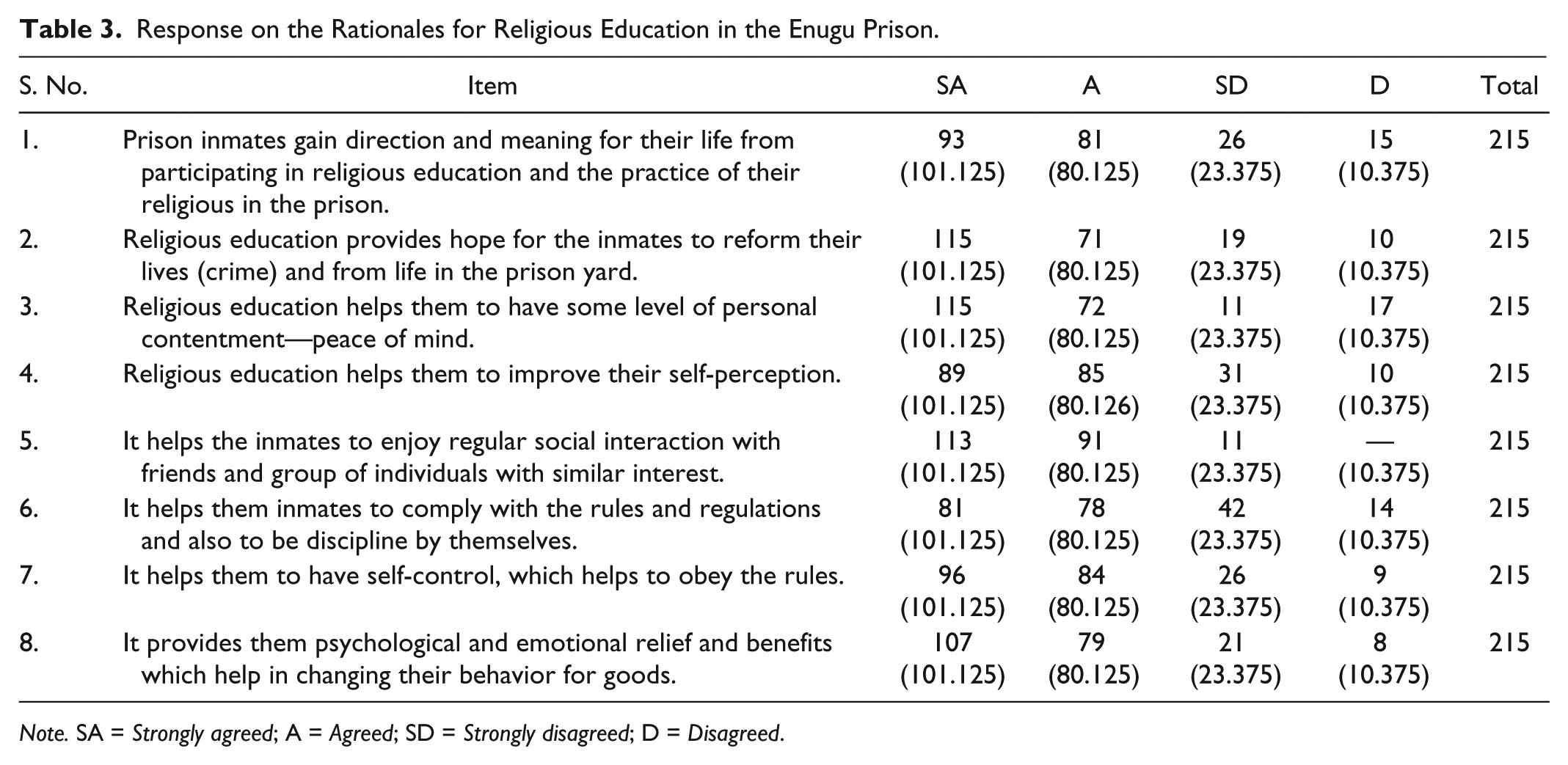
Response on the Rationales for Religious Education in the Enugu Prison.
Discussion of Results
The Roles of Prison Education in Improving the Life of Prisoners and Ex-Prisoners
The respondents’ view on the role of education in improving the life of prisoners shows that education offers them opportunity for personal development and transformation; has the capacity to change their perception of self and others; helps them to live successfully; develops the motivation, autonomy, and responsibility to control their own lives; is the major tool that helps to support their rehabilitation and integration into the society after completion of the sentence; and helps to improve their employability which is the key factor that reduces the likelihood of reoffending. These findings agreed with the submission of Hawley et al. (2013) that supporting prisoners to gain knowledge, skills, and competences forms an important stepping-stone in the major journey toward rehabilitation and reintegration into the society.
Similarly, the findings that education gives the prisoners the capacity to develop sense of civic responsibility, to cope with number of issues they face, the ability to manage their health needs and their financial needs, tally with the opinion of Schuller (2009) that prison education and training helps to provide prisoners with the number of issues they face, the ability to manage their own health needs, and financial capabilities. The agreement of these authors with the respondents’ view shows that these findings are authentic.
Rationales for Teaching Religious Education
The study found religious education has the rationale of helping the prison inmates to gain direction and meaning for their lives. This agrees with the opinion of Dammer (2000) that, in many cases, inmates gain direction and meaning for their lives from participating in religious education and through their practice of religion. Other findings are that religious education provides hope for the inmates—hope to reform from life of crime, and from life of imprisonment, helps them to have some levels of personal contentment—peace of mind. These findings corresponds with Dammer (2002) that inmates feel that participating in religious education and practice of religious gives them a “peace of mind” which means having some level of personal contentment. Having peace of mind helps inmates to improve their well-being especially those serving long sentence.
Furthermore, the respondents’ view shows that religious education helps the inmates in improving their self-perfection. It helps them to enjoy regular social interaction with friends and group of individuals with similar interest, it helps them to comply to discipline their condition requires and to have self-control which help them to comply with the prison rule and regulations, and that it provides for them psychological and emotional reliefs and benefits which help in changing their behavior. These findings agree with the submission of Dammer (2002) that in addition to the many psychological and emotional benefits, inmates also can use religious education to change their behavior and that by following the principles and discipline that required in the serious practice of religion inmates can be taught self-control. These are to say that religious education is important to inmates in the prison.
Responses on the Impacts of Religious Education in Uplifting the Image of Prisons and Ex-Prisoners in Enugu State.

Response on the Role of Religious Education in Curtailing Ex-Prisoners’ Recidivism.

The Impacts of Religious Education in Uplifting the Image of Prisoners and Ex-Prisoners
The study found that religious education makes prison inmates to be realized and be treated as people who are image of God. This agrees with the submission of Brown (2013) that the community to whom religious education is taught consists of people made in the image of God. In the same way, the finding that religious education makes prisoners to be seen and heard and that it cultivates hope in the prisoners, heals fears and ignorance of the prisoners, as well as that it promotes personal and communal liberation of shame and shaming, corresponds with the opinion of Hooks (2003) that religious education has two tasks to play; the task of cultivating hope and fostering community. Hope works contrary to abusiveness and “stretches the limits of what is possible. That fostering community serves to (re)introduce the prisoners to the feelings of connectedness and closeness that are often lost through in incarceration. The findings also agree with Chopp (1995) that through religious education, the inmates voice their own experiences, and this is helpful in guarding against an ethos of victimization and blame.
Similarly, the respondent’s view that religious education helps the students to write new positive script on the blank pages of their previously dismal tale and that it encourages the inmates to write the life they envisioned to live outside the prison agree with submission of Brown (2013) that the best method to adopt in transforming prison inmates is one of narrative and dialogue, that narrative refers to the process of allowing the inmates to rewrite and retail their stories. By telling their own stories, prisoners learn to tell of and compose their lives in new ways. The conclusion of the findings and the opinions of the various scholars reviewed show that religious education uplifts the image of the prisoners in Enugu prison, Enugu state, Nigeria.
Religious Education and Curtailing of Ex-Prisoners’ Recidivism
The analyses on the respondents’ responses on the role of religious education in curtailing ex-prisoners’ recidivism in Enugu prison show that religious education gives necessary rehabilitation of prisoners and supports their reintegration in the society after serving the sentence. This is in line with the opinion of Brown (2013) that religious education helps to support the reintegration of prisoners into the society.
In the same way, respondents’ view also shows that religious education addresses the key factor that influences the ex-prisoners’ chances of returning to crime, such as level of education, employment status, drug abuse, misuse of alcohol, and so on. This agrees with the submission of Hawley et al. (2013) that a prison sentence in itself may not be enough to prevent, reoffending, that it is crucial that religious education should ensure that time spent in prison is used to the best effect in terms of addressing the key factors that influences the prisoners’ chances of returning to crime, such as level of education, employment status, drug abuse and misuse of alcohol, mental and physical health, attitudes and self-control, instutionalization and life skills, housing and financial supports, as well as debt and family network.
Similarly, the finding that religious education provides for inmates moral guidance and standards of various conduct that will guide them in otherwise corrupt, materialistic, and degenerated society, and that religious education inculcates morality, belief in God, and obedience to God, which makes them God fearing and moral persons agree with the opinion of Ani (2012) that genuine religion instills sense of morality in any society and that religious education has value frameworks that guide the prisoners in determining between right and wrong, which is the pursuit of morality. The finding that through religious education some of the prisoners become qualified as theologians and have theological certificate, which qualifies them to, serves as lay religious leaders and pastors, agree with Brown (2013) that some prisoners become lay readers and pastors. This service keeps them busy and do not allow them to reoffend.
Conclusion
Prison education provides the inmates the opportunities to be rehabilitated and reintegrated into the society from where they had been convicted. It does this by offering them the opportunity for personal development and transformation, and it provides them with “life skills” which make them employable and thereby reducing their likelihood of reoffending. Religious education raises the image of the prison inmates by making them and everyone else to understand that the prisoners are people made in the image of God. It erases fear, ignorance, guilt, shame, and shaming of the prison inmates. By this, the personhood of the prisoners is likely to be restored. And the fundamental human rights are also made manifest. Religious education also curtails the recidivism of the ex-prisoners after completing of their sentence by addressing the key factors that leads to ex-prisoners returning to crime such as raising their employment status, discouraging their drug abuse, and misuse of alcohol. Again religious education makes some of the prisoners to become theologians, lay regions leaders, and pastors, and this makes them to be fully engaged in the society after their release from the prisons. Moreover, religious education also provides the prison inmates with the required moral guidance and standards of virtuous conduct that will guide them in otherwise corrupt, materialistic, and degenerated society they are returning to. It also makes them to be God fearing. Through all these provisions, the chance of reoffending is curtailed. It is glaring that religious education has the capacity to change the image of prisoners and ex-prisoners and also the ability to curtail ex-prisoners’ reoffending. It is therefore necessary to encourage the teaching of religious education in prisons in Nigeria. Moreover, all hands must be on deck to see that all the obstacles that militate against the provision of religious education in prison are eradicated.
Recommendations
Sensitive to inmates’ religious background: Enugu state is a multiethnic, multicultural, and religious society, and so are the prisons in Enugu. The inmates are diverse; thus, any effective religious education should take into consideration the inmates’ diverse religious persuasions and strive to encounter them personally. To be sure, there are times when an ecumenical learning or activities as a means of helping the inmates to gain or to learn values such as tolerance or respect for other people’s religious views, however any healthy religious viewpoint cherished by the inmates must be respected and supported.
Sensitive to their sociocultural background: In taking into consideration the cultural diversity of the inmates, religious education, besides providing theoretical aspects, should tap into inmates’ sociocultural background or values whether Hausa, Igbo, Yoruba, and Efik among others and employ such cultural values to impact the life of the inmates.
Social responsibility: For religious education to create greater impact and minimize recidivism, the curriculum should focus not only on morality or on moral principles but also on social responsibility educating every inmate on how he or she is a unit of the whole, and how his change can bring positive changes in the society.
Family and community involvement: If we are to witness a major change in the conduct of our ex-prisoners or minimize the degree of recidivism, religious education should involve not only the inmates but also prison staff, family members, and members of the public through seminars, workshop, media campaign with the cooperation of the governmental and nongovernmental groups with the aim to change societal attitude or perspective about prisons as purely punitive, vengeful, and vindictive measure to one that is meant to rehabilitate the offender so that he or she can return to the society better equipped to contribute his or her talent to the society.
Inmates with poor education and lack of skills are likely to have lower paying jobs if job opportunities are given to them, and if they remain idle, there are chances that they will go back to another crime and thus back to prison. Religious leaders should work with the government to ensure that in addition to religious education, vocational training and skill acquisition programs are in place in prisons, and postrelease rehabilitation program to help prisoners develop, enhance their skills, and rehabilitate themselves.
Curriculum: Religious education should be formulated in a way to enhance and promote intellectual and career development. In other words, religious education should embody curriculum and teaching tools and equipment that not only help raise prisoners’ self-esteem or self-worth and nurture hope but also help them to learn various vocational skills.
Good staff recruitment: Besides equipment and tools, the prison should be properly staffed with well-trained specialized staff, professionals, counselors, psychologists, and physiotherapists with a wealth of experience to provide adequate support to the inmates.
Care with dignity: Religious leaders need to expand their collaboration with the human rights advocacy groups to promote and defend the rights of prisoners, and to make sure that no prisoners are exposed to torture or physical or psychological abuse while in prison.
Religious leaders need to consider the training of and appointment of full-time chaplains to minister to inmates as a matter of priority. The appointment of these chaplains should take into consideration the diverse nature of the prisoners.
Sustainability of program: To sustain most programs including religious education programs in the prisons, the government should take a lead in the funding and work with philanthropists and community outreach groups to ensure that these programs are sustained and maintained. In addition, in designing the program, factors such as adaptability, feasibility, affordability, and sustainability should be considered.