







Abstract
Introduction
Anthropology, as a discipline, explores the full range of human diversity and similarity across cultures, social structures, habitats and environments. Anthropological skeletal analysis, a subset of this field, is particularly focused on understanding the human skeletal system. This study encompasses a multidisciplinary approach, integrating insights from natural, social and cultural sciences.
It is about reading the stories that human remains tell—from sex, age, and health to broader aspects like cultural practices and environmental impacts. Hence, data from historical and prehistoric anthropology (Grupe et al., 2015), as well as modern forensic science, provides a comprehensive understanding of deceased individuals and past populations from different time periods. This process involves investigating individuals’ identity, health status, behavior, lifestyle, culture, and the circumstances of their death Heuschkel et al. (2021) by determining phenotypes such as sex, age, height, ancestry, and other individualizing traits using anthropological methods. Sex assessment is a key part of this analysis because it provides essential information about an individual’s identity and helps build a biological profile. This profile offers insights into the person’s life, health, and the population they belonged to, aiding in reconstructing past societies, understanding demographic patterns, and identifying individuals in forensic cases.
The ANthropological Notation Ontology (ANNO) is motivated by the need for consistent data recording, enhanced comparability, facilitated access to, and sustainable preservation of human skeletal remains for research and cultural heritage contexts. It provides a standardized, digital framework for documenting, analyzing, and presenting data from human skeletal remains, making information accessible and usable for future research. ANNO supports the use of digital 3D models of bones in 3D editors such as AnthroWorks3D, playing a crucial role in categorizing and analyzing data in a flexible yet standardized and machine-readable manner, thus ensuring interoperability across different systems and studies. Anthropological analysis of human skeletal remains is inherently comparative, heavily relying on reference collections (Heuschkel et al., 2021). Several key challenges profoundly affect anthropological research (Heuschkel et al., 2020):
Preservation
From the moment of excavation, skeletal remains are subject to wear and tear, diminishing their informational value. Transferring the examination to digital models reduces physical handling, minimizes deterioration, and ensures that data is preserved and accessible for future research, even in cases of repatriation or reburial. This is crucial because “knowledge and evidence production can only yield what the original material provides” (Heuschkel et al., 2024, p. 132). Exemplifying ANNO’s underlying utility in this regard is the Rödelheim skeletal collection curated and researched by the Department of Historical Anthropology and Human Ecology at the University of Göttingen, consisting of over 200 skeletal remains from Napoleon’s army. With these remains scheduled for reburial in 2021, digitization became essential. By creating digital 3D models via AnthroWorks3D, and annotating them based on the ANNO ontological framework, the models were converted into research data that is analyzable across studies, despite the physical remains being reburied.
Access
Anthropological skeletal material from excavations often remains undetermined due to a shortage of specialists at the respective institutions. A digital solution would provide greater availability of human skeletal remains and allow for the efficient allocation of anthropologists and collections. For example, the Archaeological Heritage Office of Saxony faces a significant backlog of unevaluated skeletal collections due to a shortage of anthropologists. By digitizing these remains and using ANNO for annotation, the data can be made available to experts worldwide. This approach allows for the efficient allocation of resources, enabling comprehensive analysis that would otherwise be infeasible.
Comparability and Transparent Documentation and Analysis
Existing data recording systems in anthropology are often individualized, leading to compatibility issues that hinder comparative analysis and comprehensive intra- and inter-disciplinary research (Heuschkel et al., 2024). A digital solution combining ANNO, a standardized ontology for skeletal data, and AnthroWorks 3D, a 3D editor for creating and annotating digital bone models, provides unprocessed and undistorted information, making it comprehensible, reproducible, and sustainably documented. It also supports flexible and objective documentation of bone parts or fragments (Heuschkel et al., 2020). This allows researchers to “surround themselves with every shred of information about a collection or an object,” (Palkovich, 2001, p. 148) with future possibilities such as integration into collection management systems and the application of AI analysis (Heuschkel et al., 2024). Researchers comparing skeletal remains from different regions can use ANNO to standardize their annotations, ensuring that data from disparate sources is compatible. For instance, if two teams are studying bone wear patterns to infer lifestyle differences using different skeletal collections, ANNO allows them to document their findings in a uniform manner, facilitating direct comparisons and more robust conclusions.
While the concept of ANNO encompasses a broad range of anthropological aspects, its first and fundamental module, which is the focus of this paper, is on skeletal anatomy. This module serves as the foundation for all subsequent developments within the ANNO framework.
In anthropological skeletal analyses, methods employed include morphological and osteometric examinations. Apart from contextual information, anthropological focus on identifying and analysing traces found directly on the bones, indicating bone reactions or functional aspects.
For this purpose, anthropologists use human anatomy, specifically the skeletal system and further tissues of the musculoskeletal system, to classify and describe and thus document bones, anatomical structures, and diagnostic features within the overall framework of the skeleton in a comprehensive and transparent fashion. Precisely locating the traces on the skeleton is crucial. Accurate identification and mapping of these features allow for a detailed understanding of their implications and connections to broader anthropological inquiries. This precision is vital for meaningful and reliable interpretations in anthropological research. By applying the same principles used for mapping the Earth’s surface terrain, a detailed map of the human body can be created. This map contains visible anatomical surface structures, as well as artificial objects such as measurement points or content-related or methodologically based classifications and boundaries (Standring, 2016). ANNO represents such a map by providing an ontology for accurate and exhaustive definitions that allow to unequivocally locate these, facilitate their retrieval and furthermore serve as a basis for an objective examination, including measurements.
Osteometric examinations involve precise measurements that numerically capture features important in anthropology. These measurements are crucial for discriminant function analysis, a key method for determining the biological sex of deceased individuals. Discriminant function analysis identifies differences between predefined groups, such as males and females, by assessing specific bone measurements that typically differ between the sexes, such as the size and shape of certain features. The goal is to pinpoint characteristics that significantly differentiate these groups. The resulting discriminant function includes measurements as variables and their weights representing these characteristics. By inputting these measurements into the formula, the discriminant function calculates a score that classifies skeletal remains into one of the groups, indicating the likelihood of the remains being male or female (Grupe et al., 2015).
The digitization and digitalization of anthropological skeletal materials offer significant advantages. This process extends beyond visualizing remains to creating and analyzing annotated 3D models, incorporating traditional anthropological methods into digital formats. Such technological advancements facilitate preservation, documentation, and global collaboration, allowing remote access and minimizing physical specimen wear. These developments address access challenges and enable the linking of diverse study samples, thus enhancing research and data integration. The digital 3D models can serve as digital twins, as they present virtual, detailed replicas of skeletal remains, created using 3D imaging technologies. ANNO complements this digital twin by providing an ontological framework that enriches the model with detailed, accurate anthropological data. This synergy enhances the digital twin’s utility, enabling precise annotation, analysis, and sharing of anthropological findings. The benefits include improved research efficiency, enhanced data sharing and collaboration opportunities, and a deeper, more nuanced understanding of anthropological subjects. It provides a consistent yet flexible framework for representing anthropologically relevant anatomical and anthropological knowledge. By mapping information directly onto 3D models, ANNO ensures that data is not only comprehensible and reproducible but also sustainably documented. This approach improves data interoperability, a crucial prerequisite for successful digitization. Furthermore, data sets consolidated this way and formalized through the ANNO presented here allow for efficient data analysis techniques, such as data and text mining that promote deeper insights. Therefore, the contribution of ANNO lies in its ability to encapsulate and connect anthropological methods, aspects, and skeletal features within an ontological structure that aids in the digitization process, promoting more in-depth anthropological research and broader interdisciplinary studies.
Generally, ontologies are theories about the kinds of objects, the properties of objects, and the relations between objects in a knowledge domain. On the one hand, these are controlled vocabularies, but on the other hand, ontologies are also conceptualizations that the vocabulary terms are intended to capture (Chandrasekaran et al., 1999). Researchers in many areas recognized the need for ontologies to clearly define specialized vocabularies for these domains (McDaniel & Storey, 2019). The success of using ontologies to annotate biological data can also be confirmed by multiple examples (Konopka, 2015). It was therefore an easy decision for us to use an ontology for modeling the anthropological domain.
The main tasks to be supported by the intended ontology are the annotation of anthropological models, the specification of spatial relations between anatomical entities and the definition of phenotyping functions, see section “Methodology.” However, the ontology must remain relatively simple and compact to allow easy handling by domain experts and efficient integration into software. Existing anatomical ontologies often lack standardization in the naming and definition of concepts. Furthermore, the hierarchical structure is often too complex or general to be efficiently integrated into software for realizing specific anthropological use cases, see section “Other Existing Ontologies.” Since we could not find any ontologies that fully met our requirements and the integration or adaptation of selected ontology parts would be much more complex, we decided to develop a new ontology and then map it to the most prominent one.
Our main contributions are the following:
ANNOdc (section “Description and Foundation of ANNOdc,” Figures 1 and 2) is a domain-core (dc) ontology that defines the core entities of the domain. This includes general anatomical categories (Bone and Tooth), a category for describing their characteristics (Anatomical property), anatomical spatial entities (Anatomical space, surface, line and point) as well as the category Phenotype to model the rules for determining human phenotypes. ANNOdc was embedded in the General Formal Ontology (GFO), that is, the ANNOdc classes are subclasses of GFO classes. ANNOds (section “Development of ANNOds”) is a domain-specific (ds) ontology for describing domain-specific entities to be used for annotating the parts of the human skeleton. These are bones, teeth, their parts and compounds, such as mandible, Mental protuberance or the facial skeleton. It is also used for modeling their properties and relations, such as the distance between ANNO is integrated into AnthroWorks3D (section “Use Case: Integration Into AnthroWorks3D”), a photogrammetry pipeline and application for generating and analyzing 3D-models of human skeletal remains. ANNO is published over multiple channels, see Table 1.

Integration of ANNO with the top-level GFO ontology.

The ANNOdc domain-core ontology.

The two components of ANNO (ANNOdc and ANNOds) play different roles and complement each other in the overall framework. ANNOdc (section “Description and Foundation of ANNOdc”) is a static part of the ontology that describes a clear structure (core categories and properties) of the knowledge base and was mainly developed by ontologists (in consultation with anthropologists). ANNOds (section “Development of ANNOds”), on the other hand, is a dynamic (extensible) part that is developed by domain experts in strict compliance with ANNOdc (by providing an appropriate template). This means that the ANNOds categories are subcategories of the ANNOdc categories, and only the properties defined in ANNOdc are used. Furthermore, such an ontology structure plays a decisive role in the integration of ANNO into AnthroWorks3D (section “Use Case: Integration Into AnthroWorks3D”). According to the three-ontology method (Hoehndorf & Ngomo, 2009), the software only has to implement access to the entities (categories/classes and properties) of ANNOdc, while the categories/classes of ANNOds are processed dynamically.
The intended audience for the ANNO encompasses all anthropologists and professionals working in related settings, including museums and archaeological contexts. This audience is critical as the digitization of skeletal remains and the development of comprehensive data management systems are essential advancements for the sustainability of the discipline. Over the past decade, there has been a growing recognition of the importance of digital transformation in anthropology, which is crucial for the long-term preservation, accessibility, and analysis of anthropological data.
ANNO plays a pivotal role in this digital transformation as it represents a significant step in this digitalization effort, serving as a bridge between various fields such as IT, semantic web technologies, ontology development, and anthropology. By creating a unified platform for the digitization, annotation, and analysis of skeletal remains, ANNO not only enhances the efficiency and accuracy of anthropological research but also fosters interdisciplinary collaboration. This collaboration is vital for addressing the complex challenges in the field and ensuring that the methodologies and findings in anthropology remain robust and relevant in the digital age.
Tools such as ANNO and AnthroWorks 3D are the driving forces and bridges of digitization, enabling the much-needed digital transformation in anthropological research. They provide a comprehensive and sustainable solution, enhancing our understanding of human history and cultural heritage.
Distinguishing Features of the Anthropological Notation Ontology
ANNO distinguishes itself by focusing specifically on anthropology rather than general anatomy. This focus underscores the importance of understanding the relationship between bones and the anatomical and osteometric features found on them. ANNO emphasizes the need for precise definitions using established anatomical and anthropological terminology, including directional terms, to facilitate clear communication within the field. This approach allows for a more nuanced understanding of human skeletal structures, essential for anthropological analysis and research. The ontology aims to map the entirety of anthropological knowledge directly onto a digital 3D skeletal model, functioning as a comprehensive knowledge representation. It projects anthropological information as a layer onto the skeleton, incorporating, and localizing aspects and interrelations crucial for anthropological study, effectively serving as a navigable atlas for skeletal analysis.
ANNO is designed to align anthropological knowledge, including measurement explanations and landmark identification, with methods and the skeletal framework itself. This modeling ensures data compatibility for extensive analysis, integrating a maximal amount of information. A pivotal advantage of ANNO is its ability to directly associate information with a digital 3D model facilitating the inherent connection to the raw data and enhancing comprehension, reproducibility, and sustainability of documentation. ANNO meticulously details skeletal anatomy through an atomic design approach, breaking it down into its most basic, indivisible components, then systematically organizing these components to represent the skeletal structure with high fidelity.
This granular method facilitates a deep and scalable anthropological understanding. ANNO is capable of referencing various (online) resources that are structurally and semantically diverse, such as other terminologies, ontologies, websites (Gobée et al., 2011) or media, aiming for synonym mediation, standardization, and conceptual clarity.
The current state of ANNO includes a foundational module that focuses on skeletal anatomy on the one hand and anthropological aspects such as osteometric landmarks (measurement points) and measurements (distances), which are either sporadically represented or absent in existing ontologies, on the other hand. ANNO is designed to evolve gradually by integrating more anthropological aspects, ultimately becoming a modular knowledge environment. This approach allows for step-by-step enhancements to the ontology’s scope and utility, enabling a comprehensive integration of anthropological knowledge.
Existing Solutions and Research Gaps
Nomenclatures: Terminologia anatomica (TA)
There are various reference materials for the description of anatomical structures, ranging from anatomical atlases to nomenclatures. The latter aim for an established standardized naming and systematization. The TA (Federative International Programme for Anatomical Terminology, 2019) is a hierarchy of anatomical structure concepts for the entire human body. For historical reasons, it uses a terminology consisting of Latin and originally Greek, which was later latinized. For each anatomical structure, the TA provides the “preferred,” that is, standard, Latin term and its English equivalent as well as an individual identification number. In some cases, Latin and English synonyms are also included, e.g.
Existing Ontologies: Foundational Model of Anatomy (FMA)
Other ontologies either lack a comprehensive approach to anthropology or exhibit inconsistency in depicting knowledge within this field, since they are not designed with this specific purpose in mind. The FMA (Rosse & Mejino, 2008) ontology represents the physical organization of human anatomy by mapping relations to one another. It allows the knowledge it contains to be represented in a way that is humanly comprehensible and machine-interpretable. The FMA uses the Basic Formal Ontology (BFO) as its top-level ontology. Corresponding to its relational nature, new higher level concepts are introduced and used for reorganizing the actual anatomical structures diverging from the TA’s hierarchical structure. Thus, in 90% of the cases this leads to new creations of anatomical concepts (Gobée et al., 2011) whereas only 1% contain textual definitions (Mungall et al., 2012). The FMA primarily focuses on depicting the entirety of human anatomy. This broad approach results in inconsistencies in how skeletal structures are detailed, as the FMA’s overarching goal to cover anatomy in general cannot sufficiently address the complexities and nuances of skeletal anatomy. Such a wide scope also means that the anatomical knowledge pertaining to the skeleton is not depicted with the depth or precision that anthropological work demands, reflecting the limitations in existing literature on the subject. From an anthropological perspective, the FMA ontology exhibits challenges in terms of content depth, comprehensiveness, and granularity. Specifically, the main issues encompass a lack of cross-references between concepts, taxonomic and hierarchical inconsistencies, insufficient detail levels, and conceptual ambiguity. These gaps result in a notable absence of detailed relationships, associations, and concepts that are crucial for a thorough anthropological understanding and analysis. Additionally, the distinction between normal anatomy, pathology, and anatomical variants, which is essential, is not adequately addressed by the FMA’s architecture. Interlinks from ANNO to the FMA are added manually as decisions by the domain experts are required because seemingly equivalent classes may be hypernyms, hyponyms or not related at all.
The ANNO-FMA links are used in combination with unofficial FMA-TA2 links from Wikidata to automatically generate links between ANNO and the TA2.
The following examples illustrate the issues described above.
Specific bones can be found as a subclass of “bone organ” (
fma:224804
) but, among others, also in terms of tissue as “bone tissue” (
fma:224804
) with then varying terms such as “bone tissue of hip bone” (
fma:42854
) or “bone of sacrum” (
fma:43624
) and placed on the same level as histological structures like “lamellar bone” (
fma:224806
). Different anatomical landmarks are classified taxonomically in various ways. Many landmarks are described as a “zone of bone organ” (
fma:10483
) with superclasses determined by bone shape), e.g. “flat bone” (
fma:7476
). However, the categorization of bone shape is not consistently defined across anatomical sources (Burns, 2015; Rauber & Kopsch, 1987). To avoid these dependencies and potential incongruities, ANNO sidesteps taxonomic categorizations. Through location-based mapping, ANNO allows for the coexistence of diverse taxonomies. On the other hand, another landmark, the “external acoustic aperture” (
fma:61301
), is classified as a subclass of “orifice of skull” (
fma:53133
), which falls under a different subtree of “anatomical spaces” (
fma:5897
) in FMA. Osteometric landmarks are mixed with anatomical landmarks in a hierarchy (subclasses of “anatomical point” (
fma:9658
)) that lacks coherence and detail. The “orbit” (
fma:53074
), comprised of multiple landmarks, is classified without detailed segmentation into its constituent landmarks.
ANNO and FMA are not seen as competing ontologies; instead, they are intended to complement each other. This synergy allows for a richer, more interconnected representation of anatomical knowledge.
Other Existing Ontologies
Uberon, the Uber Anatomy Ontology (Mungall et al., 2012) covers different species, lacking the necessary detail in anatomical and osteometric landmarks specific to anthropology. The Biological Spatial Ontology (BSPO) (Dahdul et al., 2014) focuses on spatial concepts applicable across various taxa but does not directly address skeletal anatomy, bones, or landmarks required. The National Cancer Institute Thesaurus (NCIT) (Golbeck et al., 2003), despite including some relevant anatomical landmarks, primarily relates to bones through text, also lacking in osteometric landmarks. The Anatomical Entity Ontology (AEO) (Bard, 2012) offers detailed tissue classification but does not cover human anatomical and osteometric landmarks. Read Codes Version 3 (RCD) (O’neil et al., 1995), with a focus on anatomy and diseases, includes bones but misses out on the detailed anatomical and osteometric landmarks.
Further Research Gaps
There are several issues and research gaps when it comes to naming and defining anatomical concepts and instances that neither current ontologies nor reference literature—general or subject-specific—can address adequately. The primary issue lies in the absence of standardization. While both the TA and FMA have been proposed as a means of standardizing terminology, they haven’t garnered sufficient acceptance to facilitate the adoption of a unified and consistent body of work to establish standardization in practice (Hirsch, 2011; Kachlik et al., 2008; Martin et al., 2014). Instead, the usage of terminology is as fluid as any other language, depending on its socio-cultural environment, such as schools or language areas (Gobée et al., 2011; Hirsch, 2011; Martin et al., 2014; O’Rahilly, 1989; Ocak et al., 2017). Thus, for example, the usage of English designations is preferred in the Anglo-American sphere, while Latin terms are commonly used in German-speaking areas (Buklijas, 2017; Dauber & Feneis, 2019; Kachlik et al., 2016). As a consequence there are at times various translations for the same anatomical terms (Loukas et al., 2016). Yet, knowledge of Latin is generally declining. With the terms becoming more abstract to the people using them, there is also a common prevalence for spelling divergences and grammar mistakes (Dauber & Feneis, 2019; Kachlik et al., 2008, 2015; Neumann, 2017). Moreover, in textual descriptions Latin and the native language are commonly used interchangeably for stylistic purposes. For instance, Dauber and Feneis (2019) uses the German terms of the bones in the explanation of sutures. Meanwhile, the existing terminology is not flexible enough for language-like usage; for example, there is an inconsistent use of singular and plural forms or gaps in lateralized landmarks.
Anatomical terms, unless historically evolved, typically describe the location, affiliation or function of a concept or structure (Buklijas, 2017). However, this naming convention is often inconsistent and non-intuitive. An example, showing the variability in illustrative descriptions, is the Tuberculum articulare of the Processus zygomaticus, which in Zilles and Tillmann (2010) is described as saddle-shaped although it is not called
Another issue is that neither FMA nor TA are tailored to fit the requirements of anthropology or any other specialized field (Rosse & Mejino, 2008). For example, articular surfaces of the individual bones are relevant anthropologically, yet not all articular surfaces (e.g., on the
Furthermore, anatomical resources often lack adequate visual representation of anatomical structures. The labeling is often selective, varies by source and mostly relies on arrows for local designation. However, since they are multi-dimensional structures, it is essential to provide a marker over the entire landmark and delineate it accurately. The latter also requires a clear textual definition. Unfortunately, there are currently no equivalent standardized definitions for skeletal anatomy, meanwhile anatomical resources only provide sparse information on this topic.
To address these issues, it is necessary to develop unified, textual, visual, and detailed descriptive definitions for anthropologically relevant anatomical concepts and instances. These definitions should be presented within an easily understandable ontology, with ANNO contributing to filling this specific niche.
The main requirement for the intended ontology to cover the defined tasks is that it adequately represents the basic anatomical and anthropological entities, the spatial relations between them and the phenotyping functions, while remaining relatively simple and compact. This approach allows on the one hand an easy manageability of the ontology for domain experts and on the other hand its efficient integration into software (e.g., AnthroWorks3D) according to the three-ontology method (Hoehndorf & Ngomo, 2009).
Following this method, the software only needs to implement access to the core categories (of the core or task ontology), while their subcategories (from the domain-specific ontology) are processed dynamically.
This means, among other things, that all relevant anatomical entities (bones, teeth, their parts and composite structures) must each be located in one subtree (i.e., must have a common superclass) rather than spread across the entire ontology, as is the case with FMA. Several partial subtrees would have to be combined for this purpose. Also, the FMA, for example, does not have single equivalent concepts to represent bone compounds or bone parts, see section“Description and Foundation of ANNOdc.” Furthermore, clear relations must exist between the core entities so that the dependencies between them can be efficiently resolved by the software. None of the evaluated ontologies could cover all defined requirements and adequately support the specific anthropological use cases. We decided to develop a new ontology because the integration (extension and adaptation) of all necessary parts from different ontologies would have been much more complex.
Methodology
For the development of ANNO, we applied the onto-axiomatic method, a combination of the axiomatic method with a top-level ontology (Baumann et al., 2014; Herre, 2010). The axiomatic method comprises principles for developing theories or formal knowledge bases, which aim at the foundation, systematization, and formalization of a knowledge domain (Baumann et al., 2014; Herre, 2010). When knowledge is systematized, a set of categories is considered
The considered axioms differ in their degree of abstraction. At the most general level of abstraction, they are provided by top-level ontologies, whose axioms and categories can be applied to most domains of the world. The onto-axiomatic method combines the axiomatic method with a top-level ontology, which is used to create more specialized core- and domain-specific ontologies (Baumann et al., 2014). Possible ways of discovering axioms in empirical domains are generalization based on single cases and idealization (Baumann & Herre, 2011).
We built ANNO on the basis of an ontology development schema that includes three main steps: 1. Domain Specification, 2. Conceptualization and 3. Axiomatization (Herre, 2010), and used the General Formal Ontology (GFO) (Burek et al., 2020; Herre, 2010; Loebe et al., 2022) as a top-level ontology in the sense of the onto-axiomatic method.
Domain Specification
As part of the domain specification, the anthropology experts conducted an extensive review of existing literature and ontologies, analysing and classifying the relevant information. Together with ontologists, relevant use cases and competence questions
1
(Blomqvist et al., 2016; Shimizu et al., 2023), as well as views and classification principles of the objects in the anthropology domain (Herre, 2010) were discussed. The following main use cases and competence questions (sub-items, selected examples) were defined:
Annotation of anthropological models (representations of anatomical entities) using a controlled vocabulary
Query all bone types Query all parts (types) of a specific bone (type) Query all parts (types) of a specific bone compound (type) Query all tooth types Query all parts (types) of a specific tooth (type) Specification of spatial relations between anatomical entities
Query all defined spatial relations What is the relative anatomical location of an anatomical entity in relation to another anatomical entity? On which anatomical structure does a defined measurement point lie? Between which measurement points does a defined anatomical line lie? Specification of phenotyping functions
Query all phenotype specifications Query the phenotyping function for determining a particular phenotype Which parameters/variables (e.g., measurement distances/angles/points) are required to determine a particular phenotype?
Relevant domain objects were identified on the basis of the defined use cases. These include bones, teeth, phenotypes, as well as spatial anatomical entities. The objects are classified according to their type and part-whole relationship.
Conceptualization
During the conceptualization phase (Herre, 2010), the core concepts (categories, classes) and relations were introduced that form ANNOdc (domain-core ontology) (Figure 2). The concepts were created by generalizing and classifying the domain objects. To answer the competence questions of the first use case, for example, a distinction must be made between whole bones, bone parts and composite bone structures. Therefore, the corresponding concepts
Axiomatization
For the axiomatization and formal foundation of ANNO we utilized GFO as a top-level ontology and reused its categories, relations, axioms, and modules (as a kind of Ontology Design Patterns (Blomqvist et al., 2016; Gangemi, 2005; Shimizu et al., 2023)). We instantiated specifically the GFO modules
Further axioms were introduced to precisely define certain categories. In addition to an explicit textual definition of the category 

Regarding use cases, we integrated the ontology into the AnthroWorks3D software (Fritzsch et al., 2021) and were able to successfully realize all three intended use cases. Thereby, 14 of the core categories 2 and 4 of the relation types 3 of ANNOdc were utilized and their subcategories and specific relations were dynamically queried (according to the three-ontology method). Statistical information about the ontology is shown in Table 2.
Statistical Information.

Column values do not add up because some entities are defined in both subontologies.
The core ontology development occurs in close collaboration between ontologists and anthropologists. The objective is twofold: to adequately represent the most basic anatomical and anthropological entities and to keep the ontology relatively simple and compact. This approach ensures that domain experts can easily handle the ontology and efficiently integrate it into the AnthroWorks3D software, see section “Use Case: Integration Into AnthroWorks3D.”
The position of all anatomical entities is described in a standardized fashion using conceptual axes (a kind of anatomical line), planes (a kind of anatomical surface) as well as directions (relative anatomical locations). Directions are relative to the body based on the standard anatomical position ( The longitudinal or vertical axis runs in the superior-inferior direction in an upright position, perpendicular to the ground. It intersects with the frontal and sagittal planes. The sagittal axis runs in the ventral-dorsal direction, from the front to the back surface of the body and vice versa. It intersects with the sagittal and transverse planes. The transverse or horizontal axis extends from left to right, intersecting with the frontal and transverse planes.

Left: Anatomical Planes and Axes: 1 saggital plane, 2 midsaggital plane, 3 frontal plane, 4 transverse or horizontal plane, 5 saggital axis, 6 transverse axis, 7 longitudinal or vertical axis. a: Planum sagittale (sagittal plane), includes sagittal and longitudinal axes; the midsagital plane passes through the midline of the body, b: Planum transversale (Transversal plane), includes transverse and sagittal axes, c: Planum frontale (frontal plane): includes longitudinal and transverse axes. Right: Anatomical relative location: directional terms used in anatomy and anthropology. Modified figure based on (Paulsen et al., 2011; White et al., 2012).
The three principal planes, depicted in Figure 3, are:
The sagittal plane, i.e all vertical planes parallel to the sagittal suture of the skull and running from anterior to posterior in the upright position. The median (sagittal) plane divides the body into two symmetrical halves. The frontal plane (= coronal plane) comprising all planes parallel to the forehead (frons) or the coronal suture of the skull, running vertically from one side of the body to the other in the upright position. The transverse plane including all horizontal cross-sectional planes, relative to the upright position, dividing the body into cranial and caudal sections. They run perpendicular to the longitudinal axis of the body.
Each one has two anatomical axes as boundaries in the sense of GFO, which allows boundaries to occur inside a structure and not necessarily at the extremities. For example, the coronal (frontal) plane has the transversal (horizontal) and longitudinal (vertical) axes as boundaries.
An anatomical direction or relative anatomical location, as shown in Figure 3, is the position of an anatomical entity (e.g., a bone structure) in relation to another anatomical entity (e.g., another bone, an axis, a plane or a point such as the center of the body). Relative anatomical locations are classified according to the anatomical terms of location (e.g., cranial or superior = “towards the end of the skull,” dexter = “right” or distal = “in direction towards the end of a limb”). For example, the Glabella is located laterally to both Arcus superciliaris (Arcus superciliaris sinister and Arcus superciliaris dexter). A relative anatomical location can be considered as an individual relation between two anatomical entities (target entity and reference entity) and can therefore be modeled using a GFO relator. Relators are composed of roles (in our case target and reference) and have the power to relate arbitrary entities (in our case, anatomical entities) (Loebe, 2018).
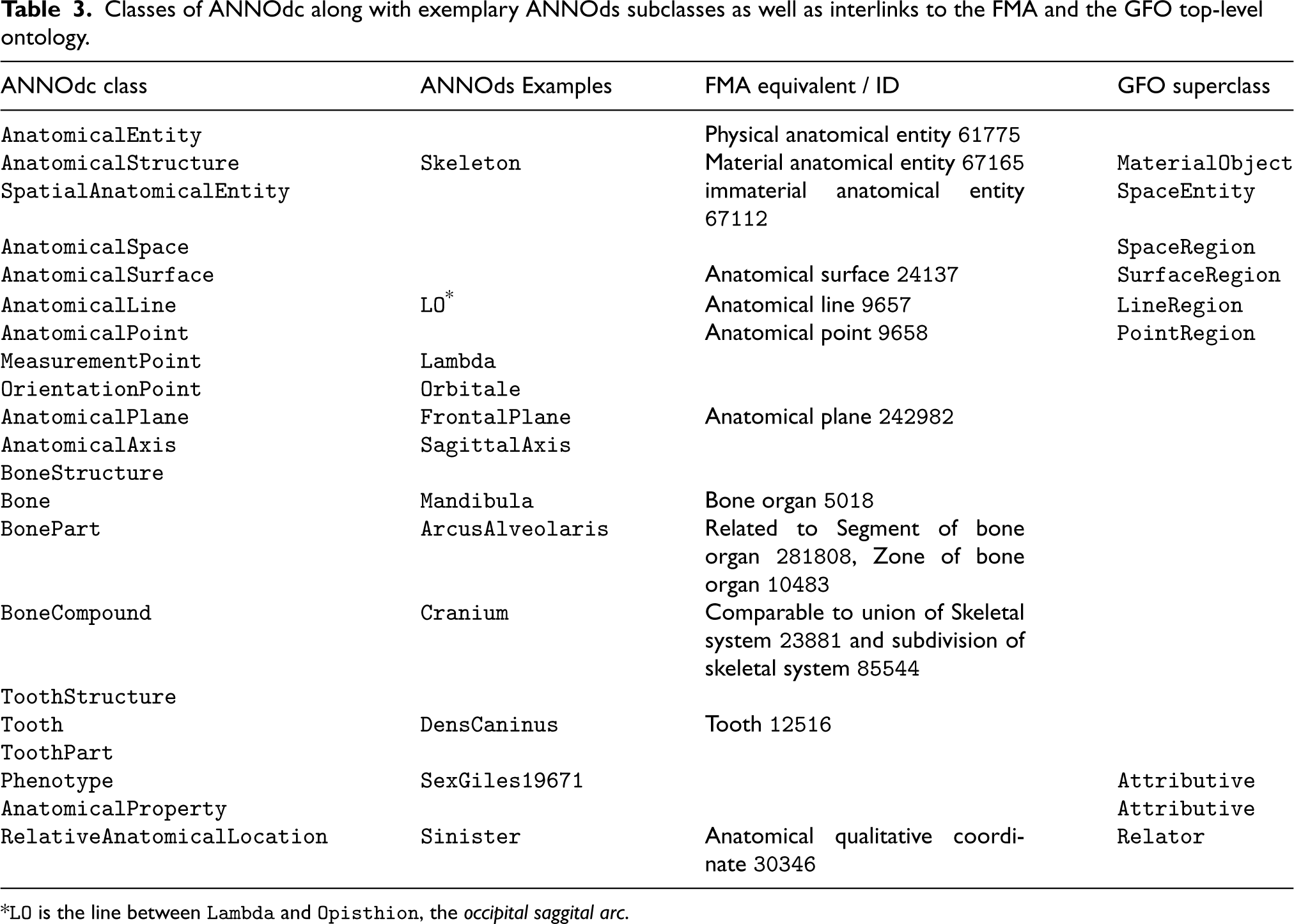
An anatomical entity is either an anatomical (material) structure or a spatial anatomical entity, such as Cranium or FrontalPlane . An anatomical structure refers to any anatomical division or material anatomical entity. ANNO describes three kinds of anatomical structures: tooth structures (teeth and teeth parts), bone structures (single bones, bone parts and bone compounds), as well as the complete skeleton. The GFO defines a material object gfo:MaterialObject as a solid concrete entity that belongs to the material region of the world, has mass, consists of matter and occupies space (Loebe et al., 2021). Accordingly, we define anno:AnatomicalStructure as a gfo:MaterialObject in the anthropological context. The closest equivalent in the FMA is the “Material anatomical entity” fma:67165 , the subclass of “Physical anatomical entity” fma:61775 that has mass.
The largest or most comprehensive skeletal anatomical structure, the human skeleton, is the framework composed of all the bones and teeth of a human being. The TA (Federative International Programme for Anatomical Terminology, 2019) equates the skeleton with the
Tooth structures comprise teeth and their parts. A human tooth is an individual unit of the human dentition (synonymous for the teeth as a whole). Teeth are part of the skeleton, yet they are characterized by their own distinctive tissue and thus treated separately from bones. Teeth, such as the Dens caninus (canine tooth) are located on bone structures. The FMA has the equivalent class “Tooth” fma:12516 . A tooth part is any portion of a tooth. They are not included in the initial scope of the ontology, but they are one of the aspects by which it can be expanded.
Bone structures comprise all possible parts of the human skeleton, which are individual bones, bone parts, bone compounds as well as the complete skeleton excluding the teeth. The FMA does not have a common superclass for those parts but instead mounts them in different parts of its hierarchy.
A bone or bone element is a single self-contained bony skeletal entity. Bones, such as Mandibula (Mandible) and Os occipitale (Occipital Bone) are individual bone organs. FMA does have a “Bone” class ( fma:30317 ) but that only has a single subclass “Skull bone” ( fma:30317 ). Instead, “Bone organ” ( fma:5018 ) is the equivalent class.
A bone compound is a section of the skeleton combining multiple bones or bone parts together, depending on the classification system chosen. This allows for the representation of any partonomy that need not necessarily be compatible with one another. Bone compounds, such as the Cranium (skull bone) consist of further bone compounds, individual bones (which in turn consist of bone parts) and bone parts. The FMA does not have a single equivalent class, but it is similar to the union of “Skeletal system” ( fma:23881 ) and “Subdivision of skeletal system” ( fma:85544 ). On the skeletal level, bone parts comprise any piece or portion of a bone. An anatomical landmark is any distinct structure on a bone. In ANNO, it is also referred to as a bone part.
An anatomical entity without mass is classified as a spatial anatomical entity, which is either an anatomical space (three-dimensional), an anatomical surface (two-dimensional), an anatomical line (one-dimensional) or an anatomical point (zero-dimensional). It is equivalent to the FMA “Immaterial anatomical entity” ( fma:67112 ).
An anatomical space is a space region (three-dimensional) occupied by an anatomical structure. An anatomical surface is a boundary (two-dimensional) of an anatomical space.
An anatomical point (or osteometric landmark) is any immaterial, conceptual point that marks a location on a bone, either to create measurements (anatomical lines) or locate other anatomical points, for example, by aligning the bone in specific planes for a measurement. The former serve as measurement points, the latterrelevant to the measurement procedure as orientation points. An anatomical point is thus a boundary (zero-dimensional) of an anatomical line.
An anatomical line is a conceptual, immaterial line on a bone passing between at least two measurement points that, in the form of distances, circumferences or angles is used to collect measurements representing aspects of a bone’s dimensions. An anatomical line is a boundary (one-dimensional) of an anatomical surface. Anatomical lines can connect or pass through anatomical entities (e.g., an edge between two or an angle between three anatomical entities). The length of the line or the angle degree can be measured and used in functions to infer individual phenotypes. For example, the anatomical line
ZyDexterumZySinistrum
between the
Usually, a phenotype is considered as a (combination of) bodily feature(s) or observable characteristic(s) of an organism, such as sex, body height or body weight (Hoehndorf et al., 2010; Mahner & Kary, 1997; Scheuermann et al., 2009). Since phenotypes are individual properties, they can be considered as attributives in the GFO sense. The phenotype notion has also been analyzed in detail within the framework of the Core Ontology of Phenotypes (Uciteli et al., 2020).
In the case of ANNO, the phenotype can be derived using functions comprising obtained measurements. Discriminant functions, for example, based on the Cranium, allow for the assignment to sex while estimation of stature is attained by using linear regressions, for example, based on Femur or Tibia length measurements. RDF is not optimized for mathematical formulas so we model those as literals.
As an example, the discriminant function no. 6 developed by Vodanovic uses the measurement of the angus mandibulae to assign sex, thus deriving a phenotype. For the left side it is given as:

An anatomical property is a characteristic (e.g., shape) of an anatomical structure. Anatomical properties are considered as attributes or qualities in GFO (Burek et al., 2020). These are dependent individuals that characterize other individuals (in our case, anatomical structures).
Other than by means of osteometry using measurements and functions, an anatomical landmark’s morphology can be used to examine anthropological aspects or phenotypes such as age or sex. For instance, assessment of the degree of an anatomical landmark’s morphological expression (the anatomical property in this case) offers information about the sex of the remains of the individual being examined. While the morphological examination was not within the scope of the project, it was nonetheless ensured that future extension in this respect is possible.
While ANNOdc is created by the ontologists in consultation with the domain experts, ANNOds is developed by the domain experts themselves. For this purpose they were provided with a spreadsheet-based SMOG (Uciteli et al., 2019) template by the ontologists, see Figures 4 and 5, eliminating the requirement of having a background in RDF and ontologies. The template is based on the structure of ANNOdc, so that the entered data is compliant with it: The ANNOds classes are subclasses of the ANNOdc classes (see Table 3) and properties (see Figure 2) from ANNOdc are used. The spreadsheet is transformed to an OWL 2 ontology consisting of a taxonomy, annotations and some simple axioms on the basis of property restrictions. This approach ensures intuitive and unimpeded data input and a valid end result. Additionally, ANNOds is validated using SHACL shapes 4 , which requires metaclasses. For example, all directly specified and transitive subclasses of Bone are also explicitly individuals of the metaclass BoneClass because of the limitations of SHACL. In addition, the objective is to initiate the process of data entry, encompassing selected bones of the skeleton.

Exemplary assessment of anatomical properties for the derivation of the phenotype sex, where five cranial bone parts are evaluated for their level of morphological expression. Method after Walker (Aftandilian et al., 1994). Image taken unmodified from Aftandilian et al. (1994).

Excerpt of the spreadsheet-based input template used by the anthropologists.
ANNO thoroughly delineates each concept with precise terminology, definitions, and clear distinctions for identifying features or taking measurements, with all information backed up by detailed source citations for transparency. All bone structures and anatomical points are annotated with their name in singular and plural form, reference bone, synonyms, textual and visual definition, FMA and TA ID, and sources. Measurements for determining phenotypes involve relevant spatial anatomical objects (e.g., lines), which are defined by the anatomical points or objects that delimit them. These include references to specific sections, the starting point, midpoint, and end point, accompanied by concise definitions. Given the overwhelming number of bone parts present in the cranium, the initial selection was narrowed down to a selection of representative and relevant parts. Overall, however, the aim is to include those that are of anthropological relevance, that is, that contribute to navigation, localization, and identification on the bone. Those structures included in the definitions of others were also to be defined. For bones that lie on the median sagittal plane (e.g., mandible or sternum), bilateral landmarks are defined, each with a side reference. For osteometric landmarks, all those already established in the core literature are to be used. Furthermore, those that are relevant for meaningful measurement distances and can be annotated in AnthroWorks3D should be used. For the measurement distances, those should be selected that are established in the majority of the core literature as well as necessary for discriminant functions and functions for estimating height and weight. The functions chosen were those with diagnostic value. These were discriminant functions for sex determination and regression functions for body height and body weight estimation.
For the definitions and measurements, a representative minimum amount of anthropological and anatomical English- and mostly German-language literature was compared in order to develop the definitions from their information. Notably, Latin or latinized ancient Greek terms often missing in the English literature and the FMA were included. Overall, the name of the structure, measurement or point is noted in Latin in singular and plural forms, English, German, synonyms in all three languages, the FMA and TA ID, and any information on function and delineation. This requires a positional description, such as the Punctum superioris capitis femoris as the superior located point of the Caput femoris. For the measurements, in addition to the name of the measurement, the type (e.g., distance measurement) and the measurement instrument were also recorded. The subsequent visual definitions were made in the different anatomical views marking the area of the anatomical structures and the position of the anatomical points.
The functions are divided into discriminant functions for sex determination and regress functions for body height. The sex of a specific individual within a population may be estimated using a function on skeletal measurements that is specific or similar to this population. Based on a threshold value, skeletons are classified into male, probably male, indifferent, probably female, and female. The exact number of categories may vary depending on the particular method used. ANNOds covers functions for at least one European, African, American, and Asian ethnicity or population.
Resolving Incongruities
The domain experts reconciled conflicting literature to arrive at a consistent and logical result, for example for the

The
Further contributions of ANNO include ensuring consistent Latin declension, including the plural form; enhancing transparency with detailed source references, distinguishing between original (primary) and citing (core) sources in the case of measurements. The ontology dissects group structures into atomic bone parts and more moreover introduces new terms and definitions for landmarks such as joint surfaces, which, despite their anthropological relevance, often remain unnamed in anatomy literature. It also formally establishes terms for osteometric measurement points outside the skull, addressing gaps not covered in the existing literature.
AnthroWorks3D, see Figure 7, is a German-language tool that combines user-friendly techniques of photogrammetry with insights from user experience research and knowledge from game development. It enables users to virtually examine digitized bone material, which can be created using a procedure designed for generating 3D models of bones. These models serve as digital twins in anthropological, morphological, and osteometric research and examination. To facilitate such examinations, the software can import and render these 3D models at runtime and provides a comprehensive suite of tools for annotating and measuring bone material. This facilitates anthropological work to be location-independent and parallel without exercizing wear and tear on the skeletal material. The examination can be performed as often as desired, even if the skeletal individuals or collections are not available at the institute or have already been reburied.

Collage of different views in AnthroWorks3D of a 3D model of a
The ANNO ontology was created to be used in conjunction with AnthroWorks3D and was integrated into the software to better meet the use cases of the program. These use cases include the annotation of bone material through markings in 3D space on the bone models, including point, line, and surface markings. They also involve the measuring of bones by providing line, circumference, and angle measurement tools for use in osteometrical contexts. To improve the quality of the annotations and measurements additional information such as alternative titles and descriptions, and others can be input by text. Moreover, the software offers the capability to display either the entire skeleton or specific parts, thereby enhancing the examination context. This feature enables users to not only focus on the specific bone they are studying but also easily access adjacent or related bones for a more comprehensive understanding. These use cases are already covered by AnthroWorks3D itself but are improved by an integration of ANNO into the software. Additional use cases that are only achievable through this integration include the automatic derivation of bone and skeletal phenotypes using mathematical functions available in the ontology and the provision of anthropological, anatomical and osteometrical knowledge for users through ANNO.
We use our ontological architecture (top-level ontology, domain core ontology, domain-specific ontology) to integrate ANNO into AnthroWorks3D based on the three-ontology method (Hoehndorf & Ngomo, 2009).
One of the advantages of the three-ontology method is that the software only needs to implement access to the entities (classes and properties) of ANNOdc ontology, whereas the classes of ANNOds are processed dynamically, as shown in Figure 8. In addition, it is now possible to perform sex determinations using discriminant functions, as shown in Figure 9.

Left: ANNO converted to the AnthroWorks3D JSON input format. Right: Bone selection in the imported hierarchy.

Sex determination in AnthroWorks3D using the imported ANNO discriminant functions.
The integration of ANNO into AnthroWorks3D significantly enhances its functionality. This integration involves four steps, the first of which was importing the ontology data in the form of JSON files. The application structure is then adjusted to align with the attributes defined in the ontology. This process includes assigning objects within the application, such as markers and measurements, to corresponding objects in the ontology. Furthermore, the ontology import process in AnthroWorks3D from a JSON file involves organizing the information hierarchically from this file and adding application-specific details, such as spatial positioning data in 3D space and placeholder models. These additional details are stored in a separate JSON file, ensuring compatibility with newer ontology versions. During runtime, AnthroWorks3D interprets the imported information, creating containers for the bone data to be imported and corresponding entries in the forms. The second step involved the adaptation of the properties of the bone objects and the related user interface elements, as the ontology includes attributes for these objects not previously implemented in AnthroWorks3D. This has led to modifications in the input forms and lists to accommodate these new attributes. As a third step, the application was adapted to facilitate the assignment of measurements and markings to concepts from the ontology. For instance, measurements taken within the application can be mapped to predefined measurement paths in the ontology. To achieve this the users can choose from a list of features from the ontology to be assigned to their measurements and markings.
Lastly, the import of discriminant functions allowed for their interpretation within the application. This updates the previous workflow of manually recording the results of the measurements, calculating the discriminant function outside of our application and evaluating the result manually to just selecting the relevant discriminant function, checking if the measurements are correctly assigned to the parts of the function and confirming their input whereupon the resulting classification is shown on the screen. This feature notably enhances the application’s capability for tasks such as sex determination.
By contributing systematic, standardized and clear definitions for (material and spatial) anatomical entities regarding the human skeleton as well as anthropological aspects such as the derivation of phenotypes, ANNO formalizes knowledge in the fields of anatomy and anthropology. It encompasses all the essential elements for the routine use of anatomical terms in daily anthropological practice. Integrating the ontology into AnthroWorks3D enables its immediate application in anthropological analysis. The ontology is interlinked with the TA and FMA and provides transparency by including all sources used to generate its content. Moreover, it provides a method for conceptualizing the ontology and generating its content. The ontology replaces an old, hard-coded format in AnthroWorks3D, which saves development time, separates annotation file compatibility from software versions, eases annotation through hierarchical browsing and improves interoperability and customization. Also, ANNO comes with extensive documentation of the process and available resources. Hence, foundations have been laid for its use and further development and management. Navigating through plenty of options for designing an ontology makes consistency challenging to achieve. As documented in the TA (Federative International Programme for Anatomical Terminology, 2019, part II), the choices frequently reflect the preference of a party having something included or named or structured in a certain way because it is considered relevant by a particular party. ANNO represents a specialized ontology that builds upon existing ontologies such as FMA and TA. However, meeting the diverse needs of the field and interdisciplinary requirements can only be accomplished through an ongoing, gradual process over time. While ANNO serves as a foundation for describing anatomical terms, additional work is required to comprehensively cover the anthropological domain. For instance, it only covers standardized normal adult anatomy. Moreover, in order to remain permanently suitable for practical usage, the ontology must be continuously reviewed, updated, enriched or adapted to further needs. Moreover, ANNO presents all necessary prerequisites to being extended to the other aspects of anthropological work with human skeletal remains.
Apart from continuing data entry, future work may involve the inclusion of other anthropologically relevant properties such as those that capture the morphology of the human skeleton and contribute to deriving phenotypes such as sex, age and developmental aspects, pathologies or ancestry. In addition, tooth parts, deciduous teeth as well as anatomical variants could be added in the future.
Regarding skeletal anatomy, the representation of preservation status through the ontology would be of great use for anthropological work. Furthermore, anatomical terms describing aspects of bone morphology or function, such as the Latin word
ANNO’s potential applications include forensic, historical and prehistoric anthropology, as well as pathology and medicine, and the field of computer science, especially medical informatics.
Footnotes
Acknowledgments
Funding
Declaration of Conflicting Interests
Orcid iDs
