







Abstract
Keywords
Introduction
INTERNET of Things (IoT) has secured its position as one of the most promising technologies supporting many smart city applications. In many IoT applications, communication technologies play a key role in transmitting large amounts of data streams from sensors to far-edge, edge, fog, and cloud computing resources. Currently, we have countless IoT applications in many vertical sectors, which include but are not limited to digital health, agriculture, retail, manufacturing/industrial, supply chain, energy, transportation/mobility, and intelligent homes. All of these sectors are utilising a certain communication standard and mainstream set of protocols in order to send and receive continuous and accumulated data streams Ding et al. (2020).
The IoT networks are crucial for enabling effective machine learning (ML) models, ensuring they can handle the necessary ML tasks for any IoT application. However, many questions still remain around the support of IoT networks to ML models in order to generate collaboration and aggregation of diverse perspectives needed for collective intelligence to emerge. Typical questions are: Which type of IoT network fits the data life-cycle of an ML model for enabling the gathering of continuous versus accumulated data streams for ML models to foster collective intelligence? Can an ML model improve the QoS of both IoT applications and IoT networks? Which learning capability (e.g., incremental learning or federated learning) should we choose for new horizontal IoT applications?
Although more than 620 IoT platforms are available across academia and industry Scully (2020), most of the implemented ML tasks have been confined to optimisation, prediction, and automation solutions. To the best of our knowledge, no IoT platform has previously been specifically designed to fully support an Intelligence Everywhere ecosystem that promotes continuous data-driven decision-making, automation, and learning across a continuum that extends from the edge (where data is generated) to the cloud (where data is stored and analyzed).
Therefore, the design of an Intelligence Everywhere ecosystem to foster new IoT applications remains an open research issue, posing several significant challenges. Limited knowledge still exists regarding the optimal selection of hardware, software, and communication components of IoT networks that can lead to the collaborative pooling of data, ML models, and insights, enabling devices and users to learn from each other and generate intelligent collective behavior.
In this paper, we introduce our proposed Intelligence Everywhere learning paradigm that can lead to advances in developing new IoT applications and the IoT network itself. The time is ripe for exploring learning capabilities capable of combining IoT networking that, if harnessed properly, may deliver the best of expectations over many vertical sectors in IoT applications and build up new horizontal IoT applications that allow users and IoT networks make collaborative decisions.
Towards this end, we have adopted Narayanan’s definition of collective intelligence (Narayanan et al., 2022), considering it as a decision-making approach in which intelligent and distributed IoT networks generate insights and feedback from their immediate environment and users. Together, they make collective decisions to perform tasks that lead to a common and desirable outcome.
The contributions of our work in this paper are as follows. • We explore the various specificities of many IoT networks and their interplay in the context of an Intelligence Everywhere learning paradigm. This paradigm is envisaged to preserve several data life-cycles of automated ML tasks by taking into account both learning and resource capabilities that are connected by IoT networks. • We compare federated learning and incremental learning to understand how they harness collective intelligence from distributed data sources, fostering collaborative decision-making and knowledge sharing from different IoT applications. • We review three vertical sectors and their best-suited IoT networks for adopting Intelligence Everywhere learning paradigms in new IoT applications. • As the final contribution, we present a comprehensive assessment of the challenges and opportunities that lie ahead, guiding future research directions in the field.
The remainder of this paper is organised as follows. We discuss the foundation of Intelligence Everywhere and our vision of its ecosystem. We also discuss the important role of IoT networks in supporting Intelligence Everywhere learning paradigms. We, then, compares Intelligence Everywhere learning architectures. Next, we give several examples of potential IoT applications in vertical sectors and delineate the future perspective of horizontal IoT applications. Then, we discuss several research challenges and opportunities from the viewpoint of Intelligence Everywhere Learning. Finally, the paper is concluded in last section.
Learning through intelligence everywhere
Integrating machine learning in IoT networks containing millions of sensors can lead to significant advances in IoT applications and the network itself. Accumulated and continuous data streams need to be analysed as they are being transferred through various computing resources at the far-edge, edge, fog, or cloud nodes of IoT networks.
Data streams play a critical role in machine learning-driven IoT networks due to their impact on model accuracy and performance. Developing efficient intelligent models is becoming increasingly important to address future demands arising from IoT applications. This is especially critical due to the surge in large-scale and rapid data streams, which escalate model intricacy and lead to exponential growth in computational needs. Gill et al. (2022) reiterate that next-generation computing systems for machine learning need to consider hardware accelerators and non-volatile memory to provide a good match between ML models and the underlying storage and computational resources.
We argue that the next generation of IoT networks for machine learning may take full advantage of our proposed Intelligence Everywhere learning paradigm, which will rely on the integration and interoperability of four capabilities as described below: • • • •
Figure 1 illustrates our vision of an ecosystem where the global Intelligence Everywhere learning paradigm encompasses many platforms that are co-existing and sharing resource, analytical, learning, and data life-cycle capabilities towards an overarching goal of enabling data diversity, enhancing contextual understanding, and supporting distributed decision-making. The vision of our proposed intelligence everywhere learning ecosystem.
A sound understanding of the intrinsic capabilities of an Intelligence Everywhere ecosystem depends on a systematic approach to gathering the massive data streams being generated from as many vertical IoT applications as possible, placing them in the context of the automated ML tasks at the right moment, and knowledgeably acting upon them. Among the latest machine learning techniques, ensemble learning has been the most researched, given its potential for dealing with the small sample sizes, high-dimensionality, and complex data structures that can be found in various IoT applications.
Finally, it is crucial to highlight the significance of exploring how these capabilities can foster collective intelligence within our proposed dynamic learning paradigm. Towards this end, feedback loops will play a pivotal role in strengthening the collective intelligence and effectiveness of IoT networks, paving the way for the development of the next generation of IoT applications.
The important role of IoT networks
In this section, we consider three specificities of IoT network technologies, known as Network Architecture Design (e.g., security protocols, associated protocols, topology, and architecture), Network Performance Monitoring (e.g., latency, QoS, bandwidth per channel, data rate, and packet length), and Network Management (e.g., power ratio, power-saving mechanism).
Network architecture design
It refers to a process of planning, designing, and building an entire network. This process depends upon a set of protocols, such as associated and security protocols. Associated protocols are the ones that are working with or are supported by the respective communication technology. Security protocols are those that are solely responsible for the security of the network with respect to communication technology. For example, routing protocols for low-power and lossy networks (RPL) and advanced encryption standards (AES) are IoT-specific protocols for Wi-Fi. Depending on distinct network requirements, several types of network topologies can be used, such as point-to-point, bus, star, ring or circular, and hybrid.
In this process, the connected resource capabilities will require always-on reachability since a heterogeneity of sensors will be connected to far-edge and edge resources using short-range networks. The data streams will be expected to stay in-memory for a limited period of time if necessary by an automated ML task, which will also depend on the data latency and the data rate of a communication network.
Towards these challenges, Guo et al. (2021) suggest hyper-convergence as the best-suited network architecture for analysing real-time data streams due to its unique virtualisation and higher fault tolerance characteristics. More research is needed to study reachability as a critical requirement to return well-timed and synchronised ML tasks. Additionally, the lack of standardisation, particularly at edge resources and IoT sensors, is currently hampering the achievement of always-on reachability required for implementing the proposed Intelligence Everywhere Learning paradigm.
Network performance monitoring
Monitoring network performance is one of the key criteria in implementing our Intelligence Everywhere Learning paradigm. The scalability of these models relies on having the same network performance parameters, including latency, QoS, bandwidth per channel, data rate, compression, fragmentation capability, and packet length/capacity. The total time of latency is different for each communication technology because it is calculated by summing up three factors: (1) time taken by the data stream itself to propagate from one device to another; (2) time taken by the transmitter to transmit the content out; and (3) time taken by an end node to process the received content. QoS is another important attribute of communication technology that usually enhances the comprehensive performance of the network by giving higher preferential treatment to higher-priority traffic over the network (i.e., end-to-end).
However, it is critical to re-think how the current practices in optimising network performances could be improved to become more suited to optimise the data life-cycle capabilities of our Intelligence Everywhere Learning ecosystem. The data life-cycles are processes for designing a seamless flow of data streams that serve as a data input and output of a sequence of distributed automated ML tasks in a network. For example, depending on the requirement of an automated ML task, we could set the priority to precise traffic-like accumulated data streams.
The majority of communication technologies support QoS features, which can be easily used to manage the performance of the automated ML tasks over the network. Data rate and packet length/capacity also play a critical role in strengthening the performance of ML tasks. Generally, packet sizes on lossy networks suffer performance issues with longer packet sizes (e.g., IPv6 1280 MTU), and communication technologies such as 6LoWPAN have endeavored to create smaller packet sizes to improve performance.
Network management
Once an IoT network infrastructure is deployed and secured, network management is focused on the reliability, efficiency, and capacity of data transfer channels taking into account the protocols, applications, and computational resources of a network. For example, target wake time (TWT) is a power-saving mechanism used in Wi-Fi 6. With the help of NetFlow, a network management mechanism that tracks all the flows (i.e., a stream of packets with the same attributes, like source/destination address, port, and protocol), one can analyse the number of applications being used and the bandwidth used by individual applications.
In contrast, very little is known about the behavior of the data streams during the execution of automated ML tasks. Logical specifications are needed to reflect what actually happens to both the input and output data streams when running automated ML tasks. Hernandez et al. (2020) propose the use of Petri Nets to expose the actual control flow patterns behind the execution of automated ML tasks running at an edge platform. This approach provides a basis for accurate conformance checking that can enable us to foster higher confidence levels in the accuracy of executed automated ML tasks. However, the challenge still remains to differentiate when bottlenecks occur due to an inefficiency of a network performance or due to the actual execution of an automated ML task.
Intelligence everywhere learning architectures
The key concept of Intelligence Everywhere learning is to replace the communication with data streams being sent to a cloud by a peer-to-peer communication capable of sending data streams between any edge, far-edge, and cloud resources. These data streams might contain raw data from a sensor or the input/output of an automated ML task. The network topology can be represented as a connected graph in which nodes are any computational resource and an edge indicates a communication channel between two resources. In contrast to the star graph topology, a network graph will send/receive data streams to/from a small number of nodes.
In the context of machine learning, there is no longer a global ML model, but instead, multiple ML models that are designed to support automated ML tasks and incrementally reach a consensus at a global level Cao (2019). This opens the opportunity to combine a variety of learning techniques, including multi-task learning, transfer learning, active learning, representation learning, online learning, and ensemble learning. It also opens the prospect of designing Intelligence Everywhere Learning paradigms that integrate descriptive, diagnostic, predictive, and prescriptive analytics by handling a variety of data sources, described as one of the following: • • • • •
Main characteristics of federated and incremental learning architectures.
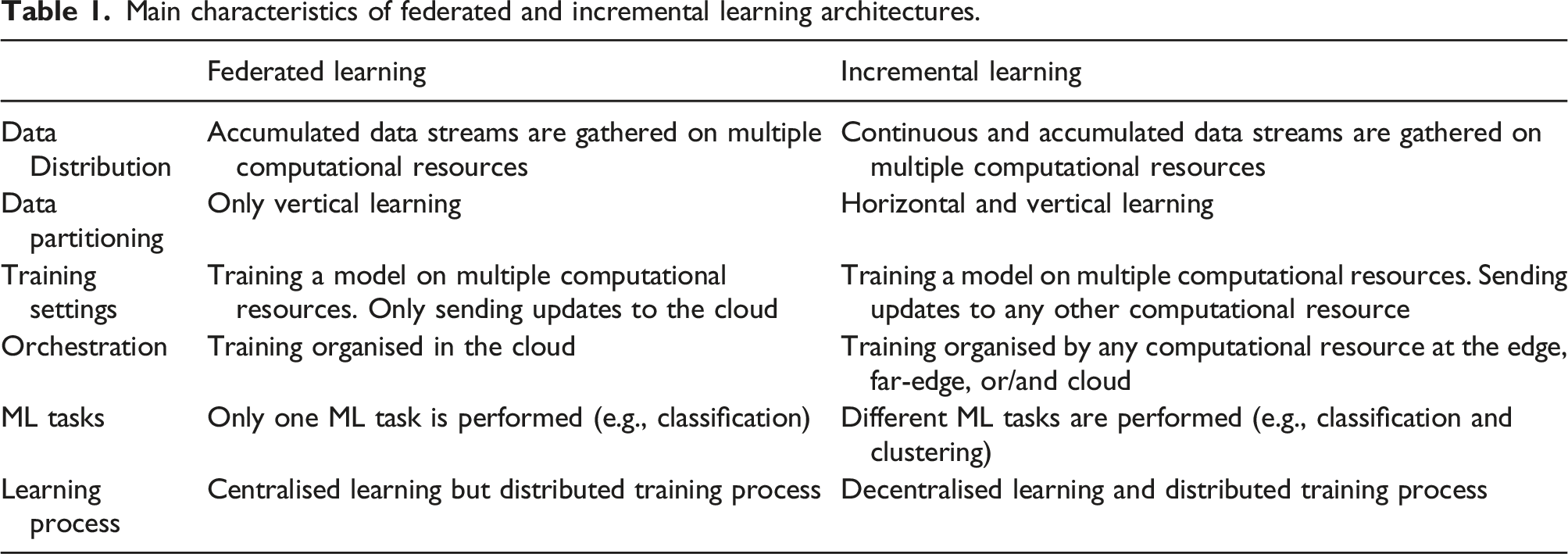
Incremental learning allows an ML model to continuously learn from new data without forgetting the previously acquired knowledge. One of the primary advantages of utilising incremental learning models is their ability to handle concept drift, which is crucial for maintaining accuracy over time and facilitating the generation of collective intelligent behavior in vertical IoT applications.
In contrast, federated learning is a distributed learning approach that enables multiple IoT devices or computing nodes to collaboratively train a global model while keeping their data locally. The result is a learning capability that allows the global model to learn from diverse data sources, making it adaptable to support collective intelligent behavior in horizontal IoT applications.
It is still premature to decide which learning architecture will prevail in the future. Human-oriented design and experimental machine learning data-driven approaches are the main paths to be explored when developing new horizontal IoT applications using these learning architectures. A holistic interdisciplinary perspective is needed to first identify which vertical sector needs have to be addressed, and then to combine these needs with communication technologies and machine learning models to amplify the potential for collective intelligence generation.
Vertical and horizontal IoT applications
There are many different vertical sectors adopting IoT applications. Personal IoT applications have been deployed in smart homes by allowing owners to have the ability to control appliances or devices around the house, and wearable devices are offering personal healthcare applications for monitoring physical activities. In general, they have shown a slow adoption trend in the last decade. In contrast, government and industrial IoT applications have been widely adopted, despite requiring a collaboration among many stakeholders. The leading vertical sectors in IoT applications are manufacturing/industrial, transportation/mobility, energy, retail, digital health, supply chain, and agriculture Scully (2020). This section reviews several potential vertical sectors and their best-suited IoT networks for adopting Intelligence Everywhere learning paradigms. They are the digital health, infrastructure, and transportation sectors.
Digital health sector
Communication technologies suited for wearable devices.
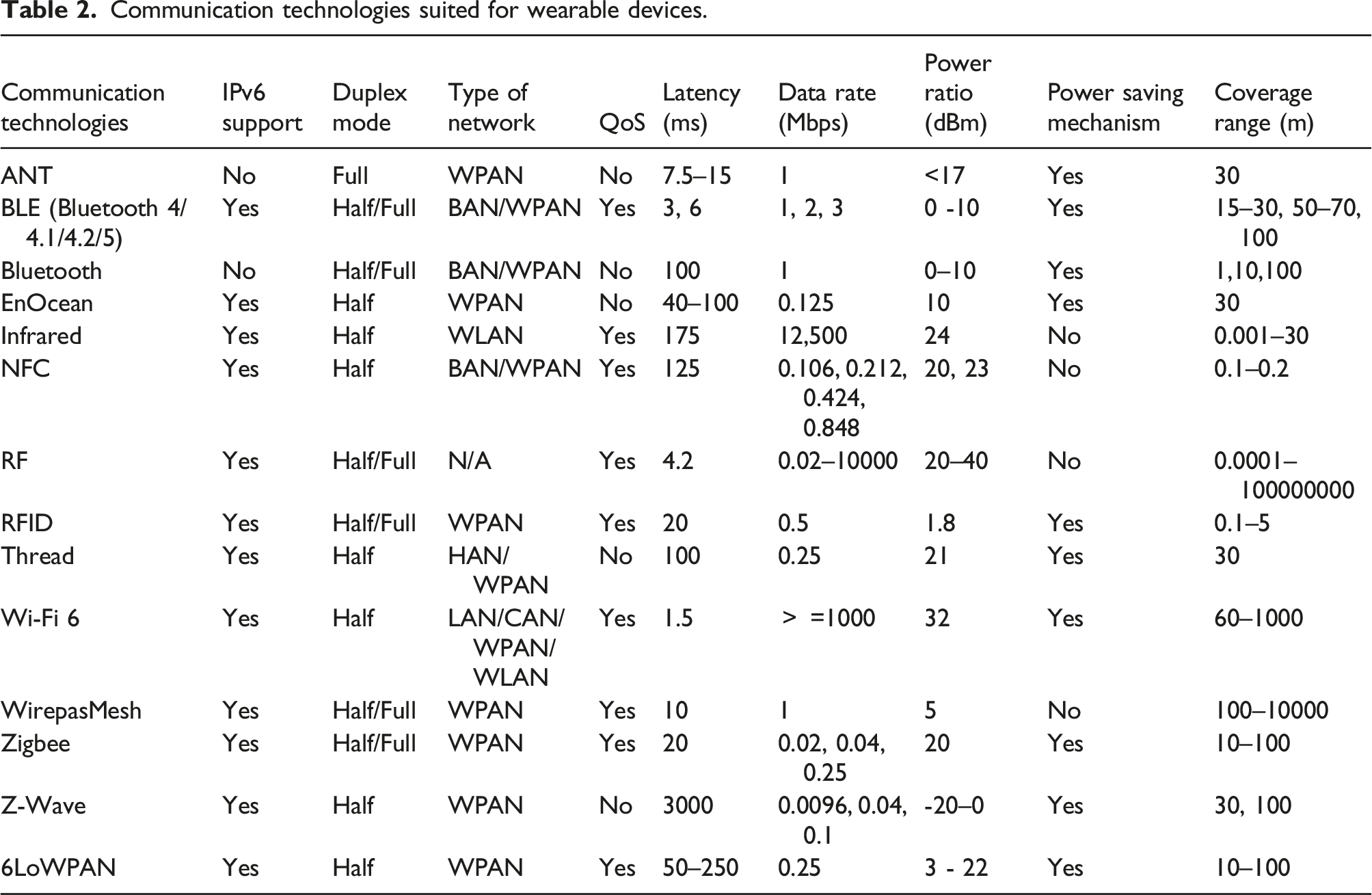
A typical communication scenario for IoT health applications can be found in a Body Area Network where EoG, ECG, and EMG sensors are attached in the form of a small chipset within wearable devices like smartwatches, wrist bands, smart shoes, clothes, or earbuds. Figure 2 shows a communication scenario for IoT health applications operating in BAN where EoG, ECG, and EMG sensors are attached in the form of a small chipset within wearable devices like smartwatches, wristbands, smart shoes, clothes, or earbuds. These gears sense, interact, and transfer data to the receiving devices through Bluetooth 5 and Wi-Fi 6. Bluetooth 5 works on 2.4GHz band with half/full-duplex mode of transmission and supports IPv6 and AES-128bit security. Moreover, through polling, it provides QoS with a minimum of 3ms latency and 3Mbps of data rate within a 100 m coverage area. Wi-Fi 6, and the integration of Wi-Fi 6 with IoT wearables, is one of the fastest-growing communication technologies because it brings kernel benefits to security, interoperability, flexibility, and improvement in data throughput. Communication scenario for IoT wearable applications.
Most IoT applications are currently focusing on monitoring continuous data streams coming from wearable sensors for activity recognition (Ige and Noor, 2022). The aim is to intuitively gather information about the behavior of users and engage them in healthy physical activities. Several ML techniques, such as one-class K-mean clustering, SVM, and CNN, are used for human/physical activity recognition. There is also a trend to analyze continuous data streams at the edge rather than in the cloud due to privacy issues (Cao and Wachowicz, 2019).
The adoption of wearables in IoT applications in the digital health sector has recently increased in light of the COVID-19 pandemic. We expect the demand for new IoT applications, such as wearable-enabled assistance, in response to increased care needs. Other applications, such as Aging in Place, where people will have the health and social support and services they need to live safely and independently in their homes and communities, will further highlight the importance of IoT technology. These applications will need to mimic learning that enables knowledge transfer from ML models and collective insights from federated and incremental learning mechanisms rather than sharing private wearable users’ data.
Infrastructure sector
Communication technologies suited for intelligent home applications.
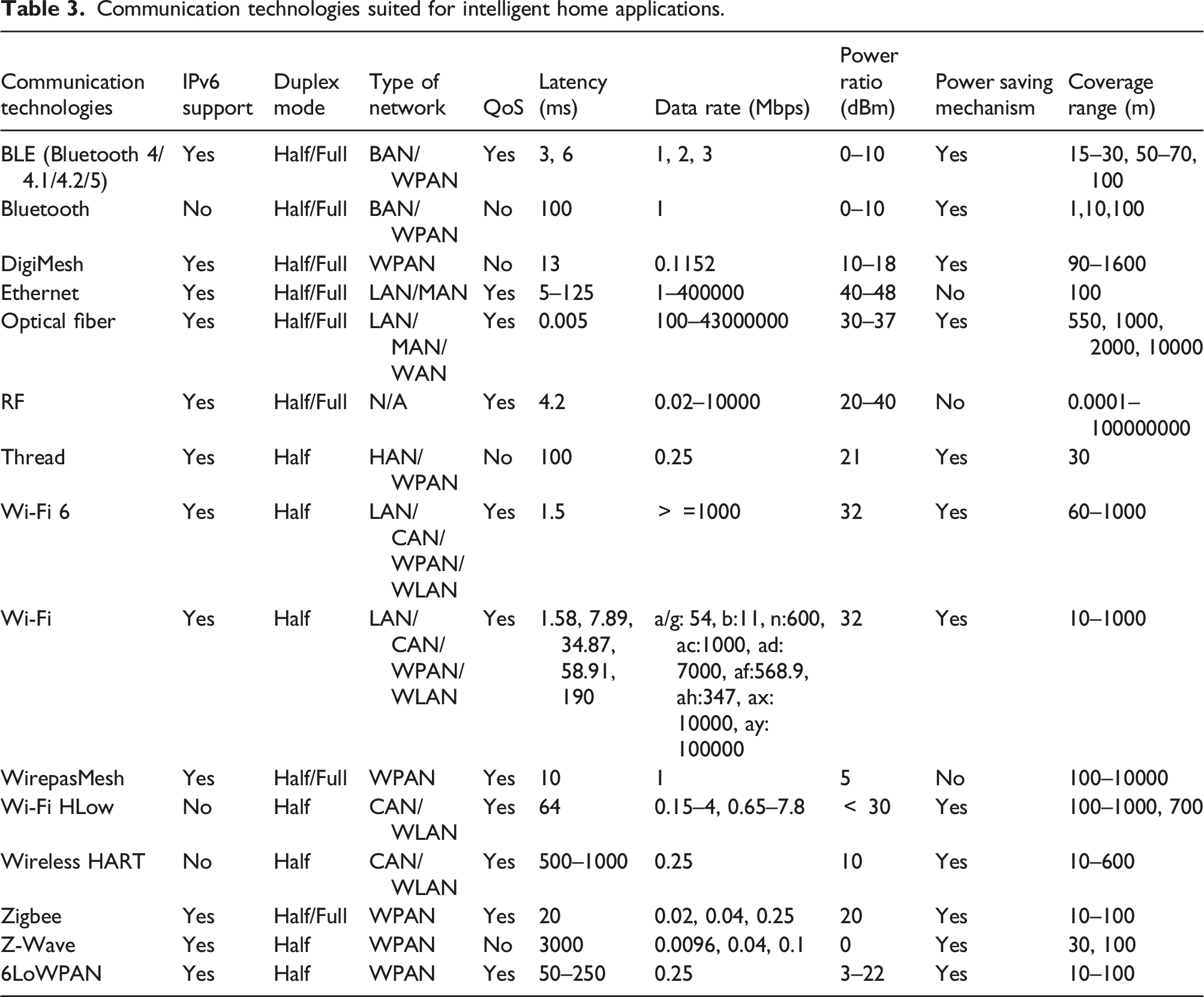
As an example of a medium-range intelligent home application, Figure 3 illustrates the communication technologies deployed in a HAN combined with the Analytics Everywhere framework to support automated analytical tasks. In intelligent homes, as in other IoT use cases, seamless connectivity is an important factor that gives users the flexibility to govern smart sensors from any location (Mao and Chang, 2023). Advanced communication tactics can minimise a smart device’s power consumption and augment its communication efficiency (Sovacool and Del Rio, 2020). Wi-Fi 6 and Wi-Fi 6E provide 1000Mbps of data rate with almost 1.5ms of negligible latency. Moreover, it uses a 6GHz band, which gives less interference compared to other technologies and provides excellent QoS with the help of mechanism like hybrid coordination function (HCF) which includes enhanced distributed channel access (for prioritised QoS services) and HCF controlled access (for parameterised QoS services). Communication scenario for intelligent home applications.
Federal Communication Commission (FCC) recently adopted a 6GHz band with new rules for unlicensed spectrum use. 6GHz spectrum has already been used by some licensed services (point-to-point microwave links, fixed satellite systems, etc.), which could increase the chance of harmful interference with unlicensed services (specifically outdoor operations). FCC permits unlicensed devices to operate at very low-power for indoor operations and at standard-power with automated frequency control (AFC) mechanism for outdoor operations across the 6GHz band in order to avoid collision with licensed services.
The key advantages of Wi-Fi 6 for IoT are TWT, dual carrier modulation (DCM), and the ability to offer lower bandwidth to IoT sensors (a single Resource Unit of 2MHz can be offered to provide 375 Kbps, which is ideal for IoT sensors). This effectively improves the link budget by 8 dB hence improving the range. Wi-Fi 6 is based on orthogonal frequency-division multiple access (OFDMA), allowing simultaneous sessions to transmit together using resource units and trigger frames. Considering all these facts, Wi-Fi 6 can potentially help in reaching the final goal of intelligent homes, which is to increase comfort and quality of life for intelligent home residents. In a HAN, accumulated and continuous IoT data streams from smart devices can normally be analyzed at the far-edge and cloud using an Analytics Everywhere framework (Cao et al., 2019). The insights from this process can support robbery detection, energy optimisation, and automated gardening.
Transportation/mobility sector
Communication technologies suited for IoV applications.
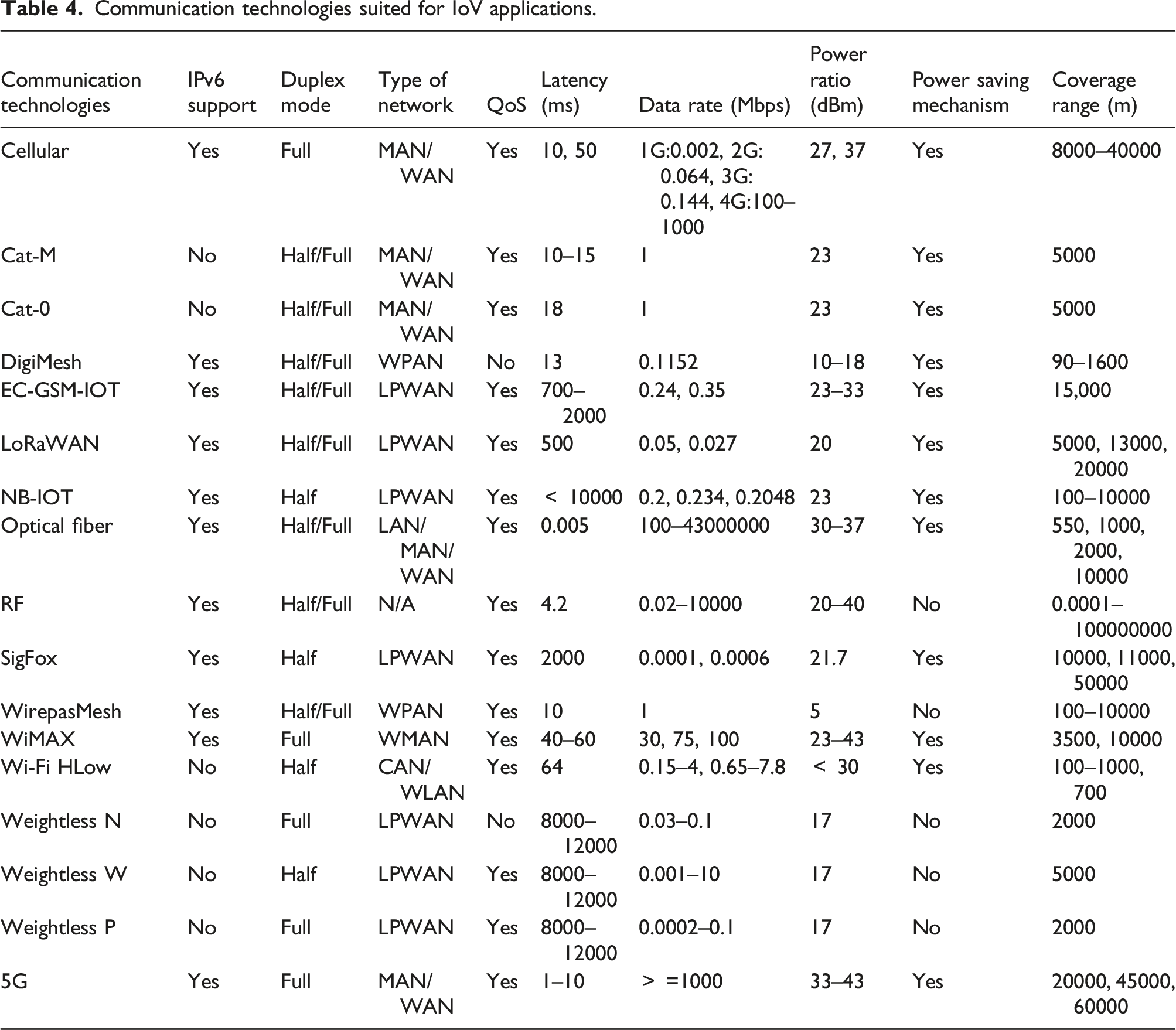
LoRaWAN follows a separate network architecture and, depending on the sensor node, requires a gateway to communicate with another endpoint, which usually is a star network topology (Miles et al., 2020). LoRaWAN supports 20–65km (dependent on many conditions e.g., spreading factor) of coverage range in a rural area with 13km of stable distance with a 500ms of latency. In contrast, SigFox has a higher latency of 2s in almost 50km of rural coverage area and 11km of stable range. In terms of data rate, LoRaWAN outperforms SigFox. In recent years, Weightless W has been one of the rarely used LPWAN communication technologies, though it has some advantages like maximum data rate and minimum power ratio among LPWAN protocols. However, LoRaWAN and SigFox seem to own the market in unlicensed spectrum. Therefore, the choice of communication technology relies on the type of IoT application being used.
5G paves the way for IoT with the highest connection density of 1 million devices/km2 compared to other communication technologies (Van Hilten and Wolfert, 2022). That such an immense number of devices could be able to communicate with the Internet within a given space is a gigantic step forward for an application like IoV. Figure 4 illustrates the networking within the context of IoV, where far-edge/near-edge/cloud computing continuum can support complex automated ML tasks. In an IoV application, 5G technology plays a pivotal role since it provides a special QoS for IoV called V2X QoS. It also provides more than 1000Mbps data rate and supports vehicle telematics, autonomous vehicles, and in-vehicle infotainment applications. In Cellular V2X (C-V2X), there are two interfaces: Uu (long-range cellular network communication) and PC5 (short-range, network-less, direct communication). The Uu utilises the 5G spectrum, while PC5 is short-range, similar to what was supported with DSRC (dedicated short-range communications). V2V, V2I, and V2P communications operate in ITS bands (e.g., 5.9GHz), which are independent of the cellular network, whereas V2N communication operates in mobile broadband licensed spectrums such as V2V, V2I, V2H, and V2X. Communication scenario for IoV applications.
Transportation is, in fact, a unique vertical sector because it is already adopting new universal architectures that rely on different communication networks to serve the needs of smart cities (Duan et al., 2020). However, the increasing number of moving smart vehicles with different speeds is already triggering problems in packet delivery to sink nodes, as well as packet delivery rate. This causes a ripple effect on the gathering of continuous data streams, the performance of ML tasks, and the development of future V2X applications.
Many ML algorithms have been proposed for smart transportation applications, including AdaBoost, Bayesian Network Seasonal Autoregressive Integrated Moving Average (BN-SARIMA), Coupled Hidden Markov Model (CHMM), Convolutional Neural Network (CNN) and Deep CNN (DCNN), and Decision Trees. Please refer to Zantalis et al. (2019) for an extensive review. With the Intelligence Everywhere learning paradigm, some of the aforementioned ML algorithms can easily be adapted to fit in federated learning and incremental learning mechanisms to provide better smart transportation applications. However, it is important to point out that the potential of V2X in developing new IoT applications serving the future needs of smart cities has not yet been fully investigated. Other network performance metrics (e.g., throughput, end-to-end delay, latency) also need to be investigated for developing innovative real-time IoV applications, taking into account the privacy and security attacks.
A vision for future horizontal IoT applications
IoT platforms have been developed globally to support different applications ranging from industrial/manufacturing and transportation/mobility to energy, healthcare, and supply chains. The current landscapes of IoT platforms highlight that most of them are focusing on specific sectors, also known as verticals (Scully, 2020). The current trend in IoT is moving towards the adoption of horizontal applications that span across different sectors, promoting interoperability in diverse IoT networks. These horizontal IoT applications will play a key role in supporting complex use cases involving multiple sectors simultaneously. For example, we might see a new IoT application ,that is, synergy in the healthcare and smart building sectors or an IoT application embedded in transportation/mobility, energy, and supply chain sectors.
As we are moving towards a Society 5.0 in the very near future Fukuda (2020), horizontal IoT applications will play a core role in transforming a large amount of streamed data across multiple vertical sectors into collective intelligence that can be made transferable, inter-connectable, and collectively create more value. Figure 5 depicts an example of a horizontal IoT application that crossed multi-vertical sectors, including digital health, infrastructure, and transportation sectors. Communication scenario for horizontal IoT applications.
We envisage that the collective intelligence obtained from the analytical activities or ML models in a vertical IoT application (i.e., digital health) can be re-used and transferred to other vertical IoT applications (i.e., infrastructure or transportation) as input information for other analytical activities or other ML models. For example, through the concept of collective intelligence, health analytics information of the home/building users is learned at the edge and transmitted to the cloud, where it is aggregated and processed to optimise the home/building environment, leading to improved health outcomes for the users.
Simultaneously, the knowledge gained from the smart home/building sector is fed back to the users at the edge, enhancing their awareness of other issues, such as energy optimisation and behavior changes, fostering a more sustainable and energy-efficient home/building ecosystem. The collective intelligence system continually learns from data gathered across multiple homes/buildings and user interactions. This ongoing learning process enables the system to improve its recommendations and responses over time, enhancing the overall effectiveness and intelligence of the IoT networks.
From the Intelligence Everywhere perspective, data and insights can traverse through multiple vertical applications using a well-defined data life-cycle and the IoT networks outlined in Tables 2, 3, and 4. Learning capability and analytical capability can assist developers in providing a mix of applications in which analytical results from the digital health sector or transportation can be used/transferred as the input for the smart home/building and vice versa.
Challenges and opportunities
In this section, we have identified the open challenges and opportunities to achieving an Intelligence Everywhere learning paradigm. This list is not meant to be exhaustive, but it gives an indication of topics for future research and development.
Challenges
A large number of important questions remain open on the topics of security, privacy, scalability, compatibility, reliability, and resilience. They are explained in more detail below. • • • • • •
Opportunities
At the same time, new opportunities emerge in the fields of infrastructure supervision and context awareness. • • •
Conclusions
In the fast-paced development of the Internet of Things, the importance of collective intelligence becomes evident as communication networks evolve from their traditional role of connecting “things” to becoming vehicles for creating and transferring valuable “insights.” Embracing this vision, this article introduces the Intelligence Everywhere learning paradigm, emphasising its four core capabilities: resource, analytical, learning, and data life-cycle capabilities. By focusing on these capabilities, the aim is to assist developers in building new platforms that not only enhance existing vertical IoT applications but also envision and pave the way for pioneering horizontal IoT applications. The incorporation of collective intelligence through the Intelligence Everywhere paradigm empowers IoT networks to harness the collaborative potential of diverse devices, systems, and users, ultimately leading to more intelligent and innovative IoT applications that address complex challenges and foster seamless interoperability across multiple domains.
We have identified the state-of-the-art in IoT networking and machine learning from a data scientist perspective, which has culminated into a collection of open challenges and opportunities. However, it is important to point out that achieving an Intelligence Everywhere learning paradigm can only be successful if users actually feel safe in an intelligent society, and know exactly what is happening with their data.
Footnotes
Acknowledgments
Declaration of conflicting interests
Funding
ORCID iD
