







Abstract
1. Introduction
Mathematics education in secondary school has been extensively researched due to its pivotal role in shaping students’ future STEM learning, critical thinking, and problem-solving skills (Boaler, 2022; Dweck, 2006; National Mathematics Advisory Panel, 2008). A range of factors influence middle school students’ mathematics achievement, including parental involvement, teacher quality, peer influence, and, most notably, individual mindset and work habits (Dweck, 2006). Prior research has explored key personal attributes such as self-concept, self-efficacy, and grit in mathematics learning. However, two critical gaps remain in the literature. First, self-concept, self-efficacy, and grit are often studied in isolation, with limited research examining their interactive and collective effects (e.g., Cai et al., 2024; Cvencek et al., 2015; Rost & Feng, 2024; Usher et al., 2019; Usher & Pajares, 2009; Yang, 2023). Second, findings on their role in gender differences in mathematics achievement remain inconsistent (e.g., Huang, 2013; Louis & Mistele, 2012; Rodriguez et al., 2020; Usher et al., 2019; Wang & Yu, 2023).
This study seeks to address these gaps by analyzing secondary data from an international study of middle school mathematics education. Specifically, it aims to answer the following research questions: Do boys and girls differ significantly in their mathematics achievement, and how do self-concept, self-efficacy, and grit interplay and contribute to potential gender disparities in mathematics performance? Guided by the literature, the relationships between these variables and students’ mathematical performance are presented in a structural equation model (SEM) diagram. The SEM models are compared between girls and boys, with parental education included as a control variable, given that parental involvement may either mitigate or amplify gender disparities in mathematics achievement (Giofrè et al., 2020; Kaiser & Zhu, 2022).
Both the data and the advanced statistical analysis enabled us to achieve the objective of this study: to gain a better understanding of the dynamics underlying gender differences in mathematics achievement, including girls’ lower confidence in their quantitative abilities and their reduced likelihood of pursuing advanced STEM coursework—despite evidence that boys and girls perform comparably in mathematics during middle school (Hyde et al., 2008).
2. Review of literature
Voluminous research is available concerning underlying causes contributing to middle school students’ mathematical achievement, as well as the gender differences therein. Understanding the factors that contribute to mathematics achievement requires an examination of closely related psychological constructs such as self-concept, and self-efficacy, and grit. These constructs, both independently and in interaction, shape students’ mindsets and work habits and shed light on how boys and girls engage with and excel in mathematics. To set a foundation for the current study, we focus the review on literature discussing the influences of these psychological factors on students’ mathematical performance, as well as related gender differences. The review below synthesizes the main research findings on these constructs by highlighting their individual and collective roles in mathematics achievement, while identifying gaps that warrant further exploration.
2.1 Self-concept and mathematics achievement
Self-concept, or an individual's perception of their competence in specific domains, is a well-established predictor of academic success (Bandura, 1997; Passiatore et al., 2024). In the context of mathematics, self-concept refers to students’ perceptions of their mathematical abilities and their self-identification with the subject. Prior research shows that mathematics self-concept in early grades significantly predicts later achievement, whereas declines in self-concept during middle school are associated with diminished performance (Shanley et al., 2019). In fact, compared with other psychosocial factors, mathematics self-concept has been shown to be a particularly strong predictor of achievement. A study by Rost and Feng (2024) demonstrated that self-concept accounts for a significant proportion of the variance in mathematics grades, outperforming constructs such as perseverance and conscientiousness in predictive strength.
Notably, boys generally report higher mathematics self-concept than girls, a disparity often attributed to societal stereotypes that associate mathematics with masculinity (Cvencek et al., 2015). Such stereotypes shape implicit beliefs, leading boys to associate mathematics with themselves more strongly than girls, even in early education. Cross-cultural research further highlights the variability in self-concept. Asian students, despite excelling in mathematics, were found to have lower self-concept compared to their Western peers, a pattern reflective of cultural modesty biases (Chiu, 2017). Together, these findings suggest that the relationship between self-concept and achievement is shaped not only by individual ability but also by broader sociocultural contexts.
2.2 Self-efficacy: A key determinant of mathematics success
Self-efficacy, defined as an individual's confidence in their ability to succeed in a specific task or domain, plays a crucial role in academic achievement (Bandura, 1997). Unlike self-concept, which reflects a more generalized perception of competence, self-efficacy is primarily shaped by task-specific experiences and mastery learning (Bandura, 1997; Luo et al., 2021; Rittmayer & Beier, 2008). In mathematics, self-efficacy has been identified as a significant predictor of achievement. Yang (2023) demonstrated that self-efficacy explains substantial variance in mathematics performance across grade levels, with large effect sizes. Moreover, self-efficacy moderates the relationship between motivation, persistence, and achievement, as shown by Cai et al. (2024). Despite these findings, relatively few studies have explored self-efficacy in interaction with other psychological traits such as grit and self-concept in predicting mathematics outcomes.
2.3 Grit and mathematics achievement
Grit, defined by Duckworth et al. (2007) as comprising perseverance of effort (PE) and consistency of interest (CI), has been widely studied in relation to academic success. Perseverance of effort reflects sustained effort toward long-term goals, while CI represents a stable commitment to interests over time. Duckworth and Quinn (2009) developed the Short Grit Scale, finding that grit predicts grade point average among adolescents. However, evidence suggests that PE is a stronger predictor than CI in academic contexts (Bowman et al., 2015; Datu et al., 2016; Jiang et al., 2019). For instance, Jiang et al. (2019) found reciprocal relationships between PE and academic achievement among Chinese elementary students, whereas CI showed limited predictive validity. Similarly, Bowman et al. (2015) and Sturman and Zappala-Piemme (2017) reported that PE is a stronger predictor of educational outcomes, with CI contributing minimally to standardized test performance.
Concerns about grit's incremental utility remain. Credé et al. (2017) argued that grit's association with academic performance is largely explained by conscientiousness, a well-established personality trait with similar characteristics. Additionally, Steinmayr et al. (2018) found that grit's predictive power diminishes when controlling for self-efficacy and prior achievement. Their findings suggest that grit may not add substantial explanatory value to models of mathematics performance when other cognitive and motivational factors are accounted for. These results challenge the notion of grit as a stand-alone determinant of academic success, particularly in mathematics, where self-concept and self-efficacy may play more significant roles.
2.4 Interplay of self-concept, self-efficacy, and grit
While extensive research supports the independent influence of self-concept, self-efficacy, and grit on mathematics achievement, their interrelations remain insufficiently explored. Theoretically, self-concept is a more general and stable construct than self-efficacy, yet the two are strongly interconnected. Arens et al. (2022) demonstrated that prior self-concept predicts subsequent self-efficacy, which, in turn, influences academic achievement. Similarly, Parker et al. (2017) underscored the importance of integrating these constructs, finding that both self-concept and self-efficacy independently predict long-term academic outcomes, with self-efficacy playing a more pronounced role in mathematics-specific contexts.
In contrast, the potential role of grit in these relationships remains underexamined. Some studies suggest that perseverance may support the development of self-concept and self-efficacy. For instance, Usher et al. (2019) found that self-efficacy mediates the relationship between grit and academic performance, indicating that perseverance enhances achievement through strengthened self-belief. However, other findings (e.g., Duckworth & Quinn, 2009; Usher & Pajares, 2009) suggest a more dynamic interplay among these constructs, wherein the impact of self-concept and self-efficacy on academic performance may be amplified by students’ perseverance so that students with higher self-concept and self-efficacy are more likely to persist in challenging tasks and demonstrate greater perseverance. The findings suggest those psychological factors are interconnected rather than functioning in isolation.
2.5 Gender-related differences in mathematics achievement
Existing research generally supports the notion of gender disparity in mathematics favoring boys; however, the extent and consistency of this advantage remain subjects of debate. While evidence suggests that boys tend to outperform girls, particularly at higher performance levels, findings vary across contexts. Large-scale studies, such as those by Lu et al. (2023), indicate significant gender differences favoring males, even after accounting for reading proficiency—a domain where females typically excel. Analyzing data from 79 countries, Lu et al. found that these disparities persist across diverse educational settings. Similarly, Keller et al. (2022) reported a global overrepresentation of males among top-performing students, with a female-to-male ratio of approximately 1:1.5 among high achievers. Their findings also highlight the role of self-efficacy, as male students consistently report greater confidence in their mathematical abilities, which likely contributes to their prevalence among top performers. The research in general suggests that self-perception plays a dynamic role in shaping gender disparities in mathematics learning and achievement.
Despite these overarching trends, exceptions provide valuable insights. For example, Rodriguez et al. (2020) found no significant gender differences in mathematics achievement among primary school students in Spain. Nonetheless, Spanish girls exhibited lower confidence in their mathematical abilities despite performing at comparable levels to boys, underscoring the potential influence of self-efficacy. Subject-specific analyses further reveal the complexity of gender disparities. Louis and Mistele (2012), drawing on data from the 2007 Trends in International Mathematics and Science Study, found that while males outperform females in some mathematical domains, females excel in algebra when self-efficacy is accounted for. These findings emphasize the need to examine gender differences within specific mathematical subfields rather than treating mathematics as a monolithic subject.
The common trend in literature points to disparities in the critical psychological factors including self-concept and self-efficacy as contributors to gender differences in mathematical performance. The differences in self-concept are particularly evident not only in mathematics, but in mathematics-intensive fields in general. According to Wang and Yu (2023), the weaker level of girls’ self-concept partially explains why they are less likely to pursue mathematics-intensive subjects despite comparable ability levels; importantly, their research also shows that interventions aimed at enhancing this self-concept improve both confidence and performance, underscoring its key role in promoting gender equity in STEM.
Gender differences in self-efficacy are also well-documented, with boys consistently reporting higher mathematics self-efficacy than girls. This pattern is supported by meta-analyses such as Huang (2013) and large-scale studies like Rodriguez et al. (2020), which found that gender gaps in self-efficacy become particularly pronounced during adolescence—a critical period for shaping long-term academic trajectories. Louis and Mistele (2012) further demonstrated that lower self-efficacy among girls partially accounts for their underrepresentation in mathematics-intensive fields. These disparities underscore self-efficacy's pivotal role in shaping gender differences in mathematics achievement and suggest that interventions aimed at strengthening self-efficacy, particularly among girls, could serve as a key strategy in reducing gender gaps in STEM participation.
Gender differences in grit further complicate its role in mathematics achievement. Yeung (2011) found that boys score lower than girls in perseverance during primary school, though this gap narrows in secondary grades. Such variations suggest that grit's influence on gender disparities in mathematics achievement may be context-dependent and shaped by additional constructs, including self-efficacy and self-concept. Moreover, Usher et al. (2019) demonstrated that grit's impact on academic outcomes is mediated by self-efficacy. These findings highlight the need to examine grit in conjunction with other psychological constructs to develop a more comprehensive understanding of gender differences in mathematics achievement. Overall, the role of psychological factors other than self-efficacy in shaping gender differences in mathematics achievement remains insufficiently explored.
It is important to note that contextual and societal factors also shape gender disparities in mathematics performance. Studies from Shanghai (Kaiser & Zhu, 2022) and Italy (Giofrè et al., 2020) demonstrate how family background, school structures, and regional disparities contribute to these differences. For instance, Giofrè et al. observed that gender gaps widened from primary to middle school, particularly in economically advanced northern regions of Italy. These findings indicate that cultural norms, resource distribution, and parental involvement can either mitigate or amplify gender disparities in mathematics achievement.
2.6 A theoretical perspective
Extant literature not only identifies self-concept, self-efficacy, and grit as the key aspects of students’ mindsets and work habits but also leaves conceptual and empirical inconsistencies about how they collectively contributed to mathematical performance of middle school students, particularly gender-related differences in this regard. To further investigate how self-concept, self-efficacy, and grit jointly contribute to mathematics learning, this study adopts Bandura's social cognitive theory (SCT; 1986, 1997) as a guiding framework. Social cognitive theory posits that human behavior results from the dynamic interplay of personal, behavioral, and environmental influences. Two key concepts in SCT, self-concept and self-efficacy play a crucial role in students’ perseverance and academic achievement. While Bandura (1986) did not explicitly use the term
In summary, within Bandura's framework, grit can be understood as a product of self-efficacy and self-concept via the process of self-regulation. Students who believe they can succeed (high self-efficacy) set goals and monitor themselves (self-regulation); students with a strong self-concept and high self-efficacy are more likely to develop adaptive learning behaviors, leading to sustained effort and resilience in the face of academic challenges (Bandura, 1997). These factors contribute to a feedback loop, where successful experiences enhance self-beliefs, further reinforcing perseverance and academic success (Usher & Pajares, 2009).
2.7 Research objectives to address existing gaps
Our review of the literature reveals critical gaps that warrant further exploration. That is, most existing studies examine self-concept, self-efficacy, and grit as isolated constructs, often neglecting their interactive and cumulative impacts on academic performance. This fragmented approach limits a comprehensive understanding of how these factors work together to shape gender disparities in mathematics achievement.
To address these gaps, this study proposes a causal model (Figure 1) based on Bandura's SCT to examine how self-concept, self-efficacy, and grit contribute to students’ mathematics learning and gender differences therein. Specifically, we hypothesize that self-concept and self-efficacy influence mathematics achievement both directly and through the mediating role of grit. Furthermore, it is hypothesized that the influences of self-concept, self-efficacy, and grit on learning outcomes remain significant even after controlling prior academic performance. Recognizing that children's self-perceptions and learning habits are shaped by their immediate environment (Giofrè et al., 2020; Kaiser & Zhu, 2022), we also include parental education levels in the model. The overarching goal of this study is to bridge the gap by systematically investigating how self-concept, self-efficacy, and grit interact and contribute to boys’ and girls’ mathematics performance differently. Specifically, the study seeks to answer the following research questions:
Is there a significant difference in mathematics self-concept, self-efficacy, grit, and achievement between boys and girls? How do self-concept, self-efficacy, and grit contribute to students’ mathematics achievement, controlling pretest scores? To what extent are self-concept, self-efficacy, and grit linked to gender-related differences in mathematics performance individually and collectively?
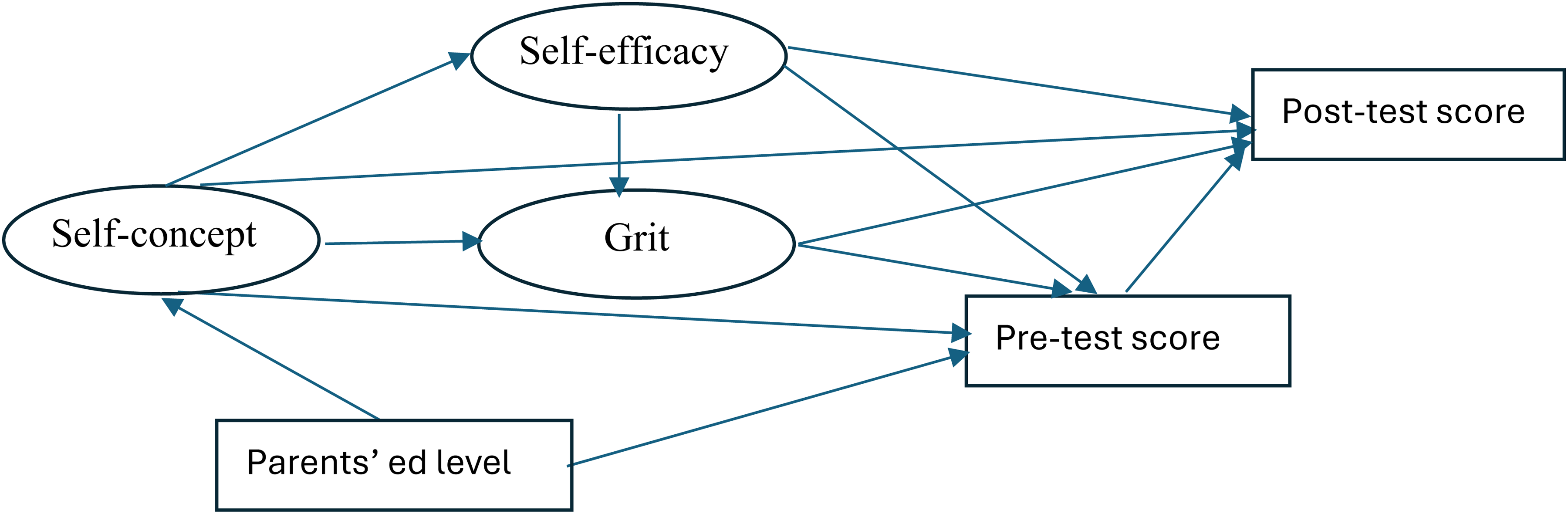
The conceptual model.
3. Methods
3.1 Data source and sample
This study utilized data from the Global Teaching Insights (GTI) study (OECD, 2019), a large-scale research initiative designed to examine mathematics teachers’ instructional practices and student learning outcomes in secondary education (Opfer et al., 2020). Conducted in collaboration with eight OECD member countries and partner economies, the GTI study collected data between 2016 and 2020 on the teaching of quadratic equations, a foundational topic in secondary mathematics curricula across participating regions. The purposeful selection of this mathematical topic allowed for cross-national comparisons of instructional approaches and student learning patterns.
To minimize contextual and societal differences, such as cultural norms and resource distribution, this study focused on a subsample of GTI data comprising middle school students from Shanghai, China. In Shanghai, quadratic equations are introduced in the eighth grade, making this sample particularly relevant for examining mathematics learning at a critical developmental stage. The final sample consisted of 2592 students taught by 85 teachers across 85 schools.
3.2 Instruments
The GTI study employed multiple instruments, including pre- and postquestionnaires for both students and teachers. The student prequestionnaire, administered prior to instruction on quadratic equations, collected background information and assessed learning-related factors. The student postquestionnaire, distributed at the end of the instructional period, gathered data on students’ learning experiences and perceptions of teaching. Additionally, the GTI study incorporated a pretest and posttest to assess students’ mathematical proficiency. The pretest, conducted within two weeks before the instructional unit, included 30 items measuring students’ general mathematics knowledge. Examples include multiple-choices questions such as “A square with side lengths of x + 2 centimeters is shown in the figure. What is the area of the square, in square centimeters?” and “What is 1092 as a product of prime numbers?” The posttest, administered within two weeks after instruction, consisted of 25 items evaluating students’ mastery of quadratic equations (Praetorius et al., 2020). Examples include multiple-choices questions such as “What are the solutions of the quadratic equation (
A parallel set of pre- and postinstruction questionnaires was administered to teachers to collect data on their backgrounds and teaching practices. However, the present study exclusively utilized student data to investigate the relationships among self-concept, self-efficacy, grit, and mathematics achievement.
3.3 Variables
The conceptual model in this study includes six key factors, three of which are latent constructs: self-concept, self-efficacy, and grit. The GTI student prequestionnaire provided validated scales for these constructs. Specifically: (1) Self-concept in mathematics was measured using a six-item scale (SQA06A–SQA06F, Cronbach's α = 0.913); (2) Self-efficacy in mathematics was assessed using a 10-item scale (SQA16A2–SQA16J2, Cronbach's α = 0.922); and (3) Grit, operationalized as perseverance, was measured with a four-item scale assessing students’ effort and persistence in mathematics (SQA09A–SQA09D, Cronbach's α = 0.866). Given prior findings (Datu et al., 2016; Duckworth & Quinn, 2009; Jiang et al., 2019; Sturman & Zappala-Piemme, 2017) indicating that perseverance better predicts academic achievement than CI, this study conceptualized grit as perseverance.
Additionally, parental education level was included as a control variable, operationalized as the highest level of education attained by either parent. Students’ total scores on the pretest and posttest served as indicators of mathematics achievement, enabling an assessment of learning progress. Descriptive statistics for all study variables, disaggregated by gender, are presented in Table 1.
Descriptive Information of All the Variables by Gender.

Items displayed in bold font indicate statistically significant gender differences at the
3.4 Analytical procedures
The analysis proceeded in several stages. First, descriptive statistics were computed to examine distributions and identify potential gender differences in mathematical learning outcomes. Given the large sample size, inferential tests of gender differences were conducted at a significance level of
Model fit was assessed using the following criteria: χ² value, Standardized Root Mean Square Residual (SRMR < .08), Root Mean Square Error of Approximation (RMSEA < .06), and Comparative Fit Index (CFI > .95). For the comparison of models between boys and girls, we followed the guidelines summarized by Cheung and Rensvold (2002). What we are interested in testing are factor loading differences (item-level metric invariance) and structural path coefficient differences (equivalence of construct covariance). Since the SEM models for boys and girls shared an identical structure, meaning that there is no configural difference, we plan to use model χ2, CFI, and RMSEA in the invariance tests between models (Cheung & Rensvold, 2002). A multigroup comparison enabled an in-depth examination of gender differences in the relationships between self-concept, self-efficacy, grit, and mathematics achievement.
4. Results
Table 1 presents the descriptive statistics of students’ self-concept, self-efficacy, perseverance, pretest scores, posttest scores, and parental education levels. With the exception of posttest scores, all variables were measured before the instructional period on quadratic equations. Items displayed in
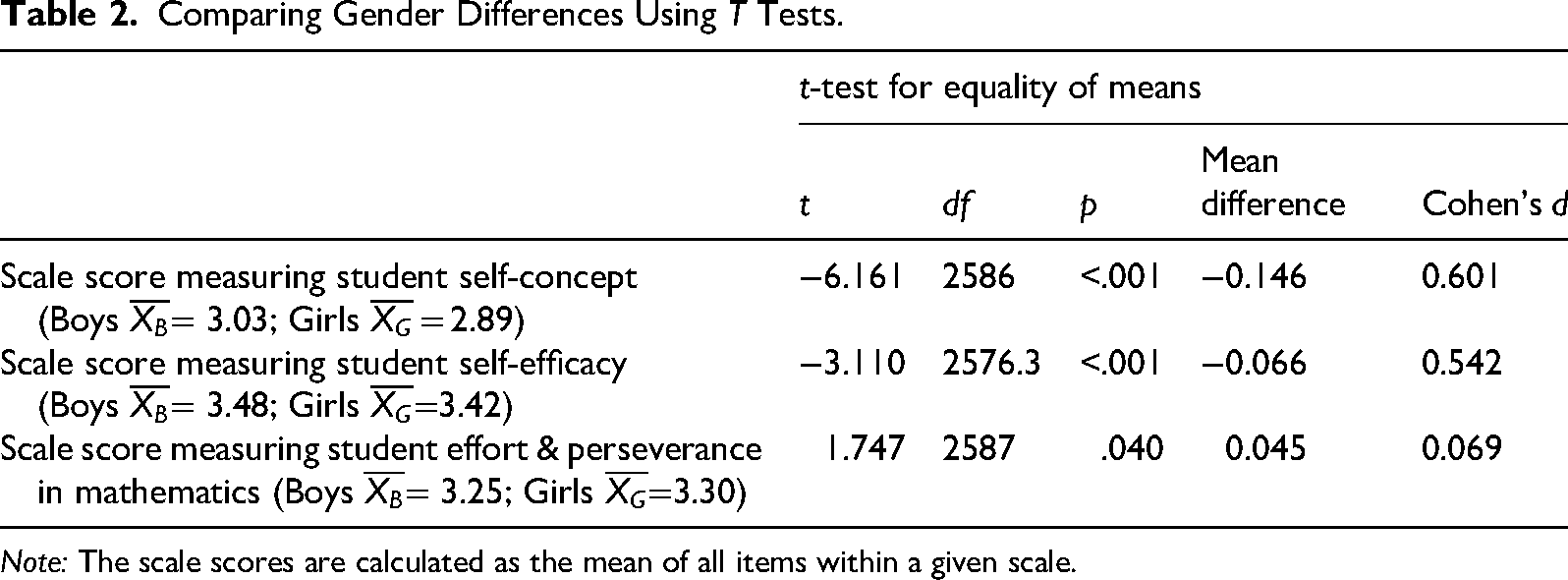
To further validate these differences, independent-samples
Comparing Gender Differences Using
4.1 Measurement model comparison
As discussed previously, the measurement model included three observed variables—parents’ education level, student pretest scores, and posttest scores—each represented by a single indicator. In contrast, mathematics self-concept, self-efficacy, and perseverance were modeled as latent constructs with multiple indicators. Descriptive statistics for all measured variables are presented in Table 3 (bivariate correlations available upon request).
Variables in the SEM Models: Descriptive Information and Factor Loadings.
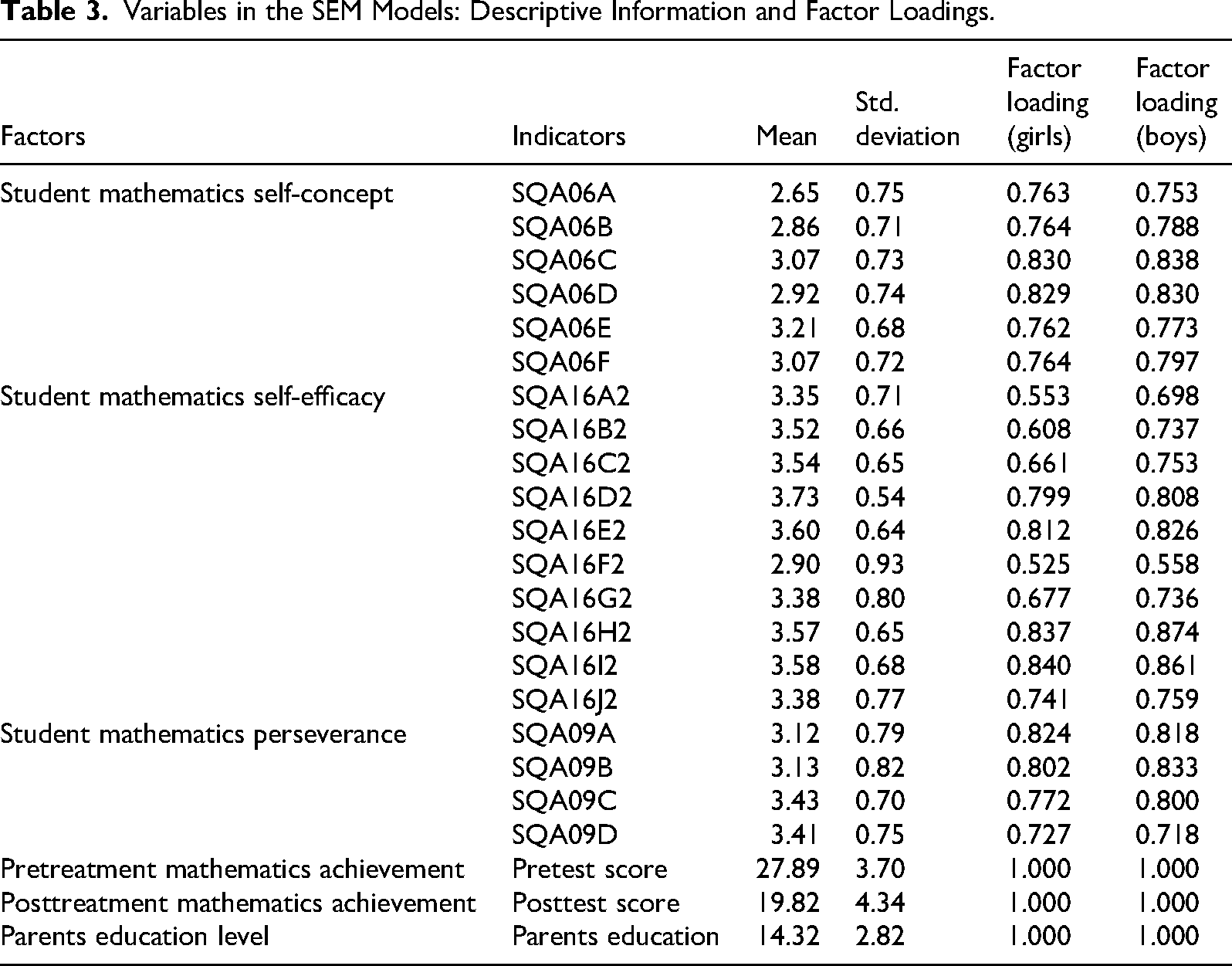
The initial test of the measurement model showed a fair fit for both boys and girls as separate groups. This allowed the data to be combined for comparison between unconstrained and constrained models. As presented in Table 4, the initial unconstrained measurement model demonstrated acceptable fit indices, though the model χ² value was high. To improve the fit, modification indices were examined, leading to the inclusion of several correlated error variances for items from the same instrument. These adjustments significantly reduced the model χ² value by more than 56% (≈1755.85) and improved other fit indices as well.
SEM Model Fit Indices.

Next, a constrained measurement model was used to test item-level metric invariance by setting all corresponding factor loadings equal between boys and girls. The overall model fit indices of the test of item-level metric invariance remained largely unchanged, except for a significant increase in the χ² value (
4.2 Structural model evaluation
Following the measurement model assessment, the structural model was tested separately for boys and girls, both demonstrating acceptable fit. The two models were then combined to examine equivalence of construct covariance using an unconstrained and a constrained structural model. As presented in Table 4, the unconstrained model showed very good fit indices, whereas the constrained model, which required all unstandardized path coefficients to be equal between genders, exhibited worsened fit indices and a 30% increase in model χ² value. These differences indicated significant gender-based variations in path coefficients and equivalence of construct covariance was not supported.
To identify the specific paths contributing to these differences, modification indices were examined, and constraints were released step by step based on their impact on χ² reduction. The following five constraints were freed in this order: (1) the path from self-efficacy to pretest score; (2) the path from self-concept to self-efficacy; (3) the path from perseverance to posttest score; (4) the path from self-concept to posttest score; and (5) the path from self-concept to perseverance. After these adjustments, the model fit indices were almost resemblant to the unconstrained model (normed χ² = 3.28; CFI = 0.964; and RMSEA = 0.042), supporting the decision to release these constraints while keeping the others fixed. The standardized path coefficients for boys and girls are illustrated in Figure 2 for a direct comparison.

The final structural model with standard path coefficients (girls/boys).
4.3 Major findings
A comprehensive summary of the factors influencing posttest scores is presented in Table 5, which details the direct, indirect, and total effects of the factor relationships in standardized values for comparative analysis. Note here that the term “effect” is a statistical terminology and may not necessarily imply causality. Given the limited duration of the intervention, it is not surprising that pretest scores emerged as the strongest predictor of posttest performance. Mathematics self-concept and self-efficacy were found to be strongly correlated, both contributing positively to students’ perseverance in mathematics-related tasks. Even when controlling pretest scores, mathematics self-concept and self-efficacy remained significant predictors of posttest scores. The effects of self-concept and self-efficacy on posttest performance were both direct and indirect, with self-efficacy having a more pronounced indirect effect and self-concept exerting a stronger direct influence. This distinction is attributed to the fact that both self-concept and self-efficacy impacted pretest scores and perseverance, which in turn significantly influenced posttest performance.
Summary of Direct Effects, Indirect Effects, and Total Effects in the SEM Models.
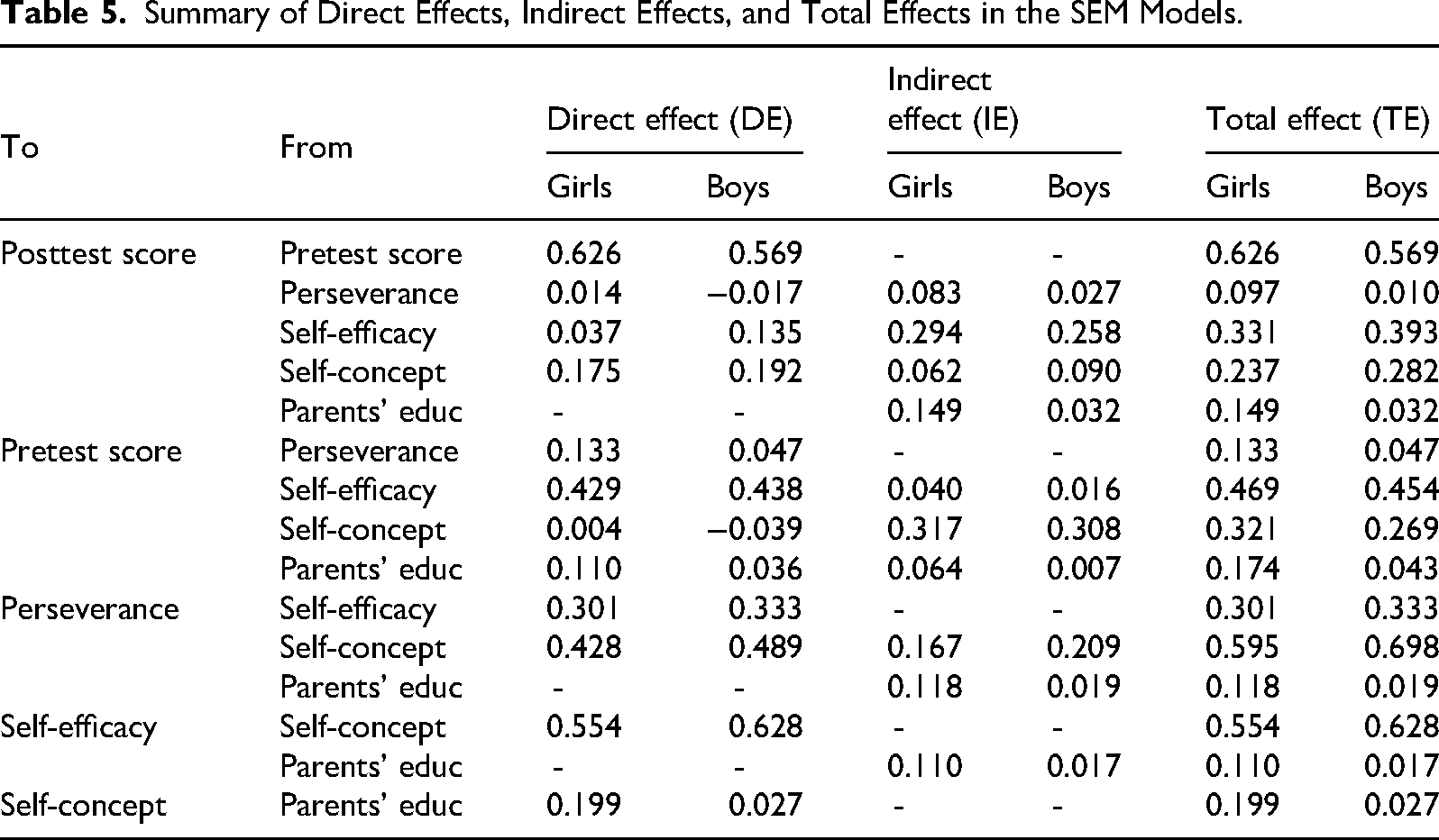
The results indicate that self-concept, self-efficacy, and perseverance work differently for boys and girls in math learning. It may appear that both mathematics self-concept (
Perseverance was positively related to both self-concept and self-efficacy, and such relationships were stronger for boys than for girls. That is, how self-concept and self-efficacy influences students’ mathematical learning is complicated by perseverance, and the observed relationships vary between boys and girls. Although the total effect of perseverance on posttest scores was much greater for girls than for boys, the direct effect was minimal for both genders. Also, the influence of perseverance on students’ posttest performance was notably smaller than that of pretest scores, self-concept, and self-efficacy.
Another gender-dependent factor with a notable impact on students’ mathematical performance was parents’ education level, which was associated with girls’ pretest and posttest scores indirectly through its effects on self-concept (
5. Discussion and implications
In this section, we discuss findings from the above analyses in relation to existing literature. Data from 2592 students across 85 middle schools in Shanghai, China, were analyzed. Their scores on both the pretest and posttest do not support the notion that girls underperform boys in mathematics. On the 30-item pretest, which measured students’ mastery of general mathematics knowledge, girls scored slightly higher than boys, although the difference was less than half a point. On the 25-item posttest, which assessed students’ mastery of quadratic equations, girls again outperformed boys, with an advantage of approximately two-thirds of a point—a statistically significant difference given the large sample size. The lack of gender differences in math performance contrasts with substantial evidence in the literature suggesting a male advantage in mathematics (Kaiser & Zhu, 2022; Keller et al., 2022; Liu et al., 2020; Lu et al., 2023). Given the rigorous design of this international project and the high quality of the data collection instruments, our findings provide strong evidence supporting the mathematical abilities of middle school girls. Furthermore, the inconsistency between our results and the prevailing view of male superiority in math achievement may serve as another piece of evidence suggesting that gender disparities in mathematics are subject-specific and age-dependent (Louis & Mistele, 2012; Yeung, 2011).
5.1 The effects of self-concept and self-efficacy
A unique aspect of our findings is that, despite the overall lack of gender differences in math achievement, significant differences exist in the underlying dynamics of contributing factors. Even after controlling preintervention math scores, both math self-concept and self-efficacy significantly influenced posttest scores through direct and indirect pathways (mediated by perseverance and pretest scores). Notably, self-efficacy exerted a stronger indirect effect, while self-concept had a more pronounced direct effect. Consistent with the theoretical framework of social cognitive theory (Bandura, 1986, 1997), math self-concept and self-efficacy were strongly related, and both showed positive association with students’ perseverance in mathematical tasks. Our findings align with Arens et al. (2022), who concluded that prior self-concept predicts subsequent self-efficacy, which in turn affects student achievement. However, our results diverge from those of Rost and Feng (2024), who emphasized that self-concept is a stronger predictor of academic performance than other psychosocial factors. This difference may be attributed to two key factors. First, our study incorporated a broader range of variables, offering a more comprehensive model of their interrelationships. Second, the intervention focused specifically on quadratic equations, and this subject-specific design may have amplified the short-term effects of self-efficacy, particularly when pretest scores were accounted for.
5.2 Perseverance: Effect is weak but still important
The results also support a significant effect of perseverance on posttest scores, but its magnitude is much weaker compared to that of pretest scores, self-concept, and self-efficacy. Recall the arguments put forth by Credé et al. (2017) that grit's relationship with academic performance is largely explained by conscientiousness and by Steinmayr et al. (2018) that grit lacked significant explanatory power to math performance once other constructs are accounted for. Our findings support the notion that self-concept and self-efficacy play much more significant roles than grit in mathematics achievement, but do not deny grit's function as a weak but stand-alone construct, especially for middle-school girls. To be clear, this study not only upholds the critical roles of self-concept, self-efficacy, and grit in shaping mathematics performance but also highlights the complex interrelations among these contributing factors.
After confirming the critical roles of self-concept and self-efficacy in math learning, it is important to note that girls scored significantly lower than boys in both self-reported math self-concept and math self-efficacy, albeit their levels of perseverance were comparable. These identified gender differences resonate with the general patterns in studies that examined the constructs of self-concept and self-efficacy: Boys generally report higher mathematics self-concept than girls (Cvencek et al., 2015; Wang & Yu, 2023); boys consistently report higher mathematics self-efficacy than girls (Huang, 2013; Louis & Mistele, 2012; and Rodriguez et al., 2020). Boys tend to score lower than girls in grit, although the gap is smaller in secondary grades than in primary school (Yeung, 2011).
5.3 Gender dynamics and practical implications
What needs to be highlighted in this study is that, despite their lower self-perceptions, girls outperformed boys on both the pretest and posttest. Although the score differences were small, the findings suggest that girls demonstrate greater resilience in their math learning habits and possess the quantitative abilities necessary for success. Furthermore, the influences of math self-efficacy and self-concept on girls’ math scores were not as strong as those of boys’, whereas the association of perseverance with math scores was stronger for girls than for boys. These findings emphasized the significance of resilience in mathematics-specific contexts. Nonetheless, although persistence may help mitigate lower self-concept and self-efficacy levels, students with greater self-concept and self-efficacy levels were more likely to demonstrate perseverance in math learning.
With gender differences revealing the multifaceted nature of these psychosocial factors, this study contributes to a more nuanced understanding of gender dynamics in math achievement, challenging the notion of a straightforward male advantage suggested by prior large-scale studies (Keller et al., 2022; Lu et al., 2023). For secondary school math teachers, recognizing gender differences in learning and implementing creative pedagogical approaches that enhance girls’ math self-concept, strengthen their self-efficacy, and foster perseverance can support long-term learning and sustain their interest in STEM. Overall, our findings support the SCT framework, providing evidence of the interplay between self-concept, self-efficacy, and grit in shaping students’ academic achievement. Students with positive self-concept and strong self-efficacy develop adaptive working habits, leading to sustained effort and resilience in the face of academic challenges (Bandura, 1997).
As a final note, parental support for children's, particularly girls’, mathematics learning cannot be overlooked. Due to limitations in our data source, we included only parents’ educational level as an indicator of parental involvement. Gendered educational practices have a long history in China, with traditional views often favoring boys over girls in quantitative skills. Our findings suggest that parents exert stronger influences on their daughters’ mathematics self-concept, self-efficacy, grit, and test scores than on those of boys. This pattern may reflect that parents with higher education levels are less likely to endorse stereotypes and more likely to provide strong support for girls’ mathematical learning. Notably, the total effect of parental education on posttest scores was greater than that of perseverance, indicating that parental involvement and encouragement not only enhance children's mathematical self-perceptions and work habits but also contribute to improved mathematics performance over time.
6. Limitations
The findings of this study have limitations in their generalizability for the following reasons. First, prior research has provided evidence that contextual variables, including family background, school resources, and cultural norms, may influence mathematic learning outcomes (Giofrè et al., 2020). To maintain a focus on self-concept, self-efficacy, and grit, we controlled for contextual variations by including only students from China and using parents’ education level as the sole measure of family background. As such, the results of this analysis may not be applicable to students in different cultural settings. Replicating this study with students from other countries is necessary to further validate the identified patterns.
Second, in the study design, the treatment period was limited to learning quadratic equations. The pre- and posttests were administered within a relatively short period of time (Praetorius et al., 2020). Gender differences identified within this context may not be generalizable to the learning of different mathematic topics. Future studies should evaluate the interplay of self-concept, self-efficacy, and grit across various stages of mathematics education to provide a more comprehensive understanding of gender differences in classroom learning.
Last but not least, a key principle of SCT is reciprocal determinism, which suggests that learning and behavior result from interactions between personal beliefs, behavioral patterns, and environmental influences. Due to the complexity of multigroup SEM, this study did not include additional environmental variables beyond parents’ education level, nor did it test reciprocal determinism. Future research should explore this feedback loop, in which successful experiences enhance self-beliefs, further reinforcing perseverance and academic success (Usher & Pajares, 2009).
7. Conclusions
In this study, we used data from the GTI study (OECD, 2019) to examine how self-concept, self-efficacy, and perseverance contribute to the mathematics learning of girls and boys differently in middle schools in Shanghai, China. Our findings indicate that both math self-concept and self-efficacy play a significant role in students’ mathematics performance, with their effects remaining strong even after controlling prior achievement. While grit also contributes to students’ scores, its impact is notably weaker compared to that of self-concept and self-efficacy. Furthermore, the interplay of these factors operates differently for boys and girls, underscoring the complexity of gender-related dynamics in math achievement.
Given the critical roles of mathematics self-concept and self-efficacy in shaping academic performance, the significantly lower levels of these traits among middle school girls are concerning and highlight areas for improvement. Teachers and parents should work collaboratively to help girls recognize that their quantitative abilities are comparable to, if not stronger than, those of boys. By fostering greater confidence and resilience through enhanced self-concept and self-efficacy, girls may experience improved academic performance, which in turn could lead to sustained success in mathematics and increased interest in STEM fields.
Footnotes
Acknowledgements
The authors would like to extend their sincere appreciation to the anonymous reviewers for their insightful comments on the draft of the manuscript.

Contributorship
Yonghong Jade Xu conceptualized and designed the study, conducted the data analyses, led the reporting of results, and the development of the discussion. Qiang Cheng drafted the literature review. Yu Wu contributed to data cleaning. Both Yu Wu and Qiang Cheng provided feedback on earlier versions of the manuscript.
Funding
The authors received no financial support for the research, authorship, and/or publication of this article.
Declaration of Conflicting Interests
The authors declared no potential conflicts of interest with respect to the research, authorship, and/or publication of this article.