







Abstract

Keywords
Introduction
Environmental sampling is a method widely used by the International Atomic Energy Agency (IAEA) to detect undeclared nuclear activities. The most common types of environmental samples collected by the IAEA are cotton swipes that can be taken outside or inside a building. Since its implementation in 1996, swipe sampling has been more heavily relied on than other environmental sample matrices, and analysis techniques have advanced to help further detect undeclared activities. 1 The analysis of swipe samples typically is done by the IAEA's Network of Analytical Laboratories (NWAL) primarily through bulk digestion, neutron activation analysis, and/or particle analysis. This provides the IAEA with data about nuclear signatures that are found within sampling locations.
Environmental swipes from the IAEA typically contain nanograms to milligrams of uranium and less than 1 ng of plutonium. 2 Traditional bulk analysis would process the entire swipe through ashing, digestion, and separation to purify U and Pu fractions that can be subjected to high precision isotopic analysis, typically by multi-collector inductively coupled plasma-mass spectrometry (MC-ICP-MS) or thermal ionization mass spectrometry.3–8 This process is quite labor intensive and can take several weeks. A disadvantage of traditional bulk analysis is the homogenization of the collected sample/particulates during the processing of the swipe. Per design, bulk analysis of the swipe creates a homogenous sample that mixes any collected nuclear material with the natural uranium inherent in the cotton swipe. This background uranium has the potential to mask small amounts of particle-level materials (i.e., enriched or depleted uranium) from declared and/or undeclared activities and may also obscure different sources of uranium that were collected on the swipe at the same time.
Previous work has shown that environmental swipes can be sampled directly, via a self-sealing microextraction probe (retrofitted from the Advion Plate Express). The initial demonstration of the Advion Plate Express microextraction device for the direct sampling of environmental swipes involved coupling it to the liquid sampling-atmospheric pressure glow discharge (LS-APGD) microplasma, which was connected directly to a Thermo Scientific QExactive Focus Orbitrap mass spectrometer. 9 The microplasma–Orbitrap combination has been developed to provide ultrahigh resolution elemental/isotopic analysis of aqueous solutions. The low-power (<60 W) plasma operates at a solution feed rate of 20–100 μL min−1, which matches well with the microextraction device. Those initial efforts demonstrated a relatively simple implementation towards the removal and transport of standard uranium solutions deposited on cotton swipes. Isotope ratio precision on the order of 5–10% relative standard deviation (RSD) was realized for standards of different levels of 235U enrichment, with sample masses on the order of 100 ng for uranium deposits. Overall, the primary motivation (outlook) of the Orbitrap-based platform is high mass resolving power, which would alleviate the need for chemical separations.
Additional studies demonstrated the success of coupling microextraction sampling with a quadrupole-based ICP-MS for the analysis of solution deposited uranium/plutonium10,11 and even solid particulates.12,13 The direct sampling technique allows for the determination of multiple distributions of uranium particulates collected on the same swipe without interference from the swipe matrix. The small sample size (∼8 mm2) allows for potential mapping of the swipe surface. Additionally, detection limits for the microextraction-ICP-MS method were determined to be ∼50 pg of 238U and demonstrated accurate and precise isotope ratio measurements for uranium reference materials. Related, extraction efficiency (of the microextraction process) has been demonstrated for uranium particulates to be between 94–99% for uranyl fluorides and nitrates, respectively. 12 Subsequent efforts have looked to expand the range of applications of the microextraction method to biological materials14,15 and even nanoparticles 16 on an ICP-MS platform.
To better evaluate the use of microextraction for the analysis of uranium materials, a round robin study was conducted between Clemson University and Oak Ridge National Laboratory. The work presented here represents a comparison of the microextraction sampling method to directly analyze uranium isotopics on two different MS detection platforms. This study also compares the microextraction results to the traditional bulk analysis method. Swipes were manually spiked with different uranium reference materials (solution deposits) to simulate environmental swipes, which were then transferred to the participating laboratories for analysis of uranium isotopic content.
Experimental
Materials and Methods
All acids, nitric acid (HNO3), hydrochloric acid (HCl), hydrogen fluoride (HF), and hydrogen peroxide (H2O2, 30%) were Optima grade, purchased from Fisher Scientific, and used without further purification. Dilutions of acids were made using ASTM Type I water (>18.0 MΩ·cm) generated using a Thermo Scientific Barnstead GenPure xCAD Plus water purification system. Resin cartridges (1 mL, 50–100 μm particle size) for TEVA and UTEVA were purchased from Eichrom. Certified reference materials (CRMs) for uranium were purchased from the Institute for Reference Materials and Measurements (IRMM-2020, 2022, 2025, 2027, 2028, and 2029 for uranium), now the Joint Research Center of the European Commission (JRC-Geel) and used for mass bias and controls (IRMM-2020, 2022, and 2025) or spike of swipes (IRMM-2027, 2028, and 2029). 17 Cotton swipes (10 × 10 cm) were purchased from TexWipe (USA). All labware was acid-leached in 6 M HCl, 8 M HNO3, and 18.2 MΩ·cm H2O prior to use.
Swipe Preparation
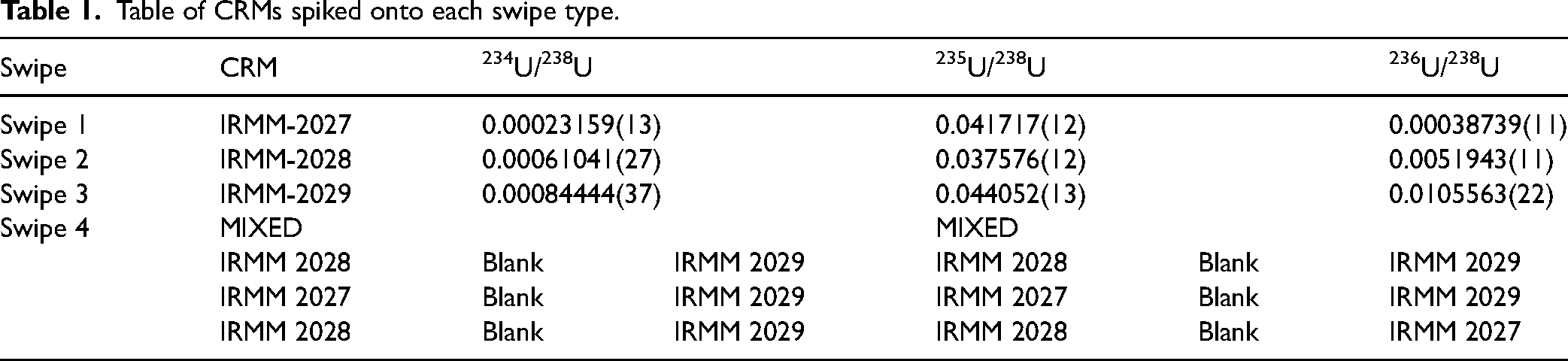
Cotton swipes were pre-stamped in nine locations (Figure 1) and were doped with various CRMs according to Table 1. Swipes were placed on top of leached plastic beakers, and each of the nine stamped locations was doped with 1 μL of a 1 μg·mL−1 solution of the CRMs. Swipes 1–3 were made with only one CRM per swipe. Swipe 4 was a mixed swipe that combined the three CRMs spiked to two different locations, leaving the middle locations blank. Five replicate swipes were made for each swipe type: Replicates 1–4 were doped with 1 ng total uranium on each of the nine locations (used for bulk digestion-MC-ICP-MS and microextraction-ICP-MS) and Replicate 5 (used for the microextraction-LS-APGD-Orbitrap) was doped with a total of 10 ng in each location, ensuring the swipe material was dry between additions. Once dry, the swipes were individually bagged and distributed for analysis.

Pre-stamped swipe being doped with CRMs.
Table of CRMs spiked onto each swipe type.
Instrumentation
A Thermo Scientific (Germany) triple quadrupole ICP-MS (ICP-TQ-MS) instrument (Figure 1) was used for all microextraction ICP-MS measurements. The nebulizer gas flow rate was predetermined via instrument tuning to be 1.2 mL min−1. For ICP-MS measurement, isotopes of 234U, 235U, 236U, and 238U were monitored with 10 ms acquisition times for each isotope across the ∼30 s injection transient. The transient signal was integrated with the Qtegra software using the ICIS peak detection algorithm. A 12-point moving mean smoothing was applied with four passes. Analyzing nine locations on a swipe was completed in approximately 30 min.
A dual-electrode microplasma was used to analyze uranium isotope ratios (which were sampled via microextraction sampling) using a Thermo Scientific QExactive Focus Orbitrap (Figure 2). 9 The dual-electrode microplasma is constructed from two stainless-steel powered anode electrodes (weldable feedthrough, MDC Vacuum Products, LLC, USA) mounted at a right angle to the solution cathode. 18 The solution cathode is made of two parts: (i) an outer stainless-steel tubing, 1.016 mm inner diameter (ID), 1.5875 in. outer diameter (OD) (McMaster Carr, USA), which directs the helium sheath gas to the plasma, and (ii) a silica capillary (250 μm ID, 360 μm OD; Molex, USA), which delivers 2% HNO3 (electrolyte solution) to the plasma. A plasma is generated between the powered anodes and the grounded solution cathode. A custom control box (GAA Custom Electronics LLS, USA) was used to set the power and gas flow rate. Although the box can control the electrolyte solution flow rate by using a built-in syringe pump, given the length of time for this study and the high flow rates, an isocratic LC (Advion) pump was used instead. A solution flow rate of 100 µL min−1 was used for all measurements with the LS-APGD-Orbitrap coupling. A current of 40 mA was applied to the two powered anodes, and an interelectrode gap of 1 mm was maintained between the central solution electrode and each powered anode. The flow rate for the He sheathe gas was 750 mL min−1. For each sample, data was collected for 3 mins across the extraction transient. The quadrupole range for the Orbitrap was set at 268.5 ± 25 Da, and the digitization range was set at 263.5–273.5 Da. An automatic gain control (AGC) target of 106 charges was used with a maximum ion accumulation time of 250 ms.19,20 These settings achieved the maximum ion accumulation time (instead of the maximum charge level) for each measurement. A setting of three microscans per scan was used, wherein each microscan measures a single injection of an ion packet into the Orbitrap mass analyzer. These settings resulted in approximately 200 scans being collected during the 3 min runtime. In addition to collecting data directly from the Orbitrap's onboard data acquisition software, a stand-alone, external, high-performance data acquisition system was used (FTMS Booster, X2, Spectroswiss, Switzerland) to record ion transient information. 21 IRMM-2025 was analyzed as a mass bias correction bracketing each analysis of a complete swipe (extractions from all nine spots).

The microextraction ICP-MS instrument platform (left) and the microextraction LS-APGD-Orbitrap-MS instrument platform (right).

Example 238U signal transients (raw and smoothed) generated from microextraction sampling into an (a) ICP-TQ-MS and (b) LS-APGD-Orbitrap.
High-precision uranium isotopic analyses of the CRM samples were performed on a Thermo Scientific Neptune Plus (Germany) double-focusing, multi-collector ICP-MS (MC-ICP-MS) instrument. This MC-ICP-MS instrument is equipped with 10 Faraday cups, three secondary electron multipliers, and two compact discrete dynodes and was used to analyze 234U/238U, 235U/238U, and 236U/238U isotopic ratios. The instrument is outfitted with an Apex Omega high-efficiency introduction system (Elemental Scientific Inc., USA), using a nickel jet sample cone and a nickel X skimmer cone. The uranium analyses were made using an amplifier with a 1011 Ω resistor on 238U, and the 234U, 235U, and 236U isotopes were measured using secondary electron multipliers. Throughout the analytical session, isotopic reference materials were analyzed, bracketing samples to correct for instrumental mass bias (IRMM-2025) and as quality controls (IRMM-2020 and IRMM-2022). Instrumental mass bias effects on samples and standards were corrected by direct comparison against IRMM-2025. Corrections were also made for instrumental blank and hydride contributions.
Microextraction System
A Plate Express microextraction system from Advion (USA) was used for all experiments. The microextraction system connected to the ICP-MS was modified to include an automated
Bulk Processing of Swipes
The cotton swipes were bulk processed according to established methods.6,7 Briefly, the swipes were ashed in a Thermcraft tube furnace at 600 °C in two 12 h cycles. The resulting ash was digested using 4 M HNO3, HF (conc), and H2O2 (30%). The residue was reconstituted in 2 mL of 3 M HNO3 before separation on TEVA and UTEVA cartridges. The purified uranium fraction was eluted from the UTEVA column, dried down, and treated once with a 1:1 mixture of 8 M HNO3–H2O2 (30%) to dissolve any column organics before being reconstituted in 1.5 mL of 2% HNO3 for analysis by MC-ICP-MS. In total, bulk processing took nine days from the start of ashing to a final purified uranium fraction that was ready for analysis by MC-ICP-MS.
Results and Discussion
The different detection platforms used in this study produce different signals. For example, the microextraction ICP-MS (ME-ICP-MS) analysis generates a transient signal as the uranium is extracted from the swipe. The analysis of transient signals requires different techniques to analyze the signal intensity in comparison to traditional multi-collector mass spectrometers. In this work, analysis of the transient signal was done through 12-point average smoothing with the area under the curve being analyzed.
The LS-ASGD-Orbitrap transients were processed using methods that are considered standard for ICP-MS measured signals. Briefly, the raw transients were smoothed using a moving Gaussian window with a window size equal to 10 data points, nominally 8 s. This smoothing function was applied iteratively five times to provide a transient signal robust to minor fluctuations in the signal. The unprocessed and smoothed transients for the ICP-TQ-MS and LS-ASGD-Orbitrap extractions are shown in Figure 3. For isotope ratios, the smoothed transients were baseline corrected and then integrated using a trapezoidal fit, similar to what has been reported for previous microextraction results10,22 and other transient signals for isotopic determinations.23,24 In total, the elution profiles for the ME-ICP-MS and LS-APGD-Orbitrap are ∼30 s for the former and 80 s for the latter, the difference being due to the difference in flow rate (200 µL min−1 for ME-ICP-MS and 100 µL min−1 for LS-APGD-Orbitrap).
Analysis of the swipes provided valuable insight into the viability of microextraction for analysis of the surface material without the aforementioned considerations of bulk digestion methods. Results are summarized in Figure 4 and Table II. Overall, the microextraction-based method(s) more accurately determined the isotopic composition of each spot on the swipe in comparison to the traditional bulk method, whose isotopics are influenced by the natural U inherent to the swipe. Regarding the 235U/238U, the percent relative difference (% RD) for the microextraction ICP-MS and microextraction LS-APGD-Orbitrap platforms were <1% and <4%, respectively, from the certified value after mass bias corrections. The %RSD of the replicates (

Comparison of 235U/238U measurements via bulk digestion MC-ICP-MS, microextraction ICP-MS, and microextraction LS-APGD-Orbitrap on the four swipe samples.
Analysis of cotton swipes by microextraction-based sampling methods compared with bulk digestion.

The fourth swipe sample was prepared to provide insight into the ability of microextraction-based sampling approaches to accurately determine the various signatures that could be separately present on a swipe surface (as opposed to homogenizing the results in a bulk format). For the microextraction LS-APGD-Orbitrap method, the various sample loadings were determined (for the 235U/238U) within 5% RD for their respective standard; for microextraction ICP-MS, the various sample loadings were determined within 2% RD. The microextraction ICP-MS method also determined the minors within 10% RD.
Regarding the comparison with bulk-based measurements, the attribution of natural uranium to the isotopic determination must be considered. For the bulk measurement, the entire sample is digested so that the swipe (containing 1–5 ng natural uranium) would blend with the uranium deposited onto the swipe surface, creating a homogeneous mixture. In all instances, the measurement by bulk digestion MC-ICP-MS had superb precision: in nearly all cases, the value was orders of magnitude better than the precision obtained by the other mass spectrometers (e.g., 0.03% for 235U/238U), especially considering the reported MC-ICP-MS uncertainty, unlike the quadrupole and Orbitrap, is expanded uncertainty, which is compliant with the Guide to the Expression of Uncertainty in Measurement (GUM). 26 However, when considering the accuracy of the measurement, the microextraction-based methods more accurately determined the “spiked” material's isotopic abundance. This was especially evident for swipe four, which was spiked with all three CRM solutions in different locations. For the mixed swipe, bulk analysis was only able to produce a homogeneous value, which, while precise, lacked accuracy in comparison to the microextraction techniques. In most cases, the % ROD for the bulk measurement was −25% when compared to the certificate value of the doped CRMs, which is expected because the bulk also incorporates natural uranium from the swipe matrix. The inherent uranium contained in a single cotton swipe from this lot swipes is estimated at ∼3 ng, so this % ROD implies ∼25% influence on the 9 ng of deposited uranium (3 ng background/12 ng total (background + deposited) = 0.25).
Conclusion
The microextraction-based sampling methods for determining uranium isotopics on cotton swipes were employed to accurately determine uranium isotope ratios with their respective analytical platform (e.g., ICP-MS or LS-APGD-Orbitrap MS). Overall, the microextraction ICP-MS provided greater sensitivity (especially for minor isotopes) and fidelity to the measurement (lower % ROD and %RSD) compared to the LS-APGD-Orbitrap system, especially considering the measurements were made on 1 ng deposits (in comparison to 10 ng for the Orbitrap). Although neither technique provided the measurement precision and low levels of uncertainty and sensitivity obtained by traditional bulk digestion methods, the microextraction techniques provided an accurate approach to determining the isotopic composition of material on a swipe without interference from the latent uranium in the swipe itself. Possibly more important is that the microextraction-based methods can also be used to evaluate samples loaded with materials of differing isotopic signatures. This application space is particularly important in the case of complex matrices where the ultrahigh resolution attainable in the LS-APGD-Orbitrap coupling can be advantageous to alleviate isobaric interferences due to concomitant elements and their oxides/hydroxides. 27 Future work will focus on improved sensitivity and precision with the ICP-MS platforms (e.g., MC-ICP-MS) and employment of the Orbitrap platform for leveraging the high mass resolution for challenging samples.
Footnotes
Acknowledgments
This work was supported by the Oak Ridge National Laboratory, managed by UT-Battelle for the Department of Energy under contract DE-AC05-000R22725. This work was funded by the United States National Nuclear Security Administration's Office of Defense Nuclear Nonproliferation Research and Development. This work was also funded in-part by the Consortium for Nuclear Forensics under Department of Energy, National Nuclear Security Administration award number DE-NA0004142.
Disclaimer
This manuscript has been authored by UT-Battelle, LLC, under contract DE-AC05-00OR22725 with the U.S. Department of Energy (DOE). The U.S. government retains and the publisher, by accepting the article for publication, acknowledges that the U.S. government retains a nonexclusive, paid-up, irrevocable, worldwide license to publish or reproduce the published form of this manuscript, or allow others to do so, for U.S. government purposes. DOE will provide public access to these results of federally sponsored research in accordance with the DOE Public Access Plan ( ).
).
Declaration of Conflicting Interests
The authors declared no potential conflicts of interest with respect to the research, authorship, and/or publication of this article.
Funding
The authors received no financial support for the research, authorship, and/or publication of this article.